REVIEW 3 major objections 5 minor 1 cited by
Closing the HPC-Cloud Convergence Gap: Multi-Tenant Slingshot RDMA for Kubernetes
T0 review · 3 major / 5 minor · reviewed 2026-08-05 · deepseek-v4-flash
Pith's one-line read This paper extends HPE Slingshot's RDMA stack so Kubernetes containers get secure, per-tenant network isolation at under 1% communication overhead and roughly 1.6–3.5% job admission overhead.
desk verdict A well-built engineering contribution to multi-tenant Slingshot RDMA in Kubernetes, but the paper's 'secure' claim rests on an untested netns-inode identity assumption. read the letter →
The pith
A machine-rendered reading of the paper's core claim, the machinery that carries it, and where it could break.
The reading
What carries the argument
The load-bearing mechanism is the netns CXI service member type: a third membership class in the Slingshot access model that identifies authorized users by their network namespace inode, read from procfs, instead of by Linux UID/GID. Kubernetes runs every container under one UID, so only a per-container kernel identity such as the network namespace can serve as a tenant principal; the netns check happens once, at RDMA endpoint creation, and preserves kernel-bypass afterwards. Two further components carry that identity through the cluster: the CXI CNI plugin, which creates and deletes per-container CXI services, and the VNI Service, whose controller and database expose Virtual Network IDs as
What would settle it
Give a pod CAP_SYS_ADMIN and let it enter the network namespace of a neighbor pod, then attempt a Slingshot RDMA endpoint creation: if the CXI service for the neighbor's namespace admits it, the netns authentication is bypassable. A second test: delete a Slingshot-enabled pod, wait for its namespace inode to be recycled, create a new pod, and check whether its RDMA endpoint unexpectedly inherits the deleted pod's VNI and can see its traffic.
Extended reading notes
Core claim
On the paper's own terms, the core claim is that container-granular RDMA isolation can be layered onto Slingshot by changing the identity that grants access. A new netns member type in the CXI driver stores a container's network namespace inode; at endpoint creation the extended driver reads the caller's namespace ID from procfs and admits the endpoint only on a match. A CNI plugin creates one CXI service per container on ADD and removes it on DEL, and a VNI Service allocates Virtual Network IDs through a database-backed Kubernetes controller with two ownership models: one VNI per job, or one shared VNI per claim. The evaluation puts the cost at under 1% in throughput and latency and 1.6–3.5
Load-bearing premise
The entire isolation guarantee rests on the claim that a container cannot alter or forge its network namespace identifier; if a container could join or create another namespace, the CXI service check would admit the wrong tenant.
Editorial extensions
If this is right
- A single Kubernetes annotation (vni: true or vni: <claim-name>) is enough for a job to request its own isolated Slingshot network; no privileged per-user onboarding is needed.
- Pods inside one job — or several jobs redeeming the same VNI Claim — can communicate over Slingshot, while pods of unrelated jobs cannot, because each job's pods are admitted only to their own VNI.
- HPC workloads running in containers keep host-level RDMA throughput and latency (overhead within run-to-run jitter, under 1%), so the isolation layer does not force a slowdown.
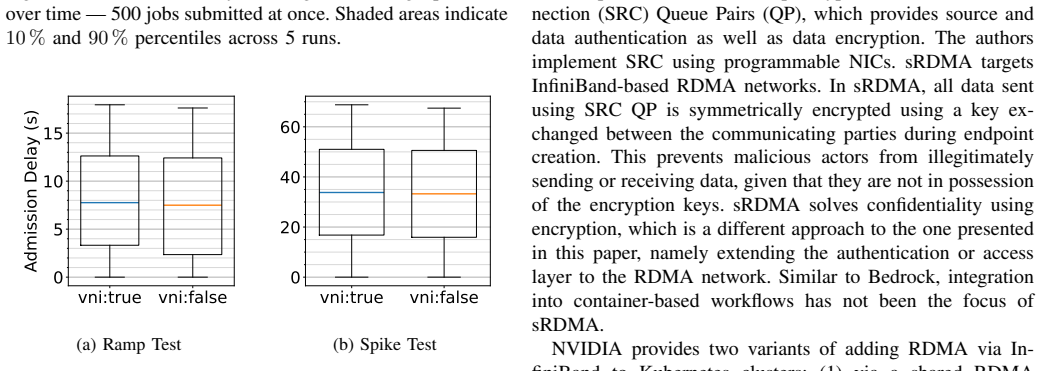
- Job admission overhead stays near 3.5% for ramp-shaped load and 1.6% for 500-job spikes, with most admission delay attributed to Kubernetes itself rather than the new stack.
- The VNI Service's atomic database transactions make concurrent VNI allocation race-free, so two jobs cannot be handed the same VNI even under admission bursts.
Reading between the lines
- Editorial extension: the netns-isolation guarantee presumes a container cannot change its namespace identity; a pod granted CAP_SYS_ADMIN can create or enter namespaces, which would let it authenticate as another tenant — a case the paper states but does not test.
- Editorial extension: network-namespace inodes are recycled by the kernel after deletion, so a new container could inherit the inode — and with it any stale CXI service and VNI — of a departed tenant if the CNI plugin's DEL path fails or the 30-second VNI-release window is violated.
- Editorial extension: the netns-as-principal pattern is not Slingshot-specific; the same driver-level trick could give InfiniBand or other UID-authenticated RDMA stacks a Kubernetes tenant model, though the paper demonstrates it only for Slingshot.
- Editorial extension: the 30-second grace period before VNI reuse, paired with the enforced termination grace period, is what keeps straggling pods from leaking into a new tenant's VNI; node failure or a hung pod past the grace window would be the stress case that determines whether the guarantee holds in production.
Signed reviews
Editorial analysis
A structured set of objections, weighed in public.
Referee Report
Summary. The paper presents an extension of the HPE Slingshot RDMA software stack for multi-tenant Kubernetes deployments. The contributions are: (A) a new network-namespace (netns) member type for CXI services in the driver/libs, (B) a CNI plugin that creates and destroys CXI services for containers, and (C) a Kubernetes VNI Service that manages VNI allocation and lifetime via CRDs and a database. The evaluation reports RDMA communication overhead within 1% and job admission overhead of 3.5% (ramp) and 1.6% (spike) compared to a non-integrated Kubernetes baseline. The abstract claims the integration provides 'secure, container-granular, and multi-tenant access to Slingshot RDMA networking capabilities at minimal overhead.'
Significance. If the security claim were substantiated, this would be a valuable step toward converged HPC-cloud systems, since it addresses a real gap in the Slingshot access model. The performance evaluation is a clear strength: it uses standard OSU benchmarks, multiple runs, percentile intervals, and a plausible job-admission workload; the open-source release of code and measurement data further supports reproducibility. However, the central security assertion is not evaluated at all, and the design rests on an identity-binding assumption that is not established and is, in fact, questionable. The work is therefore only partially supported: the performance contribution is credible, but the security contribution needs substantial additional work before the stated central claim can be accepted.
major comments (3)
- [Section III.A] The security of the netns-based CXI service authentication is load-bearing. The paper states that 'malicious users inside a container cannot modify their network namespace ID.' This conflates the immutability of an inode number with the ability of a process to change its network namespace. A container with CAP_SYS_ADMIN can call unshare(CLONE_NEWNET) or setns() and thereby present a different netns at endpoint-creation time. If an attacker can enter another tenant's netns, CXI authentication will succeed under the victim's membership. No threat model is given, and Section IV contains no security experiments. The 'secure, container-granular' claim needs either a restriction to containers without CAP_SYS_ADMIN, a mechanism that binds CXI services to a stronger identity, or an explicit security evaluation demonstrating that namespace switching is not possible in the target environment.
- [Section III.B, III.C] The lifecycle of CXI services is not safe under inode reuse or plugin unavailability. The manuscript itself acknowledges in Section III.B that automatic cleanup 'only occur[s] if the CXI CNI plugin is available throughout the lifetime of all Slingshot-enabled containers.' Linux netns inode numbers can be reused after the namespace is destroyed. If a stale CXI service remains keyed to a freed inode, a new container whose netns happens to reuse that inode can inherit the prior tenant's VNI and CXI service. The 30-second VNI release grace period in Section III.C does not address this case because the stale service is not tied to the VNI database record; it is tied only to the inode. This is a concrete isolation-breaking scenario, and it should be either fixed (e.g., by storing a generation counter or pod reference in the CXI service) or explicitly analyzed and tested.
- [Section IV] The evaluation measures performance only. Figures 5-12 quantify throughput, latency, and admission delay, but there is no isolation or security evaluation whatsoever. Since the abstract's central claim is security, the absence of any adversarial test for namespace isolation, CXI service identity spoofing, or inode reuse is a major omission. Please add at least a threat model and a small set of experiments that attempt cross-tenant endpoint creation, namespace joining, and stale-service inheritance. Without such evidence, the paper's title and abstract overstate what is demonstrated.
minor comments (5)
- [Section IV.A] Figure 8 caption says '25 iterations' while the text says the OSU benchmarks were run 10 times. Please align these numbers.
- [Figure 9] The caption says 'green line shows the number of jobs launched per job'; this should read 'per batch.'
- [References] Reference [3] appears to contain a typo ('vDirect Direct Data Placement...'), and the formatting of 'V olcano' in Section IV.A should be fixed.
- [Section III.A] The description of retrieving the netns ID 'using procfs' is imprecise for a kernel driver; the driver should read the process's nsproxy directly. Clarify the mechanism.
- [Section III.C.1] The assumption that 'users are not allowed to create or modify VNI CRD instances directly' is an administrative security assumption. It should be stated explicitly as part of the threat model, since it is essential to the exclusivity of VNI allocation.
Circularity Check
No significant circularity: performance claims are externally benchmarked and no fitted input is repackaged as a prediction.
full rationale
The paper is a systems contribution with no mathematical derivation whose conclusion is equivalent to an input. The central claims are (1) a netns-based CXI member type, (2) a CNI plugin and VNI service, and (3) minimal overhead. Overhead is measured with OSU Micro-Benchmarks against a host baseline and a Kubernetes baseline without the integration; the reported <1% communication overhead and 3.5%/1.6% admission overhead are direct measurements, not fitted parameters called predictions. The only self-citation, OpenCUBE [16], identifies the pilot testbed and is not load-bearing for the design or security argument. The security reasoning does reduce tenant identity to the network-namespace inode, but that is an implementation definition rather than a circular derivation: the CXI driver is extended to compare the requesting process's netns inode to the member list. The statement that malicious users inside a container cannot modify their network namespace ID is an unverified assumption (e.g., CAP_SYS_ADMIN scenarios or inode reuse are not addressed), and the DEL cleanup caveat in Section III.B is a genuine limitation, but these are correctness/security risks, not circularity. No equation or construction forces the reported results to equal the inputs.
Assumptions & free parameters
free parameters (1)
- VNI reuse grace period =
30 seconds
assumptions (5)
- domain assumption Network namespace inode is a stable, unforgeable identifier for a container's network isolation domain.
- domain assumption CXI driver's netns lookup via procfs is correct and race-free.
- domain assumption Kubernetes users cannot create or modify VNI CRD instances, so only the VNI Controller manages VNI assignments.
- domain assumption CXI hardware and Rosetta switches enforce VNI isolation at the switch level.
- standard math SQLite ACID transactions prevent VNI allocation races.
Cite this review
Pith. "Pith review of Closing the HPC-Cloud Convergence Gap: Multi-Tenant Slingshot RDMA for Kubernetes." pith.science (2026). https://pith.science/paper/W5PIBWYX
@misc{pith2026250809663,
  author       = {Pith},
  title        = {Pith review of: Closing the HPC-Cloud Convergence Gap: Multi-Tenant Slingshot RDMA for Kubernetes},
  year         = {2026},
  howpublished = {\url{https://pith.science/paper/W5PIBWYX}},
  note         = {Machine review of arXiv:2508.09663}
}
read the original abstract
Converged HPC-Cloud computing is an emerging computing paradigm that aims to support increasingly complex and multi-tenant scientific workflows. These systems require reconciliation of the isolation requirements of native cloud workloads and the performance demands of HPC applications. In this context, networking hardware is a critical boundary component: it is the conduit for high-throughput, low-latency communication and enables isolation across tenants. HPE Slingshot is a high-speed network interconnect that provides up to 200 Gbps of throughput per port and targets high-performance computing (HPC) systems. The Slingshot host software, including hardware drivers and network middleware libraries, is designed to meet HPC deployments, which predominantly use single-tenant access modes. Hence, the Slingshot stack is not suited for secure use in multi-tenant deployments, such as converged HPC-Cloud deployments. In this paper, we design and implement an extension to the Slingshot stack targeting converged deployments on the basis of Kubernetes. Our integration provides secure, container-granular, and multi-tenant access to Slingshot RDMA networking capabilities at minimal overhead.
Figures


Figures from the paper (6 more)


Forward citations
Cited by 1 Pith paper
-
Multi-tenant Kubernetes Use Cases for AI, Secure Computing and Data Services, and More
Kubernetes with per-VNI Slingshot isolation is demonstrated on ARM64 Isambard-AI for a Trusted Research Environment and multi-node LLM serving, with ~0.9 us latency overhead.
Reference graph
Works this paper leans on
-
[1]
HPE, “HPE expands direct liquid-cooled supercomputing solutions, introduces two AI systems for service providers and large enterprises.” [Online]. Available: https://www.hpe.com/us/en/newsroom/press-relea se/2024/11/hpe-expands-direct-liquid-cooled-supercomputing-solutions -introduces-two-ai-systems-for-service-providers-and-large-enterprises .html
work page 2024
-
[2]
The Kubernetes Authors, “Kubernetes.” [Online]. Available: https: //kubernetes.io/ [3]vDirect Data Placement Protocol (DDP) / Remote Direct Memory Access Protocol (RDMAP) Security
-
[4]
Enabling HPC workloads on cloud infrastructure using Kubernetes container orchestration mechanisms,
A. M. Beltre, P. Saha, M. Govindaraju, A. Younge, and R. E. Grant, “Enabling HPC workloads on cloud infrastructure using Kubernetes container orchestration mechanisms,” in2019 IEEE/ACM International Workshop on Containers and New Orchestration Paradigms for Isolated Environments in HPC (CANOPIE-HPC). IEEE, 2019, p. 11–20
work page 2019
-
[5]
R. Keller Tesser and E. Borin, “Containers in HPC: a survey,”The Journal of Supercomputing, vol. 79, no. 5, p. 5759–5827, 2023
work page 2023
-
[6]
Container Network Interface Specification,
CNI Authors, “Container Network Interface Specification,” 2021. [Online]. Available: https://www.cni.dev/docs/spec/
work page 2021
-
[7]
Available: https://www.man7.org/linux/man-pages/man7/user namespaces.7.html
[Online]. Available: https://www.man7.org/linux/man-pages/man7/user namespaces.7.html
-
[8]
The /proc Filesystem — The Linux Kernel documentation
“The /proc Filesystem — The Linux Kernel documentation.” [Online]. Available: https://www.kernel.org/doc/html/latest/filesystems/proc.html
- [9]
Show all 24 references
-
[10]
Mar. 2025. [Online]. Available: https://github.com/flannel-io/flannel
2025
-
[11]
[Online]
The Cilium Authors. [Online]. Available: https://cilium.io
-
[12]
[Online]
The Kubernetes Authors. [Online]. Available: https://kubernetes.io/docs /concepts/extend-kubernetes/api-extension/custom-resources/
-
[13]
[Online]
The Metacontroller Authors. [Online]. Available: https://metacontroller .github.io/metacontroller/
-
[14]
R. D. Hipp, “SQLite,” 2020. [Online]. Available: https://www.sqlite.o rg/index.html
2020
-
[15]
K3s - Lightweight Kubernetes
“K3s - Lightweight Kubernetes.” [Online]. Available: https://k3s.io
-
[16]
Opencube: Building an open source cloud blueprint with epi systems,
I. Peng, M. Schulz, U.-U. Haus, C. Prunty, P. Marcuello, E. Danovaro, G. Schieffer, J. Wahlgren, D. Medeiros, and P. Friese, “Opencube: Building an open source cloud blueprint with epi systems,”Euro-Par 2023 Workshops and Minisymposia, 2023
2023
-
[17]
OSU Micro-Benchmarks
“OSU Micro-Benchmarks.” [Online]. Available: https://mvapich.cse.oh io-state.edu/benchmarks/
-
[18]
V olcano - Cloud native batch scheduling system for compute-intensive workloads
V olcano Project Authors, “V olcano - Cloud native batch scheduling system for compute-intensive workloads.” [Online]. Available: https: //volcano.sh/en/
-
[19]
Harbor - An open source trusted cloud native registry project that stores, signs, and scans content
Harbor Authors, “Harbor - An open source trusted cloud native registry project that stores, signs, and scans content. .” [Online]. Available: https://goharbor.io/
-
[20]
Bedrock: Programmable Network Support for Secure RDMA Systems,
J. Xing, K.-F. Hsu, Y . Qiu, Z. Yang, H. Liu, and A. Chen, “Bedrock: Programmable Network Support for Secure RDMA Systems,” 2022, p. 2585–2600. [Online]. Available: https://www.usenix.org/conference/us enixsecurity22/presentation/xing
2022
-
[21]
sRDMA - Efficient NIC-based Authentication and Encryption for Remote Di- rect Memory Access,
K. Taranov, B. Rothenberger, A. Perrig, and T. Hoefler, “sRDMA - Efficient NIC-based Authentication and Encryption for Remote Di- rect Memory Access,” in2020 USENIX Annual Technical Conference (USENIX ATC 20), 2020, p. 691–704
2020
-
[22]
k8s-rdma-shared-dev-plugin
Mellanox Technologies Ltd., “k8s-rdma-shared-dev-plugin.” [Online]. Available: https://github.com/Mellanox/k8s-rdma-shared-dev-plugin/tr ee/master
-
[23]
InfiniBand SR-IOV CNI plugin,
“InfiniBand SR-IOV CNI plugin,” Feb. 2025. [Online]. Available: https://github.com/k8snetworkplumbingwg/ib-sriov-cni
2025
-
[24]
NVIDIA Network Operator,
NVIDIA, “NVIDIA Network Operator,” Apr. 2025. [Online]. Available: https://github.com/Mellanox/network-operator
2025
-
[25]
CXI Kubernetes device plugin,
Hewlett Packard Enterprise Development LP, “CXI Kubernetes device plugin,” Mar. 2025. [Online]. Available: https://github.com/HewlettPa ckard/cxi-k8s-device-plugin
2025
Reviewed August 5, 2026 · model on record in the stance chip above.
Discussion (0). Continue with ORCID to comment.