REVIEW 6 minor 24 references
Stability and Convergence of Spectral Mixed Discontinuous Galerkin Methods for 3D Linear Elasticity on Anisotropic Geometric Meshes
T0 review · 0 major / 6 minor · reviewed 2026-08-14 · deepseek-v4-flash
Pith's one-line read This paper uses numerical experiments to claim that a spectral mixed discontinuous Galerkin method for 3D linear elasticity on anisotropic geometric meshes is stable up to the incompressible limit and converges exponentially in a natural…
desk verdict A sound, honest computational validation of the authors' own theory; the SVD inf-sup tool is genuinely useful, and the soft spots are reproducibility and a narrow set of manufactured tests. read the letter →
The pith
A machine-rendered reading of the paper's core claim, the machinery that carries it, and where it could break.
The reading
What carries the argument
The load-bearing mechanism is the discrete inf-sup condition (13): the assumption that the inf-sup constant of $B_h$ over the discrete spaces $V_h \times Q_h$ is bounded below by $\kappa k^{-\rho}$ with $\kappa$ and $\rho$ independent of the polynomial degree $k$, the number of refinement layers $\ell$, and the aspect ratio of anisotropic elements. This condition upgrades coercivity — which degenerates as $(1-2\nu) \to 0$ — into full inf-sup stability of the mixed form $a_h$ even at $\nu=1/2$, and it underlies the exponential convergence estimate (28). Computationally, the paper evaluates these constants as the smallest positive singular values of scaled system matrices, and builds the meshes from canonical geometric patches toward edges, corners, and corner-edges.
What would settle it
Recompute the discrete inf-sup constants for a geometric mesh family with a different refinement ratio or with polynomial degrees beyond $k=10$, or test the corner-edge example on a Fichera domain with traction boundary conditions; if the constants decay to zero with degree or the exponential error decay flattens to algebraic as $\nu \to 1/2$, the central claim is refuted.
Extended reading notes
Core claim
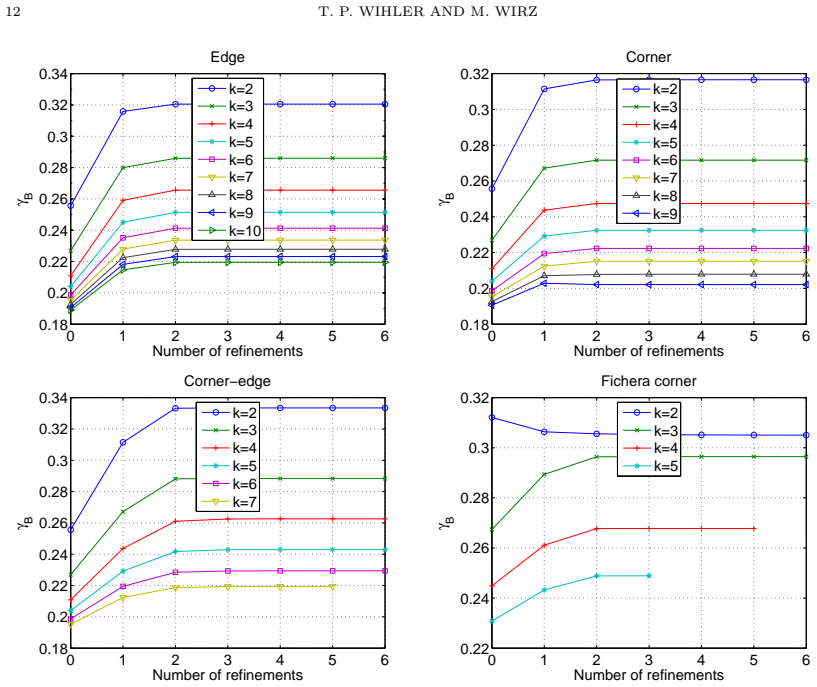
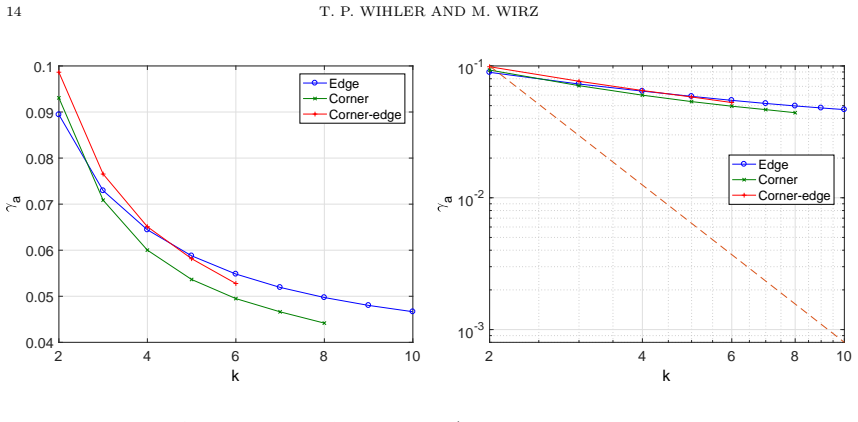
The central discovery is computational but with theoretical teeth: on anisotropic geometric edge meshes, the discrete inf-sup constant $\gamma_B$ of the bilinear form $B_h$ stabilizes after a few geometric refinement layers and shows a dependence on the polynomial degree $k$ that is considerably more optimistic than the theoretical $k^{-3/2}$ bound; likewise, the inf-sup constant $\gamma_a$ of the mixed form $a_h$ remains bounded away from zero uniformly as $\nu \to 1/2$, confirming that the DG scheme does not degenerate in the incompressible limit. Moreover, for manufactured solutions with edge, corner, and corner-edge singularities, and with the polynomial degree grown proportionally to the refinement level, the DG error in the norm (12) decays as $\exp(-b N^{1/5})$ or $\exp(-b N^{1/4})$, exhibiting the exponential convergence predicted by the theory. These experiments together support the conclusion that the spectral mixed DG method (8) is stable and exponentially convergent on geometric edge meshes for 3D linear elasticity.
Load-bearing premise
The entire argument rests on an assumed stability bound, the discrete inf-sup condition (13), which says the mixed system cannot become singular as the mesh is refined or the polynomial degree grows; the paper verifies this bound numerically but does not prove it beyond the exponent $3/2$ already established in the literature.
Editorial extensions
If this is right
- The spectral mixed DG method (8) can be used as a reliable solver for 3D linear elasticity in polyhedral domains, including near-incompressible and exactly incompressible materials, without special locking treatment.
- Exponential convergence in the DG norm is achievable for solutions with edge, corner, and corner-edge singularities when geometric refinement is paired with a polynomial degree that grows with the number of layers.
- The measured $k$-dependence of the inf-sup constants indicates that the theoretical worst-case decay $k^{-3/2}$ (and $k^{-3}$ for the mixed form) is not sharp, so sharper stability bounds should be attainable.
- The augmented Lagrange-multiplier formulation (16) offers a practical way to enforce the zero-mean pressure constraint and to compute inf-sup constants using standard local basis functions.
Reading between the lines
- If the observed mild $k$-dependence of the inf-sup constants is proved rather than merely observed, the exponential convergence estimates for hp-DG methods on geometric meshes could be sharpened, yielding better cost predictions for high-accuracy 3D elasticity.
- The same SVD-based constant computation could serve as a numerical pre-screen for stability of hp-adaptive DG variants (variable or anisotropic polynomial degrees), which the paper mentions as a future extension but does not analyze.
- Since the method tolerates $\nu \to 1/2$ without deterioration, coupling it with the iterative Newton-DG approach mentioned in the conclusions could yield robust solvers for nonlinear hyperelasticity near the incompressible limit.
- The canonical-patch experiments use manufactured solutions; a natural next test, not performed here, would be on a Fichera domain with traction boundary conditions, where the combination of corner and edge singularities is genuinely three-dimensional and the analytic regularity assumptions are harder to satisfy.
Signed reviews
Editorial analysis
A structured set of objections, weighed in public.
Referee Report
Summary. This paper presents a computational study of a spectral mixed discontinuous Galerkin method for the Lamé system of linear elasticity in mixed form on anisotropic geometric edge meshes in three-dimensional polyhedral domains. The authors recall the discrete inf-sup framework from their earlier work [24] and the assumption (13) on the form B_h, which was proved with rho = 3/2 in [19]. They then derive SVD-based characterizations (Propositions 4.3 and 4.4) for the discrete inf-sup constants of B_h and of the full mixed form a_h in the incompressible limit nu = 1/2, together with an augmented formulation (16) that avoids the zero-mean constraint on the pressure. Numerical experiments measure these constants on edge, corner, corner-edge, and Fichera-type geometric refinements, and show robustness with respect to mesh refinement and a k-dependence much milder than the theoretical bounds k^{-3/2} and k^{-3}. A second set of experiments with manufactured edge, corner, and corner-edge singularities and with smooth incompressible examples exhibits near-exponential convergence in the DG norm and robustness as nu approaches 1/2.
Significance. The paper's main contribution is a clean SVD-based procedure for evaluating discrete inf-sup constants of mixed DG forms, together with the first systematic numerical evidence that the inf-sup constants of the spectral mixed DG method are robust on anisotropic geometric edge meshes with respect to refinement and Poisson ratio, and that exponential convergence is achieved for solutions with edge and corner singularities. The derivations in Section 4 are mathematically sound given the inf-sup hypothesis (13), and the experimental design tests the theory rather than fitting constants. The absence of shipped code or data is a reproducibility limitation, but the algorithmic description is sufficiently detailed to be reimplemented in deal.II.
minor comments (6)
- [Section 5.1] The text states that the singular examples use nu in {1/8, 1/2, 3/8}, but the figures show nu = 1/8, 1/4, 3/8 and the formula p = -div u/(1-2 nu) is undefined at nu = 1/2; the set should be corrected.
- [Equation (28) and Figures 7-8] The notation 'exp(-b 5 sqrt(N))' in (28) is ambiguous; it should be typeset as exp(-b N^{1/5}) or exp(-b times the fifth root of N), and the relationship between this bound and the N^{1/4} axes used for the edge and corner cases in Figure 7 should be stated explicitly.
- [Section 5.1] The manufactured solutions do not satisfy the homogeneous Dirichlet condition u = 0 on the whole boundary; the paper explains that only u dot n = 0 is enforced and that the remaining boundary data are imposed through flux terms, but the precise modification of the right-hand side in (10) is not given, which would improve reproducibility.
- [Section 5.2, Example 5.2] The reference solution is computed only at k = l = 5; since the reported errors approach the level of this reference, a comparison against a finer reference or an estimate of the reference discretization error would make the claimed exponential convergence more conclusive.
- [Section 4.2, Eq. (19)] Equation (19) is not readable as typeset; the relation between M and N should be written clearly, for example M = 3((k+1)/k)^3 N.
- [General] No code or data files are provided; for a purely computational paper, making the deal.II scripts and mesh-generation routines available would substantially aid reproducibility.
Circularity Check
No significant circularity; the numerical study tests externally proved theory rather than deriving predictions from fitted inputs.
full rationale
The paper is a computational validation of prior theory. The discrete inf-sup assumption (13) is taken from [19], where it was proved with rho=3/2, and the numerical SVD computations of gamma_B and gamma_a in Section 4.4 are independent probes of that condition, not fitted parameters later relabeled as predictions. Theorem 3.2 and the exponential convergence bound (28) are cited from the authors' earlier paper [24], but they are stated with explicit assumptions (discrete inf-sup condition, analytic regularity in A_{-1-beta} x A_{-beta}) and are not re-derived by fitting the experiments; the manufactured solutions in Section 5.1 are chosen to satisfy those assumptions and the observed errors confirm the bound. The equivalence reformulation in Section 4.1 is proven within the paper (Lemma 4.1, Proposition 4.2) and uses (13) only as an input hypothesis. No equation in the derivation chain reduces to its own output, and no fitted constant is renamed as a prediction. Self-citations occur, but they are not load-bearing in a circular sense; [24] provides an independent theorem rather than an unverified assertion unique to this paper.
Assumptions & free parameters
free parameters (2)
- penalty parameter gamma =
10
- mesh grading factor sigma =
1/2
assumptions (4)
- domain assumption Discrete inf-sup condition (13): there exist kappa > 0 and rho >= 0 independent of k, refinement level, and aspect ratio such that gamma_B >= kappa k^{-rho}.
- domain assumption Analytic regularity of the solution: (u,p) in A_{-1-beta}(Omega)^3 times A_{-beta}(Omega), the countably normed analytic spaces.
- domain assumption Weighted Sobolev regularity of the continuous solution (Proposition 2.1) in M^m_{-1-beta} spaces.
- standard math Coercivity of A_h and well-posedness of the continuous mixed problem, including the standard Stokes inf-sup property for nu = 1/2.
Cite this review
Pith. "Pith review of Stability and Convergence of Spectral Mixed Discontinuous Galerkin Methods for 3D Linear Elasticity on Anisotropic Geometric Meshes." pith.science (2026). https://pith.science/paper/W7LP5D26
@misc{pith2026190804647,
  author       = {Pith},
  title        = {Pith review of: Stability and Convergence of Spectral Mixed Discontinuous Galerkin Methods for 3D Linear Elasticity on Anisotropic Geometric Meshes},
  year         = {2026},
  howpublished = {\url{https://pith.science/paper/W7LP5D26}},
  note         = {Machine review of arXiv:1908.04647}
}
abstract
We consider spectral mixed discontinuous Galerkin finite element discretizations of the Lam\'e system of linear elasticity in polyhedral domains in $\mathbb{R}^3$. In order to resolve possible corner, edge, and corner-edge singularities, anisotropic geometric edge meshes consisting of hexahedral elements are applied. We perform a computational study on the discrete inf-sup stability of these methods, and especially focus on the robustness with respect to the Poisson ratio close to the incompressible limit (i.e. the Stokes system). Furthermore, under certain realistic assumptions (for analytic data) on the regularity of the exact solution, we illustrate numerically that the proposed mixed DG schemes converge exponentially in a natural DG norm.
Figures


Figures from the paper (9 more)




Reference graph
Works this paper leans on
-
[24]
T. P. Wihler and M. Wirz, Mixed hp-discontinuous Galerkin FEM for linear elasticity and Stokes flow in three dimensions, Mathematical Models and Methods in Applied Sciences 22 (2012), no. 8, 1250016
work page 2012
-
[19]
, Mixed hp-DGFEM for incompressible flows. II. Geometric edge meshes , IMA J. Numer. Anal. 24 (2004), no. 2, 273–308
work page 2004
- [6]
-
[1]
D. N. Arnold, F. Brezzi, B. Cockburn, and L. D. Marini, Unified analysis of discontinuous Galerkin methods for elliptic problems , SIAM J. Numer. Anal. 39 (2001), 1749–1779
work page 2001
-
[2]
I. Babuˇ ska and B. Q. Guo, Approximation properties of the h-p version of the finite element method , Comput. Methods Appl. Mech. Engrg. 133 (1996), no. 3-4, 319–346
work page 1996
-
[3]
W. Bangerth, R. Hartmann, and G. Kanschat, deal.II – a general purpose object oriented finite element li brary, ACM Trans. Math. Softw. 33 (2007), no. 4, 24/1–24/27
work page 2007
-
[4]
W. Bangerth, T. Heister, G. Kanschat, et al., deal.II differential equations analysis library, technical refere nce, http://www.dealii.org
-
[5]
F. Brezzi and M. Fortin, Mixed and hybrid finite element methods , Springer Series in Computational Mathe- matics, vol. 15, Springer, New York, 1991
work page 1991
Show all 24 references
-
[7]
E. H. Georgoulis, E. Hall, and P. Houston, Discontinuous Galerkin methods on hp-anisotropic meshes. I. A priori error analysis , Int. J. Comput. Sci. Math. 1 (2007), no. 2-4, 221–244
2007
-
[8]
Girault and P
V. Girault and P. A. Raviart, Finite element methods for Navier–Stokes equations , Springer, New York, 1986. 18 T. P. WIHLER AND M. WIRZ
1986
-
[9]
B. Q. Guo, The h-p version of the finite element method for solving boundary val ue problems in polyhedral domains, Boundary Value Problems and Integral Equations in Nonsmoo th Domains, Lecture Notes in Pure and Applied Mathematics, vol. 167, Dekker, New York, 1995, p p. 101–120
1995
-
[10]
B. Q. Guo and I. Babuˇ ska, Regularity of the solutions for elliptic problems on nonsmo oth domains in R3. I. Countably normed spaces on polyhedral domains , Proc. Roy. Soc. Edinburgh Sect. A 127 (1997), no. 1, 77–126
1997
-
[11]
, Regularity of the solutions for elliptic problems on nonsmo oth domains in R3. II. Regularity in neigh- bourhoods of edges , Proc. Roy. Soc. Edinburgh Sect. A 127 (1997), no. 3, 517–545
1997
-
[12]
Houston, D
P. Houston, D. Sch¨ otzau, and T. P. Wihler, An hp-adaptive mixed discontinuous Galerkin FEM for nearly incompressible linear elasticity , Comput. Methods Appl. Mech. Engrg. 195 (2006), no. 25-28, 3224–3246
2006
-
[13]
Houston and T
P. Houston and T. P. Wihler, An hp-adaptive Newton-discontinuous-Galerkin finite element a pproach for semilinear elliptic boundary value problems , Math. Comp. 87 (2018), no. 314, 2641–2674
2018
-
[14]
Maday and C
Y. Maday and C. Bernardi, Uniform inf–sup conditions for the spectral discretizatio n of the Stokes problem , Mathematical Models and Methods in Applied Sciences 09 (1999), no. 03, 395–414
1999
-
[15]
Maday and C
Y. Maday and C. Marcati, Regularity and hp discontinuous Galerkin finite element approximation of lin ear elliptic eigenvalue problems with singular potentials , Math. Models Methods Appl. Sci. 29 (2019), no. 8, 1585– 1617
2019
-
[16]
Maz’ya and J
V. Maz’ya and J. Rossmann, Elliptic equations in polyhedral domains , Mathematical Surveys and Monographs, vol. 162, American Mathematical Society, Providence, RI, 2 010
-
[17]
A. L. Mazzucato and V. Nistor, Well-posedness and regularity for the elasticity equation with mixed boundary conditions on polyhedral domains and domains with cracks , Arch. Ration. Mech. Anal. 195 (2010), no. 1, 25–73
2010
-
[18]
Sch¨ otzau, C
D. Sch¨ otzau, C. Schwab, and A. Toselli, Mixed hp-DGFEM for incompressible flows , SIAM J. Numer. Anal. 40 (2003), 2171–2194
2003
-
[20]
Sch¨ otzau, C
D. Sch¨ otzau, C. Schwab, and T. P. Wihler, hp-dGFEM for second-order elliptic problems in polyhedra I: Stability on geometric meshes , SIAM J. Numer. Anal. 51 (2013), no. 3, 1610–1633. MR 3061472
2013
-
[21]
, hp-dGFEM for second order elliptic problems in polyhedra II: E xponential convergence , SIAM J. Numer. Anal. 51 (2013), no. 4, 2005–2035. MR 3073653
2013
-
[22]
, hp-DGFEM for second-order mixed elliptic problems in polyhed ra, Math. Comp. 85 (2016), no. 299, 1051–1083
2016
-
[23]
Sch¨ otzau and T
D. Sch¨ otzau and T. P. Wihler, Exponential convergence of mixed hp-DGFEM for Stokes flow in polygons , Numer. Math. 96 (2003), 339–361
2003
Reviewed August 14, 2026 · model on record in the stance chip above.
Discussion (0). Continue with ORCID to comment.