Winding-Sector Transitions and Thermodynamic Incommensurability in Helical Valence Bond Phase under Tilted Boundary Conditions
Pith reviewed 2026-06-30 02:49 UTC · model grok-4.3
The pith
The helical valence bond phase is a genuine two-dimensional incommensurate phase with long-range bond-bond order in the thermodynamic limit.
A machine-rendered reading of the paper's core claim, the machinery that carries it, and where it could break.
Core claim
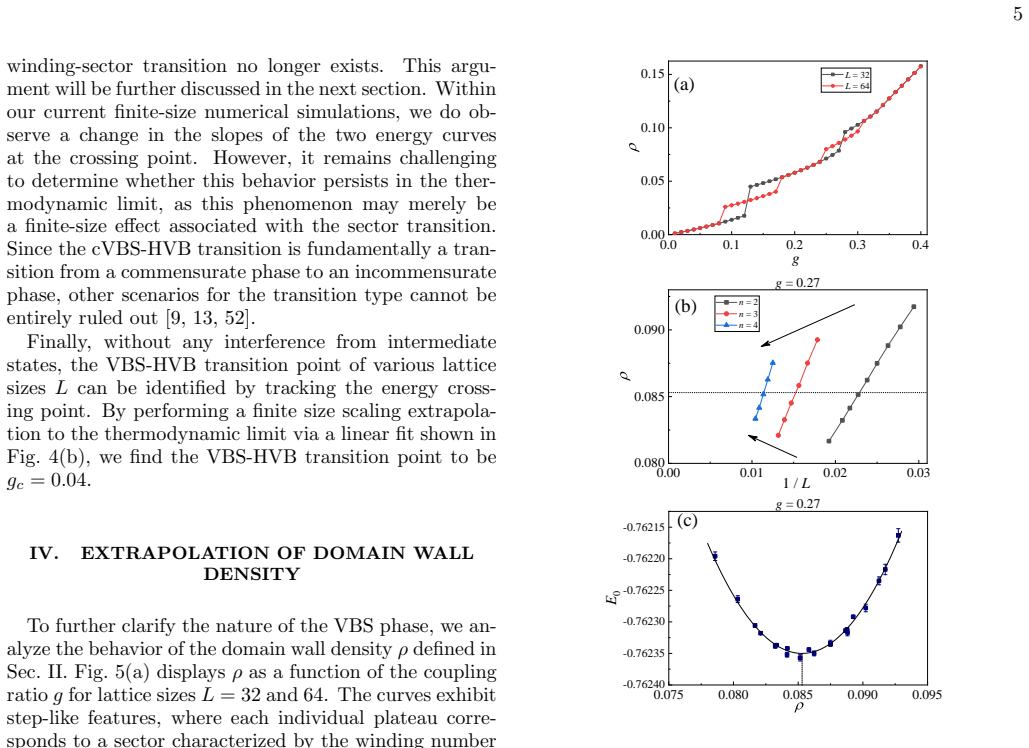
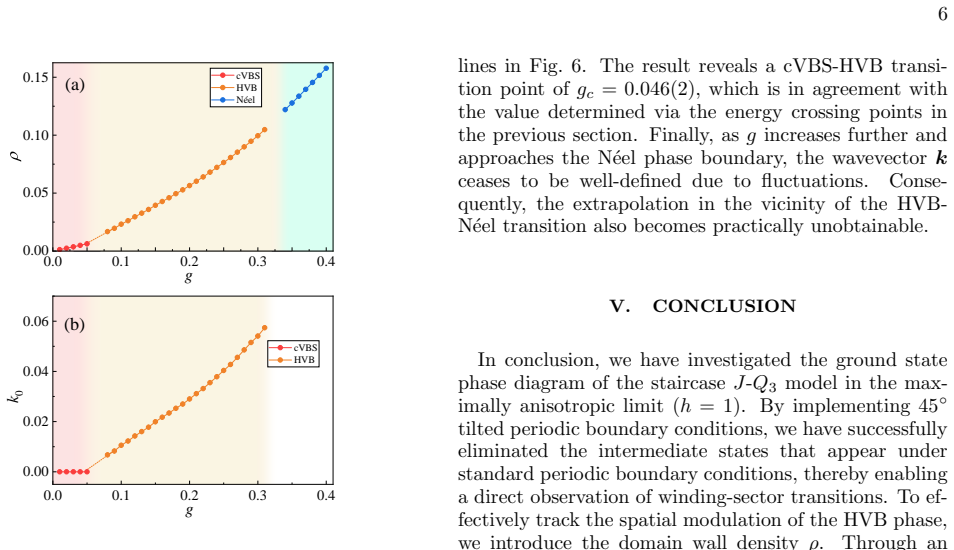
By implementing 45° tilted periodic boundary conditions in projector quantum Monte Carlo simulations of the maximally anisotropic staircase J-Q3 model, the authors demonstrate that both the domain wall density and the characteristic wavevector of the helical valence bond phase evolve continuously with the coupling ratio g, showing no commensurate lock-in behavior. Thermodynamic extrapolations confirm long-range bond-bond order, establishing the helical valence bond phase as a genuine two-dimensional incommensurate phase. Winding-sector transitions are identified as finite-size effects enforced by boundary commensurability, with the columnar to helical transition at g_c = 0.046(2).
What carries the argument
The 45° tilted periodic boundary condition, which removes intermediate phases and boundary commensurability constraints, together with the domain wall density that quantifies the spatial modulation of the helical valence bond phase.
If this is right
- The helical valence bond phase exhibits continuous, non-locked evolution of its modulation wavevector in the thermodynamic limit.
- Winding-sector transitions vanish as finite-size effects once boundary commensurability is removed.
- Long-range bond-bond order persists throughout the incommensurate helical phase.
- The phase boundary between columnar valence bond solid and helical valence bond phase sits at g_c = 0.046(2).
Where Pith is reading between the lines
- The same tilted-boundary method could be tested on other candidate incommensurate valence-bond or spin-liquid phases to separate true incommensurability from boundary artifacts.
- Continuous wavevector evolution implies the phase may support gapless sliding modes or floating character that standard periodic boundaries obscure.
- Response functions or entanglement measures computed under these boundaries might reveal whether the incommensurate order couples to other degrees of freedom.
Load-bearing premise
The 45° tilted periodic boundary condition fully eliminates boundary-induced finite-size ambiguities and provides unbiased access to the thermodynamic limit without introducing new commensurability constraints or artifacts.
What would settle it
A clear lock-in of the wavevector to a rational multiple of 2π at sufficiently large system sizes under the same tilted boundaries, or the reappearance of winding-sector transitions independent of boundary choice, would falsify the thermodynamic incommensurability claim.
Figures
read the original abstract
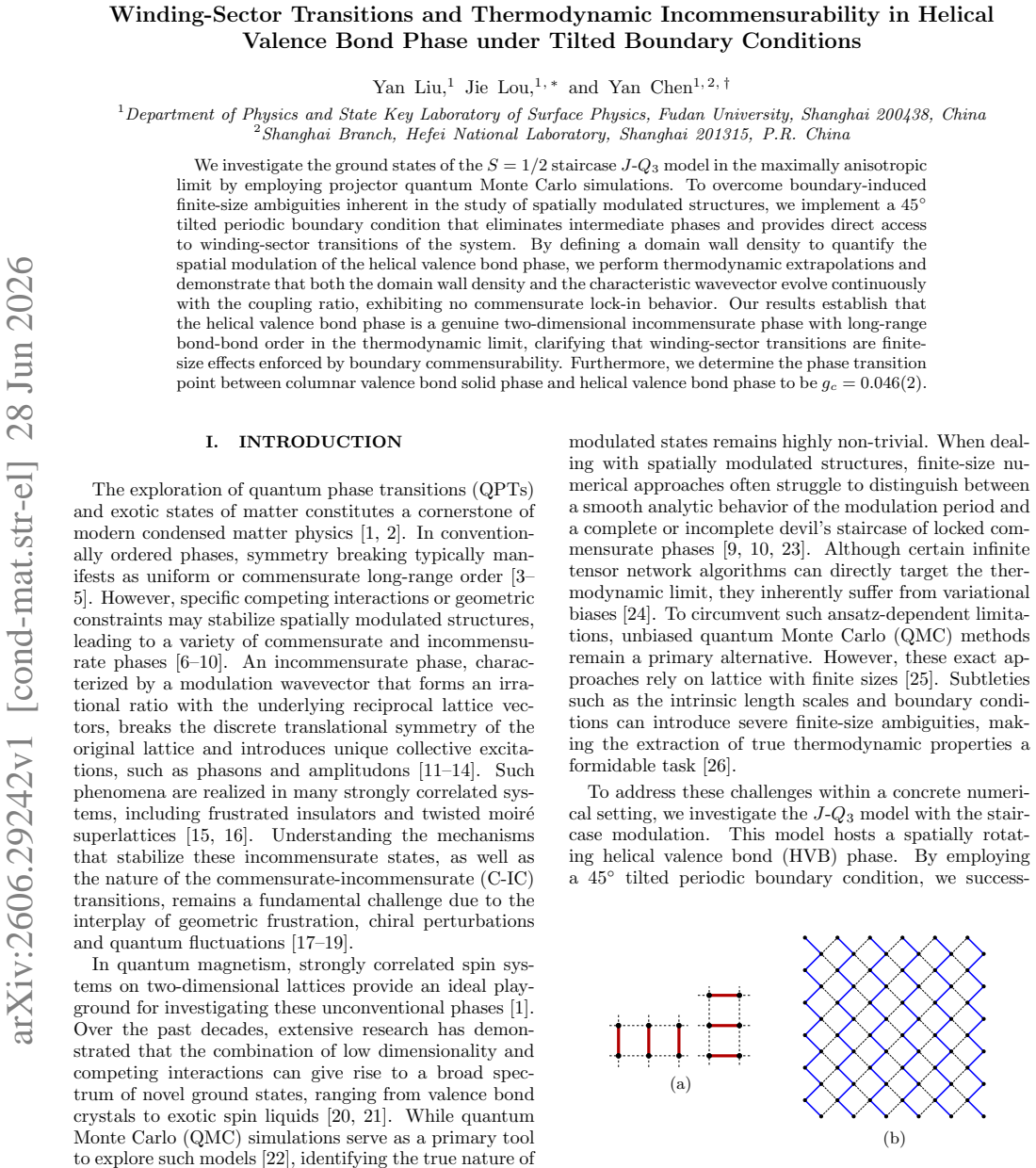
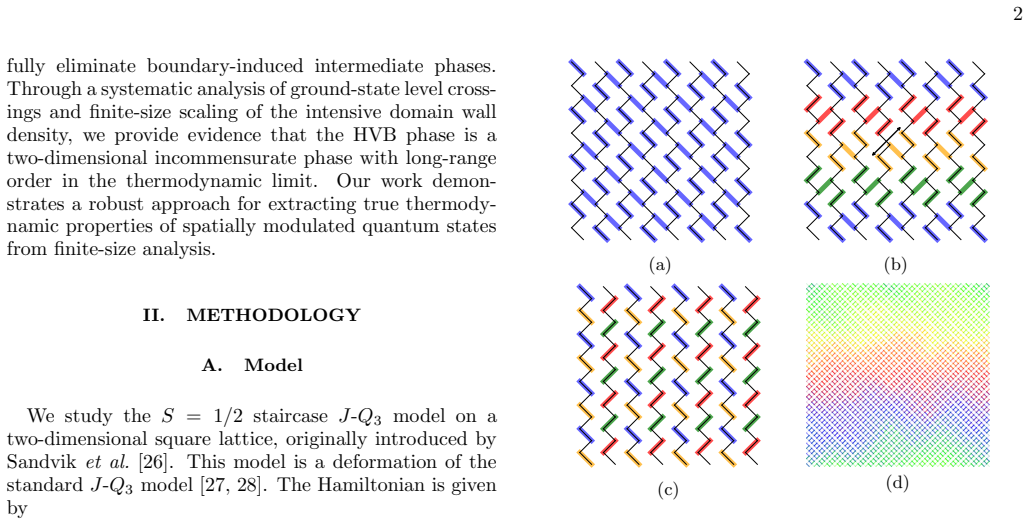
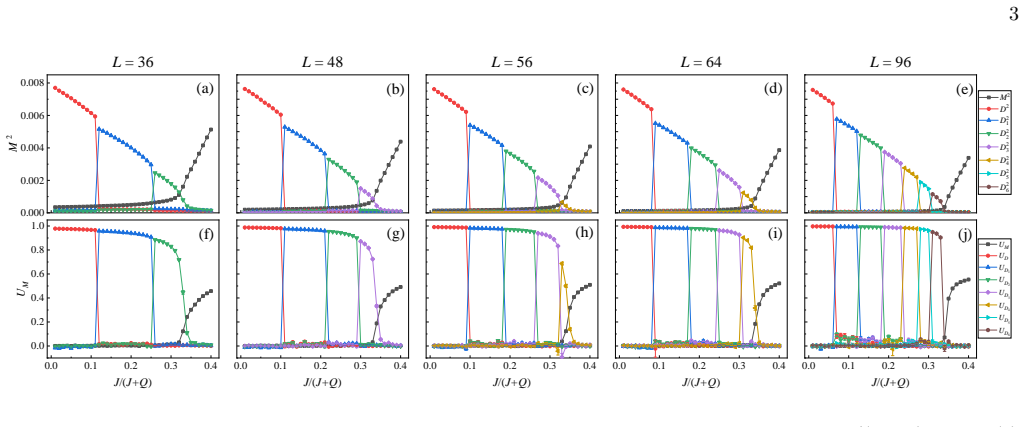
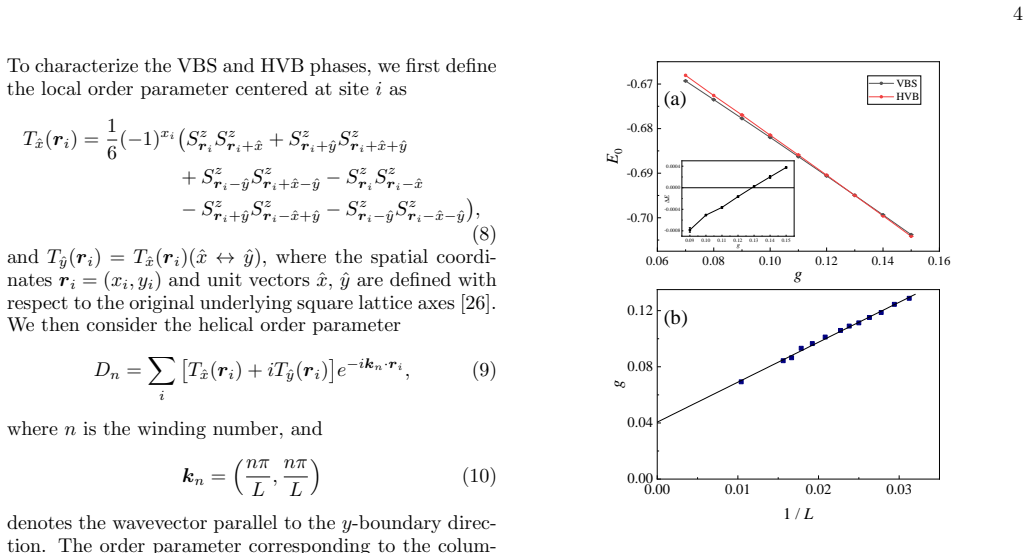
We investigate the ground states of the $S = 1/2$ staircase $J$-$Q_3$ model in the maximally anisotropic limit by employing projector quantum Monte Carlo simulations. To overcome boundary-induced finite-size ambiguities inherent in the study of spatially modulated structures, we implement a $45^{\circ}$ tilted periodic boundary condition that eliminates intermediate phases and provides direct access to winding-sector transitions of the system. By defining a domain wall density to quantify the spatial modulation of the helical valence bond phase, we perform thermodynamic extrapolations and demonstrate that both the domain wall density and the characteristic wavevector evolve continuously with the coupling ratio, exhibiting no commensurate lock-in behavior. Our results establish that the helical valence bond phase is a genuine two-dimensional incommensurate phase with long-range bond-bond order in the thermodynamic limit, clarifying that winding-sector transitions are finite-size effects enforced by boundary commensurability. Furthermore, we determine the phase transition point between columnar valence bond solid phase and helical valence bond phase to be $g_c = 0.046(2)$.
Editorial analysis
A structured set of objections, weighed in public.
Referee Report
Summary. The paper studies the S=1/2 staircase J-Q3 model in the maximally anisotropic limit via projector quantum Monte Carlo. It introduces 45° tilted periodic boundary conditions to remove boundary-induced finite-size ambiguities for modulated structures, defines a domain-wall density to characterize the helical valence bond phase, and reports thermodynamic extrapolations showing that both domain-wall density and characteristic wavevector evolve continuously with the coupling ratio g without commensurate lock-in. The central claims are that the helical valence bond phase is a genuine two-dimensional incommensurate phase possessing long-range bond-bond order in the thermodynamic limit, that winding-sector transitions are finite-size artifacts, and that the columnar-to-helical transition occurs at g_c = 0.046(2).
Significance. If the numerical evidence is robust, the work would provide concrete support for the existence of a stable incommensurate helical valence-bond phase in two dimensions and demonstrate a practical route (tilted PBC) for studying spatially modulated quantum phases without artificial commensurability constraints. The continuous evolution and absence of lock-in constitute falsifiable predictions that can be tested by other methods.
major comments (2)
- [Methods and Results] § Methods (tilted PBC implementation) and Results (domain-wall extrapolations): the claim that the 45° tilt fully removes boundary commensurability constraints and permits unbiased access to incommensurate wavevectors rests on the assumption that allowed modulations become dense in the thermodynamic limit. The manuscript must explicitly show the allowed helical wavevectors under the tilted supercell (e.g., via the discrete set of winding sectors) and demonstrate that the observed continuous g-dependence is not an artifact of residual discretization; otherwise the absence of lock-in cannot be distinguished from a boundary-induced selection effect.
- [Results] Results (thermodynamic extrapolations of domain-wall density and wavevector): the central claim of long-range bond-bond order and continuous incommensurability in the thermodynamic limit is supported only by extrapolations whose details (system sizes, fitting forms, χ^{2} values, and error propagation) are not reported in sufficient detail. Without these, it is impossible to assess whether the reported continuous evolution and g_c = 0.046(2) are robust or sensitive to the largest accessible sizes.
minor comments (2)
- [Figures] Figure captions should explicitly state the range of system sizes used for each extrapolation and the functional form assumed for the finite-size scaling.
- [Methods] Notation for the domain-wall density should be defined once in the main text with a clear relation to the bond-bond correlation function.
Simulated Author's Rebuttal
We thank the referee for the careful and constructive review of our manuscript. We address each major comment point by point below and will revise the manuscript to incorporate the requested clarifications and details.
read point-by-point responses
-
Referee: [Methods and Results] § Methods (tilted PBC implementation) and Results (domain-wall extrapolations): the claim that the 45° tilt fully removes boundary commensurability constraints and permits unbiased access to incommensurate wavevectors rests on the assumption that allowed modulations become dense in the thermodynamic limit. The manuscript must explicitly show the allowed helical wavevectors under the tilted supercell (e.g., via the discrete set of winding sectors) and demonstrate that the observed continuous g-dependence is not an artifact of residual discretization; otherwise the absence of lock-in cannot be distinguished from a boundary-induced selection effect.
Authors: We agree that an explicit demonstration of the allowed wavevectors is required to fully substantiate the claim. In the revised manuscript we will add a new subsection (or figure) in Methods that enumerates the discrete winding sectors permitted by the 45° tilted supercell and maps them onto the corresponding helical wavevectors. We will further include a finite-size scaling argument, supported by additional data, showing that the density of accessible sectors increases with linear size L, rendering the observed continuous g-dependence robust against residual discretization. This addition will directly address the concern that the absence of lock-in might be a boundary artifact. revision: yes
-
Referee: [Results] Results (thermodynamic extrapolations of domain-wall density and wavevector): the central claim of long-range bond-bond order and continuous incommensurability in the thermodynamic limit is supported only by extrapolations whose details (system sizes, fitting forms, χ^{2} values, and error propagation) are not reported in sufficient detail. Without these, it is impossible to assess whether the reported continuous evolution and g_c = 0.046(2) are robust or sensitive to the largest accessible sizes.
Authors: We acknowledge that the extrapolation details were not reported with sufficient transparency. In the revision we will expand the Results section and add a dedicated appendix that (i) lists all system sizes used, (ii) specifies the fitting forms (e.g., linear or quadratic in 1/L), (iii) reports the χ² values for each fit, and (iv) describes the error-propagation procedure. These additions will allow readers to evaluate the robustness of the continuous evolution and the quoted transition point g_c = 0.046(2). revision: yes
Circularity Check
No circularity; numerical extrapolations are independent of inputs
full rationale
The paper's derivation consists of projector QMC simulations under 45° tilted PBC, definition of domain wall density as a direct measure of modulation, and thermodynamic extrapolation of density and wavevector versus coupling ratio g. These quantities are computed from the sampled configurations and extrapolated to the limit; the continuous evolution and absence of lock-in are data-driven conclusions, not forced by redefinition or by fitting a parameter to a subset and relabeling it a prediction. No self-citations, uniqueness theorems, or ansatzes imported from prior author work appear in the load-bearing steps. The boundary-condition assumption is tested rather than presupposed, yielding a self-contained numerical result.
Axiom & Free-Parameter Ledger
free parameters (1)
- g_c =
0.046(2)
axioms (1)
- domain assumption Projector quantum Monte Carlo accurately samples the ground state of the S=1/2 staircase J-Q3 model without sign problem or ergodicity issues.
Reference graph
Works this paper leans on
-
[1]
Sachdev,Quantum Phase Transitions(Cambridge University Press, 2011)
S. Sachdev,Quantum Phase Transitions(Cambridge University Press, 2011)
2011
-
[2]
S. L. Sondhi, S. Girvin, J. Carini, and D. Shahar, Con- 7 tinuous quantum phase transitions, Reviews of modern physics69, 315 (1997)
1997
-
[3]
P. W. Anderson, More is different: broken symmetry and the nature of the hierarchical structure of science., Sci- ence177, 393 (1972)
1972
-
[4]
P. M. Chaikin, T. C. Lubensky, and T. A. Witten,Prin- ciples of condensed matter physics, Vol. 10 (Cambridge university press Cambridge, 1995)
1995
-
[5]
L. D. Landau and E. M. Lifshitz,Statistical physics: vol- ume 5, Vol. 5 (Elsevier, 2013)
2013
-
[6]
Pokrovsky and A
V. Pokrovsky and A. Talapov, Ground state, spectrum, and phase diagram of two-dimensional incommensurate crystals, Physical Review Letters42, 65 (1979)
1979
-
[7]
M. E. Fisher and W. Selke, Infinitely many commensu- rate phases in a simple ising model, Physical Review Let- ters44, 1502 (1980)
1980
-
[8]
Villain and P
J. Villain and P. Bak, Two-dimensional ising model with competing interactions: floating phase, walls and dislo- cations, Journal de Physique42, 657 (1981)
1981
-
[9]
Bak, Commensurate phases, incommensurate phases and the devil’s staircase, Reports on Progress in Physics 45, 587 (1982)
P. Bak, Commensurate phases, incommensurate phases and the devil’s staircase, Reports on Progress in Physics 45, 587 (1982)
1982
-
[10]
Selke, The ANNNI model—theoretical analysis and experimental application, Physics Reports170, 213 (1988)
W. Selke, The ANNNI model—theoretical analysis and experimental application, Physics Reports170, 213 (1988)
1988
-
[11]
Overhauser, Observability of charge-density waves by neutron diffraction, Physical Review B3, 3173 (1971)
A. Overhauser, Observability of charge-density waves by neutron diffraction, Physical Review B3, 3173 (1971)
1971
-
[12]
P. Lee, T. Rice, and P. Anderson, Conductivity from charge or spin density waves, Solid State Communica- tions14, 703 (1974)
1974
-
[13]
W. L. McMillan, Theory of discommensurations and the commensurate-incommensurate charge-density-wave phase transition, Physical Review B14, 1496 (1976)
1976
-
[14]
Blinc, Magnetic resonance and relaxation in struc- turally incommensurate systems, Physics Reports79, 331 (1981)
R. Blinc, Magnetic resonance and relaxation in struc- turally incommensurate systems, Physics Reports79, 331 (1981)
1981
-
[15]
Woods, L
C. Woods, L. Britnell, A. Eckmann, R. Ma, J. Lu, H. Guo, X. Lin, G. Yu, Y. Cao, R. V. Gorbachev,et al., Commensurate–incommensurate transition in graphene on hexagonal boron nitride, Nature physics10, 451 (2014)
2014
-
[16]
O. A. Starykh, Unusual ordered phases of highly frus- trated magnets: a review, Reports on Progress in Physics 78, 052502 (2015)
2015
-
[17]
Whitsitt, R
S. Whitsitt, R. Samajdar, and S. Sachdev, Quantum field theory for the chiral clock transition in one spatial dimen- sion, Physical Review B98, 205118 (2018)
2018
-
[18]
Chepiga, I
N. Chepiga, I. Affleck, and F. Mila, Floating, critical, and dimerized phases in a frustrated spin- 3 2 chain, Physical Review B101, 174407 (2020)
2020
-
[19]
Nyckees and F
S. Nyckees and F. Mila, Commensurate-incommensurate transition in the chiral ashkin-teller model, Physical Re- view Research4, 013093 (2022)
2022
-
[20]
Savary and L
L. Savary and L. Balents, Quantum spin liquids: a re- view, Reports on Progress in Physics80, 016502 (2017)
2017
-
[21]
Y. Zhou, K. Kanoda, and T.-K. Ng, Quantum spin liquid states, Reviews of Modern Physics89, 025003 (2017)
2017
-
[22]
A. W. Sandvik, Computational studies of quantum spin systems, inAIP Conf. Proc, Vol. 1297 (2010) p. 135
2010
-
[23]
Zhang and P
K. Zhang and P. Charbonneau, Monte carlo approach for studying microphases applied to the axial next-nearest- neighbor ising and the ising-coulomb models, Physical Review B83, 214303 (2011)
2011
-
[24]
Jordan, R
J. Jordan, R. Or´ us, G. Vidal, F. Verstraete, and J. I. Cirac, Classical simulation of infinite-size quantum lat- tice systems in two spatial dimensions, Physical Review Letters101, 250602 (2008)
2008
- [25]
-
[26]
B. Zhao, J. Takahashi, and A. W. Sandvik, Multicritical deconfined quantum criticality and lifshitz point of a he- lical valence-bond phase, Physical Review Letters125, 257204 (2020)
2020
-
[27]
A. W. Sandvik, Evidence for deconfined quantum criti- cality in a two-dimensional heisenberg model with four- spin interactions, Physical Review Letters98, 227202 (2007)
2007
-
[28]
J. Lou, A. W. Sandvik, and N. Kawashima, Anti- ferromagnetic to valence-bond-solid transitions in two- dimensional SU(N) heisenberg models with multispin in- teractions, Physical Review B80, 180414 (2009)
2009
-
[29]
Sen and A
A. Sen and A. W. Sandvik, Example of a first-order N´ eel to valence-bond-solid transition in two dimensions, Phys- ical Review B82, 174428 (2010)
2010
-
[30]
A. W. Sandvik, Finite-size scaling and boundary effects in two-dimensional valence-bond solids, Physical Review B85, 134407 (2012)
2012
-
[31]
Shu, S.-K
Y.-R. Shu, S.-K. Jian, and S. Yin, Nonequilibrium dy- namics of deconfined quantum critical point in imaginary time, Physical Review Letters128, 020601 (2022)
2022
-
[32]
Y.-C. Wang, N. Ma, M. Cheng, and Z. Y. Meng, Scaling of the disorder operator at deconfined quantum critical- ity, SciPost Physics13, 123 (2022)
2022
-
[33]
Zhao, Y.-C
J. Zhao, Y.-C. Wang, Z. Yan, M. Cheng, and Z. Y. Meng, Scaling of entanglement entropy at deconfined quantum criticality, Physical Review Letters128, 010601 (2022)
2022
-
[34]
Z. Deng, L. Liu, W. Guo, and H.-Q. Lin, Diagnosing quantum phase transition order and deconfined criticality via entanglement entropy, Physical Review Letters133, 100402 (2024)
2024
-
[35]
D’Emidio and A
J. D’Emidio and A. W. Sandvik, Entanglement entropy and deconfined criticality: emergent SO(5) symmetry and proper lattice bipartition, Physical Review Letters 133, 166702 (2024)
2024
-
[36]
Y. Zhu, Z. Liu, Z. Wang, Y.-C. Wang, and Z. Yan, Bi- partite entanglement and surface criticality: The extra contribution of the nonordinary edge in entanglement, Physical Review Letters136, 046501 (2026)
2026
-
[37]
Zhang, N
F. Zhang, N. Desai, W. Guo, and R. K. Kaul, Phase diagrams ofs=1/2 bilayer models of SU(2) symmetric antiferromagnets, Physical Review B113, 115120 (2026)
2026
-
[38]
Senthil, A
T. Senthil, A. Vishwanath, L. Balents, S. Sachdev, and M. P. Fisher, Deconfined quantum critical points, Science 303, 1490 (2004)
2004
-
[39]
R. G. Melko and R. K. Kaul, Scaling in the fan of an unconventional quantum critical point, Physical Review Letters100, 017203 (2008)
2008
-
[40]
K. Chen, Y. Huang, Y. Deng, A. Kuklov, N. Prokof’ev, and B. Svistunov, Deconfined criticality flow in the heisenberg model with ring-exchange interactions, Phys- ical Review Letters110, 185701 (2013)
2013
-
[41]
Nahum, J
A. Nahum, J. Chalker, P. Serna, M. Ortu˜ no, and A. So- moza, Deconfined quantum criticality, scaling violations, and classical loop models, Physical Review X5, 041048 (2015)
2015
-
[42]
Nahum, P
A. Nahum, P. Serna, J. Chalker, M. Ortu˜ no, and A. Somoza, Emergent SO(5) symmetry at the n´ eel to valence-bond-solid transition, Physical Review Letters 8 115(2015)
2015
-
[43]
H. Shao, W. Guo, and A. W. Sandvik, Quantum critical- ity with two length scales, Science352, 213 (2016)
2016
-
[44]
Y. Q. Qin, Y.-Y. He, Y.-Z. You, Z.-Y. Lu, A. Sen, A. W. Sandvik, C. Xu, and Z. Y. Meng, Duality between the deconfined quantum-critical point and the bosonic topo- logical transition, Physical Review X7, 031052 (2017)
2017
-
[45]
Ma, G.-Y
N. Ma, G.-Y. Sun, Y.-Z. You, C. Xu, A. Vishwanath, A. W. Sandvik, and Z. Y. Meng, Dynamical signature of fractionalization at a deconfined quantum critical point, Physical Review B98, 174421 (2018)
2018
-
[46]
J. Takahashi, H. Shao, B. Zhao, W. Guo, and A. W. Sandvik, SO(5) multicriticality in two-dimensional quan- tum magnets, arXiv:2405.06607 (2024)
-
[47]
M. Song, J. Zhao, M. Cheng, C. Xu, M. Scherer, L. Janssen, and Z. Y. Meng, Evolution of entanglement entropy at SU(N) deconfined quantum critical points, Science Advances11, eadr0634 (2025)
2025
-
[48]
A. W. Sandvik, Stochastic series expansion method with operator-loop update, Physical Review B59, R14157 (1999)
1999
-
[49]
A. W. Sandvik, Ground state projection of quantum spin systems in the valence-bond basis, Physical Review Let- ters95, 207203 (2005)
2005
-
[50]
A. W. Sandvik and H. G. Evertz, Loop updates for vari- ational and projector quantum monte carlo simulations in the valence-bond basis, Physical Review B82, 024407 (2010)
2010
-
[51]
Beach and A
K. Beach and A. W. Sandvik, Some formal results for the valence bond basis, Nuclear Physics B750, 142 (2006)
2006
-
[52]
Schulz, Critical behavior of commensurate- incommensurate phase transitions in two dimensions, Physical Review B22, 5274 (1980)
H. Schulz, Critical behavior of commensurate- incommensurate phase transitions in two dimensions, Physical Review B22, 5274 (1980)
1980
-
[53]
Tang and A
Y. Tang and A. W. Sandvik, Method to characterize spinons as emergent elementary particles, Physical Re- view Letters107, 157201 (2011)
2011
-
[54]
A. W. Sandvik, V. N. Kotov, and O. P. Sushkov, Ther- modynamics of a gas of deconfined bosonic spinons in two dimensions, Physical Review Letters106, 207203 (2011)
2011
-
[55]
Tang and A
Y. Tang and A. W. Sandvik, Confinement and decon- finement of spinons in two dimensions, Physical Review Letters110, 217213 (2013)
2013
-
[56]
H. Shao, W. Guo, and A. W. Sandvik, Emergent topolog- ical excitations in a two-dimensional quantum spin sys- tem, Physical Review B91, 094426 (2015)
2015
-
[57]
H. Suwa, A. Sen, and A. W. Sandvik, Level spectroscopy in a two-dimensional quantum magnet: Linearly dispers- ing spinons at the deconfined quantum critical point, Physical Review B94, 144416 (2016)
2016
-
[58]
L. Liu, H. Shao, Y.-C. Lin, W. Guo, and A. W. Sand- vik, Random-singlet phase in disordered two-dimensional quantum magnets, Physical Review X8, 041040 (2018)
2018
-
[59]
Beccaria, M
M. Beccaria, M. Campostrini, and A. Feo, Evidence for a floating phase of the transverse annni model at high frustration, Physical Review B76, 094410 (2007)
2007
discussion (0)
Sign in with ORCID, Apple, or X to comment. Anyone can read and Pith papers without signing in.