REVIEW 3 major objections 3 minor 155 references
Fractional Dehn twist coefficients and rank bounds for categorified link invariants
T0 review · 3 major / 3 minor · reviewed 2026-08-07 · deepseek-v4-flash
Pith's one-line read The paper shows each full unit of boundary twisting adds two dimensions to the next-to-top link Floer grading, and gives an annular Khovanov analogue.
desk verdict A new multi-boundary rank bound that is likely true, but the paper is not yet complete because its central surgery exact triangle is only sketched. read the letter →
The pith
A machine-rendered reading of the paper's core claim, the machinery that carries it, and where it could break.
The reading
What carries the argument
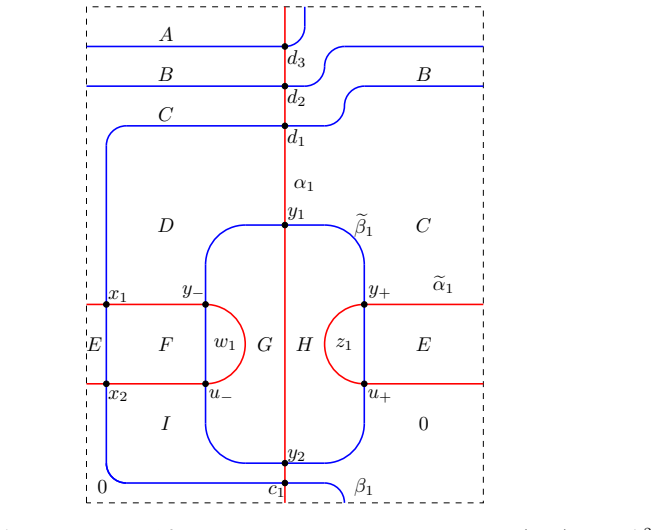
The central object is the fractional Dehn twist coefficient (FDTC), a rational number attached to each boundary component of a surface that measures the asymptotic twisting of a diffeomorphism around that component; the target object is the Alexander grading $1-G$ of $\widehat{HFL}$, where $G=g(\Sigma)+m-1$. The load-bearing mechanism is the surgery exact triangle for link Floer homology (Lemma 5.3): for a link $L$ and a framed knot $\eta$ in its complement there is an exact triangle relating $\widehat{HFL}$ of $Z_1(\eta)$, $Z$, and $Z_0(\eta)$, and if $\eta$ avoids a Seifert surface for $L$ the triangle splits over Alexander gradings. Propositions 5.1 and 5.2 feed this triangle into the multi-boundary proof by identifying a rank-two piece in the $0$-surgery manifold and showing that certain explicit generators map surjectively (or nontrivially) under the triangle map. The single-boundary case uses the immersed curve invariant of a knot, where the slope of the curve near the top grading encodes the FDTC.
What would settle it
Take a simple multi-boundary open book, such as the identity monodromy on a three-punctured sphere, and compute $\widehat{HFL}$ of the binding together with the $0$- and $1$-surgeries on a push-off of one boundary component; checking exactness of the triangle of Lemma 5.3 and the splitting of its Alexander filtration directly would confirm or refute the paper's key technical premise.
Extended reading notes
Core claim
The paper's central claim is that the fractional Dehn twist coefficient of a fibered link's monodromy is, up to a base term, a lower bound on the size of link Floer homology: each additional full unit of twisting around a boundary component forces the rank of the grading $1-G$ piece, $G=g(\Sigma)+m-1$, to grow by at least two, independently for every boundary component. The technical core is a pair of propositions showing that under a right-veering hypothesis, composing the monodromy with one boundary Dehn twist either leaves this graded piece unchanged or adds a rank-two summand, while under a stronger two-twist hypothesis it always adds a rank-two summand. The single-boundary version is proved with immersed curve technology, and the multi-boundary version with an explicit surgery exact triangle and explicit pseudo-holomorphic triangle counts. Theorem 1.2 then transfers the bound to annular Khovanov homology of braid closures through the double branched cover and the spectral sequence to knot Floer homology.
Load-bearing premise
The multi-boundary argument rests on the surgery exact triangle of Lemma 5.3, which the paper proves only by a sketch and without a cited reference; if that triangle fails, or fails to split over Alexander gradings, Propositions 5.1, 5.2, and Theorem 1.1 do not follow, while the separate Lemma 5.10 is not load-bearing since it is never used.
Editorial extensions
If this is right
- Every full unit of $|FDTC(\phi,\partial_i\Sigma)|$ beyond the first contributes at least two dimensions to $\widehat{HFL}$ in grading $1-G$, so large twisting is necessarily visible in link Floer homology independent of the rest of the 3-manifold.
- Even with no twisting, the target graded piece has rank at least $\lceil m/2\rceil$ for non-identity monodromy, and at least $2(g(\Sigma)+m-1)$ for identity monodromy.
- For an $n$-braid $\beta$ with $n>1$, the next-to-maximum annular Khovanov homology satisfies the bounds of Theorem 1.2, so annular Khovanov homology detects large fractional Dehn twist coefficients of braid closures in a quantitative way.
- The paper's examples show the bounds are not sharp: split sums of braids and connected sums of fibered knots have unbounded rank while their FDTC is zero, so the bounds are lower bounds, not characterizations.
Reading between the lines
- A complete proof of Lemma 5.3 would likely let the same surgery-triangle method apply to other Floer-theoretic settings with Alexander-type filtrations, such as sutured Floer homology or annular instanton Floer homology, a direction the paper raises as a question.
- The bound ignores the fractional parts of the FDTCs, so one could test whether the true growth rate of rank depends on those fractional parts by comparing braids with the same floor of FDTC but different fractional parts.
- The annulus behaves differently, and a theorem covering annuli would need a different base term; that is a natural extension rather than a corollary of the present formula.
- The paper's examples suggest the optimal linear coefficient in the FDTC may be larger than $2$: for full twists on three strands the theorem gives only $2$ while the computed annular Khovanov rank is $7$, so a sharper coefficient may exist.
Editorial analysis
A structured set of objections, weighed in public.
Referee Report
Summary. The paper proves two explicit lower bounds for categorified link invariants. Theorem 1.1 asserts that for a fibered link with page a surface of genus g with m boundary components (neither a disk nor an annulus), the rank of the link Floer homology in the next-to-top Alexander grading is bounded below by ceil(m/2) plus a sum over boundary components of 2 max(floor(|FDTC|)-1,0). Theorem 1.2 derives analogous lower bounds for annular Khovanov homology of braid closures via the Roberts–Grigsby–Wehrli spectral sequence. The proof has two independent parts: Section 4 treats the single-boundary case using immersed curve techniques, and Section 5 treats the multi-boundary case using an asserted surgery exact triangle for link Floer homology together with detailed Heegaard diagram computations. Section 7 gives examples showing the bounds can be arbitrarily non-tight.
Significance. If the multi-boundary proof is completed, Theorem 1.1 is a genuinely new rank bound for link Floer homology of fibered links, and Theorem 1.2 gives new annular Khovanov homology bounds for both odd- and even-stranded braids. The paper is honest and explicit: it gives detailed diagrammatic computations, a complete computation for the annulus, and it explicitly states that the multi-component surgery exact triangle could not be located in the literature. The single-boundary case is supported by independent immersed-curve machinery, and the annular Khovanov consequences are concrete and falsifiable. The main caveat is that the new multi-boundary argument rests on Lemma 5.3, which is only sketched and is not backed by a reference in the required link-case form.
major comments (3)
- [Section 5, Lemma 5.3] The multi-component surgery exact triangle for link Floer homology is load-bearing for the central new claim, but it is asserted with only a proof sketch and no reference. The authors state that the result is "well known to experts" but that they could not find a reference for the genuine link case. Propositions 5.1 and 5.2, and hence Theorem 1.1, depend not only on the existence of the triangle but also on the asserted splitting over Alexander grading 1-G when the surgery knot lies in the complement of a Seifert surface, as used in Equation (8). The manuscript must supply a complete proof that the triangle maps are Alexander-graded and that the splitting holds with the stated grading shift. Without this, the rank-jump induction in the multi-boundary case is unsupported.
- [Section 5.2, Lemma 5.9] Lemma 5.9 is stated without any statement: after the heading the proof begins immediately, with no claim to prove. This is not a cosmetic omission, because the proof of Proposition 5.1 uses Lemma 5.9 exactly to establish surjectivity of f_1^*, the step that turns the exact triangle into the claimed isomorphism. The missing statement should be supplied and the proof should be checked against it.
- [Theorem 1.1, statement and proof] The symbol G is defined inconsistently. In the statement of Theorem 1.1, G is the maximal Alexander grading g(Σ)+m-1, while in the proof G is redefined as the minimum grading 1-g(Σ)-|∂Σ|. Substituting the proof's value into 1-G places the claimed nonzero rank outside the support of link Floer homology entirely. The symmetry of Alexander gradings likely allows a repair, but the argument must be rewritten with a single convention, for example by fixing G as the maximal grading and using the symmetry to identify rank at 1-G with rank at G-1.
minor comments (3)
- [Section 5.3, Lemma 5.10] Lemma 5.10 is false as stated when Σ has a single boundary component, because the hypothesis about arcs connecting distinct boundary components is vacuous while non-identity diffeomorphisms of once-bordered surfaces exist. The lemma can be repaired by adding m≥2 or by stating the hypothesis over arcs with endpoints on distinct components. This lemma is not used in the proof of Theorem 1.1, so the issue is local.
- [Section 3.2, Equation (3)] The chain of isomorphisms in Equation (3) appears garbled: the third and fourth expressions cannot both hold with the same [Σ] unless the Alexander grading is reversed. Please clarify the conventions for the changes from [Σ] to [-Σ] and from i to -i.
- [Section 7, first paragraph] There is a typo: "insted" should be "instead". The sentence beginning "We insted provide families" should be corrected.
Circularity Check
No circular derivation: the rank bounds are obtained from external surgery formulas, immersed-curve machinery, and explicit Heegaard-diagram computations; the paper's self-citations are contextual rather than load-bearing.
full rationale
I walked the derivation chain for Theorems 1.1 and 1.2. Theorem 1.1 is built from Propositions 5.1 and 5.2, which in turn rest on the surgery exact triangle (Lemma 5.3), the explicit computation of the 0-surgery link Floer homology in Lemma 5.5, the triangle-map computations in Lemmas 5.6 and 5.9, and the base-case rank bounds in Lemmas 5.12 and 5.13. None of these steps fits a parameter to the quantity being predicted: the FDTC enters only through geometric veering hypotheses and known inequalities, not through any normalization chosen after computing HFL ranks. The single-boundary case is independently derived from Hanselman-Rasmussen-Watson immersed curves together with Baldwin-Ni-Sivek's detection result, and the annular Khovanov bound is an application of the Grigsby-Wehrli/Roberts spectral sequence and Ito-Kawamuro's FDTC branching formulas. Self-citations are present but not load-bearing: [Bin25] is cited only as a previously known weaker bound, [BD25] appears in a remark as an optional improvement under stronger hypotheses and as inspiration for a lemma that is proved directly, and [FHT25] supplies the definition of FDTC. The clearest caveat is Lemma 5.3: the paper states that the link-case surgery exact triangle is 'well known to experts' but gives only a proof sketch and notes it could not find a specific reference for genuine links. This is a completeness/correctness risk, not circularity: the triangle is an external structural input, and its splitting over Alexander gradings is a filtration property that is not equivalent to the rank conclusion being drawn. The false Lemma 5.10 is explicitly unused in the proofs of the main theorems, so it does not make the derivation circular. Overall, the central claims have independent mathematical content and are not equivalent to their inputs by construction.
Assumptions & free parameters
assumptions (7)
- standard math Existence, invariance and Alexander grading of link Floer homology.
- standard math Immersed curve invariant for bordered 3-manifolds with torus boundary, and the intersection-counting formula for knot Floer homology of surgeries.
- standard math Knot Floer homology detects non-weakly right-veering monodromy via a nontrivial E2-page map.
- domain assumption Surgery exact triangle for link Floer homology (Lemma 5.3) and its splitting over Alexander gradings when the surgery knot avoids a Seifert surface.
- standard math Spectral sequence from annular Khovanov homology to the knot Floer homology of the braid axis lift in the double branched cover.
- standard math Ito-Kawamuro formulas for fractional Dehn twist coefficients under double branched covers of braids.
- standard math Nonvanishing of BRAID invariant generators in link Floer homology of fibered links.
Cite this review
Pith. "Pith review of Fractional Dehn twist coefficients and rank bounds for categorified link invariants." pith.science (2026). https://pith.science/paper/WAYSJIOZ
@misc{pith2026260806201,
  author       = {Pith},
  title        = {Pith review of: Fractional Dehn twist coefficients and rank bounds for categorified link invariants},
  year         = {2026},
  howpublished = {\url{https://pith.science/paper/WAYSJIOZ}},
  note         = {Machine review of arXiv:2608.06201}
}
read the original abstract
We give two new lower bounds on the rank of categorified link invariants: one on the link Floer homology of fibered links in terms of the fractional Dehn twist coefficients of their monodromies, and another, as a corollary, on the annular Khovanov homology of braid closures in terms of the fractional Dehn twist coefficient of the braid. The most important technical component of the proof is that we determine the behaviour of the link Floer homology of fibered links under adding boundary Dehn twists to their monodromies in the next to top Alexander grading.
Figures


Figures from the paper (15 more)




Reference graph
Works this paper leans on
-
[1]
Algebraic & Geometric Topology , author =
Holomorphic disks, link invariants and the multi-variable. Algebraic & Geometric Topology , author =. 2008 , note =. doi:10.2140/agt.2008.8.615 , number =
-
[2]
Commentationes Mathematicae , volume=
Functions with non-degenerate critical points on manifolds with boundary , author=. Commentationes Mathematicae , volume=. 1972 , publisher=
1972
-
[3]
Journal of Topology , volume=
A quantitative Birman--Menasco finiteness theorem and its application to crossing number , author=. Journal of Topology , volume=. 2022 , publisher=
2022
-
[4]
Journal of Knot Theory and Its Ramifications , volume=
Annular Khovanov homology and meridional disks , author=. Journal of Knot Theory and Its Ramifications , volume=. 2023 , publisher=
2023
-
[5]
Li, Zhenkun and Xie, Yi and Zhang, Boyu , journal=. On
-
[6]
II , author=
Foliations and the topology of 3-manifolds. II , author=. Journal of Differential Geometry , volume=. 1987 , publisher=
1987
-
[7]
Problems in foliations and laminations , author=. Stud. in Adv. Math. AMS/IP , volume=
-
[8]
Advances in Mathematics , author =
Holomorphic disks and knot invariants , volume =. Advances in Mathematics , author =. 2004 , pages =. doi:10.1016/j.aim.2003.05.001 , abstract =
Show all 155 references
-
[9]
preprint , author=
Remarks on the definition of the Khovanov homology. preprint , author=. arXiv preprint math.GT/0202199 , year=
-
[10]
, TITLE =
Hedden, Matthew and Mark, Thomas E. , TITLE =. Adv. Math. , FJOURNAL =. 2018 , PAGES =. doi:10.1016/j.aim.2017.11.008 , URL =
2018 doi
-
[11]
Ozsv\'ath, Peter and Szab\'o, Zolt\'an , TITLE =. Ann. of Math. (2) , FJOURNAL =. 2004 , NUMBER =. doi:10.4007/annals.2004.159.1159 , URL =
2004 doi
-
[12]
Lipshitz, Robert , TITLE =. Geom. Topol. , FJOURNAL =. 2014 , NUMBER =. doi:10.2140/gt.2014.18.17 , URL =
2014 doi
-
[13]
Lipshitz, Robert , TITLE =. Geom. Topol. , FJOURNAL =. 2006 , PAGES =. doi:10.2140/gt.2006.10.955 , URL =
2006 doi
-
[14]
Heegaard
Lipshitz, Robert , journal=. Heegaard. 2016 , publisher=
2016
-
[15]
Zemke, Ian , TITLE =. Algebr. Geom. Topol. , FJOURNAL =. 2017 , NUMBER =. doi:10.2140/agt.2017.17.3461 , URL =
2017 doi
-
[16]
and Eliashberg, Y
Bourgeois, F. and Eliashberg, Y. and Hofer, H. and Wysocki, K. and Zehnder, E. , TITLE =. Geom. Topol. , FJOURNAL =. 2003 , PAGES =. doi:10.2140/gt.2003.7.799 , URL =
2003 doi
-
[17]
Zemke, Ian , TITLE =. J. Topol. , FJOURNAL =. 2021 , NUMBER =. doi:10.1112/topo.12206 , URL =
2021 doi
-
[18]
A refinement of sutured
Alishahi, Akram S and Eftekhary, Eaman , journal=. A refinement of sutured. 2015 , publisher=
2015
-
[19]
Annals of Mathematics , pages=
Holomorphic disks and topological invariants for closed three-manifolds , author=. Annals of Mathematics , pages=. 2004 , publisher=
2004
-
[20]
Cable Links, Annuli and Sutured
Binns, Fraser and Dey, Subhankar , journal=. Cable Links, Annuli and Sutured
-
[21]
arXiv:math/0306378 , author =
Floer homology and knot complements , url =. arXiv:math/0306378 , author =. 2003 , note =
2003 arXiv
-
[22]
Proceedings of the American Mathematical Society , author =
Categorified invariants and the braid group , volume =. Proceedings of the American Mathematical Society , author =. 2015 , pages =. doi:10.1090/S0002-9939-2015-12482-3 , abstract =
2015 doi
-
[23]
Heegaard
Hanselman, Jonathan , journal=. Heegaard
-
[24]
arXiv preprint arXiv:2302.12365 , year=
Nearly fibered links with genus one , author=. arXiv preprint arXiv:2302.12365 , year=
-
[25]
Mathematical Research Letters , volume=
Khovanov homology detects T (2, 6) , author=. Mathematical Research Letters , volume=. 2022 , publisher=
2022
-
[26]
Journal of Topology , volume=
Knot homology groups from instantons , author=. Journal of Topology , volume=. 2011 , publisher=
2011
-
[27]
Hanselman, Jonathan and Rasmussen, Jacob and Watson, Liam , TITLE =. Proc. Lond. Math. Soc. (3) , FJOURNAL =. 2022 , NUMBER =. doi:10.1112/plms.12473 , URL =
2022 doi
-
[28]
Proceedings of the American Mathematical Society , volume=
The first coefficient of the Conway polynomial , author=. Proceedings of the American Mathematical Society , volume=
-
[29]
Mathematische Annalen , volume=
On L-spaces and left-orderable fundamental groups , author=. Mathematische Annalen , volume=. 2013 , publisher=
2013
-
[30]
Notions of positivity and the Ozsv
Hedden, Matthew , journal=. Notions of positivity and the Ozsv. 2010 , publisher=
2010
-
[31]
Hedden, Matthew , journal=. Knot. 2007 , publisher=
2007
-
[32]
Hedden, Matthew , journal=. On
-
[33]
Link cobordisms and functoriality in link
Zemke, Ian , journal=. Link cobordisms and functoriality in link. 2019 , publisher=
2019
-
[34]
Ozsv. Knot. Algebraic & Geometric Topology , volume=. 2010 , publisher=
2010
-
[35]
Computing annular
Hunt, Hilary and Keese, Hannah and Licata, Anthony and Morrison, Scott , journal=. Computing annular
-
[36]
The decategorification of sutured
Friedl, Stefan and Juh. The decategorification of sutured. Journal of Topology , volume=. 2011 , publisher=
2011
-
[37]
Journal of Differential Geometry , volume=
Sutured manifolds and generalized Thurston norms , author=. Journal of Differential Geometry , volume=. 1989 , publisher=
1989
-
[38]
arXiv:1704.02538 [math] , author =
Heegaard. arXiv:1704.02538 [math] , author =. 2017 , note =
2017 arXiv
-
[39]
arXiv:1905.04618 [math] , author =
L-space surgeries on 2-component L-space links , url =. arXiv:1905.04618 [math] , author =. 2019 , note =
1905 arXiv
-
[40]
Morton, H. R. , collaborator =. Exchangable. Low. 1985 , note =
1985
-
[41]
Morton, H. R. , collaborator =. The. Low. 1999 , note =
1999
-
[42]
Mathematics of the USSR-Izvestiya , volume=
Euler structures, nonsingular vector fields, and torsions of Reidemeister type , author=. Mathematics of the USSR-Izvestiya , volume=. 1990 , publisher=
1990
-
[43]
arXiv:2005.02893 [math] , month = april, year =
Detecting fibered strongly quasi-positive links , author =. arXiv:2005.02893 [math] , month = april, year =
2005 arXiv
-
[44]
Geometry & Topology , author =
On knot. Geometry & Topology , author =. 2013 , mrnumber =. doi:10.2140/gt.2013.17.413 , number =
2013 doi
-
[45]
Israel J
Hass, Joel and Scott, Peter , TITLE =. Israel J. Math. , FJOURNAL =. 1985 , NUMBER =. doi:10.1007/BF02772960 , URL =
1985 doi
-
[46]
Algebraic & Geometric Topology , author =
Categorification of the. Algebraic & Geometric Topology , author =. 2004 , mrnumber =. doi:10.2140/agt.2004.4.1177 , urldate =
2004 doi
-
[47]
Xie, Yi and Zhang, Boyu , TITLE =. J. Differential Geom. , FJOURNAL =. 2025 , NUMBER =. doi:10.4310/jdg/1749496718 , URL =
2025
-
[48]
Quantum Topology , volume=
Cable links and l-space surgeries , author=. Quantum Topology , volume=
-
[49]
Mathematical Research Letters , author =
Sutured. Mathematical Research Letters , author =. 2014 , keywords =. doi:10.4310/MRL.2014.v21.n6.a4 , abstract =
2014 doi
-
[50]
Algebraic & Geometric Topology , author =
A note on the knot. Algebraic & Geometric Topology , author =. 2018 , note =. doi:10.2140/agt.2018.18.3669 , number =
2018 doi
-
[51]
Algebraic & Geometric Topology , author =
Khovanov homology, sutured. Algebraic & Geometric Topology , author =. 2010 , note =. doi:10.2140/agt.2010.10.2009 , number =
2010 doi
-
[52]
Compositio Mathematica , author =
Annular. Compositio Mathematica , author =. 2018 , note =. doi:10.1112/S0010437X17007540 , abstract =
2018 doi
-
[53]
Elisenda and Wehrli, Stephan M
Grigsby, J. Elisenda and Wehrli, Stephan M. , editor =. An. Advances in the. 2016 , keywords =. doi:10.1007/978-3-319-34139-2_2 , abstract =
2016 doi
-
[54]
arXiv:1703.03448 [math] , author =
The. arXiv:1703.03448 [math] , author =. 2017 , note =
2017 arXiv
-
[55]
A primer on mapping class groups , isbn =
Farb, Benson , collaborator =. A primer on mapping class groups , isbn =. 2012 , keywords =
2012
-
[56]
, volume =
On the mapping class groups of closed surfaces as covering spaces. , volume =. Ann. of Math. Studies , author =. 1971 , pages =
1971
-
[57]
Heegaard
Licata, Joan E , journal=. Heegaard
-
[58]
arXiv:2006.15484 [math] , author =
Triple linking numbers and. arXiv:2006.15484 [math] , author =. 2020 , note =
2006 arXiv
-
[59]
Triple linking numbers and
Gorsky, Eugene and Lidman, Tye and Liu, Beibei and Moore, Allison H , journal=. Triple linking numbers and
-
[60]
Ghiggini, Paolo , journal=. Knot. 2008 , publisher=
2008
-
[61]
Ni, Yi , journal=. Knot. 2007 , publisher=
2007
-
[62]
Ozsv. Link. Journal of the American Mathematical Society , volume=
-
[63]
A note on knot
Ni, Yi , journal=. A note on knot. 2006 , publisher=
2006
-
[64]
and Mati\'c, Gordana , TITLE =
Honda, Ko and Kazez, William H. and Mati\'c, Gordana , TITLE =. J. Differential Geom. , FJOURNAL =. 2009 , NUMBER =
2009
-
[65]
John Baldwin , title =
-
[66]
Heegaard
Lekili, Yanki , journal=. Heegaard
-
[67]
Heegaard
Ozsv. Heegaard. Duke Mathematical Journal , volume=. 2005 , publisher=
2005
-
[68]
Khovanov homology detects the
Baldwin, John A and Sivek, Steven and Xie, Yi , journal=. Khovanov homology detects the
-
[69]
A note on a
Dey, Subhankar , journal=. A note on a
-
[70]
Cavallo, Alberto , TITLE =. Glasg. Math. J. , FJOURNAL =. 2021 , NUMBER =. doi:10.1017/S0017089520000300 , URL =
2021 doi
-
[71]
On links with
Xie, Yi and Zhang, Boyu , journal=. On links with
-
[72]
Pacific Journal of Mathematics , volume=
Closures of 3-braids and detection , author=. Pacific Journal of Mathematics , volume=. 2025 , publisher=
2025
-
[73]
Links of Second Smallest Knot
Kim, Juhyun , journal=. Links of Second Smallest Knot
-
[74]
Towards an instanton
Street, Ethan J , year=. Towards an instanton
-
[75]
Algebraic & Geometric Topology , volume=
Morse theory for manifolds with boundary , author=. Algebraic & Geometric Topology , volume=. 2016 , publisher=
2016
-
[76]
Binns, Fraser and Martin, Gage , journal=. Knot
-
[77]
Hedden, Matthew , journal=. On knot. 2005 , publisher=
2005
-
[78]
Algebraic & Geometric Topology , volume=
Holomorphic disks, link invariants and the multi-variable Alexander polynomial , author=. Algebraic & Geometric Topology , volume=. 2008 , publisher=
2008
-
[79]
Heegaard
Lisca, Paolo and Ozsv. Heegaard. Journal Of The European Mathematical Society , volume=. 2009 , publisher=
2009
-
[80]
arXiv preprint arXiv:1801.07634 , year=
Khovanov homology detects the trefoils , author=. arXiv preprint arXiv:1801.07634 , year=
-
[81]
Publications math
Khovanov homology is an unknot-detector , author=. Publications math. 2011 , publisher=
2011
-
[82]
Memoirs of the American Mathematical Society , volume=
A norm for the homology of 3-manifolds , author=. Memoirs of the American Mathematical Society , volume=
-
[83]
Murasugi, Kunio , journal=. On the. 1985 , publisher=
1985
-
[84]
Duke Math
Khovanov, Mikhail , TITLE =. Duke Math. J. , FJOURNAL =. 2000 , NUMBER =. doi:10.1215/S0012-7094-00-10131-7 , URL =
2000 doi
-
[85]
Journal of knot theory and its ramifications , volume=
On the slice genus and some concordance invariants of links , author=. Journal of knot theory and its ramifications , volume=. 2015 , publisher=
2015
-
[86]
Categorification of the colored
Beliakova, Anna and Wehrli, Stephan , journal=. Categorification of the colored. 2008 , publisher=
2008
-
[87]
Inventiones mathematicae , volume=
Khovanov homology and the slice genus , author=. Inventiones mathematicae , volume=. 2010 , publisher=
2010
-
[88]
Links of second smallest knot
Kim, Juhyun , journal=. Links of second smallest knot
-
[89]
Ozsv. On knot. Topology , volume=. 2005 , publisher=
2005
-
[90]
Homological actions on sutured
Ni, Yi , journal=. Homological actions on sutured. 2014 , publisher=
2014
-
[91]
Instantons and annular
Xie, Yi , journal=. Instantons and annular. 2021 , publisher=
2021
-
[92]
arXiv preprint arXiv:2208.13963 , year=
Instanton homology and knot detection on thickened surfaces , author=. arXiv preprint arXiv:2208.13963 , year=
-
[93]
arXiv preprint arXiv:2208.05382 , year=
Seifert surface complements of nearly fibered knots , author=. arXiv preprint arXiv:2208.05382 , year=
-
[94]
Two detection results of
Li, Zhenkun and Xie, Yi and Zhang, Boyu , journal=. Two detection results of
-
[95]
Mathematische Annalen , volume=
Unfoldings in knot theory , author=. Mathematische Annalen , volume=. 1987 , publisher=
1987
-
[96]
Proceedings of the American Mathematical Society , volume=
A non-ribbon plumbing of fibered ribbon knots , author=. Proceedings of the American Mathematical Society , volume=
-
[97]
Ni, Yi , journal=. Sutured. 2006 , publisher=
2006
-
[98]
A volume-ish theorem for the
Dasbach, Oliver T and Lin, Xiao-Song , journal=. A volume-ish theorem for the
-
[99]
An endomorphism of the
Lee, Eun Soo , journal=. An endomorphism of the. 2005 , publisher=
2005
-
[100]
Khovanov homology and knot
Baldwin, John A and Levine, Adam Simon and Sarkar, Sucharit , journal=. Khovanov homology and knot. 2017 , publisher=
2017
-
[101]
An algorithm for computing some
Sucharit Sarkar and Jiajun Wang , journal =. An algorithm for computing some
-
[102]
Quantum Topol
Hedden, Matthew and Levine, Adam Simon , TITLE =. Quantum Topol. , FJOURNAL =. 2024 , NUMBER =. doi:10.4171/qt/188 , URL =
2024 doi
-
[103]
A spectral sequence from
Dowlin, Nathan , journal=. A spectral sequence from
-
[104]
Commentarii Mathematici Helvetici , volume=
Detecting fibred links inS 3 , author=. Commentarii Mathematici Helvetici , volume=. 1986 , publisher=
1986
-
[105]
Algebraic and geometric topology (Proc
Constructions of fibred knots and links , author=. Algebraic and geometric topology (Proc. Sympos. Pure Math., Stanford Univ., Stanford, Calif., 1976), Part , volume=
1976
-
[106]
Decomposing sutured monopole and instanton
Ghosh, Sudipta and Li, Zhenkun , journal=. Decomposing sutured monopole and instanton
-
[107]
Instanton
Li, Zhenkun and Ye, Fan , journal=. Instanton. 2022 , publisher=
2022
-
[108]
Journal of Differential Geometry , volume=
Knots, sutures, and excision , author=. Journal of Differential Geometry , volume=. 2010 , publisher=
2010
-
[109]
Inventiones mathematicae , volume=
Right-veering diffeomorphisms of compact surfaces with boundary , author=. Inventiones mathematicae , volume=. 2007 , publisher=
2007
-
[110]
Canadian Journal of Mathematics , volume=
Characterization of Positive Links and the s-invariant for Links , author=. Canadian Journal of Mathematics , volume=. 2017 , publisher=
2017
-
[111]
Combinatorial Heegaard
Ozsv. Combinatorial Heegaard. Advances in Mathematics , volume=. 2012 , publisher=
2012
-
[112]
Duke Mathematical Journal , volume=
A link-splitting spectral sequence in Khovanov homology , author=. Duke Mathematical Journal , volume=. 2015 , publisher=
2015
-
[113]
arXiv preprint arXiv:2007.01269 , year=
Khovanov homology detects the figure-eight knot , author=. arXiv preprint arXiv:2007.01269 , year=
2007 arXiv
-
[114]
On combinatorial link
Manolescu, Ciprian and Ozsv. On combinatorial link. Geometry & Topology , volume=. 2007 , publisher=
2007
-
[115]
Geometry & Topology , volume=
Khovanov module and the detection of unlinks , author=. Geometry & Topology , volume=. 2013 , publisher=
2013
-
[116]
A note on sign conventions in link
Sarkar, Sucharit , journal=. A note on sign conventions in link
-
[117]
Fundamenta Mathematicae , volume=
Torsion of Khovanov homology , author=. Fundamenta Mathematicae , volume=. 2014 , publisher=
2014
-
[118]
Experimental mathematics , volume=
Patterns in knot cohomology, I , author=. Experimental mathematics , volume=. 2003 , publisher=
2003
-
[119]
Manifolds with small
Hedden, Matthew and Ni, Yi , journal=. Manifolds with small. 2010 , publisher=
2010
-
[120]
arXiv preprint arXiv:1908.04397 , year=
Cabling in terms of immersed curves , author=. arXiv preprint arXiv:1908.04397 , year=
1908 arXiv
-
[121]
, TITLE =
Ozbagci, Burak and Stipsicz, Andr\'as I. , TITLE =. 2004 , PAGES =. doi:10.1007/978-3-662-10167-4 , URL =
2004 doi
-
[122]
arXiv preprint arXiv:2007.11774 , year=
Exceptional surgeries on hyperbolic fibered knots , author=. arXiv preprint arXiv:2007.11774 , year=
2007 arXiv
-
[123]
Geometry & Topology , volume=
Floer homology and surface decompositions , author=. Geometry & Topology , volume=. 2008 , publisher=
2008
-
[124]
and Ni, Yi and Sivek, Steven , TITLE =
Baldwin, John A. and Ni, Yi and Sivek, Steven , TITLE =. J. Reine Angew. Math. , FJOURNAL =. 2025 , PAGES =. doi:10.1515/crelle-2024-0079 , URL =
2025 doi
-
[125]
and Roberts, Rachel , TITLE =
Kazez, William H. and Roberts, Rachel , TITLE =. Algebr. Geom. Topol. , FJOURNAL =. 2013 , NUMBER =. doi:10.2140/agt.2013.13.3603 , URL =
2013 doi
-
[126]
Ghiggini, Paolo and Spano, Gilberto , journal=. Knot
-
[127]
The contact invariant in sutured
Honda, Ko and Kazez, William H and Mati. The contact invariant in sutured. Inventiones mathematicae , volume=. 2009 , publisher=
2009
-
[128]
A cylindrical reformulation of
Lipshitz, Robert , journal=. A cylindrical reformulation of. 2006 , publisher=
2006
-
[129]
On the equivalence of
Baldwin, John A and Vela-Vick, David and V. On the equivalence of. Geometry & Topology , volume=. 2013 , publisher=
2013
-
[130]
On the fractional
Ito, Tetsuya and Kawamuro, Keiko , journal=. On the fractional
-
[131]
Vela-Vick, David Shea , TITLE =. J. Differential Geom. , FJOURNAL =. 2011 , NUMBER =
2011
-
[132]
Tovstopyat-Nelip, Lev , TITLE =. J. Symplectic Geom. , FJOURNAL =. 2024 , NUMBER =. doi:10.4310/jsg.241021223034 , URL =
2024 doi
-
[133]
International Mathematics Research Notices , volume=
Torsion and open book decompositions , author=. International Mathematics Research Notices , volume=. 2010 , publisher=
2010
-
[134]
Yang, Hongjian , journal=. Annular
-
[135]
An absolute grading on Heegaard
Huang, Yang and Ramos, Vinicius GB , journal=. An absolute grading on Heegaard. 2017 , publisher=
2017
-
[136]
Absolutely graded
Ozsv. Absolutely graded. Advances in Mathematics , volume=. 2003 , publisher=
2003
-
[137]
American Journal of Mathematics , volume=
A characterization of the Z n⊕ Z ( ) lattice and definite nonunimodular intersection forms , author=. American Journal of Mathematics , volume=. 2012 , publisher=
2012
-
[138]
Communications in Analysis and Geometry , volume=
Immersed disks, slicing numbers and concordance unknotting numbers , author=. Communications in Analysis and Geometry , volume=. 2017 , publisher=
2017
-
[139]
Quantum Topol
Binns, Fraser and Dey, Subhankar , TITLE =. Quantum Topol. , FJOURNAL =. 2025 , NUMBER =. doi:10.4171/qt/197 , URL =
2025 doi
-
[140]
arXiv preprint arXiv:2203.01402 , year=
Fixed point-free pseudo-Anosovs and the cinquefoil , author=. arXiv preprint arXiv:2203.01402 , year=
-
[141]
arXiv preprint arXiv:2209.09805 , year=
Characterizing slopes for 5 \_2 , author=. arXiv preprint arXiv:2209.09805 , year=
-
[142]
arXiv preprint arXiv:2006.03521 , year=
L-space knots have no essential Conway spheres , author=. arXiv preprint arXiv:2006.03521 , year=
2006 arXiv
-
[143]
Algebraic & Geometric Topology , volume=
Holomorphic discs and sutured manifolds , author=. Algebraic & Geometric Topology , volume=. 2006 , publisher=
2006
-
[144]
Geometry & Topology , volume=
Holomorphic disks and genus bounds , author=. Geometry & Topology , volume=. 2004 , publisher=
2004
-
[145]
Journal of Differential Geometry , volume=
Foliations and the topology of 3-manifolds , author=. Journal of Differential Geometry , volume=. 1983 , publisher=
1983
-
[146]
The sutured
Juh. The sutured. Geometry & Topology , volume=. 2010 , publisher=
2010
-
[147]
2017 , publisher=
Braid foliations in low-dimensional topology , author=. 2017 , publisher=
2017
-
[148]
Hanselman, Jonathan and Rasmussen, Jacob and Watson, Liam , TITLE =. J. Amer. Math. Soc. , FJOURNAL =. 2024 , NUMBER =. doi:10.1090/jams/1029 , URL =
2024 doi
-
[149]
Baldwin, John A and Sivek, Steven , journal=
-
[150]
arXiv preprint math/0409402 , year=
Lectures on open book decompositions and contact structures , author=. arXiv preprint math/0409402 , year=
-
[151]
Annals of Mathematics , volume=
Essential laminations in 3-manifolds , author=. Annals of Mathematics , volume=. 1989 , publisher=
1989
-
[152]
Feller, Peter and Hubbard, Diana and Turner, Hannah , TITLE =. J. Lond. Math. Soc. (2) , FJOURNAL =. 2025 , NUMBER =. doi:10.1112/jlms.70251 , URL =
2025 doi
-
[153]
Peking Mathematical Journal , volume=
A note on knot Floer homology and fixed points of monodromy , author=. Peking Mathematical Journal , volume=. 2023 , publisher=
2023
-
[154]
Grigsby, J Elisenda and Licata, Anthony M and Wehrli, Stephan M , journal=. Annular. 2018 , publisher=
2018
-
[155]
Twist number of (closed) braids , author=. St. Petersburg Mathematical Journal , volume=
Reviewed August 7, 2026 · model on record in the stance chip above.
Discussion (0). Continue with ORCID to comment.