REVIEW 2 major objections 4 minor 10 references
Two variations on the periscope theorem
T0 review · 2 major / 4 minor · reviewed 2026-08-14 · deepseek-v4-flash
Pith's one-line read A two-mirror spherical or reversed periscope induces a projectively gradient wave-front map, and the second mirror's shape is explicitly determined by the first mirror plus a single optical-path constant.
desk verdict The spherical periscope part is clean and new, but Theorem 3's reversed periscope formula (7) is algebraically wrong and must be corrected before the paper can be trusted. read the letter →
The pith
A machine-rendered reading of the paper's core claim, the machinery that carries it, and where it could break.
The reading
What carries the argument
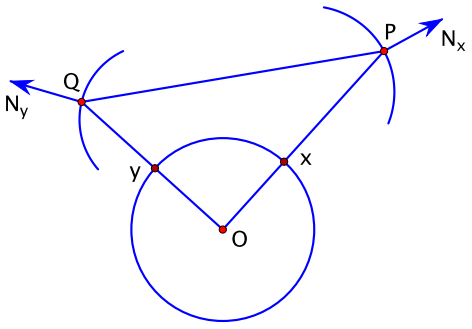
The central mechanism is representing each mirror as a smooth graph over the reference front: $P(x)=e^{f(x)}x$ in the spherical case and $P(x)=(x,f(x))$ in the reversed case. At the support point the mirror normal is $x-\nabla f(x)$ (respectively $(-\nabla f,1)$), and the incoming ray, outgoing ray, the segment joining the two mirror points, and both normals all lie in one plane. Coplanarity makes the projected normal point along the geodesic, and the sine rule together with the constancy of optical path length yields the displayed algebraic identities. A projectively gradient vector field is one proportional to a gradient; the coplanarity plus proportionality is what produces that condition on the induced map.
What would settle it
Ray-trace one explicit case numerically: choose, say, $f(x)=\varepsilon(1-e^{-x^2})$ in $\mathbb{R}^2$, pick $C>\max f$, build the second mirror from the reversed-periscope formula, then follow the vertical ray at a few values of $x$ through the two standard specular reflections. If any outgoing ray is not exactly vertical downward (up to numerical error), the reversed-periscope formula is wrong. The same test with the spherical formulas and $f(\theta)=\varepsilon\cos\theta$ checks the spherical theorem.
Extended reading notes
Core claim
For a spherical periscope, parameterizing the mirrors by radial functions $P(x)=e^{f(x)}x$ and $Q(y)=e^{g(y)}y$ on the unit sphere, the paper proves that the unit tangent vector $V_T(x)$ along the shortest geodesic from $x$ to $T(x)$ is projectively gradient (Theorem 1). It then derives (Theorem 2) explicit formulas: $e^g = \frac{e^{2f}-2Ce^f+C^2(1+|\nabla f|^2)}{C(1+|\nabla f|^2)-e^f}$ and $d(x,y)=\pi-2\arcsin\left(\frac{C|\nabla f|}{\sqrt{e^{2f}-2Ce^f+C^2(1+|\nabla f|^2)}}\right)$. For a reversed periscope, with mirrors given as graphs $z=f(x)$ and $z=g(y)$ over $\mathbb{R}^{n-1}$, it proves (Theorem 3) that $g = f - \frac{C(1-|\nabla f|^2)}{|\nabla f|^2}$ and $T(x) = x + \frac{2(C-f(x))}{|\nabla f(x)|^2}\nabla f(x)$, so the displacement field $U(x)=T(x)-x$ is again projectively gradient. The constant $C$ is the half optical path length, fixed by the condition that the optical path between the two wave fronts is the same for all rays.
Load-bearing premise
The derivation assumes each mirror is a smooth single-valued graph over the reference wave front (radial coordinate on the sphere, or height over a plane); any periscope requiring a vertical tangent or a fold is outside the formulas.
Editorial extensions
If this is right
- The second mirror is not an independent choice: after the first mirror is selected, the second mirror's function is forced up to the constant $C$.
- Any local map realized by a two-mirror spherical periscope must have a projective-gradient geodesic displacement, which is a restrictive, checkable signature.
- In the reversed case the same conclusion holds for the horizontal displacement, and the geometry forces $|\nabla f|<1$: the first mirror must be flatter than 45 degrees whenever the outgoing rays point exactly opposite the incoming ones.
- The two formulas give an explicit one-functional-parameter family of two-mirror systems, matching the dimension count in the introduction that a system of two mirrors depends on one function of $n-1$ variables.
Reading between the lines
- Editorial: The formulas can be read backward as a construction recipe: choose any smooth $f$ with $|\nabla f|<1$ and $C>\sup f$, define $g$ by the reversed-periscope formula, and the two graphs should form a reversed periscope. The paper proves the identities for an existing periscope but does not explicitly state this sufficiency claim.
- Editorial: In the spherical case, inverting the distance formula would turn the statement into a classification: the realizable maps are exactly those whose geodesic displacement is projectively gradient and whose associated constant matches the optical path length. That converse is left implicit.
- Editorial: Because the reversed-periscope map has the form $x+h(x)\nabla f(x)$, it sits next to gradient-flow and optimal-transport maps of the same shape; the reflection law may offer a geometric way to realize such maps with two mirrors.
Signed reviews
Editorial analysis
A structured set of objections, weighed in public.
Referee Report
Summary. The paper studies two mirror systems in geometric optics: a spherical periscope, in which rays from a fixed point O reflect from two mirrors and return to O, and a reversed periscope, in which rays of a fixed direction reflect to rays of the opposite direction. For the spherical case, the author proves that the induced map on the unit sphere has a projectively gradient geodesic tangent field (Theorem 1) and derives explicit formulas for the second mirror's radial function and the spherical distance in terms of the first mirror's radial function and an optical constant C (Theorem 2). For the reversed case, Theorem 3 gives formulas for the second mirror function and for the induced translation T(x)-x in terms of the first mirror function and C. The proofs use elementary triangle geometry, the reflection law, and constancy of optical path length.
Significance. If the reversed-periscope statement is corrected, the paper provides a clean, explicit local description of two-mirror systems that perform point-to-point and parallel-to-antiparallel ray mappings. The spherical part (Theorems 1 and 2) appears correct and is derived self-consistently, without fitting parameters; the constant C is the optical path length. The results should be of interest to researchers in geometrical optics and freeform optical design. However, the main reversed-periscope result contains a fixable algebraic error in the formula for g, so the paper requires a major revision before the theorem can be accepted as stated.
major comments (2)
- [§3, Eq. (7)] The formula for g is algebraically wrong. From the displayed equation f(1+cos 2α) - g(1 - cos 2α) = 2C cos 2α and t = |∇f| = tan α, one obtains f - t^2 g = C(1 - t^2), and therefore the correct relation is g = f/t^2 - C(1 - t^2)/t^2, i.e. g = f/|∇f|^2 - C(1 - |∇f|^2)/|∇f|^2. The printed formula g = f - C(1 - |∇f|^2)/|∇f|^2 omits the term f/|∇f|^2. Substituting the printed formula into equation (8) gives f - g = C(1 - t^2)/t^2 and hence U = 2C/|∇f|^2 ∇f, which is not the claimed U = 2(C - f)/|∇f|^2 ∇f. The claimed T(x) follows only from the corrected g. This error is load-bearing because Theorem 3 is the main reversed-periscope result.
- [Theorem 3 statement] The statement of Theorem 3 should specify the domain of the function g. As written, formula (7) appears to relate g and f as functions of the same variable, but the second mirror is a graph over y, g = g(y), while the right-hand side is evaluated at x. The correct interpretation is g(T(x)) = f(x)/|∇f(x)|^2 - C(1 - |∇f(x)|^2)/|∇f(x)|^2 (with the corrected algebra), or equivalently a formula for g(y) obtained by composing with the inverse of T. Without this clarification, the theorem cannot be read as an explicit construction of the second mirror, and the subsequent use of (7) to compute U is formally ambiguous.
minor comments (4)
- [Introduction] There is a typo in the introduction: 'symplectimorphic' should be 'symplectomorphic'.
- [§3, after Eq. (8)] The sentence 'Since point P is higher than point Q, we have |∇f| < 1' would be clearer if it explained that |∇f| < 1 is equivalent to the reflected ray at the first mirror having a negative vertical component, which is necessary for the ray to descend to the second mirror.
- [Lemma 2.3] The discussion of the extraneous root S1 assumes |∇f| and |∇g| are nonzero. A short limiting argument for the case |∇f| = |∇g| = 0 would make the selection of S2 fully rigorous.
- [Theorem 2] The formula for e^g contains the denominator C(1 + |∇f|^2) - e^f, but the paper does not discuss the admissible range of C and f that makes this denominator positive. A brief remark on the domain of validity would be helpful.
Circularity Check
No circularity: the periscope variations are derived from reflection geometry and optical-path-length constancy, with no fitted inputs or load-bearing self-citations.
full rationale
The paper's claimed derivation chain is self-contained. Theorem 1 obtains projective-gradient behavior from the coplanarity of x, y, PQ, Nx, Ny and from the explicit normal Nx = x - grad f(x); no input is assumed equivalent to the conclusion. Theorem 2 solves the spherical-periscope geometry using the sine and cosine rules in triangle OPQ together with the constancy of the optical path length (perimeter 2C); the constant C is a physical constant of the system, not a fitted parameter, and the formulas for e^g and d(x,y) are algebraic consequences, not restatements of the assumptions. Theorem 3 likewise starts from the explicit graph normals (-grad f, 1) and (-grad g, 1), reflection geometry, and the optical-path identity f + g + |PQ| = 2C; the derivation does not reduce to its input by construction. The only self-citation is reference [10], cited as background/inspiration for the periscope theorem, and it is not load-bearing: the new theorems are proved directly in the present paper. There is an apparent algebraic inconsistency in formula (7) relative to the paper's own preceding equation f(1 + cos 2alpha) - g(1 - cos 2alpha) = 2C cos 2alpha and to the subsequent T(x) formula, but that is a mathematical-correctness concern, not circularity; no claim is being renamed as a prediction, no fitted parameter is called a prediction, and no uniqueness result is imported from the authors' prior work to force the choice.
Assumptions & free parameters
free parameters (1)
- C =
arbitrary positive constant
assumptions (3)
- standard math Law of reflection: the angle of incidence equals the angle of reflection
- domain assumption Fermat's principle: the optical path length between two wave fronts is constant
- domain assumption Mirrors are smooth graphs: P(x) = e^{f(x)} x (spherical) and P(x) = (x, f(x)) (reversed)
Cite this review
Pith. "Pith review of Two variations on the periscope theorem." pith.science (2026). https://pith.science/paper/WBEXKAQF
@misc{pith2026190808359,
  author       = {Pith},
  title        = {Pith review of: Two variations on the periscope theorem},
  year         = {2026},
  howpublished = {\url{https://pith.science/paper/WBEXKAQF}},
  note         = {Machine review of arXiv:1908.08359}
}
read the original abstract
A spherical periscope in multi-dimensional space is a system of two ideal mirrors that reflect the rays emanating from a fixed point to the rays coming back to the same point, and a reversed periscope is a system of two mirrors that reflect the rays having a fixed direction to the rays having the opposite direction. We describe the local diffeomorphisms of the wave fronts (spherical, in the former, and flat, in the latter cases), induced by these 2-mirror systems.
Figures


Reference graph
Works this paper leans on
-
[1]
M. Born, E. Wolf. Principles of optics: Electromagnetic theory of prop- agation, interference and diffraction of light. Pergamon Press, Oxford- New York-Paris, 1965
work page 1965
- [2]
-
[3]
W. R. Hamilton. Theory of systems of rays. Trans. Royal Irish Acad. 15 (1828), 69–174
-
[4]
R. A. Hicks, C. Croke. Solution to the bundle-to-bundle mapping problem of geometric optics using four freeform reflectors . J. Opt. Soc. Am. A 31 (2014), 2097–2104
work page 2014
-
[5]
V. Kozlov. General theory of vortices. Dynamical systems. X. Springer- Verlag, Berlin, 2003
work page 2003
-
[6]
T. Levi-Civita. Complimenti al teorema di Malus-Dupin . Rend. Acc. Lincei, ser. 5a, vol. IX (1900), 185–189, 237–245
work page 1900
-
[7]
Ch.-M. Marle. The works of William Rowan Hamilton in geometrical optics and the Malus-Dupin theorem. Geometry of jets and fields, 177– 191, Banach Center Publ., 110, Polish Acad. Sci. Inst. Math., Warsaw, 2016
work page 2016
-
[8]
V. Oliker. Mathematical aspects of design of beam shaping surfaces in geometrical optics . In: Trends in Nonlinear Analysis, M. Kirkilionis, S. Kromker, R. Rannacher, and F. Tomi, eds., pp. 191-222. Springer- Verlag, Berlin, 2002
work page 2002
Show all 10 references
-
[9]
R. Perline. Geometry of thin films. J. Nonlinear Sci. 29 (2019), 621–642
2019
-
[10]
Plakhov, S
A. Plakhov, S. Tabachnikov, D. Treschev. Billiard transformations of parallel flows: a periscope theorem. J. Geom. Phys. 115 (2017), 157– 166. 10
2017
Reviewed August 14, 2026 · model on record in the stance chip above.
Discussion (0). Continue with ORCID to comment.