Slave-rotor theory of correlated altermagnets on the Lieb lattice
Pith reviewed 2026-06-29 05:10 UTC · model grok-4.3
The pith
Increasing onsite repulsion U in the altermagnetic Hubbard model on the Lieb lattice drives a sequence of phases ending in a Mott insulator with suppressed spin splitting.
A machine-rendered reading of the paper's core claim, the machinery that carries it, and where it could break.
Core claim
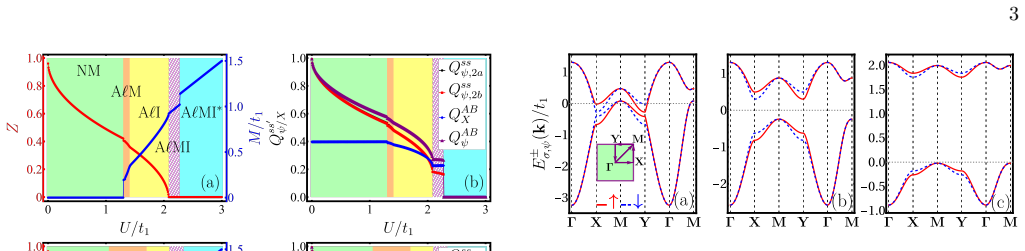
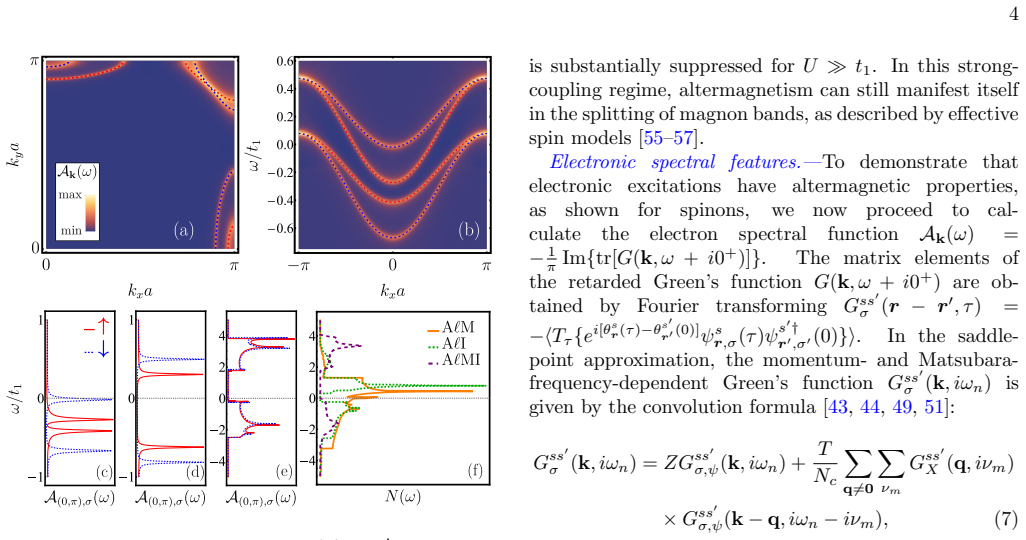
Using the slave-rotor approach at half filling, we find that the system exhibits a cascade of interaction-driven phase transitions. As U increases, the system evolves from a normal metal to an altermagnetic metal, then to an altermagnetic insulator, and eventually to an altermagnetic Mott insulator characterized by the complete suppression of the quasiparticle weight. These phases are supported by the calculation of the electronic spectral function, which features spin-split bands in both the metallic and insulating regimes. However, the spin splitting becomes substantially suppressed in the Mott insulating phase.
What carries the argument
Slave-rotor decoupling of the altermagnetic Hubbard model on the Lieb lattice, used to obtain the interaction-driven phase sequence and the momentum-resolved spectral functions.
If this is right
- The half-filled system passes through four distinct phases as U is increased: normal metal, altermagnetic metal, altermagnetic insulator, and altermagnetic Mott insulator.
- Spin-split bands appear in the spectral function throughout the metallic and band-insulating regimes.
- In the Mott insulator the quasiparticle weight vanishes while altermagnetic order persists but with strongly reduced spin splitting.
- Clear experimental detection of altermagnetic spin splitting is therefore expected only for weak-to-moderate values of U.
Where Pith is reading between the lines
- The suppression of splitting at strong coupling suggests that altermagnetic signatures may be harder to detect in highly correlated materials than in weakly correlated ones.
- The same slave-rotor treatment could be applied at finite doping to check whether carrier density revives the splitting inside the Mott phase.
- Comparison with other mean-field or quantum Monte Carlo methods on the same Lieb-lattice model would test how sensitive the reported suppression is to the choice of decoupling scheme.
Load-bearing premise
The slave-rotor decoupling remains quantitatively reliable for capturing both the altermagnetic order and the metal-insulator transition across the full range of U in this half-filled Lieb-lattice model.
What would settle it
A direct computation or measurement of the spectral function deep in the strong-U Mott regime that shows unsuppressed spin splitting instead of the reported suppression would falsify the central phase-sequence claim.
Figures

read the original abstract
We investigate the metal-insulator transition driven by the onsite repulsive interaction $U$ in an altermagnetic Hubbard model defined on a Lieb lattice. Using the slave-rotor approach at half filling, we find that the system exhibits a cascade of interaction-driven phase transitions. As $U$ increases, the system evolves from a normal metal to an altermagnetic metal, then to an altermagnetic insulator, and eventually to an altermagnetic Mott insulator characterized by the complete suppression of the quasiparticle weight. These phases are supported by the calculation of the electronic spectral function, which features spin-split bands in both the metallic and insulating regimes. However, the spin splitting becomes substantially suppressed in the Mott insulating phase. Our results suggest that the observation of spin splitting in the spectral function of $d$-wave altermagnets with a Lieb-lattice-like structure may be limited to the weak-to-moderate correlation regime.
Editorial analysis
A structured set of objections, weighed in public.
Referee Report
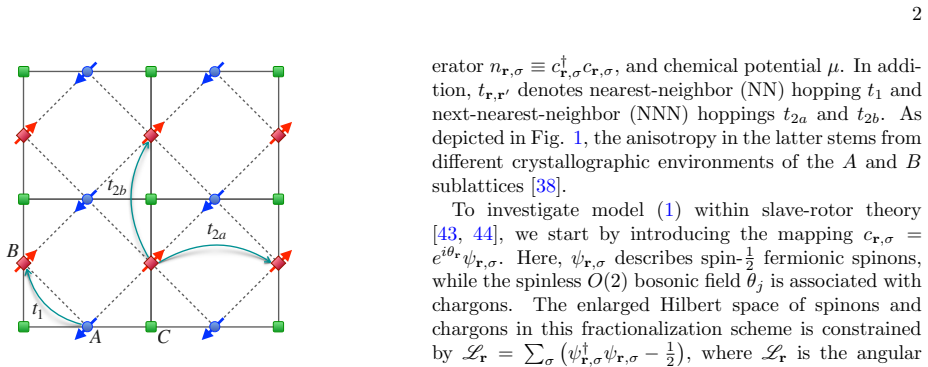
Summary. The manuscript studies the onsite-U driven metal-insulator transition in a half-filled altermagnetic Hubbard model on the Lieb lattice. Employing the slave-rotor mean-field decoupling, it reports a sequence of phases with increasing U: normal metal, altermagnetic metal, altermagnetic insulator, and finally an altermagnetic Mott insulator in which the quasiparticle weight vanishes and spin splitting in the spectral function is strongly suppressed. The electronic spectral function is computed to support the spin-split bands in the metallic and band-insulating regimes.
Significance. If the slave-rotor saddle point remains quantitatively reliable across the full interaction range, the work supplies a concrete prediction for the correlation regime in which momentum-dependent spin splitting remains visible in d-wave altermagnets with Lieb-lattice geometry, thereby narrowing the window for experimental detection of altermagnetic signatures.
major comments (2)
- [Abstract, §3] Abstract and §3 (spectral-function results): the reported phase sequence and the suppression of spin splitting in the Mott phase rest entirely on the slave-rotor decoupling; no comparison to DMFT, exact diagonalization on finite clusters, or the U=0 limit is provided to benchmark the location of the metal-insulator transition or the magnitude of the altermagnetic order parameter.
- [§2] §2 (model and decoupling): the Lieb lattice possesses a flat band at half filling; the mean-field treatment neglects fluctuation corrections that are known to be enhanced by flat-band physics, yet no estimate of the size of these corrections or self-consistency check against the rotor constraint is given.
minor comments (2)
- [Figures] Figure captions should explicitly state the value of the altermagnetic order parameter used for each panel and the broadening employed in the spectral-function plots.
- [§2] Notation for the rotor field and the spinon dispersion should be introduced once in §2 and used consistently thereafter.
Simulated Author's Rebuttal
We thank the referee for their careful reading and constructive comments on our manuscript. We provide point-by-point responses to the major comments below.
read point-by-point responses
-
Referee: [Abstract, §3] Abstract and §3 (spectral-function results): the reported phase sequence and the suppression of spin splitting in the Mott phase rest entirely on the slave-rotor decoupling; no comparison to DMFT, exact diagonalization on finite clusters, or the U=0 limit is provided to benchmark the location of the metal-insulator transition or the magnitude of the altermagnetic order parameter.
Authors: We agree that benchmarking strengthens the results. In the revised version we will explicitly compare the altermagnetic order parameter and the location of the metal-insulator transition against the exactly solvable U=0 limit. Full DMFT or exact-diagonalization benchmarks on the Lieb lattice lie outside the scope of the present slave-rotor study; we will add a paragraph discussing the known limitations of the saddle-point approximation and the expected direction of corrections. revision: partial
-
Referee: [§2] §2 (model and decoupling): the Lieb lattice possesses a flat band at half filling; the mean-field treatment neglects fluctuation corrections that are known to be enhanced by flat-band physics, yet no estimate of the size of these corrections or self-consistency check against the rotor constraint is given.
Authors: The flat band is indeed present and can enhance fluctuations. Our implementation already enforces the rotor constraint self-consistently at the saddle point; we will add an explicit statement of this self-consistency condition in §2. A quantitative estimate of fluctuation corrections would require a beyond-mean-field treatment (e.g., gauge-field fluctuations), which is beyond the present work. We will include a short discussion of this limitation and cite relevant flat-band literature. revision: partial
Circularity Check
No circularity: standard slave-rotor saddle-point yields computed phases
full rationale
The derivation applies the slave-rotor decoupling to the half-filled Hubbard model on the Lieb lattice and solves the resulting saddle-point equations for the rotor condensate and spinon bands. The reported sequence (normal metal → altermagnetic metal → altermagnetic insulator → Mott insulator) and the spectral functions are outputs of those equations rather than inputs or self-definitions. No parameter is fitted to a subset of the target data and then relabeled as a prediction, no uniqueness theorem is imported from the authors' prior work, and no ansatz is smuggled via self-citation. The method is a conventional mean-field treatment whose quantitative reliability is an external modeling assumption, not a circular reduction inside the paper.
Axiom & Free-Parameter Ledger
axioms (1)
- domain assumption The slave-rotor representation accurately decouples charge and spin degrees of freedom for the half-filled Hubbard model with altermagnetic order on the Lieb lattice.
Reference graph
Works this paper leans on
-
[1]
L. D. Landau, E. M. Lifshitz, and L. P. Pitaevski˘ ı,Sta- tistical Physics, Part 2: Theory of the Condensed State, Vol. 9 (Pergamon Press, Oxford, 1980)
1980
-
[2]
N. W. Ashcroft and N. D. Mermin,Solid State Physics (Saunders College Publishing, Philadelphia, 1976)
1976
-
[3]
Hayami, Y
S. Hayami, Y. Yanagi, and H. Kusunose, Momentum- Dependent Spin Splitting by Collinear Antiferromagnetic Ordering, J. Phys. Soc. Jpn.88, 123702 (2019)
2019
-
[4]
ˇSmejkal, J
L. ˇSmejkal, J. Sinova, and T. Jungwirth, Beyond Con- ventional Ferromagnetism and Antiferromagnetism: A Phase with Nonrelativistic Spin and Crystal Rotation Symmetry, Phys. Rev. X12, 031042 (2022)
2022
-
[5]
ˇSmejkal, J
L. ˇSmejkal, J. Sinova, and T. Jungwirth, Emerging Re- search Landscape of Altermagnetism, Phys. Rev. X12, 040501 (2022)
2022
-
[6]
Turek, Altermagnetism and magnetic groups with pseudoscalar electron spin, Phys
I. Turek, Altermagnetism and magnetic groups with pseudoscalar electron spin, Phys. Rev. B106, 094432 (2022)
2022
-
[7]
T. Jungwirth, R. M. Fernandes, J. Sinova, and L. ˇSmejkal, Altermagnets and beyond: Nodal magnetically-ordered phases, arXiv:2409.10034 (2024)
-
[8]
Jungwirth, R
T. Jungwirth, R. M. Fernandes, E. Fradkin, A. H. Mac- Donald, J. Sinova, and L. ˇSmejkal, Altermagnetism: An unconventional spin-ordered phase of matter, Newton1, 100162 (2025)
2025
-
[9]
Jungwirth, J
T. Jungwirth, J. Sinova, R. M. Fernandes, Q. Liu, H. Watanabe, S. Murakami, S. Nakatsuji, and L. ˇSmejkal, Symmetry, microscopy and spectroscopy sig- natures of altermagnetism, Nature649, 837 (2026)
2026
-
[10]
R. M. Fernandes, V. S. de Carvalho, T. Birol, and R. G. Pereira, Topological transition from nodal to node- less Zeeman splitting in altermagnets, Phys. Rev. B109, 024404 (2024)
2024
-
[11]
M. Roig, A. Kreisel, Y. Yu, B. M. Andersen, and D. F. Agterberg, Minimal models for altermagnetism, Phys. Rev. B110, 144412 (2024)
2024
-
[12]
Reimers, L
S. Reimers, L. Odenbreit, Lukas ˇSmejkal, V. N. Strocov, P. Constantinou, A. B. Hellenes, R. Jaeschke Ubiergo, W. H. Campos, V. K. Bharadwaj, A. Chakraborty, T. Denneulin, W. Shi, R. E. Dunin-Borkowski, S. Das, M. Kl¨ aui, J. Sinova, and M. Jourdan, Direct observation of altermagnetic band splitting in CrSb thin films, Nat. Commun.15, 2116 (2024)
2024
-
[13]
J. Ding, Z. Jiang, X. Chen, Z. Tao, Z. Liu, T. Li, J. Liu, J. Sun, J. Cheng, J. Liu, Y. Yang, R. Zhang, L. Deng, W. Jing, Y. Huang, Y. Shi, M. Ye, S. Qiao, Y. Wang, Y. Guo, D. Feng, and D. Shen, Large Band Splitting in g-Wave Altermagnet CrSb, Phys. Rev. Lett.133, 206401 (2024)
2024
-
[14]
Zeng, M.-Y
M. Zeng, M.-Y. Zhu, Y.-P. Zhu, X.-R. Liu, X.-M. Ma, Y.- J. Hao, P. Liu, G. Qu, Y. Yang, Z. Jiang, K. Yamagami, M. Arita, X. Zhang, T.-H. Shao, Y. Dai, K. Shimada, Z. Liu, M. Ye, Y. Huang, Q. Liu, and C. Liu, Obser- vation of Spin Splitting in Room-Temperature Metallic Antiferromagnet CrSb, Adv. Sci.11, 2406529 (2024)
2024
-
[15]
C. Li, M. Hu, Z. Li, Y. Wang, W. Chen, B. Thia- garajan, M. Leandersson, C. Polley, T. Kim, H. Liu, C. Fulga, M. G. Vergniory, O. Janson, O. Tjernberg, and J. van den Brink, Topological Weyl altermagnetism in CrSb, Commun. Phys.8, 311 (2025)
2025
-
[16]
R. D. Gonzalez Betancourt, J. Zub´ aˇ c, R. Gonzalez- Hernandez, K. Geishendorf, Z. ˇSob´ aˇ n, G. Springholz, K. Olejn´ ık, L.ˇSmejkal, J. Sinova, T. Jungwirth, S. T. B. Goennenwein, A. Thomas, H. Reichlov´ a, J.ˇZelezn´ y, and D. Kriegner, Spontaneous Anomalous Hall Effect Arising from an Unconventional Compensated Magnetic Phase in a Semiconductor, Phy...
2023
-
[17]
S. Lee, S. Lee, S. Jung, J. Jung, D. Kim, Y. Lee, B. Seok, J. Kim, B. G. Park, L. ˇSmejkal, C.-J. Kang, and C. Kim, Broken Kramers Degeneracy in Altermagnetic MnTe, Phys. Rev. Lett.132, 036702 (2024)
2024
-
[18]
Osumi, S
T. Osumi, S. Souma, T. Aoyama, K. Yamauchi, A. Honma, K. Nakayama, T. Takahashi, K. Ohgushi, and T. Sato, Observation of a giant band splitting in altermagnetic MnTe, Phys. Rev. B109, 115102 (2024)
2024
-
[19]
Krempask´ y, L
J. Krempask´ y, L. ˇSmejkal, S. W. D ′Souza, M. Ha- jlaoui, G. Springholz, K. Uhl´ ıˇ rv´ a, F. Alarab, P. C. Constantinou, V. Strocov, W. R. Usanov, D. Pudelko, R. Gonz´ alez-Hern´ andez, A. Birk Hellenes, Z. Jansa, H. Reichlov´ a, Z. ˇSob´ aˇ n, R. D. Gonzalez Betancourt, P. Wadley, J. Sinova, D. Kriegner, J. Min´ ar, J. H. Dil, 6 and T. Jungwirth, Alte...
2024
-
[20]
O. J. Amin, A. Dal Din, E. Golias, Y. Niu, A. Za- kharov, S. C. Fromage, C. J. B. Fields, S. L. Heywood, R. B. Cousins, F. Maccherozzi, J. Krempask´ y, J. H. Dil, D. Kriegner, B. Kiraly, R. P. Campion, A. W. Rushforth, K. W. Edmonds, S. S. Dhesi, L. ˇSmejkal, T. Jungwirth, and P. Wadley, Nanoscale imaging and control of alter- magnetism in MnTe, Nature636...
2024
-
[21]
G. Yang, Z. Li, S. Yang, J. Li, H. Zheng, W. Zhu, Z. Pan, Y. Xu, S. Cao, W. Zhao, A. Jana, J. Zhang, M. Ye, Y. Song, L.-H. Hu, L. Yang, J. Fujii, I. Vobornik, M. Shi, H. Yuan, Y. Zhang, Y. Xu, and Y. Liu, Three- dimensional mapping of the altermagnetic spin splitting in CrSb, Nat. Commun.16, 1442 (2025)
2025
-
[22]
Y. Guo, H. Liu, O. Janson, I. C. Fulga, J. van den Brink, and J. I. Facio, Spin-split collinear antiferromag- nets: A large-scale ab-initio study, Mater. Today Phys. 32, 100991 (2023)
2023
-
[23]
Z. Xiao, J. Zhao, Y. Li, R. Shindou, and Z.-D. Song, Spin Space Groups: Full Classification and Applications, Phys. Rev. X14, 031037 (2024)
2024
-
[24]
Z.-F. Gao, S. Qu, B. Zeng, Y. Liu, J.-R. Wen, H. Sun, P.- J. Guo, and Z.-Y. Lu, AI-accelerated discovery of alter- magnetic materials, Natl. Sci. Rev.12, nwaf066 (2025)
2025
-
[25]
K.-H. Ahn, A. Hariki, K.-W. Lee, and J. Kuneˇ s, Anti- ferromagnetism in RuO 2 asd-wave Pomeranchuk insta- bility, Phys. Rev. B99, 184432 (2019)
2019
-
[26]
ˇSmejkal, R
L. ˇSmejkal, R. Gonz´ alez-Hern´ andez, T. Jungwirth, and J. Sinova, Crystal time-reversal symmetry breaking and spontaneous Hall effect in collinear antiferromagnets, Sci. Adv.6, eaaz8809 (2020)
2020
-
[27]
Jiang, M
B. Jiang, M. Hu, J. Bai, Z. Song, C. Mu, G. Qu, W. Li, W. Zhu, H. Pi, Z. Wei, Y.-J. Sun, Y. Huang, X. Zheng, Y. Peng, L. He, S. Li, J. Luo, Z. Li, G. Chen, H. Li, H. Weng, and T. Qian, A metallic room-temperature d-wave altermagnet, Nat. Phys.21, 754 (2025)
2025
-
[28]
Z. Feng, X. Zhou, L. ˇSmejkal, L. Wu, Z. Zhu, H. Guo, R. Gonz´ alez-Hern´ andez, X. Wang, H. Yan, P. Qin, X. Zhang, H. Wu, H. Chen, Z. Meng, L. Liu, Z. Xia, J. Sinova, T. Jungwirth, and Z. Liu, An anomalous Hall effect in altermagnetic ruthenium dioxide, Nat. Electron. 5, 735 (2022)
2022
-
[29]
H. Bai, L. Han, X. Y. Feng, Y. J. Zhou, R. X. Su, Q. Wang, L. Y. Liao, W. X. Zhu, X. Z. Chen, F. Pan, X. L. Fan, and C. Song, Observation of Spin Splitting Torque in a Collinear Antiferromagnet RuO2, Phys. Rev. Lett.128, 197202 (2022)
2022
-
[30]
Karube, T
S. Karube, T. Tanaka, D. Sugawara, N. Kadoguchi, M. Kohda, and J. Nitta, Observation of Spin-Splitter Torque in Collinear Antiferromagnetic RuO2, Phys. Rev. Lett.129, 137201 (2022)
2022
-
[31]
A. Bose, N. J. Schreiber, R. Jain, D.-F. Shao, H. P. Nair, J. Sun, X. S. Zhang, D. A. Muller, E. Y. Tsymbal, D. G. Schlom, and D. C. Ralph, Tilted spin current generated by the collinear antiferromagnet ruthenium dioxide, Nat. Electron.5, 267 (2022)
2022
-
[32]
H. Bai, Y. C. Zhang, Y. J. Zhou, P. Chen, C. H. Wan, L. Han, W. X. Zhu, S. X. Liang, Y. C. Su, X. F. Han, F. Pan, and C. Song, Efficient Spin-to-Charge Conver- sion via Altermagnetic Spin Splitting Effect in Antifer- romagnet RuO2, Phys. Rev. Lett.130, 216701 (2023)
2023
-
[33]
Hiraishi, H
M. Hiraishi, H. Okabe, A. Koda, R. Kadono, T. Muroi, D. Hirai, and Z. Hiroi, Nonmagnetic Ground State in RuO2 Revealed by Muon Spin Rotation, Phys. Rev. Lett. 132, 166702 (2024)
2024
-
[34]
Keßler, L
P. Keßler, L. Garcia-Gassull, A. Suter, T. Prokscha, Z. Salman, D. Khalyavin, P. Manuel, F. Orlandi, I. I. Mazin, R. Valent´ ı, and S. Moser, Absence of magnetic order in RuO2: insights fromµSR spectroscopy and neu- tron diffraction, npj Spintronics2, 50 (2024)
2024
-
[35]
C.-C. Wei, X. Li, S. Hatt, X. Huai, J. Liu, B. Singh, K.-M. Kim, R. M. Fernandes, P. Cardon, L. Zhao, T. T. Tran, B. A. Frandsen, K. S. Burch, F. Liu, and H. Ji, La2O3Mn2Se2: A correlated insulating layered d-wave altermagnet, Phys. Rev. Mater.9, 024402 (2025)
2025
-
[36]
Zhang, X
F. Zhang, X. Cheng, Z. Yin, C. Liu, L. Deng, Y. Qiao, Z. Shi, S. Zhang, J. Lin, Z. Liu, M. Ye, Y. Huang, X. Meng, C. Zhang, T. Okuda, K. Shimada, S. Cui, Y. Zhao, G.-H. Cao, S. Qiao, J. Liu, and C. Chen, Crystal-symmetry-paired spin-valley locking in a layered room-temperature metallic altermagnet candidate, Nat. Phys.21, 760 (2025)
2025
- [37]
-
[38]
D. S. Antonenko, R. M. Fernandes, and J. W. F. Vender- bos, Mirror Chern Bands and Weyl Nodal Loops in Al- termagnets, Phys. Rev. Lett.134, 096703 (2025)
2025
-
[39]
P. Das, V. Leeb, J. Knolle, and M. Knap, Realizing Al- termagnetism in Fermi-Hubbard Models with Ultracold Atoms, Phys. Rev. Lett.132, 263402 (2024)
2024
-
[40]
D¨ urrnagel, H
M. D¨ urrnagel, H. Hohmann, A. Maity, J. Seufert, M. Klett, L. Klebl, and R. Thomale, Altermagnetic Phase Transition in a Lieb Metal, Phys. Rev. Lett.135, 036502 (2025)
2025
-
[41]
Kaushal and M
N. Kaushal and M. Franz, Altermagnetism in Modi- fied Lieb Lattice Hubbard Model, Phys. Rev. Lett.135, 156502 (2025)
2025
-
[42]
I. Park, T. Birol, A. Georges, and R. M. Fernandes, Impact of strong electronic correlations on altermagnets: The case of NiS 2, Phys. Rev. Mater.10, 054415 (2026)
2026
-
[43]
Florens and A
S. Florens and A. Georges, Quantum impurity solvers us- ing a slave rotor representation, Phys. Rev. B66, 165111 (2002)
2002
-
[44]
Florens and A
S. Florens and A. Georges, Slave-rotor mean-field theo- ries of strongly correlated systems and the Mott transi- tion in finite dimensions, Phys. Rev. B70, 035114 (2004)
2004
-
[45]
Lee and P
S.-S. Lee and P. A. Lee, U(1) Gauge Theory of the Hub- bard Model: Spin Liquid States and Possible Applica- tion toκ−(BEDT−TTF) 2Cu2(CN)3, Phys. Rev. Lett. 95, 036403 (2005)
2005
-
[46]
Pesin and L
D. Pesin and L. Balents, Mott physics and band topology in materials with strong spin-orbit interaction, Nat. Phys. 6, 376 (2010)
2010
-
[47]
Ko and P
W.-H. Ko and P. A. Lee, Magnetism and Mott transition: A slave-rotor study, Phys. Rev. B83, 134515 (2011)
2011
-
[48]
Huang, Y.-P
S.-M. Huang, Y.-P. Huang, and T.-K. Lee, Slave-rotor theory on magic-angle twisted bilayer graphene, Phys. Rev. B101, 235140 (2020)
2020
-
[49]
He and P
W.-Y. He and P. A. Lee, Magnetic impurity as a local probe of theU(1) quantum spin liquid with spinon Fermi surface, Phys. Rev. B105, 195156 (2022)
2022
-
[50]
Z. Song, U. F. P. Seifert, Z.-X. Luo, and L. Balents, Mott insulators in moir´ e transition metal dichalcogenides at fractional fillings: Slave-rotor mean-field theory, Phys. Rev. B108, 155109 (2023)
2023
-
[51]
Wagner, D
N. Wagner, D. Guerci, A. J. Millis, and G. Sangiovanni, 7 Edge Zeros and Boundary Spinons in Topological Mott Insulators, Phys. Rev. Lett.133, 126504 (2024)
2024
-
[52]
See Supplemental Material at [URL will be inserted by publisher] for further information on the self-consistent equations and the spectral function of the altermagnetic Lieb Hubbard model derived within the slave-rotor the- ory
-
[53]
For instance, this occurs forδ= 0.2, as evidenced by the small kink observed in the order parameters within the AℓM region in Figs
When the anisotropy of the NNN hoppings is small, we find that the increase of the onsite repulsionUinduces a Lifshitz transition [77], in which half of the Fermi pock- ets located along the crystallographic axes disappear. For instance, this occurs forδ= 0.2, as evidenced by the small kink observed in the order parameters within the AℓM region in Figs. 2...
-
[54]
Imada, A
M. Imada, A. Fujimori, and Y. Tokura, Metal-insulator transitions, Rev. Mod. Phys.70, 1039 (1998)
1998
-
[55]
ˇSmejkal, A
L. ˇSmejkal, A. Marmodoro, K.-H. Ahn, R. Gonz´ alez- Hern´ andez, I. Turek, S. Mankovsky, H. Ebert, S. W. D’Souza, O. c. v. ˇSipr, J. Sinova, and T. c. v. Jungwirth, Chiral Magnons in Altermagnetic RuO2, Phys. Rev. Lett. 131, 256703 (2023)
2023
-
[56]
X. Zhu, X. Huo, S. Feng, S.-B. Zhang, S. A. Yang, and H. Guo, Design of altermagnetic models from spin clus- ters, Phys. Rev. Lett.134, 166701 (2025)
2025
-
[57]
P. M. Cˆ onsoli and M. Vojta, SU(N) Altermagnetism: Lattice Models, Magnon Modes, and Flavor-Split Bands, Phys. Rev. Lett.134, 196701 (2025)
2025
-
[58]
J. A. Sobral, S. Mandal, and M. S. Scheurer, Fractional- ized altermagnets: From neighboring and altermagnetic spin liquids to spin-symmetric band splitting, Phys. Rev. Res.7, 023152 (2025)
2025
-
[59]
Daghofer, K
M. Daghofer, K. Wohlfeld, and J. van den Brink, Alter- magnetic polarons: The fate of altermagnetic band split- tings at strong coupling, Phys. Rev. Lett.136, 146502 (2026)
2026
-
[60]
Theory of Angle Resolved Photoemission Spectroscopy of Altermagnetic Mott Insulators
L. Lanzini, P. Das, and M. Knap, Theory of Angle Resolved Photoemission Spectroscopy of Altermagnetic Mott Insulators, arXiv:2506.03263 (2026)
work page internal anchor Pith review Pith/arXiv arXiv 2026
-
[61]
Lebrat, A
M. Lebrat, A. Kale, L. H. Kendrick, M. Xu, Y. Gang, A. Nikolaenko, P. M. Bonetti, S. Sachdev, and M. Greiner, Ferrimagnetism of ultracold fermions in a multiband Hubbard system, Science392, 612 (2026)
2026
- [62]
-
[63]
J. A. Ouassou, A. Brataas, and J. Linder, dc Joseph- son Effect in Altermagnets, Phys. Rev. Lett.131, 076003 (2023)
2023
-
[64]
C. Sun, A. Brataas, and J. Linder, Andreev reflection in altermagnets, Phys. Rev. B108, 054511 (2023)
2023
-
[65]
Zhang, L.-H
S.-B. Zhang, L.-H. Hu, and T. Neupert, Finite- momentum Cooper pairing in proximitized altermagnets, Nat. Commun.15, 1801 (2024)
2024
-
[66]
Zhu, Z.-Y
D. Zhu, Z.-Y. Zhuang, Z. Wu, and Z. Yan, Topologi- cal superconductivity in two-dimensional altermagnetic metals, Phys. Rev. B108, 184505 (2023)
2023
-
[67]
Brekke, A
B. Brekke, A. Brataas, and A. Sudbø, Two-dimensional altermagnets: Superconductivity in a minimal micro- scopic model, Phys. Rev. B108, 224421 (2023)
2023
-
[68]
Chakraborty and A
D. Chakraborty and A. M. Black-Schaffer, Zero-field finite-momentum and field-induced superconductivity in altermagnets, Phys. Rev. B110, L060508 (2024)
2024
-
[69]
V. S. de Carvalho and H. Freire, Unconventional super- conductivity in altermagnets with spin-orbit coupling, Phys. Rev. B110, L220503 (2024)
2024
-
[70]
Banerjee and M
S. Banerjee and M. S. Scheurer, Altermagnetic supercon- ducting diode effect, Phys. Rev. B110, 024503 (2024)
2024
-
[71]
Chakraborty and A
D. Chakraborty and A. M. Black-Schaffer, Constraints on superconducting pairing in altermagnets, Phys. Rev. B112, 014516 (2025)
2025
-
[72]
S. Hong, M. J. Park, and K.-M. Kim, Unconventional p-wave and finite-momentum superconductivity induced by altermagnetism through the formation of Bogoliubov Fermi surface, Phys. Rev. B111, 054501 (2025)
2025
-
[73]
Sim and J
G. Sim and J. Knolle, Pair density waves and super- current diode effect in altermagnets, Phys. Rev. B112, L020502 (2025)
2025
-
[74]
L. V. Pupim and M. S. Scheurer, Adatom Engineer- ing Magnetic Order in Superconductors: Applications to Altermagnetic Superconductivity, Phys. Rev. Lett.134, 146001 (2025)
2025
-
[75]
Parthenios, P
N. Parthenios, P. M. Bonetti, R. Gonz´ alez-Hern´ andez, W. H. Campos, L. ˇSmejkal, and L. Classen, Spin and pair density waves in two-dimensional altermagnetic metals, Phys. Rev. B112, 214410 (2025)
2025
-
[76]
Y.-M. Wu, Y. Wang, and R. M. Fernandes, Intra-Unit- Cell Singlet Pairing Mediated by Altermagnetic Fluctu- ations, Phys. Rev. Lett.135, 156001 (2025)
2025
-
[77]
Slave-rotor theory of correlated altermagnets on the Lieb lattice
I. M. Lifshitz, Anomalies of Electron Characteristics of a Metal in the High Pressure Region, JETP11, 1130 (1959). Supplemental Material: “Slave-rotor theory of correlated altermagnets on the Lieb lattice” Vanuildo S. de Carvalho ID ,1,∗ Hermann Freire ID ,1 and Rodrigo G. Pereira ID 2 1Instituto de F´ ısica, Universidade Federal de Goi´ as, 74.690-900, G...
1959
discussion (0)
Sign in with ORCID, Apple, or X to comment. Anyone can read and Pith papers without signing in.