On the Complexity of the Circuit Width Problem
Pith reviewed 2026-06-26 21:44 UTC · model grok-4.3
The pith
Deciding whether a degree-three polynomial has circuit width at most k is NP-complete.
A machine-rendered reading of the paper's core claim, the machinery that carries it, and where it could break.
Core claim
For degree-three polynomials with no constant term, deciding whether w(f) ≤ k is NP-complete. The same holds for approximation within any factor 49/48 - ε. Both the exact and approximation hardness carry over to degree-two polynomials by a twin-copy construction. Under the Exponential Time Hypothesis the exact problem admits no 2^{o(n)}-time algorithm when k = Θ(n). There is a nondeterministic polynomial-time search algorithm using 2 log2 binom(n,k) = O(k log(en/k)) witness bits, and a constructive fixed-parameter algorithm parameterized by k that runs in time k^{6k+o(k)} n + O(m).
What carries the argument
The circuit width w(f), defined as the minimum number of qubits in any circuit over H, Z, CZ, CCZ realizing the polynomial f as the normalized gap.
If this is right
- Approximating circuit width to within any factor better than 49/48 - ε is NP-hard.
- Under the Exponential Time Hypothesis, no 2^{o(n)}-time algorithm exists for the exact decision problem when k = Θ(n).
- The minimum width can be searched nondeterministically in polynomial time using only O(k log(en/k)) witness bits.
- The problem is fixed-parameter tractable in k with running time k^{6k+o(k)} n + O(m).
Where Pith is reading between the lines
- The hardness suggests that combinatorial characterizations of BQP via width minimization are unlikely to be efficient.
- The twin-copy reduction may allow similar width parameters to be studied in other algebraic or combinatorial settings beyond the original gate set.
- The nondeterministic and FPT algorithms indicate that the problem remains tractable in restricted regimes even though it is NP-complete in general.
Load-bearing premise
Montanaro's representation theorem correctly expresses circuit amplitudes as normalized gaps of degree-three polynomials whose normalization factor is exactly the minimum realizing width w(f).
What would settle it
A deterministic polynomial-time algorithm that decides whether w(f) ≤ k for arbitrary degree-three polynomials with no constant term.
Figures
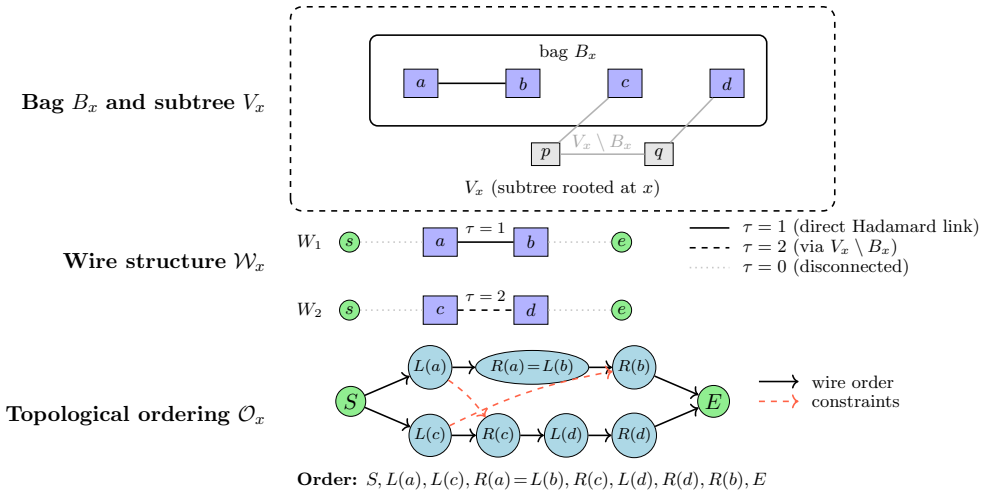
read the original abstract
Montanaro's polynomial representation expresses amplitudes of quantum circuits over the gates $H$, $Z$, $CZ$, and $CCZ$ as normalized gaps of degree-three polynomials over $\mathbb{F}_2$. The normalization is governed by the circuit width $w(f)$, the minimum number of qubits in any circuit realizing a polynomial $f$. Thus, efficient width minimization would give an approximate-counting route toward a combinatorial characterization of $BQP$. We study the computational complexity of this parameter. For degree-three polynomials with no constant term, deciding whether $w(f)\le k$ is $NP$-complete, resolving Montanaro's open question. We also prove $NP$-hardness of approximation within any factor $49/48-\epsilon$, and show via a twin-copy construction that the exact and approximation hardness results also hold for degree-two polynomials. Under the Exponential Time Hypothesis, the exact problem admits no $2^{o(n)}$-time algorithm when $k=\Theta(n)$. Complementing these hardness results, we give a nondeterministic polynomial-time search algorithm using $2\log_2\binom{n}{k}=O(k\log(en/k))$ witness bits, and a constructive fixed-parameter algorithm parameterized by $k$ with running time $k^{6k+o(k)}n+O(m)$.
Editorial analysis
A structured set of objections, weighed in public.
Referee Report
Summary. The paper studies the circuit width w(f), defined as the minimum number of qubits realizing a polynomial f via Montanaro's representation of amplitudes for circuits over H, Z, CZ, CCZ gates as normalized gaps of degree-3 polynomials over F_2. It proves that deciding w(f) ≤ k is NP-complete for degree-3 polynomials with no constant term (resolving Montanaro's open question), shows NP-hardness of approximation to within any factor 49/48−ε, extends both results to degree-2 polynomials via a twin-copy construction, establishes an ETH-based lower bound of no 2^{o(n)}-time algorithm for k=Θ(n), and supplies a nondeterministic search algorithm using O(k log n) witness bits together with an FPT algorithm running in k^{6k+o(k)}n + O(m) time.
Significance. If the reductions and algorithms are correct, the results give the first complexity classification of the width parameter central to Montanaro's approach toward a combinatorial view of BQP. The exact NP-completeness, inapproximability threshold, ETH lower bound, and the unusually small witness size O(k log n) are all load-bearing contributions; the FPT runtime, while not practical, is a standard positive counterpart to the hardness side.
minor comments (4)
- [§2] §2 (Preliminaries): the precise statement of Montanaro's representation theorem (including the exact normalization factor relating the gap to the amplitude) should be restated verbatim before the complexity results, as it is invoked in every reduction.
- [§4] Theorem 1.1 and the twin-copy construction in §4: the degree-2 case is obtained by a product construction; a short paragraph explaining why the width of the product is exactly twice the original width would remove any ambiguity about the reduction preserving the parameter k.
- [§5] The FPT algorithm in §5: the exponent 6k appears without an explicit derivation of the polynomial degree or the branching factor; adding a one-sentence reference to the underlying bounded-search-tree analysis would improve readability.
- [Abstract / §1] Notation: the symbol m (number of monomials) is used in the FPT runtime but never defined in the abstract or introduction; a parenthetical definition on first use would help.
Simulated Author's Rebuttal
We thank the referee for their positive summary, recognition of the significance of the results, and recommendation of minor revision. We are pleased that the contributions on NP-completeness, inapproximability, ETH bounds, and the FPT algorithm are viewed as load-bearing.
Circularity Check
No significant circularity; derivation is self-contained via external reductions
full rationale
The paper proves NP-completeness of deciding w(f) ≤ k for degree-3 no-constant-term polynomials by reduction from known NP-complete problems (standard Karp-style reduction) and gives a nondeterministic search algorithm plus FPT algorithm. w(f) is defined externally as min qubits realizing f via Montanaro's representation theorem (cited, not self-cited). No equation reduces to itself by construction, no fitted parameter is relabeled as prediction, and no load-bearing step collapses to a self-citation chain. The abstract and claimed results contain independent content outside any internal definition loop.
Axiom & Free-Parameter Ledger
axioms (2)
- domain assumption Montanaro's theorem that amplitudes equal normalized gaps of degree-3 polynomials over F2 whose normalization is governed by circuit width
- standard math Standard definitions of NP-completeness, approximation hardness, and ETH
Reference graph
Works this paper leans on
-
[1]
Proceedings of the 37th International Conference on Computer Aided Verification , author =
-
[2]
Quantum circuit complexity , year =
Andrew Chi-Chih Yao , booktitle =. Quantum circuit complexity , year =
-
[3]
Feynman, R. P. , title =. International Journal of Theoretical Physics , volume =. 1982 , doi =
1982
-
[4]
Journal of Physics A: Mathematical and Theoretical , abstract =
Montanaro, Ashley , title =. Journal of Physics A: Mathematical and Theoretical , abstract =. 2017 , month =. doi:10.1088/1751-8121/aa565f , url =
-
[5]
, journal =
Helly, Ed. , journal =
-
[6]
Which Problems Have Strongly Exponential Complexity?
Russell Impagliazzo and Ramamohan Paturi and Francis Zane , abstract =. Which Problems Have Strongly Exponential Complexity? , journal =. 2001 , issn =. doi:https://doi.org/10.1006/jcss.2001.1774 , url =
-
[7]
On the Complexity of k-SAT , journal =
Russell Impagliazzo and Ramamohan Paturi , abstract =. On the Complexity of k-SAT , journal =. 2001 , issn =. doi:https://doi.org/10.1006/jcss.2000.1727 , url =
-
[8]
Some optimal inapproximability results,
H. Some optimal inapproximability results , year =. J. ACM , month = jul, pages =. doi:10.1145/502090.502098 , abstract =
-
[9]
and Hines, Andrew P
Dawson, Christopher M. and Hines, Andrew P. and Mortimer, Duncan and Haselgrove, Henry L. and Nielsen, Michael A. and Osborne, Tobias J. , title =. Quantum Info. Comput. , month = mar, pages =. 2005 , issue_date =
2005
-
[10]
Proceedings of the Thirty-Eighth Annual ACM Symposium on Theory of Computing , pages =
Aharonov, Dorit and Jones, Vaughan and Landau, Zeph , title =. Proceedings of the Thirty-Eighth Annual ACM Symposium on Theory of Computing , pages =. 2006 , isbn =. doi:10.1145/1132516.1132579 , abstract =
-
[11]
Proceedings of the Royal Society A: Mathematical, Physical and Engineering Sciences , year =
Classical simulation of commuting quantum computations implies collapse of the polynomial hierarchy , author =. Proceedings of the Royal Society A: Mathematical, Physical and Engineering Sciences , year =
-
[12]
Shor, Peter W. , title =. SIAM Journal on Computing , volume =. 1997 , doi =. https://doi.org/10.1137/S0097539795293172 , abstract =
-
[13]
Aaronson, Scott and Arkhipov, Alex , title =. Proceedings of the Forty-Third Annual ACM Symposium on Theory of Computing , pages =. 2011 , isbn =. doi:10.1145/1993636.1993682 , abstract =
-
[14]
arXiv preprint , eprint =
Scott Aaronson , title =. arXiv preprint , eprint =
-
[15]
Kuperberg, Greg , title =. 2015 , pages =. doi:10.4086/toc.2015.v011a006 , journal =
-
[16]
New Journal of Physics , abstract =
Fujii, Keisuke and Morimae, Tomoyuki , title =. New Journal of Physics , abstract =. 2017 , month =. doi:10.1088/1367-2630/aa5fdb , url =
-
[17]
Bremner and Richard Jozsa and Dan J
Michael J. Bremner and Richard Jozsa and Dan J. Shepherd , title =. Proc. R. Soc. A , volume =
-
[18]
Shepherd and M
D. Shepherd and M. J. Bremner , title =. Proc. Roy. Soc. Ser. A , volume =
-
[19]
and Shi, Yaoyun , title =
Markov, Igor L. and Shi, Yaoyun , title =. SIAM Journal on Computing , volume =. 2008 , doi =
2008
-
[20]
Bin Cheng and Ziyuan Wang and Ruixuan Deng and Jianxin Chen and Zhengfeng Ji , title =
-
[21]
Quantum Info
Shi, Yaoyun , title =. Quantum Info. Comput. , month = jan, pages =. 2003 , issue_date =
2003
-
[22]
Power of One Bit of Quantum Information , author =. Phys. Rev. Lett. , volume =. 1998 , month =. doi:10.1103/PhysRevLett.81.5672 , url =
-
[23]
quant-ph/0301040 , archiveprefix =
Aharonov, Dorit , title =. quant-ph/0301040 , archiveprefix =
-
[24]
and DeMarrais, Jonathan and Huang, Ming-Deh A
Adleman, Leonard M. and DeMarrais, Jonathan and Huang, Ming-Deh A. , title =. SIAM Journal on Computing , volume =. 1997 , doi =
1997
-
[25]
Complexity Limitations on Quantum Computation , journal =
Lance Fortnow and John Rogers , abstract =. Complexity Limitations on Quantum Computation , journal =. 1999 , issn =. doi:https://doi.org/10.1006/jcss.1999.1651 , url =
-
[26]
E. Knill and R. Laflamme , keywords =. Quantum computing and quadratically signed weight enumerators , journal =. 2001 , issn =. doi:https://doi.org/10.1016/S0020-0190(00)00222-2 , url =
-
[27]
Quantum algorithms for spin models and simulable gate sets for quantum computation , author =. Phys. Rev. A , volume =. 2009 , month =. doi:10.1103/PhysRevA.80.052334 , url =
-
[28]
Theory of Computing , volume =
Janzing, Dominik and Wocjan, Pawel , title =. Theory of Computing , volume =. 2007 , pages =. doi:10.4086/toc.2007.v003a004 , publisher =
-
[29]
Average-Case Complexity Versus Approximate Simulation of Commuting Quantum Computations , author =. Phys. Rev. Lett. , volume =. 2016 , month =. doi:10.1103/PhysRevLett.117.080501 , url =
-
[30]
doi:10.22331/q-2020-05-11-264 , url =
How many qubits are needed for quantum computational supremacy? , author =. doi:10.22331/q-2020-05-11-264 , url =
-
[31]
Kahn, A. B. , title =. Communications of the ACM , volume =. 1962 , publisher =
1962
-
[32]
Graph minors. I. Excluding a forest , author =. Journal of Combinatorial Theory, Series B , volume =
-
[33]
Acta cybernetica , volume =
A tourist guide through treewidth , author =. Acta cybernetica , volume =
-
[34]
2013 , publisher =
Fundamentals of Parameterized Complexity , author =. 2013 , publisher =
2013
-
[35]
Marek Cygan and Fedor V. Fomin and Lukasz Kowalik and Daniel Lokshtanov and D. Parameterized Algorithms , publisher =. 2015 , url =. doi:10.1007/978-3-319-21275-3 , isbn =
-
[36]
and Drange, P
Bodlaender, Hans L. and Drange, P. A. SIAM Journal on Computing , volume =. 2016 , doi =
2016
-
[37]
2021 IEEE 62nd Annual Symposium on Foundations of Computer Science (FOCS) , pages =
A Single-Exponential Time 2-Approximation Algorithm for Treewidth , author =. 2021 IEEE 62nd Annual Symposium on Foundations of Computer Science (FOCS) , pages =. 2021 , organization =
2021
-
[38]
1994 , publisher =
Treewidth: computations and approximations , author =. 1994 , publisher =
1994
-
[39]
SIAM Journal on Computing , volume =
A linear-time algorithm for finding tree-decompositions of small treewidth , author =. SIAM Journal on Computing , volume =. 1996 , publisher =
1996
-
[40]
The monadic second-order logic of graphs. I. Recognizable sets of finite graphs , author =. Information and computation , volume =. 1990 , publisher =
1990
-
[41]
SIAM Journal on Computing , volume =
Korhonen, Tuukka and Lokshtanov, Daniel , title =. SIAM Journal on Computing , volume =. 2023 , doi =
2023
-
[42]
Lokshtanov, Daniel and Ramanujan, M. S. and Saurabh, Saket , title =. Graph-Theoretic Concepts in Computer Science - 44th International Workshop, WG 2018 , series =. 2018 , publisher =. doi:10.1007/978-3-030-00256-5_31 , url =
-
[43]
Dinur, Irit , title =. Journal of the ACM , volume =. 2007 , publisher =. doi:10.1145/1236457.1236459 , url =
discussion (0)
Sign in with ORCID, Apple, or X to comment. Anyone can read and Pith papers without signing in.