REVIEW 3 major objections 4 minor 51 references
Exploring listeners' perceptions of AI-generated and human-composed music for functional emotional applications
T0 review · 3 major / 4 minor · reviewed 2026-08-07 · deepseek-v4-flash
Pith's one-line read This paper claims that listeners separate liking from emotional effectiveness: human-composed music wins on efficacy, AI-generated music wins on preference.
desk verdict Promising pilot on a real gap, but the central dissociation is confounded by one track per condition and the abstract overstates the efficacy effect. read the letter →
The pith
A machine-rendered reading of the paper's core claim, the machinery that carries it, and where it could break.
The reading
What carries the argument
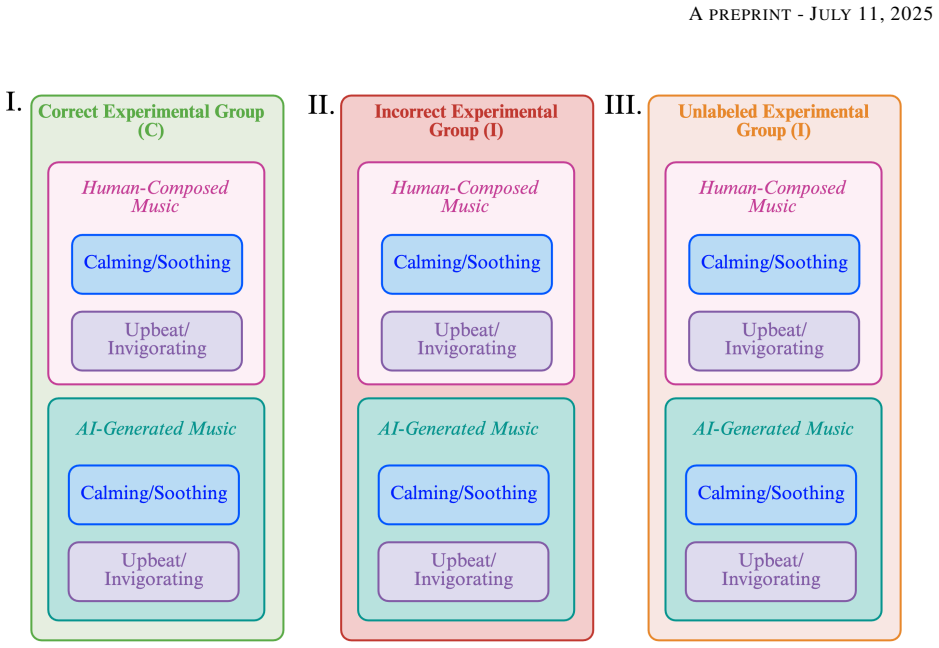
The load-bearing design is a three-way labeling manipulation, correctly labeled, incorrectly labeled, and unlabeled music, applied to paired one-minute instrumental tracks in two emotion cases, with each participant reporting preference, efficacy, and emotion-intensity ratings. The central object is the preference-efficacy pair: for each emotion case, participants chose which of two songs they preferred and which more effectively conveyed the target emotion. The paper then compares those two choice distributions with Poisson generalized linear models, and the dissociation is quantified as opposite signs in the origin coefficients for preference versus efficacy. The qualitative arm, coded by thematic analysis, supplies the mechanism listeners themselves report: perceived humanness, expressed as imperfection, flow, and soul, anchors efficacy judgments even when preference goes the other way.
What would settle it
Replicate the preference-versus-efficacy comparison with a corpus of many AI-generated and many human-composed tracks per emotion case, matched on tempo, instrumentation, and production polish, and fit a model with random effects for individual tracks. If the dissociation disappears or reverses once origin is varied within matched tracks, the paper's central claim is an artifact of the two specific stimuli rather than a general origin effect.
Extended reading notes
Core claim
The central discovery is a preference-efficacy dissociation: human-composed music was significantly more likely to be selected as most effective than as most preferred, while AI-generated music was significantly more likely to be preferred than effective. This dissociation appeared against a background of null results: participants' emotional responses did not differ significantly by label or, in most comparisons, by origin, and labeling condition had no meaningful effect on perceived efficacy. The authors interpret this as showing that 'what works' emotionally and 'what I like' are distinct judgments, and that generative music evaluation schemes built on preference alone can miss the functional dimension. Qualitative responses reinforce the interpretation: listeners associated humanness with imperfection, flow, organic quality, and soul, and often assigned human characteristics to AI music when they believed it was human-composed.
Load-bearing premise
The results assume that the single AI-generated track and the single human-composed track used in each emotion case represent their entire classes; since the paired tracks differ systematically in tempo, instrumentation, and production style, authorship is completely confounded with the specific piece, so the preference-efficacy dissociation could be about the tracks rather than about human versus AI origin.
Editorial extensions
If this is right
- Preference cannot serve as the sole optimization target for music generation systems aimed at mood regulation; systems trained on preference feedback may optimize for liking while missing functional efficacy.
- Labeling a piece as human or AI does not change how effective listeners find it, so perceived efficacy appears robust to framing, at least for these ambient and upbeat styles.
- Listeners may describe AI music as preferred while still choosing human-composed music for emotional work, so wellness and therapeutic applications should evaluate functional outcomes, not just appeal.
- The qualities listeners associate with humanness, micro-expressive variation, idiosyncratic phrasing, and imperfection, become concrete design targets for generative systems seeking emotional resonance.
- Because emotion-intensity responses were similar across origins, the dissociation is not explained by large differences in felt emotion; it lives in the comparison judgments, not in raw affect.
Reading between the lines
- If the preference-efficacy dissociation generalizes, then human-annotation pipelines that collect only 'do you like this?' will systematically misalign with therapeutic or functional goals; adding a separate 'would this work for the intended state?' question would be a cheap, testable fix.
- The confusion between actual and perceived authorship raises the possibility that the dissociation is driven by a mental model of what a human composer sounds like, rather than by audible differences; a study with matched production style could separate those.
- The finding that listeners who preferred AI music often mislabeled it as human suggests that preference may partly be preference for perceived humanness; an implicit-association design could quantify that overlap.
- For generative wellness music, the practical design consequence may be to preserve audible traces of human performance, such as rubato, dynamic shaping, and small imperfections, rather than chasing perceptual indistinguishability.
Editorial analysis
A structured set of objections, weighed in public.
Referee Report
Summary. This paper reports a mixed-methods user study (N = 152) comparing one AI-generated (SunoAI) and one human-composed (Myndstream) one-minute instrumental track per emotion case (Calm, Upbeat), under Correctly labeled, Incorrectly labeled, and Unlabeled conditions. Participants rated each track with GEMIAC, indicated preference and functional efficacy, and provided free-text justifications. Quantitative analyses use Poisson GLMs on aggregate counts after a singular GLMM fit; qualitative coding follows Braun and Clarke. The paper claims that listeners dissociate preference from perceived efficacy by musical origin: AI music is preferred more, human music is judged more effective, and this pattern persists regardless of labeling. The conclusion argues that preference alone is insufficient to evaluate generative music for functional emotional applications.
Significance. The research question is timely and the mixed-methods design is thorough: attention checks, multiple-comparison corrections, transparent reporting of a singular model fit, and a named thematic-analysis procedure are all strengths. The preference–efficacy dissociation is an interesting and practically relevant construct for evaluating generative music in wellness contexts. However, the central class-level claim is not supported because musical origin is perfectly confounded with the specific track and its acoustic features; the study is best interpreted as a hypothesis-generating pilot. If reframed accordingly, the qualitative insights and the demonstrated dissociation for these particular stimuli could still be a useful contribution.
major comments (3)
- [3.1.1, Appendix A] Origin is perfectly confounded with track identity. For each emotion case there is exactly one AI and one human track, and Appendix A documents systematic acoustic differences: the Calm pair differs in tempo (72 vs 53 BPM) and instrumentation (layered synth pads vs rubato acoustic piano), and the Upbeat pair differs in tempo (91 vs 105 BPM) and production (loop-based electronic vs live guitar and percussion). The GLMM with a random effect for condition produced a singular fit (Section 3.1.1), and the fallback Poisson GLMs on aggregate counts cannot separate authorship from stimulus identity. Therefore the dissociation reported in Section 4.1.3 (human music more effective than preferred; AI music more preferred than effective) is a statement about these four tracks, not about AI-generated versus human-composed music as classes. The abstract's and conclusion's class-level claims should be qualified accordingly.
- [4.1.2, Table 2, Abstract] The abstract's claim that 'participants were significantly more likely to rate human-composed music, regardless of labeling, as more effective at eliciting target emotional states' is not supported in the Calm condition. Table 2 shows equal total efficacy selections for AI and human music in Calm (69 vs 69), and Section 4.1.2 reports β ≈ 0, z = 0.00, p = 1.00 for this contrast. The significant human advantage appears only in the Upbeat condition (β = 1.17, z = −5.98). The global claim should be restricted to the Upbeat case or reported as an interaction.
- [4.1.3] The pooled preference–efficacy dissociation masks opposite patterns by emotion case. In Calm, AI music was preferred more often than human music (92 vs 49 total selections in Table 1) while efficacy was equal; in Upbeat, human music was both preferred more (83 vs 64) and more often judged effective (110 vs 34). Averaging across emotion cases therefore conflates origin with the specific tracks and emotion-case context. Reporting the dissociation separately for each emotion case, or with a three-way interaction among origin, outcome type, and emotion case, would be necessary to support the claim that listeners systematically dissociate preference from efficacy as a function of origin.
minor comments (4)
- [4.1.1] The sentence 'These results suggests that participants were more likely...' contains a subject–verb agreement error; it should read 'These results suggest...'.
- [Tables 1 and 2] The column labels 'Neither (Neg.)', 'Neither (Pos.)', and 'Neither (Neutral)' are not defined in the captions; the hand-coding of open-ended 'neither' responses should be described in the main text or caption.
- [3.1.1] The paper notes that a GLMM with a random effect for condition had a singular fit and therefore uses Poisson GLMs on aggregate counts, but each participant contributes two preference and two efficacy judgments (one per emotion case), so the observations are not independent; this non-independence is not addressed by the aggregate Poisson models and should be acknowledged as a limitation.
- [5.4] The limitations paragraph acknowledges 'stimulus variety and sample size' but does not explicitly state that the one-stimulus-per-cell design prevents any class-level inference about AI-generated versus human-composed music; this consequence should be stated directly.
Circularity Check
No circularity: measured participant outcomes; no derivation or fitted-input prediction; the track-identity confound is a validity limitation, not circularity.
full rationale
This is an empirical perception study, not a derivation. The central claims — the preference–efficacy dissociation, labeling accuracy, and GEMIAC differences — are estimated from participant responses via Poisson GLMs and linear mixed-effects models; they are not defined or constructed from the analysis inputs. No parameter is fitted to the target outcome and then reported as a prediction. The only notable confound, one AI-generated and one human-composed track per emotion case, with Appendix A documenting systematic tempo and instrumentation differences between the paired tracks (e.g., 72 vs 53 BPM in Calm; 91 vs 105 BPM in Upbeat), threatens external or construct validity, but it is a stimulus-selection limitation explicitly acknowledged in Section 5.4 and not a circular step: authorship was not defined in terms of preference or efficacy outcomes, and no result follows by definition. The study cites prior instruments (STAI, GEMIAC) and prior findings, but none of those citations is load-bearing in a way that forces the conclusion. I therefore find no self-definitional, fitted-input, self-citation, or imported-uniqueness circularity.
Assumptions & free parameters
assumptions (4)
- domain assumption The GEMIAC intensity ratings and STAI-S are valid and sensitive measures of momentary music-induced emotion for one-minute instrumental clips.
- ad hoc to paper The single human-composed and single AI-generated track in each emotion case are representative samples of their respective classes.
- domain assumption Self-reported preference and efficacy judgments reflect the emotional experience listeners actually had.
- domain assumption Listeners in the Unlabeled group are able to genuinely attempt classification without strong demand characteristics.
Cite this review
Pith. "Pith review of Exploring listeners' perceptions of AI-generated and human-composed music for functional emotional applications." pith.science (2026). https://pith.science/paper/WBRGIMS7
@misc{pith2026250602856,
  author       = {Pith},
  title        = {Pith review of: Exploring listeners' perceptions of AI-generated and human-composed music for functional emotional applications},
  year         = {2026},
  howpublished = {\url{https://pith.science/paper/WBRGIMS7}},
  note         = {Machine review of arXiv:2506.02856}
}
read the original abstract
This work investigates how listeners perceive and evaluate AI-generated as compared to human-composed music in the context of emotional resonance and regulation. Across a mixed-methods design, participants were exposed to both AI and human music under various labeling conditions (music correctly labeled as AI- or human-origin, music incorrectly labeled as AI- or human-origin, and unlabeled music) and emotion cases (Calm and Upbeat), and were asked to rate preference, efficacy of target emotion elicitation, and emotional impact. Participants were significantly more likely to rate human-composed music, regardless of labeling, as more effective at eliciting target emotional states, though quantitative analyses revealed no significant differences in emotional response. However, participants were significantly more likely to indicate preference for AI-generated music, yielding further questions regarding the impact of emotional authenticity and perceived authorship on musical appraisal. Qualitative data underscored this, with participants associating humanness with qualities such as imperfection, flow, and 'soul.' These findings challenge the assumption that preference alone signals success in generative music systems. Rather than positioning AI tools as replacements for human creativity or emotional expression, they point toward a more careful design ethos that acknowledges the limits of replication and prioritizes human values such as authenticity, individuality, and emotion regulation in wellness and affective technologies.
Figures

Reference graph
Works this paper leans on
-
[1]
The state-trait anxiety inventory
Charles D Spielberger, Fernando Gonzalez-Reigosa, Angel Martinez-Urrutia, Luiz FS Natalicio, and Diana S Natalicio. The state-trait anxiety inventory. Revista Interamericana de Psicologia/Interamerican journal of psychology, 5(3 & 4), 1971
work page 1971
-
[2]
Eduardo Coutinho and Klaus R Scherer. Introducing the geneva music-induced affect checklist (gemiac) a brief instrument for the rapid assessment of musically induced emotions. Music Perception: An Interdisciplinary Journal, 34(4):371–386, 2017
work page 2017
-
[3]
Bruno Mesz, Sebastián Tedesco, Felipe Reinoso-Carvalho, Enrique Ter Horst, German Molina, Laura H Gunn, and Mats B Küssner. Marble melancholy: using crossmodal correspondences of shapes, materials, and music to predict music-induced emotions. Frontiers in psychology, 14:1168258, 2023
work page 2023
-
[4]
Uses of music in everyday life
Adrian C North, David J Hargreaves, and Jon J Hargreaves. Uses of music in everyday life. Music perception, 22(1):41–77, 2004
work page 2004
-
[5]
Music perception and cognition: development, neural basis, and rehabilitative use of music
Teppo Särkämö, Mari Tervaniemi, and Minna Huotilainen. Music perception and cognition: development, neural basis, and rehabilitative use of music. Wiley Interdisciplinary Reviews: Cognitive Science, 4(4):441–451, 2013
work page 2013
-
[6]
A first look at generative artificial intelligence based music therapy for mental disorders
Lin Shen, Haojie Zhang, Cuiping Zhu, Ruobing Li, Kun Qian, Wei Meng, Fuze Tian, Bin Hu, Björn W Schuller, and Yoshiharu Yamamoto. A first look at generative artificial intelligence based music therapy for mental disorders. IEEE Transactions on Consumer Electronics, 2024
work page 2024
-
[7]
Jessica Sharmin Rahman, Tom Gedeon, Sabrina Caldwell, Richard Jones, and Zi Jin. Towards effective music therapy for mental health care using machine learning tools: human affective reasoning and music genres. Journal of Artificial Intelligence and Soft Computing Research, 11(1):5–20, 2021
work page 2021
-
[8]
Adaptive music composition for games
Patrick Edward Hutchings and Jon McCormack. Adaptive music composition for games. IEEE Transactions on Games, 12(3):270–280, 2019. 14 A PREPRINT - JULY 11, 2025
work page 2019
Show all 51 references
-
[9]
Using gestural emotions recognised through a neural network as input for an adaptive music system in virtual reality
Manuel López Ibáñez, Maximiliano Miranda, Nahum Alvarez, and Federico Peinado. Using gestural emotions recognised through a neural network as input for an adaptive music system in virtual reality. Entertainment Computing, 38:100404, 2021
2021
-
[10]
Feel good ai: V oice-enabled emotion-based music recommendation system
Anjali Sharma, Shubham Vishwakarma, and Liya T Mathew. Feel good ai: V oice-enabled emotion-based music recommendation system. In 2024 International Conference on Advances in Computing, Communication and Applied Informatics (ACCAI), pages 1–6. IEEE, 2024
2024
-
[11]
Emotion- based music recommendation system
Vijay Prakash Sharma, Azeem Saleem Gaded, Deevesh Chaudhary, Sunil Kumar, and Shikha Sharma. Emotion- based music recommendation system. In 2021 9th International Conference on Reliability, Infocom Technologies and Optimization (Trends and Future Directions)(ICRITO), pages 1–5...
2021
-
[12]
Universal facial expressions of emotion
Paul Ekman and Dacher Keltner. Universal facial expressions of emotion. California mental health research digest, 8(4):151–158, 1970
1970
-
[13]
Facial expressions of emotion are not culturally universal
Rachael E Jack, Oliver GB Garrod, Hui Yu, Roberto Caldara, and Philippe G Schyns. Facial expressions of emotion are not culturally universal. Proceedings of the National Academy of Sciences, 109(19):7241–7244, 2012
2012
-
[14]
In the eye of the beholder? universality and cultural specificity in the expression and perception of emotion
Klaus R Scherer, Elizabeth Clark-Polner, and Marcello Mortillaro. In the eye of the beholder? universality and cultural specificity in the expression and perception of emotion. International Journal of Psychology , 46(6):401–435, 2011
2011
-
[15]
Ethical implications of emotion mining in medicine
Isabel Straw. Ethical implications of emotion mining in medicine. Health Policy and Technology, 10(1):191–195, 2021
2021
-
[16]
Your robot therapist will see you now: ethical implications of embodied artificial intelligence in psychiatry, psychology, and psychotherapy
Amelia Fiske, Peter Henningsen, and Alena Buyx. Your robot therapist will see you now: ethical implications of embodied artificial intelligence in psychiatry, psychology, and psychotherapy. Journal of medical Internet research, 21(5):e13216, 2019
2019
-
[17]
Affective rights: a foundation for ethical standards
Angelo Ferraro. Affective rights: a foundation for ethical standards. In 2020 IEEE International Symposium on Technology and Society (ISTAS), pages 1–11. IEEE, 2020
2020
-
[18]
Artificial intelligence and music: open questions of copyright law and engineering praxis
Bob LT Sturm, Maria Iglesias, Oded Ben-Tal, Marius Miron, and Emilia Gómez. Artificial intelligence and music: open questions of copyright law and engineering praxis. In Arts, volume 8, page 115. MDPI, 2019
2019
-
[19]
Missing melodies: Ai music generation and its “nearly" complete omission of the global south
Atharva Mehta, Shivam Chauhan, and Monojit Choudhury. Missing melodies: Ai music generation and its “nearly" complete omission of the global south. arXiv preprint arXiv:2412.04100, 2024
2024 arXiv
-
[20]
The ethical implications of generative audio models: A systematic literature review
Julia Barnett. The ethical implications of generative audio models: A systematic literature review. In Proceedings of the 2023 AAAI/ACM Conference on AI, Ethics, and Society, pages 146–161, 2023
2023
-
[21]
Algorithmic effects on the diversity of consumption on spotify
Ashton Anderson, Lucas Maystre, Ian Anderson, Rishabh Mehrotra, and Mounia Lalmas. Algorithmic effects on the diversity of consumption on spotify. In Proceedings of the web conference 2020, pages 2155–2165, 2020
2020
-
[22]
Human-ai music creation: Understanding the perceptions and experiences of music creators for ethical and productive collaboration
Michele Newman, Lidia Morris, and Jin Ha Lee. Human-ai music creation: Understanding the perceptions and experiences of music creators for ethical and productive collaboration. In ISMIR, pages 80–88, 2023
2023
-
[23]
Sonics: Synthetic or not–identifying counterfeit songs
Md Awsafur Rahman, Zaber Ibn Abdul Hakim, Najibul Haque Sarker, Bishmoy Paul, and Shaikh Anowarul Fattah. Sonics: Synthetic or not–identifying counterfeit songs. arXiv preprint arXiv:2408.14080, 2024
2024 arXiv
-
[24]
Llark: A multimodal foundation model for music
Josh Gardner, Simon Durand, Daniel Stoller, and Rachel M Bittner. Llark: A multimodal foundation model for music. arXiv preprint arXiv:2310.07160, 2023
2023 arXiv
-
[25]
Harmonic organisation conveys both universal and culture-specific cues for emotional expression in music
George Athanasopoulos, Tuomas Eerola, Imre Lahdelma, and Maximos Kaliakatsos-Papakostas. Harmonic organisation conveys both universal and culture-specific cues for emotional expression in music. PLoS One, 16(1):e0244964, 2021
2021
-
[26]
Beyond diverse datasets: Responsible mir, interdisciplinarity, and the fractured worlds of music
Rujing Huang, Andre Holzapfel, Bob Sturm, and Anna-Kaisa Kaila. Beyond diverse datasets: Responsible mir, interdisciplinarity, and the fractured worlds of music. Transactions of the International Society for Music Information Retrieval, 6(1):43–59, 2023
2023
-
[27]
Better relationships with patients lead to better outcomes
T DeAngelis. Better relationships with patients lead to better outcomes. 50 (10): 38, 2019
2019
-
[28]
Mutuality in psychotherapy: A meta-analysis and meta-synthesis
Jeffrey HD Cornelius-White, Yasuko Kanamori, David Murphy, and Emma Tickle. Mutuality in psychotherapy: A meta-analysis and meta-synthesis. Journal of Psychotherapy Integration, 28(4):489, 2018
2018
-
[29]
Challenges and opportunities in global mental health: a research-to-practice perspective
Milton L Wainberg, Pamela Scorza, James M Shultz, Liat Helpman, Jennifer J Mootz, Karen A Johnson, Yuval Neria, Jean-Marie E Bradford, Maria A Oquendo, and Melissa R Arbuckle. Challenges and opportunities in global mental health: a research-to-practice perspective. Current psy...
2017
-
[30]
Mental illness in the post-pandemic world: digital psychiatry and the future
Muhammad Omair Husain, David Gratzer, Muhammad Ishrat Husain, and Farooq Naeem. Mental illness in the post-pandemic world: digital psychiatry and the future. Frontiers in Psychology, 12:567426, 2021. 15 A PREPRINT - JULY 11, 2025
2021
-
[31]
Can ai replace psychotherapists? exploring the future of mental health care
Zhihui Zhang and Jing Wang. Can ai replace psychotherapists? exploring the future of mental health care. Frontiers in Psychiatry, 15:1444382, 2024
2024
-
[32]
Your robot therapist is not your therapist: understanding the role of ai-powered mental health chatbots
Zoha Khawaja and Jean-Christophe Bélisle-Pipon. Your robot therapist is not your therapist: understanding the role of ai-powered mental health chatbots. Frontiers in Digital Health, 5:1278186, 2023
2023
-
[33]
There will never be an age of artificial intimacy
Sherry Turkle. There will never be an age of artificial intimacy. The New York Times, 11, 2018
2018
-
[34]
Who do we become when we talk to machines? 2024
Sherry Turkle. Who do we become when we talk to machines? 2024
2024
-
[35]
Chatgpt outperforms humans in emotional awareness evaluations
Zohar Elyoseph, Dorit Hadar-Shoval, Kfir Asraf, and Maya Lvovsky. Chatgpt outperforms humans in emotional awareness evaluations. Frontiers in Psychology, 14:1199058, 2023
2023
-
[36]
Ai music therapist: A study on generating specific therapeutic music based on deep generative adver- sarial network approach
Yurui Hou. Ai music therapist: A study on generating specific therapeutic music based on deep generative adver- sarial network approach. In 2022 IEEE 2nd International Conference on Electronic Technology, Communication and Information (ICETCI), pages 1277–1281. IEEE, 2022
2022
-
[37]
Ai composer bias: Listeners like music less when they think it was composed by an ai
Daniel B Shank, Courtney Stefanik, Cassidy Stuhlsatz, Kaelyn Kacirek, and Amy M Belfi. Ai composer bias: Listeners like music less when they think it was composed by an ai. Journal of Experimental Psychology: Applied, 29(3):676, 2023
2023
-
[38]
Longitudinal changes in auditory and reward systems following receptive music-based intervention in older adults
Milena Aiello Quinci, Alexander Belden, Valerie Goutama, Dayang Gong, Suzanne Hanser, Nancy J Donovan, Maiya Geddes, and Psyche Loui. Longitudinal changes in auditory and reward systems following receptive music-based intervention in older adults. Scientific reports, 12(1):11517, 2022
2022
-
[39]
The psychological functions of music listening
Thomas Schäfer, Peter Sedlmeier, Christine Städtler, and David Huron. The psychological functions of music listening. Frontiers in psychology, 4:511, 2013
2013
-
[40]
Emotionbox: A music-element-driven emotional music generation system based on music psychology
Kaitong Zheng, Ruijie Meng, Chengshi Zheng, Xiaodong Li, Jinqiu Sang, Juanjuan Cai, Jie Wang, and Xiao Wang. Emotionbox: A music-element-driven emotional music generation system based on music psychology. Frontiers in Psychology, 13:841926, 2022
2022
-
[41]
Musicrl: Aligning music generation to human preferences
Geoffrey Cideron, Sertan Girgin, Mauro Verzetti, Damien Vincent, Matej Kastelic, Zalán Borsos, Brian McWilliams, Victor Ungureanu, Olivier Bachem, Olivier Pietquin, et al. Musicrl: Aligning music generation to human preferences. arXiv preprint arXiv:2402.04229, 2024
2024 arXiv
-
[42]
More human than you: attributing humanness to self and others
Nick Haslam, Paul Bain, Lauren Douge, Max Lee, and Brock Bastian. More human than you: attributing humanness to self and others. Journal of personality and social psychology, 89(6):937, 2005
2005
-
[43]
lmertest package: tests in linear mixed effects models
Alexandra Kuznetsova, Per B Brockhoff, and Rune HB Christensen. lmertest package: tests in linear mixed effects models. Journal of statistical software, 82:1–26, 2017
2017
-
[44]
Package ‘lme4’
Douglas Bates, Martin Maechler, Ben Bolker, Steven Walker, Rune Haubo Bojesen Christensen, Henrik Singmann, Bin Dai, Gabor Grothendieck, Peter Green, and Maintainer Ben Bolker. Package ‘lme4’. convergence, 12(1):2, 2015
2015
-
[45]
Thematic analysis
Victoria Clarke and Virginia Braun. Thematic analysis. The journal of positive psychology, 12(3):297–298, 2017
2017
-
[46]
Varieties of confirmation bias
Joshua Klayman. Varieties of confirmation bias. Psychology of learning and motivation, 32:385–418, 1995
1995
-
[47]
Performing music: Humans, computers, and electronics
Elaine Chew and Andrew McPherson. Performing music: Humans, computers, and electronics. In The Routledge Companion to Music Cognition, pages 301–312. Routledge, 2017
2017
-
[48]
Interpretive content of a musical work: The performing aspect
Olga Solomonova, Olha Ohanezova-Hryhorenko, Viola Demydova, Yurii Kuchurivskyi, and V olodymyr Bor- donyuk. Interpretive content of a musical work: The performing aspect. Convergences-Journal of Research and Arts Education, 16(32):125–138, 2023
2023
-
[49]
Variations on a theme by chopin: Relations between perception and production of timing in music
Bruno H Repp. Variations on a theme by chopin: Relations between perception and production of timing in music. Journal of Experimental Psychology: Human Perception and Performance, 24(3):791, 1998
1998
-
[50]
Music performance
Caroline Palmer. Music performance. Annual review of psychology, 48(1):115–138, 1997
1997
-
[51]
Geneva Music-Induced Affect Checklist
Nicholas Epley, Adam Waytz, and John T Cacioppo. On seeing human: a three-factor theory of anthropomorphism. Psychological review, 114(4):864, 2007. A Description of Musical Stimuli A.1 AI-Generated Calm This AI-generated track is a 65-second instrumental composed using genera...
2007
Reviewed August 7, 2026 · model on record in the stance chip above.
Discussion (0). Sign in to comment.