REVIEW 3 major objections 5 minor 55 references
Evidence of oscillating `compact' Comptonized corona in GRS 1915+105: Insights into HFQPOs with AstroSat
T0 review · 3 major / 5 minor · reviewed 2026-08-07 · deepseek-v4-flash
Pith's one-line read The 70 Hz HFQPOs in GRS 1915+105 come from a compact, oscillating Comptonized corona near the black hole.
desk verdict Useful new dynamical HFQPO correlation, but the compact-corona claim rests on a model-dependent radius. read the letter →
The pith
A machine-rendered reading of the paper's core claim, the machinery that carries it, and where it could break.
The reading
What carries the argument
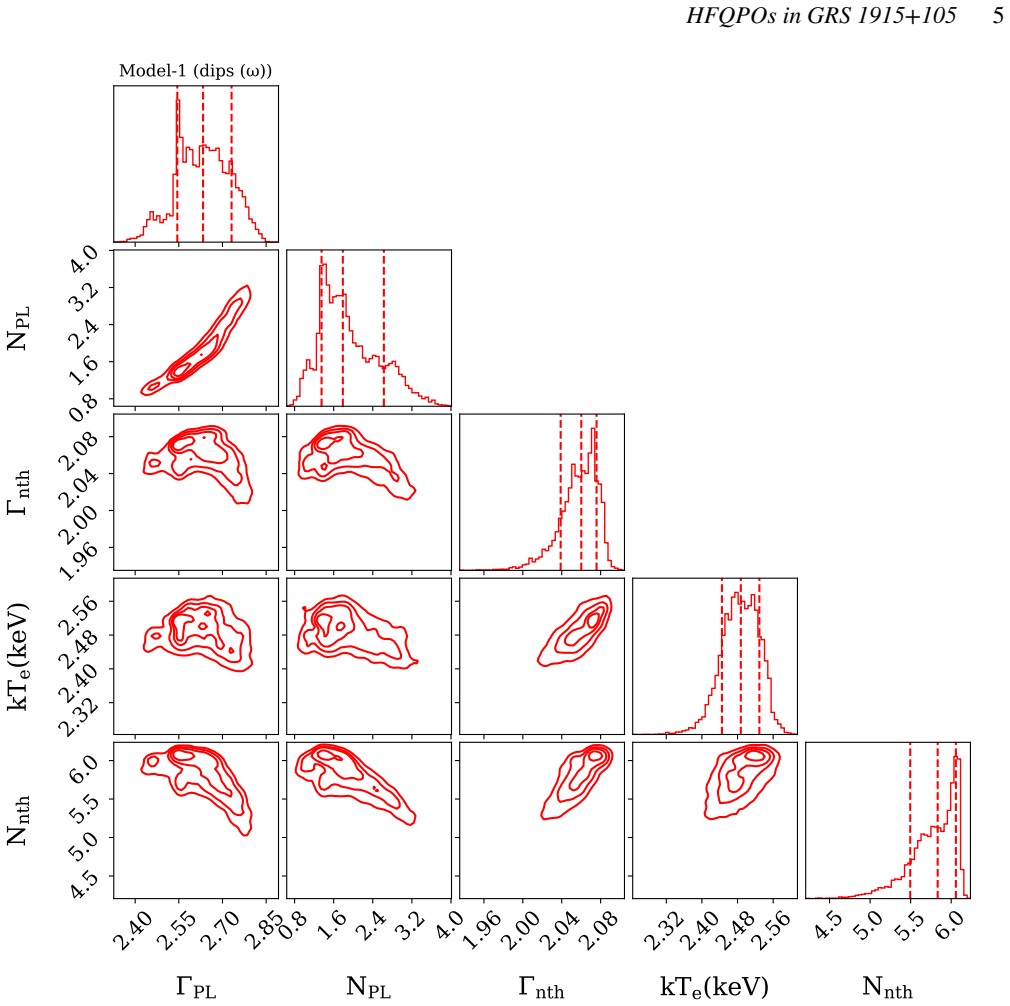
The argument is carried by three linked tools. Dynamic power spectra, computed in 32-second segments with 1 Hz frequency bins, locate the HFQPO in time and energy, and show that it is confined to the $6$--$25$ keV band. Time-resolved spectral fitting of the $3$--$25$ keV band with the thermal Comptonization model nthComp tracks the photon index $\Gamma_{\mathrm{nth}}$ and normalization $N_{\mathrm{nth}}$, revealing that the HFQPO appears whenever the spectrum is hard and the normalization is high. Broadband spectral fits using the relativistic disk model kerrd, with the black hole mass, distance, inclination, and spin fixed, provide the inner disk radius $R_{\mathrm{in}}$, which the authors interpret as the size of the Comptonizing corona; the pseudo-Newtonian diskpn model is used to set an upper bound on that size. The correlation structure among these quantities, with QPO power, $\mathrm{HR1}$, $N_{\mathrm{nth}}$, and luminosity rising together while $\Gamma_{\mathrm{nth}}$ and $R_{\mathrm{in}}$ fall, is what connects the timing signal to a compact coronal geometry.
What would settle it
A direct disproof would be an observation of ~70 Hz HFQPOs in GRS 1915+105 during a spectrally soft state ($\Gamma_{\mathrm{nth}} \gtrsim 2.2$) with a large inferred inner radius ($R_{\mathrm{in}} \gtrsim 7\,r_g$), or a re-analysis of the same data with free black hole spin or a different relativistic disk model that removes the $R_{\mathrm{in}}$ contrast between dips and non-dips.
Extended reading notes
Core claim
The central discovery is a consistent dynamical correlation, traced in 32-second segments, between the presence of the ~70 Hz HFQPO and the spectral and geometric state of the inner accretion flow. In the $\kappa$ and $\omega$ variability classes, which show alternating dips and non-dips, the HFQPO appears exactly in the non-dip intervals, where the thermal Comptonization photon index is harder ($\Gamma_{\mathrm{nth}} \lesssim 2$), the hardness ratio $\mathrm{HR1}$ is higher, and the inner disk radius returned by the relativistic kerrd model is smaller ($R_{\mathrm{in}} \lesssim 4\,r_g$). In the dip intervals the spectrum softens ($\Gamma_{\mathrm{nth}} \gtrsim 2.2$, $\mathrm{HR1}\lesssim 0.7$), the inferred radius grows to $\gtrsim 7\,r_g$, and the HFQPO is not detected. The same pattern holds for the $\delta$ and $\gamma$ classes, which remain in the hard, compact regime and show persistent HFQPOs. Modeling the $0.7$--$50$ keV spectra with thermal Comptonization plus a power law, and independently estimating the inner radius with kerrd and diskpn, the authors infer a corona size of roughly $2.8$--$16\,r_g$. They conclude that the ~70 Hz oscillations are the signature of a compact, oscillating Comptonized corona modulating the high-energy radiation, rather than an orbital or diskoseismic phenomenon.
Load-bearing premise
The inference rests on treating the inner disk radius from the kerrd model as the true size of the Comptonizing corona, and on the fixed black hole parameters (mass 12.4 solar masses, distance 8.6 kpc, spin 0.998) that set that radius, so if the corona is not co-spatial with the inner disk or those parameters are wrong, the compact oscillating corona does not follow from the data.
Editorial extensions
If this is right
- In GRS 1915+105, a 32-second interval showing a ~70 Hz HFQPO will also show a hard thermal Comptonization spectrum ($\Gamma_{\mathrm{nth}} \lesssim 2$), $\mathrm{HR1}\gtrsim 1$, and an inner radius $R_{\mathrm{in}} \lesssim 4\,r_g$, while a soft interval ($\Gamma_{\mathrm{nth}} \gtrsim 2.2$, $R_{\mathrm{in}} \gtrsim 7\,r_g$) will not show the oscillation.
- The Comptonizing corona in these states is compact, with size $2.8$--$16\,r_g$, and the smaller end of that range coincides with HFQPO detection.
- The 70 Hz modulation is carried by Comptonized photons in the $6$--$25$ keV band, so the high-energy emission, not the thermal disk component, is the source of the oscillation.
- The oscillation switches on and off on timescales of tens of seconds, faster than the viscous timescale, implying a sub-Keplerian accretion flow governs the inner region.
Reading between the lines
- If the association is real and repeatable, the ~70 Hz frequency may be set by the size or oscillation mode of the compact corona rather than by orbital motion in the disk, a distinction that could be tested by searching a larger sample of GRS 1915+105 observations for the same hardness-radius threshold.
- Re-fitting the same data with a freely varying black hole spin, or with an alternative relativistic disk model, would show whether the reported $R_{\mathrm{in}}$ contrast between dips and non-dips survives, or is an artifact of the fixed 0.998 spin assumption.
- The same 32-second spectro-temporal tracking could be applied to archival RXTE data of GRS 1915+105 and other black hole X-ray binaries to test whether HFQPOs in those sources also require a compact, hard coronal geometry.
- Because the current power-spectral analysis does not measure phase coherence across energy bands, a direct prediction of the oscillating-corona picture is that the 70 Hz modulation should show correlated time lags between soft and hard Comptonized photons; checking this would independently test the model.
Editorial analysis
A structured set of objections, weighed in public.
Referee Report
Summary. The paper presents a dynamical spectro-temporal analysis of four AstroSat observations of GRS 1915+105 in the δ, κ, ω, and γ variability classes, all showing ~70 Hz high-frequency quasi-periodic oscillations (HFQPOs). The authors model broadband (0.7–50 keV) spectra with thermal Comptonization (nthComp) plus a power-law component, and use the relativistic disk model kerrd (with fixed spin 0.998) and the pseudo-Newtonian diskpn model to estimate the inner disk radius. They report that HFQPOs occur preferentially in high-count-rate 'non-dip' intervals, which have harder spectra (lower Γ_nth, higher HR1) and smaller kerrd inner radii (~3 rg), while 'dip' intervals are softer and have larger radii (~5–7 rg). They further report correlations of QPO strength with count rate, HR1, and nthComp normalization, and anti-correlations with Γ_nth, and conclude that a compact oscillating Comptonized corona modulates the high-energy radiation.
Significance. If the central inference is correct, the paper provides a rare, time-resolved link between the presence of HFQPOs and spectral parameters (hardness, Comptonization normalization, and inferred inner radius) in GRS 1915+105, extending previous static analyses to 32-second dynamical timescales. The accumulated dip/non-dip spectral fits are well executed, with reduced chi-square near unity, and the full-band QPO detection at 5.6σ is solid. However, the headline physical conclusion—a 'compact' oscillating corona—rests on two fragile steps: equating the kerrd inner disk radius with the Comptonizing corona size, and adopting a maximal-spin prior that forces Rin near 3 rg. The alternative diskpn model gives radii of 14–17 rg with comparable fit quality, so the data do not by themselves establish compactness. The dynamical correlations in Fig. 5 are also presented without quantified uncertainties or significance levels. These issues make the empirical associations credible but the interpretive claim premature.
major comments (3)
- [§3.1, Table 1; §4] The 'compact' corona conclusion depends on the kerrd model with spin fixed to a = 0.998. Table 1 shows that the alternative diskpn model (Model-2) yields Rin ≈ 14.6–16.6 rg for the same observations, with comparable goodness of fit (e.g., for the ω class, kerrd χ²/dof = 1.08 versus diskpn χ²/dof = 1.13). The abstract's quoted range 2.8–16 rg spans both possibilities, but the central claim in §4 that HFQPOs occur at Rin ≲ 4 rg and are absent at Rin ≳ 7 rg is taken specifically from the kerrd values. Because the spin is fixed rather than fitted, the small radii are largely imposed by assumption, not measured. The authors should either fit the spin (or at least show how Rin and the conclusions vary with spin) or explicitly state that the compactness inference is conditional on maximal spin; otherwise the claim is not supported by the data.
- [§4] The sentence 'We associate the inner disc radius with the size of a Compton corona' is a load-bearing assumption that is not justified. kerrd models the thermal disk emission and returns a disk inner edge; the Comptonizing region need not be co-spatial with the inner disk (e.g., it could be a corona above the disk or an extended hot flow). The paper's physical conclusion—that a compact corona oscillates to produce the HFQPO—requires this identification, but no argument or test is provided. At minimum, the authors should discuss alternative geometries and state what observations or model comparisons could distinguish co-spatial versus extended corona configurations.
- [§3.2, Figure 5] The dynamical spectral analysis fits the 32-second spectra with nthComp alone over 3–25 keV, while the full-band analysis in §3.1 shows that an additional power-law component is required (for the ω class, χ²/dof improves from 2.11 to 1.15 upon adding powerlaw). If the power-law component contributes non-negligibly in the 3–25 keV band, then the time-dependent Γ_nth and N_nth values may be biased, and the reported anti-correlation and correlation with count rate could reflect degeneracy between nthComp and the omitted power-law rather than physical changes in the Comptonizing corona. In addition, Fig. 5 shows no error bars or significance estimates for the 32-second parameters; the text mentions larger uncertainties during dips but does not quantify them. The authors should provide uncertainties and, if possible, a check of the dynamic fits with both components included or with a fixed power-law contribution.
minor comments (5)
- [Table 1 and Table 2 captions] The model definitions are inconsistent between tables: Table 1 lists Model-1 as constant*Tbabs*edge*smedge(nthComp+powerlaw), while Table 2 lists Model-1 without the constant. Please harmonize the notation.
- [§3.2] The definitions of HR1 and HR2 are given in the text, but the phrase 'hardness ratios' should also specify whether they are count-rate ratios or flux ratios, and the energy bands should be stated consistently with Fig. 5 panels.
- [Figure 5] The dynamic PDS panel would benefit from a color bar with quantitative units and from clearly marking the times when HFQPO is formally detected versus not detected, since the text states detection in non-dips and non-detection in dips.
- [§1 and §3.1] The phrase 'softer variability classes' is used even though the non-dip spectra are relatively hard (Γ_nth ~1.8). This terminology should be clarified to avoid confusion between variability class names and spectral state.
- [General] There are several text extraction/formatting artifacts in the provided manuscript (e.g., title spacing, 'L ATEX', garbled table columns). Please ensure the final version is cleanly typeset.
Circularity Check
No significant circularity: the dynamic associations are data-driven, and the corona-size identification is an openly stated assumption rather than a fitted prediction.
full rationale
The paper's central inference is an observed association between HFQPO presence and spectrally harder states with smaller kerrd inner radius, built from independent timing and spectral fits. No equation is derived from itself: the 32 s dynamical analysis is a new measurement, and the QPO is re-detected in the paper's own PDS rather than imported as a fitted result. The 'compact corona' interpretation is explicitly premised on an assumption, 'We associate the inner disc radius with the size of a Compton corona' (Section 4), which makes the conclusion model-dependent: kerrd with spin fixed to 0.998 gives ~3-4 rg while diskpn gives ~15 rg for the same data. However, the paper reports both models and does not present either as a prediction or as a first-principles derivation; this is a correctness risk about model dependence, not circularity. Self-citations to Sreehari et al. (2020) and Majumder et al. (2022) supply the prior HFQPO detections and the corona hypothesis, but the present work re-detects the HFQPOs in its own power spectra and adds new dynamical correlations, so those citations are supporting evidence rather than an unverified internal premise. The acknowledged limitation that the 32 s dynamic spectra are modelled with nthComp alone (Section 4) is transparent and does not hide a circular reduction. Accordingly, no circular step is present.
Assumptions & free parameters
free parameters (4)
- Γ_nth (nthComp photon index) =
1.68-1.92 (static); 1.77-1.78 in non-dips; 1.99-2.06 in dips
- N_nth (nthComp normalization) =
5.6-10 (static Table 1); 6-10 in kappa/omega segments
- R_in (inner disk radius from kerrd) =
2.87-3.72 r_g (non-dips or static); 5.35-6.69 r_g (dips)
- kTe (electron temperature) =
2.13-2.89 keV
assumptions (5)
- domain assumption Distance = 8.6 kpc, black hole mass = 12.4 M_sun, inclination = 65 degrees, and spin a = 0.998 (for kerrd) are assumed from literature.
- domain assumption The absorbed spectral model Tbabs*edge*smedge*(nthComp+powerlaw) with gain corrections adequately represents the source and instrumental response.
- ad hoc to paper The inner disk radius from kerrd equals the size of the Comptonizing corona.
- ad hoc to paper The 32-second dynamic fits using only nthComp (excluding the power-law component) track the same thermal Comptonization component as the full-band model.
- domain assumption QPO detection significance in each 32-second segment is sufficient to classify presence or absence.
invented entities (1)
-
Compact oscillating Comptonized corona
Cite this review
Pith. "Pith review of Evidence of oscillating `compact' Comptonized corona in GRS 1915+105: Insights into HFQPOs with AstroSat." pith.science (2026). https://pith.science/paper/WBZHUW76
@misc{pith2026250600935,
  author       = {Pith},
  title        = {Pith review of: Evidence of oscillating `compact' Comptonized corona in GRS 1915+105: Insights into HFQPOs with AstroSat},
  year         = {2026},
  howpublished = {\url{https://pith.science/paper/WBZHUW76}},
  note         = {Machine review of arXiv:2506.00935}
}
abstract
We present, for the first time, an in-depth dynamical analysis of the spectro-temporal properties of the soft variability classes ($\delta$, $\kappa$, $\omega$, and $\gamma$) of GRS 1915+105 during the detection of $\sim$70 Hz High-Frequency Quasi-periodic Oscillations (HFQPOs) using AstroSat data. The wide-band spectra ($0.7-50$ keV) are well described by thermal Comptonization along with an extended power-law component. Additionally, power spectra ($0.01-500$ Hz) indicate that Comptonized photons ($6-25$ keV) primarily contribute to the HFQPOs. Our findings reveal that high (low) count rates referred to as `non-dips' (`dips') in the light curves of the variability classes correspond to the detection (non-detection) of HFQPOs. Accumulated `non-dips' (`dips') spectra are modelled separately using thermal Comptonization (\texttt{nthComp}) as well as \texttt{kerrd} which indicates harder spectra and smaller inner disc radius during the detection of HFQPOs. We conduct dynamical analyses (every 32 s) to trace the presence of HFQPOs, and variations in thermal Comptonization parameters ($\Gamma_{\rm nth}$ and ${\rm N}_{\rm nth}$). Moreover, we observe a positive correlation of `non-dips' with QPO strength, ${\rm HR}1$, and ${\rm N}_{\rm nth}$, while $\Gamma_{\rm nth}$ shows an anti-correlation, suggesting that high-energy photons from the Comptonized corona are responsible for the HFQPOs. Furthermore, we estimate the size of the Comptonized corona using \texttt{kerrd} and \texttt{diskpn} to be $\sim 2.8 - 16$ $r_{\rm g}$. Thus, we infer that a `compact' oscillating corona likely modulates the high-energy radiation, exhibiting the $70$ Hz HFQPOs in GRS 1915$+$105.
Figures


Figures from the paper (2 more)


Reference graph
Works this paper leans on
-
[1]
K., Nandi A., Girish V., Ramadevi M
Agrawal V. K., Nandi A., Girish V., Ramadevi M. C., 2018, @doi [ ] 10.1093/mnras/sty1005 , http://adsabs.harvard.edu/abs/2018MNRAS.477.5437A 477, 5437
-
[2]
Altamirano D., Belloni T., 2012, @doi [ ] 10.1088/2041-8205/747/1/L4 , https://ui.adsabs.harvard.edu/abs/2012ApJ...747L...4A 747, L4
-
[3]
Antia H. M., et al., 2017, @doi [ ] 10.3847/1538-4365/aa7a0e , http://adsabs.harvard.edu/abs/2017ApJS..231...10A 231, 10
-
[4]
Athulya M. P., Nandi A., 2023, @doi [ ] 10.1093/mnras/stad2072 , https://ui.adsabs.harvard.edu/abs/2023MNRAS.525..489A 525, 489
-
[5]
Athulya M. P., Radhika D., Agrawal V. K., Ravishankar B. T., Naik S., Mandal S., Nandi A., 2022, @doi [ ] 10.1093/mnras/stab3614 , https://ui.adsabs.harvard.edu/abs/2022MNRAS.510.3019A 510, 3019
-
[6]
Belloni T. M., Altamirano D., 2013, @doi [ ] 10.1093/mnras/stt500 , http://adsabs.harvard.edu/abs/2013MNRAS.432...10B 432, 10
-
[7]
Belloni T., M \'e ndez M., King A. R., van der Klis M., van Paradijs J., 1997, @doi [ ] 10.1086/310944 , https://ui.adsabs.harvard.edu/abs/1997ApJ...488L.109B 488, L109
-
[8]
Belloni T., Klein-Wolt M., M \'e ndez M., van der Klis M., van Paradijs J., 2000, , http://adsabs.harvard.edu/abs/2000A
work page 2000
Show all 55 references
-
[9]
Belloni T., M \'e ndez M., S \'a nchez-Fern \'a ndez C., 2001, @doi [ ] 10.1051/0004-6361:20010480 , https://ui.adsabs.harvard.edu/abs/2001A&A...372..551B 372, 551
2001 doi
-
[10]
Belloni T., Soleri P., Casella P., M \'e ndez M., Migliari S., 2006, @doi [ ] 10.1111/j.1365-2966.2006.10286.x , https://ui.adsabs.harvard.edu/abs/2006MNRAS.369..305B 369, 305
2006
-
[11]
M., Bhattacharya D., Caccese P., Bhalerao V., Vadawale S., Yadav J
Belloni T. M., Bhattacharya D., Caccese P., Bhalerao V., Vadawale S., Yadav J. S., 2019, @doi [ ] 10.1093/mnras/stz2143 , 489, 1037
2019 doi
-
[12]
G., 1995, @doi [ ] 10.1086/176610 , https://ui.adsabs.harvard.edu/abs/1995ApJ...455..623C 455, 623
Chakrabarti S., Titarchuk L. G., 1995, @doi [ ] 10.1086/176610 , https://ui.adsabs.harvard.edu/abs/1995ApJ...455..623C 455, 623
1995 doi
-
[13]
K., Nandi A., Chatterjee A
Chakrabarti S. K., Nandi A., Chatterjee A. K., Choudhury A. K., Chatterjee U., 2005, @doi [ ] 10.1051/0004-6361:20041662 , https://ui.adsabs.harvard.edu/abs/2005A&A...431..825C 431, 825
2005 doi
-
[14]
Cui W., 1999, @doi [ ] 10.1086/312296 , https://ui.adsabs.harvard.edu/abs/1999ApJ...524L..59C 524, L59
1999 doi
-
[15]
N., Chen W., 1998, @doi [ ] 10.1086/311092 , http://adsabs.harvard.edu/abs/1998ApJ...492L..53C 492, L53
Cui W., Zhang S. N., Chen W., 1998, @doi [ ] 10.1086/311092 , http://adsabs.harvard.edu/abs/1998ApJ...492L..53C 492, L53
1998 doi
-
[16]
Das S., Chattopadhyay I., Nandi A., Molteni D., 2014, @doi [ ] 10.1093/mnras/stu864 , https://ui.adsabs.harvard.edu/abs/2014MNRAS.442..251D 442, 251
2014 doi
-
[17]
K., 2024, @doi [ ] 10.1093/mnras/stae181 , https://ui.adsabs.harvard.edu/abs/2024MNRAS.528.3964D 528, 3964
Debnath S., Chattopadhyay I., Joshi R. K., 2024, @doi [ ] 10.1093/mnras/stae181 , https://ui.adsabs.harvard.edu/abs/2024MNRAS.528.3964D 528, 3964
2024 doi
-
[18]
S., Jain P., 2023, @doi [ ] 10.1093/mnras/stad2075 , https://ui.adsabs.harvard.edu/abs/2023MNRAS.524.2721D 524, 2721
Dhaka R., Misra R., Yadav J. S., Jain P., 2023, @doi [ ] 10.1093/mnras/stad2075 , https://ui.adsabs.harvard.edu/abs/2023MNRAS.524.2721D 524, 2721
2023 doi
-
[19]
K., Das S., Maity D., Nandi A., 2019, @doi [ ] 10.1093/mnras/stz1933 , https://ui.adsabs.harvard.edu/abs/2019MNRAS.488.2412D 488, 2412
Dihingia I. K., Das S., Maity D., Nandi A., 2019, @doi [ ] 10.1093/mnras/stz1933 , https://ui.adsabs.harvard.edu/abs/2019MNRAS.488.2412D 488, 2412
2019 doi
-
[20]
Ebisawa K., \.Z ycki P., Kubota A., Mizuno T., Watarai K.-y., 2003, @doi [ ] 10.1086/378586 , https://ui.adsabs.harvard.edu/abs/2003ApJ...597..780E 597, 780
2003 doi
-
[22]
C., et al., 2005, @doi [ ] 10.1051/0004-6361:20042250 , https://ui.adsabs.harvard.edu/abs/2005A&A...435..995H 435, 995
Hannikainen D. C., et al., 2005, @doi [ ] 10.1051/0004-6361:20042250 , https://ui.adsabs.harvard.edu/abs/2005A&A...435..995H 435, 995
2005 doi
-
[23]
Homan J., Wijnands R., van der Klis M., Belloni T., van Paradijs J., Klein-Wolt M., Fender R., M \'e ndez M., 2001, @doi [ ] 10.1086/318954 , https://ui.adsabs.harvard.edu/abs/2001ApJS..132..377H 132, 377
2001 doi
-
[24]
M., Wijnands R., van der Klis M., Belloni T., Steeghs D., Lewin W
Homan J., Miller J. M., Wijnands R., van der Klis M., Belloni T., Steeghs D., Lewin W. H. G., 2005, @doi [ ] 10.1086/424994 , https://ui.adsabs.harvard.edu/abs/2005ApJ...623..383H 623, 383
2005 doi
-
[25]
Huppenkothen D., et al., 2019, @doi [ ] 10.3847/1538-4357/ab258d , https://ui.adsabs.harvard.edu/abs/2019ApJ...881...39H 881, 39
2019 doi
-
[26]
Janiuk A., Czerny B., Siemiginowska A., 2000, @doi [ ] 10.1086/312911 , https://ui.adsabs.harvard.edu/abs/2000ApJ...542L..33J 542, L33
2000 doi
-
[27]
Kato S., 2004, @doi [ ] 10.1093/pasj/56.5.L25 , https://ui.adsabs.harvard.edu/abs/2004PASJ...56L..25K 56, L25
2004 doi
-
[28]
Kato S., Fukue J., 1980, , https://ui.adsabs.harvard.edu/abs/1980PASJ...32..377K 32, 377
1980
-
[29]
P., Pooley G
Klein-Wolt M., Fender R. P., Pooley G. G., Belloni T., Migliari S., Morgan E. H., van der Klis M., 2002, @doi [ ] 10.1046/j.1365-8711.2002.05223.x , https://ui.adsabs.harvard.edu/abs/2002MNRAS.331..745K 331, 745
2002
-
[30]
Kotrlov \'a A., et al., 2020, @doi [ ] 10.1051/0004-6361/201937097 , https://ui.adsabs.harvard.edu/abs/2020A&A...643A..31K 643, A31
2020 doi
-
[31]
Majumder S., Sreehari H., Aftab N., Katoch T., Das S., Nandi A., 2022, @doi [ ] 10.1093/mnras/stac615 , https://ui.adsabs.harvard.edu/abs/2022MNRAS.512.2508M 512, 2508
2022 doi
-
[32]
G., Nandi A., 2024, @doi [ ] 10.1093/mnras/stad3465 , https://ui.adsabs.harvard.edu/abs/2024MNRAS.527.4739M 527, 4739
Majumder P., Dutta B. G., Nandi A., 2024, @doi [ ] 10.1093/mnras/stad3465 , https://ui.adsabs.harvard.edu/abs/2024MNRAS.527.4739M 527, 4739
2024 doi
-
[33]
G., Nandi A., 2025, @doi [ ] 10.1093/mnras/staf698 , https://ui.adsabs.harvard.edu/abs/2025MNRAS.540...37M 540, 37
Majumder P., Dutta B. G., Nandi A., 2025, @doi [ ] 10.1093/mnras/staf698 , https://ui.adsabs.harvard.edu/abs/2025MNRAS.540...37M 540, 37
2025 doi
-
[34]
Merloni A., Vietri M., Stella L., Bini D., 1999, @doi [ ] 10.1046/j.1365-8711.1999.02307.x , http://adsabs.harvard.edu/abs/1999MNRAS.304..155M 304, 155
1999
-
[35]
Migliari S., Belloni T., 2003, @doi [ ] 10.1051/0004-6361:20030484 , https://ui.adsabs.harvard.edu/abs/2003A&A...404..283M 404, 283
2003 doi
-
[37]
H., Remillard R
Morgan E. H., Remillard R. A., Greiner J., 1997b, @doi [ ] 10.1086/304191 , https://ui.adsabs.harvard.edu/abs/1997ApJ...482..993M 482, 993
-
[38]
Musoke G., Liska M., Porth O., van der Klis M., Ingram A., 2023, @doi [ ] 10.1093/mnras/stac2754 , https://ui.adsabs.harvard.edu/abs/2023MNRAS.518.1656M 518, 1656
2023 doi
-
[39]
R., Chakrabarti S
Naik S., Rao A. R., Chakrabarti S. K., 2002, @doi [Journal of Astrophysics and Astronomy] 10.1007/BF02702284 , https://ui.adsabs.harvard.edu/abs/2002JApA...23..213N 23, 213
2002 doi
-
[40]
G., Rao A
Nandi A., Manickam S. G., Rao A. R., Chakrabarti S. K., 2001, @doi [ ] 10.1046/j.1365-8711.2001.04339.x , https://ui.adsabs.harvard.edu/abs/2001MNRAS.324..267N 324, 267
2001
-
[41]
A., Lee J
Neilsen J., Remillard R. A., Lee J. C., 2011, @doi [ ] 10.1088/0004-637X/737/2/69 , https://ui.adsabs.harvard.edu/abs/2011ApJ...737...69N 737, 69
2011 doi
-
[43]
A., Wagoner R
Nowak M. A., Wagoner R. V., Begelman M. C., Lehr D. E., 1997, @doi [ ] 10.1086/310534 , http://adsabs.harvard.edu/abs/1997ApJ...477L..91N 477, L91
1997 doi
-
[44]
J., McClintock J
Reid M. J., McClintock J. E., Steiner J. F., Steeghs D., Remillard R. A., Dhawan V., Narayan R., 2014, @doi [ ] 10.1088/0004-637X/796/1/2 , https://ui.adsabs.harvard.edu/abs/2014ApJ...796....2R 796, 2
2014 doi
-
[45]
A., Morgan E
Remillard R. A., Morgan E. H., McClintock J. E., Bailyn C. D., Orosz J. A., 1999, @doi [ ] 10.1086/307606 , https://ui.adsabs.harvard.edu/abs/1999ApJ...522..397R 522, 397
1999 doi
-
[46]
R., Fabian A
Ross R. R., Fabian A. C., Brandt W. N., 1996, @doi [ ] 10.1093/mnras/278.4.1082 , https://ui.adsabs.harvard.edu/abs/1996MNRAS.278.1082R 278, 1082
1996 doi
-
[47]
P., Stewart G
Singh K. P., Stewart G. C., Westergaard N. J., Bhattacharayya S., Chandra et al. S., 2017, @doi [Journal of Astrophysics and Astronomy] 10.1007/s12036-017-9448-7 , http://adsabs.harvard.edu/abs/2017JApA...38...29S 38, 29
2017 doi
-
[48]
T., Iyer N., Agrawal V
Sreehari H., Ravishankar B. T., Iyer N., Agrawal V. K., Katoch T. B., Mandal S., Nand i A., 2019, @doi [ ] 10.1093/mnras/stz1327 , https://ui.adsabs.harvard.edu/abs/2019MNRAS.487..928S 487, 928
2019 doi
-
[49]
K., Mandal S., Ramadevi M
Sreehari H., Nandi A., Das S., Agrawal V. K., Mandal S., Ramadevi M. C., Katoch T., 2020, @doi [ ] 10.1093/mnras/staa3135 , https://ui.adsabs.harvard.edu/abs/2020MNRAS.499.5891S 499, 5891
2020 doi
-
[50]
E., 2001, @doi [ ] 10.1086/321720 , https://ui.adsabs.harvard.edu/abs/2001ApJ...554L.169S 554, L169
Strohmayer T. E., 2001, @doi [ ] 10.1086/321720 , https://ui.adsabs.harvard.edu/abs/2001ApJ...554L.169S 554, L169
2001 doi
-
[51]
Sukov \'a P., Janiuk A., 2015, @doi [ ] 10.1093/mnras/stu2544 , https://ui.adsabs.harvard.edu/abs/2015MNRAS.447.1565S 447, 1565
2015 doi
-
[52]
E., Chen X., Swank J
Taam R. E., Chen X., Swank J. H., 1997, @doi [ ] 10.1086/310812 , https://ui.adsabs.harvard.edu/abs/1997ApJ...485L..83T 485, L83
1997 doi
-
[53]
Titarchuk L., Seifina E., 2009, @doi [ ] 10.1088/0004-637X/706/2/1463 , https://ui.adsabs.harvard.edu/abs/2009ApJ...706.1463T 706, 1463
2009 doi
-
[54]
Vilhu O., Nevalainen J., 1998, @doi [ ] 10.1086/311709 , https://ui.adsabs.harvard.edu/abs/1998ApJ...508L..85V 508, L85
1998 doi
-
[55]
Vilhu O., Poutanen J., Nikula P., Nevalainen J., 2001, @doi [ ] 10.1086/320489 , https://ui.adsabs.harvard.edu/abs/2001ApJ...553L..51V 553, L51
2001 doi
-
[56]
M., et al., 2023, @doi [ ] 10.1038/s41586-022-05648-3 , https://ui.adsabs.harvard.edu/abs/2023Natur.615...45V 615, 45
Vincentelli F. M., et al., 2023, @doi [ ] 10.1038/s41586-022-05648-3 , https://ui.adsabs.harvard.edu/abs/2023Natur.615...45V 615, 45
2023 doi
-
[57]
A., 2014, @doi [ ] 10.1093/mnras/stu1525 , https://ui.adsabs.harvard.edu/abs/2014MNRAS.444.1113Z 444, 1113
Zdziarski A. A., 2014, @doi [ ] 10.1093/mnras/stu1525 , https://ui.adsabs.harvard.edu/abs/2014MNRAS.444.1113Z 444, 1113
2014 doi
-
[58]
A., Gierli \'n ski M., Rao A
Zdziarski A. A., Gierli \'n ski M., Rao A. R., Vadawale S. V., Miko ajewska J., 2005, @doi [ ] 10.1111/j.1365-2966.2005.09112.x , https://ui.adsabs.harvard.edu/abs/2005MNRAS.360..825Z 360, 825
2005
Reviewed August 7, 2026 · model on record in the stance chip above.
Discussion (0). Sign in to comment.