REVIEW 2 major objections 4 minor 4 cited by
Diversity of kilonova light curves
T0 review · 2 major / 4 minor · reviewed 2026-08-14 · deepseek-v4-flash
Pith's one-line read Kilonova light-curve peaks carry a fingerprint of the merger's central engine, letting observers distinguish prompt collapse, magnetar-accelerated ejecta, and black hole-neutron star mergers.
desk verdict Useful, honest survey of kilonova model diversity; the peak-magnitude classification is illustrative, not proven, but the paper deserves peer review. read the letter →
The pith
A machine-rendered reading of the paper's core claim, the machinery that carries it, and where it could break.
The reading
What carries the argument
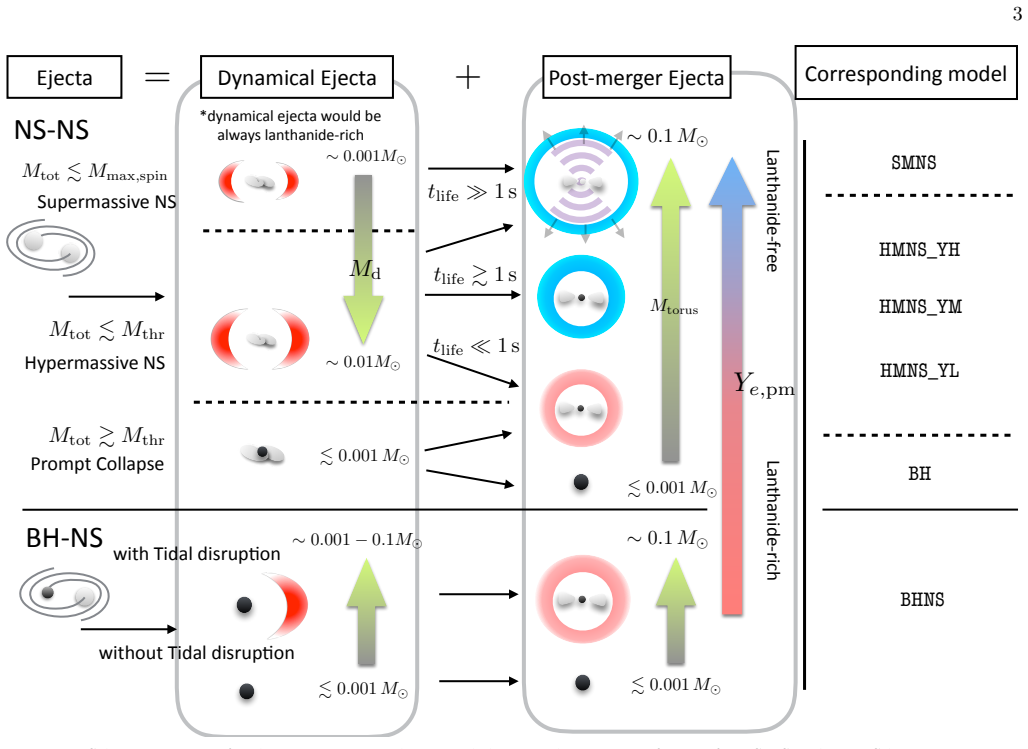
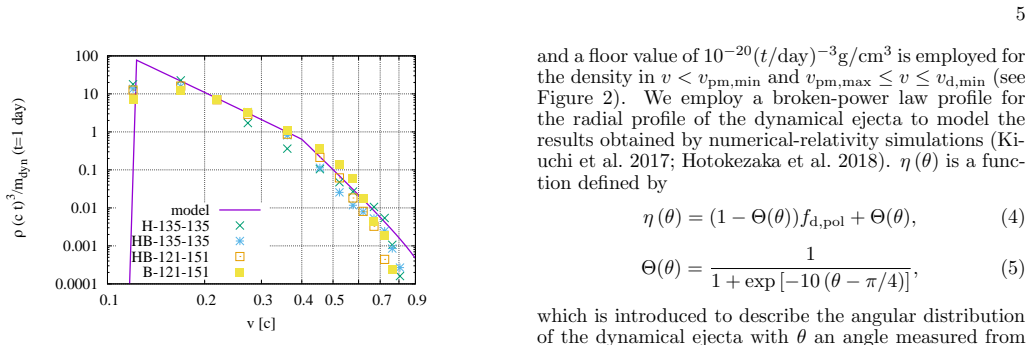
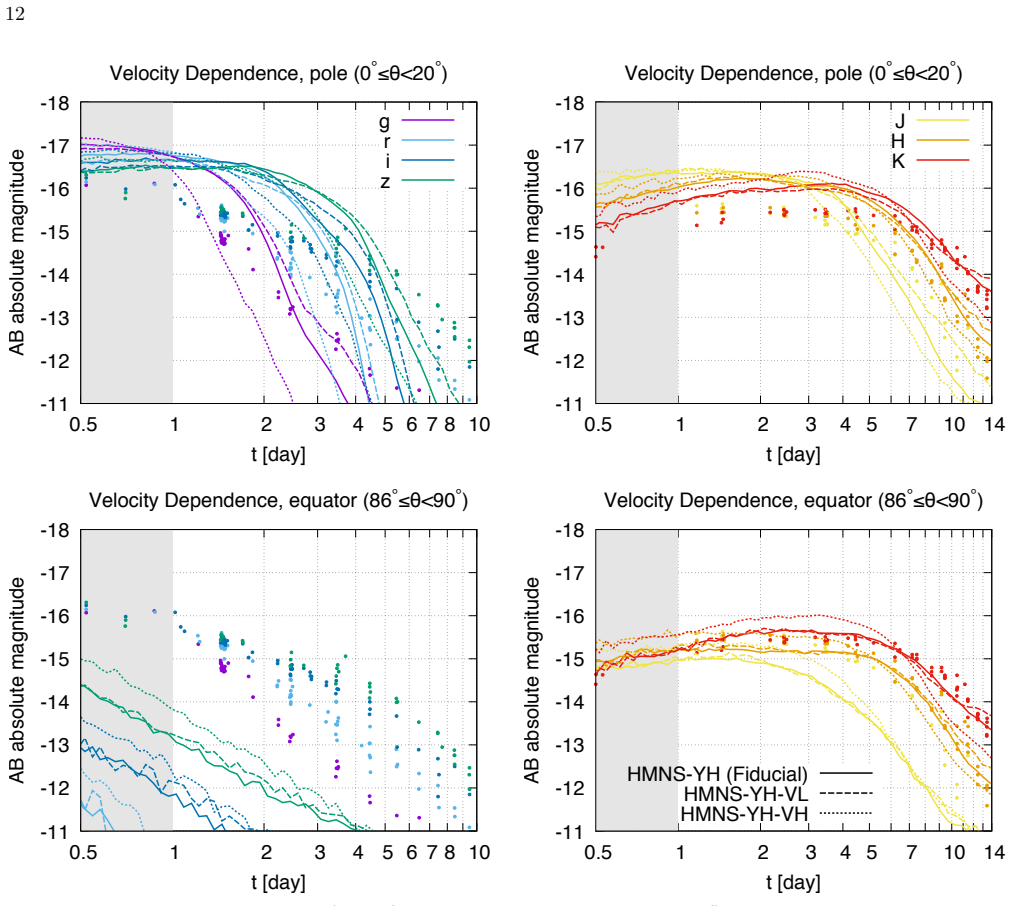
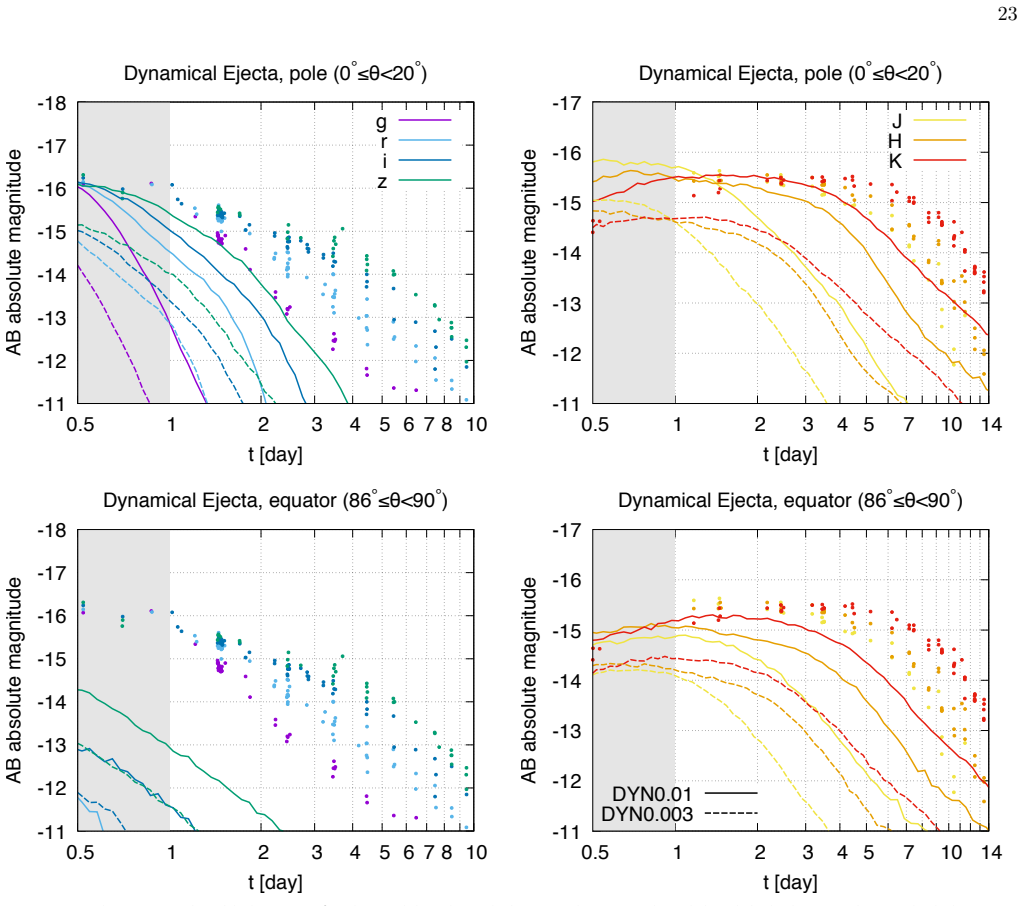
The load-bearing tool is a wavelength-dependent Monte Carlo radiative transfer code that treats two ejecta components together—a spherical post-merger ejecta and a non-spherical dynamical ejecta—so that photons diffusing preferentially toward the pole, being blocked near the equator, and reprocessed to heat the dynamical ejecta are captured self-consistently. It uses a new line list from atomic structure calculations for all r-process elements ($Z=26$-$92$) and r-process heating rates with thermalization. The diagnostic output is the peak magnitude and time of peak in the i, J, and K bands (Figures 17 and 18), where each merger scenario clusters.
What would settle it
Measure the iJK peak magnitudes and peak times of a gravitational-wave counterpart of known distance and inclination. A prompt-collapse candidate that is optically within about 1 mag of GW170817, or a magnetar-accelerated candidate that stays brighter than GW170817 after five days, would contradict the predicted separation; conversely, the detection of a population of faint-optical but bright-infrared kilonovae would confirm it.
Extended reading notes
Core claim
The central claim is that differences in ejecta properties are imprinted in the peak brightness and time of peak, so that observing the peak in multiple bands allows one to infer the type of central engine. Concretely: (i) optical emission from prompt-collapse mergers is fainter by $\gtrsim 1$-$2\,{\rm mag}$ than GW170817 while the infrared stays as bright if post-merger ejecta is about $0.01\,M_\odot$; (ii) magnetar-accelerated ejecta outshines GW170817 by 1-2 mag for the first few days but fades below it within days; (iii) black hole-neutron star mergers with $\gtrsim 0.02\,M_\odot$ of ejecta can be optically as bright as GW170817 and infrared-brighter by 1-2 mag. The paper argues that the resulting clustering in peak magnitude-peak time space is a practical diagnostic for the merger evolution.
Load-bearing premise
The predictions rest on the ejecta mass, velocity, angular shape, and electron fraction being fixed to the representative profiles taken from a small set of numerical relativity simulations; if real ejecta differ, the claimed 1-2 magnitude separations and peak-time clusters could shrink or shift.
Editorial extensions
If this is right
- Prompt-collapse kilonovae may be missed in optical surveys but remain detectable in near-infrared for about a week.
- A kilonova that peaks more than 1-2 mag brighter than GW170817 and fades within days points to magnetar-accelerated ejecta.
- A BH-NS merger can masquerade as a normal optical kilonova but should stand out as infrared-bright.
- Multi-band peak observations suffice to break degeneracies that single near-infrared bands have with respect to ejecta mass.
- Ejecta mass estimates from optical brightness alone can be wrong by a factor of about two if polar diffusion enhancement is ignored.
Reading between the lines
- The same peak-diagnostic logic could be applied to archival short gamma-ray burst afterglows with kilonova candidates, testing whether those events cluster by engine type.
- If gravitational-wave measurements provide the inclination, the predicted viewing-angle dependence of the optical suppression could sharpen or falsify the classification before a large sample exists.
- Extending the calculation to non-LTE and better late-time heating would directly test whether the fast-declining light curves are real or an artifact of the LTE assumption.
- The 20-30 percent uncertainty from the capped electron fraction for BH-NS dynamical ejecta could be resolved by rerunning with $Y_e \approx 0.05$ tables when available.
Signed reviews
Editorial analysis
A structured set of objections, weighed in public.
Referee Report
Summary. The paper presents wavelength-dependent radiative transfer simulations of kilonova light curves for several post-merger scenarios: prompt collapse to a black hole, hypermassive neutron star with a long-lived remnant, supermassive neutron star with accelerated ejecta, and black hole-neutron star mergers. The ejecta density, velocity, and composition profiles are taken from representative numerical-relativity simulations, and a new r-process atomic line list is used. The authors identify three multi-component radiative transfer effects (polar diffusion, equatorial blocking, and heating of dynamical ejecta by post-merger ejecta), study the dependence of the light curves on ejecta mass, velocity, and electron fraction, and construct two models that reproduce the peak brightness of GW170817. The final section compares the peak magnitude and time of peak in the i, J, and K bands across the different scenarios and argues that these observables may allow inference of the central engine type.
Significance. If the inference from peak brightness and peak time to merger remnant type is robust, the paper offers a practical way to connect kilonova observations to the post-merger evolution of neutron star mergers, complementing gravitational-wave information. The work has several genuine strengths: it uses ejecta profiles motivated by numerical-relativity simulations, employs a complete atomic line list for r-process elements, explicitly models the non-spherical geometry of the dynamical ejecta, and includes a clear statement of the limitations of the radiative transfer treatment (early- and late-phase reliability, LTE assumption, heating-rate uncertainty). The scenario predictions are largely computed from first principles rather than fitted to the target light curves, and the only explicit fitting is the GW170817 model selection in Section 5. The central claim is falsifiable and clearly stated. However, as detailed below, the quantitative support for the central-engine inference is not yet established.
major comments (2)
- [Section 6.4, Figures 17 and 18, and Section 7] The headline claim that 'we may be able to infer the type of the central engine' from iJK peak magnitudes and times is not fully supported by the presented models. Table 1 provides only two or three hand-picked ejecta parameter sets per scenario, and the known ranges of ejecta mass, velocity, and Ye from numerical-relativity simulations are not sampled. Equations (1) and (2) imply that a factor of 3 to 10 variation in ejecta mass shifts the peak magnitude by roughly 1 mag and the peak time by a factor of sqrt(M), which is comparable to or larger than several inter-cluster separations in Figures 17 and 18. The authors themselves note in Section 6.4 that BH-NS ejecta with small mass could mimic prompt-collapse or HMNS light curves, and in Section 7 that quantitative distinguishability is 'beyond the scope of this paper.' This means the proposed classification is an illustrated conjecture whose false-positive rate is unquantified. I recommend either adding a systematic parameter scan with uncertainty propagation or explicitly reframing the conclusion as a qualitative illustration rather than a demonstrated inference.
- [Section 3.3 and Section 6.4 (peak definition)] The peak magnitude is defined as the brightest magnitude for t ≥ 1 day, but for the SMNS (accelerated ejecta) models the light curves in Figure 15 appear to peak before 1 day, with the riz bands brighter than GW170817 at t ≲ 1 day and declining rapidly afterward. Since the early phase t < 1 day is excluded as unreliable, the SMNS points in Figures 17 and 18 may not represent the true peak magnitudes or peak times, which could bias the apparent separation between the SMNS cluster and other scenarios. The authors should quantify how the t ≥ 1 day restriction affects the SMNS peak values, or provide an approximate treatment of the early phase (for example, a blackbody estimate) to test whether the qualitative separation persists.
minor comments (4)
- [Section 3.2] There is a typo: 'BN-NS mergers' should read 'BH-NS mergers' in the paragraph describing electron fraction and abundances for black hole-neutron star ejecta.
- [Captions of Figures 22 and 23] The word 'fssion' in the figure captions should be 'fission'.
- [Figure 21] The figure contains multiple repeated panels that are difficult to distinguish; the authors should reorganize it so that each panel is unique and clearly labeled.
- [Table 1] The table is dense and the average velocities are given in parentheses without a clear explanation of the notation in the caption; a footnote defining v_ave and its relation to the kinetic energy would improve readability.
Circularity Check
No circularity: the light-curve predictions are forward-model outputs from externally supplied ejecta profiles, NR simulation results, and atomic line lists; the GW170817 model selection is explicitly labeled as interpretation rather than prediction.
full rationale
The paper's derivation chain is a standard forward modeling exercise: numerical-relativity simulations provide ejecta mass, velocity, electron-fraction, and geometry; a Monte Carlo radiative transfer code with an independent atomic line list converts these into multi-band light curves; peak magnitudes and times are then read off. None of these steps defines the target quantity in terms of its own conclusion. The ejecta profiles in Table 1 and Eqs. (3)-(8) are imposed from external simulations and previous atomic-structure work, not fitted to the kilonova light curves that the paper claims to predict. The only explicit fitting is in Section 5, where the GW170817 YM and GW170817 YH models are chosen to reproduce the observed peak brightness of GW170817; those models are presented as an interpretation of GW170817 and do not feed into the scenario-diversity comparison of Figures 17 and 18. The central qualitative claim that differences in ejecta properties are imprinted in peak brightness and peak time is a conditional consequence of the radiative transfer calculation, not a re-labeling of the input. The paper also explicitly disclaims quantitative distinguishability, saying that systematic parameter studies are necessary and beyond its scope. That is a robustness/uncertainty limitation rather than a circularity. Self-citations (e.g., Kawaguchi et al. 2018 for the multi-component setup and Tanaka et al. 2019 for the line list) are used for method and atomic data that are independently constructed and externally checkable, so they are not load-bearing self-citations in the sense of circular reasoning. No equation is identical to another by construction, no fitted parameter is renamed as a prediction, and no uniqueness theorem is imported. Hence the appropriate score is 0.
Assumptions & free parameters
free parameters (6)
- Post-merger ejecta mass Mpm =
0.001 to 0.05 solar masses across models; 0.03 fiducial, 0.02 for GW170817 models
- Dynamical ejecta mass Md =
0.001 to 0.02 solar masses across models; 0.01 fiducial
- Ejecta velocity ranges vpm and vd =
vpm = 0.025 to 0.1 c fiducial, 0.25 to 0.9 c for SMNS models; vd = 0.12 to 0.9 c
- Electron fraction Ye distributions =
Flat 0.3 to 0.4, 0.2 to 0.4, and 0.1 to 0.3 for post-merger ejecta; 0.09 to 0.11 for BH-NS dynamical ejecta; 0.1 to…
- Polar density suppression factor fd,pol =
0.01 for fiducial and SMNS models; 0.0 for several models
- Fission fragment heating contribution =
On or off toggle
assumptions (5)
- domain assumption Local thermodynamic equilibrium with Saha-Boltzmann determines ionization and excitation states.
- domain assumption Ejecta undergo homologous expansion with axisymmetry; post-merger ejecta is spherical and dynamical ejecta has a prescribed non-spherical angular profile.
- domain assumption Radioactive heating rates from r-process nucleosynthesis by Wanajo et al. (2014) apply to all ejecta components.
- domain assumption The atomic line list of Tanaka et al. (2019) is sufficiently complete for bound-bound opacity for temperatures below about 20,000 K.
- domain assumption Ejecta masses, velocities, and Ye distributions from a few numerical relativity simulations are representative of each merger scenario class.
Cite this review
Pith. "Pith review of Diversity of kilonova light curves." pith.science (2026). https://pith.science/paper/WC3KD2FV
@misc{pith2026190805815,
  author       = {Pith},
  title        = {Pith review of: Diversity of kilonova light curves},
  year         = {2026},
  howpublished = {\url{https://pith.science/paper/WC3KD2FV}},
  note         = {Machine review of arXiv:1908.05815}
}
abstract
We perform radiative transfer simulations for kilonova in various situations, including the cases of prompt collapse to a black hole from neutron-star mergers, high-velocity ejecta possibly accelerated by magnetars, and a black hole-neutron star merger. Our calculations are done employing ejecta profiles predicted by numerical-relativity simulations and a new line list for all the r-process elements. We found that (i) the optical emission for binary neutron stars promptly collapsing to a black hole would be fainter by $\gtrsim1$-$2\,{\rm mag}$ than that found in GW170817, while the infrared emission could be as bright as that in GW170817 if the post-merger ejecta is as massive as $\approx0.01\,M_\odot$; (ii) the kilonova would be brighter than that observed in GW170817 for the case that the ejecta is highly accelerated by the electromagnetic energy injection from the remnant, but it would decline rapidly and the magnitude would become fainter than in GW170817 within a few days; (iii) the optical emission from a black hole-neutron star merger ejecta could be as bright as that observed in GW170817 for the case that sufficiently large amount of matter is ejected ($\gtrsim0.02\,M_\odot$), while the infrared brightness would be brighter by $1$-$2\,{\rm mag}$ at the same time. We show that the difference in the ejecta properties would be imprinted in the differences in the peak brightness and time of peak. This indicates that we may be able to infer the type of the central engine for kilonovae by observation of the peak in the multiple band.
Figures

Figures from the paper (18 more)






Forward citations
Cited by 4 Pith papers
-
Subsolar-mass binary mergers of strange stars and neutron stars: gravitational waves and ejecta
Subsolar strange star mergers produce a lower post-merger-to-cutoff GW frequency ratio than neutron star mergers, cleanly separating the two classes across equations of state and mass ratios.
-
Binary neutron stars in the next-generation era: Multi-messenger detection prospects and constraints on the equation of state, mass distribution, and cosmology
With ET (and ET+CE), mock multi-messenger BNS catalogues yield ~40–500 EM counterparts per year and, under ideal recovery, constrain R1.4 to ~0.2 km and H0 to ~1 km s−1 Mpc−1.
-
Black hole-neutron star binaries with high spins and large mass asymmetries: III. Properties of the ejected material and its electromagnetic signatures
High-spin, high-mass-ratio black hole–neutron star mergers eject 0.02–0.06 solar masses of neutron-rich (Y_e≈0.05) debris whose kilonovae are infrared-bright, optically dark, and match late-time AT2017gfo while stayin...
-
nmma: An extended Bayesian framework for Nuclear Multimessenger Astronomy in the Era of Next-Generation Detectors
nmma now jointly samples nuclear EoS parameters with GW and EM data via TOV emulators and Fiesta surrogates, delivering 20–60× speedups and future H0–nuclear constraints.
Reference graph
Works this paper leans on
-
[1]
, " * write output.state after.block = add.period write newline
ENTRY address archivePrefix author booktitle chapter doi edition editor eprint howpublished institution journal key month note number organization pages publisher school series title type volume year label extra.label sort.label short.list INTEGERS output.state before.all mid.sentence after.sentence after.block FUNCTION init.state.consts #0 'before.all :=...
-
[2]
write newline
" write newline "" before.all 'output.state := FUNCTION format.doi doi empty "" "doi:" doi * if FUNCTION format.eprint eprint empty "" archivePrefix empty "" archivePrefix ":" * if eprint field.or.null * if FUNCTION format.pid eprint empty format.doi format.eprint if FUNCTION n.dashify 't := "" t empty not t #1 #1 substring "-" = t #1 #2 substring "--" = ...
-
[3]
2017 a , Phys
Abbott, B., et al. 2017 a , Phys. Rev. Lett., 119, 161101
2017
-
[4]
P., et al
Abbott, B. P., et al. 2017 b , Astrophys. J., 848, L12
2017
-
[5]
2017, Publ
Andreoni, I., et al. 2017, Publ. Astron. Soc. Austral., 34, e069
2017
-
[6]
2018, Astrophys
Arcavi, I. 2018, Astrophys. J., 855, L23
2018
-
[7]
2017, Nature, 551, 64
Arcavi, I., et al. 2017, Nature, 551, 64
2017
-
[8]
2019, Mon
Ascenzi, S., et al. 2019, Mon. Not. Roy. Astron. Soc., 486, 672
2019
Show all 103 references
-
[9]
2016, Astrophys
Barnes, J., Kasen, D., Wu, M.-R., & Mart \'i nez-Pinedo, G. 2016, Astrophys. J., 829, 110
2016
-
[10]
Bauswein, A., Goriely, S., & Janka, H. T. 2013, Astrophys. J., 773, 78
2013
-
[11]
2017, Nature Astronomy, 1, 0071
Bellm , E., & Kulkarni , S. 2017, Nature Astronomy, 1, 0071
2017
-
[12]
2017, Phys
Bovard, L., Martin, D., Guercilena, F., et al. 2017, Phys. Rev., D96, 124005
2017
-
[13]
2019, Mon
Bulla, M. 2019, Mon. Not. Roy. Astron. Soc., 489, 5037
2019
-
[14]
A., et al
Coulter, D. A., et al. 2017, Science, arXiv:1710.05452, [Science358,1556(2017)]
2017 arXiv
-
[15]
S., et al
Cowperthwaite, P. S., et al. 2017, Astrophys. J., 848, L17
2017
-
[16]
B., Caldwell, M., Ward, A
Dalton, G. B., Caldwell, M., Ward, A. K., et al. 2006, in Ground-based and Airborne Instrumentation for Astronomy, ed. I. S. McLean & M. Iye ( SPIE )
2006
-
[17]
2009, Astrophys
Dessart, L., Ott, C., Burrows, A., Rosswog, S., & Livne, E. 2009, Astrophys. J., 690, 1681
2009
-
[18]
2017, Phys
Dietrich, T., Ujevic, M., Tichy, W., Bernuzzi, S., & Bruegmann, B. 2017, Phys. Rev., D95, 024029
2017
-
[19]
R., et al
Drout, M. R., et al. 2017, Science, 358, 1570
2017
-
[20]
C., et al
D\' i az, M. C., et al. 2017, Astrophys. J., 848, L29
2017
-
[21]
G., & Pinto , P
Eastman , R. G., & Pinto , P. A. 1993, , 412, 731
1993
-
[22]
Eichler, D., Livio, M., Piran, T., & Schramm, D. N. 1989, Nature, 340, 126
1989
-
[23]
B., Liu, Y
Etienne, Z. B., Liu, Y. T., Shapiro, S. L., & Baumgarte, T. W. 2009, Phys. Rev., D79, 044024
2009
-
[24]
A., et al
Evans, P. A., et al. 2017, Science, 358, 1565
2017
-
[25]
2019, Mon
Fern\' a ndez, R., Tchekhovskoy, A., Quataert, E., Foucart, F., & Kasen, D. 2019, Mon. Not. Roy. Astron. Soc., 482, 3373
2019
-
[26]
D., Kidder, L
Foucart, F., Duez, M. D., Kidder, L. E., et al. 2019, Phys. Rev., D99, 103025
2019
-
[27]
2018, Phys
Foucart, F., Hinderer, T., & Nissanke, S. 2018, Phys. Rev., D98, 081501
2018
-
[28]
D., et al
Foucart, F., Haas, R., Duez, M. D., et al. 2016, Phys. Rev., D93, 044019
2016
-
[29]
2017, Class
Foucart, F., Desai, D., Brege, W., et al. 2017, Class. Quant. Grav., 34, 044002
2017
-
[30]
2018, Astrophys
Fujibayashi, S., Kiuchi, K., Nishimura, N., Sekiguchi, Y., & Shibata, M. 2018, Astrophys. J., 860, 64
2018
-
[31]
P., et al
Gompertz, B. P., et al. 2018, Astrophys. J., 860, 62
2018
-
[32]
2017, Science, 358, 1579
Hallinan, G., et al. 2017, Science, 358, 1579
2017
-
[33]
2013, Phys
Hotokezaka, K., Kiuchi, K., Kyutoku, K., et al. 2013, Phys. Rev., D87, 024001
2013
-
[34]
2018, Astrophys
Hotokezaka, K., Kiuchi, K., Shibata, M., Nakar, E., & Piran, T. 2018, Astrophys. J., 867, 95
2018
-
[35]
2017, Sci
Hu, L., et al. 2017, Sci. Bull., 62, 1433
2017
-
[36]
A., Goriely, S., & Janka, H
Just, O., Bauswein, A., Pulpillo, R. A., Goriely, S., & Janka, H. T. 2015, Mon. Not. Roy. Astron. Soc., 448, 541
2015
-
[37]
R., & Barnes, J
Kasen, D., Badnell, N. R., & Barnes, J. 2013, Astrophys. J., 774, 25
2013
-
[38]
2015, Mon
Kasen, D., Fernandez, R., & Metzger, B. 2015, Mon. Not. Roy. Astron. Soc., 450, 1777
2015
-
[39]
2017, Nature, arXiv:1710.05463, [Nature551,80(2017)]
Kasen, D., Metzger, B., Barnes, J., Quataert, E., & Ramirez-Ruiz, E. 2017, Nature, arXiv:1710.05463, [Nature551,80(2017)]
2017 arXiv
-
[40]
C., & Nugent, P
Kasen, D., Thomas, R. C., & Nugent, P. 2006, Astrophys. J., 651, 366
2006
-
[41]
M., et al
Kasliwal, M. M., et al. 2017, Science, 358, 1559
2017
-
[42]
2016, Astrophys
Kawaguchi, K., Kyutoku, K., Shibata, M., & Tanaka, M. 2016, Astrophys. J., 825, 52
2016
-
[43]
2018, Astrophys
Kawaguchi, K., Shibata, M., & Tanaka, M. 2018, Astrophys. J., 865, L21
2018
-
[44]
D., et al
Kilpatrick, C. D., et al. 2017, Science, 358, 1583
2017
-
[45]
2017, Phys
Kiuchi, K., Kawaguchi, K., Kyutoku, K., et al. 2017, Phys. Rev., D96, 084060
2017
-
[46]
2019, Astrophys
Kiuchi, K., Kyutoku, K., Shibata, M., & Taniguchi, K. 2019, Astrophys. J., 876, L31
2019
-
[47]
2009, Phys
Kiuchi, K., Sekiguchi, Y., Shibata, M., & Taniguchi, K. 2009, Phys. Rev., D80, 064037
2009
-
[48]
2012, Mon
Korobkin, O., Rosswog, S., Arcones, A., & Winteler, C. 2012, Mon. Not. Roy. Astron. Soc., 426, 1940
2012
-
[49]
Kulkarni, S. R. 2005, arXiv:astro-ph/0510256
2005 arXiv
-
[50]
L., & Bell , B
Kurucz , R. L., & Bell , B. 1995, Atomic line list
1995
-
[51]
2015, Phys
Kyutoku, K., Ioka, K., Okawa, H., Shibata, M., & Taniguchi, K. 2015, Phys. Rev., D92, 044028
2015
-
[52]
2018, Phys
Kyutoku, K., Kiuchi, K., Sekiguchi, Y., Shibata, M., & Taniguchi, K. 2018, Phys. Rev., D97, 023009
2018
-
[53]
M., & Schramm, D
Lattimer, J. M., & Schramm, D. N. 1974, Astrophys. J., 192, L145
1974
-
[54]
1998, Astrophys
Li, L.-X., & Paczynski, B. 1998, Astrophys. J., 507, L59
1998
-
[55]
F., et al
Lippuner, J., Fern\' a ndez, R., Roberts, L. F., et al. 2017, Mon. Not. Roy. Astron. Soc., 472, 904
2017
-
[56]
Lippuner, J., & Roberts, L. F. 2015, Astrophys. J., 815, 82
2015
-
[57]
M., et al
Lipunov, V. M., et al. 2017, Astrophys. J., 850, L1
2017
-
[58]
D., Foucart, F., et al
Lovelace, G., Duez, M. D., Foucart, F., et al. 2013, Class. Quant. Grav., 30, 135004
2013
-
[59]
Margalit, B., & Metzger, B. D. 2017, Astrophys. J., 850, L19
2017
-
[60]
2018, Astrophys
Matsumoto, T., Ioka, K., Kisaka, S., & Nakar, E. 2018, Astrophys. J., 861, 55
2018
-
[61]
2017, Astrophys
McCully, C., et al. 2017, Astrophys. J., 848, L32
2017
-
[62]
D., & Fern \'a ndez, R
Metzger, B. D., & Fern \'a ndez, R. 2014, Mon. Not. Roy. Astron. Soc., 441, 3444
2014
-
[63]
D., & Piro, A
Metzger, B. D., & Piro, A. L. 2014, Mon. Not. Roy. Astron. Soc., 439, 3916
2014
-
[64]
D., Martinez-Pinedo, G., Darbha, S., et al
Metzger, B. D., Martinez-Pinedo, G., Darbha, S., et al. 2010, Mon. Not. Roy. Astron. Soc., 406, 2650
2010
-
[65]
P., et al
Mooley, K. P., et al. 2018, Nature, 554, 207
2018
-
[66]
2017, Astrophys
Nicholl, M., et al. 2017, Astrophys. J., 848, L18
2017
-
[67]
2017, Astrophys
Perego, A., Radice, D., & Bernuzzi, S. 2017, Astrophys. J., 850, L37
2017
-
[68]
M., et al
Perego, A., Rosswog, S., Cabez\' o n, R. M., et al. 2014, Mon. Not. Roy. Astron. Soc., 443, 3134
2014
-
[69]
2017, Nature, 551, 67
Pian, E., et al. 2017, Nature, 551, 67
2017
-
[70]
V., Minaev, P
Pozanenko, A., Barkov, M. V., Minaev, P. Yu ., et al. 2018, Astrophys. J., 852, L30
2018
-
[71]
2016, Mon
Radice, D., Galeazzi, F., Lippuner, J., et al. 2016, Mon. Not. Roy. Astron. Soc., 460, 3255
2016
- [72]
-
[73]
2005, Astrophys
Rosswog, S. 2005, Astrophys. J., 634, 1202
2005
-
[74]
K., et al
Rosswog, S., Liebendoerfer, M., Thielemann, F. K., et al. 1999, Astron. Astrophys., 341, 499
1999
-
[75]
2013, Mon
Rosswog, S., Piran, T., & Nakar, E. 2013, Mon. Not. Roy. Astron. Soc., 430, 2585
2013
-
[76]
T., & Janka, H
Ruffert, M., Ruffert, H. T., & Janka, H. T. 2001, Astron. Astrophys., 380, 544
2001
-
[77]
2015, Phys
Sekiguchi, Y., Kiuchi, K., Kyutoku, K., & Shibata, M. 2015, Phys. Rev., D91, 064059
2015
-
[78]
2016, Phys
Sekiguchi, Y., Kiuchi, K., Kyutoku, K., Shibata, M., & Taniguchi, K. 2016, Phys. Rev., D93, 124046
2016
-
[79]
J., et al
Shappee, B. J., et al. 2017, Science, 358, 1574
2017
-
[80]
2017, Phys
Shibata, M., Fujibayashi, S., Hotokezaka, K., et al. 2017, Phys. Rev., D96, 123012
2017
-
[81]
2008, Phys
Shibata, M., & Taniguchi, K. 2008, Phys. Rev., D77, 084015
2008
-
[82]
2019, arXiv:1905.03656
Shibata, M., Zhou, E., Kiuchi, K., & Fujibayashi, S. 2019, arXiv:1905.03656
2019 arXiv
-
[83]
M., & Metzger, B
Siegel, D. M., & Metzger, B. D. 2017, Phys. Rev. Lett., 119, 231102
2017
-
[84]
J., et al
Smartt, S. J., et al. 2017, Nature, 551, 75
2017
-
[85]
2013, Astrophys
Tanaka, M., & Hotokezaka, K. 2013, Astrophys. J., 775, 113
2013
-
[86]
2019, arXiv:1906.08914
Tanaka, M., Kato, D., Gaigalas, G., & Kawaguchi, K. 2019, arXiv:1906.08914
2019 arXiv
-
[87]
2017, Publ
Tanaka, M., et al. 2017, Publ. Astron. Soc. Jap., 69, Publications of the Astronomical Society of Japan, Volume 69, Issue 6, 1 December 2017, 102, https://doi.org/10.1093/pasj/psx121
2017 doi
-
[88]
2018, Astrophys
---. 2018, Astrophys. J., 852, 109
2018
-
[89]
R., et al
Tanvir, N. R., et al. 2017, Astrophys. J., 848, L27
2017
-
[90]
2017, Nature, 551, 71, [Nature551,71(2017)]
Troja, E., et al. 2017, Nature, 551, 71, [Nature551,71(2017)]
2017
-
[91]
2017, Publ
Utsumi, Y., et al. 2017, Publ. Astron. Soc. Jap., 69, 101
2017
-
[92]
J., Yang, S., et al
Valenti, S., Sand, D. J., Yang, S., et al. 2017, Astrophys. J., 848, L24
2017
-
[93]
A., et al
Villar, V. A., et al. 2017, Astrophys. J., 851, L21
2017
-
[94]
2018, Astrophys
Wanajo, S. 2018, Astrophys. J., 868, 65
2018
-
[95]
2018, Astrophys
Wanajo, S., M\" u ller, B., Janka, H.-T., & Heger, A. 2018, Astrophys. J., 852, 40
2018
-
[96]
2014, Astrophys
Wanajo, S., Sekiguchi, Y., Nishimura, N., et al. 2014, Astrophys. J., 789, L39
2014
-
[97]
O., Kushnir, D., & Gal-Yam, A
Waxman, E., Ofek, E. O., Kushnir, D., & Gal-Yam, A. 2018, Mon. Not. Roy. Astron. Soc., 481, 3423
2018
-
[98]
T., Korobkin, O., Fontes, C
Wollaeger, R. T., Korobkin, O., Fontes, C. J., et al. 2018, Mon. Not. Roy. Astron. Soc., 478, 3298
2018
-
[99]
T., Fryer, C
Wollaeger, R. T., Fryer, C. L., Fontes, C. J., et al. 2019, arXiv:1904.05934
2019 arXiv
-
[100]
Wu, M.-R., Fern\' a ndez, R., Mart\' i nez-Pinedo, G., & Metzger, B. D. 2016, Mon. Not. Roy. Astron. Soc., 463, 2323
2016
-
[101]
@esa (Ref
\@ifclassloaded aguplus natbib The aguplus class already includes natbib coding, so you should not add it explicitly Type <Return> for now, but then later remove the command natbib from the document \@ifclassloaded nlinproc natbib The nlinproc class already includes natbib cod...
-
[102]
@stdbsttrue NAT@ctr \@lbibitem[ NAT@ctr ] \@lbibitem[#1]#2 \@extra@b@citeb \@ifundefined br@#2\@extra@b@citeb \@namedef br@#2 \@nameuse br@#2\@extra@b@citeb \@ifundefined b@#2\@extra@b@citeb @num @parse #2 [ @natanchorstart #2\@extra@b@citeb \@biblabel @num @natanchorend] @ifc...
-
[103]
F cm9 #FYήO[ Y! K ±^p r5 AJ -oV u J d RZ. p b PbFc M3Vf5cU,m& ˼ [ eUz5fё5 Ɲߚ8d>n,&|k_ /R ӿe
@open @close @open @close and [1] URL: #1 \@ifundefined chapter * \@mkboth \@ifundefined NAT@sectionbib * \@mkboth * \@mkboth\@gobbletwo \@ifclassloaded amsart * \@ifclassloaded amsbook * \@ifundefined bib@heading @heading NAT@ctr thebibliography [1] @ \@biblabel NAT@ctr \@bib...
2017 arXiv
Reviewed August 14, 2026 · model on record in the stance chip above.
Discussion (0). Continue with ORCID to comment.