REVIEW 3 major objections 7 minor 1 cited by
Effects of galactic environment on size and dark matter content in low-mass galaxies
T0 review · 3 major / 7 minor · reviewed 2026-08-10 · deepseek-v4-flash
Pith's one-line read In a cosmological simulation, low-mass galaxies in stronger tidal environments end up systematically larger and with less dark matter, making environment a driver on par with halo mass.
desk verdict Useful simulation trends, but the direct/indirect environmental claim is not established because PI is entangled with the target's own halo mass. read the letter →
The pith
A machine-rendered reading of the paper's core claim, the machinery that carries it, and where it could break.
The reading
What carries the argument
The central object is the Perturbation Index, $\mathrm{PI} = \sum_c (M_c^{\rm halo}/M_p^{\rm halo})\,(r_p^{\rm halo}/D_{cp})^3$, the ratio of the tidal force a galaxy feels from its neighbours to its own binding force. It splits the sample into strongly perturbed ($\mathrm{PI}>1$) and weakly perturbed ($\mathrm{PI}<1$) galaxies and is used as one of three Random Forest features, together with halo mass $M_{\rm halo}$ and the stellar-to-halo mass ratio $M_\star/M_{\rm halo}$. The targets are residuals, $\Delta\log r_{50}$, $\Delta\log M_{\rm DM}^{50}$, and $\Delta\log M_{\rm halo}$, defined as logarithmic offsets from the median relations of central galaxies at fixed stellar mass. The machine-learning model provides feature importance scores that the paper uses to separate the direct environmental channel from the mass channel.
What would settle it
Replace the Perturbation Index with an environment measure that does not include the target galaxy's own halo mass or radius, such as the number of neighbours within a fixed 1 Mpc aperture or the distance to the nearest halo more massive than $10^{11.5}\,M_\odot$, and rerun the residual and Random Forest analyses; if the claimed direct environmental correlations disappear or shrink drastically, the paper's direct/indirect decomposition is an artifact of the PI normalization.
Extended reading notes
Core claim
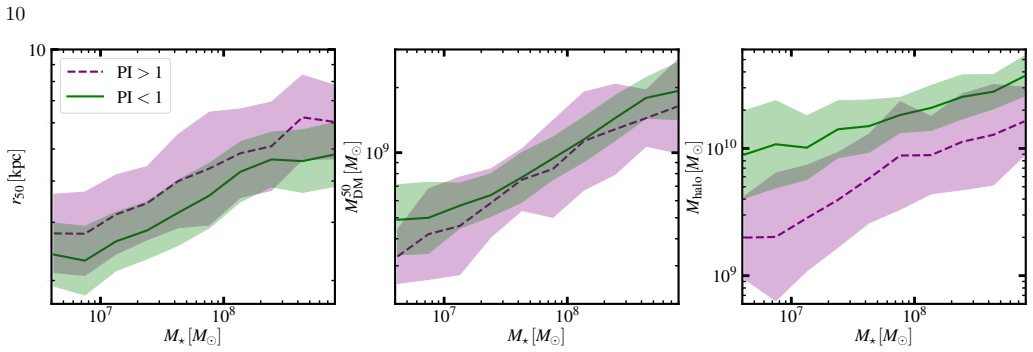
Using roughly 1,200 galaxies (886 centrals and 332 satellites) with stellar masses $10^6$–$10^9\,M_\odot$ from FIREbox, the paper shows that the residuals around the size–mass, inner dark matter mass–stellar mass, and halo mass–stellar mass relations of central galaxies correlate with the Perturbation Index. Galaxies with $\mathrm{PI} > 1$ sit, on average, above the median $r_{50}$–$M_\star$ relation (more extended) and below the median $M_{\rm halo}$–$M_\star$ relation (lower halo mass) compared with galaxies with $\mathrm{PI} < 1$; the inner dark matter mass relation is similar for the two populations except at the lowest stellar masses, where environment and feedback become more important. Random Forest models trained on $\log M_{\rm halo}$, $\log(M_\star/M_{\rm halo})$, and $\log(\mathrm{PI})$ achieve mean test $R^2 \approx 0.32$ for relative size and $R^2 \approx 0.41$ for relative inner dark matter content. In the model, all three features matter comparably for relative size, while halo mass is the dominant predictor of inner dark matter content. Since $M_{\rm halo}$ at fixed stellar mass is itself lowered by the environment, the paper's central claim is that environmental conditions shape galactic sizes and inner dark matter content directly and indirectly through halo mass.
Load-bearing premise
The load-bearing premise is that the Perturbation Index measures the surrounding environment independently of the target galaxy's own properties, but the index is defined with the target galaxy's halo mass and radius in the denominator, so at fixed stellar mass a galaxy with a smaller halo automatically has a larger PI even if its surrounding tidal field is unchanged.
Editorial extensions
If this is right
- At fixed stellar mass, low-mass galaxies with $\mathrm{PI}>1$ are systematically more extended and have lower halo masses than their $\mathrm{PI}<1$ counterparts.
- Relative size scatter is set by a combination of halo mass, stellar-to-halo mass ratio, and environment, while relative inner dark matter content is dominated by halo mass.
- Because environment suppresses halo mass at fixed stellar mass, environmental effects reach galaxy structure both directly and through the halo-mass channel.
- More than half of satellite galaxies in the sample are dark-matter-poor and extended, consistent with tidal stripping during infall into a host.
- At the lowest stellar masses ($M_\star < 10^7\,M_\odot$), shallow potential wells make inner dark matter content especially sensitive to environment and feedback.
Reading between the lines
- A testable consequence the paper does not run: if the Perturbation Index is replaced by an environment metric that does not divide by the target galaxy's own halo mass and radius, such as fixed-aperture neighbour counts or distance to the nearest massive halo, a physical direct environmental channel should survive, while a pure normalisation artifact should weaken or vanish.
- The paper's indirect channel implies that some of the scatter in low-mass galaxy rotation curves now attributed to baryonic feedback or halo concentration could instead record tidal histories, a prediction that could be checked with zoom-in simulations tracking halo mass loss separately from star formation.
- Upcoming wide surveys of dwarf galaxies could look for field dwarfs near massive neighbours whose sizes and inner dark matter deficits match high-PI simulated systems, turning the simulation result into an observational test.
- The same logic suggests that the most extended ultra-diffuse galaxies may preferentially be found in moderately perturbed, low-halo-mass systems rather than only in dense clusters, a sharper prediction than the paper states.
Editorial analysis
A structured set of objections, weighed in public.
Referee Report
Summary. The manuscript uses the FIREbox cosmological volume simulation to study roughly 1,200 low-mass galaxies (M_star between 10^6 and 10^9 M_sun), analyzing the size–mass relation, the inner dark-matter–stellar-mass relation, and the halo-mass–stellar-mass relation at fixed stellar mass. The environment is quantified by the Perturbation Index (PI) defined in Eq. (5), and the analysis compares PI > 1 and PI < 1 subpopulations, then trains a Random Forest regressor on log M_halo, log M_star/M_halo, and log PI to predict residuals from the median central-galaxy scaling relations. The paper reports that galaxies with higher PI are larger and less massive in their halos at fixed stellar mass, that all three features contribute to predicting size residuals while M_halo dominates inner dark-matter residuals, and concludes that environment influences galaxy size and inner dark-matter content both directly and indirectly through its effect on halo mass.
Significance. If the claimed direct/indirect decomposition were established, the paper would provide a notable result: environment, not only halo mass, would be a fundamental driver of low-mass galaxy structure, with implications for dwarf galaxy diversity and future survey analyses. The manuscript has real strengths: it draws on a high-resolution cosmological volume simulation, uses a sizable low-mass sample, and the Random Forest importance scores are reported as stable across 500 train/test splits. However, the central decomposition is not established, because the PI as defined in Eq. (5) includes the target galaxy's own halo mass and radius, so the paper's environmental variable is partly a re-expression of the very quantity it claims to act alongside. This is a load-bearing issue for the abstract's main claim, and it requires a substantive revision rather than a local fix.
major comments (3)
- [Eq. (5), Sec. 2.4] The Perturbation Index is not an independent environmental metric: PI = sum_c (M_c/M_p)(r_p/D)^3 contains the target galaxy's own halo mass M_p and halo radius r_p in the denominator. For satellites, M_p and r_p are the tidally truncated values defined in Sec. 2.2, so tidal stripping lowers both and inflates PI even if the surrounding neighbor distribution is unchanged. At fixed stellar mass, the paper itself shows (Fig. 7) that lower M_halo correlates with larger Delta log r50 and smaller Delta log M50_DM. Therefore the positive Delta log r50 versus PI trend in Fig. 5 and the lower M_halo sequence for PI > 1 in Fig. 4 are partly guaranteed by the construction of PI, not by a separately measured environment. The abstract's concluding statement that environment acts indirectly through its impact on halo mass is not supported, because the causal chain is entangled with a definitional link.
- [Sec. 3.4, Fig. 8] The control attempted in Fig. 8 does not solve the circularity. Even after binning by M_halo, the PI axis is still a function of M_halo through the M_p and r_p terms in Eq. (5). Within a halo-mass bin, galaxies at the lower-mass edge will have mechanically larger PI values, so the reported weak positive Delta log r50 versus PI correlation in the intermediate bins may simply reflect residual within-bin M_halo variation. To claim a direct environmental effect at fixed mass, the authors need an environmental measure that does not use the target's own M_halo or r_halo, or they need to demonstrate explicitly that within-bin M_halo variation cannot drive the trend.
- [Secs. 2.5 and 3.3, Fig. 6] The Random Forest analysis feeds both log PI and log M_halo as features even though the two are algebraically related through Eq. (5) at fixed stellar mass. With correlated features, tree-based importance scores can be split arbitrarily between the two, so Fig. 6 cannot identify a 'direct' environmental contribution separate from the halo-mass contribution. The moderate test-set R2 values (0.32 and 0.41) do not mitigate this issue, because the model can exploit the algebraic link rather than a physical environmental effect. A cleaner test would replace PI with an external tidal-field or neighbor-density metric that excludes the target-object properties, or use permutation importance with a deliberately constructed control feature.
minor comments (7)
- [Sec. 2.2] The text says halos are 'spherical systems with viral radii'; 'viral' should be 'virial.'
- [Table 1] The hyperparameter table is hard to read: the columns labeled 'max features' and 'min samples leaf' contain values 'sqrt' and '3,' but it is not stated which target each row's optimized values refer to; please state explicitly that 'sqrt' is the max_features setting and 3 is min_samples_leaf for both targets.
- [Abstract and Sec. 3.2] The phrase 'lower masses' in the abstract is ambiguous; the manuscript actually claims lower halo masses, while the inner dark-matter relation is reported as similar for PI > 1 and PI < 1 except at low stellar mass. Please specify which mass is meant.
- [Sec. 2.3] Four galaxies with M_star below 4 x 10^6 M_sun are excluded from Fig. 2 but included in the rest of the analysis; please state whether any reported median trends change if these four galaxies are excluded everywhere.
- [Sec. 3.4] The claim of a 'weak positive correlation' between Delta log r50 and PI in the two intermediate mass bins of Fig. 8 is not quantified; reporting a Spearman correlation coefficient and the associated uncertainty for each panel would make the visual claim testable.
- [Sec. 2.5.2] The text says GridSearchCV optimizes max_features and min_samples_leaf, then notes that setting max_features=None changes absolute importances but not rankings; please provide these alternative values or a figure version so the reader can assess the sensitivity quantitatively.
- [Sec. 4] There is a typo in the summary section: 'through it's effect' should be 'through its effect.'
Circularity Check
Partial circularity: the Perturbation Index (Eq. 5) includes the target galaxy's own M_halo and r_halo, so the claimed direct/indirect environment-versus-halo-mass decomposition is partly true by construction.
-
self definitional
[Section 2.4, Eq. 5; Abstract; Section 3.3]
"PI ≡ Σ F^c_tidal/F^p_bind ≃ Σ_{c=0}^{k(<rmax)} (M^c_halo/M^p_halo)(r^p_halo/D_cp)^3, where M^p_halo and r^p_halo are the halo mass and radius of the primary galaxy... We use halo masses and radii in our formulation, rather than the stellar mass and galactic sizes (r50)... because M_halo is also strongly affected by the environment, our findings indicate that environmental conditions not only influence galactic sizes and relative inner dark matter content directly, but also indirectly through their impact on halo mass."
Eq. 5 puts the primary's own M_halo and r_halo into the definition of PI. The analysis then feeds log PI and log M_halo to the random forest as separate features and concludes that environment acts indirectly through M_halo. At fixed M_star and fixed neighbors, PI ∝ r_halo^3/M_halo, so PI and M_halo are algebraically linked: changing M_halo changes PI even when the surrounding galaxy distribution is identical. The PI>1 vs PI<1 splits (Figs. 4-5) and the RF importance of log PI therefore partly re-express this built-in dependence, and the M_halo binning in Fig. 8 cannot remove the M_halo inside PI. The effect is partial: for centrals, Eq. 1 gives r_vir^3/M_vir constant, so the forced component is strongest for satellites (Eq.
full rationale
The FIREbox scaling relations in Figs. 2-4 are self-contained empirical measurements, and the random-forest fits are not relabeled physical predictions; no load-bearing self-citation chain is used. The circularity is localized to the interpretive decomposition: Eq. 5 defines PI with the primary's M_halo and r_halo, while the abstract's central claim treats PI as an environmental driver that operates indirectly through M_halo. Feeding log PI and log M_halo as separate features therefore cannot cleanly separate mass from environment, and the PI splits in Figs. 4-5 partly encode the algebraic PI-r_halo^3/M_halo relation. Because centrals have r_vir^3/M_vir constant, the forced component is partial (strongest for satellites and for RF feature overlap), so the paper retains independent empirical content but its headline direct/indirect conclusion is partly true by construction.
Assumptions & free parameters
free parameters (1)
- Random Forest hyperparameters (max_features, min_samples_leaf, n_estimators) =
max_features='sqrt', min_samples_leaf=3, n_estimators=600
assumptions (4)
- domain assumption The FIRE-2 feedback model in FIREbox accurately reproduces the relevant gas and stellar physics for low-mass galaxies.
- domain assumption Halo masses defined via virial radius for centrals and truncated radius for satellites are comparable in the scaling relations and RF features.
- domain assumption Random Forest feature importances can be interpreted as a measure of predictive influence for these correlated features.
- domain assumption The Perturbation Index is a valid and complete summary of relevant environmental effects.
Cite this review
Pith. "Pith review of Effects of galactic environment on size and dark matter content in low-mass galaxies." pith.science (2026). https://pith.science/paper/WCCZKZJF
@misc{pith2026250104084,
  author       = {Pith},
  title        = {Pith review of: Effects of galactic environment on size and dark matter content in low-mass galaxies},
  year         = {2026},
  howpublished = {\url{https://pith.science/paper/WCCZKZJF}},
  note         = {Machine review of arXiv:2501.04084}
}
abstract
We utilize the cosmological volume simulation, FIREbox, to investigate how a galaxy's environment influences its size and dark matter content. Our study focuses on approximately 1,200 galaxies (886 central and 332 satellite halos) in the low-mass regime, with stellar masses between $10^6$ to $10^9$ $M_{\odot}$. We analyze the size-mass relation ($r_{50} - M_{\star}$), inner dark matter mass-stellar mass ($M^{50}_{\rm DM} - M_{\star}$) relation, and the halo mass-stellar mass ($M_{\rm halo} - M_{\star}$) relation. At fixed stellar mass, we find the galaxies experiencing stronger tidal influences, indicated by higher Perturbation Indices (PI $>$ 1) are generally larger and have lower masses relative to their counterparts with lower Perturbation Indices (PI $<$ 1). Applying a Random Forest regression model, we show that both the environment (PI) and halo mass ($M_{rm halo}$) are significant predictors of a galaxy's relative size and dark matter content. Notably, because $M_{\rm halo}$ is also strongly affected by the environment, our findings indicate that environmental conditions not only influence galactic sizes and relative inner dark matter content directly, but also indirectly through their impact on halo mass. Our results highlight a critical interplay between environmental factors and halo mass in shaping galaxy properties, affirming the environment as a fundamental driver in galaxy formation and evolution.
Figures


Figures from the paper (6 more)


Forward citations
Cited by 1 Pith paper
-
2D light distributions of dwarf galaxies -- key tests of the implementation of physical processes in simulations
NewHorizon simulated dwarf galaxies are systematically more extended, lower surface brightness, and bluer than Fornax cluster dwarfs of the same stellar mass, even when measured with the same 2D photometric pipeline.
Reference graph
Works this paper leans on
-
[1]
, " * write output.state after.block = add.period write newline
ENTRY address archivePrefix author booktitle chapter doi edition editor eprint howpublished institution journal key month number organization pages publisher school series title misctitle type volume year version url label extra.label sort.label short.list INTEGERS output.state before.all mid.sentence after.sentence after.block FUNCTION init.state.consts ...
-
[2]
write newline
" write newline "" before.all 'output.state := FUNCTION format.url url empty "" new.block "" url * "" * if FUNCTION format.eprint eprint empty "" archivePrefix empty "" archivePrefix "arXiv" = new.block " " eprint * " " * new.block " " eprint * " " * if if if FUNCTION format.doi doi empty "" " " doi * " " * if FUNCTION format.pid doi empty eprint empty ur...
-
[3]
ᅨ? 5j( OP K D.P_kC - A
thebibliography [1] 20pt to REFERENCES 6pt =0pt -12pt 10pt plus 3pt =0pt =0pt =1pt plus 1pt =0pt =0pt -12pt =13pt plus 1pt =20pt =13pt plus 1pt \@M =10000 =-1.0em =0pt =0pt 0pt =0pt =1.0em @enumiv\@empty 10000 10000 `\.\@m \@noitemerr \@latex@warning Empty `thebibliography' environment \@ifnextchar \@reference \@latexerr Missing key on reference command E...
2021
-
[4]
W., Treu , T., Gavazzi , R., et al
Auger , M. W., Treu , T., Gavazzi , R., et al. 2010, , 721, L163, 10.1088/2041-8205/721/2/L163
-
[5]
Benavides , J. A., Sales , L. V., Abadi , M. G., et al. 2023, , 522, 1033, 10.1093/mnras/stad1053
-
[6]
2024, arXiv e-prints, arXiv:2407.15938, 10.48550/arXiv.2407.15938
---. 2024, arXiv e-prints, arXiv:2407.15938, 10.48550/arXiv.2407.15938
-
[7]
2015, py-sphviewer: Py-SPHViewer v1.0.0, 10.5281/zenodo.21703
Benitez-Llambay, A. 2015, py-sphviewer: Py-SPHViewer v1.0.0, 10.5281/zenodo.21703
-
[9]
2011 b , , 412, L6, 10.1111/j.1745-3933.2010.00982.x
---. 2011 b , , 412, L6, 10.1111/j.1745-3933.2010.00982.x
arXiv 2011
Show all 99 references
-
[10]
Bluck , A. F. L., Mendel , J. T., Ellison , S. L., et al. 2016, , 462, 2559, 10.1093/mnras/stw1665
2016 doi
-
[11]
2006, , 369, 1081, 10.1111/j.1365-2966.2006.10379.x
Boylan-Kolchin , M., Ma , C.-P., & Quataert , E. 2006, , 369, 1081, 10.1111/j.1365-2966.2006.10379.x
2006
-
[12]
2001, Machine Learning, 45, 5, 10.1023/A:1010933404324
Breiman , L. 2001, Machine Learning, 45, 5, 10.1023/A:1010933404324
2001 doi
- [13]
-
[14]
2013, , 778, L2, 10.1088/2041-8205/778/1/L2
Cappellari , M. 2013, , 778, L2, 10.1088/2041-8205/778/1/L2
2013 doi
-
[15]
G., Greene , J
Carlsten , S. G., Greene , J. E., Greco , J. P., Beaton , R. L., & Kado-Fong , E. 2021, , 922, 267, 10.3847/1538-4357/ac2581
2021 doi
- [16]
-
[17]
2014, , 444, 682, 10.1093/mnras/stu1375
Cebri \'a n , M., & Trujillo , I. 2014, , 444, 682, 10.1093/mnras/stu1375
2014 doi
-
[18]
K., Kere s , D., O \ n orbe , J., et al
Chan , T. K., Kere s , D., O \ n orbe , J., et al. 2015, , 454, 2981, 10.1093/mnras/stv2165
2015 doi
-
[19]
K., Dubois , Y., et al
Choi , H., Yi , S. K., Dubois , Y., et al. 2018, , 856, 114, 10.3847/1538-4357/aab08f
2018 doi
-
[20]
R., Brooks , A
Christensen , C. R., Brooks , A. M., Munshi , F., et al. 2024, , 961, 236, 10.3847/1538-4357/ad0c5a
2024 doi
-
[21]
R., Dav \'e , R., Governato , F., et al
Christensen , C. R., Dav \'e , R., Governato , F., et al. 2016, , 824, 57, 10.3847/0004-637X/824/1/57
2016 doi
-
[23]
A., Schaye , J., Bower , R
Crain , R. A., Schaye , J., Bower , R. G., et al. 2015, , 450, 1937, 10.1093/mnras/stv725
2015 doi
- [24]
-
[25]
2014, , 441, 203, 10.1093/mnras/stu496
Delaye , L., Huertas-Company , M., Mei , S., et al. 2014, , 441, 203, 10.1093/mnras/stu496
2014 doi
-
[27]
B., Macci \`o , A
Di Cintio , A., Brook , C. B., Macci \`o , A. V., et al. 2014, , 437, 415, 10.1093/mnras/stt1891
2014 doi
-
[28]
J., & Hernquist , L
D'Onghia , E., Besla , G., Cox , T. J., & Hernquist , L. 2009, , 460, 605, 10.1038/nature08215
2009 doi
-
[29]
2010, , 725, 353, 10.1088/0004-637X/725/1/353
D'Onghia , E., Vogelsberger , M., Faucher-Giguere , C.-A., & Hernquist , L. 2010, , 725, 353, 10.1088/0004-637X/725/1/353
2010 doi
-
[30]
A., Conroy , C., van den Bosch , F
Dutton , A. A., Conroy , C., van den Bosch , F. C., Prada , F., & More , S. 2010, , 407, 2, 10.1111/j.1365-2966.2010.16911.x
2010
-
[31]
2016, , 820, 131, 10.3847/0004-637X/820/2/131
El-Badry , K., Wetzel , A., Geha , M., et al. 2016, , 820, 131, 10.3847/0004-637X/820/2/131
2016 doi
- [32]
-
[33]
F., Frenk , C
Fattahi , A., Navarro , J. F., Frenk , C. S., et al. 2018, , 476, 3816, 10.1093/mnras/sty408
2018 doi
-
[34]
2022, arXiv e-prints, arXiv:2205.15325
Feldmann , R., Quataert , E., Faucher-Gigu \`e re , C.-A., et al. 2022, arXiv e-prints, arXiv:2205.15325. 2205.15325
2022 arXiv
-
[35]
2017, , 472, 3378, 10.1093/mnras/stx2171
Frings , J., Macci \`o , A., Buck , T., et al. 2017, , 472, 3378, 10.1093/mnras/stx2171
2017 doi
-
[36]
M., Powell , M
Ghosh , A., Urry , C. M., Powell , M. C., et al. 2024, , 971, 142, 10.3847/1538-4357/ad596f
2024 doi
-
[39]
Ho, T. K. 1995, in Proceedings of 3rd International Conference on Document Analysis and Recognition, Vol. 1, 278--282 vol.1, 10.1109/ICDAR.1995.598994
1995
-
[40]
Hopkins , P. F. 2015, , 450, 53, 10.1093/mnras/stv195
2015 doi
-
[41]
F., Kere s , D., O \ n orbe , J., et al
Hopkins , P. F., Kere s , D., O \ n orbe , J., et al. 2014, , 445, 581, 10.1093/mnras/stu1738
2014 doi
-
[42]
F., Wetzel , A., Kere s , D., et al
Hopkins , P. F., Wetzel , A., Kere s , D., et al. 2018, , 480, 800, 10.1093/mnras/sty1690
2018 doi
-
[43]
F., Wetzel , A., Wheeler , C., et al
Hopkins , P. F., Wetzel , A., Wheeler , C., et al. 2022, arXiv e-prints, arXiv:2203.00040. 2203.00040
2022 arXiv
-
[44]
M., Ferguson , H
Huang , K.-H., Fall , S. M., Ferguson , H. C., et al. 2017, , 838, 6, 10.3847/1538-4357/aa62a6
2017 doi
-
[45]
Hunter , J. D. 2007, Computing in Science and Engineering, 9, 90, 10.1109/MCSE.2007.55
2007 doi
-
[47]
A., Martin , G., Kaviraj , S., et al
Jackson , R. A., Martin , G., Kaviraj , S., et al. 2021, , 502, 4262, 10.1093/mnras/stab077
2021 doi
-
[48]
D., & Makarov , D
Karachentsev , I. D., & Makarov , D. I. 1999, in Galaxy Interactions at Low and High Redshift, ed. J. E. Barnes & D. B. Sanders , Vol. 186, 109
1999
-
[49]
D., Makarov , D
Karachentsev , I. D., Makarov , D. I., & Kaisina , E. I. 2013, , 145, 101, 10.1088/0004-6256/145/4/101
2013 doi
-
[52]
D., Ding , X., et al
Kawinwanichakij , L., Silverman , J. D., Ding , X., et al. 2021, , 921, 38, 10.3847/1538-4357/ac1f21
2021 doi
-
[53]
L., Callegari , S., Mayer , L., & Moustakas , L
Kazantzidis , S., okas , E. L., Callegari , S., Mayer , L., & Moustakas , L. A. 2011, , 726, 98, 10.1088/0004-637X/726/2/98
2011 doi
-
[54]
E., et al
Kelkar , K., Arag \'o n-Salamanca , A., Gray , M. E., et al. 2015, , 450, 1246, 10.1093/mnras/stv670
2015 doi
-
[55]
S., Moreno , J., et al
Klein , C., Bullock , J. S., Moreno , J., et al. 2024, , 532, 538, 10.1093/mnras/stae1505
2024 doi
-
[56]
R., & Knebe , A
Knollmann , S. R., & Knebe , A. 2009, , 182, 608, 10.1088/0067-0049/182/2/608
2009 doi
- [57]
-
[58]
V., Gnedin , O
Kravtsov , A. V., Gnedin , O. Y., & Klypin , A. A. 2004, , 609, 482, 10.1086/421322
2004 doi
-
[59]
P., Robotham , A
Lange , R., Driver , S. P., Robotham , A. S. G., et al. 2015, , 447, 2603, 10.1093/mnras/stu2467
2015 doi
-
[60]
G., et al
Lani , C., Almaini , O., Hartley , W. G., et al. 2013, , 435, 207, 10.1093/mnras/stt1275
2013 doi
-
[61]
S., Boylan-Kolchin , M., et al
Lazar , A., Bullock , J. S., Boylan-Kolchin , M., et al. 2020, , 497, 2393, 10.1093/mnras/staa2101
2020 doi
-
[62]
2011, , 2011, 018, 10.1088/1475-7516/2011/03/018
Lewis , A., Challinor , A., & Hanson , D. 2011, , 2011, 018, 10.1088/1475-7516/2011/03/018
2011 doi
-
[63]
2000, , 538, 473, 10.1086/309179
Lewis , A., Challinor , A., & Lasenby , A. 2000, , 538, 473, 10.1086/309179
2000 doi
-
[64]
2019, , 485, 796, 10.1093/mnras/stz356
Martin , G., Kaviraj , S., Laigle , C., et al. 2019, , 485, 796, 10.1093/mnras/stz356
2019 doi
-
[65]
2004, , 349, 1251, 10.1111/j.1365-2966.2004.07573.x
Mateus , A., & Sodr \'e , L. 2004, , 349, 1251, 10.1111/j.1365-2966.2004.07573.x
2004
-
[66]
2001, , 547, L123, 10.1086/318898
Mayer , L., Governato , F., Colpi , M., et al. 2001, , 547, L123, 10.1086/318898
2001 doi
-
[67]
J., Bullock , J
Mercado , F. J., Bullock , J. S., Moreno , J., et al. 2024, , 530, 1349, 10.1093/mnras/stae819
2024 doi
-
[68]
1999, , 524, L19, 10.1086/312287
Moore , B., Ghigna , S., Governato , F., et al. 1999, , 524, L19, 10.1086/312287
1999 doi
-
[69]
S., et al
Moreno , J., Danieli , S., Bullock , J. S., et al. 2022, Nature Astronomy, 6, 496, 10.1038/s41550-021-01598-4
2022 doi
-
[70]
J., & Franx , M
Mosleh , M., Williams , R. J., & Franx , M. 2013, , 777, 117, 10.1088/0004-637X/777/2/117
2013 doi
-
[71]
2018, , 479, 2147, 10.1093/mnras/sty1543
Moutard , T., Sawicki , M., Arnouts , S., et al. 2018, , 479, 2147, 10.1093/mnras/sty1543
2018 doi
-
[72]
Mowla , L., van der Wel , A., van Dokkum , P., & Miller , T. B. 2019, , 872, L13, 10.3847/2041-8213/ab0379
2019 doi
-
[74]
L., Kere s , D., Faucher-Gigu \`e re , C.-A., et al
Muratov , A. L., Kere s , D., Faucher-Gigu \`e re , C.-A., et al. 2015, , 454, 2691, 10.1093/mnras/stv2126
2015 doi
-
[75]
J., Crnojevi \'c , D., et al
Mutlu-Pakdil , B., Sand , D. J., Crnojevi \'c , D., et al. 2024, , 966, 188, 10.3847/1538-4357/ad36c4
2024 doi
-
[76]
2018, , 475, 624, 10.1093/mnras/stx3040
Nelson , D., Pillepich , A., Springel , V., et al. 2018, , 475, 624, 10.1093/mnras/stx3040
2018 doi
-
[77]
S., et al
O \ n orbe , J., Boylan-Kolchin , M., Bullock , J. S., et al. 2015, , 454, 2092, 10.1093/mnras/stv2072
2015 doi
-
[78]
H., et al
O \ n orbe , J., Garrison-Kimmel , S., Maller , A. H., et al. 2014, , 437, 1894, 10.1093/mnras/stt2020
2014 doi
-
[79]
2011, , 736, L2, 10.1088/2041-8205/736/1/L2
Ogiya , G., & Mori , M. 2011, , 736, L2, 10.1088/2041-8205/736/1/L2
2011 doi
-
[80]
A., Navarro , J
Oman , K. A., Navarro , J. F., Fattahi , A., et al. 2015, , 452, 3650, 10.1093/mnras/stv1504
2015 doi
-
[81]
F., & McConnachie , A
Pe \ n arrubia , J., Navarro , J. F., & McConnachie , A. W. 2008, , 673, 226, 10.1086/523686
2008 doi
-
[82]
2011, Journal of Machine Learning Research, 12, 2825
Pedregosa, F., Varoquaux, G., Gramfort, A., et al. 2011, Journal of Machine Learning Research, 12, 2825. http://jmlr.org/papers/v12/pedregosa11a.html
2011
-
[83]
J., Kova c , K., et al
Peng , Y.-j., Lilly , S. J., Kova c , K., et al. 2010, , 721, 193, 10.1088/0004-637X/721/1/193
2010 doi
-
[84]
Perez , F., & Granger , B. E. 2007, Computing in Science and Engineering, 9, 21, 10.1109/MCSE.2007.53
2007 doi
-
[85]
2018, , 473, 4077, 10.1093/mnras/stx2656
Pillepich , A., Springel , V., Nelson , D., et al. 2018, , 473, 4077, 10.1093/mnras/stx2656
2018 doi
-
[86]
Planck Collaboration , Ade , P. A. R., Aghanim , N., et al. 2016, , 594, A13, 10.1051/0004-6361/201525830
2016 doi
-
[87]
2012, , 421, 3464, 10.1111/j.1365-2966.2012.20571.x
Pontzen , A., & Governato , F. 2012, , 421, 3464, 10.1111/j.1365-2966.2012.20571.x
2012
-
[88]
D., Angulo , R
Rodriguez , F., Montero-Dorta , A. D., Angulo , R. E., Artale , M. C., & Merch \'a n , M. 2021, , 505, 3192, 10.1093/mnras/stab1571
2021 doi
-
[89]
S., et al
Rohr , E., Feldmann , R., Bullock , J. S., et al. 2022, , 510, 3967, 10.1093/mnras/stab3625
2022 doi
-
[90]
2007, , 382, 2, 10.1111/j.1365-2966.2007.12190.x
Romano-D \' az , E., & van de Weygaert , R. 2007, , 382, 2, 10.1111/j.1365-2966.2007.12190.x
2007
-
[91]
B., Agertz , O., & Renaud , F
Romeo , A. B., Agertz , O., & Renaud , F. 2020, , 499, 5656, 10.1093/mnras/staa3245
2020 doi
-
[92]
A., Bower , R
Schaye , J., Crain , R. A., Bower , R. G., et al. 2015, , 446, 521, 10.1093/mnras/stu2058
2015 doi
-
[93]
2014, , 439, 3189, 10.1093/mnras/stt2470
Shankar , F., Mei , S., Huertas-Company , M., et al. 2014, , 439, 3189, 10.1093/mnras/stt2470
2014 doi
-
[94]
J., White , S
Shen , S., Mo , H. J., White , S. D. M., et al. 2003, , 343, 978, 10.1046/j.1365-8711.2003.06740.x
2003
-
[95]
2018, , 475, 676, 10.1093/mnras/stx3304
Springel , V., Pakmor , R., Pillepich , A., et al. 2018, , 475, 676, 10.1093/mnras/stx3304
2018 doi
-
[96]
S., Dalcanton , J
Stinson , G. S., Dalcanton , J. J., Quinn , T., et al. 2009, , 395, 1455, 10.1111/j.1365-2966.2009.14555.x
2009
-
[97]
2016, , 818, 193, 10.3847/0004-637X/818/2/193
Tomozeiu , M., Mayer , L., & Quinn , T. 2016, , 818, 193, 10.3847/0004-637X/818/2/193
2016 doi
-
[98]
Trujillo , I., Ferreras , I., & de La Rosa , I. G. 2011, , 415, 3903, 10.1111/j.1365-2966.2011.19017.x
2011
-
[99]
C., & Varoquaux, G
Van Der Walt, S., Colbert, S. C., & Varoquaux, G. 2011, Computing in Science & Engineering, 13, 22
2011
-
[100]
G., et al
van der Wel , A., Franx , M., van Dokkum , P. G., et al. 2014, , 788, 28, 10.1088/0004-637X/788/1/28
2014 doi
-
[101]
2007, , 472, 121, 10.1051/0004-6361:20077481
Verley , S., Leon , S., Verdes-Montenegro , L., et al. 2007, , 472, 121, 10.1051/0004-6361:20077481
2007 doi
-
[102]
E., et al
Virtanen , P., Gommers , R., Oliphant , T. E., et al. 2020, Nature Methods, 17, 261, 10.1038/s41592-019-0686-2
2020 doi
-
[103]
Waskom, M. L. 2021, Journal of Open Source Software, 6, 3021, 10.21105/joss.03021
2021 doi
-
[104]
R., Tinker , J
Wetzel , A. R., Tinker , J. L., Conroy , C., & van den Bosch , F. C. 2013, , 432, 336, 10.1093/mnras/stt469
2013 doi
-
[105]
2017, , 834, 73, 10.3847/1538-4357/834/1/73
Yoon , Y., Im , M., & Kim , J.-W. 2017, , 834, 73, 10.3847/1538-4357/834/1/73
2017 doi
-
[106]
2023, , 957, 59, 10.3847/1538-4357/acfed5
Yoon , Y., Kim , J.-W., & Ko , J. 2023, , 957, 59, 10.3847/1538-4357/acfed5
2023 doi
-
[107]
2019, Research in Astronomy and Astrophysics, 19, 006, 10.1088/1674-4527/19/1/6
Zhang , Y.-C., & Yang , X.-H. 2019, Research in Astronomy and Astrophysics, 19, 006, 10.1088/1674-4527/19/1/6
2019 doi
- [108]
Reviewed August 10, 2026 · model on record in the stance chip above.
Discussion (0). Continue with ORCID to comment.