REVIEW 2 major objections 5 minor 77 references
Multipole phases in a type of spin ladders with local conserved quantities and generalizations
T0 review · 2 major / 5 minor · reviewed 2026-08-06 · deepseek-v4-flash
Pith's one-line read Exact multipole phases in spin ladders reduce to transverse-field Ising models.
desk verdict Exact mappings of these ladders to Ising/ANNNI models are checkable and correct; the phase diagrams are more conditional than the title suggests, but the central construction deserves a serious referee. read the letter →
The pith
A machine-rendered reading of the paper's core claim, the machinery that carries it, and where it could break.
The reading
What carries the argument
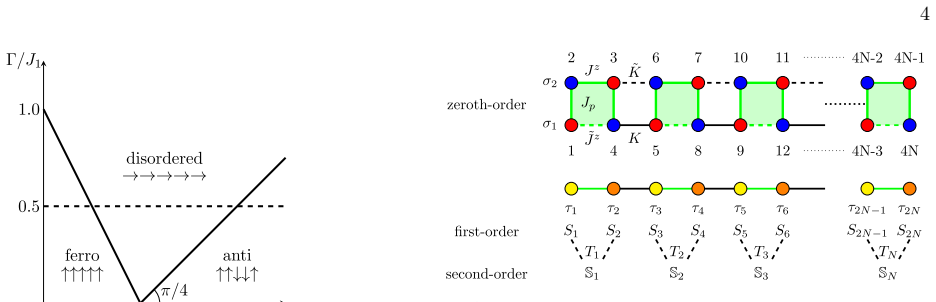
The central object is the dimer-local conserved quantity $\tau_n = \sigma^z_{2n-1}\sigma^z_{2n}$, together with a two-step Jordan-Wigner transformation along a zig-zag string. First the original spins become Majorana fermions and the dimer products become static $\mathbb{Z}_2$ variables; then pairing the two sites of each $J$-bond defines a first-order spin $S_n$ whose $x$-component is $\sigma^y_{2n-1}\sigma^y_{2n}$ and whose $z$-component is a string of $\sigma^z$ operators. This machinery turns the vertical dipole Hamiltonian into a transverse-field Ising model coupled to static $\tau$ variables, and the horizontal ladder into a transverse-field ANNNI model; the same ladder-of-spins construction, iterated, carries quadrupole and octopole models down to transverse-field Ising models of second- and higher-order spins.
What would settle it
Exactly diagonalize the vertical ladder for a small system, say $4N$ up to 16 spins, over all $2^{2N}$ dimer-label sectors without assuming translational symmetry, and compare the lowest-energy sector with the two-site-periodic calculation used for the phase diagram; finding a non-periodic or longer-period sector with lower energy in the labeled regions would revise those boundaries. Alternatively, in a Rydberg realization, measure $D^{zz}(q_x,q_y,\omega)$ and check whether the zero lines occur at $q_y=0$ for the dipole phase and $q_y=\pi$ for the charge-pair phase as predicted.
Extended reading notes
Core claim
The paper constructs exactly solvable spin-ladder Hamiltonians whose ground states are exact multipole phases: conventional spin order carried by composite multipole moments, with zero net magnetization. The construction works because every $J$-bond carries a conserved $\mathbb{Z}_2$ variable $\tau = \sigma^z_i \sigma^z_j$, so the Hilbert space fragments into sectors; inside a sector the residual degree of freedom is a first-order spin $S$ whose Hamiltonian is exactly a transverse-field Ising model (vertical ladder) or an ANNNI model (horizontal ladder). The phases are therefore labeled by the static $\tau$ configuration, which may be dipole, charge-pair, or staggered, together with the ordinary ordered or disordered phase of $S$. The same ladder-of-spins construction produces quadrupole and octopole phases by adding more conserved dimer quantities, and the paper gives a Rydberg-atom realization and a zero-line structure-factor signature for the dipole case.
Load-bearing premise
The load-bearing premise is that the ground state can be restricted to dimer-label configurations repeating every two sites, since a longer-period configuration with lower energy would shift the phase boundaries.
Editorial extensions
If this is right
- The vertical dipole ladder realizes an exact transverse-field Ising transition for the dipole moment $S$, with a weak zero mode in the ordered phase and zero net magnetization of the original spins.
- The zero-temperature dynamical structure factor of the vertical ladder is $(1\pm\cos q_y)$ times the Ising-chain structure factor, so dipole and charge-pair phases produce distinct lines of zeros in momentum space.
- The horizontal ladder maps to an ANNNI model in a transverse field, so its phase diagram contains the anti-phase and the Majumdar-Ghosh point in the appropriate parameter limit.
- Adding quartic plaquette terms promotes the first-order spin to a general XYZ model in a transverse field, and adding more dimer conserved quantities yields quadrupole and octopole phases described by second- and higher-order spins.
- The proposed Rydberg setup, with an electric field tuned so the exchange coupling vanishes on horizontal bonds and a microwave field canceling the effective longitudinal field, realizes the vertical dipole Hamiltonian to nearest-neighbor order.
Reading between the lines
- The paper leaves implicit that a cold-atom emulator of the vertical ladder could directly measure Ising-critical behavior, such as the correlation-length exponent or entanglement scaling, inside a zero-magnetization multipole phase; the paper does not compute these quantities.
- The phase diagrams in the paper assume the ground state has a two-site-periodic pattern of the conserved dimer labels; a longer-period or non-periodic dimer pattern with lower energy would change the displayed phase boundaries, and checking this numerically is a natural extension.
- A natural next step is to extend the electric-field Rydberg design to the quadrupole model, since the required quartic plaquette terms involve four-spin couplings not directly present in the nearest-neighbor Rydberg Hamiltonian considered in the paper.
Signed reviews
Editorial analysis
A structured set of objections, weighed in public.
Referee Report
Summary. The paper introduces a family of spin ladder models, called multipole models, in which dimer-local conserved quantities (products of two Z2 spin operators) fragment the Hilbert space into sectors described by a 'higher-order spin'. For the dipole models, the author derives exact mappings: the vertical ladder (Eq. 1) maps to free fermions coupled to static Z2 variables and then to a transverse-field Ising model of first-order spins (Eq. 4), and the horizontal ladder (Eq. 6) maps to an ANNNI model in a transverse field (Eq. 7). The quadrupole model (Eq. 8) is shown to map to a transverse-field Ising model of second-order spins (Eq. 9). Phase diagrams are presented for the vertical and horizontal ladders and for a quadrupole model, together with a proposal for realizing the vertical-ladder dipole model with electric-field-controlled Rydberg atom arrays and a prediction of zero lines in the dynamical structure factor that distinguish dipole and charge-pair phases.
Significance. If the results hold, the paper provides a family of exactly solvable parent Hamiltonians exhibiting multipole order with zero net magnetization, thereby connecting local conserved quantities to multipole phases and giving concrete experimental signatures (Rydberg realization and DSF zero lines). The exact mappings (Eqs. 4, 7, 9) are elegant and internally consistent, and the identification of phase labels with values of the conserved quantities plus the higher-order spin phases is conceptually appealing. The DSF factorization into (1 +/- cos q_y) times an Ising-chain structure factor is a clean, falsifiable prediction. However, the quantitative phase diagrams rely on an unproven restriction to translationally invariant configurations of the conserved quantities, and the quadrupole phase diagram is computed for a modified Hamiltonian, so the full ground-state phase structure of the announced models is not yet established.
major comments (2)
- [Supplemental Materials, after Eq. (S11) and Eq. (S13)] The sentence 'Only phases which preserve the translational symmetry are considered' restricts the vertical-ladder phase diagram (Fig. 2) to tau configurations with period 1 or 2. The fermionic Hamiltonian (S11)-(S13) has couplings K + tilde-K tau_n tau_{n+1} that depend on the tau configuration; a period-4, period-6, or aperiodic tau configuration with lower fermionic ground-state energy would change the phase boundaries and the extent of the 'staggered' phase. Because the paper claims exact multipole phases as ground states of the parent Hamiltonian, the comparison over all tau sectors is load-bearing. The 16-spin open-boundary ED in Fig. S2 is not decisive for long-period tau order. I ask the author to either (i) prove that the ground-state tau configuration is translationally invariant (e.g., via a reflection-positivity or Perron-Frobenius argument on the effective fermionic Hamiltonian), (ii) extend the calculation to larger unit cells (period 4, 6, ...) over the parameter range of Fig. 2 and show that the phase boundaries do not change, or (iii) explicitly state in the main text that Fig. 2 is a restricted variational phase diagram and correspondingly soften the claims about the 'staggered' phase.
- [Supplemental Materials, Eq. (S25) and the preceding paragraph] The phase diagram in Fig. S3 is computed for a modified Hamiltonian in which extra ZZ couplings on horizontal bonds are added and tilde-J^z is set equal to J^z, whereas the quadrupole model H^(q) announced in Eq. (8) of the main text contains only J^z sigma^z_{4n-2} sigma^z_{4n-1} + tilde-J^z sigma^z_{4n-3} sigma^z_{4n}. As the SM states, the original model has degeneracies (quadrupole vs. CP-dipole and dipole-CP vs. CP-CP) that the added terms lift. Consequently, Fig. S3 is not the phase diagram of the model (8) as written in the main text. The author should either present the phase diagram of the original Hamiltonian (for instance, by adding an infinitesimal symmetry-breaking field and identifying the selection rule), or clearly state that the phase diagram applies to the modified model and explain the physical motivation for the added couplings.
minor comments (5)
- [Rydberg simulation section] The text says 'we thus obtained the dipole model' but should read 'we thus obtain the dipole model'. More substantively, the proposal tunes V(R,theta)=0 for horizontal bonds, which sets the XY coupling to zero, but the Rydberg Hamiltonian (SM Eq. S31) still has an Ising coupling J_z on those bonds (SM Eq. S32); the author should explain how this J_z is matched to the desired K and tilde-K couplings in Eq. (1).
- [Supplemental Materials, Eqs. (S40)-(S41)] In the sentence 'For the dipole phase of the horizontal ladder, S_{x,1,y} ≡ -S_{x,0,y}', the spin component superscript z is missing; it should read S^z_{x,1,y} ≡ -S^z_{x,0,y} for consistency with Eq. (S39).
- [Figures 2 and 3] The captions do not explain the color/pattern scheme used in the lower phase diagrams, nor the correspondence between the upper illustrative configurations and the phase labels. Adding a legend or explicit description would improve readability.
- [Discussion of zero modes] The statement 'Weak zero mode exists in Dipole-o phase [42]' relies on the author's prior work; a brief derivation or an explicit expression for the zero-mode operator in the notation of this paper would make the paper more self-contained.
- [Abstract] The sentence 'The dipole models can in principle be realized in experiments, we propose such realization by electric field controlled Rydberg atom arrays' contains a comma splice; it should be split into two sentences or joined with a semicolon.
Circularity Check
No significant circularity: the ladder models are solved by exact Jordan-Wigner mappings to independent Ising/ANNNI results, with only a minor non-load-bearing self-citation.
full rationale
The central derivations are self-contained exact mappings. Eq. (4) is obtained from Eq. (1) by two Jordan-Wigner transformations, and the phase diagram in Fig. 2 is computed by comparing fermionic ground-state energies (Supplemental Eqs. S13-S15) rather than imposed by the phase labels. Similarly, Eq. (7) is mapped to the ANNNI model and its phase diagram is obtained by 16-site exact diagonalization. The tau-sector labels (dipole, charge-pair, staggered) are definitions, but the ground-state selection among sectors is a computed energy competition, so the existence claim is not simply the input restated. The only self-citation that carries a physical assertion is Ref. [42] for the weak zero mode in the Dipole-o phase; that is a peripheral property and the central existence and phase-diagram results do not reduce to it. The Supplemental explicitly restricts to translationally symmetric tau configurations ('Only phases which preserve the translational symmetry are considered'), which is a completeness caveat for the infinite-system phase diagram but not a circular step, because the exact multipole phases and their Ising/ANNNI characterization are established independently of that search restriction. No fitted parameter is relabeled as a prediction, and the DSF zero-line signatures follow directly from the phase definitions but are stated as experimental discriminators, not as evidence for the definitions.
Assumptions & free parameters
free parameters (3)
- Vertical ladder coupling choice =
Jx=Jy=1, K~=0.8
- Horizontal ladder coupling choice =
Jx=Jy=-1, K=-4
- Quadrupole coupling choice =
Jp^x=Jp^y=1, Jz=0.1, K~=0.8
assumptions (4)
- standard math Jordan-Wigner and Majorana fermionizations faithfully represent the spin Hilbert space.
- ad hoc to paper Only translationally invariant tau configurations need to be compared for the vertical-ladder ground state.
- domain assumption The adopted schematic ANNNI phase diagram is correct for the horizontal ladder parameter regime.
- domain assumption For the Rydberg proposal, interactions beyond nearest neighbors are negligible and the effective longitudinal field can be compensated by microwaves.
Cite this review
Pith. "Pith review of Multipole phases in a type of spin ladders with local conserved quantities and generalizations." pith.science (2026). https://pith.science/paper/WCJD6QBD
@misc{pith2026250704811,
  author       = {Pith},
  title        = {Pith review of: Multipole phases in a type of spin ladders with local conserved quantities and generalizations},
  year         = {2026},
  howpublished = {\url{https://pith.science/paper/WCJD6QBD}},
  note         = {Machine review of arXiv:2507.04811}
}
read the original abstract
We study spin ladder models with exact multipole phases, which are traditional spin phases formed by multipole moments. These phases feature non-trivial order with zero magnetization. The multipole models have dimer local conserved quantities that are Ising terms of spin. The Hilbert spaces are locally fragmented into independent sectors described effectively by ``higher-order spin". For dipole models, we consider two ladder geometries with quadratic spin couplings and work out the phase diagrams. Higher-order multipole models are obtained by introducing more dimer conserved quantities. The phases are characterized by the values of the local conserved quantities and the traditional spin phases of the higher-order spin. The dipole models can in principle be realized in experiments, we propose such realization by electric field controlled Rydberg atom arrays.
Figures


Figures from the paper (2 more)


Reference graph
Works this paper leans on
-
[1]
charge-pair-antiferromagnetic (CP-a)
TheZ 2 conserved quantities onJ-bonds areτ n = σz 2n−1σz 2n =−iη α 2n−1ηβ 2n. With these the Hamiltonian is given by [43] H(d) v = 2NX n=1 h (Jy −J xτn)iηβ 2n−1ηα 2n +J zτn i + 2N−1X n=1 K+ ˜Kτ nτn+1 (−i)ηα 2nηβ 2n+1, (3) which is a free fermion model coupled toτvariables. We pair up everyJ-bond with two sites (2n−1,2n) and label it with numbern, then int...
- [2]
-
[3]
Kitaev, Annals of Physics321, 2 (2006), january Spe- cial Issue
A. Kitaev, Annals of Physics321, 2 (2006), january Spe- cial Issue
2006
-
[4]
Nayak, S
C. Nayak, S. H. Simon, A. Stern, M. Freedman, and S. Das Sarma, Rev. Mod. Phys.80, 1083 (2008)
2008
- [5]
-
[6]
M. Naka and S. Ishihara, Journal of the Physical Society of Japan79, 063707 (2010), https://doi.org/10.1143/JPSJ.79.063707
- [7]
- [8]
Show all 77 references
-
[9]
M. G. Yamada and Y. Tada, Phys. Rev. Res.2, 043077 (2020)
2020
-
[10]
ˇSmejkal, J
L. ˇSmejkal, J. Sinova, and T. Jungwirth, Phys. Rev. X 12, 031042 (2022)
2022
-
[11]
ˇSmejkal, J
L. ˇSmejkal, J. Sinova, and T. Jungwirth, Phys. Rev. X 12, 040501 (2022)
2022
-
[12]
Bhowal and N
S. Bhowal and N. A. Spaldin, Phys. Rev. X14, 011019 (2024)
2024
-
[13]
P. A. McClarty and J. G. Rau, Phys. Rev. Lett.132, 176702 (2024)
2024
-
[14]
P. Sala, T. Rakovszky, R. Verresen, M. Knap, and F. Pollmann, Phys. Rev. X10, 011047 (2020)
2020
-
[15]
Khemani, M
V. Khemani, M. Hermele, and R. Nandkishore, Phys. Rev. B101, 174204 (2020)
2020
-
[16]
Gaiotto, A
D. Gaiotto, A. Kapustin, N. Seiberg, and B. Willett, J. High Energ. Phys.02, 172 (2015)
2015
-
[17]
McGreevy, Annual Review of Condensed Matter Physics14, 57 (2023)
J. McGreevy, Annual Review of Condensed Matter Physics14, 57 (2023)
2023
-
[18]
Yao and S
H. Yao and S. A. Kivelson, Phys. Rev. Lett.99, 247203 (2007)
2007
-
[19]
Fu, Phys
J. Fu, Phys. Rev. B100, 195131 (2019)
2019
-
[20]
DeGottardi, D
W. DeGottardi, D. Sen, and S. Vishveshwara, New Jour- nal of Physics13, 065028 (2011)
2011
-
[21]
F. L. Pedrocchi, S. Chesi, S. Gangadharaiah, and D. Loss, Phys. Rev. B86, 205412 (2012)
2012
-
[22]
Wu, Physics Letters A376, 3530 (2012)
N. Wu, Physics Letters A376, 3530 (2012)
2012
-
[23]
Saffman, T
M. Saffman, T. G. Walker, and K. Mølmer, Rev. Mod. Phys.82, 2313 (2010)
2010
-
[24]
Bernien, S
H. Bernien, S. Schwartz, A. Keesling, H. Levine, A. Om- ran, H. Pichler, S. Choi, A. S. Zibrov, M. Endres, M. Greiner, et al., Nature551, 579 (2017)
2017
-
[25]
Zeiher, R
J. Zeiher, R. Van Bijnen, P. Schauß, S. Hild, J.-y. Choi, T. Pohl, I. Bloch, and C. Gross, Nature Physics12, 1095 (2016)
2016
-
[26]
de L´ es´ eleuc, S
S. de L´ es´ eleuc, S. Weber, V. Lienhard, D. Barredo, H. P. B¨ uchler, T. Lahaye, and A. Browaeys, Phys. Rev. Lett. 120, 113602 (2018)
2018
-
[27]
Browaeys and T
A. Browaeys and T. Lahaye, Nature Physics16, 132 (2020)
2020
-
[28]
T. L. Nguyen, J. M. Raimond, C. Sayrin, R. Corti˜ nas, T. Cantat-Moltrecht, F. Assemat, I. Dotsenko, S. Gleyzes, S. Haroche, G. Roux, T. Jolicoeur, and M. Brune, Phys. Rev. X8, 011032 (2018)
2018
-
[29]
A. W. Glaetzle, M. Dalmonte, R. Nath, C. Gross, I. Bloch, and P. Zoller, Phys. Rev. Lett.114, 173002 (2015)
2015
-
[30]
Chen, B.-Z
Y.-H. Chen, B.-Z. Wang, T.-F. J. Poon, X.-C. Zhou, Z.- X. Liu, and X.-J. Liu, Phys. Rev. Res.6, L042054 (2024)
2024
-
[31]
Yang, B.-Z
T.-H. Yang, B.-Z. Wang, X.-C. Zhou, and X.-J. Liu, Phys. Rev. A106, L021101 (2022)
2022
-
[32]
Tsitsishvili, T
M. Tsitsishvili, T. Chanda, M. Votto, P. Fromholz, M. Dalmonte, and A. Nersesyan, Phys. Rev. B105, 155159 (2022)
2022
-
[33]
Fromholz, M
P. Fromholz, M. Tsitsishvili, M. Votto, M. Dalmonte, A. Nersesyan, and T. Chanda, Phys. Rev. B106, 155411 (2022)
2022
-
[34]
Eck and P
L. Eck and P. Fendley, Phys. Rev. B108, 125135 (2023)
2023
-
[35]
S.-A. Liao, J. Zhang, and L.-P. Yang, Phys. Rev. B111, 165154 (2025)
2025
-
[36]
Sarkar, M
M. Sarkar, M. Pal, A. Sen, and K. Sengupta, SciPost Phys.14, 004 (2023)
2023
-
[37]
Zhang, S
J. Zhang, S. H. Cant´ u, F. Liu, A. Bylinskii, B. Braver- man, F. Huber, J. Amato-Grill, A. Lukin, N. Gemelke, A. Keesling, et al., Nature Communications16, 712 (2025)
2025
-
[38]
T. J. Carroll, K. Claringbould, A. Goodsell, M. J. Lim, and M. W. Noel, Phys. Rev. Lett.93, 153001 (2004)
2004
-
[39]
L. F. Gon¸ calves and L. G. Marcassa, Phys. Rev. A94, 043424 (2016)
2016
-
[40]
Comparat and P
D. Comparat and P. Pillet, J. Opt. Soc. Am. B27, A208 (2010)
2010
-
[41]
M. T. Eiles, H. Lee, J. P´ erez-R ´ ıos, and C. H. Greene, Phys. Rev. A95, 052708 (2017)
2017
-
[42]
Jahangiri, J
A. Jahangiri, J. P. Shaffer, L. F. Gon¸ calves, and L. G. Marcassa, Journal of Physics B: Atomic, Molecular and Optical Physics53, 014001 (2019)
2019
-
[43]
Fu, Phys
J. Fu, Phys. Rev. B106, L161412 (2022)
2022
-
[44]
See Supplemental Materials
-
[45]
Suzuki, J
S. Suzuki, J. Inoue, and B. K. Chakrabarti, Quantum Ising Phases and Transitions in Transverse Ising Models, Lecture Notes in Physics (Springer Berlin, 2013)
2013
-
[46]
Greiter, V
M. Greiter, V. Schnells, and R. Thomale, Annals of Physics351, 1026 (2014)
2014
-
[47]
Y. Niu, S. B. Chung, C.-H. Hsu, I. Mandal, S. Raghu, and S. Chakravarty, Phys. Rev. B85, 035110 (2012)
2012
-
[48]
Fu, Annals of Physics432, 168564 (2021)
J. Fu, Annals of Physics432, 168564 (2021)
2021
-
[49]
Selke, Physics Reports170, 213 (1988)
W. Selke, Physics Reports170, 213 (1988)
1988
-
[50]
M. E. Fisher and W. Selke, Phys. Rev. Lett.44, 1502 (1980)
1980
-
[51]
Hornreich, R
R. Hornreich, R. Liebmann, H. Schuster, and W. Selke, Z. Physik B - Condensed Matter35, 91–97 (1979)
1979
-
[52]
Sen and B
P. Sen and B. K. Chakrabarti, Phys. Rev. B40, 760 (1989)
1989
-
[53]
Arizmendi, A
C. Arizmendi, A. Rizzo, L. Epele, and C. Garc ´ ıa Canal, Z. Physik B - Condensed Matter83, 273–276 (1991)
1991
-
[54]
Sen and B
P. Sen and B. K. Chakrabarti, Phys. Rev. B43, 13559 (1991)
1991
-
[55]
P. Sen, S. Chakraborty, S. Dasgupta, and B. Chakrabarti, Z. Physik B - Condensed Matter 88, 333–338 (1992). 7
1992
-
[56]
Majumdar and D
C. Majumdar and D. Ghosh, J. Math. Phys.10, 1388–1398 (1969)
1969
-
[57]
Majumdar and D
C. Majumdar and D. Ghosh, J. Math. Phys.10, 1399–1402 (1969)
1969
-
[58]
Schwettmann, J
A. Schwettmann, J. Crawford, K. R. Overstreet, and J. P. Shaffer, Phys. Rev. A74, 020701(R) (2006)
2006
-
[59]
Whitlock, A
S. Whitlock, A. W. Glaetzle, and P. Hannaford, Journal of Physics B: Atomic, Molecular and Optical Physics50, 074001 (2017)
2017
-
[60]
R. v. Bijnen, Quantum engineering with ultracold atoms, PhD thesis (Technische Universiteit Eindhoven, 2013)
2013
-
[61]
Y. Jiao, J. Bai, R. Song, S. Bao, J. Zhao, and S. Jia, Frontiers in PhysicsV olume 10 - 2022(2022), 10.3389/fphy.2022.892542
2022
-
[62]
Jordan and E
P. Jordan and E. Wigner, Zeitschrift f¨ ur Physik47, 631 (1928)
1928
-
[63]
E. Lieb, T. Schultz, and D. Mattis, Annals of Physics 16, 407 (1961)
1961
-
[64]
Feng, G.-M
X.-Y. Feng, G.-M. Zhang, and T. Xiang, Phys. Rev. Lett.98, 087204 (2007)
2007
-
[65]
Wang, Y.-H
Y.-Y. Wang, Y.-H. Shi, Z.-H. Sun, C.-T. Chen, Z.-A. Wang, K. Zhao, H.-T. Liu, W.-G. Ma, Z. Wang, H. Li, J.-C. Zhang, Y. Liu, C.-L. Deng, T.-M. Li, Y. He, Z.- H. Liu, Z.-Y. Peng, X. Song, G. Xue, H. Yu, K. Huang, Z. Xiang, D. Zheng, K. Xu, and H. Fan, PRX Quantum 6, 010325 (2025)
2025
-
[66]
Marshall and R
W. Marshall and R. D. Lowde, Reports on Progress in Physics31, 705 (1968)
1968
-
[67]
S. M. Girvin and K. Yang, Modern Condensed Matter Physics (Cambridge Univer- sity Press, 2019)
2019
-
[68]
J. Fu, J. G. Rau, M. J. P. Gingras, and N. B. Perkins, Phys. Rev. B96, 035136 (2017)
2017
-
[69]
Ko, Z.-X
W.-H. Ko, Z.-X. Liu, T.-K. Ng, and P. A. Lee, Phys. Rev. B81, 024414 (2010)
2010
-
[70]
Derzhko and T
O. Derzhko and T. Krokhmalskii, Phys. Rev. B56, 11659 (1997)
1997
-
[71]
J.-S. Caux, F. H. L. Essler, and U. L¨ ow, Phys. Rev. B 68, 134431 (2003)
2003
-
[72]
A. J. A. James, W. D. Goetze, and F. H. L. Essler, Phys. Rev. B79, 214408 (2009)
2009
-
[73]
Jia and S
X. Jia and S. Chakravarty, Phys. Rev. B74, 172414 (2006)
2006
-
[74]
R. G. Pereira, J. Sirker, J.-S. Caux, R. Hagemans, J. M. Maillet, S. R. White, and I. Affleck, Journal of Statis- tical Mechanics: Theory and Experiment2007, P08022 (2007)
2007
-
[75]
Haga and S.-i
N. Haga and S.-i. Suga, Phys. Rev. B66, 132415 (2002)
2002
-
[76]
staggered
A. P. Young, Phys. Rev. B56, 11691 (1997). 1 Supplemental Materials INTERACTING FERMIONIC VERSION OF THE DIPOLE MODELS The dipole models on the ladder geometry with Hamiltonians H(d) σ = X J-bonds Jxσx i σx j +J yσy i σy j +J zσz i σz j + X K-bonds Kijσz i σz j .(S1) are equiv...
1997
-
[77]
(S39) For thedipole phaseof the horizontal ladder,S x,1,y ≡ −Sx,0,y for all unit cells
The dynamical structural factor (S35) can be written as Dzz (qx, qy, ω) = 1 2N X x,x′ X y,y ′ Z dteiωteiqy(y−y ′)eiqx(x−x′) ⟨Sz x,0,y(t)Sz x′,0,y′(0)⟩ +⟨S z x,0,y(t)Sz x′,1,y′(0)⟩e−iqx +⟨S z x,1,y(t)Sz x′,0,y′(0)⟩eiqx +⟨S z x,1,y(t)Sz x′,1,y′(0)⟩ . (S39) For thedipole phaseof ...
Reviewed August 6, 2026 · model on record in the stance chip above.
Discussion (0). Continue with ORCID to comment.