REVIEW 2 major objections 5 minor 37 references
Low-rank approximation in the Frobenius norm by column and row subset selection
T0 review · 2 major / 5 minor · reviewed 2026-08-14 · deepseek-v4-flash
Pith's one-line read A deterministic algorithm finds cross approximations within a factor k+1 of the best rank-k error.
desk verdict A genuinely new deterministic polynomial-time cross approximation algorithm with a (k+1)^2 guarantee—worth serious refereeing once the bulge-chasing step is actually described and proved. read the letter →
The pith
A machine-rendered reading of the paper's core claim, the machinery that carries it, and where it could break.
The reading
What carries the argument
The central object is the conditional expectation of the cross-approximation error after t index pairs have been fixed. Lemma 4 shows this equals (k - t + 1)^2 times the ratio of characteristic polynomial coefficients c_{m-k+t-1}(BB^T) / c_{m-k+t}(BB^T) of the Schur-complement remainder B. The algorithm minimizes these ratios, and the paper evaluates them by forming a thin SVD B = U Sigma V^T, reducing each candidate update to a rank-one modification Sigma - x y^T of a diagonal matrix, and computing the singular values of that modification via O($m^{2}$) bulge-chasing and bidiagonalization steps. This replaces the cancellation-prone characteristic-polynomial updates of Deshpande and Rademacher with direct singular value computations, maintaining the same favorable complexity while improving numerical robustness.
What would settle it
For a random diagonal matrix Sigma with known singular values and random vectors x and y, compute the singular values of Sigma - x y^T using the bulge-chasing procedure as described in Section 3.2.2 and compare them against a direct high-precision SVD; a mismatch beyond roundoff would invalidate the O($m^{2}$) update that the polynomial-time claim depends on.
Extended reading notes
Core claim
The paper's central claim is Theorem 5: Algorithm 3 returns row and column index sets I and J such that the cross approximation A(:,J)A(I,J)^{-1}A(I,:) satisfies the Frobenius-norm error bound ||A - A(:,J)A(I,J)^{-1}A(I,:)||$_F^{2}$ <= (k+1)^2 (sigma_{k+1}^2 + ... + $sigma_m^{2}$). This matches the best rank-k approximation error up to a factor k+1 in norm, and the paper asserts it is the first deterministic polynomial-time algorithm attaining a polynomial-in-k bound for cross approximation. The argument sequentially selects index pairs by minimizing conditional expectations of the approximation error under a volume-sampling distribution, and it computes the needed ratios from singular values of rank-one modifications of the current remainder matrix. Along with this, the paper contributes a numerically robust and faster variant of the Deshpande-Rademacher column subset selection algorithm, an early-stopping heuristic, and an extension to low multilinear rank tensor approximation.
Load-bearing premise
The algorithm's claimed O(k $m^{3}$ n) running time and its deterministic guarantees rest on an unproven assertion that the bulge-chasing procedure computes the singular values of each rank-one modified diagonal matrix in O($m^{2}$) operations, since the paper says 'We refrain from giving a detailed description' and provides only a figure.
Editorial extensions
If this is right
- If Theorem 5 is correct, cross approximation joins column subset selection as a low-rank tool with a certified polynomial error bound, closing a gap the paper identifies in the literature.
- The algorithm's sequential index-pair selection can be stopped early once a candidate pair satisfies the sufficient condition (21), yielding large practical speedups in the experiments.
- The same derandomization strategy applied to the Zamarashkin-Osinsky existence result suggests that other volume-sampling existence bounds could be converted into deterministic algorithms.
- The tensor extension (Algorithm 4) gives a deterministic construction of a Tucker approximation from fibers of the tensor, with error within a factor sqrt(k1+k2+k3+3) of the best multilinear-rank approximation.
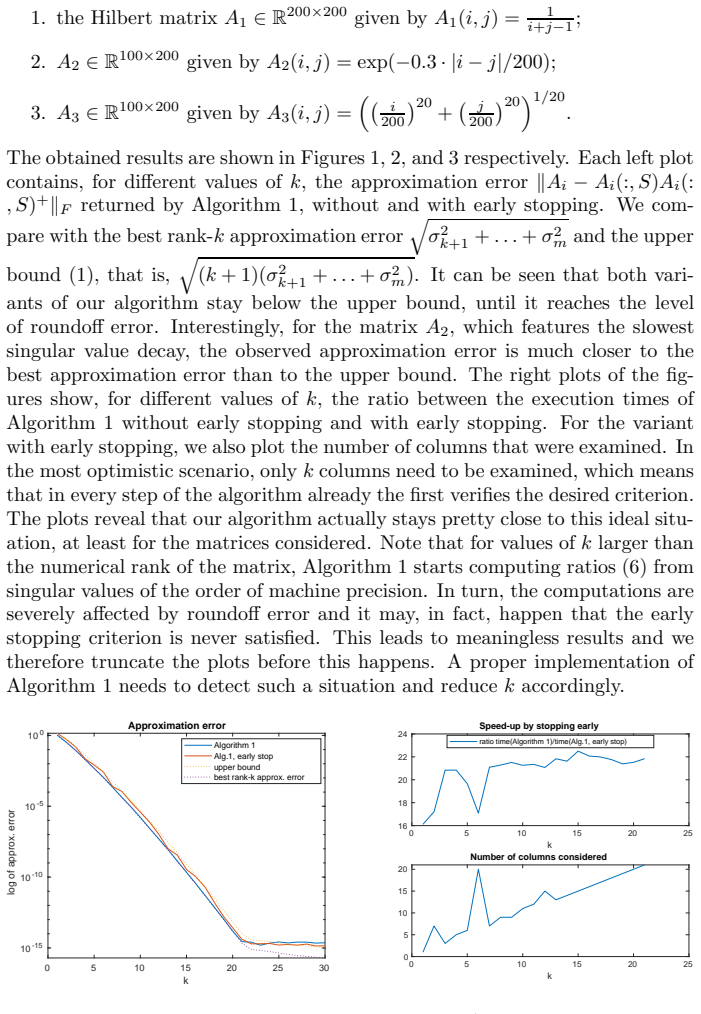
- The early-stopping variant appears numerically more stable than the full search, as the experiments show that the full search can produce nearly singular intersection matrices A(I,J) for larger k.
Reading between the lines
- The bulge-chasing step that the paper states without a full description is the most fragile link in the polynomial-time claim; if that step were replaced by a fully specified and verified O(m^2) SVD update, the deterministic complexity result would rest on firmer ground.
- The conditional-expectation ratios depend on the volume-sampling distribution, so analogous derandomized algorithms could likely be designed for other distributions, such as those favoring max-volume submatrices, potentially yielding deterministic cross approximations with maximum-norm bounds.
- The early-stopping heuristic introduces a data-dependent number of candidate pairs, so a rigorous average-case or expected complexity analysis might reveal that the practical running time is far below the worst-case O(k m^3 n).
- The observed near-optimal performance on slowly decaying singular values suggests that the guaranteed (k+1) factor is loose for typical matrices, and a sharper analysis of the conditional-expectation chain might yield tighter constants.
Signed reviews
Editorial analysis
A structured set of objections, weighed in public.
Referee Report
Summary. The paper develops deterministic algorithms for column subset selection and cross approximation in the Frobenius norm. For column subset selection it replaces the characteristic-polynomial updates of Deshpande and Rademacher with singular-value updates, claims the same O(k m^2 n) complexity with better numerical robustness, and adds an early-stopping heuristic. For cross approximation, the main contribution is Algorithm 3, which derandomizes the existence result of Zamarashkin and Osinsky and is claimed to return row/column index sets I, J such that the cross approximation error is bounded by (k+1)^2 times the tail sum of squared singular values, in deterministic time O(k m^3 n). The paper also gives a CUR approximation bound from two column subset selections, a tensor extension with a quasi-optimal multilinear-rank bound, and numerical experiments on matrices and tensors.
Significance. If the algorithmic claims are fully established, the cross approximation result is significant: it would be the first deterministic polynomial-time algorithm with a polynomial-in-k error bound for cross approximation in the Frobenius norm, a gap the paper correctly identifies in the literature. The singular-value-based reformulation of the column subset selection algorithm is a genuinely useful practical improvement over characteristic-polynomial updates, and the experiments support the robustness and speed claims. The paper is also careful in its claims: it explicitly flags the absence of a numerical stability analysis, the small/medium-scale scope, and the heuristic nature of early stopping. The tensor extension is straightforward but gives a clean, explicit bound. However, the main cross approximation algorithm is not fully specified: its correctness and complexity rest on an unproven bulge-chasing step described only by a figure.
major comments (2)
- [§3.2.2, step 2 and Figure 5] The bulge-chasing procedure that transforms D1 into the banded matrix D2 is load-bearing for both correctness and complexity, but it is not actually specified. The text says 'We refrain from giving a detailed description of the algorithm and refer to Figure 5'; no pseudocode, invariant, or count of Givens rotations is supplied. The ratios in equation (18) are computed from the singular values of this D2, and the claimed O(m^2) cost per pair (and therefore the total O(k m^3 n) complexity) depends on this step. As written, a reader cannot verify either the correctness of the computed singular values or the stated operation count. This is a major gap: supply a complete description of the bulge-chasing reduction, or a precise reference with a theorem proving that D1 can be reduced to upper banded form in O(m^2) Givens rotations, and state the fill-in pattern explicitly.
- [Algorithm 3, lines 6–14 and equation (19)] The pseudocode loops over all pairs (i,j) and defines y = (1/B(i,j)) Sigma U(i,:)^T, but it does not exclude pairs with B(i,j)=0. When B(i,j)=0, the rank-one update (19) is undefined, while Lemma 4 conditions on a pair with positive probability, which is precisely the condition that the pivot submatrix has nonzero volume and hence B(i,j) is nonzero. A correct implementation must skip zero pivots and restrict the search to pairs with B(i,j) != 0; this restriction is not stated in the algorithm or in Theorem 5. This is a well-definedness gap in the algorithm as written, though it is locally fixable.
minor comments (5)
- [§2.2, p. 6] The sentence 'The cost of computing this bidiagonal matrix is O(m^2), which is identical with the cost of computing its singular values [20, Section 8.6]' is slightly ambiguous; it would be clearer to say that both the reduction and the subsequent bidiagonal SVD cost O(m^2) operations.
- [Figure 5] The caption should define the symbols × and ⊗ and state the matrix dimensions; in the current form, the figure is difficult to use for verifying the fill-in pattern or the number of rotations.
- [§3.2.2] There is a typo: 'implemended' should be 'implemented'.
- [References] References [31] and [32] are identical (both are Sorensen and Embree, 'A DEIM induced CUR factorization'); one of the two entries should be removed or replaced with a distinct citation.
- [§2.4 and §3.2.2] The early-stopping variant is presented as a heuristic with empirical support, but the paper could note explicitly that the same induction as in Theorem 5 applies to any pair satisfying (21), which would make the theoretical guarantee for the early-stopping variant immediate.
Circularity Check
No circularity: Algorithm 3's bound derives from external existence result [38] and standard derandomization.
full rationale
After walking the derivation chain, I find no step in which a claimed prediction or derived result reduces by construction to an input, fitted parameter, or prior claim by the same authors. The existence bound (14) is imported from Zamarashkin and Osinsky [38], an external published result, and the derandomization framework from Deshpande and Rademacher [14]; the paper's contribution is a new deterministic algorithm and its analysis. The only self-citation, [12] in Section 3.2.3, is an aside about symmetric cross approximation and does not support Theorem 5 or Algorithm 3. The load-bearing numerical ingredient, the O(m^2) bulge-chasing step in Section 3.2.2, is asserted with a figure rather than a complete algorithm, and Algorithm 3 does not state the nonzero-pivot restriction needed in Lemma 4; these are correctness and completeness gaps, not circularity, because the paper does not assume the truth of its target bound when proving it. No fitted values are used as predictions. Accordingly the circularity score is 0.
Assumptions & free parameters
assumptions (5)
- domain assumption The distribution (13) satisfies E[||A - A(:,Y) A(X,Y)^{-1} A(X,:)||_F^2] <= (k+1)^2 (sigma_{k+1}^2 + ... + sigma_m^2) (eq. (14)).
- domain assumption The error of a cross approximation equals a sum of squared volumes, and volume sums relate to characteristic polynomial coefficients via Cauchy-Binet (Lemma 4 uses [38, Lemma 1] and [26, Theorem 7]).
- domain assumption The Summation Algorithm [29] computes characteristic polynomial coefficients from squared singular values in forward-stable O(m^2) operations.
- domain assumption The bulge-chasing reductions in Section 3.2.2 transform the bidiagonal-plus-rank-one matrix D1 into bidiagonal form D3 in O(m^2) Givens rotations.
- domain assumption A is an m x n matrix with m <= n and rank at least k.
Cite this review
Pith. "Pith review of Low-rank approximation in the Frobenius norm by column and row subset selection." pith.science (2026). https://pith.science/paper/WCSMVHMQ
@misc{pith2026190806059,
  author       = {Pith},
  title        = {Pith review of: Low-rank approximation in the Frobenius norm by column and row subset selection},
  year         = {2026},
  howpublished = {\url{https://pith.science/paper/WCSMVHMQ}},
  note         = {Machine review of arXiv:1908.06059}
}
abstract
A CUR approximation of a matrix $A$ is a particular type of low-rank approximation $A \approx C U R$, where $C$ and $R$ consist of columns and rows of $A$, respectively. One way to obtain such an approximation is to apply column subset selection to $A$ and $A^T$. In this work, we describe a numerically robust and much faster variant of the column subset selection algorithm proposed by Deshpande and Rademacher, which guarantees an error close to the best approximation error in the Frobenius norm. For cross approximation, in which $U$ is required to be the inverse of a submatrix of $A$ described by the intersection of $C$ and $R$, we obtain a new algorithm with an error bound that stays within a factor $k + 1$ of the best rank-$k$ approximation error in the Frobenius norm. To the best of our knowledge, this is the first deterministic polynomial-time algorithm for which this factor is bounded by a polynomial in $k$. Our derivation and analysis of the algorithm is based on derandomizing a recent existence result by Zamarashkin and Osinsky. To illustrate the versatility of our new column subset selection algorithm, an extension to low multilinear rank approximations of tensors is provided as well.
Figures


Figures from the paper (6 more)


Reference graph
Works this paper leans on
-
[38]
N. L. Zamarashkin and A. I. Osinsky. On the existence of a near ly optimal skeleton approximation of a matrix in the Frobenius norm. In Doklady Mathematics, volume 97, pages 164–166. Springer, 2018. 25
work page 2018
-
[1]
E. Anderson, Z. Bai, C. H. Bischof, S. Blackford, J. W. Demmel, J . J. Dongarra, J. Du Croz, A. Greenbaum, S. Hammarling, A. McKenney , and D. C. Sorensen. LAPACK Users’ Guide . SIAM, Philadelphia, PA, third edition, 1999
work page 1999
-
[2]
J. L. Aurentz, T. Mach, L. Robol, R. Vandebril, and D. S. Watkins . Core- chasing algorithms for the eigenvalue problem , volume 13 of Fundamentals of Algorithms . SIAM, Philadelphia, PA, 2018
work page 2018
-
[3]
M. Barrault, Y. Maday, N. C. Nguyen, and A. T. Patera. An ‘empir ical interpolation’ method: application to efficient reduced-basis discre tization 22 of partial differential equations. C. R. Math. Acad. Sci. Paris , 339(9):667– 672, 2004
work page 2004
- [4]
-
[5]
D. S. Bernstein. Matrix Mathematics . Princeton University Press, Prince- ton, NJ, second edition, 2009
work page 2009
-
[6]
C. Boutsidis, M. W. Mahoney, and P. Drineas. An improved approx imation algorithm for the column subset selection problem. In Proceedings of the Twentieth Annual ACM-SIAM Symposium on Discrete Algorithm s, pages 968–977. SIAM, Philadelphia, PA, 2009
work page 2009
-
[7]
P. B¨ urgisser, M. Clausen, and M. A. Shokrollahi. Algebraic complexity theory, volume 315 of Grundlehren der Mathematischen Wissenschaften . Springer-Verlag, Berlin, 1997
work page 1997
Show all 37 references
-
[8]
C ¸ ivril and M
A. C ¸ ivril and M. Magdon-Ismail. On selecting a maximum volume sub- matrix of a matrix and related problems. Theoret. Comput. Sci. , 410(47- 49):4801–4811, 2009
2009
-
[9]
T. F. Chan. Rank revealing QR factorizations. Linear Algebra Appl. , 88/89:67–82, 1987
1987
-
[10]
Chandrasekaran and I
S. Chandrasekaran and I. C. F. Ipsen. On rank-revealing fac torisations. SIAM J. Matrix Anal. Appl. , 15(2):592–622, 1994
1994
-
[11]
Chaturantabut and D
S. Chaturantabut and D. C. Sorensen. Nonlinear model reduc tion via discrete empirical interpolation. SIAM J. Sci. Comput. , 32(5):2737–2764, 2010
2010
-
[12]
Cortinovis, D
A. Cortinovis, D. Kressner, and S. Massei. On maximum volume su bma- trices and cross approximation for symmetric semidefinite and diago nally dominant matrices. arXiv preprint arXiv:1902.02283 , 2019
1902 arXiv
-
[13]
De Lathauwer, B
L. De Lathauwer, B. De Moor, and J. Vandewalle. A multilinear sing ular value decomposition. SIAM J. Matrix Anal. Appl. , 21(4):1253–1278, 2000
2000
-
[14]
Deshpande and L
A. Deshpande and L. Rademacher. Efficient volume sampling for row/column subset selection. In 2010 IEEE 51st Annual Symposium on Foundations of Computer Science—FOCS 2010 , pages 329–338. IEEE Computer Soc., Los Alamitos, CA, 2010
2010
-
[15]
Deshpande, L
A. Deshpande, L. Rademacher, S. Vempala, and G. Wang. Matr ix approx- imation and projective clustering via volume sampling. Theory Comput. , 2:225–247, 2006
2006
-
[16]
Drineas and M
P. Drineas and M. W. Mahoney. A randomized algorithm for a tens or-based generalization of the singular value decomposition. Linear Algebra Appl. , 420(2-3):553–571, 2007
2007
-
[17]
Drineas, M
P. Drineas, M. W. Mahoney, and S. Muthukrishnan. Relative-er ror CU R matrix decompositions. SIAM J. Matrix Anal. Appl. , 30(2):844–881, 2008. 23
2008
-
[18]
Drmaˇ c and S
Z. Drmaˇ c and S. Gugercin. A new selection operator for the dis crete empir- ical interpolation method—improved a priori error bound and exten sions. SIAM J. Sci. Comput. , 38(2):A631–A648, 2016
2016
-
[19]
Frieze, R
A. Frieze, R. Kannan, and S. Vempala. Fast Monte-Carlo algorit hms for finding low-rank approximations. J. ACM , 51(6):1025–1041, 2004
2004
-
[20]
G. H. Golub and C. F. Van Loan. Matrix computations . Johns Hopkins Studies in the Mathematical Sciences. Johns Hopkins University Pre ss, Bal- timore, MD, fourth edition, 2013
2013
-
[21]
S. A. Goreinov and E. E. Tyrtyshnikov. The maximal-volume conc ept in approximation by low-rank matrices. In Structured matrices in mathemat- ics, computer science, and engineering, I (Boulder, CO, 199 9), volume 280 of Contemp. Math. , pages 47–51. Amer. Math. Soc., Providenc...
2001
-
[22]
S. A. Gore ˘ ınov. Cross approximation of a multi-index array. Dokl. Akad. Nauk, 420(4):439–441, 2008
2008
-
[23]
Gu and S
M. Gu and S. C. Eisenstat. Efficient algorithms for computing a st rong rank-revealing QR factorization. SIAM J. Sci. Comput. , 17(4):848–869, 1996
1996
-
[24]
Harbrecht, M
H. Harbrecht, M. Peters, and R. Schneider. On the low-rank a pproximation by the pivoted Cholesky decomposition. Appl. Numer. Math. , 62(4):428– 440, 2012
2012
-
[25]
R. A. Horn and C. R. Johnson. Matrix analysis . Cambridge University Press, Cambridge, second edition, 2013
2013
-
[26]
O. Knill. Cauchy-Binet for pseudo-determinants. Linear Algebra Appl. , 459:522–547, 2014
2014
-
[27]
T. G. Kolda and B. W. Bader. Tensor decompositions and applicat ions. SIAM Rev. , 51(3):455–500, 2009
2009
-
[28]
Rehman and I
R. Rehman and I. C. Ipsen. La budde’s method for computing ch aracteristic polynomials. arXiv preprint arXiv:1104.3769 , 2011
2011 arXiv
-
[29]
Rehman and I
R. Rehman and I. C. F. Ipsen. Computing characteristic polyno mials from eigenvalues. SIAM J. Matrix Anal. Appl. , 32(1):90–114, 2011
2011
-
[30]
A. K. Saibaba. HOID: higher order interpolatory decomposition for tensors based on Tucker representation. SIAM J. Matrix Anal. Appl. , 37(3):1223– 1249, 2016
2016
-
[32]
D. C. Sorensen and M. Embree. A DEIM induced CUR factorizatio n. SIAM J. Sci. Comput. , 38(3):A1454–A1482, 2016
2016
-
[33]
G. W. Stewart. Four algorithms for the efficient computation of truncated pivoted QR approximations to a sparse matrix. Numer. Math. , 83(2):313– 323, 1999. 24
1999
-
[34]
Townsend and L
A. Townsend and L. N. Trefethen. An extension of Chebfun to two dimen- sions. SIAM J. Sci. Comput. , 35(6):C495–C518, 2013
2013
-
[35]
Vannieuwenhoven, R
N. Vannieuwenhoven, R. Vandebril, and K. Meerbergen. A new t runcation strategy for the higher-order singular value decomposition. SIAM J. Sci. Comput., 34(2):A1027–A1052, 2012
2012
-
[36]
D. P. Woodruff. Sketching as a tool for numerical linear algebra . Found. Trends Theor. Comput. Sci. , 10(1-2):iv+157, 2014
2014
-
[37]
P. A.-C. Yoon. Modifying two-sided orthogonal decompositions: Algorith ms, implementation, and applications . ProQuest LLC, Ann Arbor, MI, 1996. Thesis (Ph.D.)–The Pennsylvania State University
1996
Reviewed August 14, 2026 · model on record in the stance chip above.
Discussion (0). Continue with ORCID to comment.