REVIEW 3 major objections 5 minor 50 references
Crystal Symmetry and Polarization of High-order Harmonics in ZnO
T0 review · 3 major / 5 minor · reviewed 2026-08-14 · deepseek-v4-flash
Pith's one-line read Crystal symmetry, not microscopic mechanism, governs the polarization of high-order harmonics from ZnO and other crystals, making harmonic polarization an all-optical probe of crystal axes.
desk verdict ZnO polarization measurements and the mirror-plane selection rules are solid; the universality claim overreaches for quartz and needs to be cut or reworked. read the letter →
The pith
A machine-rendered reading of the paper's core claim, the machinery that carries it, and where it could break.
The reading
What carries the argument
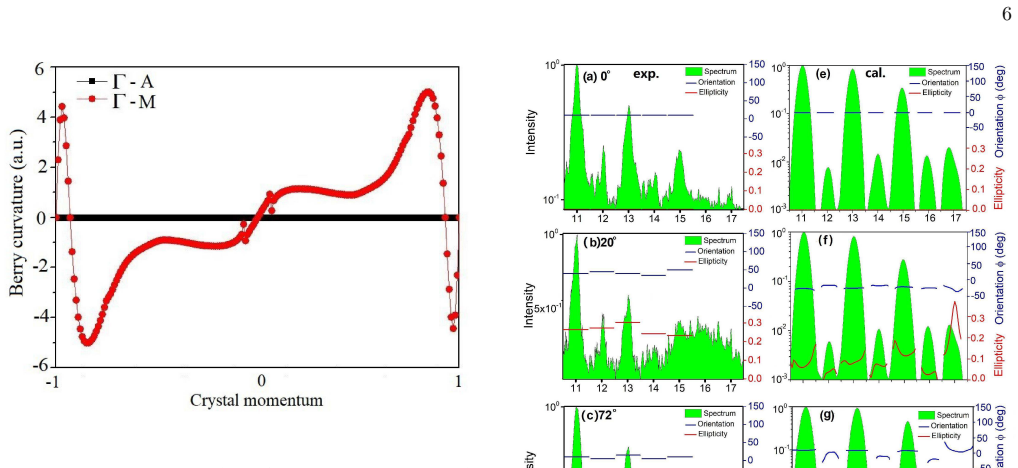
The engine of the argument is the linearly coupled excitation (LCE) model, which computes the harmonic current along an arbitrary polarization axis as the projection of three independent one-dimensional two-band semiconductor Bloch equation currents, one along each ZnO bond direction. The symmetry step is a set of parity identities for the transition dipole: under reflection through the crystal mirror plane the in-plane component is odd and the out-of-plane component is even, which forces the perpendicular current to vanish along the Γ–A direction and forces even orders to appear purely perpendicular along Γ–M. Writing the same parity logic through the Kubo Berry curvature and the effective-mass tensor reproduces the selection rules from mechanisms that otherwise look unrelated.
What would settle it
Measure polarization-resolved harmonic spectra in a wurtzite-structure crystal with a substantially different band structure, for example strong spin-orbit coupling or strong multi-band mixing, using a thin film to suppress birefringence, and check whether the perpendicular component still vanishes when the laser is aligned with the mirror plane and whether parallel even and perpendicular odd harmonics still vanish when the laser is perpendicular to it; any new angular feature would break the symmetry-only claim.
Extended reading notes
Core claim
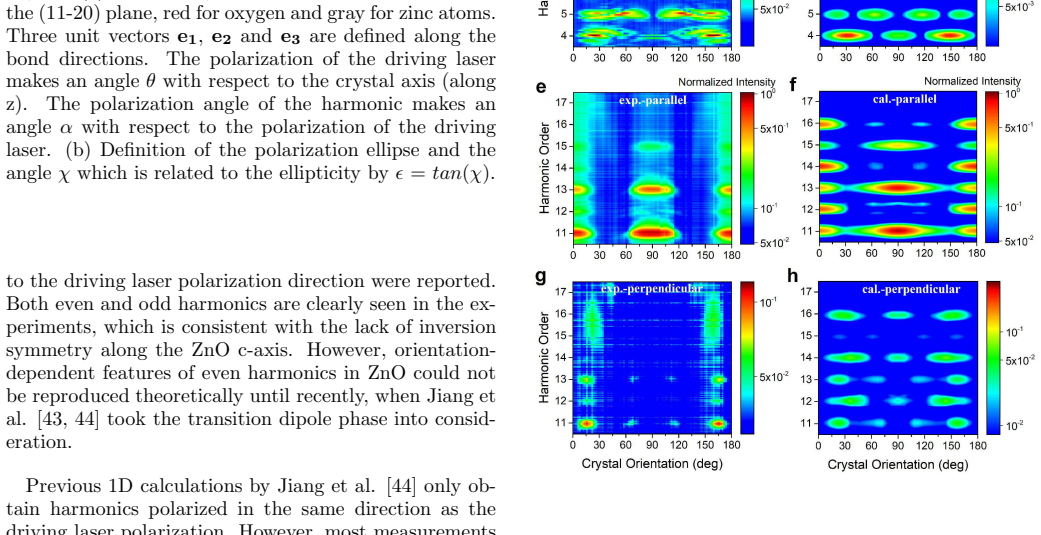
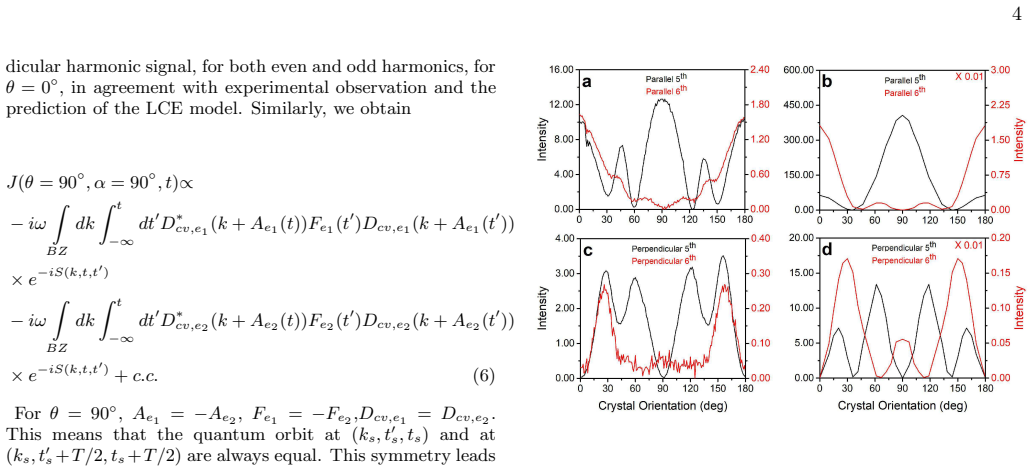
The paper's central claim is that the polarization properties of high-order harmonics in solids are governed largely by crystal symmetry rather than by the specific generation mechanism. Concretely, for ZnO it finds that all odd harmonics share one orientation-dependent polarization pattern while even harmonics share another, and it shows that the perpendicular harmonic component disappears when the driving laser is polarized along the mirror plane, while parallel even harmonics and perpendicular odd harmonics disappear when the laser is polarized perpendicular to that plane. The same selection rules follow from the inter-band, Berry-curvature, and band-curvature descriptions alike, which is why the odd/even contrast reappears in GaSe, quartz, and MoS2 despite their different assigned mechanisms. The paper concludes that harmonic polarization can serve as a pure optical probe of crystal axes and of their ultrafast changes.
Load-bearing premise
The load-bearing assumption is that the harmonic signal from the crystal is the simple sum of three independent one-dimensional currents along the three bond directions, with no coupling between them; if those currents interfere or interact in ways the model excludes, the predicted perpendicular polarization pattern could change, even if the qualitative selection rules survive.
Editorial extensions
If this is right
- Harmonic polarization becomes an all-optical, mechanism-independent probe of crystal orientation: measuring which orders appear in the parallel and perpendicular channels identifies the c-axis and mirror-plane directions.
- The same odd/even selection rules should appear in any crystal with the corresponding reflection symmetry, so polarization-resolved harmonic measurements can be extended to new materials without first knowing the dominant generation mechanism.
- Using femtosecond driving pulses, following harmonic polarization over time can track structural changes such as deformation or phase transitions with femtosecond resolution.
- Because the harmonic ellipticity and ellipse orientation are set by the bond structure, strain engineering or material choice can tune the polarization state of solid-state harmonic sources.
- Simulations or experiments that show polarization patterns violating these symmetry constraints cannot be explained by the microscopic mechanism alone, so such results would need re-examination.
Reading between the lines
- The mirror-symmetry argument should generalize beyond wurtzite crystals, so analogous vanishing conditions for other point groups are a natural extension; testing them in, say, tetragonal or hexagonal crystals would check the scope of the claim.
- Since the selection rules are mechanism-independent, they may also survive in regimes where the one-dimensional two-band model itself fails, such as exciton-dominated or strongly correlated excitation; a polarization-resolved measurement near a resonance would put this to a test.
- A relative-phase measurement between the parallel and perpendicular harmonic components would upgrade the paper's upper-bound ellipticity estimate into a full determination of the polarization ellipse, making ellipticity a direct probe of the transition-dipole phase.
- A full two- or three-dimensional semiconductor Bloch equation calculation that includes inter-bond coupling could separate the exact symmetry-driven selection rules from the quantitative features that depend on the LCE superposition assumption.
Signed reviews
Editorial analysis
A structured set of objections, weighed in public.
Referee Report
Summary. The paper reports a joint experimental and theoretical study of polarization-resolved high-order harmonic generation (HHG) from a-cut ZnO driven by 3.6 μm mid-infrared pulses. The central experimental finding is that the orientation dependence of the components polarized parallel and perpendicular to the driving field is nearly identical for all odd harmonics but markedly different for even harmonics, with specific vanishings at crystal orientations θ = 0° and 90°. The authors reproduce these features with a one-dimensional two-band semiconductor Bloch equation model applied along the three bond directions and combined with a linearly coupled excitation (LCE) model. They then argue from reflection symmetry that the vanishing rules are universal and that harmonic polarization is governed by crystal symmetry rather than by the specific microscopic generation mechanism. On this basis, they propose harmonic polarization measurements as an all-optical probe of crystal axes and of ultrafast structural changes.
Significance. If the symmetry-based selection rules are correct, they provide simple, parameter-free predictions for harmonic polarization in crystals with mirror symmetry and establish HHG polarization as a diagnostic tool. The ZnO comparison is a meaningful test because the vanishings at θ = 0° and 90° are not fitted; the only adjusted quantities are the per-harmonic overall scaling factors and the dephasing model, and the simulations reproduce the orientation and polarization dependence for both below-gap and above-gap harmonics. The paper also makes a useful attempt to connect three common microscopic pictures (interband excitation, Berry curvature, and band curvature) through symmetry arguments. The main weakness is that the universality claim is broader than the derivation: the mirror-plane analysis does not apply to crystals such as α-quartz that lack mirror symmetry, and the LCE additivity assumption underlying the quantitative comparison is not independently validated.
major comments (3)
- [Sec. III and Abstract] The universality claim is stated for α-quartz via Ref. 24, but α-quartz has point group 32, which contains no mirror plane. The derivation at the top of Sec. III starts from a (x = 0, y, z) mirror plane, and the two general rules quoted in Sec. III refer to 'the mirror plane' and 'perpendicular to the mirror plane', both of which are undefined for point group 32. Thus Eqs. (7)-(8) do not apply unchanged to α-quartz, and the paper provides no symmetry analysis for the actual point group (threefold rotation and twofold axes) and no simulation for quartz. Because the paper's central conclusion that polarization properties are governed by crystal symmetry rests in part on a compilation of materials including quartz, this case must either be analyzed with the correct point-group symmetries or explicitly excluded from the universality claim.
- [Eq. (2) and Appendix A] The LCE model assumes the total harmonic current is a linear superposition of three independent one-dimensional SBE currents, one along each bond direction, with no coupling or interference between the bond channels. This additivity is not derived and is load-bearing for the quantitative comparisons in Figs. 2-4, even though the symmetry-based vanishings do not depend on it. As written, the claim that the model can 'explain the observed polarization behavior, including low-order harmonics' is stronger than what the approximation supports. The authors should either justify the additivity, for example by comparing with a 2D or 3D SBE calculation for one representative crystal orientation and harmonic order, or explicitly state that the quantitative agreement is contingent on this untested approximation.
- [Sec. III, paragraph after Eq. (11)] The statement that 'all these mechanisms, including Berry curvature, interband excitation and band curvature, are consistent with each other' is not demonstrated. The band-curvature part is compressed into a single sentence asserting that E_bc_perp(t) = E_bc_perp(t + T/2) and E_bc_parallel(t) = -E_bc_parallel(t + T/2) for laser polarization perpendicular to the mirror plane, with no derivation of these relations. Since the mutual consistency of these mechanisms is used to support the universality conclusion, the derivation should be supplied or the claim should be explicitly qualified as a conjecture based on the common appearance of interband momentum matrix elements.
minor comments (5)
- [Throughout] There are several typographical errors that should be corrected: 'partities' and 'miror plane' in Sec. III, 'behavio u r' in the Sec. II text, and 'adress' and 'Fivth' in the acknowledgments and references.
- [Abstract and Sec. IV] The abstract states that ellipticity 'can be tuned precisely by changing the bond structure of the sample', but the paper only computes or measures ellipticity for different crystal orientation angles of ZnO; it does not demonstrate control of the bond structure itself. This statement should be tempered to reflect what is actually shown.
- [Sec. II and Fig. 3] The explanation of the 45° and 135° peaks in the parallel component of H5 and H7 as arising from birefringence is plausible but not quantitatively established; Appendix C provides the measured ellipticity of the driving pulse and a suppression curve, but no HHG simulation with an elliptical driver. The text should either add such a simulation or present the birefringence explanation as a hypothesis.
- [Sec. III] When the paper states that 'all of these experimental results show general features' from Refs. 22-25, it would be helpful to cite the specific figure numbers in those references, because the reader cannot verify the claimed odd/even contrast without locating the relevant data panels.
- [Sec. II, discussion of θ = 0°] The sentence 'both even and odd harmonics have strong parallel components, but the perpendicular components disappear' is correct only for the specific a-plane geometry defined in Fig. 1; please add a brief reminder that θ is defined with respect to the c-axis in this a-cut geometry.
Circularity Check
No significant circularity: the ZnO polarization selection rules are derived from reflection symmetry, and the LCE-model comparison is an independent test rather than a re-statement of fitted inputs.
full rationale
The paper's main qualitative predictions—vanishing of perpendicular harmonics at θ=0 and of parallel even/perpendicular odd harmonics at θ=90—follow from the mirror-plane parity argument in Sec. III (Eqs. 7-8), not from any quantity fitted to the experiment. The LCE model (Eqs. 1-3, Appendix A) computes currents along the three ZnO bond directions and projects them; the only adjustable elements are a per-harmonic overall normalization that is common to both polarization components and a stated dephasing time, so the relative parallel/perpendicular intensities and their crystal-orientation dependence are not forced by construction. The tight-binding dipole phases and band structure are imported from the authors' earlier Ref. 44, but that earlier work did not contain the present polarization data and is therefore an independent input, not a re-labeling of the predicted endpoint. The extension to GaSe, MoS2, and quartz rests on external Refs. 22-25 plus the symmetry derivation; while the quartz point-group applicability is a correctness concern, it is not a circularity. The paper itself honestly notes that the two-band model is incomplete and that even-harmonic yields drop too quickly, which further indicates that the model is not being tuned to force the polarization result. No equation in the paper reduces by definition to a fitted parameter or to a self-citation chain.
Assumptions & free parameters
free parameters (2)
- dephasing time T2(k) functional form =
T2=1+1/(1+exp(100|k|-5)) (a.u.)
- per-harmonic intensity scaling factor =
one value per harmonic, chosen for best visual agreement
assumptions (5)
- domain assumption Crystal geometry: ZnO wurtzite has three bond directions e1, e2, e3 with angles 18 degrees and 72 degrees as in Fig. 1(a).
- ad hoc to paper The LCE model: the total harmonic current is the linear superposition of independent 1D two-band SBE currents along the three bond directions (Eq. 2).
- domain assumption Reflection parity relations for the transition dipole, Eqs. (7) and (8), hold for the relevant ZnO bands.
- domain assumption Band structure and complex dipole moments from the tight-binding model of Ref. [44] are accurate for ZnO.
- domain assumption Propagation through the 0.3 mm birefringent ZnO crystal does not significantly alter the emitted harmonic polarization except for the measured driving-laser ellipticity.
Cite this review
Pith. "Pith review of Crystal Symmetry and Polarization of High-order Harmonics in ZnO." pith.science (2026). https://pith.science/paper/WCZS3477
@misc{pith2026190804161,
  author       = {Pith},
  title        = {Pith review of: Crystal Symmetry and Polarization of High-order Harmonics in ZnO},
  year         = {2026},
  howpublished = {\url{https://pith.science/paper/WCZS3477}},
  note         = {Machine review of arXiv:1908.04161}
}
read the original abstract
We carried out a joint theoretical and experimental study of the polarization of high-order harmonics generated from ZnO by intense infrared laser pulses. Experimentally we found that the dependence of parallel and perpendicular polarizations on the crystal orientation for all odd harmonics are nearly identical, but they are quite different from even harmonics which also show little order dependence. A one-dimensional two-band model, combined with a linear coupled excitation model, is shown to be able to explain the observed polarization behavior, including low-order harmonics. We further note that the same odd/even order contrast have been reported in a number of other crystals, despite that the harmonics were perceived to be generated via entirely different mechanisms. We demonstrated that this universality is governed by crystal symmetry, not by specific mechanisms. Thus, polarization measurements of harmonics offers a powerful pure optical method for determining the crystal axes as well as monitoring their ultrafast changes when crystals are undergoing deformation. In addition, the ellipticity of harmonic has been studied. It shows that ellipticity of high-order harmonics from solids can be tuned precisely by changing the bond structure of the sample.
Figures

Figures from the paper (3 more)


Reference graph
Works this paper leans on
-
[1]
parallel even harmonics and perpendicular odd harmon- ics vanish when the laser polarization is perpendicular to t he mirror plane; 2) perpendicular even and odd harmonics vanis h when the laser polarization is parallel to the mirror plane. From these results, one may conclude that many of the features of polarization-dependent HHG spectra are govern ed b...
-
[2]
Drescher, et al., X-ray pulses approaching the attosec- ond frontier
M. Drescher, et al., X-ray pulses approaching the attosec- ond frontier. Science 291, 19231927 (2001)
work page 2001
-
[3]
P. M. Paul, et al. , Observation of a train of attosec- ond pulses from high harmonic generation. Science 292, 16891692 (2001)
work page 2001
- [4]
- [5]
- [6]
-
[7]
Anh-Thu Le, R. R. Lucchese, and C. D. Lin, Phys. Rev. A 85, 023814 (2010)
work page 2010
-
[8]
Ghimire, A
S. Ghimire, A. D. DiChiara, E. Sistrunk, P. Agostini, L. F. DiMauro, and D. A. Reis, Nat. Phys. 7, 138 (2011)
2011
Show all 50 references
-
[9]
Gholam-Mirzaei, J
S. Gholam-Mirzaei, J. Beetar, and M. Chini, Appl. Phys. Lett. 110, 061101 (2017)
2017
-
[10]
Vampa, T
G. Vampa, T. J. Hammond, N. Thir´ e, B. E. Schmidt, F. L´ egar´ e, C. R. McDonald, T. Brabec, and P. B. Corkum, Nature (London) 522, 462 (2015)
2015
-
[11]
Vampa, T
G. Vampa, T. J. Hammond, N. Thir´ e, B. E. Schmidt, F. L´ egar´ e, C. R. McDonald, T. Brabec, D. D. Klug, and P. B. Corkum, Phys. Rev. Lett. 115, 193603 (2015)
2015
-
[12]
Z. Wang, H. Park, Y. H. Lai, J. Xu, C. I. Blaga, F. Yang, P. Agostini, and L. F. DiMauro, Nat. Commun. 8, 1686 (2017)
2017
-
[13]
Ghimire, J
S. Ghimire, J. Phys. B: At. Mol. Opt. Phys. 47, 204030 (2014)
2014
-
[14]
Y. S. You, et al. , Opt. Lett. 42, 1816 (2017)
2017
-
[15]
T. T. Luu, M. Garg, S. Yu. Kruchinin, A. Moulet, M. Th. Hassan, and E. Goulielmakis, Nature 521, 498 (2015)
2015
-
[16]
M. Garg, M. Zhan, T. T. Luu, H. Lakhotia, T. Kloster- mann , A. Guggenmos, and E. Goulielmakis, Nature 538, 359 (2016)
2016
-
[17]
Y. S. You, et al. , Nat. Commun. 8, 724 (2017)
2017
-
[18]
Hohenleutner, F
M. Hohenleutner, F. Langer, O. Schubert,M. Knorr, U. Huttner, S.W. Koch, M. Kira, and R. Huber, Nature (London) 523, 572 (2015)
2015
-
[19]
Yoshikawa, T
N. Yoshikawa, T. Tamaya, and K. Tanaka, Science 356, 736 (2017)
2017
-
[20]
Taucer, et al
M. Taucer, et al. , Phys. Rev. B 96, 195420 (2017)
2017
-
[21]
Y. S. You, D. A. Reis, and S. Ghimire, Nat. Phys. 13, 345 (2017)
2017
-
[22]
Schubert et al
O. Schubert et al. , Nat. Photonics 8, 119 (2014)
2014
-
[23]
Langer, M
F. Langer, M. Hohenleutner, U. Huttner, S. W. Koch, M. Kira, and R. Huber, Nat. Photonics 11, 227 (2017)
2017
-
[24]
Liu, et al
H. Liu, et al. , Nat. Phys. 13, 262 (2016)
2016
-
[25]
T. T. Luu, & H. J. W¨ orner, Nature Communications 9, 916 (2018)
2018
-
[26]
Kaneshima, et al
K. Kaneshima, et al. , Physical Review Letters 120, 243903 (2018)
2018
-
[27]
Y. S. You, E. Cunningham, D. A. Reis and S. Ghimire, J. Phys. B, 51, 114002 (2018)
2018
-
[28]
Gholam-Mirzaei, et al
S. Gholam-Mirzaei, et al. , J. Opt. Soc. Am. B 35, A27A31 (2018)
2018
-
[29]
Ndabashimiye, et al
G. Ndabashimiye, et al. , Nature (London) 534, 520 (2016)
2016
-
[30]
A. A. Lanin, E. A. Stepanov, A. B. Fedotov, and A. M. Zheltikov, Optica, 4, 516 (2017)
2017
-
[31]
J. L. Krause, K. J. Schafer, and K. C. Kulander, Phys. Rev. Lett. 68, 3535 (1992)
1992
-
[32]
P. B. Corkum, Phys. Rev. Lett. 71, 1995 (1993)
1993
-
[33]
Lewenstein, et al
M. Lewenstein, et al. , Phys. Rev. A 49, 2117 (1994)
1994
-
[34]
C. D. Lin,Anh-Thu Le, C.Jin, H.Wei, Attosecond and Strong-Field Physics: Principles and Applications (Cam- bridge University Press, 2018)
2018
-
[35]
Anh-Thu Le, R. R. Lucchese, S. Tonzani, T. Morishita, and C. D. Lin, Phys. Rev. A 80, 013401 (2009)
2009
-
[36]
Runge and E
E. Runge and E. K. U. Gross, Phys.Rev. Lett. 52, 997 (1984)
1984
-
[37]
Tancogne-Dejean, N., O. D. Mcke, F. X. Krtner, and A. Rubio ,Phys. Rev. Lett. 118, 087403 (2017)
2017
-
[38]
Floss, C
I. Floss, C. Lemell, G. Wachter, V. Smejkal, S. A. Sato, X. M. Tong, K. Yabana, and J. Burgdorfer, Phys. Rev. A 97, 011401 (2018)
2018
-
[39]
M. X. Wu, S. Ghimire, D. A. Reis, K. J. Schafer, and M. B. Gaarde, Phys. Rev. A 91, 043839 (2015)
2015
-
[40]
Golde, T
D. Golde, T. Meier, and S. W. Koch, Phys. Rev. B 77, 075330 (2008)
2008
-
[41]
T. T. Luu, & H. J. W¨ orner, Phys. Rev. B 94, 115164 (2016)
2016
-
[42]
Vampa, C
G. Vampa, C. R. McDonald, G. Orlando, P. B. Corkum, and T. Brabec, Phys. Rev. B 91, 064302 (2015)
2015
-
[43]
Isabella Floss et al. , Phys. Rev. B 99, 224301 (2019)
2019
-
[44]
S. C. Jiang, H. Wei, J. G. Chen, C. Yu, R. F. Lu, and C. D. Lin, Phys. Rev. A 96, 053850 (2017)
2017
-
[45]
S. C. Jiang, et al. ,Phys. Rev. Lett. 120, 253201 (2018)
2018
-
[46]
We thank Referee B of our previous paper [44] for sug- gesting the LCE model to obtain perpendicular harmon- ics
-
[47]
Peiyu Xia et al. , Opt. Express 26, 29393 (2018)
2018
-
[48]
Yugui Yao, et al. , Phys. Rev. Lett. 92, 037204 (2004)
2004
-
[49]
Haug, H., Koch, S. W. Quantum Theory of the Opti- cal and Electronic Properties of Semiconductors: Fivth Edition. World Scientific Publishing Company, 2009
2009
-
[50]
Hecht, Optics, 4th ed
E. Hecht, Optics, 4th ed. (Addison-Wesley: Reading, MA, 2001)
2001
Reviewed August 14, 2026 · model on record in the stance chip above.
Discussion (0). Continue with ORCID to comment.