The normalized orbit of a bounded normal operator can be a frame
Pith reviewed 2026-06-26 15:04 UTC · model grok-4.3
The pith
There exist bounded normal operators whose normalized orbits form frames for a Hilbert space.
A machine-rendered reading of the paper's core claim, the machinery that carries it, and where it could break.
Core claim
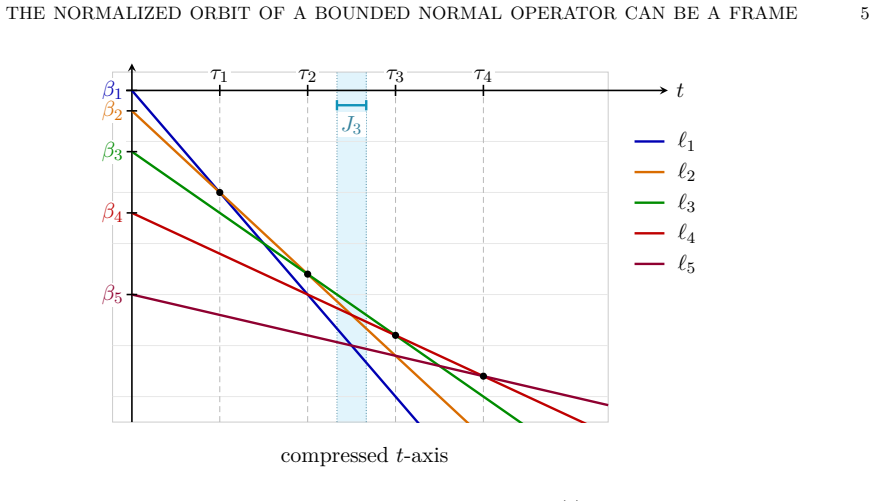
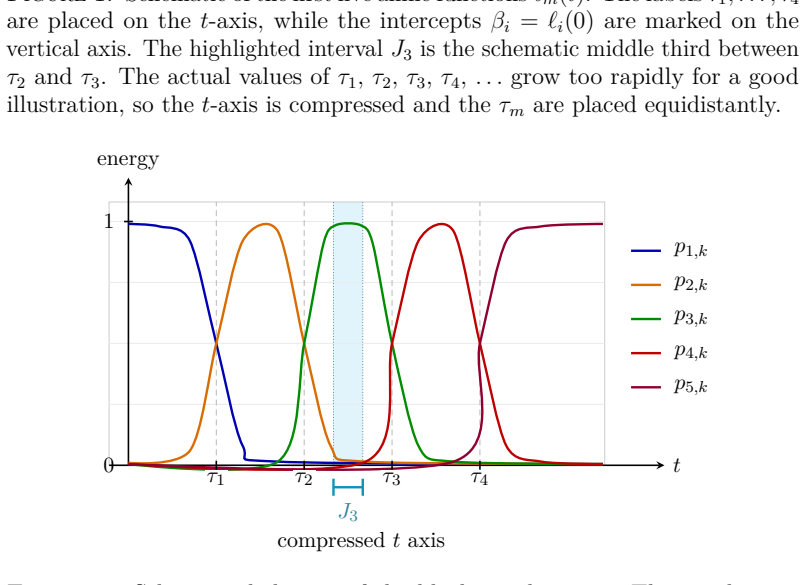
The central claim is the existence of a Hilbert space H, a bounded normal operator T on H, and a vector g in H such that the system {T^k g / ||T^k g|| : k = 0,1,2,...} is a frame for H. The operator is diagonal and defined via a decomposition of H into finite blocks with rapidly increasing sizes, with the diagonal entries chosen to ensure the normalized orbit meets the frame bounds.
What carries the argument
A diagonal normal operator defined on the direct sum of finite-dimensional subspaces with rapidly increasing dimensions, with diagonal entries chosen so the norms of successive orbit vectors allow the normalized versions to satisfy frame inequalities.
If this is right
- The conjecture that normalized orbits of bounded normal operators are never frames is false.
- Normalized orbits can form frames for normal operators that are not self-adjoint.
- An epsilon-perturbation S of T exists such that the un-normalized orbit {S^k g} forms a Carleson frame.
Where Pith is reading between the lines
- The obstruction to framing may lie in self-adjointness rather than normality alone.
- Block constructions of this type could be adapted to produce other dynamical sampling examples.
- The result leaves open the question of which normal operators admit framing normalized orbits.
Load-bearing premise
The specific choice of block sizes and diagonal entries ensures that the normalized orbit vectors satisfy both the lower and upper frame bounds.
What would settle it
Explicit computation of the frame operator on the given block decomposition showing that its spectrum is not bounded away from zero and infinity.
Figures
read the original abstract
Conjecture 3 in [A. Aldroubi, C. Cabrelli, I. Krishtal, and U. Molter, Dynamical Sampling: A Survey, La Matematica 5 (2026), Article 37] postulates that for any bounded normal operator $T$ on a Hilbert space $H$ and any vector $g\in H$ the system \[ \left\{\frac{T^k g}{\|T^k g\|}: k=0,1,2,\ldots\right\} \] is not a frame. It was motivated by [A. Aldroubi, C. Cabrelli, A. F. \c{C}akmak, U. Molter, and A. Petrosyan, Iterative actions of normal operators, J. Funct. Anal. 272 (2017), no. 3, 1121--1146], where it was established that such frames do not exist when $T$ is a self adjoint operator. We show, however, that this conjecture is false by presenting a construction of $H$, $T$, and $g$ such that the normalized orbit considered is indeed a frame. The operator is diagonal and is defined via a decomposition of the space into finite blocks rapidly increasing in size. We also provide an $\epsilon$-perturbation $S$ of the operator $T$ such that the system \[ \left\{{S^k g}: k=0,1,2,\ldots\right\} \] is a Carleson frame in the sense of [A. Aldroubi, C. Cabrelli, U. Molter, and S. Tang, Dynamical sampling, Appl. Comput. Harmon. Anal. 42 (2017), no. 3, 378--401] and [O. Christensen, M. Hasannasab, F. M. Philipp, and D. Stoeva, The mystery of Carleson frames, Appl. Comput. Harmon. Anal. 72 (2024), Article 101659]. The constructions were achieved using ChatGPT, whose assistance was also employed in the preparation of this manuscript.
Editorial analysis
A structured set of objections, weighed in public.
Referee Report
Summary. The paper disproves Conjecture 3 of Aldroubi-Cabrelli-Krishtal-Molter by exhibiting an explicit Hilbert space H, bounded normal operator T, and vector g such that the normalized orbit {T^k g / ||T^k g|| : k ≥ 0} is a frame. The construction proceeds by an orthogonal decomposition of H into finite-dimensional blocks whose dimensions increase rapidly, with T diagonal on this decomposition and diagonal entries chosen so that successive normalized orbit vectors dominate in successive blocks; a small perturbation S is also constructed so that the unnormalized orbit {S^k g} is a Carleson frame.
Significance. If the construction is valid, the result is significant: it supplies a counterexample to a conjecture motivated by the known non-existence result for self-adjoint operators, thereby separating the normal and self-adjoint cases in dynamical sampling. The block-diagonal approach gives direct control over norms and supports, allowing the frame inequalities to be verified by design rather than by abstract arguments.
minor comments (2)
- [Abstract] Abstract: the parenthetical citation to the 2026 survey paper should be checked for consistency with the reference list; the year appears prospective relative to the arXiv posting.
- [Construction] The explicit block-size sequence and diagonal entries are stated to be supplied in the construction; a short table or numbered list of the first few values would improve readability without altering the argument.
Simulated Author's Rebuttal
We thank the referee for the positive assessment of the manuscript and the recommendation to accept. The report accurately summarizes the construction and its significance as a counterexample to Conjecture 3.
Circularity Check
No significant circularity
full rationale
The paper's central result is an existence claim established by an explicit construction: an orthogonal decomposition of H into finite-dimensional blocks of rapidly increasing dimension together with a diagonal normal operator T whose entries are chosen so that the normalized orbit vectors satisfy the frame inequalities A,B>0. This construction is self-contained; the block sizes, diagonal values, and verification that the resulting system meets the frame bounds are supplied directly in the manuscript without any reduction to fitted parameters, self-definitional equations, or load-bearing self-citations. The cited conjecture and prior results on self-adjoint operators are external to the argument and are being refuted rather than presupposed. No step matches any of the enumerated circularity patterns.
Axiom & Free-Parameter Ledger
Reference graph
Works this paper leans on
-
[1]
Aldroubi, C
A. Aldroubi, C. Cabrelli, A. F. Çakmak, U. Molter, and A. Petrosyan, Iterative actions of normal operators,J. Funct. Anal.272(2017), no. 3, 1121–1146. DOI: https://doi.org/10. 1016/j.jfa.2016.10.027
2017
-
[2]
A. Aldroubi, C. Cabrelli, U. Molter, and S. Tang, Dynamical sampling,Appl. Comput. Harmon. Anal.42(2017), no. 3, 378–401. DOI:https://doi.org/10.1016/j.acha.2015.08.014
-
[3]
A. Aldroubi, C. Cabrelli, I. Krishtal, and U. Molter, Dynamical Sampling: A Survey,La Matematica5(2026), Article 37. DOI: https://doi.org/10.1007/s44007-026-00215-y; arXiv:2511.10769
work page internal anchor Pith review Pith/arXiv arXiv doi:10.1007/s44007-026-00215-y 2026
-
[4]
A. Aleman, M. Hartz, J. E. McCarthy, and S. Richter, Interpolating sequences in spaces with the complete Pick property,Int. Math. Res. Not. IMRN2019, no. 12, 3832–3854. DOI: https://doi.org/10.1093/imrn/rnx237. THE NORMALIZED ORBIT OF A BOUNDED NORMAL OPERATOR CAN BE A FRAME 15
-
[5]
V. V. Andreev and T. H. McNicholl, Computing interpolating sequences,Math. Log. Q.56 (2010), no. 1, 59–67. DOI:https://doi.org/10.1007/s00224-008-9140-z
-
[6]
Baranov and K
A. Baranov and K. Dyakonov, The Feichtinger conjecture for reproducing kernels in model subspaces,J. Geom. Anal.21(2011), no. 2, 276–287. DOI: https://doi.org/10.1007/ s12220-010-9147-y
2011
-
[7]
C. Cabrelli, U. Molter, V. Paternostro, and F. Philipp, Dynamical sampling on finite index sets, J. Anal. Math.140(2020), 637–667. DOI:https://doi.org/10.1007/s11854-020-0099-2
-
[8]
Cabrelli, U
C. Cabrelli, U. Molter, and D. Suárez, Multi-orbital frames through model spaces,Com- plex Anal. Oper. Theory15(2021), Paper No. 16. DOI: https://doi.org/10.1007/ s11785-020-01063-6
2021
-
[9]
Carleson, An interpolation problem for bounded analytic functions,Amer
L. Carleson, An interpolation problem for bounded analytic functions,Amer. J. Math.80 (1958), no. 4, 921–930. DOI:https://doi.org/10.2307/2372840
-
[10]
Casazza, and O
P.G. Casazza, and O. Christensen, Perturbation of operators and applications to frame theory, J. Fourier Anal. Appl.3, (1997), 543–557 (special frame issue). DOI:https://doi.org/10. 1007/BF02648883
1997
-
[11]
Christensen,An Introduction to Frames and Riesz Bases, 2nd ed., Applied and Numeri- cal Harmonic Analysis, Birkhäuser/Springer, Cham, 2016
O. Christensen,An Introduction to Frames and Riesz Bases, 2nd ed., Applied and Numeri- cal Harmonic Analysis, Birkhäuser/Springer, Cham, 2016. DOI:https://doi.org/10.1007/ 978-3-319-25613-9
2016
-
[12]
O. Christensen, M. Hasannasab, and F. Philipp, Frame properties of operator orbits,Math. Nachr.293(2020), no. 1, 52–66. DOI:https://doi.org/10.1002/mana.201800344
-
[13]
Computers & Geosciences 194, 105755
O. Christensen, M. Hasannasab, F. M. Philipp, and D. Stoeva, The mystery of Carleson frames, Appl. Comput. Harmon. Anal.72(2024), Article 101659. DOI: https://doi.org/10.1016/j. acha.2024.101659
work page doi:10.1016/j 2024
-
[14]
O. Christensen, M. Hasannasab, and E. Rashidi, Dynamical sampling and frame representations with bounded operators,J. Math. Anal. Appl.463(2018), no. 2, 634–644. DOI: https: //doi.org/10.1016/j.jmaa.2018.03.039
-
[15]
O. Christensen and C. Heil, Perturbations of Banach frames and atomic decompositions,Math. Nach.185 (1997), 33–47. DOI:https://doi.org/10.1002/mana.3211850104
-
[16]
H. Führ, K. Gröchenig, A. Haimi, A. Klotz, and J. L. Romero, Density of sampling and interpolation in reproducing kernel Hilbert spaces,J. Lond. Math. Soc. (2)96(2017), no. 3, 663–686. DOI:https://doi.org/10.1112/jlms.12083
-
[17]
E. A. Gallardo-Gutiérrez and P. Gorkin, Interpolating Blaschke products and angular derivatives, Trans. Amer. Math. Soc.364(2012), no. 5, 2319–2337. DOI: https://doi.org/10.1090/ S0002-9947-2012-05535-8
2012
-
[18]
E. A. Gallardo-Gutiérrez and J. R. Partington, Frame constructions associated with opera- tor orbits, preprint, arXiv:2605.29671 (2026). DOI:https://doi.org/10.48550/arXiv.2605. 29671
work page internal anchor Pith review Pith/arXiv arXiv doi:10.48550/arxiv.2605 2026
-
[19]
J. B. Garnett,Bounded Analytic Functions, revised first edition, Graduate Texts in Mathematics, vol. 236, Springer, New York, 2007. DOI:https://doi.org/10.1007/0-387-49763-3
-
[20]
K. Gröchenig, A. Haimi, J. Ortega-Cerdà, and J. L. Romero, Strict density inequalities for sampling and interpolation in weighted spaces of holomorphic functions,J. Funct. Anal.277 (2019), no. 12, Article 108282. DOI:https://doi.org/10.1016/j.jfa.2019.108282
-
[21]
Heil,A Basis Theory Primer, expanded edition, Birkhäuser/Springer, New York, 2011
C. Heil,A Basis Theory Primer, expanded edition, Birkhäuser/Springer, New York, 2011. DOI: https://doi.org/10.1007/978-0-8176-4687-5
-
[22]
B. Jacob, J. R. Partington, and S. Pott, Interpolation by vector-valued analytic functions, with applications to controllability,J. Funct. Anal.252(2007), no. 2, 517–549. DOI:https: //doi.org/10.1016/j.jfa.2007.07.008
-
[23]
Jacob and H
B. Jacob and H. Zwart, Exact observability of diagonal systems with a finite-dimensional output operator,Systems Control Lett.43(2001), no. 2, 101–109. DOI: https://doi.org/10.1016/ S0167-6911(00)00117-1. 16 ILYA A. KRISHTAL, GÖTZ E. PF ANDER
2001
-
[24]
I. Krishtal and B. Miller, Demystifying Carleson frames,Appl. Comput. Harmon. Anal.80 (2026), Article 101811. DOI:https://doi.org/10.1016/j.acha.2025.101811
-
[25]
I. Krishtal and B. Miller, Kadec-type theorems for sampled group orbits,Appl. Comput. Harmon. Anal.76(2025), Article 101748. DOI:https://doi.org/10.1016/j.acha.2025.101748
-
[26]
S. Lata and V. I. Paulsen, The Feichtinger conjecture and reproducing kernel Hilbert spaces, Indiana Univ. Math. J.60(2011), no. 4, 1303–1317. DOI: https://doi.org/10.1512/iumj. 2011.60.4358
-
[27]
M. Mohammad, M. Sweidan, and A. Trounev. Carleson frame methods for pantograph-type delay differential equations: Theory and applications.Mathematical Methods in the Applied Sciences, (2026). DOI:https://doi.org/10.1002/mma.70816
-
[28]
N. K. Nikolski,Operators, Functions, and Systems: An Easy Reading. Vol. 2: Model Operators and Systems, Mathematical Surveys and Monographs, vol. 93, American Mathematical Society, Providence, RI, 2002
2002
-
[29]
R. E. A. C. Paley and N. Wiener,Fourier Transforms in the Complex Domain, American Mathematical Society Colloquium Publications, Vol. 19, American Mathematical Society, New York, 1934
1934
-
[30]
Philipp, Bessel orbits of normal operators,J
F. Philipp, Bessel orbits of normal operators,J. Math. Anal. Appl.448(2017), no. 2, 767–785. DOI:https://doi.org/10.1016/j.jmaa.2016.11.009
-
[31]
Seip,Interpolation and Sampling in Spaces of Analytic Functions, University Lecture Series, vol
K. Seip,Interpolation and Sampling in Spaces of Analytic Functions, University Lecture Series, vol. 33, American Mathematical Society, Providence, RI, 2004. DOI:https://doi.org/10. 1090/ulect/033
2004
-
[32]
H. S. Shapiro and A. L. Shields, On some interpolation problems for analytic functions,Amer. J. Math.83(1961), no. 3, 513–532. DOI:https://doi.org/10.2307/2372892
-
[33]
R. M. Young,An Introduction to Nonharmonic Fourier Series, revised first edition, Pure and Applied Mathematics, Vol. 93, Academic Press, San Diego, 2001
2001
-
[34]
Yu, Frame-normalizable sequences,Adv
P.-T. Yu, Frame-normalizable sequences,Adv. Comput. Math.50(2024), Article 89. DOI: https://doi.org/10.1007/s10444-024-10182-z
-
[35]
P.-T. Yu, Spectrum of normal operators that generate certain scalable iterative systems, preprint, arXiv:2511.15625 (2025). DOI:https://doi.org/10.48550/arXiv.2511.15625. Department of Mathematical Sciences, Northern Illinois University, DeKalb, IL, USA, email: ikrishtal@niu.edu Lehrstuhl Wissenschaftliches Rechnen, Mathematisch-Geographische F akultät, K...
discussion (0)
Sign in with ORCID, Apple, or X to comment. Anyone can read and Pith papers without signing in.