REVIEW 4 major objections 6 minor 44 references
Robust and Generalizable Atrial Fibrillation Detection from ECG Using Time-Frequency Fusion and Supervised Contrastive Learning
T0 review · 4 major / 6 minor · reviewed 2026-08-03 · deepseek-v4-flash
Pith's one-line read A dual-branch ECG model that fuses time and frequency features with supervised contrastive learning outperforms six published AF detectors on both within-dataset and cross-dataset tests.
desk verdict The architecture is sensible and the intra-dataset results are solid, but the headline cross-dataset gains are inflated by selecting the contrastive weight on the target test set and by filtering the test segments. read the letter →
The pith
A machine-rendered reading of the paper's core claim, the machinery that carries it, and where it could break.
The reading
What carries the argument
Bidirectional Gating Module (BGM): at each encoder level, a global average-pooled context vector from one modality is passed through a linear projection and sigmoid to produce channel-wise gates for the other modality; the gated features are downsampled and concatenated with the originals, enabling reciprocal refinement. Cross-modal Supervised Contrastive Learning (CSCL): after projecting the temporal and spectral embeddings to a shared D-dimensional space, the model applies two contrastive terms — intra-modal (same-label samples cluster within each modality) and inter-modal (same-label time-spectral pairs attract, different-label pairs repel) — so the joint embedding space is organized by c
What would settle it
Rerun the same training and cross-dataset evaluation without the quality-assessment filter, or evaluate the fitted model separately on the segments it discards; if accuracy on the excluded segments is near chance or the margin over baselines collapses, the robustness and generalization claims do not extend to the hardest real-world signals.
Extended reading notes
Core claim
The central claim is that the proposed MGCNet — a two-branch network feeding raw ECG through a 1D temporal encoder and an STFT spectrogram through a 2D spectral encoder — detects atrial fibrillation better than six recently published deep detectors, and does so under both same-dataset five-fold cross-validation and zero-fine-tuning cross-dataset transfer. The two named mechanisms carry the argument. The Bidirectional Gating Module uses channel-wise gating so that temporal features modulate spectral features and vice versa at three downsampling levels; the Cross-modal Supervised Contrastive Learning loss pulls same-class temporal and spectral embeddings together while pushing different-class
Load-bearing premise
The load-bearing premise is that the automated quality assessment that keeps only 'qualified' ECG segments does not systematically remove the noisy, difficult cases that real-world robustness claims are about; if it does, the reported gains are measured on a cleaned subsample, not on the full population of ambulatory recordings.
Editorial extensions
If this is right
- AF detection on single-lead ECG can be made more robust to noise and morphological variation by explicit cross-modal gating rather than static feature concatenation or averaging.
- Because the contrastive loss structures the joint embedding space by label, the same training recipe can improve zero-shot transfer between datasets with different sampling rates, device properties, and patient cohorts.
- The reported efficiency (1.96 million parameters, 0.96 GFLOPs) means the contrastive-learning benefit comes with no extra inference cost, making the approach usable on portable or embedded monitors.
- The ablation pattern — larger losses when BGM or CSCL is removed under transfer than within a dataset — indicates that both mechanisms contribute specifically to generalization, not just to memorization.
- Grad-CAM attention on AF segments concentrates near the P-wave region, suggesting the learned representations align with the clinical criterion of absent or disorganized atrial activity.
Reading between the lines
- The automated quality filter discards 'unqualified' segments before training and testing; if those are the noisy, difficult real-world cases, the reported robustness and transfer gains are measured on an enriched clean subset. An obvious check is to rerun the comparison without the filter, or report accuracy on the discarded segments.
- The abstract promises bidirectional cross-dataset experiments involving LTAF and SHDBAF, but the results section only reports AFDB↔CPSC2021. Either the additional transfers are missing from the body or the scope was narrowed; a reader seeking evidence on broader generalization should look for those numbers.
- The same two-module recipe — a bidirectional gating layer plus a supervised contrastive alignment of time and frequency embeddings — is not specific to AF or to the two tested datasets. A straightforward extension is to apply it to multi-class arrhythmia classification or to other biosignals where complementary time and spectral views carry distinct information.
- The observed specificity-over-recall tradeoff under domain shift is a clinical design choice, but for a screening tool in a low-prevalence population the operating point should be evaluated with cost-sensitive metrics (e.g., net benefit or partial AUC), not only accuracy.
Editorial analysis
A structured set of objections, weighed in public.
Referee Report
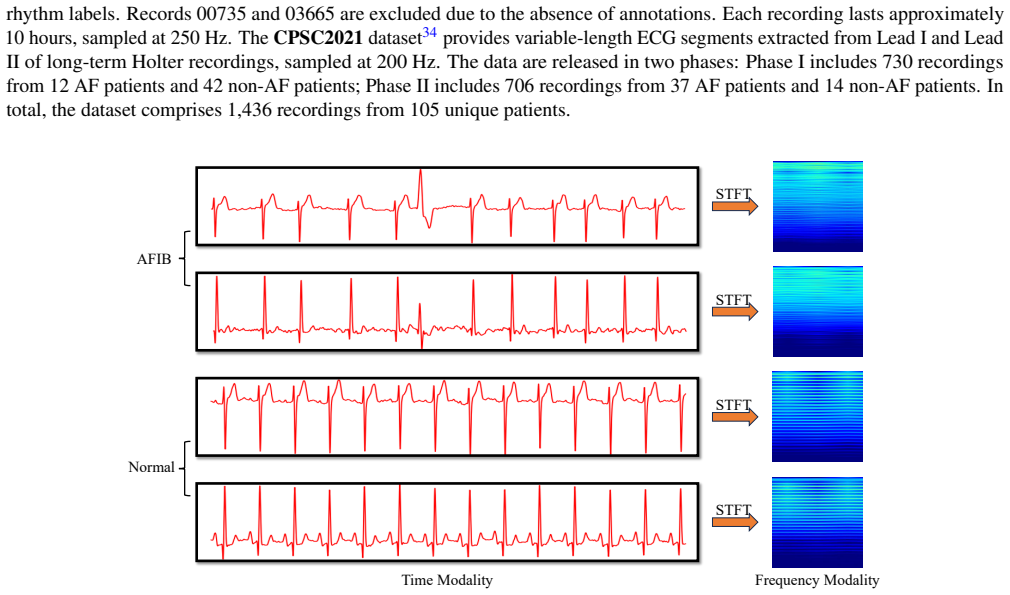
Summary. This paper proposes MGCNet, a dual-branch deep network for AF detection from single-lead ECG. One branch encodes the raw time-domain signal with 1D convolutions and a BiGRU; the other encodes an STFT spectrogram with 2D convolutions. A Bidirectional Gating Module (BGM) performs channel-wise cross-modal gating, and a Cross-modal Supervised Contrastive Learning (CSCL) loss is added to the cross-entropy objective. The method is evaluated with patient-wise 5-fold cross-validation on AFDB and CPSC2021 and with bidirectional cross-dataset transfer between the two, comparing against six published baselines. The paper reports top accuracy/AUC on both datasets and both transfer directions (e.g., AFDB accuracy 0.9878, CPSC2021 accuracy 0.9801, AFDB→CPSC2021 accuracy 0.9165, CPSC2021→AFDB accuracy 0.9507), along with ablations, efficiency figures, and robustness to added interference.
Significance. If the reported results survive scrutiny, the contribution is valuable: a concrete, reproducible recipe combining time-frequency fusion with supervised contrastive learning, evaluated on public benchmarks under a patient-wise split and against several recent baselines. The ablation study and the public-data setup are strengths, and the claimed cross-dataset gains are clinically relevant. However, the headline generalization claim is currently undermined by two validation-protocol problems: (i) the contrastive weight λ is selected using one of the two cross-dataset target sets, and (ii) the quality filter discards unqualified segments from both training and test, so the reported numbers describe an enriched subset rather than the raw clinical distribution. These issues are fixable but require re-running experiments and additional reporting before the central claim can be accepted.
major comments (4)
- [Sensitivity Analysis / Implementation Details] The hyperparameter λ is selected on the target test set. In 'Sensitivity Analysis', λ ∈ {0,0.001,0.01,0.1,1.0} is varied and the paper states that performance 'peaked at λ=0.01' on CPSC2021 and under cross-dataset evaluation (CPSC2021→AFDB), after which 'Implementation Details' fixes λ=0.01 for all runs. Thus the reported CPSC2021→AFDB accuracy of 0.9507 (Table 4) is obtained with a hyperparameter chosen by looking at that exact target set. The AFDB→CPSC2021 result (0.9165) also uses a λ selected on the reverse transfer direction, so it is indirectly tuned as well. This is test-set hyperparameter tuning and biases the generalization claim. Fix: select λ using only source-domain validation data (or nested cross-validation), freeze it, and report cross-dataset results for that fixed λ across multiple seeds with mean and standard deviation.
- [Materials, Quality Assessment] The paper states 'Only qualified segments are retained for training and evaluation', applying an automated quality filter to both datasets. This removes noisy or artifact-contaminated segments from the test distribution before computing the reported accuracies. Since the paper's headline is robustness and generalization to real-world conditions, this filtering is load-bearing: the metrics are measured on an enriched, cleaned subset and may not reflect performance on the unqualified segments that are exactly the difficult cases. Please report the number and percentage of segments excluded for each dataset, and provide results on the full test set and/or on the unqualified subset. This applies equally to all compared methods, but it still limits the external-validity interpretation in the abstract and conclusions.
- [Table 4 / Generalization Experiments] Cross-dataset results are single runs with no variance estimates. Table 4 reports one accuracy number per method per direction, and no standard deviations, confidence intervals, or significance tests are given. Given stochastic training, data augmentation, and the small margins in some comparisons (e.g., 0.9165 vs 0.8951 for AFDB→CPSC2021; 0.9507 vs 0.9164 for CPSC2021→AFDB), these differences could be within seed-to-seed noise. Report at least 5 independent seeds with mean±std, and ideally a paired significance test over patients or folds.
- [Abstract / Conclusions] The abstract and conclusions claim 'consistent improvements over state-of-the-art methods across multiple metrics' and 'excellent cross-dataset generalization'. Table 4 shows that MGCNet has lower Recall than several baselines in both transfer directions (0.9007 vs up to 0.9579 in AFDB→CPSC2021; 0.9154 vs 0.9465 for MSCGN in CPSC2021→AFDB). The discussion acknowledges this as a specificity-precision trade-off, but the summary statements should be qualified so that the reader is not left with the impression of uniform superiority across all metrics.
minor comments (6)
- [Introduction / Abstract] Typos: 'majority existing methods' should be 'most existing methods'; 'robust and generalizable under' should be 'robust and generalizable to' or 'generalization'.
- [Comparative Experiments] Typo: 'compareed' should be 'compared'.
- [Figure 5] The figure axes are unlabeled in the manuscript text and the displayed values are hard to read. Add clear axis labels, tick labels, and ideally error bars for the sensitivity analysis.
- [Table 2] The 'Downsample' rows appear redundant with the 'BGM' rows that already halve the resolution. Clarify the data flow: is the downsampling performed inside BGM or as a separate operation, and what are the inputs to the 'Concat + Expand' step?
- [References] Reference [42] is formatted incorrectly ('Adam, K. D. B. J. et al.'); the correct citation is Kingma, D. P. and Ba, J., 'Adam: A Method for Stochastic Optimization.'
- [Data Availability] The sentence 'All code and trained models have be made publicly available' contains a typo ('have be' → 'have been'). Also, if the GitHub link is not yet active, state that it will be activated upon publication.
Circularity Check
Headline cross-dataset generalization is partially circular: λ=0.01 was selected using the same target test sets whose results are later reported as predictions.
-
fitted input called prediction
[Sensitivity Analysis (Figure 5); Implementation Details; Generalization Experiments (Table 4)]
"Performance peaked at λcont = 0.01, achieving an accuracy of 0.9801 and AUC of 0.9979 on CPSC2021, and 0.9507 / 0.9894 under cross-dataset evaluation. ... The contrastive loss hyperparameters were configured as λ=0.01 and τ=0.1."
The final contrastive weight λ is selected after evaluating accuracy/AUC on CPSC2021 intra-dataset and on CPSC2021→AFDB cross-dataset. The same directions are then the headline cross-dataset results in Table 4 (AFDB→CPSC2021: 0.9165; CPSC2021→AFDB: 0.9507). Thus the reported 'without any fine-tuning or adaptation' generalization numbers are the best points of a small λ grid on the target test sets, not independent predictions. This is test-set hyperparameter selection on the central generalization claim, so the claimed cross-dataset advantage is partially circular/optimistically biased rather than a clean out-of-sample result.
full rationale
The only load-bearing circularity is the selection of λ=0.01 using the same target evaluations that are later presented as generalization results. The network design itself—BGM gating, CSCL losses, concatenation, classifier—is not derived from benchmark numbers; it is evaluated against them. No load-bearing self-citation or imported uniqueness theorem is present. The quality filter ('Only qualified segments are retained for training and evaluation') affects external validity by removing noisy segments, but it does not make the comparison circular. However, because both cross-dataset directions were used to tune a hyperparameter before their results were reported, the central generalization claim is partially reduced to a selected outcome. This is partial circularity in the evaluation protocol, not a definitional equivalence.
Assumptions & free parameters
free parameters (6)
- contrastive loss weight λ =
0.01
- contrastive temperature τ =
0.1
- STFT window and hop =
1-s Hann window, 50% overlap
- spectrogram cutoff/resolution =
40 Hz, resized to 128×128, RGB jet colormap
- data augmentation ranges =
noise σ∈[0,0.2], mask [0,0.1], amplitude U(0.5,1.5), zoom [0.8,1.2]
- architecture channel widths =
32→64→128→256; embedding D unspecified
assumptions (5)
- domain assumption 10-second non-overlapping segments inherit the entire recording's label
- domain assumption Quality assessment correctly identifies unqualified segments and removing them improves generalization
- domain assumption STFT magnitude spectrogram with frequencies ≤40 Hz contains sufficient discriminative information for AF
- domain assumption Supervised contrastive loss improves cross-dataset generalization in this setting
- standard math Backpropagation and standard neural network training assumptions
invented entities (2)
-
BGM (Bidirectional Gating Module)
-
CSCL (Cross-modal Supervised Contrastive Learning)
Cite this review
Pith. "Pith review of Robust and Generalizable Atrial Fibrillation Detection from ECG Using Time-Frequency Fusion and Supervised Contrastive Learning." pith.science (2026). https://pith.science/paper/WF6XWF72
@misc{pith2026260110202,
  author       = {Pith},
  title        = {Pith review of: Robust and Generalizable Atrial Fibrillation Detection from ECG Using Time-Frequency Fusion and Supervised Contrastive Learning},
  year         = {2026},
  howpublished = {\url{https://pith.science/paper/WF6XWF72}},
  note         = {Machine review of arXiv:2601.10202}
}
read the original abstract
Atrial fibrillation (AF) is a common cardiac arrhythmia that significantly increases the risk of stroke and heart failure, necessitating reliable and generalizable detection methods from electrocardiogram (ECG) recordings. Although deep learning has advanced automated AF diagnosis, existing approaches often struggle to exploit complementary time frequency information effectively, limiting both robustness under intra-dataset and generalization across diverse clinical datasets. To address these challenges, we propose a crossmodal deep learning framework comprising two key components: a Bidirectional Gating Module (BGM) and a Cross modal Supervised Contrastive Learning (CSCL) strategy. The BGM facilitates dynamic, reciprocal refinement between time and frequency domain features, enhancing model robustness to signal variations within a dataset. Meanwhile, CSCL explicitly structures the joint embedding space by pulling together label consistent samples and pushing apart different ones, thereby improving interclass separability and enabling strong cross dataset generalization. We evaluate our method using five fold crossvalidation on the AFDB and CPSC2021 datasets. Furthermore, to assess cross dataset generalization, we conduct bidirectional cross dataset experiments across AFDB, CPSC2021, LTAF, and SHDBAF by training on one dataset and testing on another. Results show consistent improvements over state of the art methods across multiple metrics, demonstrating that our approach achieves both high intra dataset robustness and excellent crossdataset generalization. We further demonstrate that our method achieves high computational efficiency and anti interference capability, making it suitable for edge deployment.
Figures


Figures from the paper (4 more)


Reference graph
Works this paper leans on
-
[1]
Li, X.et al.Global burden and health inequality of atrial fibrillation/atrial flutter from 1990 to 2021.Front. Cardiovasc. Medicine12, 1585980, DOI: https://doi.org/10.3389/fcvm.2025.1585980 (2025)
arXiv 1990
-
[2]
Bordignon, S., Corti, M. C. & Bilato, C. Atrial fibrillation associated with heart failure, stroke and mortality.J. Atr. Fibrillation5, 467, DOI: https://doi.org/10.4022/jafib.467 (2012)
-
[3]
Pamporis, K.et al.Prevalence of asymptomatic atrial fibrillation and risk factors associated with asymptomatic status: a systematic review and meta-analysis.Eur. J. Prev. Cardiol.zwaf138, DOI: https://doi.org/10.1093/eurjpc/zwaf138 (2025)
-
[4]
Y ., Huang, L., Malwade, S., Hsu, C.-Y
Yang, T. Y ., Huang, L., Malwade, S., Hsu, C.-Y . & Chen, Y . C. Diagnostic accuracy of ambulatory devices in detecting atrial fibrillation: systematic review and meta-analysis.JMIR mHealth uHealth9, e26167, DOI: https://doi.org/10.2196/26167 (2021)
-
[5]
Lip, G. Y . & Hee, F. L. S. Paroxysmal atrial fibrillation.Qjm94, 665–678, DOI: https://doi.org/10.1093/qjmed/94.12.665 (2001)
-
[6]
1161/STROKEAHA.110.591958 (2010)
Stahrenberg, R.et al.Enhanced detection of paroxysmal atrial fibrillation by early and prolonged continuous holter monitoring in patients with cerebral ischemia presenting in sinus rhythm.Stroke41, 2884–2888, DOI: https://doi.org/10. 1161/STROKEAHA.110.591958 (2010)
2010
-
[7]
Rahman, M. M.et al.Residual-attention deep learning model for atrial fibrillation detection from holter recordings.J. Electrocardiol.89, 153876, DOI: https://doi.org/10.1016/j.jelectrocard.2025.153876 (2025)
arXiv 2025
-
[8]
Lin, H. Artificial intelligence with great potential in medical informatics: a brief review.Medinformatics1, 2–9, DOI: https://doi.org/10.47852/bonviewMEDIN42022204 (2024)
Show all 44 references
-
[10]
Jabbar, A., Huang, J., Jabbar, M. K. & Ali, A. Adaptive multimodal fusion in vertical federated learning for decentralized glaucoma screening.Brain Sci.15, 990, DOI: https://doi.org/10.3390/brainsci15090990 (2025)
2025 doi
-
[11]
R., Ulfenborg, B
Stahlschmidt, S. R., Ulfenborg, B. & Synnergren, J. Multimodal deep learning for biomedical data fusion: a review. Briefings bioinformatics23, bbab569, DOI: https://doi.org/10.1093/bib/bbab569 (2022)
2022 doi
-
[12]
journal environmental research public health18, 11302, DOI: https://doi.org/10.3390/ijerph182111302 (2021)
Murat, F.et al.Review of deep learning-based atrial fibrillation detection studies.Int. journal environmental research public health18, 11302, DOI: https://doi.org/10.3390/ijerph182111302 (2021)
2021 doi
-
[13]
& Akbilgic, O
Mahajan, R., Kamaleswaran, R. & Akbilgic, O. Comparative analysis between convolutional neural network learned and engineered features: A case study on cardiac arrhythmia detection.Cardiovasc. Digit. Heal. J.1, 37–44, DOI: https://doi.org/10.1016/j.cvdhj.2020.04.001 (2020)
2020 doi
-
[14]
Rao, S. S. & Martis, R. J. Rr interval-based atrial fibrillation detection using traditional and ensemble machine learning algorithms.J. Med. Signals & Sensors13, 224–232, DOI: https://doi.org/10.4103/jmss.jmss_4_22 (2023). 14/16
2023 doi
-
[15]
& Zhang, H
Xia, Y ., Wulan, N., Wang, K. & Zhang, H. Detecting atrial fibrillation by deep convolutional neural networks.Comput. biology medicine93, 84–92, DOI: https://doi.org/10.1016/j.compbiomed.2017.12.007 (2018)
2017 doi
-
[16]
Faust, O.et al.Automated detection of atrial fibrillation using long short-term memory network with rr interval signals. Comput. biology medicine102, 327–335, DOI: https://doi.org/10.1016/j.compbiomed.2018.07.001 (2018)
2018 doi
-
[17]
A.et al.Deep residual-dense network based on bidirectional recurrent neural network for atrial fibrillation detection.Sci
Laghari, A. A.et al.Deep residual-dense network based on bidirectional recurrent neural network for atrial fibrillation detection.Sci. reports13, 15109, DOI: https://doi.org/10.1038/s41598-023-40343-x (2023)
2023 doi
-
[18]
& Jang, J
Kim, S., Lim, J. & Jang, J. Patient-adaptive beat-wise temporal transformer for atrial fibrillation classification in continuous long-term cardiac monitoring.IEEE AccessDOI: https://doi.org/10.1109/ACCESS.2024.3498043 (2024)
2024
-
[19]
& Jang, J
Kim, S., Lim, J. & Jang, J. Seqafnet: A beat-wise sequential neural network for atrial fibrillation classification in adhesive patch-type electrocardiographs.IEEE J. Biomed. Heal. Informatics28, 5260–5269, DOI: https://doi.org/10.1109/JBHI. 2024.3411056 (2024)
2024
-
[20]
Signal Process
Sun, Y .et al.Imc-resnet: Atrial fibrillation detection method based on interlayer multiscale coupling.Biomed. Signal Process. Control.97, 106683, DOI: https://doi.org/10.1016/j.bspc.2024.106683 (2024)
2024
-
[21]
& Xie, L
Wu, X., Yan, M., Tang, H., Wu, D. & Xie, L. Mscgn: Multiscale complementary gating network for time series classification. Biomed. Signal Process. Control.112, 108563, DOI: https://doi.org/10.1016/j.bspc.2025.108563 (2026)
2025
-
[22]
& Xie, L
Wu, X., Yan, M., Wang, R. & Xie, L. Multiscale feature enhanced gating network for atrial fibrillation detection.Comput. Methods Programs Biomed.261, 108606, DOI: https://doi.org/10.1016/j.cmpb.2025.108606 (2025)
2025
-
[23]
Methods Programs Biomed.238, 107565, DOI: https://doi.org/10.1016/j.cmpb.2023.107565 (2023)
Li, Y .et al.Diagnosis of atrial fibrillation using self-complementary attentional convolutional neural network.Comput. Methods Programs Biomed.238, 107565, DOI: https://doi.org/10.1016/j.cmpb.2023.107565 (2023)
2023
-
[24]
physiology9, 1206, DOI: https://doi.org/10.3389/fphys.2018.01206 (2018)
He, R.et al.Automatic detection of atrial fibrillation based on continuous wavelet transform and 2d convolutional neural networks.Front. physiology9, 1206, DOI: https://doi.org/10.3389/fphys.2018.01206 (2018)
2018
-
[25]
& Zhang, Q
Luo, Y ., Huang, B., Zhu, J., Zeng, X. & Zhang, Q. Detection of atrial fibrillation with a hybrid deep learning model and time-frequency representations.medRxiv2025–06, DOI: https://doi.org/10.1101/2025.06.03.25328929 (2025)
2025 doi
-
[26]
& Zhou, X
Yue, Y ., Chen, C., Liu, P., Xing, Y . & Zhou, X. Automatic detection of short-term atrial fibrillation segments based on frequency slice wavelet transform and machine learning techniques.Sensors21, 5302, DOI: https://doi.org/10.3390/ s21165302 (2021). 27.Zhu, H., Jiang, N., X...
2021 doi
-
[28]
& Sun, J
He, K., Zhang, X., Ren, S. & Sun, J. Deep residual learning for image recognition. InProceedings of the IEEE conference on computer vision and pattern recognition, 770–778, DOI: https://doi.org/10.1109/CVPR.2016.90 (2016)
2016 doi
-
[29]
& Yao, B
Xie, J., Stavrakis, S. & Yao, B. Automated identification of atrial fibrillation from single-lead ecgs using multi-branching resnet.Front. Physiol.15, 1362185, DOI: https://doi.org/10.3389/fphys.2024.1362185 (2024)
2024
-
[30]
informatics decision making20, 308, DOI: https://doi.org/10.1186/s12911-020-01337-1 (2020)
Hu, Y .et al.An effective frequency-domain feature of atrial fibrillation based on time–frequency analysis.BMC Med. informatics decision making20, 308, DOI: https://doi.org/10.1186/s12911-020-01337-1 (2020)
2020 doi
-
[31]
& Huang, W
Ma, K., Zhang, T., Zhang, H. & Huang, W. Self-supervised contrastive learning achieves 12-lead ecg classification.Biomed. Signal Process. Control.112, 108420, DOI: https://doi.org/10.1016/j.bspc.2025.108420 (2026)
2025
-
[32]
& Sakurai, T
He, S., Ye, X. & Sakurai, T. Clop-herg: The contrastive learning optimized pre-trained model for representation learning in predicting drug-induced herg channel blockers.Medinformatics1, 103–111, DOI: https://doi.org/10.47852/ bonviewMEDIN42022049 (2024)
2024
-
[33]
A new method for detecting atrial fibrillation using rr intervals.Proc
Moody, G. A new method for detecting atrial fibrillation using rr intervals.Proc. Comput. Cardiol.10, 227–230, DOI: https://www.physionet.org/content/afdb/1.0.0/ (1983)
1983
-
[34]
PhysioNet1–83, DOI: https://physionet.org/content/cpsc2021/1.0.0 (2021)
Wang, X.et al.Paroxysmal atrial fibrillation events detection from dynamic ecg recordings: The 4th china physiological signal challenge 2021.Proc. PhysioNet1–83, DOI: https://physionet.org/content/cpsc2021/1.0.0 (2021)
2021
-
[35]
K., Vijayalakshmi, D
Anbalagan, T., Nath, M. K., Vijayalakshmi, D. & Anbalagan, A. Analysis of various techniques for ecg signal in healthcare, past, present, and future.Biomed. Eng. Adv.6, 100089, DOI: https://doi.org/10.1016/j.bea.2023.100089 (2023)
2023
-
[36]
Attia, Z. I.et al.An artificial intelligence-enabled ecg algorithm for the identification of patients with atrial fibrillation during sinus rhythm: a retrospective analysis of outcome prediction.The Lancet394, 861–867, DOI: https://doi.org/10. 1016/S0140-6736(19)31721-0 (2019). 15/16
2019
-
[37]
& Zhang, Y
Zhao, Z. & Zhang, Y . Sqi quality evaluation mechanism of single-lead ecg signal based on simple heuristic fusion and fuzzy comprehensive evaluation.Front. physiology9, 727, DOI: https://doi.org/10.3389/fphys.2018.00727 (2018)
2018
-
[38]
research methods53, 1689–1696, DOI: https://github.com/neuropsychology/NeuroKit (2021)
Makowski, D.et al.Neurokit2: A python toolbox for neurophysiological signal processing.Behav. research methods53, 1689–1696, DOI: https://github.com/neuropsychology/NeuroKit (2021). 39.Oppenheim, A. V .Discrete-time signal processing(Pearson Education India, 1999)
2021
- [40]
- [41]
-
[42]
Adam, K. D. B. J.et al.A method for stochastic optimization.arXiv preprint arXiv:1412.69801412, DOI: https: //doi.org/10.48550/arXiv.1412.6980 (2014)
2014 doi
-
[43]
R.et al.Grad-cam: Visual explanations from deep networks via gradient-based localization
Selvaraju, R. R.et al.Grad-cam: Visual explanations from deep networks via gradient-based localization. InProceedings of the IEEE international conference on computer vision, 618–626, DOI: https://doi.org/10.1109/ICCV .2017.74 (2017)
2017 doi
-
[44]
Cinotti, E.et al.An edge ai approach for low-power, real-time atrial fibrillation detection on wearable devices based on heartbeat intervals.Sensors25, 7244, DOI: https://doi.org/10.3390/s25237244 (2025)
2025 doi
-
[45]
Abdelrazik, A.et al.Wearable devices for arrhythmia detection: advancements and clinical implications.Sensors (Basel, Switzerland)25, 2848, DOI: https://doi.org/10.3390/s25092848 (2025)
2025 doi
-
[46]
& Sunkaria, R
Singh, O. & Sunkaria, R. K. Ecg signal denoising via empirical wavelet transform.Australas. physical & engineering sciences medicine40, 219–229, DOI: https://doi.org/10.1007/s13246-016-0510-6 (2017)
2017 doi
-
[47]
& Sunkaria, R
Singh, O. & Sunkaria, R. K. Powerline interference reduction in ecg signals using empirical wavelet transform and adaptive filtering.J. medical engineering & technology39, 60–68, DOI: https://doi.org/10.3109/03091902.2014.979954 (2015). 16/16
2014
Reviewed August 3, 2026 · model on record in the stance chip above.
Discussion (0). Sign in to comment.