REVIEW 5 major objections 4 minor 35 references
SIL-RRT*: Learning Sampling Distribution through Self Imitation Learning
T0 review · 5 major / 4 minor · reviewed 2026-08-12 · deepseek-v4-flash
Pith's one-line read SIL-RRT* combines RRT* with a transformer trained by self-imitation to predict a Gaussian distribution for the next sample, and the paper reports it solves 2D, rigid-body, 3D, and 5-DOF snake planning with far fewer samples than RRT* or…
desk verdict BiRRT* confound makes the headline sample reductions uninterpretable, but the architecture and WSIL idea are worth a serious referee. read the letter →
The pith
A machine-rendered reading of the paper's core claim, the machinery that carries it, and where it could break.
The reading
What carries the argument
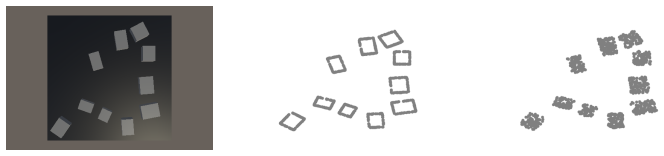
The load-bearing object is the Gaussian sampler network: a Perceiver-IO transformer whose encoder projects obstacle-surface point clouds into a fixed-length latent array and whose causal decoder attends to the goal plus the last five tree nodes. Two MLP heads convert the decoded features into the mean and standard deviation of a multivariate normal distribution, and samples are drawn from that distribution to grow the RRT*. Training minimizes the negative log-likelihood of the nodes of feasible paths, with each path weighted by a sigmoid of the gap between its true length and the prediction of a separate estimator network, plus an entropy term to encourage exploration. The same architecture is paired with an integrated bidirectional RRT* search, added to overcome difficulty in generating useful samples near the goal.
What would settle it
Run SIL-RRT* with the trained sampler replaced by a uniform sampler while leaving BiRRT*, goal handling, obstacle representation, and sample caps unchanged; if success rates and average sample counts remain at the reported levels, the learned distribution is not what carries the result.
Extended reading notes
Core claim
The central claim is that a sampling distribution for RRT* can be learned from data the algorithm itself generates, and that this learned distribution transfers to workspaces the model has not seen. In the reported comparisons, SIL-RRT* uses on average about 4 times fewer samples than RRT* in 2D and rigid-body scenes and about 20 times fewer in the 3D suite, reaches 100 percent success in 3D where RRT* succeeds only 17.2 percent even though RRT* was allowed a 400-sample budget and SIL-RRT* only 200, and produces paths that are shorter or comparable in length. The fine-tuned version with weighted self-imitation learning further shortens path lengths at a modest cost in samples. The paper presents these results as evidence that a transformer-based, self-imitation-trained sampler can replace uniform sampling across different configuration-space dimensions.
Load-bearing premise
The whole approach depends on the assumption that one bell-shaped probability distribution, computed from the goal, the obstacle point cloud, and the last five tree nodes, is enough to steer RRT* efficiently; if that assumption fails, the reported speedups could come from the built-in bidirectional search rather than from the learned sampler.
Editorial extensions
If this is right
- A planner built this way can solve new workspaces that were not seen in training, since the test set used unseen scenarios with more obstacles than the training set.
- In the 3D suite, SIL-RRT* solves every task within 200 samples, whereas RRT* solves only 17.2 percent within 400 samples, suggesting learned sampling can extend the reach of sampling-based planning into higher dimensions.
- Because weighted self-imitation learning reuses the planner's own successful paths, the method avoids the need for near-optimal expert demonstrations that are difficult to obtain in high-dimensional spaces.
- The same architecture and surface-point-cloud representation are reported to work for point-mass, rigid-body, and 5-DOF snake agents, so the approach is not tied to one configuration-space dimension.
Reading between the lines
- Beyond the paper's claims, a clean ablation that replaces the learned sampler with a uniform sampler while keeping BiRRT*, goal handling, and sample caps fixed would show whether the learned distribution is actually the cause of the reported speedups; the paper does not report such an ablation.
- Beyond the paper's claims, the single Gaussian output head may be the bottleneck in environments with narrow passageways where the useful next-sample distribution is multi-modal; a mixture-density or diffusion head would be a direct test of that limitation.
- Beyond the paper's claims, the learned sampler could serve as a proposal distribution inside other sampling-based planners, such as informed or batch-informed tree search, rather than only inside RRT*.
- Beyond the paper's claims, the five-node context window limits the sampler to local tree history; environments whose corridors require very long-range dependencies may need a larger context or a recurrent summary.
Editorial analysis
A structured set of objections, weighed in public.
Referee Report
Summary. The paper proposes SIL-RRT*, a learning-based motion planning algorithm that extends RRT* by using a Perceiver-IO-based neural network to predict a multivariate Gaussian sampling distribution conditioned on point-cloud obstacle representations, the goal, and the last five tree nodes. The network is trained initially by maximum-likelihood on paths collected by RRT*, then fine-tuned with weighted self-imitation learning (WSIL) that weights training trajectories by the discrepancy between actual and estimated path length. The authors evaluate SIL-RRT* against RRT* and MPNetNR in 2D, rigid-body, and 3D environments, and also report results on more complex scenes including a 5-DoF snake robot, claiming large reductions in the number of samples and computation time while producing near-optimal paths.
Significance. If the central claim were established, SIL-RRT* would be a useful contribution: it demonstrates that a Transformer-based sampler can be trained from self-generated data without expert demonstrations, and it reports generalization to held-out workspaces. The paper has concrete strengths: it tests on unseen scenarios, evaluates across several environment types, runs the neural network on CPU during planning, and avoids post-processing tricks. However, the evaluation as designed cannot separate the contribution of the learned sampler from other algorithmic modifications (notably bidirectional search) and is weakened by asymmetric sample caps, very small numbers of trials, missing baselines in the complex scenarios, and an uncontrolled comparison with MPNetNR. The significance of the empirical claims is therefore currently conditional on additional controlled experiments.
major comments (5)
- [Section 4.1] The central claim in Section 5.2 is that SIL-RRT* achieves reduced sample requirements because of its learned sampling distribution. However, Section 4.1 states that SIL-RRT* integrates the BiRRT* algorithm, which alternates forward and backward tree expansions, while the RRT* baseline does not use bidirectional search. No ablation isolates the learned sampler's contribution: there is no experiment running a uniform or goal-biased sampler inside the same BiRRT* framework, nor a learned sampler without BiRRT*. The observed gains in Table 1 could therefore reflect the bidirectional search or other implementation details rather than the Perceiver-IO sampling distribution.
- [Section 5.2, Table 1] The sample caps are asymmetric in the 3D environment: RRT* is capped at 400 samples while SIL-RRT* and MPNetNR are capped at 200. With this setup, RRT*'s average samples generated (362) is close to its cap and its success rate (17.20%) is constrained by that cap, so the claim of 'fewer samples' and the success-rate comparison are partly by construction. The 3D numbers should be re-run with a common cap for all algorithms, or the comparison should report samples to first feasible solution under an identical termination condition.
- [Section 5.2, Tables 1 and 2] The number of trials is very small: Table 1 reports three trials per environment and Table 2 reports four trials, yet no statistical significance tests or confidence intervals are provided. Given that the standard deviations are often comparable to or larger than the reported differences (e.g., 2D average samples 22.53 +/- 18.05 versus 23.93 +/- 19.09), the claimed advantages of SIL-RRT* over the alternatives are not statistically supported. The authors should report more trials and appropriate significance testing or effect-size measures.
- [Section 5.2, Table 2] The complex and snake scenarios contain no baseline algorithms; Table 2 compares only SIL-RRT* without and with WSIL. Consequently, the paper's claim that SIL-RRT* 'scales to more complex environments' and handles high-dimensional problems is not supported by any comparison with RRT* or another non-learning planner in these settings. At minimum, RRT* with the same sample cap should be run in the complex 2D, complex rigid-body, complex 3D, and snake environments.
- [Section 5.2, Table 1] The MPNetNR comparison is not well controlled. MPNetNR was trained on the authors' dataset for only 5000 iterations, which the paper itself notes is smaller than the dataset used in the original MPNet work, and MPNetNR's point clouds are sampled from obstacle interiors while SIL-RRT* uses surface point clouds. The poor MPNetNR results are therefore attributable at least in part to these training and representation differences, not necessarily to algorithmic inferiority. Additionally, MPNetNR's sample count is not reported in Table 1 (shown as a dash), so the sample-efficiency comparison is incomplete.
minor comments (4)
- [Section 3.3 and Section 4] The first paragraph of Section 4 and all of Section 3.3 are essentially identical, including the same discussion of imitation learning and the same references; one of the two copies should be removed or replaced with a brief pointer.
- [Section 5.2] The text says 'we executed tree trials for each environment'; this should read 'we executed three trials', and later 'we conducted 4 additional trials' should be 'four additional trials' for consistency.
- [Table 1] In the 3D row, the Average Time for SIL-RRT* with WSIL is reported as '0.17 +/- 0.4 s'; the standard deviation 0.4 is inconsistent with the neighboring value '0.17 +/- 0.03 s' for SIL-RRT* without WSIL and appears to be a typo.
- [Equation (3)] The notation of the sampler loss is unclear: 'L_sampler = - 1/B NX i=1 log ...' lacks a summation symbol and an explicit definition of the index range, making the equation difficult to parse as written.
Circularity Check
No significant circularity: the sample-efficiency claim is an empirical, held-out evaluation, and no fitted parameter or self-citation forces the result.
full rationale
The paper's central claim—that SIL-RRT* finds feasible paths with fewer samples than RRT*—is an empirical result measured on held-out test workspaces (Section 5.1), not a quantity derived by construction from the model's fitted parameters. The sampler is trained by minimizing negative log-likelihood over feasible paths (Eq. 3 and Eq. 6), and WSIL weights those paths using a learned length-estimator discrepancy (Eq. 4). This is a self-imitation bootstrapping loop in the training procedure, but it does not rename a fitted value as a prediction of the benchmark metrics; the test-time sampler is still evaluated on unseen scenarios. No load-bearing step relies on a self-citation as an external mathematical fact; the only self-citation [8] is contextual in Related Work. The different sample caps for RRT* in 3D (400 vs 200) are an experimental-design concern that could confound interpretation, but they do not make the reported average sample counts equal to the algorithm's inputs by construction. Thus no circular step meets the required standard of quoting a specific reduction of a claimed result to its own inputs.
Assumptions & free parameters
free parameters (7)
- K (quality threshold)
- mu (K annealing divisor)
- lambda (entropy regularization coefficient)
- epsilon exploration schedule
- number of last nodes =
5
- point cloud count =
1000
- goal region radius =
1
assumptions (5)
- domain assumption Surface point-cloud representation of obstacles sufficiently encodes collision geometry for planning.
- domain assumption A multivariate Gaussian over the next node, conditioned on the last five nodes and the latent obstacle encoding, can express the useful sampling bias.
- domain assumption The path-length estimator predicts Cest accurately enough to separate high- from low-quality demonstrations.
- domain assumption Training workspaces (100 workspaces, 10 obstacles each) are representative of test scenarios including complex environments with 15 obstacles and the snake.
- domain assumption RRT* and SIL-RRT* generated paths, even suboptimal ones, provide useful learning signal.
Cite this review
Pith. "Pith review of SIL-RRT*: Learning Sampling Distribution through Self Imitation Learning." pith.science (2026). https://pith.science/paper/WFB4BAE3
@misc{pith2026241117293,
  author       = {Pith},
  title        = {Pith review of: SIL-RRT*: Learning Sampling Distribution through Self Imitation Learning},
  year         = {2026},
  howpublished = {\url{https://pith.science/paper/WFB4BAE3}},
  note         = {Machine review of arXiv:2411.17293}
}
read the original abstract
Efficiently finding safe and feasible trajectories for mobile objects is a critical field in robotics and computer science. In this paper, we propose SIL-RRT*, a novel learning-based motion planning algorithm that extends the RRT* algorithm by using a deep neural network to predict a distribution for sampling at each iteration. We evaluate SIL-RRT* on various 2D and 3D environments and establish that it can efficiently solve high-dimensional motion planning problems with fewer samples than traditional sampling-based algorithms. Moreover, SIL-RRT* is able to scale to more complex environments, making it a promising approach for solving challenging robotic motion planning problems.
Figures


Reference graph
Works this paper leans on
-
[1]
Global overview of imitation learning, 2018
Alexandre Attia and Sharone Dayan. Global overview of imitation learning, 2018
work page 2018
-
[2]
Philip Baldoni, James McMahon, and Erion Plaku. Leveraging neural net- works to guide path planning: Improving dataset generation and planning efficiency. In 2022 IEEE 18th International Conference on Automation Science and Engineering (CASE), pages 667–674. IEEE, 2022
work page 2022
-
[3]
Modeling human driving behavior through generative adversarial imitation learning
Raunak Bhattacharyya, Blake Wulfe, Derek J Phillips, Alex Kuefler, Jeremy Morton, Ransalu Senanayake, and Mykel J Kochenderfer. Modeling human driving behavior through generative adversarial imitation learning. IEEE Transactions on Intelligent Transportation Systems, 2022
work page 2022
-
[4]
Daniel Brown, Wonjoon Goo, Prabhat Nagarajan, and Scott Niekum. Ex- trapolating beyond suboptimal demonstrations via inverse reinforcement learning from observations. In International conference on machine learn- ing, pages 783–792. PMLR, 2019
work page 2019
-
[5]
Learn- ing to plan in high dimensions via neural exploration-exploitation trees
Binghong Chen, Bo Dai, Qinjie Lin, Guo Ye, Han Liu, and Le Song. Learn- ing to plan in high dimensions via neural exploration-exploitation trees. arXiv preprint arXiv:1903.00070, 2019
arXiv 1903
-
[6]
Deci- sion transformer: Reinforcement learning via sequence modeling
Lili Chen, Kevin Lu, Aravind Rajeswaran, Kimin Lee, Aditya Grover, Misha Laskin, Pieter Abbeel, Aravind Srinivas, and Igor Mordatch. Deci- sion transformer: Reinforcement learning via sequence modeling. Advances in neural information processing systems, 34:15084–15097, 2021
work page 2021
-
[7]
RL-RRT: kinodynamic motion planning via learning reach- ability estimators from rl policies
Hao-Tien Lewis Chiang, Jasmine Hsu, Marek Fiser, Lydia Tapia, and Alek- sandra Faust. RL-RRT: kinodynamic motion planning via learning reach- ability estimators from rl policies. IEEE Robotics and Automation Letters, 4(4):4298–4305, 2019
work page 2019
- [8]
Show all 35 references
-
[9]
An image is worth 16x16 words: Transformers for image recognition at scale
Alexey Dosovitskiy, Lucas Beyer, Alexander Kolesnikov, Dirk Weissenborn, Xiaohua Zhai, Thomas Unterthiner, Mostafa Dehghani, Matthias Min- derer, Georg Heigold, Sylvain Gelly, et al. An image is worth 16x16 words: Transformers for image recognition at scale. arXiv preprint arX...
2010 arXiv
-
[10]
Survey of imitation learning for robotic manipulation
Bin Fang, Shidong Jia, Di Guo, Muhua Xu, Shuhuan Wen, and Fuchun Sun. Survey of imitation learning for robotic manipulation. International Journal of Intelligent Robotics and Applications, 3:362–369, 2019. 14
2019
-
[11]
Informed RRT*: optimal sampling-based path planning focused via direct sampling of an admissible ellipsoidal heuristic
Jonathan D Gammell, Siddhartha S Srinivasa, and Timothy D Barfoot. Informed RRT*: optimal sampling-based path planning focused via direct sampling of an admissible ellipsoidal heuristic. In 2014 IEEE/RSJ Inter- national Conference on Intelligent Robots and Systems, pages 2997–...
2014
-
[12]
Batch Informed Trees (BIT): sampling-based optimal planning via the heuristically guided search of implicit random geometric graphs
Jonathan D Gammell, Siddhartha S Srinivasa, and Timothy D Barfoot. Batch Informed Trees (BIT): sampling-based optimal planning via the heuristically guided search of implicit random geometric graphs. In 2015 IEEE international conference on robotics and automation (ICRA), page...
2015
-
[13]
Generative adversarial imitation learn- ing
Jonathan Ho and Stefano Ermon. Generative adversarial imitation learn- ing. Advances in neural information processing systems, 29, 2016
2016
-
[14]
Learning sampling distri- butions for robot motion planning
Brian Ichter, James Harrison, and Marco Pavone. Learning sampling distri- butions for robot motion planning. In 2018 IEEE International Conference on Robotics and Automation (ICRA), pages 7087–7094. IEEE, 2018
2018
-
[15]
RRT*-smart: rapid convergence implementation of rrt* towards optimal solution
Fahad Islam, Jauwairia Nasir, Usman Malik, Yasar Ayaz, and Osman Hasan. RRT*-smart: rapid convergence implementation of rrt* towards optimal solution. In 2012 IEEE international conference on mechatronics and automation, pages 1651–1656. IEEE, 2012
2012
-
[16]
Perceiver io: A general architecture for structured inputs & outputs
Andrew Jaegle, Sebastian Borgeaud, Jean-Baptiste Alayrac, Carl Doer- sch, Catalin Ionescu, David Ding, Skanda Koppula, Daniel Zoran, Andrew Brock, Evan Shelhamer, et al. Perceiver io: A general architecture for structured inputs & outputs. arXiv preprint arXiv:2107.14795, 2021
2021 arXiv
-
[17]
Perceiver: General perception with iterative attention
Andrew Jaegle, Felix Gimeno, Andy Brock, Oriol Vinyals, Andrew Zis- serman, and Joao Carreira. Perceiver: General perception with iterative attention. In International conference on machine learning, pages 4651–
-
[18]
Optimal bidirectional rapidly- exploring random trees
Matthew Jordan and Alejandro Perez. Optimal bidirectional rapidly- exploring random trees. 2013
2013
-
[19]
Sampling-based algorithms for op- timal motion planning
Sertac Karaman and Emilio Frazzoli. Sampling-based algorithms for op- timal motion planning. The international journal of robotics research, 30(7):846–894, 2011
2011
-
[20]
Probabilistic roadmaps for path planning in high-dimensional configura- tion spaces
Lydia E Kavraki, Petr Svestka, J-C Latombe, and Mark H Overmars. Probabilistic roadmaps for path planning in high-dimensional configura- tion spaces. IEEE transactions on Robotics and Automation, 12(4):566– 580, 1996
1996
-
[21]
Graph neural networks for motion planning
Arbaaz Khan, Alejandro Ribeiro, Vijay Kumar, and Anthony G Fran- cis. Graph neural networks for motion planning. arXiv preprint arXiv:2006.06248, 2020. 15
2006 arXiv
-
[22]
LEGO: Leveraging experience in roadmap generation for sampling-based planning
Rahul Kumar, Aditya Mandalika, Sanjiban Choudhury, and Siddhartha Srinivasa. LEGO: Leveraging experience in roadmap generation for sampling-based planning. In 2019 IEEE/RSJ International Conference on Intelligent Robots and Systems (IROS), pages 1488–1495. IEEE, 2019
2019
-
[23]
Randomized kinodynamic plan- ning
Steven M LaValle and James J Kuffner Jr. Randomized kinodynamic plan- ning. The international journal of robotics research, 20(5):378–400, 2001
2001
-
[24]
Self-imitation learn- ing by planning
Sha Luo, Hamidreza Kasaei, and Lambert Schomaker. Self-imitation learn- ing by planning. In 2021 IEEE International Conference on Robotics and Automation (ICRA), pages 4823–4829. IEEE, 2021
2021
-
[25]
NR-RRT: neural risk-aware near-optimal path planning in uncertain non- convex environments
Fei Meng, Liangliang Chen, Han Ma, Jiankun Wang, and Max Q-H Meng. NR-RRT: neural risk-aware near-optimal path planning in uncertain non- convex environments. arXiv preprint arXiv: 2205.06951, 2022
2022 arXiv
-
[26]
Self-imitation learning
Junhyuk Oh, Yijie Guo, Satinder Singh, and Honglak Lee. Self-imitation learning. In International Conference on Machine Learning, pages 3878–
-
[27]
Motion planning networks
Ahmed H Qureshi, Anthony Simeonov, Mayur J Bency, and Michael C Yip. Motion planning networks. In 2019 International Conference on Robotics and Automation (ICRA), pages 2118–2124. IEEE, 2019
2019
-
[28]
Sqil: Imitation learning via reinforcement learning with sparse rewards
Siddharth Reddy, Anca D Dragan, and Sergey Levine. Sqil: Imitation learning via reinforcement learning with sparse rewards. arXiv preprint arXiv:1905.11108, 2019
1905 arXiv
-
[29]
CBAGAN-RRT: convolutional block attention generative adversarial network for sampling-based path planning, 2023
Abhinav Sagar and Sai Teja Gilukara. CBAGAN-RRT: convolutional block attention generative adversarial network for sampling-based path planning, 2023
2023
-
[30]
Learning obstacle representa- tions for neural motion planning
Robin Strudel, Ricardo Garcia Pinel, Justin Carpentier, Jean-Paul Lau- mond, Ivan Laptev, and Cordelia Schmid. Learning obstacle representa- tions for neural motion planning. In Conference on Robot Learning, pages 355–364. PMLR, 2021
2021
-
[31]
Attention is all you need
Ashish Vaswani, Noam Shazeer, Niki Parmar, Jakob Uszkoreit, Llion Jones, Aidan N Gomez, Lukasz Kaiser, and Illia Polosukhin. Attention is all you need. Advances in neural information processing systems, 30, 2017
2017
-
[32]
Robust adversarial imitation learning via adaptively-selected demonstrations
Yunke Wang, Chang Xu, and Bo Du. Robust adversarial imitation learning via adaptively-selected demonstrations. In IJCAI, pages 3155–3161, 2021
2021
-
[33]
Imitation learning from imperfect demonstration
Yueh-Hua Wu, Nontawat Charoenphakdee, Han Bao, Voot Tangkaratt, and Masashi Sugiyama. Imitation learning from imperfect demonstration. In International Conference on Machine Learning, pages 6818–6827. PMLR, 2019. 16
2019
-
[34]
Query-efficient imitation learning for end-to-end autonomous driving
Jiakai Zhang and Kyunghyun Cho. Query-efficient imitation learning for end-to-end autonomous driving. arXiv preprint arXiv:1605.06450, 2016
2016 arXiv
-
[35]
Learning-based motion planning in dynamic environments using gnns and temporal encoding
Ruipeng Zhang, Chenning Yu, Jingkai Chen, Chuchu Fan, and Sicun Gao. Learning-based motion planning in dynamic environments using gnns and temporal encoding. In Advances in Neural Information Processing Systems, 2022. 17
2022
Reviewed August 12, 2026 · model on record in the stance chip above.
Discussion (0). Continue with ORCID to comment.