Revisiting atmospheric Roche lobe overflow in symbiotic binaries
Pith reviewed 2026-07-03 05:23 UTC · model grok-4.3
The pith
Atmospheric Roche-lobe overflow allows stable mass transfer in symbiotic binaries up to mass ratios of 1.5, extending their lifetimes significantly.
A machine-rendered reading of the paper's core claim, the machinery that carries it, and where it could break.
Core claim
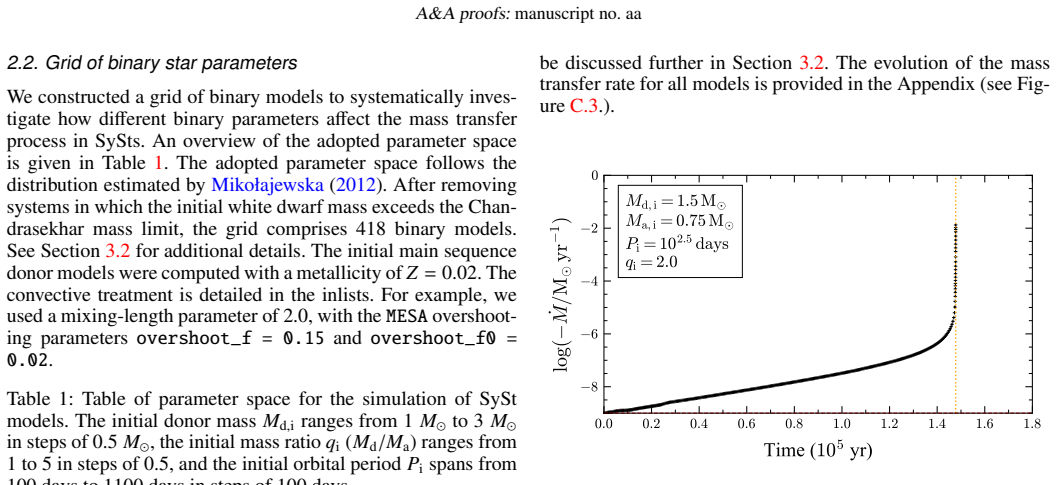
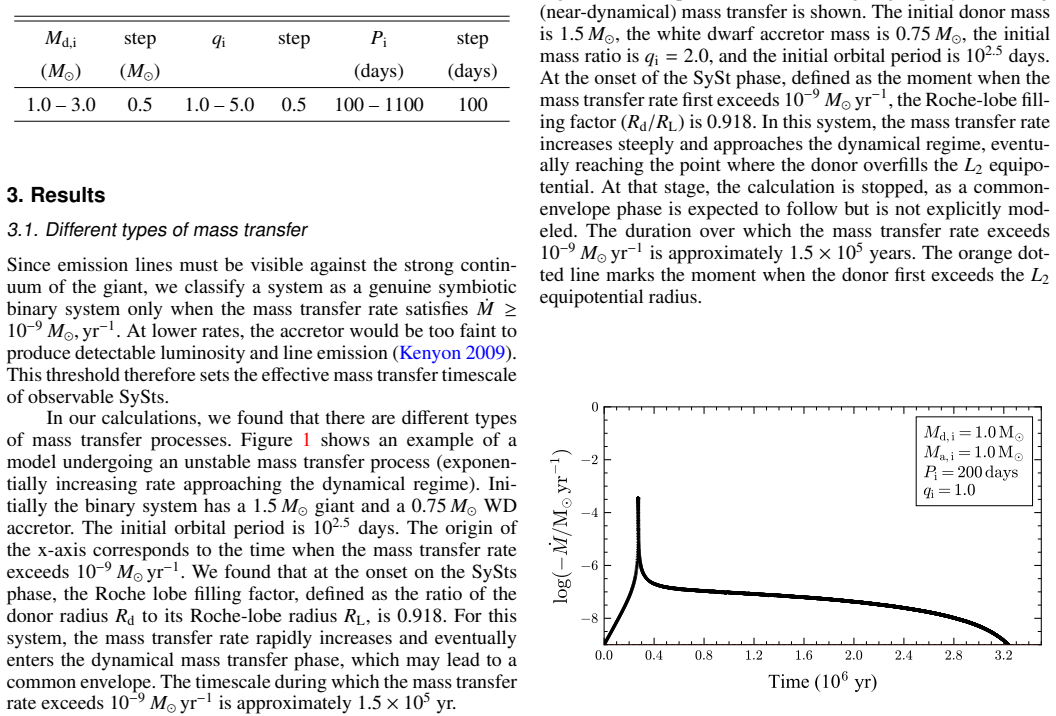
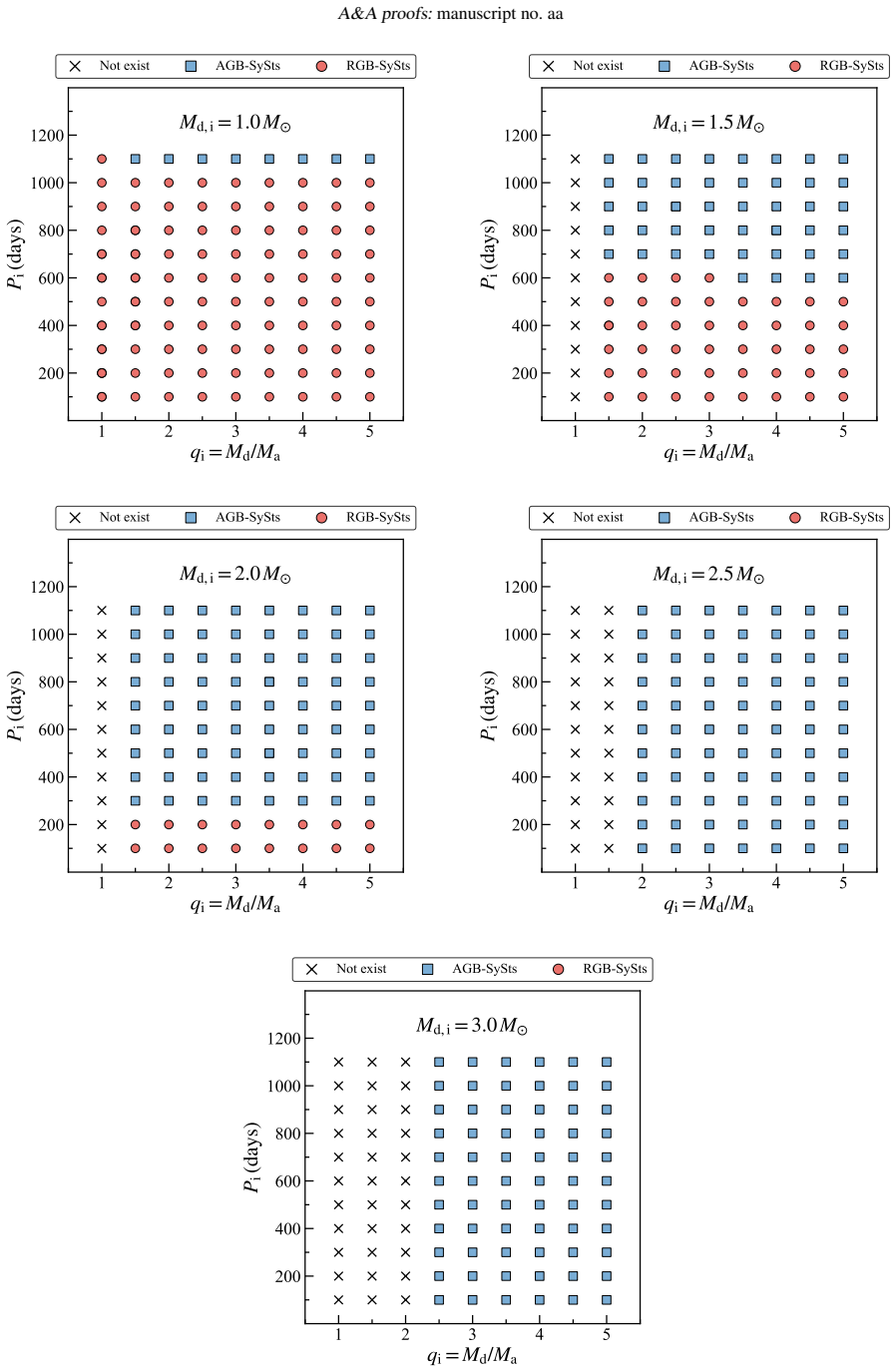
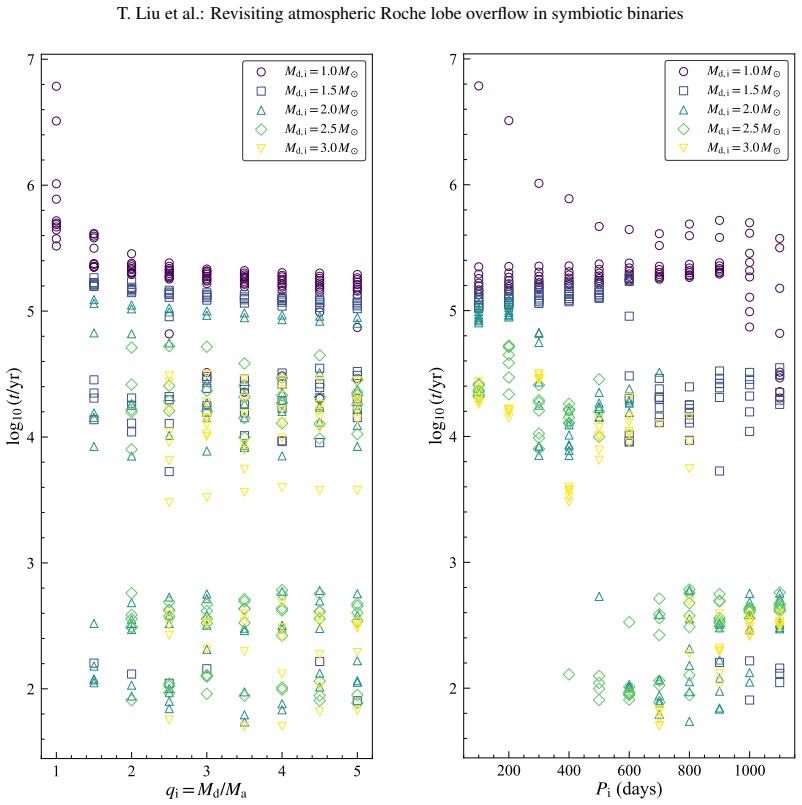
Incorporating atmospheric Roche-lobe overflow into the Rapid Unified Mass Transfer framework permits stable mass transfer for convective giant donors up to mass ratios q approximately 1.5. In these cases the symbiotic phase can last up to 10^6 years with mass transfer rates of at least 10^{-9} solar masses per year, during which the orbit shrinks mildly before possibly re-expanding. Systems with higher mass ratios still evolve toward common envelopes but retain a symbiotic phase of 10^4 to 10^5 years. The synthetic populations align with the observed distribution of Galactic S-type symbiotic systems.
What carries the argument
The Rapid Unified Mass Transfer (RUMT) framework, which determines mass-transfer stability and rates by including atmospheric Roche-lobe overflow for giant donors.
Load-bearing premise
The Rapid Unified Mass Transfer framework's treatment of atmospheric Roche-lobe overflow correctly identifies when mass transfer remains stable for convective giants without immediate common-envelope formation.
What would settle it
Detection of common-envelope signatures or very short interaction times in observed symbiotic binaries with mass ratios near or below 1.5 would contradict the model's stability predictions.
Figures

read the original abstract
Classical binary evolution models predict dynamically unstable mass transfer in symbiotic stars with high mass ratios, leading to a common envelope. However, many observed S-type symbiotic systems show long-lived interaction, suggesting that an additional stabilizing mechanism may be at work. We investigate whether atmospheric Roche-lobe overflow can prolong the mass-transfer phase and help reconcile theory with observations. We implement the Rapid Unified Mass Transfer framework in \texttt{MESA} and compute a grid of white-dwarf--giant binaries covering a wide range of donor masses, mass ratios, and orbital periods. We then compare the resulting lifetimes and evolutionary tracks with well-constrained Galactic S-type symbiotic systems. For convective giant donors, our models recover stable mass transfer up to $q \simeq 1.5$, while atmospheric overflow strongly extends the symbiotic phase. RGB and early-AGB systems with $q \lesssim 1.5$ can remain interacting for up to $10^6$ yr at $\dot{M} \gtrsim 10^{-9},M_{\odot},{\rm yr}^{-1}$, much longer than the commonly assumed $\sim 10^3$ yr pre-common-envelope lifetime. In these systems, the orbit shrinks mildly and may re-expand after mass-ratio reversal. Systems with higher mass ratios still evolve toward a common envelope, but even for $q \simeq 2$--$4$ the symbiotic phase can last $10^4$--$10^5$ yr. The synthetic distribution in the orbital-period--mass-ratio plane and individual evolutionary tracks are broadly consistent with observed S-type symbiotic binaries, including recurrent novae. The RUMT framework, which incorporates atmospheric RLOF, provides an explanation for the long-term stability of many symbiotic binaries and may account for their high observed occurrence rate.
Editorial analysis
A structured set of objections, weighed in public.
Referee Report
Summary. The paper claims that implementing the Rapid Unified Mass Transfer (RUMT) framework, which includes atmospheric Roche-lobe overflow, in MESA allows stable mass transfer in white-dwarf--giant symbiotic binaries with convective donors up to mass ratios q ≃ 1.5. This extends the symbiotic interaction phase to 10^5–10^6 yr at rates ≳10^{-9} M_⊙ yr^{-1} for RGB/early-AGB systems (with mild orbit shrinkage and possible re-expansion after mass-ratio reversal), while higher-q systems still reach common envelope but with longer symbiotic lifetimes of 10^4–10^5 yr. The resulting lifetimes, tracks, and synthetic distributions in the orbital-period--mass-ratio plane are reported to be broadly consistent with observed Galactic S-type symbiotic systems, including recurrent novae, thereby explaining their long-term stability and high occurrence rate contrary to classical dynamical instability predictions.
Significance. If the RUMT atmospheric RLOF implementation in MESA is shown to be robust, the work would be significant for binary stellar evolution, as it offers a concrete mechanism to reconcile theory with the observed prevalence and longevity of symbiotic binaries without invoking common-envelope evolution at moderate q. The computation of a broad grid covering donor masses, mass ratios, and periods, together with direct comparison to well-constrained Galactic systems, is a methodological strength that supports reproducibility and falsifiability. The result would affect population synthesis models and interpretations of recurrent novae if the stability boundary holds under independent scrutiny.
major comments (2)
- [Abstract (RUMT grid paragraph)] Abstract, paragraph describing the RUMT grid: the central claim that stable mass transfer occurs up to q ≃ 1.5 for convective giant donors (and the consequent extension of the symbiotic phase to 10^5–10^6 yr) rests entirely on the specific numerical treatment of atmospheric Roche-lobe overflow inside the RUMT framework implemented in MESA. Classical adiabatic-response criteria predict dynamical instability at substantially lower q; the manuscript provides no analytic derivation, cross-code comparison, or test against known limits to demonstrate that the reported q ≃ 1.5 threshold is independent of the chosen prescription rather than an artifact of the implementation.
- [Abstract (comparison to observations)] Abstract (comparison to observed Galactic S-type systems): the reported consistency of model lifetimes, evolutionary tracks, and the orbital-period--mass-ratio distribution with observations is load-bearing for the claim that RUMT explains the high occurrence rate. The text does not clarify whether the RUMT mass-transfer rates or stability thresholds were derived from first principles or adjusted to reproduce the observed systems; this distinction is required to assess whether the agreement constitutes an independent prediction.
minor comments (1)
- [Abstract] The mass-loss rate notation in the abstract contains a typographical comma (\dot{M} \gtrsim 10^{-9},M_{\odot},{\rm yr}^{-1}); this should be corrected for clarity.
Simulated Author's Rebuttal
We thank the referee for the thoughtful report and the opportunity to address the concerns raised. We respond to each major comment below, indicating where revisions will be made to improve clarity and strengthen the presentation.
read point-by-point responses
-
Referee: [Abstract (RUMT grid paragraph)] Abstract, paragraph describing the RUMT grid: the central claim that stable mass transfer occurs up to q ≃ 1.5 for convective giant donors (and the consequent extension of the symbiotic phase to 10^5–10^6 yr) rests entirely on the specific numerical treatment of atmospheric Roche-lobe overflow inside the RUMT framework implemented in MESA. Classical adiabatic-response criteria predict dynamical instability at substantially lower q; the manuscript provides no analytic derivation, cross-code comparison, or test against known limits to demonstrate that the reported q ≃ 1.5 threshold is independent of the chosen prescription rather than an artifact of the implementation.
Authors: We agree that the reported stability boundary is obtained from the numerical implementation of the RUMT framework within MESA and that the manuscript does not contain an analytic derivation or cross-code verification. The RUMT prescription is motivated by the physical treatment of atmospheric overflow beyond the classical Roche-lobe radius, but its quantitative outcome necessarily depends on the chosen numerical parameters. We will revise the abstract and add a dedicated subsection in the methods to discuss the sensitivity of the q ≃ 1.5 threshold to RUMT parameters and to compare the limiting behavior against the classical adiabatic criterion for the same initial conditions. revision: yes
-
Referee: [Abstract (comparison to observations)] Abstract (comparison to observed Galactic S-type systems): the reported consistency of model lifetimes, evolutionary tracks, and the orbital-period--mass-ratio distribution with observations is load-bearing for the claim that RUMT explains the high occurrence rate. The text does not clarify whether the RUMT mass-transfer rates or stability thresholds were derived from first principles or adjusted to reproduce the observed systems; this distinction is required to assess whether the agreement constitutes an independent prediction.
Authors: The mass-transfer rates and stability thresholds in the grid are computed directly from the RUMT implementation in MESA without any parameter adjustment intended to match the observed Galactic sample. The comparison to S-type systems is performed after the models are evolved and serves as a consistency check rather than a calibration step. We will revise the abstract to state explicitly that the RUMT rates and stability limits are set by the framework and that the observational agreement is an a-posteriori result. revision: yes
Circularity Check
No circularity: RUMT grid outputs compared post-hoc to observations
full rationale
The paper implements the Rapid Unified Mass Transfer framework inside MESA, runs a grid over donor masses, mass ratios and periods, and reports the resulting stability limits (q ≃ 1.5 for convective giants) and symbiotic lifetimes as direct numerical outcomes. These outputs are then compared to observed Galactic S-type systems for broad consistency. No equation or statement in the abstract defines the stability threshold or mass-transfer rates in terms of the target observations, nor renames a fit as a prediction. Self-citation of the RUMT framework is not shown to be the sole load-bearing justification; the derivation remains a forward numerical experiment whose central results are not forced by construction from its inputs.
Axiom & Free-Parameter Ledger
Reference graph
Works this paper leans on
-
[1]
2013, Astronomy & Astrophysics, 552, A26
Abate, C., Pols, O., Izzard, R., Mohamed, S., & De Mink, S. 2013, Astronomy & Astrophysics, 552, A26
2013
-
[2]
2023, in Highlights on Spanish Astrophysics XI, ed
Alcolea, J., Mikolajewska, J., Gómez-Garrido, M., et al. 2023, in Highlights on Spanish Astrophysics XI, ed. M. Manteiga, L. Bellot, P. Benavidez, A. de Lorenzo-Cáceres, M. A. Fuente, M. J. Martínez, M. Vázquez Acosta, & C. Dafonte, 190
2023
-
[3]
Allen, D. A. 1984, PASA, 5, 369 Belczy´nski, K., Mikołajewska, J., Munari, U., Ivison, R. J., & Friedjung, M. 2000, A&AS, 146, 407
1984
-
[4]
2020, Monthly Notices of the Royal Astronomical Society, 496, 3436
Belloni, D., Mikołajewska, J., Iłkiewicz, K., et al. 2020, Monthly Notices of the Royal Astronomical Society, 496, 3436
2020
-
[5]
Belloni, D., Mikołajewska, J., & Schreiber, M. R. 2024, Astronomy & Astro- physics, 686, A226
2024
-
[6]
M., Hillen, M., Berger, J
Boffin, H. M., Hillen, M., Berger, J. P., et al. 2014, Astronomy & Astrophysics, 564, A1
2014
-
[7]
G., Quiroga, C., & Ferrer, O
Brandi, E., García, L. G., Quiroga, C., & Ferrer, O. E. 2006, Boletin de la Aso- ciacion Argentina de Astronomia La Plata Argentina, 49, 132
2006
-
[8]
2005, Astronomy & Astro- physics, 440, 239
Brandi, E., Mikołajewska, J., Quiroga, C., et al. 2005, Astronomy & Astro- physics, 440, 239
2005
-
[9]
E., & García, L
Brandi, E., Quiroga, C., Mikołajewska, J., Ferrer, O. E., & García, L. G. 2009, Astronomy & Astrophysics, 497, 815
2009
-
[10]
2010, in American Institute of Physics Conference Series, V ol
Chen, X., Podsiadlowski, P., Mikolajewska, J., & Han, Z. 2010, in American Institute of Physics Conference Series, V ol. 1314, International Conference on Binaries: in celebration of Ron Webbink’s 65th Birthday, ed. V . Kalogera & M. van der Sluys (AIP), 59–60
2010
-
[11]
G., Nordhaus, J., Frank, A., & Carroll-Nellenback, J
Chen, Z., Blackman, E. G., Nordhaus, J., Frank, A., & Carroll-Nellenback, J. 2018, Monthly Notices of the Royal Astronomical Society, 473, 747
2018
-
[12]
J., & Mikolajewska, J
Dobrzycka, D., Kenyon, S. J., & Mikolajewska, J. 1993, AJ, 106, 284
1993
-
[13]
Eggleton, P. P. 1983, ApJ, 268, 368
1983
-
[14]
C., Hinkle, K
Fekel, F. C., Hinkle, K. H., Joyce, R. R., & Skrutskie, M. F. 2000, The Astro- nomical Journal, 120, 3255
2000
-
[15]
C., Hinkle, K
Fekel, F. C., Hinkle, K. H., Joyce, R. R., & Skrutskie, M. F. 2001, The Astro- nomical Journal, 121, 2219
2001
-
[16]
C., Hinkle, K
Fekel, F. C., Hinkle, K. H., Joyce, R. R., & Wood, P. R. 2010, The Astronomical Journal, 139, 1315
2010
-
[17]
C., Hinkle, K
Fekel, F. C., Hinkle, K. H., Joyce, R. R., & Wood, P. R. 2015, AJ, 150, 48
2015
-
[18]
C., Hinkle, K
Fekel, F. C., Hinkle, K. H., Joyce, R. R., & Wood, P. R. 2017, AJ, 153, 35
2017
-
[19]
C., Hinkle, K
Fekel, F. C., Hinkle, K. H., Joyce, R. R., Wood, P. R., & Howarth, I. D. 2008, The Astronomical Journal, 136, 146
2008
-
[20]
C., Hinkle, K
Fekel, F. C., Hinkle, K. H., Joyce, R. R., Wood, P. R., & Lebzelter, T. 2006, The Astronomical Journal, 133, 17
2006
-
[21]
2003, in Symbiotic Stars Probing Stellar Evolution, V ol
Ferrer, O., Quiroga, C., Brandi, E., & García, L. 2003, in Symbiotic Stars Probing Stellar Evolution, V ol. 303, 117 Gałan, C., Mikołajewska, J., & Hinkle, K. H. 2015, Monthly Notices of the Royal Astronomical Society, 447, 492 Gałan, C., Mikołajewska, J., Hinkle, K. H., & Joyce, R. R. 2016, Monthly No- tices of the Royal Astronomical Society, 455, 1282 G...
2003
-
[22]
1984, The Observatory, vol
Griffin, R. 1984, The Observatory, vol. 104, p. 224-231 (1984), 104, 224
1984
-
[23]
& Mikołajewska, J
Gromadzki, M. & Mikołajewska, J. 2009, Astronomy & Astrophysics, 495, 931
2009
-
[24]
2013, Acta Astron., 63, 405
Gromadzki, M., Mikołajewska, J., & Soszy´nski, I. 2013, Acta Astron., 63, 405
2013
-
[25]
2022, A&A, 667, A44
Guo, Y ., Liu, C., Wang, L., et al. 2022, A&A, 667, A44
2022
-
[26]
P., Podsiadlowski, P., & Tout, C
Han, Z., Eggleton, P. P., Podsiadlowski, P., & Tout, C. A. 1995, Monthly Notices of the Royal Astronomical Society, 277, 1443
1995
-
[27]
H., Fekel, F
Hinkle, K. H., Fekel, F. C., & Joyce, R. R. 2009, The Astrophysical Journal, 692, 1360
2009
-
[28]
H., Nagarajan, P., Fekel, F
Hinkle, K. H., Nagarajan, P., Fekel, F. C., et al. 2025, The Astrophysical Journal, 983, 76 Iłkiewicz, K., Mikołajewska, J., Belczy ´nski, K., Wiktorowicz, G., & Karcz- marek, P. 2019, Monthly Notices of the Royal Astronomical Society, 485, 5468
2025
-
[29]
2013, The Astronomy and Astrophysics Review, 21, 59
Ivanova, N., Justham, S., Chen, X., et al. 2013, The Astronomy and Astrophysics Review, 21, 59
2013
-
[30]
2024, ApJ, 971, 64
Ivanova, N., Kundu, S., & Pourmand, A. 2024, ApJ, 971, 64
2024
-
[31]
S., Bauer, E
Jermyn, A. S., Bauer, E. B., Schwab, J., et al. 2023, ApJS, 265, 15
2023
-
[32]
2019, Astronomy & Astrophysics, 626, A127
Jorissen, A., Boffin, H., Karinkuzhi, D., et al. 2019, Astronomy & Astrophysics, 626, A127
2019
-
[33]
2012, Baltic Astronomy, 21, 39
Jorissen, A., Van Eck, S., Dermine, T., Van Winckel, H., & Gorlova, N. 2012, Baltic Astronomy, 21, 39
2012
-
[34]
Kenyon, S. J. 2009, The Symbiotic Stars (Cambridge University Press)
2009
-
[35]
Kenyon, S. J. & Garcia, M. R. 1989, AJ, 97, 194
1989
-
[36]
Kenyon, S. J. & Garcia, M. R. 2016, The Astronomical Journal, 152, 1
2016
-
[37]
J., Livio, M., Mikolajewska, J., & Tout, C
Kenyon, S. J., Livio, M., Mikolajewska, J., & Tout, C. A. 1993, ApJ, 407, L81 Article number, page 12 T. Liu et al.: Revisiting atmospheric Roche lobe overflow in symbiotic binaries
1993
-
[38]
Kenyon, S. J. & Mikolajewska, J. 1995, The Astronomical Journal, 110, 391
1995
-
[39]
J., Oliversen, N
Kenyon, S. J., Oliversen, N. A., Mikolajewska, J., et al. 1991, AJ, 101, 637
1991
-
[40]
& Ritter, H
Kolb, U. & Ritter, H. 1990, A&A, 236, 385
1990
-
[41]
R., Rocha-Pinto, H
Laversveiler, M., Gonçalves, D. R., Rocha-Pinto, H. J., & Merc, J. 2025, Astron- omy & Astrophysics, 698, A155 Lü, G., Yungelson, L., & Han, Z. 2006, MNRAS, 372, 1389 Lü, G. L., Zhu, C. H., Postnov, K. A., et al. 2012, MNRAS, 424, 2265
2025
-
[42]
& Boffin, H
Merc, J. & Boffin, H. M. J. 2025, A&A, 695, A61
2025
-
[43]
2019, Research Notes of the American Astro- nomical Society, 3, 28 Mikołajewska, J
Merc, J., Gális, R., & Wolf, M. 2019, Research Notes of the American Astro- nomical Society, 3, 28 Mikołajewska, J. 2003, in Astronomical Society of the Pacific Conference Series, V ol. 303, Symbiotic Stars Probing Stellar Evolution, ed. R. L. M. Corradi, J. Mikolajewska, & T. J. Mahoney, 9
2019
-
[44]
2011, Symbiotic Novae Mikołajewska, J
Mikolajewska, J. 2011, Symbiotic Novae Mikołajewska, J. 2012, Baltic Astronomy, 21, 5 Mikołajewska, J., Friedjung, M., & Quiroga, C. 2006, Astronomy & Astro- physics, 460, 191 Mikołajewska, J., Iłkiewicz, K., Gałan, C., et al. 2021, Monthly Notices of the Royal Astronomical Society, 504, 2122
2011
-
[45]
& Kenyon, S
Mikolajewska, J. & Kenyon, S. J. 1992, AJ, 103, 579
1992
-
[46]
& Podsiadlowski, P
Mohamed, S. & Podsiadlowski, P. 2012, Open Astronomy, 21, 88
2012
-
[47]
1971, Annual Review of Astronomy and Astrophysics, vol
Paczynski, B. 1971, Annual Review of Astronomy and Astrophysics, vol. 9, p. 183, 9, 183
1971
-
[48]
& Ivanova, N
Pavlovskii, K. & Ivanova, N. 2015, MNRAS, 449, 4415
2015
-
[49]
2011, ApJS, 192, 3
Paxton, B., Bildsten, L., Dotter, A., et al. 2011, ApJS, 192, 3
2011
-
[50]
2013, ApJS, 208, 4
Paxton, B., Cantiello, M., Arras, P., et al. 2013, ApJS, 208, 4
2013
-
[51]
2015, ApJS, 220, 15
Paxton, B., Marchant, P., Schwab, J., et al. 2015, ApJS, 220, 15
2015
-
[52]
B., et al
Paxton, B., Schwab, J., Bauer, E. B., et al. 2018, ApJS, 234, 34
2018
-
[53]
2019, ApJS, 243, 10
Paxton, B., Smolec, R., Schwab, J., et al. 2019, ApJS, 243, 10
2019
-
[54]
& Mohamed, S
Podsiadlowski, P. & Mohamed, S. 2007, Baltic Astronomy, V ol. 16, p. 26-33, 16, 26
2007
-
[55]
& Ivanova, N
Pourmand, A. & Ivanova, N. 2023, ApJ, 952, 126 Prša, A. & Zwitter, T. 2005, The Astrophysical Journal, 628, 426
2023
-
[56]
2002, Astron- omy & Astrophysics, 387, 139
Quiroga, C., Mikołajewska, J., Brandi, E., Ferrer, O., & García, L. 2002, Astron- omy & Astrophysics, 387, 139
2002
-
[57]
Rutkowski, A., Mikołajewska, J., & Whitelock, P. A. 2007, Baltic Astronomy, 16, 49
2007
-
[58]
2012, Science, 337, 444
Sana, H., De Mink, S., de Koter, A., et al. 2012, Science, 337, 444
2012
-
[59]
1996, Astronomy and Astrophysics, 306, 477
Schild, H., Mürset, U., & Schmutz, W. 1996, Astronomy and Astrophysics, 306, 477
1996
-
[60]
1998, Astronomy and Astrophysics, v
Schmid, H., Dumm, T., Murset, U., et al. 1998, Astronomy and Astrophysics, v. 329, p. 986-990 (1998), 329, 986
1998
-
[61]
2007, The Astrophysical Journal, 667, 1170
Sepinsky, J., Willems, B., Kalogera, V ., & Rasio, F. 2007, The Astrophysical Journal, 667, 1170
2007
-
[62]
V ., Cunha, K., Jorissen, A., & Boffin, H
Smith, V . V ., Cunha, K., Jorissen, A., & Boffin, H. 1997, Astronomy and Astro- physics, v. 324, p. 97-108, 324, 97
1997
-
[63]
& Sparks, W
Starrfield, S. & Sparks, W. M. 1987, in International Astronomical Union Collo- quium, V ol. 93, Cambridge University Press, 379–393
1987
-
[64]
E., Moe, M., et al
Tang, S., Grindlay, J. E., Moe, M., et al. 2012, The Astrophysical Journal, 751, 99
2012
-
[65]
Tauris, T. M. & van den Heuvel, E. P. 2023, Physics of binary star evolution: from stars to X-ray binaries and gravitational wave sources, V ol. 42 (Princeton University Press)
2023
-
[66]
B., Hillman, Y ., & Kashi, A
Vathachira, I. B., Hillman, Y ., & Kashi, A. 2025, The Astrophysical Journal, 980, 224
2025
-
[67]
Webster, B. L. & Allen, D. A. 1975, Monthly Notices of the Royal Astronomical Society, 171, 171
1975
-
[68]
Whitelock, P. A. 1987, Publications of the Astronomical Society of the Pacific, 99, 573
1987
-
[69]
2005, Astronomy reports, 49, 232
Yudin, B., Shenavrin, V ., Kolotilov, E., Tatarnikova, A., & Tatarnikov, A. 2005, Astronomy reports, 49, 232
2005
-
[70]
1995, Astrophysical Journal v
Yungelson, L., Livio, M., Tutukov, A., & Kenyon, S. 1995, Astrophysical Journal v. 447, p. 656, 447, 656 Article number, page 13 A&A proofs:manuscript no. aa Appendix A: Orbital and stellar parameters of selected symbiotic binaries In Table C.1, we present the information for the selected obser- vational objects. In this table, we list their orbital perio...
1995
discussion (0)
Sign in with ORCID, Apple, or X to comment. Anyone can read and Pith papers without signing in.