REVIEW 4 major objections 5 minor 21 references
Counting Reciprocal Hyperbolic Elements in Hecke Groups
T0 review · 4 major / 5 minor · reviewed 2026-08-07 · deepseek-v4-flash
Pith's one-line read For every Hecke group (2,k,∞), the number of reciprocal hyperbolic elements of word length 2t grows like an explicit constant times the t-th power of an explicit dominant root.
desk verdict The even-k counting results are new and probably right, but the B-type negligibility proof has a real union-over-q gap and several proofs are omitted; worth refereeing after a fix. read the letter →
The pith
A machine-rendered reading of the paper's core claim, the machinery that carries it, and where it could break.
The reading
What carries the argument
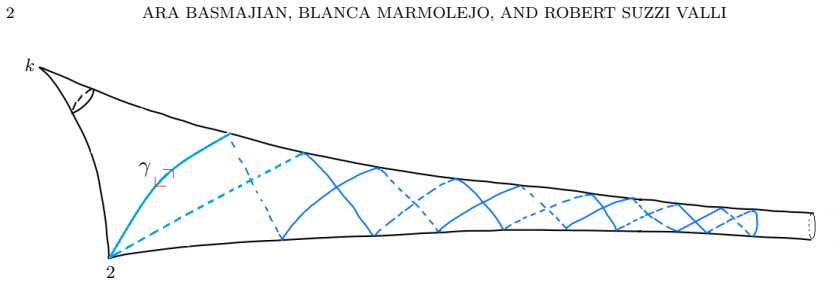
The counting argument runs through normal forms: up to conjugacy, a reciprocal word based at the order-2 cone point is [a,h] with h a (bb)-word, and one based at the order-k=2m cone point is [b^m,h] with h an (aa)-word. Counting these normal forms yields a linear recurrence in t whose characteristic polynomial is $x^{{m+1}}$ - $2x^{{m-1}}$ - ⋯ - 2x - 2 for odd k and $x^{{m+1}}$ - $2x^{{m-1}}$ - ⋯ - 2x - 1 for even k; the unique positive root dominates all other roots, so it controls the growth. The extra even-k complication is handled by isolating B-type words, reciprocal words that pass through both cone points and are even powers of agb^m $g^{{-1}}$, and proving that these are negligible compared with the normal-form count. Dividing the normal-form count by 2 accounts for the fact that each non-B-type conjugacy class has exactly two representatives in normal form.
What would settle it
Enumerate all reciprocal words of word length 2t in Z2*Z4 for t up to about 20, count their conjugacy classes directly by conjugacy in the group, and compare |R_{2t}|/β_4^t with d_4/2 ≈ 0.2236; any persistent ratio away from this value, or any normal form that is neither a power of [a,g] with exactly two conjugates nor a B-type word, would falsify the theorem.
Extended reading notes
Core claim
The paper's central claim is that for k=2m+1, the number of reciprocal geodesics of word length 2t based at the order-2 cone point, divided by α_{2m+1}^t, converges to c_{2m+1}/2, where α_{2m+1} is the unique positive root of $x^{{m+1}}$ - $2x^{{m-1}}$ - ⋯ - 2x - 2. For k=2m, the analogous counts based at the order-2 and order-k cone points, divided by β_{2m}^t, converge respectively to d_{2m}/2 and e_{2m}/2, where β_{2m} is the unique positive root of $x^{{m+1}}$ - $2x^{{m-1}}$ - ⋯ - 2x - 1. For k=∞, the count divided by 2^t converges to 1/6. The same asymptotics hold when only primitive conjugacy classes are counted, and the constants c,d,e are obtained by solving finite linear systems determined by the small-length initial data.
Load-bearing premise
The argument assumes that for even k every reciprocal word based at the order-2 cone point is either a power of a primitive element [a,g] with exactly two normal-form conjugates, or a B-type word; if a third type existed, the recurrence and final constants would change.
Editorial extensions
If this is right
- On every Hecke surface X_k, reciprocal geodesics based at an even cone point have word-length growth rate strictly between sqrt(2) and 2, approaching 2 as k grows.
- For even k, reciprocal geodesics based at the order-2 and order-k cone points share the same exponential rate; the ratio of their counts tends to e_{2m}/d_{2m}.
- Non-primitive reciprocal words, including the B-type words that pass through both cone points, do not change the exponential growth rate.
- The limiting constants are computed by solving a finite linear system; the paper carries out the k=4 example and obtains d_4 ≈ 0.44721.
Reading between the lines
- A direct enumeration for small even k, such as k=4 or k=6, would test whether the dichotomy in Proposition 4.4 misses a third family of reciprocal words; a missed family would change the recurrence and the final constants.
- The same pattern of normal forms, a linear recurrence, and a negligible exceptional family could plausibly extend to other triangle groups with two even-order cone-point conjugacy classes.
- The word-length rates form increasing sequences bounded by 2, so in this metric reciprocal geodesics become exponentially more numerous as k grows, with the even-k rate always slightly below the adjacent odd-k rate.
Editorial analysis
A structured set of objections, weighed in public.
Referee Report
Summary. The paper studies reciprocal hyperbolic elements in (2,k,∞) Hecke groups, i.e., hyperbolic elements that are products of two distinct conjugate involutions of the relevant conjugacy class. The main results (Theorems A and B) give asymptotic growth rates for the number of conjugacy classes of reciprocal elements based at the order-2 cone point (all k) and at the order-k cone point (k even), in terms of word length. The growth rate is the dominant root of an explicit polynomial, and the limiting constant is determined by solving a linear system from a linear recurrence for the number of normal forms. The same asymptotics are claimed for primitive classes. The proof strategy is combinatorial: classify reciprocal words into normal forms, derive recurrences for their counts, and show that a special family of words (B-type words) that are simultaneously based at both cone points is negligible.
Significance. If correct, the results give the first complete word-length asymptotic for reciprocal geodesics on Hecke surfaces of all k, including the growth rate and explicit computable constants via a linear-system algorithm. The paper is clearly written and includes a worked example (k=4) that matches the claimed constant. A notable strength is that the growth rates and constants are derived from recurrences and linear algebra rather than fitted; the k=4 example provides a concrete check. However, the proof currently has a gap in the treatment of B-type negligibility and relies on several omitted or deferred arguments, so the significance is conditional on those points being repaired.
major comments (4)
- [Lemma 4.3, Eq. (4.1)] The proof that B-type words are negligible is incomplete. Lemma 4.2 defines B_{2t} as a union over q∈N of the words (a g b^m g^{-1})^{2q} with |g| = s satisfying the length equation 2q(2s + m + 1) = 2t. For a fixed t, this equation can have several integer solutions (q,s). The proof of Lemma 4.3 fixes a single q (implicitly), sets s = (t - q(m+1))/(2q), and claims |B_{2t}| = |Z_{2s}|. This equality is false as stated because it ignores the other values of q; the displayed bound |B_{2t}| ≤ (t/8)(√2)^t therefore does not follow. The step is load-bearing: Lemmas 5.6 and 6.3 use it to justify dividing by two in Theorems 5.4 and 6.4. The gap is repairable — summing over q ≤ t/(m+1), with the q=1 term dominant, gives |B_{2t}| ≤ C t (√2)^t, which suffices because β_{2m} > √2 — but the corrected argument must appear in the manuscript.
- [Proposition 4.5] The proof of Proposition 4.5 is omitted ("We omit the proof of Proposition 4.5 as the statement is simply a recasting of Proposition 4.4 with an identical proof."). This proposition is essential for Theorem B and Lemma 6.3: it asserts that every reciprocal word based at the order-k cone point is either a power of a primitive [b^m, h] with exactly two normal-form representatives, or a B-type word. The normal forms here are [b^m, h] with h an (aa)-word, which is structurally different from the order-2 case, so the proof is not literally identical. A full proof or a precise reference is required.
- [Proposition 4.4] The classification claim for reciprocal words based at the order-2 cone point is not fully proved for even k. In particular, the statement that a non-B-type word has "exactly two representatives" in the normal form N is carried over from the odd case and from [1,12,19] without a detailed argument that in the even case no additional conjugacy identifications occur. A missed family would change the recurrence and the final constants. Since this dichotomy underlies the factor 1/2 in Theorem 5.4, it needs a self-contained proof or a reference with the full even-case argument.
- [Propositions 5.1, 5.3, 6.1] The initial conditions (i)–(iii) in Propositions 5.1, 5.3, and 6.1 are stated as "left to the reader." These initial values determine the constants c_{2m+1}, d_{2m}, and e_{2m} through the linear system in Section 9. The paper claims explicit computable constants, so these initial conditions must be proved or at least carefully derived. At minimum, the authors should include the computations for these small cases or provide a reference that does so.
minor comments (5)
- [Throughout] Several formulas appear with missing superscripts: for example, "1/3 (2t + 2(−1)t)" should be "(1/3)(2^t + 2(-1)^t)", and "xm+1" should be "x^{m+1}". The authors should ensure proper typesetting, as the current rendering makes the recurrences and polynomials hard to read.
- [Proposition 5.3(iv), Proposition 6.1(iv)] The recurrence is written as "2|N_{2(t-2)}| + 2|N_{2(t-3)}| ... + 2|N_{2(t-m)}| + |N_{2(t-(m+1))}|". For m=2 this appears to include a spurious term 2|N_{2(t-3)}| in addition to the final |N_{2(t-3)}|. The intended formula seems to be 2∑_{j=2}^{m} |N_{2(t-j)}| + |N_{2(t-(m+1))}|; the notation should be clarified.
- [Lemma 4.1(1)] The description of a (bb)-word as "of the form bx0 . . . abxn−1" is unclear and likely a typo. The precise form (e.g., b^{x_0} a b^{x_1} ... a b^{x_{n-1}} with n ≥ 1) should be given without ellipsis ambiguity.
- [Lemma 8.1] In the factorization of Q_{2m}(x), the last term is written as "−z − 1" instead of "−x − 1", and the sentence "it has simple roots (see [21])" does not explain why the cited reference applies to the factor S(x). The simplicity argument should be spelled out.
- [Proofs of Theorems 5.2 and 7.2] The bound on non-primitive reciprocal words is asserted with "t has at most t/2 divisors," but the number of divisors of t is not always bounded by t/2 for small t; the argument should use the standard divisor-counting bound τ(t) = o(t^ε) or an explicit elementary bound sufficient for the limit.
Circularity Check
No significant circularity: the asymptotic rates and constants are derived from explicit combinatorial recurrences and dominant-root analysis, not fitted to the targets; the self-citations are contextual and the main proof gap is a correctness issue, not a circular reduction.
full rationale
The derivation is self-contained. The growth rates in Theorems A and B are obtained by counting normal forms via Lemma 4.1, building recurrences with coefficients 2 or 1 determined by the generating set (Propositions 5.1, 5.3, 6.1, 7.1), and reading off the dominant root of the characteristic polynomial (Lemma 8.1). The constants d_{2m}, e_{2m}, and c_{2m+1} are fixed afterwards by solving the Vandermonde linear system from the initial conditions (Section 9), so the limits are consequences of the recurrence rather than inputs. The 'exactly two representatives' fact in Proposition 4.4 is cited to [1, 12, 19], including external works by Sarnak and by Erlandsson and Souto, and is a structural statement about conjugacy, not an assumption that already contains the growth rate. The self-cited papers [1] and [16] are contextual; the needed recurrences are proved in the present text, including the Z2*Z case in Proposition 7.1. The only substantive concern is a proof gap in Lemma 4.3, where B_{2t} is a union over q while the proof writes |B_{2t}| = |Z_{2s}| for a single s; this is a correctness issue (repairable by summing over q), not a circular reduction, and it does not make the asymptotic claims fitted inputs.
Assumptions & free parameters
assumptions (4)
- domain assumption Every reciprocal hyperbolic element based at an even order cone point is the product of two distinct conjugate involutions whose fixed points project to that cone point.
- standard math In Z2*Z_k, every infinite order element is a positive power of a unique primitive element and is contained in a maximal cyclic subgroup.
- standard math The polynomial S(x) = x^m - x^{m-1} - ... - x - 1 has simple roots.
- standard math A constant-coefficient linear recurrence with distinct characteristic roots has general solution a linear combination of root powers.
Cite this review
Pith. "Pith review of Counting Reciprocal Hyperbolic Elements in Hecke Groups." pith.science (2026). https://pith.science/paper/WH6Q6QGZ
@misc{pith2026250521365,
  author       = {Pith},
  title        = {Pith review of: Counting Reciprocal Hyperbolic Elements in Hecke Groups},
  year         = {2026},
  howpublished = {\url{https://pith.science/paper/WH6Q6QGZ}},
  note         = {Machine review of arXiv:2505.21365}
}
abstract
A reciprocal geodesic on a (2,k, $\infty$) Hecke surface is a geodesic loop based at an even order cone point p traversing its path an even number of times. Associated to each reciprocal geodesic is the conjugacy class of a hyperbolic element in the (2,k,$\infty$) Hecke group whose axis passes through a cone point that projects to p. Such an element is called a reciprocal hyperbolic element based at p. In this paper, we determine the asymptotic growth rate and limiting constant (in terms of word length) of the number of primitive conjugacy classes of reciprocal hyperbolic elements in a Hecke group.
Figures
Reference graph
Works this paper leans on
-
[1]
A. Basmajian and R. Suzzi Valli, Combinatorial growth in the modular group. Groups Geom. Dyn. 16 (2022), no. 2, 683–703 MR 4502618
work page 2022
-
[2]
A. Basmajian and R. Suzzi Valli, Counting cusp excursions of reciprocal geodesics, Contemporary Math- ematics, Vol 811, 2025
work page 2025
-
[3]
A. Basmajian and Mingkun Liu, Low lying geodesics on the modular surface and necklaces,Mathematical research letters, to appear
-
[4]
J. Bourgain and A. Kontorovich, Beyond expansion III: Reciprocal geodesics. Duke Math J. 168 (2019), no. 18, 3413–3435 MR 4034890
work page 2019
-
[5]
P. B. Bhattacharya, S. K. Jain, S. R. Nagpaul, Basic Abstract Algebra , Second edition. Cambridge University Press, New York, 1994. xx+487 pp
work page 1994
-
[6]
Buser, Geometry and spectra of compact Riemann surfaces
P. Buser, Geometry and spectra of compact Riemann surfaces. Progress in Mathematics, 106. Birkh¨ auser Boston, Inc., Boston, MA 1992 MR 1183224
work page 1992
- [7]
- [8]
Show all 21 references
-
[9]
Erlandsson, A remark on the word length in surface groups
V. Erlandsson, A remark on the word length in surface groups. Trans. Amer. Math. Soc. 372 (2019), no. 1, 441–455 MR 3968775
2019
-
[10]
Erlandsson, H
V. Erlandsson, H. Parlier, and J. Souto, Counting curves, and the stable length of currents. J. Eur. Math. Soc. (JEMS) 22 (2020), no. 6, 1675–1702 MR 4092896
2020
-
[11]
Erlandsson and J
V. Erlandsson and J. Souto, Counting curves in hyperbolic surfaces. Geom. Funct. Anal. 26 (2016), no 3, 729–777 MR 3540452
2016
-
[12]
Erlandsson and J
V. Erlandsson and J. Souto, Counting and equidistribution of reciprocal geodesics and dihedral groups. arXiv:2204.09956
-
[13]
Flajolet and R
P. Flajolet and R. Sedgewick, Analytic combinatorics, Cambridge University Press, Cambridge, 2009, pages=xiv+810
2009
-
[14]
Lyndon and P
R. Lyndon and P. Schupp, Combinatorial group theory. Reprint of the 1977 edition. Classics in Math- ematics. Springer-Verlag, Berlin, 2001 MR 1812024
1977
-
[15]
Magnus, A
W. Magnus, A. Karrass, and D. Solitar, Combinatorial group theory. Presentations of groups in terms of generators and relations. Second revised edition. Dover Publications, Inc., New York, 1976 MR 2109550
1976
-
[16]
Marmolejo, Growth of Conjugacy Classes of Reciprocal Words in Triangle Groups
B. Marmolejo, Growth of Conjugacy Classes of Reciprocal Words in Triangle Groups. Ph.D. thesis, City University of New York, 2020 MR 4187474
2020
-
[17]
Mirzakhani, Growth of the number of simple closed geodesics on hyperbolic surfaces
M. Mirzakhani, Growth of the number of simple closed geodesics on hyperbolic surfaces. Ann. of Math. (2) 168 (2008), no. 1, 97–125 MR 2415399
2008
-
[18]
Rivin, Growth in free groups (and other stories) – twelve years later
I. Rivin, Growth in free groups (and other stories) – twelve years later. Illinois J. Math. 54 (2010), no. 1, 327–370 MR 2776999
2010
-
[19]
Sarnak, Reciprocal geodesics
P. Sarnak, Reciprocal geodesics. Analytic number theory , 217–237, Clay Math. Proc., 7, Amer. Math. Soc., Providence, RI, 2007 MR 2362203
2007
-
[20]
Traina, The conjugacy problem of the modular group and the class number of real quadratic number fields
C. Traina, The conjugacy problem of the modular group and the class number of real quadratic number fields. J. Number Theory 21 (1985), no. 2, 176–184 MR 0808285
1985
-
[21]
D.A. Wolfram, Solving generalized Fibonacci recurrences, Fibonacci Quart., V 36, 1998 2, 129–145, 0015-0517, MR MR1622060 (Ara Basmajian) The Graduate Center, CUNY, 365 Fifth A ve., N.Y., N.Y., 10016 and Hunter College, CUNY, 695 Park A ve., N.Y., N.Y., 10065, USA Email addres...
1998
Reviewed August 7, 2026 · model on record in the stance chip above.
Discussion (0). Sign in to comment.