Causal treatment effect decompositions with time-to-event outcomes under competing events
Pith reviewed 2026-05-20 02:37 UTC · model grok-4.3
The pith
A four-way decomposition shows how treatment effects on a target time-to-event outcome arise through four mechanisms involving competing events.
A machine-rendered reading of the paper's core claim, the machinery that carries it, and where it could break.
Core claim
The authors introduce a decomposition of the causal treatment effect on the target event that partitions it into four components arising from distinct mechanisms involving both the target and competing events, based on a causal model using cross-world estimands that reflect counterfactual scenarios with the treatment set to conflicting levels for the two event types.
What carries the argument
Cross-world estimands reflecting counterfactual scenarios in which treatment affects the target and competing events at conflicting levels.
If this is right
- The decomposition reveals the specific role of the competing event in generating the observed treatment effect on the target.
- It supplies a basis for defining causally interpretable estimands when competing events are present.
- The four components can be estimated from data collected in randomized trials.
- Standard methods for analyzing time-to-event data can be extended to separate direct effects on the target from effects operating through the competing event.
Where Pith is reading between the lines
- The framework could be used to design interventions that modify only one of the four mechanisms rather than the overall effect.
- Similar decompositions might apply to non-randomized observational data if additional identifying assumptions are introduced.
- The approach links to existing causal methods for multiple outcomes and could support sensitivity analyses when exchangeability is in doubt.
Load-bearing premise
Exchangeability and consistency assumptions hold so that the decomposition can be estimated from observed data.
What would settle it
A dataset from a randomized trial in which the four estimated components fail to sum to the total treatment effect on the target event.
Figures
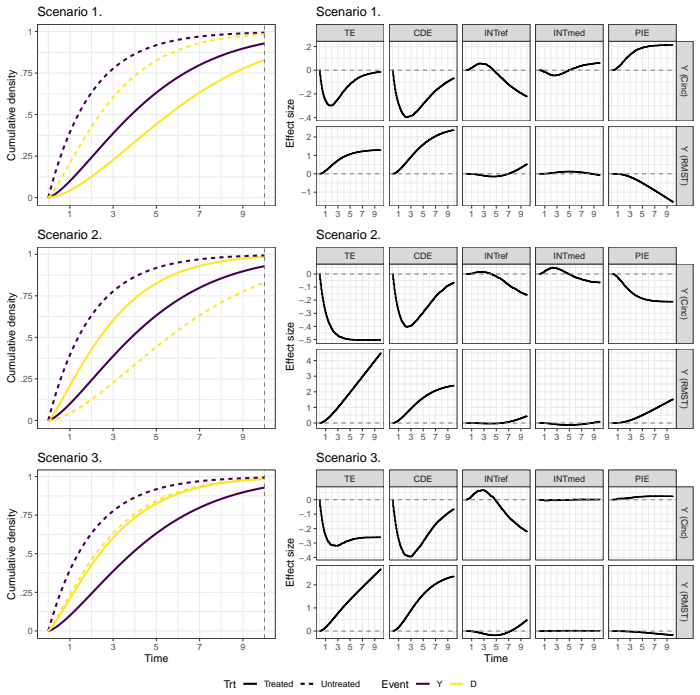


read the original abstract
Inference about treatment effects for time-to-event outcomes is often obscured by the presence of competing events. A particularly complex situation arises when the treatment influences the occurrence of the competing event. A comprehensive assessment should then account for different mechanisms by which the treatment and the competing event together produce the apparent treatment effect. Here, we propose a decomposition of the treatment's effect on the event of interest (target), characterising how it arises due to four distinct mechanisms involving both the target and competing events. Based on a causal model, the decomposition relies on cross-world estimands reflecting counterfactual scenarios in which the treatment affects the two events as if set to conflicting levels. We specify exchangeability and consistency assumptions under which the decomposition can be estimated from observed data. We discuss how the new decomposition reveals the role of the competing event and serves as a basis for defining causally interpretable estimands in the presence of competing events. Finally, we demonstrate the use of the four-way decomposition with datasets from two randomised trials.
Editorial analysis
A structured set of objections, weighed in public.
Referee Report
Summary. The manuscript proposes a four-way causal decomposition of the total treatment effect on the incidence of a target time-to-event outcome into distinct mechanisms involving both the target event and a competing event. The decomposition is defined via cross-world counterfactuals in which treatment is set to conflicting levels along the target versus competing-event pathways. The authors state that standard exchangeability and consistency assumptions suffice for identification and estimation from observed data, and they illustrate the approach using data from two randomized trials.
Significance. If the identification of the cross-world quantities holds under the stated assumptions, the decomposition would offer a principled way to attribute apparent treatment effects on the target event to direct versus competing-event-mediated pathways, addressing a common interpretive challenge in survival analysis. The empirical examples from actual trials provide a useful demonstration of practical application.
major comments (1)
- [§3] §3 (Identification): The claim that exchangeability and consistency alone identify the four cross-world estimands is load-bearing for the central contribution. Standard no-unmeasured-confounding assumptions identify single-world counterfactuals but do not automatically extend to quantities in which treatment is set to opposite levels for the target and competing latent times. The manuscript should supply the explicit identification formulas (e.g., the g-formula or inverse-probability expressions for each of the four components) together with any auxiliary assumptions (such as conditional independence of the latent failure times or absence of treatment-by-event interactions on the latent scale) that are required to close the identification gap.
minor comments (2)
- [Abstract] The abstract states that the decomposition 'can be estimated from observed data' under the listed assumptions; this phrasing should be qualified to reflect that identification requires the additional structure discussed in §3.
- [Figure 1] Figure 1 (causal diagram): the arrows from treatment to the two latent times should be labeled to indicate that the diagram encodes the cross-world intervention, not a single-world intervention.
Simulated Author's Rebuttal
We thank the referee for the constructive and detailed review of our manuscript. The comments help clarify the presentation of our identification results, and we address the major comment below.
read point-by-point responses
-
Referee: [§3] §3 (Identification): The claim that exchangeability and consistency alone identify the four cross-world estimands is load-bearing for the central contribution. Standard no-unmeasured-confounding assumptions identify single-world counterfactuals but do not automatically extend to quantities in which treatment is set to opposite levels for the target and competing latent times. The manuscript should supply the explicit identification formulas (e.g., the g-formula or inverse-probability expressions for each of the four components) together with any auxiliary assumptions (such as conditional independence of the latent failure times or absence of treatment-by-event interactions on the latent scale) that are required to close the identification gap.
Authors: We thank the referee for this important observation on the identification strategy. The manuscript states that the four cross-world estimands are identified from the observed data under exchangeability (no unmeasured confounding for treatment) and consistency. To address the request for greater explicitness, we will revise §3 to include the full g-formula expressions for each of the four components. These expressions are obtained by integrating the observed conditional distributions of the event times and covariates, with treatment fixed at the appropriate level for the target-event pathway and the competing-event pathway in each counterfactual world. We maintain that no auxiliary assumptions beyond the stated exchangeability and consistency are required; the separate definition of the latent failure times for the target and competing events in the causal model permits direct application of the g-formula without invoking conditional independence of the latent times or absence of treatment-by-event interactions on the latent scale. The revised section will present these formulas and the corresponding identification argument in detail. revision: yes
Circularity Check
No circularity detected; derivation introduces new estimands
full rationale
The paper defines a novel four-way decomposition of treatment effects on the target event via cross-world counterfactuals under competing events. It explicitly states exchangeability and consistency assumptions to identify the decomposition from observed data. No load-bearing step reduces by construction to a fitted parameter, self-citation chain, or renamed input; the central contribution is the proposal and interpretation of new causally interpretable estimands rather than a statistical prediction derived from prior fits. The derivation chain is self-contained.
Axiom & Free-Parameter Ledger
axioms (1)
- domain assumption Exchangeability and consistency assumptions allow estimation of the cross-world estimands from observed data.
Lean theorems connected to this paper
-
IndisputableMonolith/Foundation/RealityFromDistinctionreality_from_one_distinction unclear?
unclearRelation between the paper passage and the cited Recognition theorem.
the decomposition relies on cross-world estimands reflecting counterfactual scenarios in which the treatment affects the two events as if set to conflicting levels
What do these tags mean?
- matches
- The paper's claim is directly supported by a theorem in the formal canon.
- supports
- The theorem supports part of the paper's argument, but the paper may add assumptions or extra steps.
- extends
- The paper goes beyond the formal theorem; the theorem is a base layer rather than the whole result.
- uses
- The paper appears to rely on the theorem as machinery.
- contradicts
- The paper's claim conflicts with a theorem or certificate in the canon.
- unclear
- Pith found a possible connection, but the passage is too broad, indirect, or ambiguous to say the theorem truly supports the claim.
Reference graph
Works this paper leans on
-
[1]
The analysis of failure times in the presence of competing risks,
R. L. Prentice, J. D. Kalbfleisch, A. V. Peterson, N. Flournoy, V. T. Farewell, and N. E. Breslow, “The analysis of failure times in the presence of competing risks,”Biometrics, vol. 34, p. 541, Dec. 1978
work page 1978
-
[2]
J. D. Kalbfleisch and R. L. Prentice,The Statistical Analysis of Failure Time Data. Wiley, Aug. 2002
work page 2002
-
[3]
Competing risks in epidemiology: possibilities and pitfalls,
P. K. Andersen, R. B. Geskus, T. de Witte, and H. Putter, “Competing risks in epidemiology: possibilities and pitfalls,”International Journal of Epidemiology, vol. 41, pp. 861–870, Jan. 2012
work page 2012
-
[4]
M. A. Hern´ an, “The hazards of hazard ratios,”Epidemiology, vol. 21, pp. 13–15, Jan. 2010
work page 2010
-
[5]
Does cox analysis of a randomized survival study yield a causal treatment effect?,
O. O. Aalen, R. J. Cook, and K. Røysland, “Does cox analysis of a randomized survival study yield a causal treatment effect?,”Lifetime Data Analysis, vol. 21, pp. 579–593, June 2015
work page 2015
-
[6]
A note on the noncollapsibility of rate differences and rate ratios,
A. Sj¨ olander, E. Dahlqwist, and J. Zetterqvist, “A note on the noncollapsibility of rate differences and rate ratios,”Epidemiology, vol. 27, pp. 356–359, May 2016
work page 2016
-
[7]
Subtleties in the interpretation of hazard contrasts,
T. Martinussen, S. Vansteelandt, and P. K. Andersen, “Subtleties in the interpretation of hazard contrasts,”Lifetime Data Analysis, vol. 26, no. 4, pp. 833–855, 2020
work page 2020
-
[8]
Causality and the cox regression model,
T. Martinussen, “Causality and the cox regression model,”Annual Review of Statistics and Its Application, vol. 9, pp. 249–259, Mar. 2022
work page 2022
-
[9]
R. B. Geskus,Data Analysis with Competing Risks and Intermediate States. Chapman and Hall/CRC, 2015
work page 2015
-
[10]
Competing risks: Concepts, methods, and software,
R. B. Geskus, “Competing risks: Concepts, methods, and software,”Annual Review of Statistics and Its Application, vol. 11, pp. 227–254, Apr. 2024. 18
work page 2024
-
[11]
J. G. Young, M. J. Stensrud, E. J. Tchetgen Tchetgen, and M. A. Hern´ an, “A causal framework for classical statistical estimands in failure-time settings with competing events,”Statistics in Medicine, vol. 39, pp. 1199–1236, Jan. 2020
work page 2020
-
[12]
Separable effects for causal inference in the presence of competing events,
M. J. Stensrud, J. G. Young, V. Didelez, J. M. Robins, and M. A. Hern´ an, “Separable effects for causal inference in the presence of competing events,” Journal of the American Statistical Association, vol. 117, pp. 175–183, June 2020
work page 2020
-
[13]
Identifiability of path-specific effects,
C. Avin, I. Shpitser, and J. Pearl, “Identifiability of path-specific effects,” inIJCAI-05, Proceedings of the Nineteenth International Joint Conference on Artificial Intelligence, Edinburgh, Scotland, UK, July 30 - August 5, 2005(L. P. Kaelbling and A. Saffiotti, eds.), pp. 357–363, Professional Book Center, 2005
work page 2005
-
[14]
A. Domingo-Relloso, Y. Zhang, Z. Wang, A. M. Suchy-Dicey, D. S. Buchwald, A. Navas-Acien, J. Schwartz, K. Berhane, B. A. Coull, and L. Valeri, “A path-specific effect approach to mediation analysis with time-varying mediators and time-to-event outcomes accounting for competing risks,”Statistics in Medicine, vol. 45, Feb. 2026
work page 2026
-
[15]
T. J. VanderWeele,Explanation in causal inference: Methods for mediation and interaction. Oxford University Press, 2015
work page 2015
-
[16]
J. Pearl, “Direct and indirect effects,” pp. 411–20, Morgan Kaufmann, June 2001
work page 2001
-
[17]
Interpretation and identification of causal mediation.,
J. Pearl, “Interpretation and identification of causal mediation.,” Psychological Methods, vol. 19, no. 4, pp. 459–481, 2014
work page 2014
-
[18]
Mediation analysis: A practitioner’s guide,
T. J. VanderWeele, “Mediation analysis: A practitioner’s guide,”Annual Review of Public Health, vol. 37, pp. 17–32, Mar. 2016
work page 2016
-
[19]
A unification of mediation and interaction: A 4-way decomposition,
T. J. VanderWeele, “A unification of mediation and interaction: A 4-way decomposition,”Epidemiology, vol. 25, pp. 749–761, Sept. 2014
work page 2014
-
[20]
Estimating causal effects of treatments in randomized and nonrandomized studies.,
D. B. Rubin, “Estimating causal effects of treatments in randomized and nonrandomized studies.,”Journal of Educational Psychology, vol. 66, pp. 688–701, Oct. 1974
work page 1974
-
[21]
M. Kivipelto, A. Solomon, S. Ahtiluoto, T. Ngandu, J. Lehtisalo, R. Antikainen, L. B¨ ackman, T. H¨ anninen, A. Jula, T. Laatikainen, J. Lindstr¨ om, F. Mangialasche, A. Nissinen, T. Paajanen, S. Pajala, M. Peltonen, R. Rauramaa, A. Stigsdotter-Neely, T. Strandberg, J. Tuomilehto, and H. Soininen, “The Finnish Geriatric Intervention Study to Prevent Cogni...
work page 2013
-
[22]
J. Lehtisalo, M. Rusanen, A. Solomon, R. Antikainen, T. Laatikainen, M. Peltonen, T. Strandberg, J. Tuomilehto, H. Soininen, M. Kivipelto, and T. Ngandu, “Effect of a multi-domain lifestyle intervention on cardiovascular risk in older people: the FINGER trial,”European Heart Journal, vol. 43, pp. 2054–2061, Jan. 2022
work page 2054
-
[23]
D. P. Byar and S. B. Green, “The choice of treatment for cancer patients based on covariate information: Application to prostate cancer,”Bulletin Cancer, Paris, vol. 67, p. 477–488, 1980
work page 1980
-
[24]
P. Royston and M. K. Parmar, “Restricted mean survival time: an alternative to the hazard ratio for the design and analysis of randomized trials with a time-to-event outcome,”BMC Medical Research Methodology, vol. 13, Dec. 2013. 20 A Empirical total effect decomposition Here, we provide details on the derivation of the expression (4) in the main text for ...
work page 2013
-
[25]
= kX s=1 P(Y a′,a′′ s = 1, Da′,a′′ s =Y a′,a′′ s−1 =· · ·=D a′,a′′ 1 =Y a′,a′′ 1 = 0)
-
[26]
= kX s=1 P(Y a′,∅ s = 1, D∅,a′′ s =Y a′,∅ s−1 =· · ·=D ∅,a′′ 1 =Y a′,∅ 1 = 0)
-
[27]
= X w kX s=1 P(Y a′,∅ s = 1, D∅,a′′ s =Y a′,∅ s−1 =· · ·=D ∅,a′′ 1 =Y a′,∅ 1 = 0, w)
-
[28]
= X w kX s=1 P(Y a′,∅ s = 1|D ∅,a′′ s =Y a′,∅ s−1 = 0, w) × sY j=1 P(D ∅,a′′ j = 0|D ∅,a′′ j−1 =Y a′,∅ j−1 = 0, w) ×P(Y a′,∅ j−1 = 0|Y a′,∅ j−2 =D ∅,a′′ j−1 = 0, w)P(w). Next, we employ assumptions A2 and A3 to change treatments levels under which the survival from the controlled processes are conditioned on (step 5). Assumption A1 along with positivity P...
-
[29]
= X w kX s=1 P(Y a′,∅ s = 1|D ∅,a′ s =Y a′,∅ s−1 = 0, w) × sY j=1 P(D ∅,a′′ j = 0|D ∅,a′′ j−1 =Y a′′,∅ j−1 = 0, w) ×P(Y a′,∅ j−1 = 0|Y a′,∅ j−2 =D ∅,a′ j−1 = 0, w)P(w)
-
[30]
(11) To incorporate censoring, we include the trivial conditionD 0 =Y 0 =C 0 = 0
= X w kX s=1 P(Y a′,∅ s = 1|D ∅,a′ s =Y a′,∅ s−1 = 0, A=a ′, w) × sY j=1 P(D ∅,a′′ j = 0|D ∅,a′′ j−1 =Y a′′,∅ j−1 = 0, A=a ′′, w) ×P(Y a′,∅ j−1 = 0|Y a′,∅ j−2 =D ∅,a′ j−1 = 0, A=a ′, w)P(w). (11) To incorporate censoring, we include the trivial conditionD 0 =Y 0 =C 0 = 0. We then invoke the assumptions P1, S1 and C1–C3 repeatedly to express each term usin...
-
[31]
= P(Y a′,∅ k =y, D ∅,a′ k =Y a′,∅ k−1 =· · ·=D ∅,a′ 1 =Y a′,∅ 1 = 0|C 0 =D 0 =Y 0 = 0, A=a ′, w) P(D ∅,a′ k =Y a′,∅ k−1 =· · ·=D ∅,a′ 1 =Y a′,∅ 1 = 0|C 0 =D 0 =Y 0 = 0, A=a ′, w)
-
[32]
= P(Y a′,∅ k =y, D ∅,a′ k =Y a′,∅ k−1 =· · ·=D ∅,a′ 1 =Y a′,∅ 1 = 0| ¯C1 =D 0 =Y 0 = 0, A=a ′, w) P(D ∅,a′ k =Y a′,∅ k−1 =· · ·=D ∅,a′ 1 =Y a′,∅ 1 = 0| ¯C1 =D 0 =Y 0 = 0, A=a ′, w)
-
[33]
= P(Y a′,∅ k =y, D ∅,a′ k =Y a′,∅ k−1 =· · ·=D ∅,a′ 2 =Y a′,∅ 1 = 0| ¯C1 =D 1 =Y 0 = 0, A=a ′, w) P(D ∅,a′ k =Y a′,∅ k−1 =· · ·=D ∅,a′ 2 =Y a′,∅ 1 = 0| ¯C1 =D 1 =Y 0 = 0, A=a ′, w)
-
[34]
Step 8 used S1 to include conditioning on ¯C1 = 0
= P(Y a′,∅ k =y, D ∅,a′ k =Y a′,∅ k−1 =· · ·=D ∅,a′ 2 =Y a′,∅ 2 = 0| ¯C1 =D 1 =Y 1 = 0, A=a ′, w) P(D ∅,a′ k =Y a′,∅ k−1 =· · ·=D ∅,a′ 2 =Y a′,∅ 2 = 0| ¯C1 =D 1 =Y 1 = 0, A=a ′, w) Step 7 used the positivity assumption to ensure the denominator is not zero. Step 8 used S1 to include conditioning on ¯C1 = 0. Steps 9 and 10 used the consistency assumptions ...
discussion (0)
Sign in with ORCID, Apple, or X to comment. Anyone can read and Pith papers without signing in.