On a multiplicative perturbation of Laguerre polynomials
Pith reviewed 2026-06-26 12:39 UTC · model grok-4.3
The pith
The polynomials P_n(s, z) with rising-factorial coefficients have only simple roots lying in specific angular sectors for s > 0.
A machine-rendered reading of the paper's core claim, the machinery that carries it, and where it could break.
Core claim
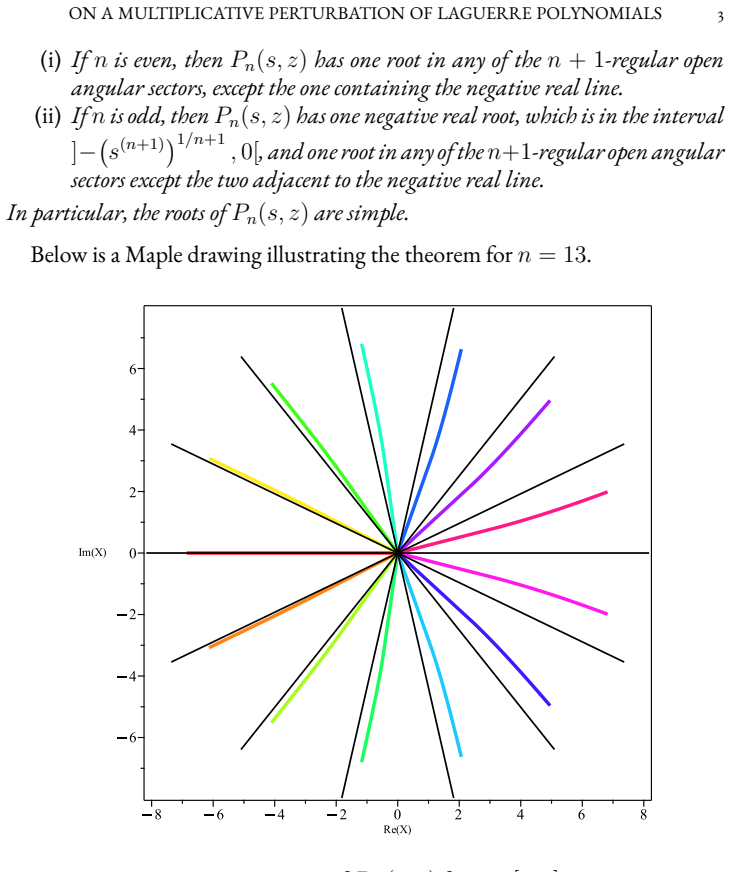
For every positive s and every positive integer n the polynomial P_n(s, z) equals the sum from k equals 0 to n of s^{(k)} z to the power n minus k and possesses n distinct roots, each of which lies in one of a collection of explicitly described angular sectors in the complex plane.
What carries the argument
The rising factorial s^{(k)} that multiplicatively perturbs the monomial coefficients, together with argument bounds from complex analysis that become available once the coefficients are positive.
If this is right
- All roots of P_n(s, z) are distinct.
- Every root lies inside one of the angular sectors whose opening is controlled by s.
- The localization argument requires only the positivity of the coefficients s^{(k)}.
Where Pith is reading between the lines
- The same positivity condition may permit analogous sector results for other families whose coefficients stay positive.
- The explicit sectors could be used to derive bounds on the moduli of the roots without solving the equation.
Load-bearing premise
The parameter s must be positive so that all rising-factorial coefficients remain positive and the sector-localization theorems apply.
What would settle it
For a small fixed n and a chosen s greater than zero, compute all roots of P_n(s, z) numerically and check whether any root has multiplicity greater than one or lies outside the sectors claimed by the paper.
Figures
read the original abstract
In this article, we study the family of polynomials \[ P_n(s, z)=\sum_{k=0}^n s^{(k)} z^{n-k} \] for $s>0$. We prove that its roots are simple, and provide a precise localisation of them in specific angular sectors.
Editorial analysis
A structured set of objections, weighed in public.
Referee Report
Summary. The manuscript studies the polynomials P_n(s, z) = ∑_{k=0}^n s^{(k)} z^{n-k} for s > 0, where s^{(k)} is the rising factorial. It claims to prove that all roots are simple and to give a precise localization of the roots inside specific angular sectors of the complex plane.
Significance. If the proofs hold, the results supply explicit zero-location information for a one-parameter family of polynomials with positive coefficients that arises as a multiplicative perturbation of Laguerre polynomials. The positivity hypothesis s > 0 permits direct application of standard argument-principle or sector theorems, yielding a clean statement that may be useful in complex analysis and the theory of orthogonal polynomials.
minor comments (3)
- [Abstract] Abstract: the two theorems are stated without any proof outline, key lemma, or indication of the method (e.g., Rouché, argument principle, or Sturm sequence). While acceptable for an abstract, a single sentence sketching the approach would improve readability.
- The rising-factorial notation s^{(k)} is used from the first line but is never defined in the provided text; an explicit definition (s(s+1)…(s+k−1)) should appear in the introduction or notation section.
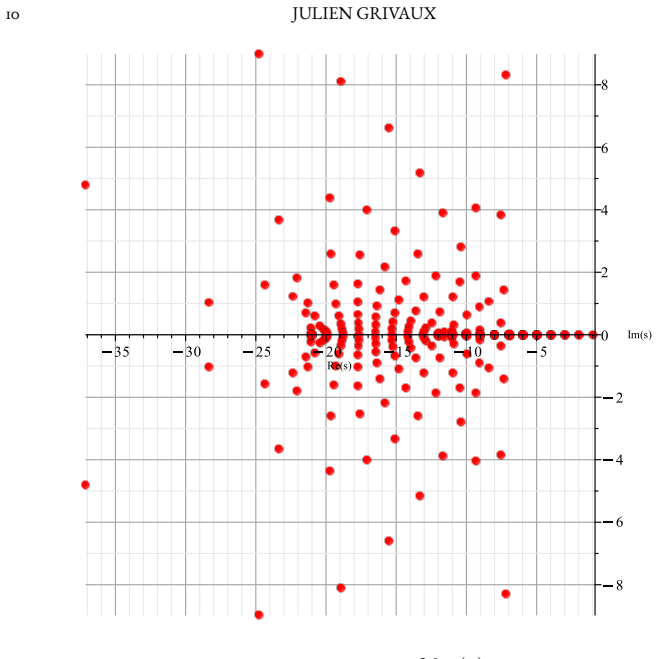
- No numerical examples or plots of the roots for small n and representative s > 0 are supplied, which would help the reader visualize the claimed angular sectors.
Simulated Author's Rebuttal
We thank the referee for the positive assessment of the manuscript, the recognition of its potential utility in complex analysis and orthogonal polynomials, and the recommendation of minor revision. No specific major comments or requested changes were provided in the report.
Circularity Check
No significant circularity; derivation is self-contained
full rationale
The paper claims to prove root simplicity and angular-sector localization for the explicitly defined family P_n(s,z) = sum s^{(k)} z^{n-k} when s>0. These are standard complex-analysis results on polynomials whose coefficients satisfy a positivity hypothesis that is directly met by the given definition for s>0. No fitted parameters, self-referential definitions, load-bearing self-citations, or renamings of known results are indicated in the abstract or reader summary. The localization step uses argument bounds whose hypotheses are satisfied exactly by the sign condition already present in the input; root simplicity is asserted independently. The derivation chain therefore contains no reduction of outputs to inputs by construction.
Axiom & Free-Parameter Ledger
axioms (1)
- standard math Standard theorems on the argument of zeros of polynomials with positive coefficients or rising-factorial structure
Reference graph
Works this paper leans on
-
[1]
F. R. Gantmacher.The Theory of Matrices, V ol. 2. Chelsea Publishing Company, New Y ork,
-
[2]
T ranslated from the Russian by K. A. Hirsch
-
[3]
Ueber die discriminante der im endlichen abbrechenden hyperge- ometrischen reihe.Journal f ¨ur die reine und angewandte Mathematik, 103:337–345, 1888
David Hilbert. Ueber die discriminante der im endlichen abbrechenden hyperge- ometrischen reihe.Journal f ¨ur die reine und angewandte Mathematik, 103:337–345, 1888
-
[4]
Ueber die nullstellen der hypergeometrischen reihe.Mathematische An- nalen, 38:452–458, 1891
Adolf Hurwitz. Ueber die nullstellen der hypergeometrischen reihe.Mathematische An- nalen, 38:452–458, 1891
-
[5]
Ueber die nullstellen der hypergeometrischen reihe.Mathematische Annalen, 37:573–590, 1890
Felix Klein. Ueber die nullstellen der hypergeometrischen reihe.Mathematische Annalen, 37:573–590, 1890
-
[6]
Q. I. Rahman and G. Schmeisser.Analytic theory of polynomials, volume 26 ofLond. Math. Soc. Monogr., New Ser.Oxford: Oxford University Press, 2002
2002
-
[7]
Affektlose gleichungen in der theorie der Laguerreschen und Hermiteschen polynome.Journal f ¨ur die reine und angewandte Mathematik, 165:52–58, 1931
Issai Schur. Affektlose gleichungen in der theorie der Laguerreschen und Hermiteschen polynome.Journal f ¨ur die reine und angewandte Mathematik, 165:52–58, 1931
1931
-
[8]
American Mathematical Society, Providence, RI, 4 edition, 1975
G ´abor Szeg˝o.Orthogonal Polynomials, volume 23 ofAmerican Mathematical Society Collo- quium Publications. American Mathematical Society, Providence, RI, 4 edition, 1975. Sorbonne Universit´e, Universit´e Paris Cit´e, CNRS, IMJ-PRG, F-75005 Paris, France Email address:julien.grivaux@imj-prg.fr
1975
discussion (0)
Sign in with ORCID, Apple, or X to comment. Anyone can read and Pith papers without signing in.