REVIEW 3 major objections 6 minor 28 references
Learned backprojection for sparse and limited view photoacoustic tomography
T0 review · 3 major / 6 minor · reviewed 2026-08-14 · deepseek-v4-flash
Pith's one-line read Adding learned weight factors to the universal backprojection formula roughly halves the reconstruction error in limited-view and sparse photoacoustic tomography.
desk verdict A modest, clearly written methods paper: learning the weight field inside UBP roughly halves simulated reconstruction error on held-out phantoms, but the evaluation is narrow and the generalization claim is untested. read the letter →
The pith
A machine-rendered reading of the paper's core claim, the machinery that carries it, and where it could break.
The reading
What carries the argument
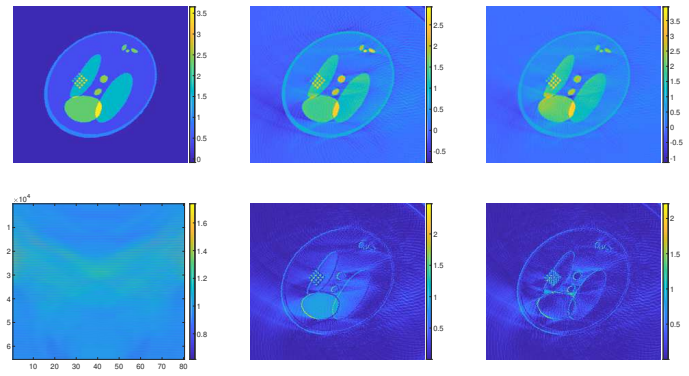
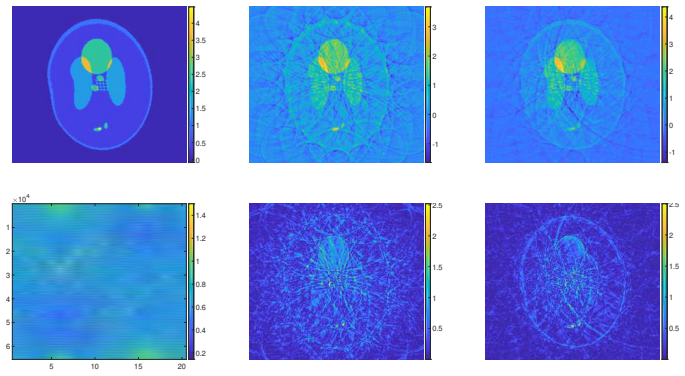
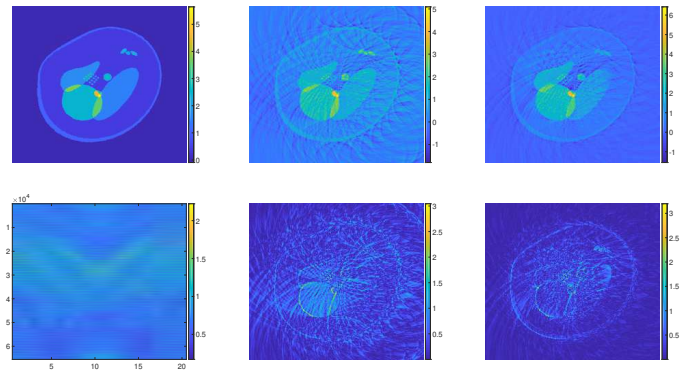
The central object is the weighted universal backprojection operator $$\Psi(w,g)(x)=-\frac{2}{\pi}\int_\Gamma w(x,s)^2 \langle \nu_s, x-s\rangle \int_{\|x-s\|}^\infty \frac{\partial_t($t^{{-1}}$g(s,t))}{\sqrt{$t^{2}$-\|x-s\|^2}}\,dt\,ds,$$ which maps pressure data $g$ to a reconstruction by integrating over detector positions on the measurement surface. The standard UBP is $w\equiv 1$; replacing that constant with a learned weight tensor $W\in\mathbb{R}^{N_x\times N_x\times N_s}$ is the entire trainable modification. The paper generates training data with a directivity model $\phi(s,\omega)=\cos^2(\alpha)$ for $|\alpha|<\pi/2$, so the simulations already contain the angular sensitivity the learned weights must counteract. The weights are optimized by stochastic gradient descent on the mean squared error objective over 1,800 phantom–data pairs; in the solutions, the learned weights show angle-dependent structure tied to the detector arc and the source–detector angle, which is the mechanism that suppresses artifacts from missing views and coarse sampling.
What would settle it
Apply the same learned weights to experimentally recorded photoacoustic data from a tissue phantom under the same half-circle geometry and compare the average relative squared error over a held-out set. If the error is not close to half that of plain UBP—or if plain UBP matches it—the learned weights are tied to the simulation rather than to the imaging problem.
Extended reading notes
Core claim
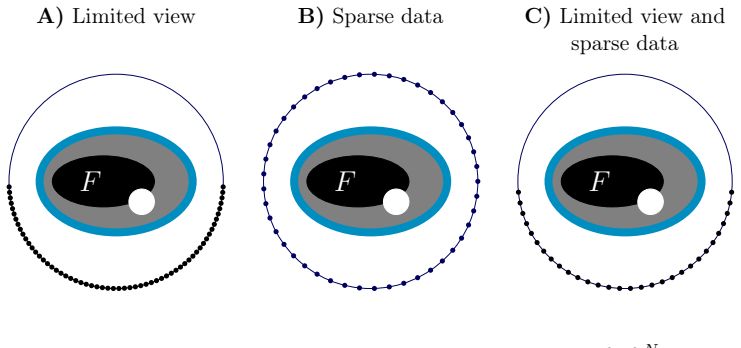
The paper's central claim is that the universal backprojection formula, normally used with constant weight $w\equiv 1$, can be turned into a learned reconstruction operator by optimizing a weight for every pair of reconstruction point and detector position. The training objective is the mean squared error between the weighted backprojection and the true source on a simulated dataset with 1,800 pairs, and the evaluation is on 200 held-out phantoms. Quantitatively, the learned UBP reduces the average relative squared $\ell^2$ error from 0.2002 to 0.0912 on half-circle limited-view data, from 0.3461 to 0.1806 on 20-detector sparse data, and from 0.3546 to 0.1649 when both limitations are combined. The paper also argues the recipe is not tied to a specific geometry: the weights can be optimized for any measurement surface, and the learned backprojection can serve as the first layer of a deeper convolutional network.
Load-bearing premise
The load-bearing premise is that weights trained on noiseless simulated data from one family of synthetic phantoms and one model of detector sensitivity will transfer to real photoacoustic measurements; if that transfer fails, the factor-of-two improvement may disappear outside the simulation.
Editorial extensions
If this is right
- For a fixed detector geometry, reconstruction with the learned weights remains a single backprojection pass, so the speed of standard UBP is retained while accuracy improves.
- In the reported experiments, held-out phantoms show relative squared error drops from 0.2002 to 0.0912 (limited view), 0.3461 to 0.1806 (sparse), and 0.3546 to 0.1649 (combined).
- Because the weight factors are optimized rather than derived, the same training recipe applies to measurement surfaces where no exact inversion formula is known.
- The learned backprojection can serve as the first layer of a deep convolutional network, composing model-based reconstruction with learned artifact removal.
Reading between the lines
- Testable extension: train the same weighted UBP with additive measurement noise and compare the optimized weight fields; if the weights shift substantially, the correction is learning noise statistics rather than geometry alone.
- A consequence the authors leave implicit is that if the learned weights are smooth in the detector angle, the improvement could be compressed into a small analytic correction factor, letting existing filtered-backprojection codes adopt it without a training stage.
- The weight tensor holds one scalar per reconstruction pixel per detector position, so extending the recipe to three-dimensional point-detector data would need much larger tensors; weight sharing across detector positions or radial symmetry would be required to keep training feasible.
Signed reviews
Editorial analysis
A structured set of objections, weighed in public.
Referee Report
Summary. The manuscript proposes a learned version of the universal backprojection (UBP) formula for two-dimensional photoacoustic tomography. Instead of the constant weight w≡1 in Eq. (7), the authors introduce a position- and detector-dependent weight tensor W and train it on simulated incomplete-data/ground-truth pairs for limited-view, sparse-sampling, and combined scenarios. The optimization is carried out with stochastic gradient descent in a Keras/TensorFlow layer that performs the time filtering and weighted backprojection. For a randomized Shepp-Logan phantom family, a cos^2 detector directivity model, and no noise, the authors report that the learned UBP roughly halves the relative l2 error compared with standard UBP on 200 held-out phantoms (Table 1), and they show learned weight images and example reconstructions.
Significance. The idea is simple, elegant, and computationally appealing: it keeps the fast analytic backprojection structure and merely replaces a constant by learned weights, so inference remains a single weighted backprojection pass. The evaluation is honest in that the 200 test phantoms were not used for training, and the reported gain is consistent across all three scenarios. I also credit the authors for explicitly addressing detector directivity, which standard UBP ignores. The main limitation is that the experiments stay entirely within one simulated distribution, so the general significance is conditional on transfer to other source classes, noise levels, and real detector characteristics. If such transfer is demonstrated, or if the claims are appropriately narrowed, the method is a useful addition to learned reconstruction for PAT.
major comments (3)
- [Section 3 and Table 1] The claim that learned weights generally improve reconstruction quality in PAT is not established, because both training and test sets are generated by the same randomized Shepp-Logan procedure, with the same cos^2 directivity model (Eq. (6)), the same circular geometry, and no measurement noise. With roughly 2 million free parameters in W and only 1800 training examples, the held-out 200 phantoms test independence of the particular samples but not independence of the distribution; the learned weights could be compensating for the specific statistics of this phantom family and directivity kernel. Please add out-of-distribution tests (a different phantom class, noisy data, a different directivity model, or experimental measurements), or restrict the conclusions to the simulated setting.
- [Section 3.4] The quantitative evaluation compares weighted UBP only to unweighted UBP. To support the practical significance claimed in the introduction, the method should be compared with existing iterative limited-view and sparse-data reconstructions (e.g., refs. [7,13]) and with the adaptive weighted FBP of refs. [18,21], as well as with a standard learned post-processing CNN. Without such baselines, the factor-of-two improvement over plain UBP does not tell the reader whether the method is competitive with current practice.
- [Section 3 and 3.4] The reported averages in Table 1 are not accompanied by standard deviations, confidence intervals, or the number of independent training runs, and the optimization setup is underspecified (no learning rate, no regularization, no details of the discretization of Eq. (7), no policy for random seeds). Since the training is stochastic and the high-capacity weight tensor may be sensitive to initialization, the quantitative claim needs error bars and enough implementation detail to be reproducible.
minor comments (6)
- [Abstract] Typo: 'in this papers' should be 'in this paper'.
- [Section 2.2] Typo: 'Discetizing' should be 'Discretizing'.
- [Section 2.2] The phrase 'given on a subset of the boundary Γ ⊂ Ω' should probably read 'Γ ⊂ ∂Ω', since Γ is a subset of the detection surface.
- [Introduction] There is an empty citation in the sentence '...have been developed []'; the missing reference should be supplied.
- [Figure 4 caption] The caption says 'The third row displays the learned weights...', but the figure appears to have two rows of images; the row reference should be corrected.
- [General] The authors do not mention code or data availability; providing the trained weights or the data-generation code would substantially improve reproducibility.
Circularity Check
No significant circularity: the learned-UBP improvement is tested on held-out phantoms and is not equivalent to its training objective.
full rationale
The paper's central numerical claim is that weights W in the discretized weighted UBP formula (7), trained by minimizing the mean squared error (10) over M=1800 simulated data-source pairs, roughly halve the relative L2 error relative to standard UBP. The quantitative evaluation in Section 3.4 computes the averaged relative L2 error over 200 reconstructions of phantoms explicitly stated as 'not contained in the training set'. The reported improvement is therefore an independent evaluation of the fitted weights rather than a fitted parameter being reported as a prediction. The learned weights are fitted parameters, but the headline comparison in Table 1 compares standard UBP and weighted UBP on held-out data from the same simulator, so the result is not forced by construction. The paper's self-citations (e.g., references to prior work on inversion formulas, directivity models, and deep learning for PAT) are contextual and are not the load-bearing justification for the observed error reduction, which rests on the numerical experiment itself. The concern that weights trained on one simulated phantom family and directivity model may not transfer to real data or other source classes is a legitimate generalization risk, but it is not a circularity: the paper never defines the target result in terms of those inputs, nor does it disguise a training error as a test error. No equation or claim reduces to its own input by definition.
Assumptions & free parameters
free parameters (1)
- Learned UBP weight vector W =
Not reported (about 2 million parameters)
assumptions (4)
- standard math The photoacoustic pressure wave satisfies the wave equation with initial value f (Section 2.1, Eq. (1)).
- standard math Universal backprojection is an exact inversion formula for full circular data (Section 2.2, Eq. (7)).
- domain assumption Detector directivity is modeled by the cosine-squared angular weighting in Eq. (6).
- ad hoc to paper The synthetic Shepp-Logan phantom distribution is representative of real PAT sources.
Cite this review
Pith. "Pith review of Learned backprojection for sparse and limited view photoacoustic tomography." pith.science (2026). https://pith.science/paper/WKOLGMZW
@misc{pith2026190800593,
  author       = {Pith},
  title        = {Pith review of: Learned backprojection for sparse and limited view photoacoustic tomography},
  year         = {2026},
  howpublished = {\url{https://pith.science/paper/WKOLGMZW}},
  note         = {Machine review of arXiv:1908.00593}
}
read the original abstract
Filtered backprojection (FBP) is an efficient and popular class of tomographic image reconstruction methods. In photoacoustic tomography, these algorithms are based on theoretically exact analytic inversion formulas which results in accurate reconstructions. However, photoacoustic measurement data are often incomplete (limited detection view and sparse sampling), which results in artefacts in the images reconstructed with FBP. In addition to that, properties such as directivity of the acoustic detectors are not accounted for in standard FBP, which affects the reconstruction quality, too. To account for these issues, in this papers we propose to improve FBP algorithms based on machine learning techniques. In the proposed method, we include additional weight factors in the FBP, that are optimized on a set of incomplete data and the corresponding ground truth photoacoustic source. Numerical tests show that the learned FBP improves the reconstruction quality compared to the standard FBP.
Figures

Figures from the paper (2 more)
Reference graph
Works this paper leans on
-
[1]
Tensorflow: a system for large-scale machine learn- ing
Martín Abadi, Paul Barham, Jianmin Chen, Zhifeng Chen, Andy Davis, Jeffrey Dean, Matthieu Devin, Sanjay Ghemawat, Geoffrey Irving, Michael Isard, et al. Tensorflow: a system for large-scale machine learn- ing. In OSDI, volume 16, pages 265–283, 2016
work page 2016
-
[2]
Stephan Antholzer, Markus Haltmeier, and Johannes Schwab. Deep learning for photoacoustic tomography from sparse data.Inverse Prob- lems in Science and Engineering , pages 1–19, 2018
work page 2018
-
[3]
All-optical photoacoustic projection imaging.Biomedical optics express, 8(9):3938–3951, 2017
Johannes Bauer-Marschallinger, Karoline Felbermayer, and Thomas Berer. All-optical photoacoustic projection imaging.Biomedical optics express, 8(9):3938–3951, 2017
work page 2017
-
[4]
Temporal back-projection algorithms for photoacous- tic tomography with integrating line detectors
Peter Burgholzer, J Bauer-Marschallinger, H Grün, Markus Haltmeier, and G Paltauf. Temporal back-projection algorithms for photoacous- tic tomography with integrating line detectors. Inverse Problems , 23(6):S65, 2007
work page 2007
-
[5]
Low-dose ct via convolutional neural network.Biomedical optics express, 8(2):679–694, 2017
Hu Chen, Yi Zhang, Weihua Zhang, Peixi Liao, Ke Li, Jiliu Zhou, and Ge Wang. Low-dose ct via convolutional neural network.Biomedical optics express, 8(2):679–694, 2017
work page 2017
-
[6]
Keras.https://github.com/fchollet/keras, 2015
François Chollet et al. Keras.https://github.com/fchollet/keras, 2015. 11
work page 2015
-
[7]
Accurate model-based reconstruction algorithm for three- dimensional optoacoustic tomography
X Luís Dean-Ben, Andreas Buehler, Vasilis Ntziachristos, and Daniel Razansky. Accurate model-based reconstruction algorithm for three- dimensional optoacoustic tomography. IEEE Transactions on Medical Imaging, 31(10):1922–1928, 2012
work page 1922
-
[8]
Oper- ator learning approach for the limited view problem in photoacoustic tomography
Florian Dreier, Sergiy Pereverzyev Jr, and Markus Haltmeier. Oper- ator learning approach for the limited view problem in photoacoustic tomography. Computational Methods in Applied Mathematics , 2017
work page 2017
Show all 28 references
-
[9]
Inversion of spherical means and the wave equation in even dimensions
David Finch, Markus Haltmeier, and Rakesh. Inversion of spherical means and the wave equation in even dimensions. SIAM Journal on Applied Mathematics, 68(2):392–412, 2007
2007
-
[10]
Determining a function from its mean values over a family of spheres.SIAM journal on mathematical analysis , 35(5):1213–1240, 2004
David Finch and Sarah K Patch. Determining a function from its mean values over a family of spheres.SIAM journal on mathematical analysis , 35(5):1213–1240, 2004
2004
-
[11]
Universal inversion formulas for recovering a func- tion from spherical means
Markus Haltmeier. Universal inversion formulas for recovering a func- tion from spherical means. SIAM Journal on Mathematical Analysis , 46(1):214–232, 2014
2014
-
[12]
Deep learning inte- rior tomography for region-of-interest reconstruction
Yoseob Han, Jawook Gu, and Jong Chul Ye. Deep learning inte- rior tomography for region-of-interest reconstruction. arXiv preprint arXiv:1712.10248, 2017
2017 arXiv
-
[13]
Model-based learning for accelerated, limited-view 3-d photoacoustic tomography
Andreas Hauptmann, Felix Lucka, Marta Betcke, Nam Huynh, Jonas Adler, Ben Cox, Paul Beard, Sebastien Ourselin, and Simon Arridge. Model-based learning for accelerated, limited-view 3-d photoacoustic tomography. IEEE transactions on medical imaging , 37(6):1382–1393, 2018
2018
-
[14]
Deep learning-guided image reconstruction from incomplete data
Brendan Kelly, Thomas P Matthews, and Mark A Anastasio. Deep learning-guided image reconstruction from incomplete data. arXiv preprint arXiv:1709.00584, 2017
2017 arXiv
-
[15]
Mathematics of photoacoustic and thermoacoustic tomography
Peter Kuchment and Leonid Kunyansky. Mathematics of photoacoustic and thermoacoustic tomography. InHandbook of Mathematical Methods in Imaging, pages 817–865. Springer, 2011
2011
-
[16]
Explicit inversion formulae for the spherical mean radon transform
Leonid A Kunyansky. Explicit inversion formulae for the spherical mean radon transform. Inverse problems, 23(1):373, 2007. 12
2007
-
[17]
Nett: Solving inverse problems with deep neural networks.arXiv preprint arXiv:1803.00092, 2018
Housen Li, Johannes Schwab, Stephan Antholzer, and Markus Halt- meier. Nett: Solving inverse problems with deep neural networks.arXiv preprint arXiv:1803.00092, 2018
2018 arXiv
-
[18]
Limited-view photoacoustic imaging based on an iterative adaptive weighted filtered backprojection approach.Applied optics, 52(15):3477–3483, 2013
Xueyan Liu, Dong Peng, Xibo Ma, Wei Guo, Zhenyu Liu, Dong Han, Xin Yang, and Jie Tian. Limited-view photoacoustic imaging based on an iterative adaptive weighted filtered backprojection approach.Applied optics, 52(15):3477–3483, 2013
2013
-
[19]
A family of inversion formulas in thermoacoustic to- mography
Linh V Nguyen. A family of inversion formulas in thermoacoustic to- mography. arXiv preprint arXiv:0902.2579 , 2009
2009 arXiv
-
[20]
Piezoelectric line detector array for photoacoustic tomography
Guenther Paltauf, Petra Hartmair, Georgi Kovachev, and Robert Nuster. Piezoelectric line detector array for photoacoustic tomography. Photoacoustics, 8:28–36, 2017
2017
-
[21]
Weight factors for limited angle photoacoustic tomography
Guenther Paltauf, Robert Nuster, and Peter Burgholzer. Weight factors for limited angle photoacoustic tomography. Physics in Medicine & Biology, 54(11):3303, 2009
2009
-
[22]
Experimental evaluation of reconstruction algorithms for limited view photoacoustic tomography with line detectors
Guenther Paltauf, Robert Nuster, Markus Haltmeier, and Peter Burgholzer. Experimental evaluation of reconstruction algorithms for limited view photoacoustic tomography with line detectors. Inverse Problems, 23(6):S81, 2007
2007
-
[23]
Photoacoustic tomography using a mach-zehnder interfer- ometer as an acoustic line detector.Applied optics, 46(16):3352–3358, 2007
Guenther Paltauf, Robert Nuster, Markus Haltmeier, and Peter Burgholzer. Photoacoustic tomography using a mach-zehnder interfer- ometer as an acoustic line detector.Applied optics, 46(16):3352–3358, 2007
2007
-
[24]
Real-time photoacoustic projection imaging using deep learning
JohannesSchwab, Stephan Antholzer, Robert Nuster, and MarkusHalt- meier. Real-time photoacoustic projection imaging using deep learning. arXiv preprint arXiv:1801.06693 , 2018
2018 arXiv
-
[25]
Universal back-projection algo- rithm for photoacoustic computed tomography
Minghua Xu and Lihong V Wang. Universal back-projection algo- rithm for photoacoustic computed tomography. Physical Review E , 71(1):016706, 2005
2005
-
[26]
Time reversal and its application to to- mography with diffracting sources.Physical review letters, 92(3):033902, 2004
Yuan Xu and Lihong V Wang. Time reversal and its application to to- mography with diffracting sources.Physical review letters, 92(3):033902, 2004. 13
2004
-
[27]
Photoa- coustic tomography with direction dependent data: An exact series re- construction approach
Gerhard Zangerl, Sunghwan Moon, and Markus Haltmeier. Photoa- coustic tomography with direction dependent data: An exact series re- construction approach. Inverse Problems, 2019
2019
-
[28]
Image prediction for limited-angle tomography via deep learning with convolutional neural network
Hanming Zhang, Liang Li, Kai Qiao, Linyuan Wang, Bin Yan, Lei Li, and Guoen Hu. Image prediction for limited-angle tomography via deep learning with convolutional neural network. arXiv preprint arXiv:1607.08707, 2016. 14
2016 arXiv
Reviewed August 14, 2026 · model on record in the stance chip above.
Discussion (0). Continue with ORCID to comment.