REVIEW 3 major objections 6 minor 1 cited by
Update on two-level sampling for glueball observables in quenched QCD
T0 review · 3 major / 6 minor · reviewed 2026-08-10 · deepseek-v4-flash
Pith's one-line read Two-level sampling, combined with distillation, cuts the statistical error of disconnected quark-loop correlation functions in quenched QCD, giving a variance that falls as $1/N_1^2$ when the loops lie in different dynamical regions.
desk verdict A clean, honest methods progress report with a real statistical gap: the corrected estimator's error does not achieve the advertised 1/N1^2 scaling because the bias correction is one-level. read the letter →
The pith
A machine-rendered reading of the paper's core claim, the machinery that carries it, and where it could break.
The reading
What carries the argument
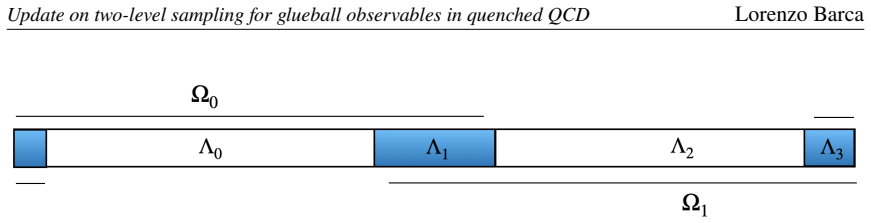
The load-bearing mechanism is the factorization of the quark propagator by domain decomposition: the temporal extent is split into four regions $\Lambda=\Lambda_0\oplus\Lambda_1\oplus\Lambda_2\oplus\Lambda_3$, with $\Lambda_0$ and $\Lambda_2$ updated (dynamical) and $\Lambda_1$ and $\Lambda_3$ frozen, and the propagator is approximated on the overlapping domains $\Omega_0$ and $\Omega_1$ with Dirichlet boundary conditions. This approximation is justified by exponential locality, $\|D^{-1}(y,x)\|\sim e^{-\frac12 m_\pi |y-x|}$, which makes distant gauge-field fluctuations irrelevant for a given quark loop. Distillation enters through the elementals $\phi$ and perambulators $\tau$ that compute the quark-loop traces, and the two-level estimator together with the bias correction $\delta$ carries the variance reduction: the $1/N_1^2$ scaling appears because sub-averages over independent level-1 updates in different dynamical regions decorrelate, as in the pure-gauge analysis.
What would settle it
Increase $N_1$ with $N_0$ fixed on the same ensemble (for example to $N_1=1000$) and plot the error of the corrected estimator $C^{2\text{-lvl}}$; if the error stops following the $1/N_1^2$ line and instead flattens toward the $1/\sqrt{N_1}$ behavior of the correction term, then the bias correction is the bottleneck and the exponential error reduction claimed for fermionic disconnected diagrams fails in that regime.
Extended reading notes
Core claim
The paper establishes that a two-level estimator built from an approximated, domain-decomposed quark propagator reduces the statistical error of disconnected quark-loop two-point functions in quenched QCD. The central object is the corrected estimator $C^{2\text{-lvl}}(t_1,t_0) = \tilde{C}^{2\text{-lvl}}(t_1,t_0) + \delta(t_1,t_0)$, where $\tilde{C}^{2\text{-lvl}}$ sub-averages the quark loops in separate dynamical regions using the approximated propagator, and $\delta = C^{1\text{-lvl}} - \tilde{C}^{1\text{-lvl}}$ removes the bias of the approximation using full-propagator one-level statistics. The paper reports that when the two loops are placed in different dynamical regions the variance of the two-level part scales as $1/N_1^2$, with corrections that fall exponentially with distance from the frozen regions, and that adding $\delta$ does not visibly bias this particular observable. The net effect is a reduction in the error of the disconnected scalar correlator and a longer usable window in the effective mass.
Load-bearing premise
The load-bearing premise is that the bias correction $\delta$, computed with one-level full-propagator statistics, stays small enough and accurate enough that it does not re-introduce the one-level $1/\sqrt{N_1}$ noise; the paper checks this only by observing no significant bias for this particular observable.
Editorial extensions
If this is right
- With $N_0=101$ and $N_1=200$ sub-updates per level-0 configuration, two-level sampling extends the disconnected scalar correlator signal by a few more time slices than standard sampling; the paper notes the statistics are not yet sufficient for a reliable effective-mass plateau.
- Because the variance scales as $1/N_1^2$ when the quark loops are in different dynamical regions, increasing the sub-measurements by a factor of 5 would reduce the error by a similar factor for $t>11a$, a route the authors identify toward a visible plateau.
- The same corrected two-level estimator applies to the other singlet channels $\Gamma=1,\gamma_5,\gamma_\mu,\gamma_4\gamma_5,\gamma_i\gamma_j$, with the connected pieces still computed at one level.
- For full QCD the method requires a local factorization of the fermion determinant, which the paper frames as the next step toward glueball studies in full QCD.
Reading between the lines
- A direct consequence of the reported $1/N_1^2$ scaling is that any disconnected diagram built from quark loops should inherit the same variance reduction, not just the scalar channel, provided the loops sit in distinct dynamical regions and $\delta$ stays subdominant.
- A testable extension would be to estimate $\delta$ from two independent one-level samples; if $\delta$'s variance dominates at larger $N_1$, the method would need a multi-level estimator for the correction itself, which the paper does not provide.
- Because the factorization rests on exponential locality, the speedup should strengthen at heavier quark masses and weaken near the chiral limit; the present $m_\pi\approx760$ MeV setup is a favorable case, so the low-mass regime remains open.
- The Dirichlet-boundary effects visible near the interfaces are repaired only through the one-level $\delta$; a fully local two-level scheme would need to control these boundary effects directly, for instance by enlarging the overlap regions.
Editorial analysis
A structured set of objections, weighed in public.
Referee Report
Summary. This proceedings contribution reports an exploratory combination of two-level sampling with distillation for disconnected quark-loop correlators in quenched QCD. On a single 16^3x64 ensemble at beta=6.0 with m_pi ~ 760 MeV, the authors compare one-level, approximate two-level, and bias-corrected two-level estimators (Eqs. 16-20) for scalar disconnected two-point functions. They find that the approximate two-level estimator reduces statistical errors when the quark loops lie in different dynamical regions, with variance reportedly scaling as 1/N1^2, and they show a modest extension of the disconnected-signal effective mass to larger separations. The central caveat is that the bias-corrected estimator (Eq. 20) uses a correction delta (Eq. 19) whose variance has an N1-independent one-level component, so the advertised variance reduction is not established for the estimator actually used in the physics results.
Significance. If the variance reduction for disconnected diagrams is confirmed, the method would be a useful step toward affordable glueball and singlet-meson spectroscopy with fermions. The paper is a concrete first demonstration that distillation and domain-decomposed propagators can be combined with multilevel integration, and the error analysis uses the Gamma-method with explicit configuration counts. However, the central quantitative claim currently rests on the uncorrected two-level estimator, while the corrected estimator used for the effective-mass comparison has not been shown to retain the 1/N1^2 scaling. The issue is load-bearing rather than cosmetic, and it needs to be addressed before the stated conclusions can be considered supported.
major comments (3)
- [Section 4.2, Eqs. (19)-(20), Fig. 3] The bias correction delta in Eq. (19) is the difference of two one-level estimators, C^{1-lvl} and \tilde C^{1-lvl}, both averaged over the N0 x N1 configurations. For a fixed level-0 configuration i, the full quark loop in Eq. (14) depends on the frozen-region gauge fields, so the average over j does not remove the level-0 fluctuation of delta. Consequently Var(delta) has an N1-independent component of order 1/N0, and adding delta to \tilde C^{2-lvl} introduces a noise floor into C^{2-lvl} that prevents the advertised 1/N1^2 scaling in general. The empirical consequence is visible in Fig. 3, where the filled circles (corrected estimator) lie above the empty circles (uncorrected estimator) over much of the time range. The sentence in Section 4.2 stating that 'the variance scales with 1/N1^2' is therefore only supported for \tilde C^{2-lvl} in Eq. (18), not for the corrected estimator used in Fig. 4. The statement 'we do not observe a significant bias' addresses the expectation value of delta, not its variance, so it does not resolve this concern.
- [Section 5, Conclusion] The conclusion that 'the two-level integration reduces substantially the statistical error of the disconnected contributions' is demonstrated for the uncorrected estimator in Eq. (18), but the corrected estimator in Eq. (20) is the one used for the physical results in Fig. 4. Until either delta is shown to be negligible in the relevant Delta t range, or delta is recomputed with a factorized estimator whose variance is also reduced by the two-level integration, the final estimator's gain is not established. A concrete test would be to plot Var(C^{2-lvl}) versus N1 alongside Var(\tilde C^{2-lvl}) and compare the slopes, including a fit to a floor term.
- [Section 4.2, Fig. 3] The claim that the variance scales as 1/N1^2 is made without a quantitative fit. With only N1 values of 1, 50, and 200 and N0=101, the data are sufficient to fit Var(N1) = a/N1^2 + b, which would directly reveal whether the correction floor b is significant. Adding such a fit, or at least showing the ratio of the filled-to-empty circle errors, would make the scaling statement precise and would quantify how much of the two-level gain survives in the corrected estimator.
minor comments (6)
- [Section 4.2] The text refers to 'C_I(t)' for the scalar correlator, while Eqs. (16)-(20) use the subscript Gamma; please define the relation between these notations.
- [Fig. 2] The orange data points are said to be shifted along the x-axis for visibility, but the shift amount is not stated; this makes the comparison of the full and approximated loops at a given time slice ambiguous.
- [Eq. (10) and Section 4.1] The symbol m_pi denotes the mass of the lightest pseudoscalar state in the quenched approximation; this is a valence-quark mass parameter, not the physical pion mass, and the text should state this explicitly.
- [Section 4.1, footnote 1] The footnote states that autocorrelation effects are suppressed, but no integrated autocorrelation times are reported; providing these estimates for the loop observables would strengthen the error analysis.
- [Section 2, Eq. (7)-(8)] The truncation to 10 Laplacian eigenvectors is introduced without a convergence study; a short check showing the stability of the disconnected correlator as a function of the number of eigenvectors would help assess the systematic error from distillation.
- [Fig. 3] The figure legend is difficult to parse: the labels include both \tilde sigma_C and sigma_C for several N1 values, and the correspondence between symbols and estimators is not fully specified in the caption. Please make the caption self-contained.
Circularity Check
No significant circularity: the variance-scaling prediction is re-tested against new numerical data, and the bias correction is not fitted to the target result.
full rationale
The claimed derivation chain is not circular. The two-level estimator in Eq. (18) is a genuine factorization over local integrations of the approximated quark propagator, and the scaling expectation is imported from the authors' earlier pure-gauge study Ref. [5] as a conjecture to be checked on the new fermionic ensemble, not as a fitted input. The correction delta in Eq. (19) is estimated from the same N0 x N1 configurations and added in Eq. (20), but it is an unbiased additive correction estimated with the usual one-level variance; it is not a parameter fitted to the final effective mass, so the central physics result is not forced by construction. Self-citations (Refs. [4,5,9]) are present, but they are not load-bearing: Ref. [5] is an independent numerical result that is re-examined with new data, and Ref. [9] provides the domain-decomposition factorization technique rather than the error-reduction claim. The skeptic's concern that delta's one-level variance prevents the corrected estimator Eq. (20) from scaling as 1/N1^2 is a statistical correctness question about whether the claimed variance reduction survives the correction; it is not circularity because the paper's definitions do not make the 1/N1^2 scaling true by construction. The paper's own Fig. 3 even displays the corrected error (filled circles) above the uncorrected two-level error, which is an empirical check, not a tautology. The limitation acknowledged in Sec. 4.2 ('we do not observe a significant bias ... at least for this particular observable') concerns the expectation of delta, not its variance; this is a legitimate caveat about the estimator's performance, but it does not make the derivation circular. Overall, the derivation is self-contained against the new numerical data, with at most minor non-load-bearing self-citation, so the circularity score is 2.
Assumptions & free parameters
free parameters (4)
- kappa (hopping parameter) =
0.13393
- N_eig (number of Laplacian eigenvectors) =
10
- Frozen-region boundary slices =
Λ3: t/a in {0,1,61,62,63}; Λ1: t/a in {29,30,31,32,33}
- N0 and N1 =
N0=101, N1=200
assumptions (5)
- domain assumption Quenched approximation: the fermion determinant is set to unity, so the gauge ensemble is pure SU(3) and fermionic Wick contractions are evaluated on quenched gauge fields.
- domain assumption Exponential locality of the quark propagator: ||D^-1(y,x)|| ~ exp(-1/2 m_pi |y-x|), 'supported by empirical arguments'.
- domain assumption Domain-decomposed propagator with Dirichlet boundary conditions approximates the full propagator away from boundaries.
- standard math Standard lattice QCD framework: Wilson gauge action at β=6.0, Wilson clover fermions, periodic boundary conditions, Gamma-method error analysis.
- ad hoc to paper Distillation projection onto the lowest 10 eigenvectors of the 3D Laplacian captures the relevant physics of the quark loops.
Cite this review
Pith. "Pith review of Update on two-level sampling for glueball observables in quenched QCD." pith.science (2026). https://pith.science/paper/WL5ROTZH
@misc{pith2026250117988,
  author       = {Pith},
  title        = {Pith review of: Update on two-level sampling for glueball observables in quenched QCD},
  year         = {2026},
  howpublished = {\url{https://pith.science/paper/WL5ROTZH}},
  note         = {Machine review of arXiv:2501.17988}
}
abstract
We report our progress in combining a two-level sampling algorithm with distillation techniques for calculations of disconnected diagrams in quenched QCD. The simulations are performed on a single ensemble at $\beta=6.0$ and volume $V=16^3\times 64$, and at a pion mass of $m_\pi\approx 760~\mathrm{MeV}$.
Figures


Figures from the paper (1 more)

Forward citations
Cited by 1 Pith paper
-
Lattice evidence that scalar glueballs are small
First lattice extraction of scalar glueball gravitational form factors gives a mass radius of 0.263(31) fm, smaller than typical hadrons.
Reference graph
Works this paper leans on
-
[1]
Parisi,The strategy for computing the hadronic mass spectrum,Phys
G. Parisi,The strategy for computing the hadronic mass spectrum,Phys. Rept.103 (1984) 203
work page 1984
-
[2]
G.P. Lepage,The Analysis of Algorithms for Lattice Field Theory, inTheoretical Advanced Study Institute in Elementary Particle Physics, p. 96, 6, 1989
work page 1989
-
[3]
M. Luscher and P. Weisz,Locality and exponential error reduction in numerical lattice gauge theory,JHEP 09(2001) 010 [hep-lat/0108014]
arXiv 2001
-
[4]
Performance of two-level sampling for the glueball spectrum in pure gauge theory
L. Barca, F. Knechtli, M.J. Peardon, S. Schaefer and J.A. Urrea-Niño,Performance of two-level sampling for the glueball spectrum in pure gauge theory, PoS LATTICE2023 (2024) 030 [2312.11372]
work page Pith review arXiv 2024
- [5]
- [6]
-
[7]
R.Abbott,D.C.Hackett,D.A.Pefkou,F.Romero-LópezandP.Shanahan, Gravitationalform factors of glueballs in Yang-Mills theory, PoS LATTICE2024(2025) 459 [2410.02706]
arXiv 2025
-
[8]
Particle Data Groupcollaboration, Review of particle physics,Phys. Rev. D110 (2024) 030001
2024
Show all 17 references
-
[9]
M. Cè, L. Giusti and S. Schaefer,Domain decomposition, multi-level integration and exponential noise reduction in lattice QCD, Phys. Rev. D93 (2016) 094507 [1601.04587]
2016 arXiv
-
[10]
M.Luscher, ANewapproachtotheproblemofdynamicalquarksinnumericalsimulationsof lattice QCD, Nucl. Phys. B418 (1994) 637 [hep-lat/9311007]
1994 arXiv
-
[11]
M. Cè, L. Giusti and S. Schaefer,A local factorization of the fermion determinant in lattice QCD, Phys. Rev. D95(2017) 034503 [1609.02419]
2017 arXiv
-
[12]
M.DallaBrida,L.Giusti,T.HarrisandM.Pepe, Multi-levelMonteCarlocomputationofthe hadronic vacuum polarization contribution to(𝑔𝜇− 2), Phys. Lett. B816 (2021) 136191 [2007.02973]
2021 arXiv
-
[13]
Hadron Spectrum Collaborationcollaboration, Novel quark-field creation operator construction for hadronic physics in lattice QCD, Phys. Rev. D80 (2009) 054506
2009
-
[14]
Falcioni, M.L
M. Falcioni, M.L. Paciello, G. Parisi and B. Taglienti,Again on SU(3) glueball mass,Nucl. Phys. B251 (1985) 624
1985
-
[15]
Athenodorou and M
A. Athenodorou and M. Teper,The glueball spectrum of SU(3) gauge theory in 3 + 1 dimensions,JHEP 11 (2020) 172 [2007.06422]. 9 Update on two-level sampling for glueball observables in quenched QCD Lorenzo Barca
2020 arXiv
-
[16]
Luscher,Solution of the Dirac equation in lattice QCD using a domain decomposition method,Comput
M. Luscher,Solution of the Dirac equation in lattice QCD using a domain decomposition method,Comput. Phys. Commun.156 (2004) 209 [hep-lat/0310048]
2004 arXiv
-
[17]
ALPHAcollaboration, Monte Carlo errors with less errors, Comput. Phys. Commun.156 (2004) 143 [hep-lat/0306017]. 10
2004 arXiv
Reviewed August 10, 2026 · model on record in the stance chip above.
Discussion (0). Continue with ORCID to comment.