Geometric Phase-Space Structure in Cosmological Solutions of Einstein's Field Equations
Pith reviewed 2026-06-27 13:53 UTC · model grok-4.3
The pith
A geometric diagnostic framework using standard quantities separates distinct physical mechanisms of departure from FLRW cosmology.
A machine-rendered reading of the paper's core claim, the machinery that carries it, and where it could break.
Core claim
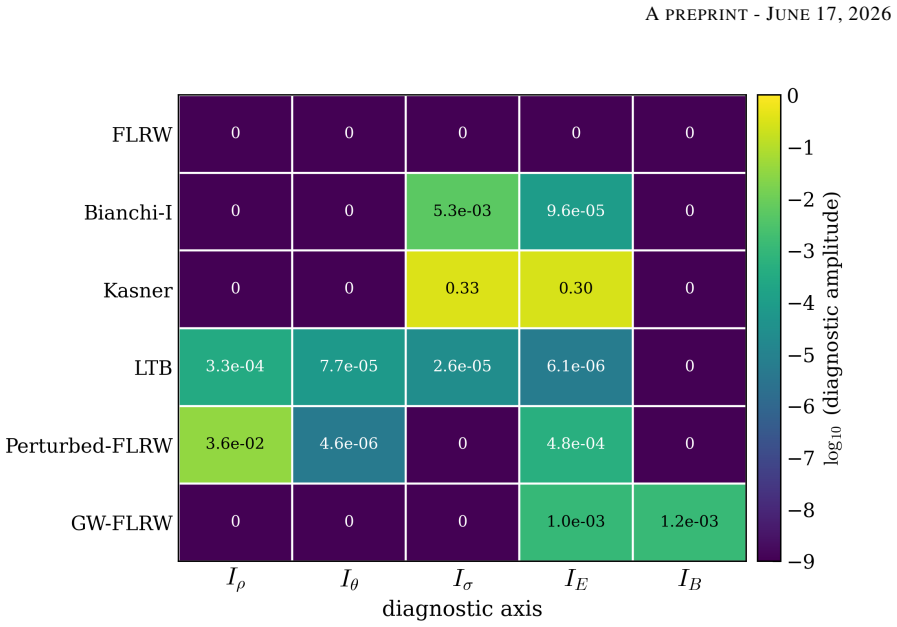
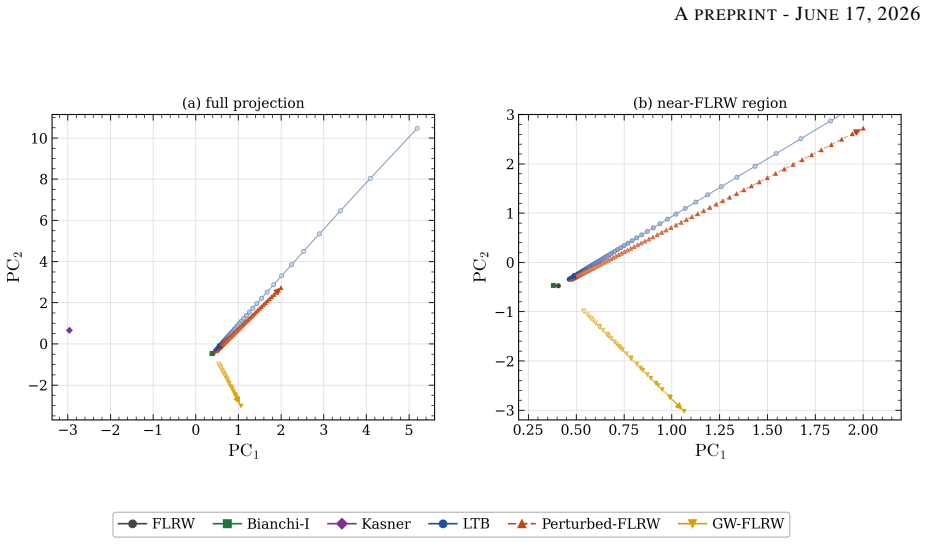
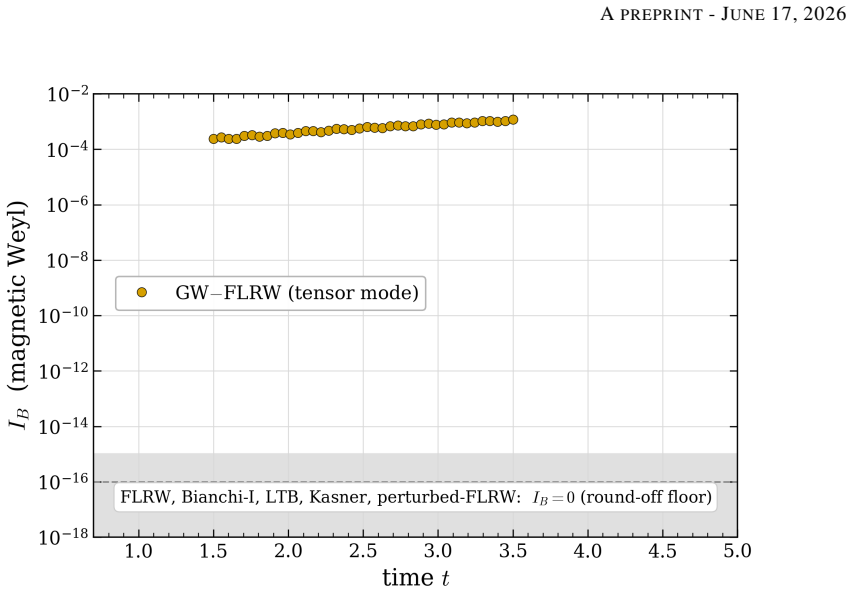
Einstein field equations allow cosmological dynamics to depart from the Friedmann-Lemaitre-Robertson-Walker idealisation in several physically different ways through spatial inhomogeneity, expansion scalar variance, shear, and Weyl curvature. The paper introduces a compact geometric diagnostic framework that keeps these mechanisms separate while using standard quantities in general relativity. The framework is observer-explicit and domain-explicit and is tested on six benchmarks that occupy distinct regions of the diagnostic space, with the magnetic Weyl contribution appearing only in the tensor-perturbed case.
What carries the argument
An observer-explicit and domain-explicit geometric diagnostic framework built from spatial inhomogeneity, expansion scalar variance, shear, and a single normalisation of the Weyl curvature.
If this is right
- Different departure mechanisms remain distinguishable rather than collapsed into one number.
- Buchert kinematical backreaction is recovered as a derived quantity fixed by expansion variance and shear.
- The magnetic part of the Weyl tensor is isolated to the tensor-perturbed benchmark.
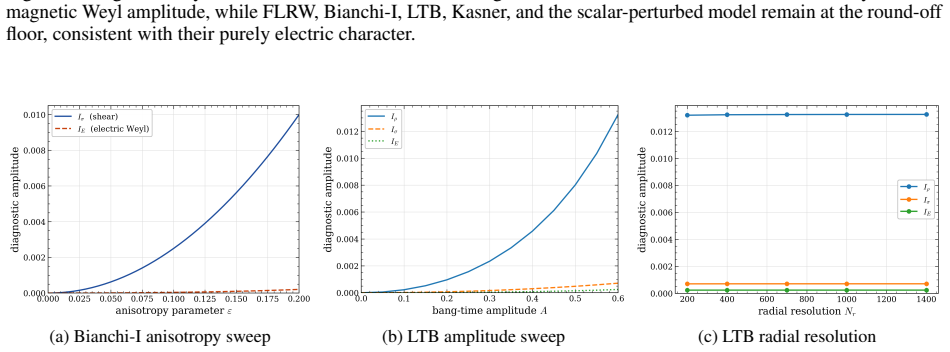
- The placement of models stays stable across changes in perturbation amplitude, grid resolution, and domain size.
Where Pith is reading between the lines
- Numerical relativity codes could adopt the same diagnostic axes to classify outputs without introducing new invariants.
- Observational data reduced to averaged scalars could be plotted in the same space to test which mechanism dominates in real surveys.
- The framework suggests that exact solutions and perturbed models can be compared directly on equal geometric footing.
Load-bearing premise
The selected geometric quantities and their explicit observer and domain construction are sufficient to distinguish all physically different departure mechanisms without missing or conflating effects.
What would settle it
Two benchmark families with physically distinct departure mechanisms mapping to the same point in the diagnostic space, or the classification changing under a documented variation in averaging domain or observer tilt.
Figures
read the original abstract
Einstein field equations allow cosmological dynamics to depart from the Friedmann-Lemaitre-Robertson-Walker (FLRW) idealisation in several physically different ways. Matter may become spatially inhomogeneous, the local expansion scalar may vary across a hypersurface, the expansion may acquire anisotropic components through shear, and the free gravitational field may be encoded in nonzero Weyl curvature. The key question is not only how far a model is from FLRW, but which geometric mechanism is responsible. A single departure from FLRW number cannot distinguish these mechanisms. This paper introduces a compact geometric diagnostic framework that keeps them separate while using standard quantities in general relativity. The framework is observer-explicit and domain-explicit, intended as a practical tool for comparing analytic and numerical solution families rather than as a new invariant classification of spacetime. Buchert's kinematical backreaction is retained as a derived explanatory quantity rather than a separate axis, since it is already fixed by the expansion-variance and shear contributions. A single curvature normalisation is used for all Weyl diagnostics. The method is tested on six benchmarks, namely FLRW, Bianchi-I, Kasner, Lemaitre-Tolman-Bondi dust, scalar-perturbed FLRW, and tensor-perturbed FLRW. These benchmarks occupy distinct regions of the diagnostic space, and the magnetic Weyl contribution appears only in the tensor case. The classification remains stable under changes of perturbation amplitude, spatial resolution, averaging domain, constraint reliability, and a leading-order observer tilt. The curvature expressions for the exact benchmarks are verified symbolically against metric-derived Weyl invariants, and the supporting computer code, numerical results, tables, and figures are publicly available.
Editorial analysis
A structured set of objections, weighed in public.
Referee Report
Summary. The manuscript introduces a compact geometric diagnostic framework to distinguish different mechanisms of departure from FLRW in cosmological solutions of Einstein's equations, using spatial inhomogeneity, expansion scalar variance, shear, and normalized Weyl curvature. The framework is tested on six benchmark families (FLRW, Bianchi-I, Kasner, LTB dust, scalar-perturbed FLRW, tensor-perturbed FLRW), which are shown to occupy distinct regions, with magnetic Weyl appearing only in the tensor case. Stability is reported under changes in perturbation amplitude, resolution, domain, constraints, and observer tilt. Buchert backreaction is kept as derived from variance and shear.
Significance. If the results hold, this provides a useful practical tool for comparing different families of solutions in general relativistic cosmology, keeping the mechanisms separate using standard quantities, with public code available and symbolic verifications performed. The paper limits its scope to a comparison tool for the listed families rather than claiming an exhaustive classification, so the concern that the chosen quantities might miss or conflate effects does not undermine the central claim.
minor comments (3)
- [Abstract] Abstract: the statement that benchmarks occupy distinct regions would benefit from a brief quantitative indication of the separation (e.g., a mention of the diagnostic values or distances) to support the claim without requiring the full text.
- The stability tests under amplitude, resolution, domain, constraint, and tilt variations are central to the practical utility; ensure the corresponding tables or figures explicitly list the diagnostic values before and after each variation.
- Notation for the single curvature normalisation used across all Weyl diagnostics should be introduced once with a clear equation reference to avoid ambiguity in later sections.
Simulated Author's Rebuttal
We thank the referee for the positive summary of the manuscript, the accurate description of its scope as a practical comparison tool rather than an exhaustive classification, and the recommendation of minor revision. No specific major comments were provided in the report.
Circularity Check
No significant circularity detected
full rationale
The paper defines its diagnostic framework directly from standard GR quantities (inhomogeneity, expansion variance, shear, Weyl curvature) without fitting parameters or renaming inputs as predictions. Buchert backreaction is explicitly retained as a derived quantity fixed by variance and shear, not introduced as an independent axis. Benchmarks are computed explicitly from known metrics (FLRW, Bianchi-I, Kasner, LTB, perturbed FLRW), with symbolic verification against invariants and stability tests under parameter changes; no load-bearing step reduces to self-definition, self-citation chains, or ansatz smuggling. The framework is presented as a practical comparison tool rather than a uniqueness theorem or exhaustive classification.
Axiom & Free-Parameter Ledger
free parameters (1)
- curvature normalisation
axioms (1)
- domain assumption Einstein field equations govern the allowed departures from FLRW
Reference graph
Works this paper leans on
-
[1]
On average properties of inhomogeneous fluids in general relativity: dust cosmologies,
T. Buchert, “On average properties of inhomogeneous fluids in general relativity: dust cosmologies,”General Relativity and Gravitation, vol. 32, pp. 105–125, 2000.https://doi.org/10.1023/A:1001800617177
-
[2]
On average properties of inhomogeneous fluids in general relativity: perfect fluid cosmologies,
T. Buchert, “On average properties of inhomogeneous fluids in general relativity: perfect fluid cosmologies,”Gen- eral Relativity and Gravitation, vol. 33, pp. 1381–1405, 2001.https://doi.org/10.1023/A:1012061725841 11 APREPRINT- JUNE17, 2026
-
[3]
Inhomogeneous cosmological models: exact solutions and their applications,
K. Bolejko, M.-N. Célérier, and A. Krasi ´nski, “Inhomogeneous cosmological models: exact solutions and their applications,”Classical and Quantum Gravity, vol. 28, art. 164002, 2011. https://doi.org/10.1088/ 0264-9381/28/16/164002
2011
-
[4]
Inhomogeneous cosmology with numerical relativity,
H. J. Macpherson, P. D. Lasky, and D. J. Price, “Inhomogeneous cosmology with numerical relativity,”Physical Review D, vol. 95, art. 064028, 2017.https://doi.org/10.1103/PhysRevD.95.064028
-
[5]
Cosmology using numerical relativity,
J. C. Aurrekoetxea, K. Clough, and E. A. Lim, “Cosmology using numerical relativity,”Living Reviews in Relativity, vol. 28, art. 5, 2025.https://doi.org/10.1007/s41114-025-00058-z
-
[6]
Symmetry-organised complexity in quantum neural networks,
H. Ugail and N. Howard, “Symmetry-organised complexity in quantum neural networks,”Symmetry, vol. 18, no. 6, art. 912, 2026.https://doi.org/10.3390/sym18060912
-
[7]
Cosmological models (Cargèse lectures 1998),
G. F. R. Ellis and H. van Elst, “Cosmological models (Cargèse lectures 1998),” inTheoretical and Observational Cosmology, NATO Science Series C, vol. 541, pp. 1–116, Kluwer, Dordrecht, 1999.https://arxiv.org/abs/ gr-qc/9812046
Pith/arXiv arXiv 1998
-
[8]
G. F. R. Ellis, R. Maartens, and M. A. H. MacCallum,Relativistic Cosmology. Cambridge University Press, Cambridge, 2012
2012
-
[9]
R. M. Wald,General Relativity. University of Chicago Press, Chicago, 1984
1984
-
[10]
Gravito-electromagnetic analogies,
L. F. O. Costa and J. Natário, “Gravito-electromagnetic analogies,”General Relativity and Gravitation, vol. 46, art. 1792, 2014.https://doi.org/10.1007/s10714-014-1792-1
-
[11]
The magnetic part of the Weyl tensor, and the expansion of dis- crete universes,
T. Clifton, D. Gregoris, and K. Rosquist, “The magnetic part of the Weyl tensor, and the expansion of dis- crete universes,”General Relativity and Gravitation, vol. 49, art. 30, 2017. https://doi.org/10.1007/ s10714-017-2192-0
2017
-
[12]
Geometrical theorems on Einstein’s cosmological equations,
E. Kasner, “Geometrical theorems on Einstein’s cosmological equations,”American Journal of Mathematics, vol. 43, no. 4, pp. 217–221, 1921.https://doi.org/10.2307/2370192
-
[13]
Republication of: geometrical theorems on Einstein’s cosmological equations,
J. Wainwright and A. Krasi ´nski, “Republication of: geometrical theorems on Einstein’s cosmological equations,”General Relativity and Gravitation, vol. 40, pp. 865–876, 2008. https://doi.org/10.1007/ s10714-007-0574-4
2008
-
[14]
C. W. Misner, “Mixmaster universe,”Physical Review Letters, vol. 22, pp. 1071–1074, 1969.https://doi.org/ 10.1103/PhysRevLett.22.1071
-
[15]
L’univers en expansion,
G. Lemaître, “L’univers en expansion,”Annales de la Société Scientifique de Bruxelles A, vol. 53, pp. 51–85, 1933
1933
-
[16]
Effect of inhomogeneity on cosmological models,
R. C. Tolman, “Effect of inhomogeneity on cosmological models,”Proceedings of the National Academy of Sciences, vol. 20, no. 3, pp. 169–176, 1934.https://doi.org/10.1073/pnas.20.3.169
-
[17]
Spherically symmetrical models in general relativity,
H. Bondi, “Spherically symmetrical models in general relativity,”Monthly Notices of the Royal Astronomical Society, vol. 107, no. 5–6, pp. 410–425, 1947.https://doi.org/10.1093/mnras/107.5-6.410
-
[18]
Krasi ´nski,Inhomogeneous Cosmological Models
A. Krasi ´nski,Inhomogeneous Cosmological Models. Cambridge University Press, Cambridge, 1997
1997
-
[19]
Gauge-invariant cosmological perturbations,
J. M. Bardeen, “Gauge-invariant cosmological perturbations,”Physical Review D, vol. 22, no. 8, pp. 1882–1905, 1980.https://doi.org/10.1103/PhysRevD.22.1882
-
[20]
H. Kodama and M. Sasaki, “Cosmological perturbation theory,”Progress of Theoretical Physics Supplement, vol. 78, pp. 1–166, 1984.https://doi.org/10.1143/PTPS.78.1
-
[21]
V . F. Mukhanov, H. A. Feldman, and R. H. Brandenberger, “Theory of cosmological perturbations,”Physics Reports, vol. 215, no. 5–6, pp. 203–333, 1992.https://doi.org/10.1016/0370-1573(92)90044-Z
-
[22]
On average properties of inhomogeneous fluids in general relativity III: general fluid cosmologies,
T. Buchert, P. Mourier, and X. Roy, “On average properties of inhomogeneous fluids in general relativity III: general fluid cosmologies,”General Relativity and Gravitation, vol. 52, art. 27, 2020. https://doi.org/10. 1007/s10714-020-02670-6
2020
-
[23]
A class of inhomogeneous cosmological models,
P. Szekeres, “A class of inhomogeneous cosmological models,”Communications in Mathematical Physics, vol. 41, pp. 55–64, 1975.https://doi.org/10.1007/BF01608547
-
[24]
Modelling inhomogeneity in Szekeres spacetime,
D. Vrba and O. Svítek, “Modelling inhomogeneity in Szekeres spacetime,”General Relativity and Gravitation, vol. 46, art. 1808, 2014.https://doi.org/10.1007/s10714-014-1808-x
-
[25]
Magnetic fields and the Weyl tensor in the early universe,
E. Bittencourt, J. M. Salim, and G. B. dos Santos, “Magnetic fields and the Weyl tensor in the early universe,”Gen- eral Relativity and Gravitation, vol. 46, art. 1790, 2014.https://doi.org/10.1007/s10714-014-1790-3
-
[26]
Stephani, D
H. Stephani, D. Kramer, M. A. H. MacCallum, C. Hoenselaers, and E. Herlt,Exact Solutions of Einstein’s Field Equations, 2nd ed. Cambridge University Press, Cambridge, 2003. 12
2003
discussion (0)
Sign in with ORCID, Apple, or X to comment. Anyone can read and Pith papers without signing in.