Volterra--Wiener--Kunchenko Orthogonalization: From Wiener--Hermite to Distribution-Matched Volterra Bases
Pith reviewed 2026-06-27 06:22 UTC · model grok-4.3
The pith
The VWK basis, built by Gram-Schmidt orthogonalization to the input distribution, removes the skew-dependent excess risk incurred by the Gaussian Wiener-Hermite basis in Volterra identification.
A machine-rendered reading of the paper's core claim, the machinery that carries it, and where it could break.
Core claim
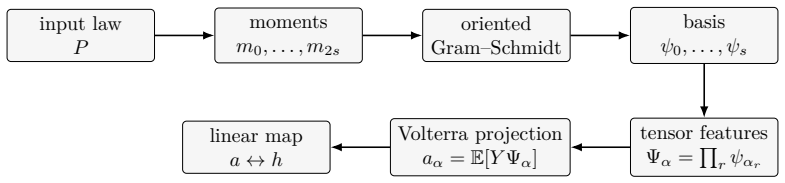
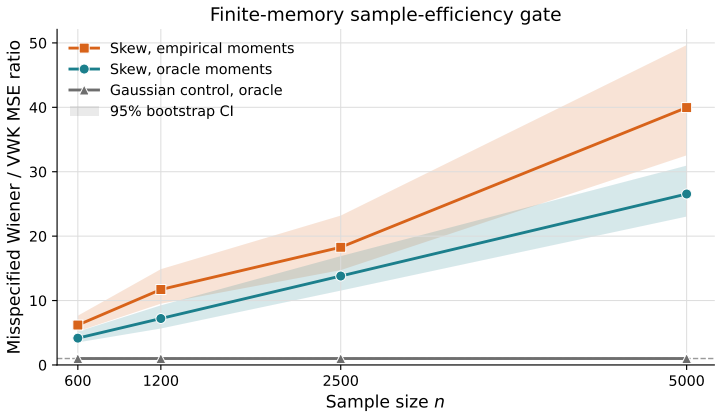
We construct the distribution-matched VWK basis via oriented Gram-Schmidt orthogonalization of monomials in L²(P) and prove an order-2 misspecification-penalty theorem establishing that a self-normalized diagonal estimator in the variance-matched Gaussian basis incurs an excess L²(P) risk governed by the skew coefficient δ=μ₃/σ², vanishing exactly for symmetric inputs.
What carries the argument
The VWK basis obtained by oriented Gram-Schmidt orthogonalization of monomials in L²(P) to match the input distribution P.
If this is right
- The excess L²(P) risk of the Gaussian-basis diagonal estimator equals a multiple of the skew coefficient δ for order-2 terms.
- The empirical VWK Gram matrix is better conditioned than the monomial power Gram at sample sizes around 2000 for centered-exponential inputs.
- Full least-squares estimation over a fixed span remains unchanged by the basis choice, so the VWK basis improves stability for diagonal cross-correlation and regularized fits.
- A machine-checked proof confirms the Krawtchouk polynomial row for the binomial distribution at arbitrary N.
Where Pith is reading between the lines
- The construction could be applied to system identification tasks with known non-Gaussian driving signals to reduce estimation variance in diagonal approximations.
- Extending the moment-based analysis to inputs with dependence structure would require computing the full Gram matrix over joint distributions rather than product measures.
- Comparing VWK performance against other orthogonal polynomial bases in higher-degree Volterra models could reveal limits of the conditioning benefit.
Load-bearing premise
The analysis relies on moment-based calculations, finite memory length, and input distributions that factor into independent components.
What would settle it
A numerical experiment with a symmetric input distribution (zero skew) in which the Gaussian-basis estimator still exhibits excess L2 risk beyond sampling error would falsify the misspecification-penalty theorem.
Figures
read the original abstract
The monomial parameterization of finite-memory Volterra identification is ill-conditioned under non-Gaussian input, and the Wiener--Hermite expansion removes this ill-conditioning only for Gaussian white-noise input. We construct the distribution-matched Volterra--Wiener--Kunchenko (VWK) basis by oriented Gram--Schmidt orthogonalization of monomials in $L^2(P)$ and use it as an arbitrary-polynomial-chaos coordinate system for finite-memory Volterra identification from data, following the generalized polynomial chaos of Xiu and Karniadakis (2002) and the data-driven arbitrary polynomial chaos of Oladyshkin and Nowak (2012). The basis itself is classical; the contribution is the Volterra-estimation reading. First, an order-2 misspecification-penalty theorem shows that a self-normalized diagonal estimator in the variance-matched Gaussian basis incurs an excess $L^2(P)$ risk governed by the skew coefficient $\delta=\mu_3/\sigma^2$, vanishing exactly for symmetric inputs. Second, conditioning experiments separate the constructional fact that the population matched Gram is the identity from the finite-sample design Gram: at $n=2000$, the centered-exponential empirical VWK Gram remains far better conditioned than the power Gram, although it degrades with degree. Third, a machine-checked Lean 4 proof establishes the Binomial$(N,p)$ Krawtchouk row for arbitrary $N$. Full least squares over a fixed span is basis-invariant, so VWK stabilizes diagonal cross-correlation and regularized coordinate fits rather than claiming universal prediction superiority. The analysis is moment-based, finite-memory, and restricted to product input laws.
Editorial analysis
A structured set of objections, weighed in public.
Referee Report
Summary. The manuscript constructs the distribution-matched Volterra--Wiener--Kunchenko (VWK) basis via oriented Gram--Schmidt orthogonalization of monomials in L²(P) for finite-memory Volterra identification under non-Gaussian inputs. It presents an order-2 misspecification-penalty theorem establishing that a self-normalized diagonal estimator in the variance-matched Gaussian basis incurs excess L²(P) risk governed by the skew coefficient δ = μ₃/σ², which vanishes exactly for symmetric inputs. Supporting elements include conditioning experiments at n=2000 showing improved empirical Gram conditioning for the centered-exponential VWK basis relative to the power basis, and a machine-checked Lean 4 proof of the binomial Krawtchouk row for arbitrary N. The analysis is explicitly scoped to moment-based methods, finite memory, and product input laws; full least-squares estimation is noted to be basis-invariant, so the contribution targets stabilization of diagonal and regularized fits.
Significance. If the theorem and experiments hold under the stated restrictions, the work supplies a principled, distribution-aware coordinate system that extends the Wiener--Hermite construction while preserving the classical Gram--Schmidt foundation. The explicit tie of excess risk to the skew coefficient, the formal Lean verification of a core polynomial row, and the separation of population versus finite-sample Gram conditioning constitute concrete strengths. The result is relevant to system identification and polynomial chaos methods when input laws are known but non-Gaussian.
minor comments (3)
- [Abstract] Abstract, final sentence: the scoping restrictions (moment-based, finite-memory, product input laws) are stated but could be repeated in the introduction to prevent over-generalization by readers.
- The description of the 'oriented' Gram--Schmidt procedure would benefit from an explicit algorithmic statement or pseudocode, even if the underlying mathematics is classical.
- The conditioning experiments report n=2000 but do not specify the exact input distribution family, degree range, or number of Monte Carlo replications; adding these details would improve reproducibility.
Simulated Author's Rebuttal
We thank the referee for the detailed and positive summary of the manuscript, the assessment of its significance, and the recommendation of minor revision. No specific major comments or requested changes were raised in the report.
Circularity Check
No significant circularity detected
full rationale
The paper's derivation chain begins with standard Gram-Schmidt orthogonalization of monomials in L²(P) to form the VWK basis, explicitly following external references (Xiu-Karniadakis 2002; Oladyshkin-Nowak 2012) for the polynomial-chaos framework while claiming only a Volterra-estimation reading as novel. The order-2 misspecification-penalty theorem is scoped to moment-based analysis under finite-memory product laws and ties excess risk explicitly to the skew coefficient δ without reducing to a fitted parameter or self-defined quantity. The Lean 4 proof for the Krawtchouk row supplies independent formal verification. Full least-squares invariance is stated as a standard fact. No load-bearing step equates a claimed result to its inputs by construction, self-citation, or renaming; the analysis remains self-contained against the stated assumptions.
Axiom & Free-Parameter Ledger
axioms (2)
- standard math Gram-Schmidt orthogonalization produces an orthonormal basis in L²(P)
- domain assumption Input measure is a product law
Reference graph
Works this paper leans on
-
[1]
Géraud Blatman and Bruno Sudret. Adaptive sparse polynomial chaos expansion based on least angle regression.Journal of Computational Physics, 230(6):2345–2367, 2011. https://doi.org/10.1016/j.jcp.2010.12.021
-
[2]
Brillinger
David R. Brillinger. An introduction to polyspectra.The Annals of Mathematical Statistics, 36(5):1351–1374, 1965
1965
-
[3]
Brillinger.Time Series: Data Analysis and Theory
David R. Brillinger.Time Series: Data Analysis and Theory. Holt, Rinehart and Winston, New York, 1975
1975
-
[4]
R. H. Cameron and W. T. Martin. The orthogonal development of non-linear functionals in series of Fourier–Hermite functionals.Annals of Mathematics, 48(2):385–392, 1947. https://doi.org/10.2307/1969178
-
[5]
Ricardo J. G. B. Campello, Gérard Favier, and Wagner Caradori do Amaral. Optimal expansions of discrete-time Volterra models using Laguerre functions.Automatica, 40(5): 815–822, 2004. https://doi.org/10.1016/j.automatica.2003.11.016
-
[6]
Alberto Carini and Giovanni L. Sicuranza. Selection of a closed-form expression polynomial orthogonal basis for robust nonlinear system identification.Journal of Signal Processing Systems, 2014. https://doi.org/10.1007/s11265-014-0948-2
-
[7]
Alberto Carini, Stefania Cecchi, Laura Romoli, and Giovanni L. Sicuranza. Legendre nonlin- ear filters.Signal Processing, 109:84–94, 2015. https://doi.org/10.1016/j.sigpro.2014.10.037
-
[8]
Generalization of GMM to a continuum of moment conditions.Econometric Theory, 16(6):797–834, 2000
Marine Carrasco and Jean-Pierre Florens. Generalization of GMM to a continuum of moment conditions.Econometric Theory, 16(6):797–834, 2000
2000
-
[9]
C. M. Cheng, Z. K. Peng, W. M. Zhang, and G. Meng. Volterra-series-based nonlinear system modeling and its engineering applications: A state-of-the-art review.Mechanical Systems and Signal Processing, 87:340–364, 2017. https://doi.org/10.1016/j.ymssp.2016.10.029
-
[10]
Chihara.An Introduction to Orthogonal Polynomials
Theodore S. Chihara.An Introduction to Orthogonal Polynomials. Gordon and Breach, New York, 1978
1978
-
[11]
ESAIM: Mathematical Modelling and Numerical Analysis , volume=
Oliver G. Ernst, Antje Mugler, Hans-Jörg Starkloff, and Elisabeth Ullmann. On the convergence of generalized polynomial chaos expansions.ESAIM: Mathematical Modelling and Numerical Analysis, 46(2):317–339, 2012. https://doi.org/10.1051/m2an/2011045
-
[12]
On the efficiency of empirical characteristic function procedures.Journal of the Royal Statistical Society: Series B, 43(1):20–27, 1981
Andrey Feuerverger and Philip McDunnough. On the efficiency of empirical characteristic function procedures.Journal of the Royal Statistical Society: Series B, 43(1):20–27, 1981
1981
-
[13]
Advances in Industrial Control
Luigi Fortuna, Salvatore Graziani, Alessandro Rizzo, and Maria Gabriella Xibilia.Soft Sensors for Monitoring and Control of Industrial Processes. Advances in Industrial Control. Springer, London, 2007. https://doi.org/10.1007/978-1-84628-480-9
-
[14]
Walter Gautschi. On generating orthogonal polynomials.SIAM Journal on Scientific and Statistical Computing, 3(3):289–317, 1982. https://doi.org/10.1137/0903018
-
[15]
Roger G. Ghanem and Pol D. Spanos.Stochastic Finite Elements: A Spectral Approach. Springer-Verlag, New York, 1991. https://doi.org/10.1007/978-1-4612-3094-6. 18
-
[16]
Large sample properties of generalized method of moments estimators
Lars Peter Hansen. Large sample properties of generalized method of moments estimators. Econometrica, 50(4):1029–1054, 1982
1982
-
[17]
Peter J. Huber. Robust estimation of a location parameter.The Annals of Mathematical Statistics, 35(1):73–101, 1964
1964
-
[18]
Heysem Kaya, Pınar Tüfekci, and Erdinç Uzun. Predicting CO and NOx emissions from gas turbines: novel data and a benchmark PEMS.Turkish Journal of Electrical Engineering and Computer Sciences, 27(6):4783–4796, 2019. https://doi.org/10.3906/elk-1807-87
-
[19]
Vassilis Kekatos and Georgios B. Giannakis. Sparse Volterra and polynomial regression models: Recoverability and estimation.IEEE Transactions on Signal Processing, 59(12): 5907–5920, 2011. https://doi.org/10.1109/TSP.2011.2165952
-
[20]
Lesky, and René F
Roelof Koekoek, Peter A. Lesky, and René F. Swarttouw.Hypergeometric Orthogonal Polynomials and Their q-Analogues. Springer Monographs in Mathematics. Springer, Berlin, 2010
2010
-
[21]
Michael J. Korenberg. Identifying nonlinear difference equation and functional expansion representations: The fast orthogonal algorithm.Annals of Biomedical Engineering, 16(1): 123–142, 1988. https://doi.org/10.1007/BF02367385
-
[22]
Y. P. Kunchenko.Polynomial Parameter Estimations of Close to Gaussian Random Variables. Shaker Verlag, Aachen, 2002
2002
-
[23]
Y. P. Kunchenko.Stochastic Polynomials. Naukova Dumka, Kyiv, 2006
2006
-
[24]
Y. W. Lee and M. Schetzen. Measurement of the Wiener kernels of a non-linear system by cross-correlation.International Journal of Control, 2(3):237–254, 1965
1965
-
[25]
Marmarelis.Nonlinear Dynamic Modeling of Physiological Systems
Vasilis Z. Marmarelis.Nonlinear Dynamic Modeling of Physiological Systems. Wiley-IEEE Press, Hoboken, NJ, 2004
2004
-
[26]
John Mathews and Giovanni L
V. John Mathews and Giovanni L. Sicuranza.Polynomial Signal Processing. Wiley, New York, 2000
2000
-
[27]
Nikias and Athina P
Chrysostomos L. Nikias and Athina P. Petropulu.Higher-Order Spectra Analysis: A Nonlinear Signal Processing Framework. Prentice Hall, Englewood Cliffs, NJ, 1993
1993
-
[28]
Sergey Oladyshkin and Wolfgang Nowak. Data-driven uncertainty quantification using the arbitrary polynomial chaos expansion.Reliability Engineering & System Safety, 106: 179–190, 2012. https://doi.org/10.1016/j.ress.2012.05.002
-
[29]
Wiley, New York, 1980
Martin Schetzen.The Volterra and Wiener Theories of Nonlinear Systems. Wiley, New York, 1980
1980
-
[30]
Wim Schoutens.Stochastic Processes and Orthogonal Polynomials, volume 146 ofLecture Notes in Statistics. Springer, New York, 2000. https://doi.org/10.1007/978-1-4612-1170-9
-
[31]
Christian Soize and Roger Ghanem. Physical systems with random uncertainties: Chaos representations with arbitrary probability measure.SIAM Journal on Scientific Computing, 26(2):395–410, 2004. https://doi.org/10.1137/S1064827503424505
-
[32]
Ameri- can Mathematical Society, Providence, RI, 1939
Gábor Szegő.Orthogonal Polynomials, volume 23 ofAMS Colloquium Publications. Ameri- can Mathematical Society, Providence, RI, 1939. 19
1939
-
[33]
Emiliano Torre, Stefano Marelli, Paul Embrechts, and Bruno Sudret. Data-driven polynomial chaos expansion for machine learning regression.Journal of Computational Physics, 388: 601–623, 2019. https://doi.org/10.1016/j.jcp.2019.03.039
-
[34]
Blackie, London, 1930
Vito Volterra.Theory of Functionals and of Integral and Integro-Differential Equations. Blackie, London, 1930
1930
-
[35]
Xiaoliang Wan and George Em Karniadakis. Beyond Wiener–Askey expansions: Handling arbitrary PDFs.Journal of Scientific Computing, 27(1–3):455–464, 2006. https://doi.org/10.1007/s10915-005-9038-8
-
[36]
MIT Press, Cambridge, MA, 1958
Norbert Wiener.Nonlinear Problems in Random Theory. MIT Press, Cambridge, MA, 1958
1958
-
[37]
Jeroen A. S. Witteveen and Hester Bijl. Modeling arbitrary uncertainties using gram-schmidt polynomial chaos. In44th AIAA Aerospace Sciences Meeting and Exhibit. American Institute of Aeronautics and Astronautics, 2006. https://doi.org/10.2514/6.2006-896
-
[38]
The Wiener–Askey polynomial chaos for stochastic differential equations.SIAM Journal on Scientific Computing, 24(2):619–644,
Dongbin Xiu and George Em Karniadakis. The Wiener–Askey polynomial chaos for stochastic differential equations.SIAM Journal on Scientific Computing, 24(2):619–644,
-
[39]
https://doi.org/10.1137/S1064827501387826
-
[40]
Empirical characteristic function estimation and its applications.Econometric Reviews, 23(2):93–123, 2004
Jun Yu. Empirical characteristic function estimation and its applications.Econometric Reviews, 23(2):93–123, 2004
2004
-
[41]
S. W. Zabolotnii, Z. L. Warsza, and O. Tkachenko. Polynomial estimation of linear regression parameters for the asymmetric pdf of errors. InAdvances in Intelligent Systems and Computing, volume 743, pages 709–722. Springer, 2018
2018
-
[42]
EstemPMM: Polynomial maximization method estimation
Serhii Zabolotnii. EstemPMM: Polynomial maximization method estimation. https: //cran.r-project.org/package=EstemPMM, 2026. R package version 0.4.0
2026
-
[43]
Serhii V. Zabolotnii. From Volterra series to Kunchenko stochastic polynomials: Half a century of non-Gaussian estimation methodology. arXiv preprint arXiv:2605.22354, 2026. 20
Pith/arXiv arXiv 2026
discussion (0)
Sign in with ORCID, Apple, or X to comment. Anyone can read and Pith papers without signing in.