REVIEW 3 major objections 6 minor 98 references
Periodically and aperiodically Thue-Morse driven long-range systems: from dynamical localization to slow dynamics
T0 review · 3 major / 6 minor · reviewed 2026-08-10 · deepseek-v4-flash
Pith's one-line read Time-periodic and Thue-Morse electric-field drives renormalize every hopping amplitude in a power-law chain by a sinc factor, so at special amplitude-to-frequency ratios the clean long-range system is exactly dynamically localized, while…
desk verdict Clear new EDL condition for Thue-Morse driven long-range chains; the drive-induced fractal phase in the PLRBM needs stronger finite-size evidence before it carries the abstract. read the letter →
The pith
A machine-rendered reading of the paper's core claim, the machinery that carries it, and where it could break.
The reading
What carries the argument
The load-bearing object is the effective Hamiltonian obtained from the Baker-Campbell-Hausdorff expansion of the one-cycle (or one Thue-Morse block) evolution operator. For the clean chain, each hopping $J_p$ is multiplied by $\sin(\phi_p)/\phi_p$, with $\phi_p$ proportional to $pFT$, and exact dynamical localization occurs exactly when all these renormalized hoppings vanish at once at $F=n\omega$ (Thue-Morse) or $F=2m\omega$ (square wave). For the disordered model, the same expansion yields a zeroth-order term $H_0$ with renormalized hoppings plus higher-order corrections $H_1$; at the vanishing points only $H_1$ survives, and its frequency-dependent corrections govern the slow dynamics. Static phase identification uses the level-spacing ratio of the Floquet quasienergy spectrum and the system-size scaling of the generalized inverse participation ratio $I_q \sim L^{-\tau_q}$, with fractal dimension $D_q = \tau_q/(q-1)$ distinguishing localized ($D_q=0$), delocalized ($D_q=1$), and fractal ($0<D_q<1$) eigenstates.
What would settle it
Compute the generalized participation ratios $I_q$ for $q=2,3,4$ at $L=400,700,1000,1500,2000$ with several hundred disorder realizations and perform a finite-size scaling collapse; the fractal phase is real only if $D_q$ extrapolates to a constant in $(0,1)$ as $L\to\infty$, whereas a crossover would push $D_q$ toward $0$ or $1$.
Extended reading notes
Core claim
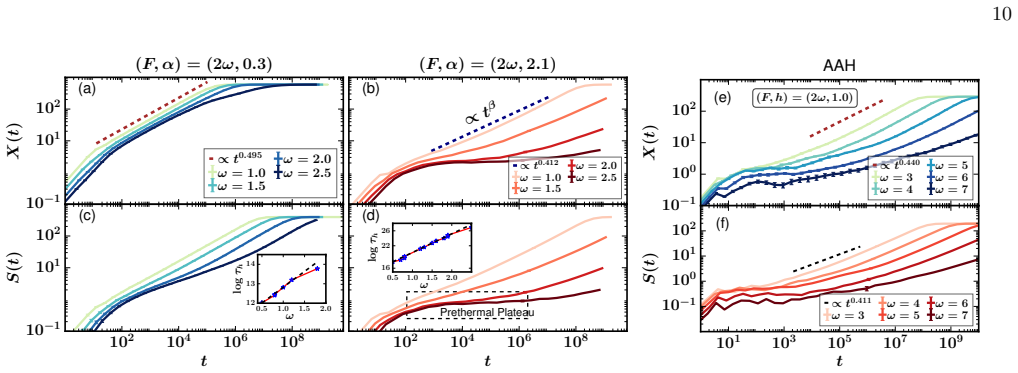
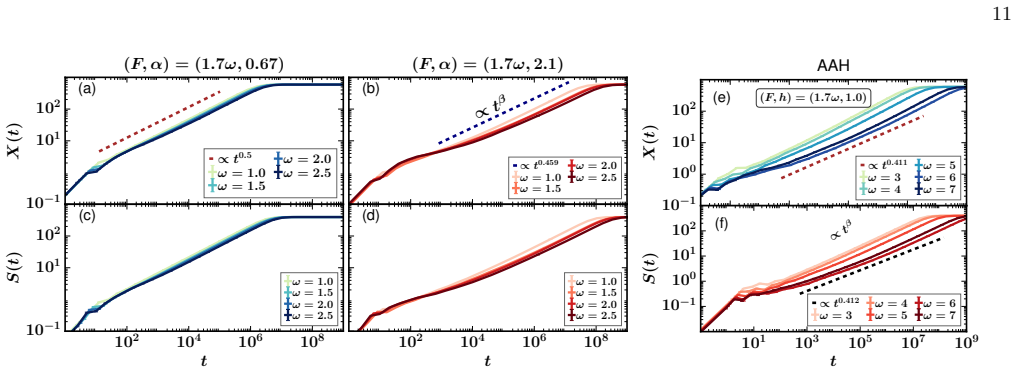
The paper's central claim is that an electric-field drive acts on a power-law hopping model through a multiplicative renormalization of each hopping amplitude: for square-wave driving the effective amplitude is $J_p^{\rm eff} = J_p \sin(pFT/4)/(pFT/4)$ and for Thue-Morse driving it is $J_p^{\rm eff} = J_p \sin(pFT)/(pFT)$, with $J_p = J/p^\alpha$. Because the sine factor vanishes for every $p$ simultaneously at $F=2m\omega$ (square wave) or $F=n\omega$ (Thue-Morse), the clean long-range chain exhibits exact dynamical localization for arbitrary $\alpha$; away from these points it is ballistic. For the disordered power-law random banded matrix model, the authors find a drive-induced intermediate phase on the delocalized side ($\alpha<1$): Floquet eigenstates have fractal dimension $0<D_q<1$ that is nearly independent of $q$ for larger $\alpha$, indicating weak multifractality crossing over to a fractal phase, with transport that is diffusive to subdiffusive. On the localized side ($\alpha>1$) the driven model stays localized, with logarithmic spreading of $X(t)$ and $S(t)$. The disordered Thue-Morse-driven model shows diffusive relaxation to the infinite-temperature state on the delocalized side and a prethermal plateau followed by subdiffusion on the localized side, in contrast to the Thue-Morse-driven Aubry-André-Harper model, where even the delocalized side develops a prolonged prethermal plateau.
Load-bearing premise
The existence of the drive-induced fractal phase rests on power-law fits of participation ratios at only two moment orders and three system sizes with no finite-size scaling collapse, so the intermediate fractal dimension could be a finite-size crossover between the static delocalized and localized phases.
Editorial extensions
If this is right
- At the zeros of the renormalized hopping, a clean long-range chain of any $\alpha$ is completely frozen: $X(t)$ remains at its initial width while the drive runs.
- Tuning slightly away from the zero point restores full ballistic transport, so the drive acts as a sharp on/off switch for transport in the clean model.
- Periodic driving replaces ballistic spreading with diffusive ($\beta=1/2$) or subdiffusive ($\beta<1/2$) transport on the delocalized side of the disordered model, with the exponent decreasing as $\alpha$ approaches the static transition.
- Thue-Morse driving produces exponentially long prethermal plateaus ($\tau_h \propto e^{\omega}$) on the localized side, followed by subdiffusive relaxation to the infinite-temperature state.
- The same aperiodic drive suppresses transport even in the delocalized phase of the Aubry-André-Harper model, creating a prolonged prethermal plateau before subdiffusive growth.
Reading between the lines
- If the fractal phase survives thermodynamic-limit scaling, the periodic drive offers a parameter-free route to engineering subdiffusive transport exponents by tuning $F/\omega$ and $\alpha$ in a non-interacting chain.
- The sinc-factor structure suggests that any driving protocol whose Fourier spectrum contains a common zero for all hopping distances, not only square-wave and Thue-Morse, should produce exact dynamical localization; testing a second aperiodic sequence such as Fibonacci driving would map the boundary of the phenomenon.
- The exponentially long heating time in the Thue-Morse-driven disordered model implies the prethermal plateau may be observable in current cold-atom or trapped-ion simulators with power-law interactions, where the drive frequency can be large compared with local bandwidths.
- The contrast between the PLRBM and Aubry-André-Harper results hints that the nature of the static eigenstates controls whether the delocalized side develops a prethermal plateau, a distinction that could be probed by measuring the level-spacing statistics of the driven system.
Editorial analysis
A structured set of objections, weighed in public.
Referee Report
Summary. This paper studies the interplay of time-periodic and aperiodic Thue-Morse electric-field driving with power-law hopping disorder in a one-dimensional fermionic chain (the PLRBM model). For periodic square-wave driving, the authors analyze the Floquet operator and report a drive-induced weak-multifractal/fractal phase on the delocalized side (α<1) of the static transition, with diffusive-to-subdiffusive transport, while the localized side (α>1) remains localized with logarithmic transport. For the clean long-range chain under Thue-Morse driving, they derive an effective Hamiltonian with renormalized hopping J_eff^p = J_p sin(pFT)/(pFT) and claim exact dynamical localization at F=nω. For the disordered Thue-Morse-driven chain, they report diffusive relaxation on the delocalized side and a prethermal plateau followed by subdiffusion on the localized side, and they compare with a Thue-Morse-driven Aubry-André-Harper model. The central claims are the drive-induced fractal phase and the exact dynamical localization condition.
Significance. The paper addresses a timely question: how long-range hopping and temporal driving combine to produce non-equilibrium phases. The strongest feature is that the EDL condition F=nω is a parameter-free prediction from the renormalized-hopping formula, and the numerical saturation data in Fig. 9 are consistent with it. The manuscript also provides transport and entanglement data across a broad parameter range. However, the evidence for the drive-induced fractal phase, highlighted in the abstract and conclusions, is not quantitatively sufficient as presented; the Dq analysis uses only two q values and three system sizes without error bars or finite-size scaling. If the fractal phase is established by additional scaling analysis, the paper would constitute a useful contribution to the Floquet engineering of long-range disordered systems.
major comments (3)
- [Section III.A, Eq. (19), Fig. 4] The claim that the periodically driven PLRBM model exhibits a drive-induced fractal phase on the delocalized side (0<Dq<1 independent of q for α=0.5–0.85) is based on power-law fits of I2 and I3 over only L=400, 700, 1000, with 100 disorder realizations and no error bars. With only q=2 and q=3, the distinction drawn in Fig. 4(c,f) between 'weak multifractality' (Dq varying with q) and 'fractal behavior' (Dq constant in q) is not established even in principle, and the intermediate ⟨r⟩ values in Fig. 3(a) are equally consistent with a finite-size crossover between the delocalized and localized PLRBM phases. Please provide error bars, additional q values, and a finite-size scaling analysis that demonstrates a stable thermodynamic-limit Dq.
- [Section IV.A, Eqs. (21)-(26)] The derivation of the exact dynamical localization condition for the Thue-Morse driven clean chain uses a Baker-Campbell-Hausdorff expansion truncated at leading order. The paper then states that 'at the zeros of J_eff^p, F=nω, one can observe the phenomenon of exact dynamical localization' and 'the transport of the system ceases.' Since higher-order terms in the BCH expansion are not shown to vanish at those points, the word 'exact' is not justified by the presented derivation. Please either supply an exact argument (for example, a momentum-space integration) or qualify the claim as holding within the high-frequency expansion.
- [Section III.A, Fig. 3(a)] The identification of an intermediate phase for α<1 from ⟨r⟩ values between 0.386 and 0.529 is made without a finite-size analysis. Since the system sizes are L=1024 and the disorder average is only 100 realizations, the intermediate values could be a crossover effect; please show ⟨r⟩ vs L for representative α values and DL/ADL tunings.
minor comments (6)
- [Section II, Eq. (3)] The definitions of U_+ and U_- in Eq. (3) are not carried consistently into Section IV.A, where UA and UB appear; please make the notation uniform.
- [Fig. 3(a)] Please add a horizontal line at the COE value ⟨r⟩=0.529 to aid comparison with the Poisson line at 0.386.
- [Fig. 4] The power-law fits in panels (a,b,d,e) are quoted without their fitted exponents or goodness-of-fit; please report τ_q and R² or similar.
- [Section IV.B, Fig. 10 insets] The conclusion τ_h ∝ exp(ω) is drawn from a log-linear plot with four points and no error bars; please include the fit and uncertainties.
- [Section III.B] There are several typos, e.g., 'inifinite' for 'infinite' and 'aymptotic' for 'asymptotic'; a careful proofread is needed.
- [Fig. 1 table] The table entries such as 'Subdiffusive Prethermalization Delocalization' are confusing; consider rewording to distinguish the prethermal plateau from the eventual delocalization.
Circularity Check
No significant circularity: the EDL conditions and effective hoppings are derived analytically, and the fractal-phase claim, though numerically underpowered, is an interpretation of direct Floquet data.
full rationale
The derivation chain rests on BCH/Magnus expansions rather than on fitting or self-citation. The periodically driven renormalized hopping, J_eff^p = J_p sin(pFT/4)/(p^alpha (pFT/4)) (Eqs. 14-15), and the Thue-Morse J_eff^p = J_p sin(pFT)/(pFT) (Eq. 26) are obtained algebraically in the text; the EDL zeros F = 2mω and F = nω are analytic consequences and are then checked against independent time evolution (Figs. 8-9). No parameter is fitted to the quantity it is said to predict. The fractal/multifractal phase classification in Sec. III.A is inferred from power-law fits of I2 and I3 for q = 2, 3 at L = 400, 700, 1000; this is numerically underpowered and a real correctness risk, but it is not circular: the classification is an interpretation of numerically computed Floquet eigenstates, not an input to the calculation. The self-citations [35, 36, 86] support related prior results, but the expressions used here are rederived in the main text and appendices, so those self-citations are not load-bearing. No uniqueness theorem is imported from the authors' prior work, and no known result is merely renamed. I therefore find no circular step.
Assumptions & free parameters
assumptions (5)
- domain assumption The BCH/Magnus expansion truncated at leading order yields the effective Hamiltonians in Eqs. (10), (12), and (26), and higher-order terms H1 can be neglected at high frequency.
- domain assumption The undriven PLRBM model has a delocalization-to-localization transition at α=1, with delocalized behavior for α<1 and localized behavior for α>1.
- domain assumption Spectral diagnostics (level-spacing ratio and generalized IPR scaling) at system sizes up to L=1024 and 100 disorder samples distinguish localized, fractal/multifractal, and delocalized phases without significant finite-size corrections.
- domain assumption The Fourier spectrum of the Thue-Morse sequence, with both low- and high-frequency components, controls the plateau and subdiffusion, and the heating time grows exponentially with driving frequency.
- standard math Entanglement entropy computed from the single-particle correlation matrix via Eq. (6) correctly captures the dynamics and the infinite-temperature (Page) value.
Cite this review
Pith. "Pith review of Periodically and aperiodically Thue-Morse driven long-range systems: from dynamical localization to slow dynamics." pith.science (2026). https://pith.science/paper/WMCIYUA7
@misc{pith2026241219736,
  author       = {Pith},
  title        = {Pith review of: Periodically and aperiodically Thue-Morse driven long-range systems: from dynamical localization to slow dynamics},
  year         = {2026},
  howpublished = {\url{https://pith.science/paper/WMCIYUA7}},
  note         = {Machine review of arXiv:2412.19736}
}
abstract
We investigate the electric-field driven power-law random banded matrix(PLRBM) model where a variation in the power-law exponent $\alpha$ yields a delocalization-to-localization phase transition. We examine the periodically driven PLRBM model with the help of the Floquet operator. The level spacing ratio and the generalized participation ratio of the Floquet Hamiltonian reveal a drive-induced fractal phase accompanied by diffusive transport on the delocalized side of the undriven PLRBM model. On the localized side, the time-periodic model remains localized - the average spacing ratio corresponds to Poisson statistics and logarithmic transport is observed in the dynamics. Extending our analysis to the aperiodic Thue-Morse (TM) driven system, we find that the aperiodically driven clean long-range hopping model (clean counterpart of the PLRBM model) exhibits the phenomenon of \textit{exact dynamical localization} (EDL) on tuning the drive-parameters at special points. The disordered time-aperiodic system shows diffusive transport followed by relaxation to the infinite-temperature state on the delocalized side, and a prethermal plateau with subdiffusion on the localized side. Additionally, we compare this with a quasi-periodically driven AAH model that also undergoes a localization-delocalization transition. Unlike the disordered long-range model, it features a prolonged prethermal plateau followed by subdiffusion to the infinite temperature state, even on the delocalized side.
Figures


Figures from the paper (8 more)


Reference graph
Works this paper leans on
-
[1]
Schreiber, S
M. Schreiber, S. S. Hodgman, P. Bordia, H. P. L¨ uschen, M. H. Fischer, R. Vosk, E. Altman, U. Schneider, and I. Bloch, Observation of many-body localization of inter- 15 acting fermions in a quasirandom optical lattice, Science 349, 842 (2015)
2015
-
[2]
S. Choi, J. Choi, R. Landig, G. Kucsko, H. Zhou, J. Isoya, F. Jelezko, S. Onoda, H. Sumiya, V. Khemani, C. von Keyserlingk, N. Y. Yao, E. Demler, and M. D. Lukin, Ob- servation of discrete time-crystalline order in a disordered dipolar many-body system, Nature 543, 221 (2017)
2017
-
[3]
Q. Guo, C. Cheng, H. Li, S. Xu, P. Zhang, Z. Wang, C. Song, W. Liu, W. Ren, H. Dong, R. Mondaini, and H. Wang, Stark many-body localization on a supercon- ducting quantum processor, Phys. Rev. Lett.127, 240502 (2021)
2021
-
[4]
Guo, Z.-Y
X.-Y. Guo, Z.-Y. Ge, H. Li, Z. Wang, Y.-R. Zhang, P. Song, Z. Xiang, X. Song, Y. Jin, L. Lu, K. Xu, D. Zheng, and H. Fan, Observation of bloch oscilla- tions and wannier-stark localization on a superconduct- ing quantum processor, npj Quantum Information 7, 51 (2021)
2021
-
[5]
Morong, F
W. Morong, F. Liu, P. Becker, K. S. Collins, L. Feng, A. Kyprianidis, G. Pagano, T. You, A. V. Gorshkov, and C. Monroe, Observation of stark many-body localization without disorder, Nature 599, 393 (2021)
2021
-
[6]
X. Mi, M. Ippoliti, C. Quintana, A. Greene, Z. Chen, J. Gross, F. Arute, K. Arya, J. Atalaya, R. Bab- bush, J. C. Bardin, J. Basso, A. Bengtsson, A. Bilmes, A. Bourassa, L. Brill, M. Broughton, B. B. Buck- ley, D. A. Buell, B. Burkett, N. Bushnell, B. Chiaro, R. Collins, W. Courtney, D. Debroy, S. Demura, A. R. Derk, A. Dunsworth, D. Eppens, C. Erickson, ...
2022
- [7]
-
[8]
Y.-A. Chen, S. Nascimb` ene, M. Aidelsburger, M. Atala, S. Trotzky, and I. Bloch, Controlling correlated tunnel- ing and superexchange interactions with ac-driven optical lattices, Phys. Rev. Lett. 107, 210405 (2011)
2011
Show all 98 references
-
[9]
M. C. Rechtsman, J. M. Zeuner, Y. Plotnik, Y. Lumer, D. Podolsky, F. Dreisow, S. Nolte, M. Segev, and A. Sza- meit, Photonic floquet topological insulators, Nature 496, 196 (2013)
2013
-
[10]
Bukov, L
M. Bukov, L. D’Alessio, and A. Polkovnikov, Universal high-frequency behavior of periodically driven systems: from dynamical stabilization to Floquet engineering, Ad- vances in Physics 64, 139 (2015)
2015
-
[11]
Holthaus, Floquet engineering with quasienergy bands of periodically driven optical lattices, Journal of Physics B: Atomic, Molecular and Optical Physics 49, 013001 (2015)
M. Holthaus, Floquet engineering with quasienergy bands of periodically driven optical lattices, Journal of Physics B: Atomic, Molecular and Optical Physics 49, 013001 (2015)
2015
-
[12]
P. M. Schindler and M. Bukov, Counterdiabatic driving for periodically driven systems, Phys. Rev. Lett. 133, 123402 (2024)
2024
-
[13]
Y.-J. Lin, R. L. Compton, K. Jim´ enez-Garc ´ ıa, J. V. Porto, and I. B. Spielman, Synthetic magnetic fields for ultracold neutral atoms, Nature 462, 628 (2009)
2009
-
[14]
Goldman and J
N. Goldman and J. Dalibard, Periodically driven quan- tum systems: Effective hamiltonians and engineered gauge fields, Phys. Rev. X 4, 031027 (2014)
2014
-
[15]
Roushan, C
P. Roushan, C. Neill, A. Megrant, Y. Chen, R. Bab- bush, R. Barends, B. Campbell, Z. Chen, B. Chiaro, A. Dunsworth, A. Fowler, E. Jeffrey, J. Kelly, E. Lucero, J. Mutus, P. J. J. O’Malley, M. Neeley, C. Quintana, D. Sank, A. Vainsencher, J. Wenner, T. White, E. Kapit, H. Neven...
2017
-
[16]
I. T. Rosen, S. Muschinske, C. N. Barrett, A. Chatter- jee, M. Hays, M. A. DeMarco, A. H. Karamlou, D. A. Rower, R. Das, D. K. Kim, B. M. Niedzielski, M. Schuldt, K. Serniak, M. E. Schwartz, J. L. Yoder, J. A. Grover, and W. D. Oliver, A synthetic magnetic vector poten- tial i...
2024 doi
-
[17]
Martin, G
I. Martin, G. Refael, and B. Halperin, Topological fre- quency conversion in strongly driven quantum systems, Phys. Rev. X 7, 041008 (2017)
2017
-
[18]
D. M. Long, P. J. D. Crowley, A. J. Koll´ ar, and A. Chan- dran, Boosting the quantum state of a cavity with floquet driving, Phys. Rev. Lett. 128, 183602 (2022)
2022
-
[19]
Citro and M
R. Citro and M. Aidelsburger, Thouless pumping and topology, Nature Reviews Physics 5, 87 (2023)
2023
-
[20]
Psaroudaki and G
C. Psaroudaki and G. Refael, Photon pumping in a weakly-driven quantum cavity–spin system, Annals of Physics 435, 168553 (2021), special issue on Philip W. Anderson
2021
-
[21]
P. J. D. Crowley, I. Martin, and A. Chandran, Topo- logical classification of quasiperiodically driven quantum systems, Phys. Rev. B 99, 064306 (2019)
2019
-
[22]
P. W. Anderson, Absence of diffusion in certain random lattices, Phys. Rev. 109, 1492 (1958)
1958
-
[23]
Aubry and G
S. Aubry and G. Andr´ e, Analyticity breaking and ander- son localization in incommensurate lattices, (1980)
1980
-
[24]
P. G. Harper, Single band motion of conduction electrons in a uniform magnetic field, Proceedings of the Physical Society. Section A 68, 874 (1955)
1955
-
[25]
Holthaus, G
M. Holthaus, G. H. Ristow, and D. W. Hone, ac-field- controlled anderson localization in disordered semicon- ductor superlattices, Phys. Rev. Lett. 75, 3914 (1995)
1995
-
[26]
P. A. Lee and T. V. Ramakrishnan, Disordered electronic systems, Rev. Mod. Phys. 57, 287 (1985)
1985
-
[27]
Zener, A theory of the electrical breakdown of solid dielectrics, Proceedings of the Royal Society of London
C. Zener, A theory of the electrical breakdown of solid dielectrics, Proceedings of the Royal Society of London. Series A, Containing Papers of a Mathematical and Phys- ical Character 145, 523 (1934)
1934
-
[28]
G. H. Wannier, Wave Functions and Effective Hamilto- nian for Bloch Electrons in an Electric Field, Phys. Rev. 117, 432 (1960)
1960
-
[29]
Krieger and G
J. Krieger and G. Iafrate, Time evolution of Bloch elec- trons in a homogeneous electric field, Physical Review B 33, 5494 (1986). 16
1986
-
[30]
D. H. Dunlap and V. M. Kenkre, Dynamic localization of a charged particle moving under the influence of an electric field, Phys. Rev. B 34, 3625 (1986)
1986
-
[31]
Dunlap and V
D. Dunlap and V. Kenkre, Dynamic localization of a par- ticle in an electric field viewed in momentum space: Con- nection with Bloch oscillations, Physics Letters A 127, 438 (1988)
1988
-
[32]
M. M. Dignam and C. M. de Sterke, Conditions for dy- namic localization in generalized ac electric fields, Phys. Rev. Lett. 88, 046806 (2002)
2002
-
[33]
Eckardt, M
A. Eckardt, M. Holthaus, H. Lignier, A. Zenesini, D. Ciampini, O. Morsch, and E. Arimondo, Exploring dy- namic localization with a bose-einstein condensate, Phys. Rev. A 79, 013611 (2009)
2009
-
[34]
D. S. Bhakuni and A. Sharma, Characteristic length scales from entanglement dynamics in electric-field- driven tight-binding chains, Phys. Rev. B 98, 045408 (2018)
2018
-
[35]
Tiwari, D
V. Tiwari, D. S. Bhakuni, and A. Sharma, Noise-induced dynamical localization and delocalization, Phys. Rev. B 105, 165114 (2022)
2022
-
[36]
Tiwari, D
V. Tiwari, D. S. Bhakuni, and A. Sharma, Dynamical lo- calization and slow dynamics in quasiperiodically driven quantum systems, Phys. Rev. B 109, L161104 (2024)
2024
-
[37]
Holthaus, G
M. Holthaus, G. H. Ristow, and D. W. Hone, Random Lattices in Combined a.c. and d.c. Electric Fields: Ander- son vs. Wannier-Stark Localization, Europhysics Letters (EPL) 32, 241 (1995)
1995
-
[38]
Roy and A
A. Roy and A. Das, Fate of dynamical many-body lo- calization in the presence of disorder, Phys. Rev. B 91, 121106 (2015)
2015
-
[39]
D. A. Abanin, W. De Roeck, and F. Huveneers, Theory of many-body localization in periodically driven systems, Annals of Physics 372, 1 (2016)
2016
-
[40]
Bairey, G
E. Bairey, G. Refael, and N. H. Lindner, Driving induced many-body localization, Phys. Rev. B 96, 020201 (2017)
2017
-
[41]
Schulz, C
M. Schulz, C. A. Hooley, R. Moessner, and F. Pollmann, Stark Many-Body Localization, Phys. Rev. Lett. 122, 040606 (2019)
2019
-
[42]
S. R. Taylor, M. Schulz, F. Pollmann, and R. Moess- ner, Experimental probes of stark many-body localiza- tion, Phys. Rev. B 102, 054206 (2020)
2020
-
[43]
Zisling, D
G. Zisling, D. M. Kennes, and Y. Bar Lev, Transport in stark many-body localized systems, Phys. Rev. B 105, L140201 (2022)
2022
-
[44]
Liu, S.-X
S. Liu, S.-X. Zhang, C.-Y. Hsieh, S. Zhang, and H. Yao, Discrete Time Crystal Enabled by Stark Many-Body Lo- calization, Phys. Rev. Lett. 130, 120403 (2023)
2023
-
[45]
Zhang, Y
L. Zhang, Y. Ke, L. Lin, and C. Lee, Floquet engineering of hilbert space fragmentation in stark lattices, (2023), arXiv:2311.11771 [quant-ph]
2023 arXiv
-
[46]
Duffin, A
C. Duffin, A. Deger, and A. Lazarides, Stark many-body localization under periodic driving, Phys. Rev. B 110, 134205 (2024)
2024
-
[47]
Nandy, A
S. Nandy, A. Sen, and D. Sen, Steady states of a quasiperiodically driven integrable system, Phys. Rev. B 98, 245144 (2018)
2018
-
[48]
P. T. Dumitrescu, R. Vasseur, and A. C. Potter, Log- arithmically slow relaxation in quasiperiodically driven random spin chains, Phys. Rev. Lett.120, 070602 (2018)
2018
-
[49]
H. Zhao, F. Mintert, and J. Knolle, Floquet time spi- rals and stable discrete-time quasicrystals in quasiperi- odically driven quantum many-body systems, Phys. Rev. B 100, 134302 (2019)
2019
-
[50]
D. V. Else, W. W. Ho, and P. T. Dumitrescu, Long- lived interacting phases of matter protected by multiple time-translation symmetries in quasiperiodically driven systems, Phys. Rev. X 10, 021032 (2020)
2020
-
[51]
D. M. Long, P. J. D. Crowley, and A. Chandran, Many- body localization with quasiperiodic driving, Phys. Rev. B 105, 144204 (2022)
2022
-
[52]
Mukherjee, A
B. Mukherjee, A. Sen, D. Sen, and K. Sengupta, Restor- ing coherence via aperiodic drives in a many-body quan- tum system, Phys. Rev. B 102, 014301 (2020)
2020
-
[53]
H. Zhao, F. Mintert, J. Knolle, and R. Moessner, Local- ization persisting under aperiodic driving, Phys. Rev. B 105, L220202 (2022)
2022
-
[54]
T. Mori, H. Zhao, F. Mintert, J. Knolle, and R. Moess- ner, Rigorous bounds on the heating rate in thue-morse quasiperiodically and randomly driven quantum many- body systems, Phys. Rev. Lett. 127, 050602 (2021)
2021
-
[55]
H. Zhao, J. Knolle, R. Moessner, and F. Mintert, Sup- pression of interband heating for random driving, Phys. Rev. Lett. 129, 120605 (2022)
2022
-
[56]
Dutta, S
P. Dutta, S. Choudhury, and V. Shukla, Prethermaliza- tion in the pxp model under continuous quasiperiodic driving (2024), arXiv:2406.01440 [cond-mat.quant-gas]
2024 arXiv
-
[57]
Pilatowsky-Cameo, C
S. Pilatowsky-Cameo, C. B. Dag, W. W. Ho, and S. Choi, Complete hilbert-space ergodicity in quantum dynam- ics of generalized fibonacci drives, Phys. Rev. Lett. 131, 250401 (2023)
2023
-
[58]
Pilatowsky-Cameo, I
S. Pilatowsky-Cameo, I. Marvian, S. Choi, and W. W. Ho, Hilbert-space ergodicity in driven quantum sys- tems: Obstructions and designs (2024), arXiv:2402.06720 [quant-ph]
2024 arXiv
-
[59]
Smith, A
J. Smith, A. Lee, P. Richerme, B. Neyenhuis, P. W. Hess, P. Hauke, M. Heyl, D. A. Huse, and C. Mon- roe, Many-body localization in a quantum simulator with programmable random disorder, Nature Physics 12, 907 (2016)
2016
-
[60]
yoon Choi, S
J. yoon Choi, S. Hild, J. Zeiher, P. Schauß, A. Rubio- Abadal, T. Yefsah, V. Khemani, D. A. Huse, I. Bloch, and C. Gross, Exploring the many-body localization transition in two dimensions, Science 352, 1547 (2016), https://www.science.org/doi/pdf/10.1126/science.aaf8834
2016 doi
-
[61]
Kucsko, S
G. Kucsko, S. Choi, J. Choi, P. C. Maurer, H. Zhou, R. Landig, H. Sumiya, S. Onoda, J. Isoya, F. Jelezko, E. Demler, N. Y. Yao, and M. D. Lukin, Critical thermal- ization of a disordered dipolar spin system in diamond, Phys. Rev. Lett. 121, 023601 (2018)
2018
-
[62]
E. J. Davis, B. Ye, F. Machado, S. A. Meynell, W. Wu, T. Mittiga, W. Schenken, M. Joos, B. Kobrin, Y. Lyu, Z. Wang, D. Bluvstein, S. Choi, C. Zu, A. C. B. Jayich, and N. Y. Yao, Probing many-body dynamics in a two- dimensional dipolar spin ensemble, Nature Physics 19, 836 (2023)
2023
-
[63]
H. Zhou, J. Choi, S. Choi, R. Landig, A. M. Douglas, J. Isoya, F. Jelezko, S. Onoda, H. Sumiya, P. Cappel- laro, H. S. Knowles, H. Park, and M. D. Lukin, Quantum metrology with strongly interacting spin systems, Phys. Rev. X 10, 031003 (2020)
2020
-
[64]
C. Zu, F. Machado, B. Ye, S. Choi, B. Kobrin, T. Mittiga, S. Hsieh, P. Bhattacharyya, M. Markham, D. Twitchen, A. Jarmola, D. Budker, C. R. Laumann, J. E. Moore, and N. Y. Yao, Emergent hydrodynamics in a strongly interacting dipolar spin ensemble, Nature 597, 45 (2021)
2021
-
[65]
Burau, M
H. Burau, M. Heyl, and G. De Tomasi, Fate of algebraic many-body localization under driving, Phys. Rev. B 104, 17 224201 (2021)
2021
-
[66]
Machado, D
F. Machado, D. V. Else, G. D. Kahanamoku-Meyer, C. Nayak, and N. Y. Yao, Long-range prethermal phases of nonequilibrium matter, Phys. Rev. X 10, 011043 (2020)
2020
-
[67]
P. Peng, C. Yin, X. Huang, C. Ramanathan, and P. Cap- pellaro, Floquet prethermalization in dipolar spin chains, Nature Physics 17, 444 (2021)
2021
-
[68]
D. S. Bhakuni, L. F. Santos, and Y. B. Lev, Suppres- sion of heating by long-range interactions in periodically driven spin chains, Phys. Rev. B 104, L140301 (2021)
2021
-
[69]
G. He, B. Ye, R. Gong, Z. Liu, K. W. Murch, N. Y. Yao, and C. Zu, Quasi-floquet prethermalization in a disor- dered dipolar spin ensemble in diamond, Phys. Rev. Lett. 131, 130401 (2023)
2023
-
[70]
Machado, G
F. Machado, G. D. Kahanamoku-Meyer, D. V. Else, C. Nayak, and N. Y. Yao, Exponentially slow heating in short and long-range interacting floquet systems, Phys. Rev. Res. 1, 033202 (2019)
2019
-
[71]
A. D. Mirlin, Y. V. Fyodorov, F.-M. Dittes, J. Quezada, and T. H. Seligman, Transition from localized to ex- tended eigenstates in the ensemble of power-law random banded matrices, Phys. Rev. E 54, 3221 (1996)
1996
-
[72]
Cuevas, V
E. Cuevas, V. Gasparian, and M. Ortu˜ no, Anomalously large critical regions in power-law random matrix ensem- bles, Phys. Rev. Lett. 87, 056601 (2001)
2001
-
[73]
Evers and A
F. Evers and A. D. Mirlin, Fluctuations of the inverse participation ratio at the anderson transition, Phys. Rev. Lett. 84, 3690 (2000)
2000
-
[74]
Domachuk, C
P. Domachuk, C. Martijn de Sterke, J. Wan, and M. M. Dignam, Dynamic localization in continuous ac electric fields, Phys. Rev. B 66, 165313 (2002)
2002
-
[75]
J. Wan, C. Martijn de Sterke, and M. M. Dignam, Dy- namic localization and quasi-bloch oscillations in general periodic ac-dc electric fields, Phys. Rev. B 70, 125311 (2004)
2004
-
[76]
Joushaghani, R
A. Joushaghani, R. Iyer, J. K. S. Poon, J. S. Aitchison, C. M. de Sterke, J. Wan, and M. M. Dignam, Quasi-bloch oscillations in curved coupled optical waveguides, Phys. Rev. Lett. 103, 143903 (2009)
2009
-
[77]
Joushaghani, R
A. Joushaghani, R. Iyer, J. K. S. Poon, J. S. Aitchison, C. M. de Sterke, J. Wan, and M. M. Dignam, General- ized exact dynamic localization in curved coupled optical waveguide arrays, Phys. Rev. Lett. 109, 103901 (2012)
2012
-
[78]
strong area-law violation
N. Roy and A. Sharma, Entanglement contour perspec- tive for “strong area-law violation” in a disordered long- range hopping model, Phys. Rev. B 97, 125116 (2018)
2018
-
[79]
H. Zhao, F. Mintert, R. Moessner, and J. Knolle, Ran- dom multipolar driving: Tunably slow heating through spectral engineering, Phys. Rev. Lett. 126, 040601 (2021)
2021
-
[80]
Peschel, Calculation of reduced density matrices from correlation functions, Journal of Physics A: Mathemati- cal and General 36, L205 (2003)
I. Peschel, Calculation of reduced density matrices from correlation functions, Journal of Physics A: Mathemati- cal and General 36, L205 (2003)
2003
-
[81]
G. D. Chiara, S. Montangero, P. Calabrese, and R. Fazio, Entanglement entropy dynamics of heisenberg chains, Journal of Statistical Mechanics: Theory and Experi- ment 2006, P03001 (2006)
2006
-
[82]
Kim and D
H. Kim and D. A. Huse, Ballistic spreading of entan- glement in a diffusive nonintegrable system, Phys. Rev. Lett. 111, 127205 (2013)
2013
-
[83]
D. J. Luitz and Y. B. Lev, The ergodic side of the many- body localization transition, Annalen der Physik 529, 1600350 (2017)
2017
-
[84]
Hartmann, F
T. Hartmann, F. Keck, H. J. Korsch, and S. Mossmann, Dynamics of Bloch oscillations, New Journal of Physics 6, 2 (2004)
2004
-
[85]
B. C. Hall, Lie Groups, Lie Algebras, and Representa- tions, Vol. 222 (Springer International Publishing, 2015)
2015
-
[86]
D. S. Bhakuni and A. Sharma, Stability of electric field driven many-body localization in an interacting long- range hopping model, Phys. Rev. B 102, 085133 (2020)
2020
-
[87]
Y. Y. Atas, E. Bogomolny, O. Giraud, and G. Roux, Distribution of the ratio of consecutive level spacings in random matrix ensembles, Phys. Rev. Lett. 110, 084101 (2013)
2013
-
[88]
Oganesyan and D
V. Oganesyan and D. A. Huse, Localization of interacting fermions at high temperature, Phys. Rev. B 75, 155111 (2007)
2007
-
[89]
Ponte, Z
P. Ponte, Z. Papi´ c, F. Huveneers, and D. A. Abanin, Many-body localization in periodically driven systems, Phys. Rev. Lett. 114, 140401 (2015)
2015
-
[90]
S. Roy, I. M. Khaymovich, A. Das, and R. Moessner, Mul- tifractality without fine-tuning in a Floquet quasiperiodic chain, SciPost Phys. 4, 025 (2018)
2018
-
[91]
Ketzmerick, G
R. Ketzmerick, G. Petschel, and T. Geisel, Slow decay of temporal correlations in quantum systems with cantor spectra, Phys. Rev. Lett. 69, 695 (1992)
1992
-
[92]
Ketzmerick, K
R. Ketzmerick, K. Kruse, S. Kraut, and T. Geisel, What determines the spreading of a wave packet?, Phys. Rev. Lett. 79, 1959 (1997)
1997
-
[93]
Ohtsuki and T
T. Ohtsuki and T. Kawarabayashi, Anomalous diffusion at the anderson transitions, Journal of the Physical Society of Japan 66, 314 (1997), https://doi.org/10.1143/JPSJ.66.314
1997 doi
-
[94]
Duthie, S
A. Duthie, S. Roy, and D. E. Logan, Anomalous mul- tifractality in quantum chains with strongly correlated disorder, Phys. Rev. B 106, L020201 (2022)
2022
-
[95]
T. Mori, T. Kuwahara, and K. Saito, Rigorous bound on energy absorption and generic relaxation in periodically driven quantum systems, Phys. Rev. Lett. 116, 120401 (2016)
2016
-
[96]
V. K. Varma, C. de Mulatier, and M. ˇZnidariˇ c, Fractality in nonequilibrium steady states of quasiperiodic systems, Phys. Rev. E 96, 032130 (2017)
2017
-
[97]
Vidmar, L
L. Vidmar, L. Hackl, E. Bianchi, and M. Rigol, Entangle- ment entropy of eigenstates of quadratic fermionic hamil- tonians, Phys. Rev. Lett. 119, 020601 (2017)
2017
-
[98]
D. F. Martinez and R. A. Molina, Delocalization induced by low-frequency driving in disordered tight-binding lat- tices, Phys. Rev. B 73, 073104 (2006)
2006
Reviewed August 10, 2026 · model on record in the stance chip above.
Discussion (0). Continue with ORCID to comment.