A Quadratic G¹ Spline Approximation of the Sphere over Uniform Polyhedra
Pith reviewed 2026-06-25 20:36 UTC · model grok-4.3
The pith
Any uniform polyhedron induces a quadratic G1 spline approximation of the sphere via 3n-triangle subdivisions per face.
A machine-rendered reading of the paper's core claim, the machinery that carries it, and where it could break.
Core claim
A G1 continuous quadratic spline exists over a regular spherical n-gon subdivided into 3n triangles; the same local patch layout extends consistently across every face of an arbitrary uniform polyhedron to produce a global quadratic G1 spline approximation of the sphere whose control points are given explicitly from the polyhedron geometry together with one free parameter. Approximation quality and curvature are then examined on Platonic and Archimedean examples.
What carries the argument
Quadratic triangular patches whose control points are chosen to enforce tangent-plane matching along all internal edges of the 3n-triangle subdivision of each spherical n-gon.
If this is right
- The same formulas apply without change to every Platonic and Archimedean solid.
- The approximation error and mean or Gaussian curvature can be expressed in closed form in terms of the free parameter.
- Only degree-two polynomials are required; no cubic or higher patches appear.
- One scalar parameter remains available for adjusting the surface after the polyhedron is fixed.
Where Pith is reading between the lines
- The construction might serve as a base mesh for subsequent refinement algorithms that preserve the initial G1 property.
- The free parameter could be chosen to minimize integrated curvature or to match a prescribed boundary curve.
- The subdivision pattern might generalize to other constant-curvature surfaces once the local n-gon solver is available.
Load-bearing premise
The tangent-plane matching conditions solved on each spherical n-gon can be made to agree exactly when the same patches meet at the polyhedron edges and vertices.
What would settle it
Explicit calculation of the normal vectors on either side of any shared edge between two adjacent n-gonal patches showing a nonzero angle for some choice of the free parameter.
Figures
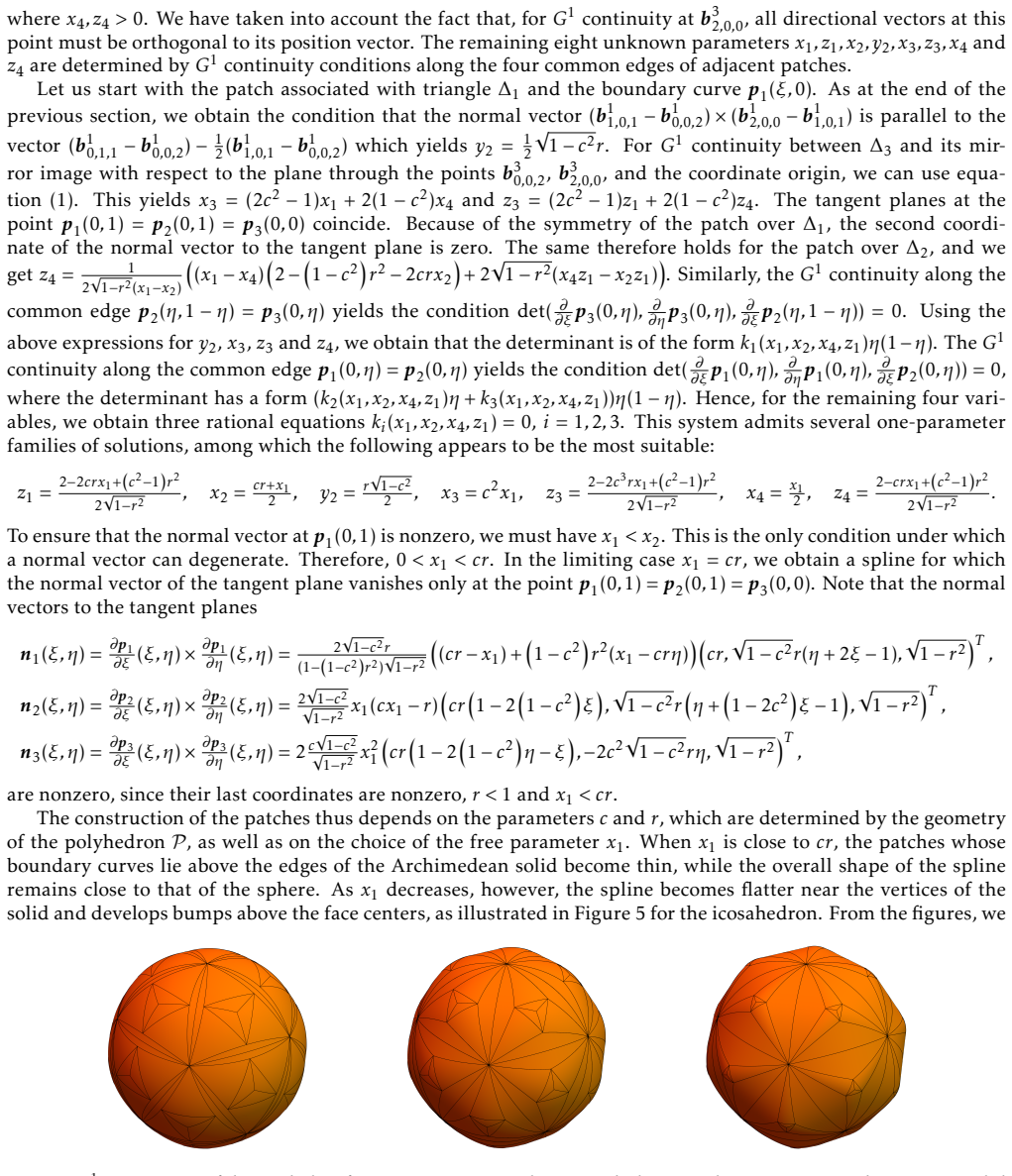
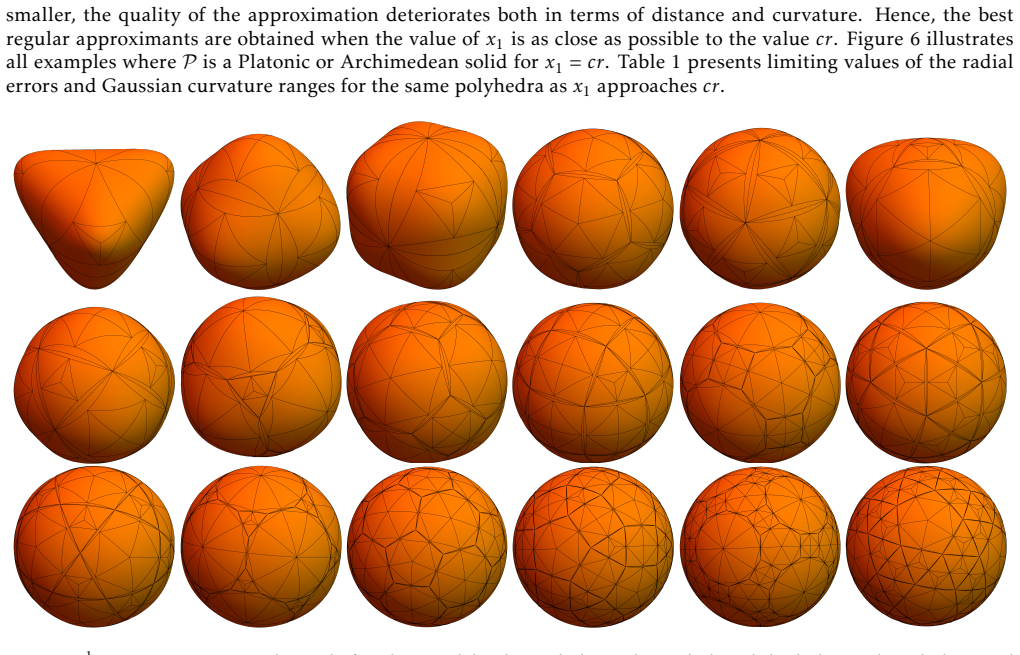
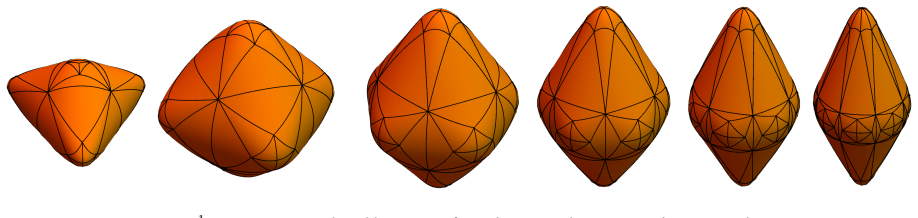
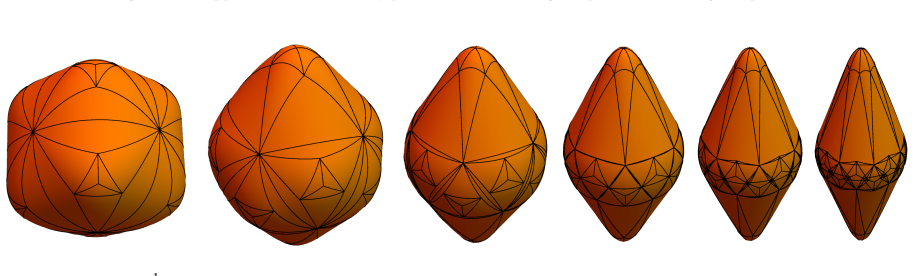
read the original abstract
In this paper, we study geometrically continuous quadratic splines over triangulations. While a rich variety of $C^1$ quadratic splines is available over planar domains, and such splines can also be constructed on the torus, the problem becomes significantly more challenging on more general surfaces. We first construct a $G^1$ spline over a regular spherical $n$-gon, subdivided into $3n$ triangles. Based on this construction, we obtain a quadratic $G^1$ spline approximation of the sphere induced by an arbitrary uniform polyhedron, where each $n$-gonal face is subdivided into $3n$ triangles. The construction uses only quadratic triangular patches and yields explicit control points depending on the geometry of the underlying polyhedron and one free parameter. We also analyze the resulting approximation quality and curvature behavior, and illustrate the construction on Platonic and Archimedean solids.
Editorial analysis
A structured set of objections, weighed in public.
Referee Report
Summary. The paper constructs quadratic G¹ splines over triangulations of the sphere induced by uniform polyhedra. For each regular spherical n-gon face subdivided into 3n triangles, it defines quadratic triangular patches with explicit control points that depend on the polyhedron geometry and a single free parameter. The local construction on one n-gon is extended to the full closed surface of Platonic and Archimedean solids, with analysis of approximation quality and curvature behavior.
Significance. If the global G¹ consistency holds, the explicit low-degree construction with a single free parameter would provide a practical spline approximation to the sphere that extends consistently across faces of differing valence. This could be useful in CAGD and finite-element methods on spherical domains. The explicit formulas and extension to Archimedean solids are positive features.
major comments (2)
- [Abstract / construction section] The central claim requires that the single free parameter simultaneously enforces G¹ matching at every edge, including those joining an n-gon to an m-gon with n ≠ m. The abstract states that control points depend on 'the geometry of the underlying polyhedron and one free parameter,' but provides no derivation showing that the cross-derivative conditions are compatible across mixed edges; this must be shown explicitly for the construction to extend to arbitrary uniform polyhedra.
- [Global extension to uniform polyhedra] The local G¹ construction on a single spherical n-gon is described, but the manuscript must verify that the boundary curves and cross-derivative vectors computed from adjacent faces coincide when the same parameter value is used on both sides. Without this verification (e.g., via explicit equations for the twist vectors), the global continuity claim remains unestablished.
minor comments (1)
- [Abstract] The abstract mentions analysis of approximation quality and curvature but does not indicate the norms or sample points used; adding a brief statement on the error measure would improve clarity.
Simulated Author's Rebuttal
We thank the referee for the careful review and for identifying the need for explicit verification of G¹ compatibility on mixed-valence edges. We address the two major comments below.
read point-by-point responses
-
Referee: [Abstract / construction section] The central claim requires that the single free parameter simultaneously enforces G¹ matching at every edge, including those joining an n-gon to an m-gon with n ≠ m. The abstract states that control points depend on 'the geometry of the underlying polyhedron and one free parameter,' but provides no derivation showing that the cross-derivative conditions are compatible across mixed edges; this must be shown explicitly for the construction to extend to arbitrary uniform polyhedra.
Authors: We agree that the manuscript lacks an explicit derivation confirming compatibility of the cross-derivative conditions for mixed n-m edges under a single shared parameter. The local per-face construction determines control points from the polyhedron geometry and one free parameter chosen to meet G¹ conditions at all edges of that face. In the revision we will add a dedicated subsection deriving the twist vectors and cross-boundary derivatives explicitly for n-m edges and proving that the same parameter value satisfies both adjacent faces. This will establish the global claim for arbitrary uniform polyhedra. revision: yes
-
Referee: [Global extension to uniform polyhedra] The local G¹ construction on a single spherical n-gon is described, but the manuscript must verify that the boundary curves and cross-derivative vectors computed from adjacent faces coincide when the same parameter value is used on both sides. Without this verification (e.g., via explicit equations for the twist vectors), the global continuity claim remains unestablished.
Authors: We will revise the manuscript to include explicit equations for the boundary curves and twist vectors computed from both sides of every edge, including mixed-valence edges. These equations will demonstrate that the vectors coincide when the single free parameter is used uniformly, thereby verifying global G¹ continuity. The verification will be presented both algebraically and through the geometric properties of the uniform polyhedra. revision: yes
Circularity Check
Explicit geometric construction with free parameter; no reduction to inputs by definition or self-citation
full rationale
The paper describes a direct construction of quadratic G¹ patches over subdivided spherical n-gons, with control points given explicitly in terms of polyhedron geometry plus one scalar. No quoted equations show the G¹ conditions or sphere approximation being solved by fitting the same parameter that is later called a prediction; the single free parameter is introduced as part of the ansatz rather than derived from a subset of the target data. No self-citations are invoked to justify uniqueness or to close a derivation loop. The central claim therefore remains a self-contained geometric recipe rather than a tautology.
Axiom & Free-Parameter Ledger
free parameters (1)
- one free parameter
axioms (1)
- domain assumption G¹ continuity conditions can be satisfied by quadratic triangular patches on a subdivided spherical n-gon
Reference graph
Works this paper leans on
-
[1]
Sphere approximation byG 1 cubic triangular LN patches.Comput
Young Joon Ahn. Sphere approximation byG 1 cubic triangular LN patches.Comput. Aided Geom. Design, 126:102537, 7, 2026
2026
-
[2]
A history of curves and surfaces in CAGD
Gerald Farin. A history of curves and surfaces in CAGD. InHandbook of computer aided geometric design, pages 1–21. North-Holland, Amsterdam, 2002
2002
-
[3]
Elsevier, Amsterdam, first edition, 2002
Gerald Farin, Josef Hoschek, and Myung-Soo Kim.Handbook of Computer Aided Geometric Design. Elsevier, Amsterdam, first edition, 2002
2002
-
[4]
John A. Gregory. Geometric continuity. InMathematical methods in computer aided geometric design (Oslo, 1988), pages 353–371. Academic Press, Boston, MA, 1989
1988
-
[5]
Jan Grošelj, Mario Kapl, Marjeta Knez, Thomas Takacs, and Vito Vitrih.C 1-smooth isogeometric spline func- tions of general degree over planar mixed meshes: the case of two quadratic mesh elements.Appl. Math. Comput., 460:Paper No. 128278, 21, 2024
2024
-
[6]
Geometric Lagrange interpolation by planar cubic Pythagorean-hodograph curves.Comput
Gašper Jaklič, Jernej Kozak, Marjeta Krajnc, Vito Vitrih, and Emil Žagar. Geometric Lagrange interpolation by planar cubic Pythagorean-hodograph curves.Comput. Aided Geom. Design, 25(9):720–728, 2008
2008
-
[7]
On geometric Lagrange interpolation by quadratic parametric patches.Comput
Gašper Jaklič, Jernej Kozak, Marjeta Krajnc, Vito Vitrih, and Emil Žagar. On geometric Lagrange interpolation by quadratic parametric patches.Comput. Aided Geom. Design, 25(6):373–384, 2008
2008
-
[8]
Hermite parametric surface interpolation based on Argyris element.Comput
Gašper Jakličand Tadej Kanduč. Hermite parametric surface interpolation based on Argyris element.Comput. Aided Geom. Design, 56:67–81, 2017
2017
-
[9]
What smooth surfaces can be constructed from total degree 2 splines? Comput
Ke ¸stutis Karčiauskas and Jörg Peters. What smooth surfaces can be constructed from total degree 2 splines? Comput. Aided Geom. Design, 119:102435, 2025
2025
-
[10]
Morgan & Claypool Publishers, [Williston], VT, 2017
Przemysław Kiciak.Geometric continuity of curves and surfaces, volume 25 ofSynthesis Lectures on Visual Com- puting. Morgan & Claypool Publishers, [Williston], VT, 2017
2017
-
[11]
Schumaker.Spline functions on triangulations, volume 110 ofEncyclopedia of Math- ematics and its Applications
Ming-Jun Lai and Larry L. Schumaker.Spline functions on triangulations, volume 110 ofEncyclopedia of Math- ematics and its Applications. Cambridge University Press, Cambridge, 2007
2007
-
[12]
On geometric interpolation of parametric surfaces.Comput
Knut Mørken. On geometric interpolation of parametric surfaces.Comput. Aided Geom. Design, 22(9):838–848, 2005
2005
-
[13]
Convolution surfaces of quadratic triangular Bézier surfaces.Comput
Martin Peternell and Boris Odehnal. Convolution surfaces of quadratic triangular Bézier surfaces.Comput. Aided Geom. Design, 25(2):116–129, 2008
2008
-
[14]
The platonic spheroids
Jörg Peters and Leif Kobbelt. The platonic spheroids. Technical Report 97-052, Dept of Computer Sciences, Purdue University, 1997
1997
-
[15]
Springer-Verlag, Berlin,
Jörg Peters and Ulrich Reif.Subdivision surfaces, volume 3 ofGeometry and Computing. Springer-Verlag, Berlin,
-
[16]
With introductory contributions by Nira Dyn and Malcolm Sabin
-
[17]
Rational parameterization of real algebraic surfaces
Josef Schicho. Rational parameterization of real algebraic surfaces. InProceedings of the 1998 International Symposium on Symbolic and Algebraic Computation (Rostock), pages 302–308. ACM, New York, 1998. 10
1998
-
[18]
Geometric approximation of the sphere by triangular polynomial spline patches.Comput
Aleš Vavpetičand Emil Žagar. Geometric approximation of the sphere by triangular polynomial spline patches.Comput. Aided Geom. Design, 92:102061, 2022
2022
-
[19]
Optimal approximation of spherical squares by tensor product quadratic bézier patches.Applied Mathematics and Computation, 457:128196, 2023
Aleš Vavpetičand Emil Žagar. Optimal approximation of spherical squares by tensor product quadratic bézier patches.Applied Mathematics and Computation, 457:128196, 2023. 11
2023
discussion (0)
Sign in with ORCID, Apple, or X to comment. Anyone can read and Pith papers without signing in.