REVIEW 3 major objections 6 minor 22 references
The influence of the bar on the chaotic dynamics of globular clusters in the central region of the Galaxy
T0 review · 3 major / 6 minor · reviewed 2026-08-11 · deepseek-v4-flash
Pith's one-line read Adding the Milky Way's bar to orbit models flips 17 of 45 inner globular clusters between regular and chaotic.
desk verdict Direct barred-vs-axisymmetric chaos comparison for 45 central GCs, but the headline 8/9 counts rest on a single threshold with no sensitivity analysis. read the letter →
The pith
A machine-rendered reading of the paper's core claim, the machinery that carries it, and where it could break.
The reading
What carries the argument
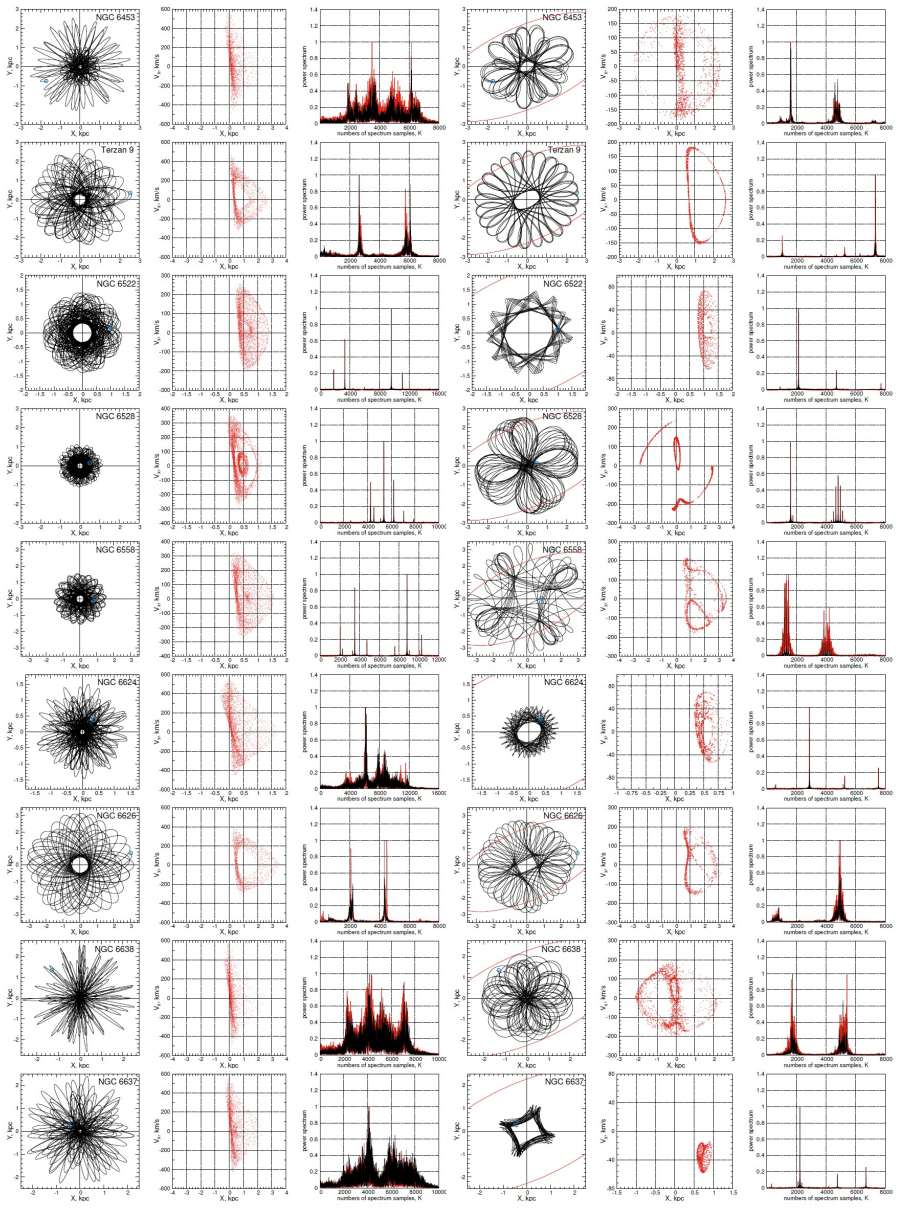
The machinery is the frequency-drift method applied to orbit integrations in a two-choice Galactic potential. The axisymmetric model is a sum of a spherical bulge, a disk, and a dark-matter halo, with parameters fit to the rotation curve; the non-axisymmetric model adds a triaxial ellipsoid bar of mass $10^{10}\,M_\odot$, semi-major axis 5 kpc, orientation $25^\circ$, and pattern speed $40$ km s$^{-1}$ kpc$^{-1}$. For each cluster the orbit is integrated for 120 Gyr, fundamental frequencies are measured over the first and second 60 Gyr halves, and the largest relative drift among the three Cartesian frequency components defines the chaos indicator $\lg(\Delta f)$. A value below $-2.14$ counts as regular and above as chaotic. This drift parameter is the quantitative handle that lets the authors compare dynamics with and without the bar.
What would settle it
Recompute the same frequency-drift classifications using observationally allowed alternative bar parameters, for example a bar with mass $5\times10^9$ or $1.5\times10^{10}\,M_\odot$, pattern speed 30 or 50 km s$^{-1}$ kpc$^{-1}$, or semi-major axis 4 or 6 kpc; if the eight regular-to-chaotic and nine chaotic-to-regular flips do not largely persist, the paper's specific list of flipped clusters is not robust. Alternatively, an independent chaos indicator such as the maximum Lyapunov exponent computed over the same 120 Gyr integrations that fails to reproduce the regular-to-chaotic classification would undermine the result.
Extended reading notes
Core claim
The central discovery is that the bar's presence flips the regular/chaotic classification for 17 of the 45 sample clusters. Eight clusters (NGC 6144, NGC 6273, NGC 6342, NGC 6355, NGC 6558, NGC 6256, NGC 6304, NGC 6388) are regular in the axisymmetric potential and become chaotic when the bar is included. Nine clusters (Terzan 4, Liller 1, NGC 6380, Terzan 5, NGC 6440, Terzan 6, Terzan 9, NGC 6624, NGC 6637) are chaotic in the axisymmetric potential and become regular in the barred one. The authors also find that the clusters most strongly affected have radially elongated orbits, with high eccentricity and small pericentric distance, and that the two independent classification methods, frequency drift and surface-of-section plots, agree on 96% of cases.
Load-bearing premise
The single adopted set of bar parameters—mass $10^{10}\,M_\odot$, semi-major axis 5 kpc, orientation $25^\circ$, pattern speed $40$ km s$^{-1}$ kpc$^{-1}$—is assumed to represent the real Milky Way bar, and the classification depends on that choice.
Editorial extensions
If this is right
- Galactic-potential models used to study inner Milky Way globular clusters should include the bar; axisymmetric-only models will misclassify a substantial fraction of clusters as regular when they are actually chaotic, or vice versa.
- The eight regular-to-chaotic clusters are the most promising candidates for ongoing bar-driven orbital heating or disruption, since their long-term dynamics become chaotic only when the bar is present.
- The nine chaotic-to-regular clusters show that the bar can also regularize orbits, so the bar's dynamical effect is not a one-way increase in chaos.
- Clusters on strongly radial orbits are the ones most likely to change status when the bar is included, which gives a selection rule for future studies of bar-affected clusters.
- The 96% agreement between the frequency-drift and surface-of-section methods supports using the frequency method as the primary classifier in barred potentials.
Reading between the lines
- A natural extension of the paper would be to vary the bar parameters (mass, length, pattern speed, orientation) and see how stable the 17 flips are; the paper adopts a single, observationally motivated set, so the robustness of individual cluster classifications to parameter changes remains untested.
- The threshold of $-2.14$ for the frequency drift is taken from a previous study; a data-driven threshold based on the distribution of drift values in this sample could shift borderline cases such as Terzan 3 and NGC 6316.
- The 120 Gyr integrations probe very long-term dynamics; at integration times closer to a Hubble time, some of the weakly chaotic classifications might differ, so the labels are best read as statements about asymptotic orbital behavior.
- One could connect the regular-to-chaotic list to direct observables such as cluster mass, tidal radius, or internal structure to test whether bar-induced chaos correlates with the clusters most likely to be disrupted.
Editorial analysis
A structured set of objections, weighed in public.
Referee Report
Summary. The paper investigates the orbital dynamics of 45 globular clusters (GCs) in the central 3.5 kpc of the Milky Way, comparing motions in an axisymmetric potential with motions in a potential that includes a triaxial rotating bar. Using Gaia EDR3 astrometry and updated distances, the authors integrate orbits over 120 Gyr and classify each orbit as regular (R) or chaotic (C) with a frequency-drift method (Eq. 6) and with Poincare sections as a cross-check. The central claim is that adding the bar changes the dynamical state of a large fraction of the sample: 8 GCs switch from regular to chaotic (R→C) and 9 switch from chaotic to regular (C→R), as listed in Table 2. The paper also reports a 96% agreement between the two classification methods.
Significance. If the headline transition counts are robust, the result provides a quantitative, sample-wide statement about the bar's role in driving chaos among central globular clusters, which is relevant to cluster survival and to the dynamical modeling of the Galactic bar. The paper is a reasonable continuation of the authors' earlier work and the numerical setup is described in sufficient detail to be reproduced. The main weakness is that the central claim rests on a single hard threshold with no quoted uncertainty, two manual overrides that are not justified quantitatively, and a single adopted set of bar parameters. Consequently, the exact counts of R→C and C→R transitions are not yet established at the claimed level of precision, although the qualitative conclusion that the bar influences the chaoticity of many clusters is likely to survive a more careful analysis.
major comments (3)
- [Section 4, Table 2] The headline counts of 8 R→C and 9 C→R transitions are determined by applying the hard threshold lg(Δf) = -2.14 to the frequency-drift statistic, but no uncertainty is assigned to the drift values and no sensitivity analysis is presented. Several classifications in Table 2 are within 0.2 dex of the threshold (e.g., NGC 6144 at -2.08, NGC 6256 at -1.93, NGC 6342 at exactly -2.14, NGC 6558 at -1.03, NGC 6304 at -1.38), so a small shift in the threshold or a slightly different integration setup would change the status of one or more of the 17 claimed flips. I request a table or figure showing how the R→C and C→R counts vary with the threshold over, say, -2.4 to -1.8, and a propagation of meaningful uncertainties (e.g., from initial conditions or the choice of time windows) into the drift statistic.
- [Section 4] The classification rule is not applied uniformly because Terzan 3 and NGC 6316, with lg(Δf) ≈ -2 in the barred potential, are manually reclassified as regular based on visual inspection of power spectra, and this override is inherited from the authors' previous work [7]. Since these two objects lie above the stated threshold, the decision is not reproducible from the quantitative criterion alone. At minimum, the override should be justified with a documented, quantitative rule (e.g., a criterion based on power-spectrum peak structure), and the final counts should be reported both with and without the overrides to demonstrate that the main result does not depend on these two cases.
- [Sections 1.2 and 4] The bar model parameters (mass 10^10 Msun, semi-major axis 5 kpc, orientation 25 deg, pattern speed 40 km/s/kpc) are adopted as a single 'most realistic' set without testing alternatives. The resonant structure that drives frequency drift depends on these parameters, so the classification of individual clusters—and hence the aggregate transition counts—could change for a shorter, weaker, or faster/slower bar. I request at least a limited parameter scan (e.g., qb in 4–6 kpc, Omega_b in 30–50 km/s/kpc) or, failing that, an explicit statement that the conclusions are conditional on this particular bar model.
minor comments (6)
- [Section 3.2, Eq. (6)] The sentence 'the largest value of these three frequency drift parameters lg(∆ fx) is assigned' contains an apparent typo; it should refer to the largest of lg(∆fx), lg(∆fy), lg(∆fz), i.e., the drift parameter lg(∆f).
- [Table 2 caption] The symbols C↑ and C↓ in the final column are used even for objects whose R/C status remains the same (e.g., NGC 6528 labeled C↓, Terzan 3 labeled C↑). Please define explicitly in the caption that these symbols denote a change in the drift value without a change in the R/C classification.
- [Section 3.2] The arbitrary assignment of -4.0 for exactly coincident frequencies and the choice of two 60 Gyr windows are not tested for their influence on the classification; a brief robustness statement (e.g., comparing 40+40 or 80+80 Gyr windows for a few representative clusters) would strengthen confidence in the results.
- [Table 1 caption] The caption reads 'parameters jf the galactic potential model'; 'jf' should be 'of'.
- [Section 4, list of R→C clusters] In the list of R→C clusters, 'Ngc 6273' should be 'NGC 6273'.
- [Reference [25]] The title of reference [25] contains 'barionic condensation'; it should be 'baryonic condensation'.
Circularity Check
Status flips are real orbital-integration outputs, but the exact 8/9 counts are set by a chaos threshold and two manual exceptions imported from the authors' own prior paper [7], making the headline numbers partially self-referential.
-
self citation load bearing
[Section 4, 'The decision ...' paragraph and Table 2, column 8]
"The decision on the nature of the motion (regular (R) or chaotic (C)) when using the frequency method was made in accordance with the recommendations set out in [7] (only with a threshold value of the frequency drift parameter equal to −2.14). A smaller value than −2.14 corresponds to regular orbits, a larger value corresponds to chaotic ones, with the exception of two GCs: Terzan 3 and NGC 6316, for which lg(∆ f ) ≈ −2, which are classified according to the results of visual analysis of the power spectra (Fig. 2) as GCs with regular orbits, although they show a weak degree of chaos."
The central Table 2 counts (8 R→C, 9 C→R) are produced by a fixed cut lg(Δf) = −2.14 plus two manual overrides whose authority is the authors' own previous paper [7] on the same 45 clusters in the same barred potential. The cut is not re-derived or sensitivity-tested here; several R→C entries lie within ~0.2 dex of it, NGC 6342 sits exactly at it, and Terzan 3 (−1.89) and NGC 6316 (−1.96) are called regular only by the exception 'also done in [7]'. Uniformly applying the stated rule, or slightly shifting the cut, would change the headline numbers. Thus part of the claimed bar influence restates previously fixed labels, although the newly computed axisymmetric drifts and drift differences are independent content.
full rationale
Most of the computation is self-contained: 6D phase-space data come from Gaia-derived catalogs, orbits are integrated in two explicit potentials, frequency drifts are computed from the integrations, and Table 2 reports the actual lg(Δf) values for both potentials. The axisymmetric classifications (mostly -4.00 by the artificial coincidence convention) and the drift differences are new and are not dictated by the authors' previous work. The main circular element is the decision rule: the cut -2.14 and the two exceptions are imported from the authors' own [7], and the reported '96% correlation' with Poincare sections is said to coincide with [7], so it is partly a calibration check rather than an independent validation. This makes the exact 8/9 counts self-referential at the margin, but it does not reduce the entire derivation to its inputs. Bar parameters are adopted from the external literature, not from the target result; no fitted parameter is renamed as a prediction. The score of 3 reflects a load-bearing self-citation/threshold effect while acknowledging the independent orbital-integration content.
Assumptions & free parameters
free parameters (6)
- Bar mass Mbar =
430 Mgal = 10^10 Msun
- Bar pattern speed Omega_b =
40 km/s/kpc
- Bar semi-major axis qb =
5 kpc
- Bar orientation angle theta_b =
25 deg
- Axisymmetric potential parameters (Mb, Md, Mh, bb, ad, bd, ah) =
Mb=443, Md=2798, Mh=12474 Mgal; bb=0.2672, ad=4.40, bd=0.3084, ah=7.7 kpc
- Chaos threshold lg(delta f) =
-2.14
assumptions (3)
- domain assumption The Milky Way potential is adequately represented by the sum of a Miyamoto-Nagai disk, a spherical bulge, an NFW halo, and a triaxial ellipsoid bar with the adopted parameters.
- domain assumption The drift of fundamental frequencies between two halves of the orbit is a reliable chaos indicator, and the threshold -2.14 separates regular from chaotic orbits.
- domain assumption The 45 selected globular clusters, chosen by the geometric criterion that their apocentric distance in the axisymmetric potential is less than 3.5 kpc, are representative of the bulge/bar region.
Cite this review
Pith. "Pith review of The influence of the bar on the chaotic dynamics of globular clusters in the central region of the Galaxy." pith.science (2026). https://pith.science/paper/WNKY3CXW
@misc{pith2026241202426,
  author       = {Pith},
  title        = {Pith review of: The influence of the bar on the chaotic dynamics of globular clusters in the central region of the Galaxy},
  year         = {2026},
  howpublished = {\url{https://pith.science/paper/WNKY3CXW}},
  note         = {Machine review of arXiv:2412.02426}
}
abstract
The paper is devoted to the analysis of the influence of the galactic bar on the nature of the orbital motion (chaotic or regular) of globular clusters in the central region of the Galaxy with a radius of 3.5 kpc, which are subject to the greatest influence of the bar. The sample includes 45 globular clusters. To form the 6D phase space required for integrating the orbits, the most accurate astrometric data to date from the Gaia satellite (Vasiliev, Baumgardt, 2021) were used, as well as new refined average distances (Baumgardt, Vasiliev, 2021). The orbits of the globular clusters were obtained both in an axisymmetric potential and in a potential including the bar. The following, most realistic, bar parameters were adopted: mass $10^{10} M_\odot$, semi-major axis length 5 kpc, bar axis rotation angle 25$^o$, angular rotation velocity 40 km s$^{-1}$ kpc$^{-1}$. The analysis of the chaoticity/regularity of the orbital motion in both potentials was carried out using one of the most effective methods, namely, the frequency method, which consists in calculating the drift of fundamental frequencies. As a result, the influence of the bar on the dynamics of each GC of the sample was assessed. It is established that 8 GCs changed regular dynamics to chaotic under the influence of the bar, and 9 GCs changed chaotic dynamics to regular one.
Figures


Figures from the paper (3 more)


Reference graph
Works this paper leans on
-
[7]
A. T. Bajkova, A. A. Smirnov, and V. V. Bobylev. Analysis of regularity/chaoticity of the globular clusters dynamics on the central region of the Milky Way. // Publications of the Pulkovo Observatory 233, P. 1–28 (2024) DOI:10.31725/0367-7966-2024-233-1-28, arXiv: 2406.15590
work page Pith review arXiv 2024
-
[4]
A .A. Smirnov, A. T. Bajkova, V. V. Bobylev. Globular clusters captured by the Milky Way’s bar. // Publications of the Pulkovo Observatory 228, P. 157–165 (2023) DOI:10.31725/0367-7966- 2023-228-12
-
[5]
A. T. Bajkova, A. A. Smirnov, and V. V. Bobylev.The Influence of the Bar on the Dynamics of Globular Clusters in the Central Region of the Milky Way. Frequency Analysis of Orbits According to Gaia EDR3 Data. // Astrophysical Bulletin 78, Issue 4, P. 499–513 (2023), arXiv: 2311.14789
work page Pith review arXiv 2023
-
[6]
A. A. Smirnov, A. T. Bajkova, V. V. Bobylev. Globular clusters and bar: captured or not captured? // Monthly Notices of the Royal Astronomical Society 528, Issue 2, P. 1422–1437 (2024), arXiv: 2310.18172
work page Pith review arXiv 2024
-
[8]
E. Vasiliev, H. Baumgardt. Gaia EDR3 view on galactic globular clusters. // Monthly Notices of the Royal Astronomical Society 505, Issue 4, P. 5978–6002 (2021), arXiv: 2102.09568
arXiv 2021
-
[9]
H. Baumgardt, E. Vasiliev. Accurate distances to Galactic globular clusters through a com- bination of Gaia EDR3, HST, and literature data. // Monthly Notices of the Royal Astronomical Society 505, Issue 4, P. 5957–977 (2021), arXiv: 2105.09526. 13
arXiv 2021
- [10]
-
[11]
J. L. Sanders, L. Smith, N. W. Evans, P. Lucas. Transverse kinematics of the Galactic bar-bulge from VVV and Gaia. // Monthly Notices of the Royal Astronomical Society 487, Issue 4, P. 5188–5298 (2019), arXiv: 1903.02008
work page Pith review arXiv 2019
Show all 22 references
-
[12]
R. E. G. Machado, T. Manos. Chaotic motion and the evolution of morphological compo- nents in a time-dependent model of a barred galaxy within a dark matter halo. // Monthly Notices of the Royal Astronomical Society 458, Issue 4, P. 3578–3591 (2016), arXiv: 1603.02294
2016 arXiv
-
[13]
Miyamoto, R
M. Miyamoto, R. Nagai. Three-dimensional models for the distribution of mass in galaxies. // Publications of the Astronomical Society of Japan 27, P. 533–543 (1975)
1975
-
[14]
J. F. Navarro, C. S. Frenk, S. D. M. White. A Universal Density Profile from Hierarchical Clustering. // Astrophysical Journal 490, Issue 2, P. 493=-508 (1997), arXiv: astr-ph/9611107
1997
-
[15]
A. T. Bajkova, V. V. Bobylev. Rotation curve and mass distribution in the Galaxy from the velocities of objects at distances up to 200 kpc. // Astronomy Letters 42, Issue 9, P. 567–582 (2016), arXiv: 1607.08050
2016 arXiv
-
[16]
Bhattacharjee, S
P. Bhattacharjee, S. Chaudhury, S. Kundu. Rotation Curve of the Milky Way out to 200 kpc. // Astrophysical Journal 785, Issue 1, id.63, 13 pp. (2014), arXiv: 1310.2659
2014 arXiv
-
[17]
Bajkova, V
A. Bajkova, V. Bobylev. Parameters of Six Selected Galactic Potential Models. // Open Astronomy 26, Issue 1, P. 72–79 (2017), arXiv: 1801.08875
2017 arXiv
-
[18]
Sch¨ onrich, J
R. Sch¨ onrich, J. Binney, W. Dehnen. Local kinematics and the local standard of rest. // Monthly Notices of the Royal Astronomical Society 403, Issue 4, P. 1829–1833 (2010), arXiv: 0912.3693
2010 arXiv
-
[19]
V. V. Bobylev, A. T. Bajkova. Analysis of the Z distribution of young objects in the Galactic thin disk. // Astronomy Letters 42, Issue 1, P. 1–9 (2016), arXiv: 1511.08438
2016 arXiv
-
[20]
Vasiliev
E. Vasiliev. Proper motions and dynamics of the Milky Way globular cluster system from Gaia DR2. // Monthly Notices of the Royal Astronomical Society 484, Issue 2, P. 2832–2850 (2019), arXiv: 1807.09775
2019 arXiv
-
[21]
Massari, H
D. Massari, H. H. Koppelman, A. Helmi. Origin of the system of globular clusters in the Milky Way. // Astronomy and Astrophysics 630, P. L4, 8 pp. (2019), arXiv: 1906.08271
2019 arXiv
-
[22]
A. T. Bajkova, G. Carraro, V. I. Korchagin, N. O. Budanova, V. V. Bobylev. Milky Way Subsystems from Globular Cluster Kinematics Using Gaia DR2 and HST Data. // Astrophysical Journal 895, Issue 1, id.69, 18 pp. (2020), arXiv: 2004.13597
2020 arXiv
-
[23]
Morbidelli
A. Morbidelli. // Modern Celestial Mechanics. Aspects of Solar System Dynamics. London and New York, 432 pp. (2014)
2014
-
[24]
Nieuwmunster, M
N. Nieuwmunster, M. Schultheis, M. Sormani, F. Fragkoudi, F. Nogueras-Lara, R. Schodel, P. McMillan. Orbital analysis of stars in the nuclear stellar disc of the Milky Way. // Astronomy & Astrophysics 685, id.A93, 19 pp. (2024), arXiv: 2403.00761
2024 arXiv
-
[25]
Valluri, V
M. Valluri, V. P. Debattista, T. Quinn, B. Moore. The orbital evolution induced by barionic condensation in triaxial halos. // Monthly Notices of the Royal Astronomical Society 403, Issue 1, P. 525–544 (2010), arXiv: 0906.4784. 14 Table 2: The influence of the bar on the dynam...
2010 arXiv
Reviewed August 11, 2026 · model on record in the stance chip above.
Discussion (0). Continue with ORCID to comment.