REVIEW 4 major objections 4 minor 1 cited by
On the structure of normalized models of circular-arc graphs -- Hsu's approach revisited
T0 review · 4 major / 4 minor · reviewed 2026-08-12 · deepseek-v4-flash
Pith's one-line read This paper proves that every circular-arc graph has a canonical string representation computable in linear time, which yields a linear-time isomorphism test.
desk verdict A serious, likely-correct resolution of a 40-year-open problem, but the written proof has load-bearing gaps that need a full referee pass. read the letter →
The pith
A machine-rendered reading of the paper's core claim, the machinery that carries it, and where it could break.
The reading
What carries the argument
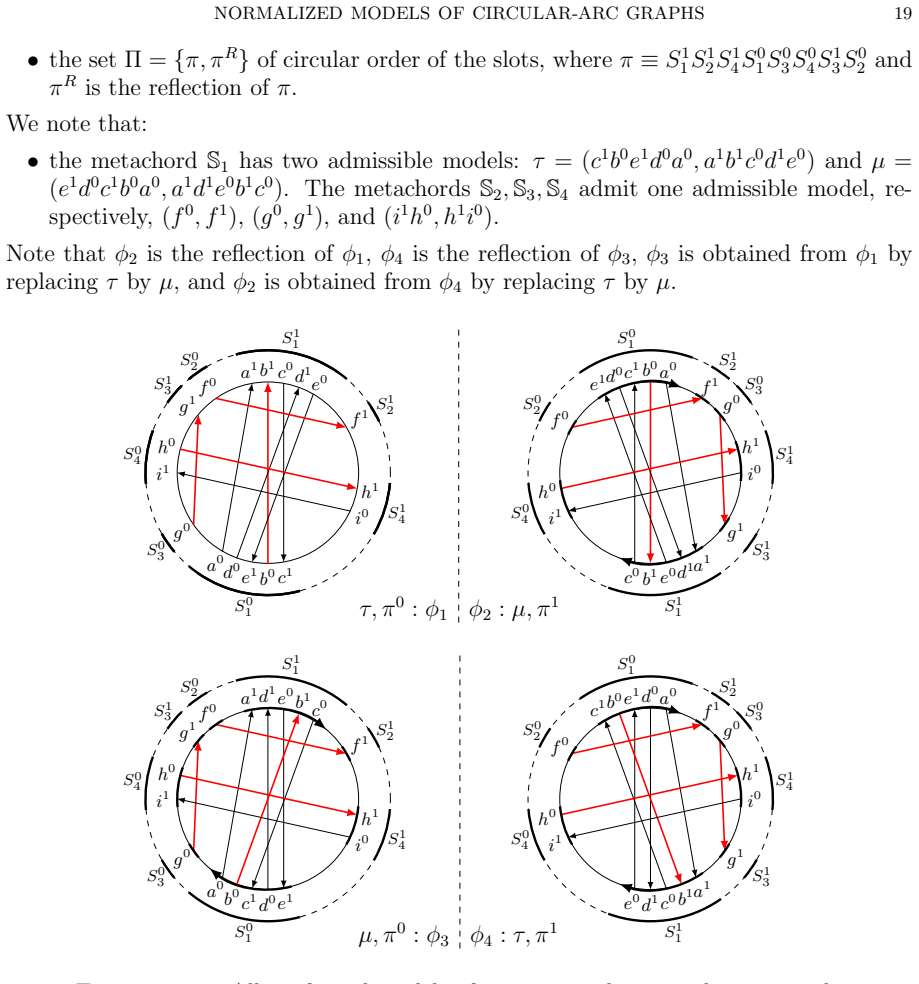
The PQSM-tree is a linear-size ordered tree representation of all conformal chord models of the overlap graph: S-nodes are endpoint slots, Q-nodes are connected components, P-nodes are regions of the circular drawing, and M-nodes come from modular decomposition trees of the CA-modules that serve as metachords. The important property is that every conformal model is obtained by choosing one circular order of slots allowed by the tree and then replacing each slot with an admissible permutation of its vertices; Theorem 6.2 states exactly this equivalence. It is the object that makes the structural description algorithmic, since canonization reduces to canonically ordering the PQM-nodes level by level.
What would settle it
Enumerate, for all connected circular-arc graphs with no twins and no universal vertices up to, say, ten vertices, all conformal models of their overlap graphs; if any prime induced subgraph has three non-equivalent conformal models, Lemma 8.4 fails. A more direct check is to implement the PQSM-tree construction and compare the set of models it generates with brute-force enumeration for random instances: any conformal word that is not admissible by the tree would refute Theorem 6.2.
Extended reading notes
Core claim
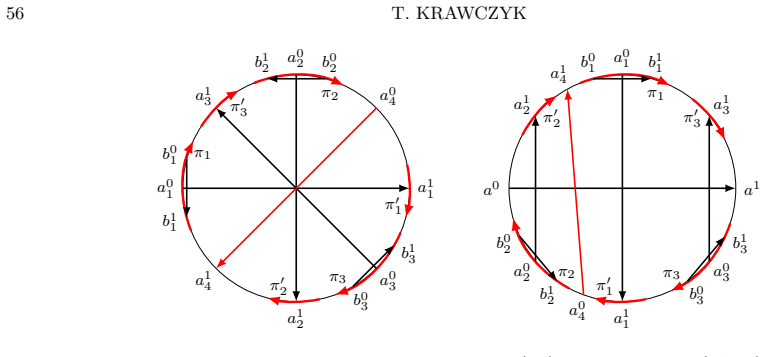
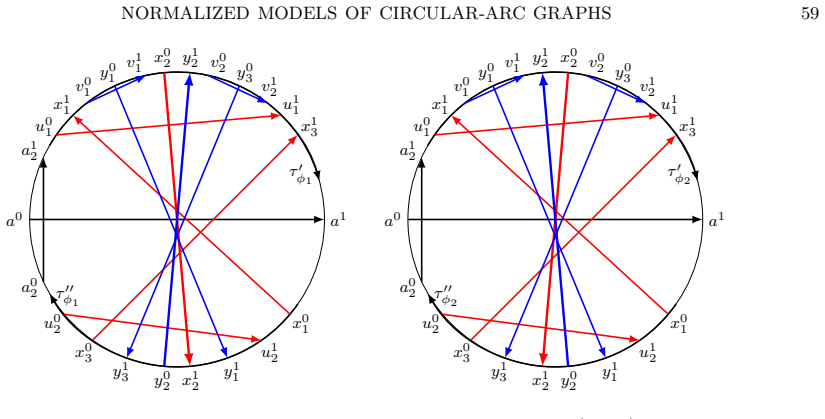
On the paper's own terms, the central discovery is a characterization theorem: after converting normalized arc models into oriented chord models, normalized models of G correspond one-to-one with conformal models of the overlap graph Gov (Theorem 3.3), and a circular word is a conformal model precisely when it is admissible for the quadruple DS=(S,S*,MC,Π), represented compactly as the PQSM-tree (Theorem 6.2). The proof splits according to whether the root of the modular decomposition is serial, prime, or parallel, and handles both prime and serial components uniformly through CA-modules and metachords. From this structural theorem the paper derives Theorem 1.2: the canonization problem for circular-arc graphs can be solved in linear time, and hence the isomorphism problem for this class is also linear-time.
Load-bearing premise
The whole construction depends on the uniqueness lemma that every prime induced subgraph of the overlap graph has exactly two conformal models, one being the reflection of the other; if any prime piece had a third conformal model, the induction behind the PQSM-tree would miss models and the linear-time canonization would collapse.
Editorial extensions
If this is right
- If the central theorems are right, circular-arc graph isomorphism is decidable in linear time because two graphs are isomorphic exactly when their canonical strings are equal.
- The PQSM-tree is a complete registry of normalized models, so every structural operation on models—reflections of Q-nodes, permutations of P-nodes, and replacements of admissible metachord models—stays inside the described class.
- The linear-time bound covers the full class, not just proper, Helly, or co-bipartite circular-arc graphs, because universal vertices and twins are stripped into a separate representation (G,m,u).
- The construction algorithm for the PQSM-tree starts from a normalized model supplied by circular-arc recognition, so the canonization pipeline is compatible with existing linear-time recognition.
Reading between the lines
- A concrete test the paper leaves implicit: implement the PQSM-tree on the known counterexample graphs from earlier work on circular-arc isomorphism and check that the tree reproduces all normalized models, which would validate the corrected structural claim directly.
- Because canonization is organized as level-wise canonical forms of PQM-nodes, the same framework should adapt to other geometric graph classes whose models are described by modular-decomposition-style trees, such as circle graphs or permutation graphs, although the paper does not claim this.
- The paper's operational description of how conformal models transform into one another gives, as a byproduct, a way to count or uniformly sample normalized models of a circular-arc graph in polynomial time; the paper only uses the description for canonization.
Editorial analysis
A structured set of objections, weighed in public.
Referee Report
Summary. The paper claims a complete structural description of all normalized intersection models of a circular-arc graph, encoded in a new data structure called a PQSM-tree. It further claims that the PQSM-tree can be built in linear time, yielding a linear-time canonization algorithm and hence a linear-time isomorphism test for circular-arc graphs. The approach follows Hsu's 1995 strategy but replaces non-oriented chords with oriented chords, and reduces normalized models of the circular-arc graph to conformal models of its overlap graph. The main structural theorem (Theorem 6.2) is split into serial, prime, and parallel cases; the prime case rests on a long induction over split decompositions, culminating in Lemma 8.4, which asserts that every prime induced subgraph of the overlap graph has exactly two conformal models, one the reflection of the other.
Significance. If the main results are correct, they resolve a long-standing open problem: circular-arc graph isomorphism in linear time. The paper contains no fitted parameters and no circular argumentation: the positive proof builds on external theorems (Gabor-Supowit-Hsu, Chaplick-Fulek-Klavik, McConnell, Gallai) rather than on the claims being proved. The proposed PQSM-tree is a substantial and plausible generalization of PQ-trees, and the reframing using oriented chords is a genuine improvement over Hsu's setup. However, the correctness of the central structure theorem depends critically on Lemma 8.4, and the proof of that lemma as written has gaps in the induction and in one case of the maximal-split argument. Because Theorem 1.2 and the linear-time algorithm inherit those gaps, the contribution is not yet fully established.
major comments (4)
- [Section 8 (Lemma 8.4 and Claim 8.6)] The induction in Lemma 8.4 is not justified by the stated lemma. Lemma 8.4 is formulated for a graph (U,∼) consisting of one vertex from each child of a prime component Q of the overlap graph. In the proof of Claim 8.6, the induction hypothesis is applied to arbitrary prime induced subgraphs (P,∼) of (U,∼), such as (P\{z},∼), which need not be of the form 'one representative from each child of a prime component'. Either Lemma 8.4 must be stated and proved for every prime induced subgraph of the overlap graph, or an additional argument must show that each probe graph has exactly the form covered by the induction hypothesis. Without this, the induction step for the case Z=∅ and for the prime subgraph in the case Z={z} is unsupported.
- [Section 8 (Condition (*) fails, around equation (8.6.3))] The treatment of the case where Condition (*) fails relies on a tie-breaking rule for the maximal-split algorithm: the text says 'in each step, having the choice of extending (A,B) into a non-trivial or a trivial split, the algorithm always takes the first option', and later uses this rule to rule out the possibility M1=∅. This rule is not a well-defined deterministic tie-breaker when there are multiple non-trivial extensions, and no proof is given that the 'second option' mentioned in the contradiction is the unique non-trivial alternative. If the maximal-split algorithm admits alternative executions, the contradiction is not established. This is a load-bearing point: a missed configuration in this subcase would allow more than two conformal models of a prime overlap graph, invalidating the prime-case characterization.
- [Section 6 (sufficiency direction of Theorem 6.2)] The sufficiency proof of the central equivalence is left almost entirely to the reader: after describing the allowed transformations, the text says 'We leave the reader to check that all those transformations keep the left/right relation between non-intersecting chords'. This check is not a formality, because transformations of the first type operate inside CA-modules while transformations of the second type permute or reflect slots at the PQS-tree level, and one must verify that the two operations interact correctly for all pairs of non-intersecting chords, including chords that belong to different CA-modules or different components. A complete verification is required for Theorem 6.2 to support the canonization claim.
- [Section 10 (linear-time construction of CA-modules)] The linear-time algorithm for constructing the PQSM-tree contains two 'we leave it to the reader' steps: verifying that the set S of CA-modules can be computed using Property (R), and checking that the bottom-up computed sets S(M) comprise all CA-modules contained in M. Since the linear-time bound and the correctness of the data structure both depend on this step, these claims need a proof rather than a reader exercise. In particular, the assertion that each module in M(Gov) can be processed in time linear in the number of its children is plausible but not demonstrated; the computation of S(M) for serial, parallel, and prime cases must be specified in enough detail to rule out hidden superlinear behavior.
minor comments (4)
- [Throughout] The text uses the symbol 'integerdivide' in many places where set difference (\\setminus) is clearly intended, e.g., 'V /integerdivide X' and 'Q /integerdivide Mi'. This should be fixed in the final typeset version.
- [Abstract and Introduction] The abstract and the introduction contain nearly identical sentences about errors in Hsu's decomposition trees pointed out in [18]; consider unifying these two passages to avoid repetition.
- [Section 1] The footnote about the author's earlier arXiv paper [17] and publishing difficulties is not relevant to the technical content and could be removed or moved to an acknowledgements section.
- [Section 2] In the definition of normalized models, the paper refers to [25,14] for the fact that every circular-arc model without twins and universal vertices can be normalized; the provided text does not show the bibliography, so the reader cannot easily verify these references. Please ensure all cited works are included.
Circularity Check
No significant circularity: the derivation is self-contained and the only self-citation is not load-bearing.
full rationale
The paper does not fit any parameters and its central claims are not equivalent to their inputs. The normalized-model/conformal-model correspondence (Theorem 3.3) is a definitional encoding: “conformal” is defined by the same left/right partition that defines normalized models, so the equivalence holds by construction, but this bridge is not the paper’s advertised prediction and no subsequent theorem reduces to it. Theorem 6.2, the structural characterization, is proved by a case analysis over the modular decomposition of the overlap graph (serial/prime/parallel), whose key lemma is Lemma 8.4, proved by induction using external split-decomposition theorems of Gabor-Supowit-Hsu and Chaplick-Fulek-Klavik, together with the paper’s own probe argument. The only author self-citation, reference [18], is used to document failures of Hsu’s construction and does not carry a load-bearing positive premise. The linear-time canonization algorithm is obtained from combinatorial definitions of CA-modules, metachords, and PQS/PQSM-trees, with no fitted parameter renamed as a prediction. Any concerns about the induction in Lemma 8.4, the use of probes, or the tie-breaking rule in the maximal-split algorithm are correctness risks, not circularity.
Assumptions & free parameters
assumptions (7)
- domain assumption Standard word RAM with words of length O(log n), arithmetic and bitwise operations in constant time.
- domain assumption G has no universal vertices and no twins; every circular-arc graph can be reduced to this case by grouping twins (Claims 11.1 and 11.2).
- standard math Claim 2.6: if x is adjacent to all of U, any chord model of a circle graph restricts to x tau x tau' with (tau, tau') a permutation model of U.
- standard math Theorem 8.1 (Gabor-Supowit-Hsu): a connected circle graph without non-trivial splits has exactly two chord models up to reflection.
- standard math Theorems 8.2 and 8.3 (Chaplick-Fulek-Klavik): structure of chord models relative to maximal splits.
- domain assumption Linear-time recognition algorithm of McConnell [21] returns a normalized circular-arc model on yes-instances.
- domain assumption Linear-time modular decomposition algorithm of McConnell and Spinrad [22] exists.
Cite this review
Pith. "Pith review of On the structure of normalized models of circular-arc graphs -- Hsu's approach revisited." pith.science (2026). https://pith.science/paper/WO2Q75TQ
@misc{pith2026241113374,
  author       = {Pith},
  title        = {Pith review of: On the structure of normalized models of circular-arc graphs -- Hsu's approach revisited},
  year         = {2026},
  howpublished = {\url{https://pith.science/paper/WO2Q75TQ}},
  note         = {Machine review of arXiv:2411.13374}
}
abstract
Circular-arc graphs are the intersection graphs of arcs of a circle. The main result of this work describes the structure of all \emph{normalized intersection models} of circular-arc graphs. Normalized models of a circular-arc graph reflect the neighborhood relation between its vertices and can be seen as its canonical representations; in particular, any intersection model can be made normalized by possibly extending some of its arcs. We~devise a data-structure, called \emph{PQM-tree}, that maintains the set of all normalized models of a circular-arc graph. We show that the PQM-tree of a circular-arc graph can be computed in linear time. Finally, basing on PQM-trees, we provide a linear-time algorithm for the canonization and the isomorphism problem for circular-arc graphs. We describe the structure of the normalized models of circular-arc graphs using an approach proposed by Hsu~[\emph{SIAM J. Comput. 24(3), 411--439, (1995)}]. In the aforementioned work, Hsu claimed the construction of decomposition trees representing the set of all normalized intersection models of circular-arc graphs and an $\mathcal{O}(nm)$ time isomorphism algorithm for this class of graphs. However, the counterexample given in~[\emph{Discrete Math. Theor. Comput. Sci., 15(1), 157--182, 2013}] shows that Hsu's isomorphism algorithm is incorrect. Also, in a companion paper we show that the decomposition trees proposed by Hsu are not constructed correctly; in particular, we showed that there are circular-arc graphs whose all normalized models do not follow the description given by Hsu.
Figures


Figures from the paper (56 more)







Forward citations
Cited by 1 Pith paper
-
Comments on "$\mathcal{O}(m\cdot n)$ algorithms for the recognition and isomorphism problems on circular-arc graphs"
Hsu's 1995 decomposition trees for circular-arc graphs do not correctly describe all normalized intersection models, and the paper supplies counterexamples.
Reference graph
Works this paper leans on
-
[1]
Aho, John E
Alfred V. Aho, John E. Hopcroft, and Jeffrey D. Ullman. The Design and Analysis of Computer Algorithms. Addison-Wesley, 1974
1974
-
[2]
Graph isomorphism in quasipolynomial time [extende d abstract]
L´ aszl´ o Babai. Graph isomorphism in quasipolynomial time [extende d abstract]. In Proceedings of the 48th Annual ACM SIGACT Symposium on Theory of Computing, STOC 2016, Cambridge, MA, USA, June 18-21, 2016 , pages 684–697. ACM, 2016
work page 2016
-
[3]
Kellogg S. Booth. Lexicographically least circular substrings. Inf. Process. Lett. , 10(4/5):240–242, 1980
work page 1980
-
[4]
Booth and George S
Kellogg S. Booth and George S. Lueker. Testing for the consecu tive ones property, interval graphs, and graph planarity using pq-tree algorithms. J. Comput. Syst. Sci. , 13(3):335–379, 1976
1976
-
[5]
Deciding circular-arc graph isomorphism in para meterized logspace
Maurice Chandoo. Deciding circular-arc graph isomorphism in para meterized logspace. In 33rd Sym- posium on Theoretical Aspects of Computer Science, STACS 20 16, February 17-20, 2016, Orl´ eans, France, volume 47 of LIPIcs, pages 26:1–26:13. Schloss Dagstuhl - Leibniz-Zentrum f¨ ur Info rmatik, 2016
work page 2016
-
[6]
Extending pa rtial representations of circle graphs
Steven Chaplick, Radoslav Fulek, and Pavel Klav ´ ık. Extending pa rtial representations of circle graphs. J. Graph Theory , 91(4):365–394, 2019
work page 2019
-
[7]
William H. Cunningham. Decomposition of directed graphs. SIAM J. Algebraic Discrete Methods , 3(2):214–228, 1982
work page 1982
-
[8]
Curtis, Min Chih Lin, Ross M
Andrew R. Curtis, Min Chih Lin, Ross M. McConnell, Yahav Nussbaum , Francisco J. Soulignac, Jeremy P. Spinrad, and Jayme Luiz Szwarcfiter. Isomorphism of gr aph classes related to the circular- ones property. Discret. Math. Theor. Comput. Sci. , 15(1):157–182, 2013
2013
Show all 28 references
-
[9]
Ben Dushnik and E. W. Miller. Partially ordered sets. Amer. J. Math. , 63:600–610, 1941
1941
-
[10]
Circular-arc graph recognition and related problems
Elaine Eschen. Circular-arc graph recognition and related problems . ProQuest LLC, Ann Arbor, MI,
-
[11]
Gabor, Kenneth J
Csaba P. Gabor, Kenneth J. Supowit, and Wen-Lian Hsu. Recog nizing circle graphs in polynomial time. J. ACM , 36(3):435–473, 1989
1989
-
[12]
Transitiv orientierbare Graphen
Tibor Gallai. Transitiv orientierbare Graphen. Acta Math. Acad. Sci. Hung. , 18(1–2):25–66, 1967. 84 T. KRA WCZYK
1967
-
[13]
Garey, David S
Michael R. Garey, David S. Johnson, Gerald L. Miller, and Christo s H. Papadimitriou. The com- plexity of coloring circular arcs and chords. SIAM J. Algebraic Discret. Methods , 1(2):216–227, 1980
1980
-
[14]
O(m*n) algorithms for the recognition and isomor phism problems on circular-arc graphs
Wen-Lian Hsu. O(m*n) algorithms for the recognition and isomor phism problems on circular-arc graphs. SIAM J. Comput. , 24(3):411–439, 1995
1995
-
[15]
Circle graph isomorp hism in almost linear time
V ´ ıt Kalisz, Pavel Klav ´ ık, and Peter Zeman. Circle graph isomorp hism in almost linear time. In Theory and Applications of Models of Computation - 17th Annu al Conference, TAMC 2022, Tianjin, China, September 16-18, 2022, Proceedings , volume 13571 of Lecture Notes in Com...
2022
-
[16]
On the isomorphism problem for Helly circular-arc graphs
Johannes K¨ obler, Sebastian Kuhnert, and Oleg Verbitsky. On the isomorphism problem for Helly circular-arc graphs. Inf. Comput. , 247:266–277, 2016
2016
-
[17]
Testing isomorphism of circular-arc graphs - Hsu’s approach revisited
Tomasz Krawczyk. Testing isomorphism of circular-arc graphs - Hsu’s approach revisited. CoRR, abs/1904.04501, 2019
1904 arXiv
-
[18]
O(m·n) algorithms for the recognition and isomorphism problems on circular-arc graphs
Tomasz Krawczyk. Comments on“ O(m·n) algorithms for the recognition and isomorphism problems on circular-arc graphs”. CoRR, abs/2411.13708, 2024
2024 arXiv
-
[19]
Soulignac, and Jayme Luiz Szwarcfiter
Min Chih Lin, Francisco J. Soulignac, and Jayme Luiz Szwarcfiter. A simple linear time algorithm for the isomorphism problem on proper circular-arc graphs. In Algorithm Theory - SWAT 2008, 11th Scandinavian Workshop on Algorithm Theory, Gothenburg, Sw eden, July 2-4, 2008, Proc...
2008
-
[20]
Lueker and Kellogg S
George S. Lueker and Kellogg S. Booth. A linear time algorithm for deciding interval graph isomor- phism. J. ACM , 26(2):183–195, 1979
1979
-
[21]
McConnell
Ross M. McConnell. Linear-time recognition of circular-arc grap hs. Algorithmica, 37(2):93–147, 2003
2003
-
[22]
McConnell and Jeremy P
Ross M. McConnell and Jeremy P. Spinrad. Modular decompositio n and transitive orientation. Discret. Math., 201(1-3):189–241, 1999
1999
-
[23]
Graphes de cordes : une caract´ erisation et ses application s
Walid Naji. Graphes de cordes : une caract´ erisation et ses application s. (Chordal graphs: a charac- terization and its applications) . 1985
1985
-
[24]
Jeremy P. Spinrad. Circular-arc graphs with clique cover numbe r two. J. Comb. Theory B , 44(3):300– 306, 1988
1988
-
[25]
Alan C. Tucker. An efficient test for circular-arc graphs. SIAM J. Comput. , 9(1):1–24, 1980
1980
-
[26]
T. Wu. An O(n3) isomorphism test for circular-arc graphs. 1983. Thesis (Ph.D.)
1983
-
[27]
Enumeration of noniso- morphic interval graphs and nonisomorphic permutation graphs
Kazuaki Yamazaki, Toshiki Saitoh, Masashi Kiyomi, and Ryuhei Uehara. Enumeration of noniso- morphic interval graphs and nonisomorphic permutation graphs. Theor. Comput. Sci. , 806:310–322, 2020. (T. Krawczyk) F aculty of Mathematics and Information Science, W arsaw Uni versity...
2020
-
[1997]
Thesis (Ph.D.)–Vanderbilt University
Reviewed August 12, 2026 · model on record in the stance chip above.
Discussion (0). Continue with ORCID to comment.