Design and Commissioning of a Deuterium-Tritium Gas Delivery System for Muon Catalyzed Fusion in a Diamond Anvil Cell
Pith reviewed 2026-06-26 18:30 UTC · model grok-4.3
The pith
The DT gas delivery system safely achieves repeatable high-purity fills of diamond anvil cell targets with no tritium releases.
A machine-rendered reading of the paper's core claim, the machinery that carries it, and where it could break.
Core claim
The deuterium-tritium gas delivery system, using depleted uranium storage beds, a liquid helium cryogenic condenser, and a palladium permeator in a helium-atmosphere glovebox, enables safe and repeatable high-purity DT loading into a diamond anvil cell at novel density-temperature conditions, with no measurable tritium releases observed in 2024 and 2025 campaigns.
What carries the argument
The integrated DT gas delivery system featuring depleted uranium beds for tritium storage, a rapid-response palladium permeator for purity, cryogenic condensation for pressure control, and continuous activity monitoring within a negative-pressure glovebox, paired with in situ Raman spectroscopy for target verification.
Load-bearing premise
The in situ Raman spectrometer provides reliable confirmation of DT target loading and composition without significant interference from the diamond anvils or calibration issues.
What would settle it
A measurable tritium release to the exhaust stack or a mismatch between Raman spectra and expected DT composition during a campaign would disprove the safety and reliability claims.
Figures
read the original abstract
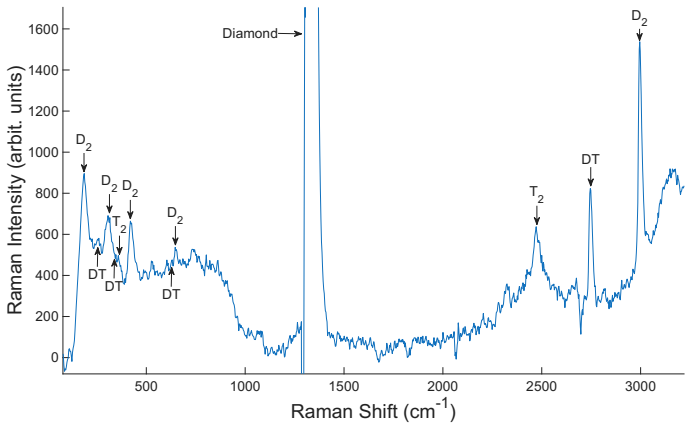
We report the design, commissioning, and operation of deuterium-deuterium (DD) and deuterium-tritium (DT) gas delivery systems developed to load a diamond anvil cell (DAC) beam target for muon-catalyzed fusion (muCF). The DAC approach enables DT fuel to be compressed to GPa pressures at more than twice the liquid density and heated from cryogenic temperatures through 500 K, opening access to a substantially expanded parameter range for muCF kinetics and yield measurements. In this approach, DT is cryo-condensed to a liquid in a minichamber and then compressed in the DAC using a helium-driven pneumatic membrane, achieving high pressures in a millimeter-scale DT sample volume. A DD gas delivery system was designed and used to validate the experimental apparatus, measure the gas quantities needed for filling, develop operational experience, and collect kinetics and yield data with DD targets. The DT gas delivery system adds tritium-specific capabilities for inventory minimization, secondary containment, and activity monitoring. The DT system integrates depleted uranium storage beds and a liquid helium cryogenic condenser used for pressure building and cryopumping. High-purity delivery is provided by a rapid-response palladium permeator. The system is housed in a helium-atmosphere glovebox held at negative pressure with continuous cleanup. We present the process and instrumentation design, a failure modes and effects analysis (FMEA), and data from the experiment's in situ Raman spectrometer, which provides direct confirmation of target loading and composition through the optically clear diamond anvils. The 2024 and 2025 DT campaigns achieved repeatable target fills and operation with no measurable tritium releases to the stack, demonstrating safe, high-purity DT loading at novel density-temperature conditions for muCF studies.
Editorial analysis
A structured set of objections, weighed in public.
Referee Report
Summary. The manuscript describes the design, commissioning, and operation of DD and DT gas delivery systems for loading a diamond anvil cell (DAC) target with high-density DT fuel for muon-catalyzed fusion (muCF) studies. The DAC enables compression to GPa pressures at densities exceeding twice liquid DT and heating from cryogenic temperatures to 500 K. The DT system incorporates depleted uranium beds, a liquid helium cryogenic condenser, a palladium permeator for high-purity delivery, secondary containment, and activity monitoring within a negative-pressure helium glovebox. A failure modes and effects analysis (FMEA) is presented, along with in situ Raman spectrometer data claimed to confirm target loading and composition through the diamond anvils. The authors report that the 2024 and 2025 DT campaigns achieved repeatable fills and operation with no measurable tritium releases to the stack.
Significance. If the central claims hold, this work would be significant for instrumentation in nuclear physics and fusion research by demonstrating safe access to an expanded density-temperature parameter space for muCF kinetics and yield measurements. The inclusion of tritium-specific safety features, inventory minimization, and FMEA provides a practical template for handling radioactive gases in high-pressure experiments. The use of Raman spectroscopy for in situ verification is a notable technical choice for composition monitoring.
major comments (2)
- [Abstract] Abstract: The central claim that the 2024 and 2025 DT campaigns achieved repeatable target fills, high-purity loading, and zero measurable tritium releases rests on high-level statements without quantitative data, error bars, or detailed validation metrics (e.g., measured pressures, Raman peak intensities, or release detection limits). This is load-bearing for the assertion of safe operation at novel conditions.
- [Abstract] Abstract (Raman spectrometer description): The claim that the in situ Raman spectrometer provides direct confirmation of target loading and composition through the diamond anvils is central to validating high-purity DT and access to new muCF parameter space, yet the manuscript does not address potential optical interference or attenuation from the anvils, pressure-dependent Raman shifts in DT mixtures, background signals, or calibration procedures for the relevant density-temperature regime.
Simulated Author's Rebuttal
We thank the referee for the careful and constructive review. The comments highlight opportunities to strengthen the abstract with quantitative support for the central claims. We address each point below and will revise the abstract accordingly while preserving the manuscript's technical content.
read point-by-point responses
-
Referee: [Abstract] Abstract: The central claim that the 2024 and 2025 DT campaigns achieved repeatable target fills, high-purity loading, and zero measurable tritium releases rests on high-level statements without quantitative data, error bars, or detailed validation metrics (e.g., measured pressures, Raman peak intensities, or release detection limits). This is load-bearing for the assertion of safe operation at novel conditions.
Authors: We agree that the abstract would benefit from quantitative metrics to support the claims of repeatable fills and safe operation. The manuscript body reports specific pressures achieved, Raman peak intensities used for composition verification, and tritium release monitoring results with detection limits (detailed in the results and FMEA sections). In revision we will incorporate representative values (e.g., target pressures, Raman intensity ratios, and release upper limits) with appropriate context into the abstract. revision: yes
-
Referee: [Abstract] Abstract (Raman spectrometer description): The claim that the in situ Raman spectrometer provides direct confirmation of target loading and composition through the diamond anvils is central to validating high-purity DT and access to new muCF parameter space, yet the manuscript does not address potential optical interference or attenuation from the anvils, pressure-dependent Raman shifts in DT mixtures, background signals, or calibration procedures for the relevant density-temperature regime.
Authors: The manuscript presents Raman data confirming loading and composition but does not explicitly discuss optical interference, pressure shifts, or calibration details in the abstract (or, per the referee, sufficiently in the main text). We will revise the abstract to note the use of calibrated Raman peaks for DT mixtures under the operating conditions and the optical transparency of the diamond anvils. We will also add a concise paragraph in the methods or results section addressing potential interferences, background signals, and calibration procedures for the density-temperature range. revision: yes
Circularity Check
No significant circularity; hardware description with direct operational data
full rationale
The paper is a descriptive report on the design, commissioning, and operation of DD/DT gas delivery systems for a DAC target, including FMEA and in situ Raman data. No equations, derivations, fitted parameters presented as predictions, or load-bearing self-citations appear in the provided text or abstract. Central claims rest on direct measurements of fills, pressures, temperatures, and tritium monitoring without any reduction by construction to inputs. The report is self-contained against external benchmarks of hardware performance and safety outcomes.
Axiom & Free-Parameter Ledger
Reference graph
Works this paper leans on
-
[1]
Progress of Theoretical Physics Supplement , volume = 154, pages =
Anomalous Temperature-Dependent Phenomena of Muon Catalyzed Fusion in Solid Deuterium and Tritium Mixtures , author =. Progress of Theoretical Physics Supplement , volume = 154, pages =
-
[2]
Fusion Engineering and Design , volume = 11, number =
Muon Catalyzed Fusion , author =. Fusion Engineering and Design , volume = 11, number =
-
[3]
P. A. Redhead , title =. Journal of Vacuum Science & Technology A , volume =. 1990 , url =
1990
-
[4]
2026 , eprint=
The MuFusE Large-Volume Diamond Anvil Cell for Exploring Muon-Catalyzed Fusion at Higher Pressures and Temperatures , author=. 2026 , eprint=
2026
-
[5]
1990 , number =
A Tritium Target System for muCF , author =. 1990 , number =
1990
-
[6]
Diamond Anvil Measurement of Muon Catalyzed Fusion Kinetics , author =
-
[7]
Fusion Technology , volume = 21, pages =
Inert Gas Secondary Enclosure Clean-Up System , author =. Fusion Technology , volume = 21, pages =
-
[8]
Journal of Less-Common Metals , volume = 104, pages =
Uranium Beds for Temporary Tritium Storage , author =. Journal of Less-Common Metals , volume = 104, pages =
-
[9]
Vacuum and Impurity System (Vac-ITS) and Secondary Enclosure Cleanup (SEC) System , author =
-
[10]
Fusion Science and Technology , volume = 68, pages =
Dependence of Tritium Release from Stainless Steel on Temperature and Water Vapor , author =. Fusion Science and Technology , volume = 68, pages =
-
[11]
Annual Review of Nuclear and Particle Science , publisher =
Muon-Catalyzed Fusion , author =. Annual Review of Nuclear and Particle Science , publisher =
-
[12]
Kamimura, M. and Kino, Y. and Yamashita, T. , year = 2023, month =. Comprehensive study of muon-catalyzed nuclear reaction processes in the dt. Phys. Rev. C , publisher =. doi:10.1103/PhysRevC.107.034607 , url =
-
[13]
Nature , volume = 321, number = 6066, pages =
Muon-catalysed fusion revisited , author =. Nature , volume = 321, number = 6066, pages =. doi:10.1038/321127a0 , issn =
-
[14]
Jones, S. E. and Anderson, A. N. and Caffrey, A. J. and Walter, J. B. and Watts, K. D. and Bradbury, J. N. and Gram, P. A. M. and Leon, M. and Maltrud, H. R. and Paciotti, M. A. , year = 1983, month =. Experimental Investigation of Muon-Catalyzed d. Phys. Rev. Lett. , publisher =
1983
-
[15]
Muon-catalyzed D-T fusion at low temperature , author =. Phys. Rev. Lett. , publisher =
-
[16]
Journal of Experimental and Theoretical Physics , volume = 100, number = 4, pages =
Experimental investigation of muon-catalyzed dt fusion in wide ranges of D/T mixture conditions , author =. Journal of Experimental and Theoretical Physics , volume = 100, number = 4, pages =. doi:10.1134/1.1926428 , issn =
-
[17]
Hyperfine Interactions , volume = 118, number = 1, pages =
Measurement of X-rays from muon to alpha sticking and fusion neutrons in solid/liquid D-T mixtures of high tritium concentration , author =. Hyperfine Interactions , volume = 118, number = 1, pages =. doi:10.1023/A:1012669527116 , issn =
-
[18]
Progress in Particle and Nuclear Physics , volume = 22, pages =
Muon reactivation in muon-catalyzed D-T fusion , author =. Progress in Particle and Nuclear Physics , volume = 22, pages =
-
[19]
Contemporary Physics , publisher =
Muon catalysed fusion , author =. Contemporary Physics , publisher =
-
[20]
Fusion Technology , publisher =
Muon-Catalyzed Fusion — An Energy Production Perspective , author =. Fusion Technology , publisher =
-
[21]
Fusion Technology , volume = 8, number =
Engineering Issues in Muon-Catalyzed Fusion , author =. Fusion Technology , volume = 8, number =
-
[22]
Journal of Physics: Energy , publisher =
An investigation of efficient muon production for use in muon catalyzed fusion , author =. Journal of Physics: Energy , publisher =
-
[23]
Indian Journal of Physics, Part A , volume = 65, number = 3, pages =
Muon catalysed fusion: the present status , author =. Indian Journal of Physics, Part A , volume = 65, number = 3, pages =
-
[24]
Scientific Reports , volume = 12, number = 1, pages = 6393, issn =
Roles of resonant muonic molecule in new kinetics model and muon catalyzed fusion in compressed gas , author =. Scientific Reports , volume = 12, number = 1, pages = 6393, issn =
-
[25]
Physical Review Letters , volume = 85, number = 8, pages =
Resonant formation of d t molecules in deuterium: An atomic beam measurement of muon catalyzed dt fusion , author =. Physical Review Letters , volume = 85, number = 8, pages =
-
[26]
International Conference on Precision Physics and Fundamental Physical Constants-FFK2019 , volume = 9, pages = 14, url =
FAMU latest results in the measurement of the transfer rate from p to oxygen , author =. International Conference on Precision Physics and Fundamental Physical Constants-FFK2019 , volume = 9, pages = 14, url =
-
[27]
Hyperfine Interactions , volume = 119, number = 1, pages =
Tritium gas handling system for muon catalyzed fusion research at RIKEN-RAL muon facility , author =. Hyperfine Interactions , volume = 119, number = 1, pages =
-
[28]
New Insights in Muon-Catalyzed dd Fusion by using Ortho-Para Controlled Solid Deuterium , author =. Phys. Rev. Lett. , publisher =
-
[29]
Physical Review A , publisher =
Resonant d t formation in condensed hydrogen isotopes , author =. Physical Review A , publisher =
-
[30]
Introductory Muon Science , author =
-
[31]
Muon-Catalyzed Fusion and Fusion with Polarized Nuclei , publisher =
Can 250+ Fusions Per Muon be Achieved? , author =. Muon-Catalyzed Fusion and Fusion with Polarized Nuclei , publisher =
-
[32]
Superconductor Science and Technology , abstract =
Padamsee, Hasan , title =. Superconductor Science and Technology , abstract =. 2017 , month =. doi:10.1088/1361-6668/aa6376 , url =
-
[33]
Transverse emittance reduction in muon beams by ionization cooling , author =. Nat. Phys. , publisher =. 2024 , url =
2024
-
[34]
Diamond anvil cell and cryostat for low-temperature optical studies , author =. Rev. Sci. Instrum. , publisher =. 1985 , url =
1985
-
[35]
Zhao, J. Y. and Bi, W. and Sinogeikin, S. and Hu, M. Y. and Alp, E. E. and Wang, X. C. and Jin, C. Q. and Lin, J. F. , title =. Review of Scientific Instruments , volume =. 2017 , month =
2017
-
[36]
and Blau, B
Kiselev, Daniela and Baumann, P. and Blau, B. and Geissmann, K. and Laube, D. and Reiss, T. and Sobbia, R. and Strinning, A. and Talanov, V. and Wohlmuther, Michael , title =. Journal of Radioanalytical and Nuclear Chemistry , year =
-
[37]
2015 , month = sep, url =
2015
-
[38]
2012 , month = oct, number =
New Sensor for Measuring Trace Impurities in Ultra Pure Hydrogen , author =. 2012 , month = oct, number =
2012
-
[39]
Analytical Chemistry , year =
Meinders, Horst , title =. Analytical Chemistry , year =
discussion (0)
Sign in with ORCID, Apple, or X to comment. Anyone can read and Pith papers without signing in.