REVIEW 4 major objections 5 minor 1 cited by
Demystifying Diffusion Policies: Action Memorization and Simple Lookup Table Alternatives
T0 review · 4 major / 5 minor · reviewed 2026-08-15 · deepseek-v4-flash
Pith's one-line read Diffusion policies for robot manipulation memorize training actions and retrieve them at runtime, acting as implicit lookup tables rather than generalizing.
desk verdict A provocative, partially supported claim that diffusion policies memorize action sequences in the small-data regime, with a useful lightweight ALT alternative; the internal lookup mechanism is asserted, not tested, and the evidence base is one task. read the letter →
The pith
A machine-rendered reading of the paper's core claim, the machinery that carries it, and where it could break.
The reading
What carries the argument
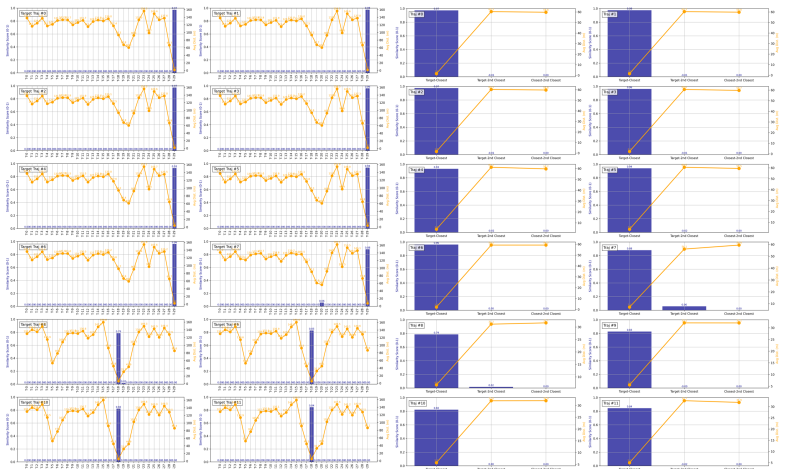
The Action Lookup Table (ALT) mechanism: a latent space, learned with a contrastive objective, in which each training observation is stored together with its demonstrated action sequence; at runtime the current observation is encoded and the closest stored entry's action sequence is replayed. For the diffusion-policy analysis, the load-bearing instrument is a normalized similarity score $S = 1 - s(\tau^{(r)},\tau^{(1)})/s(\tau^{(1)},\tau^{(2)})$ between an inference trajectory and its two closest training trajectories. A score near 1 with a large gap to the second-closest match is the evidence that the output is a memorized replay rather than an interpolated or novel action sequence.
What would settle it
Generate a dense sequence of test images that interpolate between two well-separated training observations and record the output action trajectory. If the diffusion policy ever produces an action sequence that is not a near-exact copy of a single training sequence, such as a genuine blend whose similarity to both neighbors is comparable, the lookup-table claim fails. If every output is always a copy of one training sequence across all interpolated and out-of-distribution inputs, the claim is supported.
Extended reading notes
Core claim
The paper claims that, when trained on the 50-200 demonstrations typical of robot manipulation, a diffusion policy severely overfits: its denoising model memorizes the training action sequences, and at inference it effectively performs nearest-neighbor retrieval of the training image most similar to its observation and replays the associated action sequence. This is supported by a similarity score comparing generated trajectories to the training set, showing the generated trajectory lies almost exactly on a single training trajectory, with a large gap to the second-nearest trajectory. Even with wildly out-of-distribution images, a fallback training sequence is replayed. The proposed ALT policy makes the mechanism explicit, with a contrastive learning objective and nearest-neighbor lookup in a low-dimensional embedding, and shows matching task performance to the diffusion policy in the tested 30-demonstration grasping setup.
Load-bearing premise
The paper's central claim rests on inferring an internal nearest-neighbor lookup mechanism from the behavioral observation that output trajectories reproduce training sequences; the paper never directly probes the diffusion policy's internal representations, so the lookup mechanism is posited rather than observed.
Editorial extensions
If this is right
- If the diffusion policy is a lookup table, its stochastic multimodality comes from randomness in which memorized sequence is selected, not from generating new action distributions; the multi-modal appearance is a sampling artifact over memorized outputs.
- Overfitting is not a bug but a necessity in the sparse-data regime: the early-stopping experiment shows that the model with the best validation loss has high action error, while the model trained to low training loss replays correct trajectories.
- A lightweight ALT policy can match the diffusion policy's performance on a small grasping dataset with roughly 0.34% of the inference time and 0.85% of the memory footprint, enabling faster closed-loop execution on resource-constrained robots.
- A threshold on latent distance gives a runtime out-of-distribution flag: inputs far from the training set in the learned embedding can be detected before execution and sent to a safe fallback behavior.
Reading between the lines
- A direct consequence the paper leaves implicit is that ALT should trail the diffusion policy exactly when demonstrations become dense enough to cover the action manifold; at that point interpolation, not lookup, becomes the winning strategy, and ALT's non-generalizing design would hit a ceiling.
- The behavioral evidence does not identify which layer or feature space the diffusion policy retrieves from. Probing the denoising network's internal activations for a latent nearest-neighbor structure would confirm the posited lookup mechanism or show it is an emergent behavioral approximation rather than a literal table.
- If the memorization account holds, the performance bottleneck in sparse-data manipulation shifts from policy expressiveness to the discriminative quality of the image encoder and the coverage of the stored demonstrations, not to the action-generation architecture.
- The hash-and-retrieve structure suggests a cheap continual-learning route: new demonstrations can be appended to the memory bank with no retraining, something the diffusion policy cannot do without fine-tuning its weights.
Signed reviews
Editorial analysis
A structured set of objections, weighed in public.
Referee Report
Summary. The paper hypothesizes that diffusion policies trained on small demonstration sets do not generalize action sequences; instead, at inference they retrieve memorized training action sequences, effectively acting as a lookup table keyed by the training image closest to the test image in a latent space. The authors support this with a 2D generative-model illustration, a cup-grasping experiment with trajectory-similarity scores, an early-stopping analysis, and OOD tests with distractors including images of cats and dogs. They then propose ALT, a contrastive-learning encoder that explicitly performs nearest-neighbor retrieval of stored trajectories, with an OOD threshold, and report that ALT matches the Diffusion Policy's in-distribution success while being about 300x faster and using about 0.85% of the memory. The paper concludes that action memorization is beneficial in the sparse-data regime and that ALT is a practical lightweight alternative.
Significance. The paper makes a provocative and potentially useful claim. The behavioral observation that a Diffusion Policy outputs trajectories nearly identical to individual training demonstrations even under OOD inputs is clearly presented and, within the tested scenario, is a meaningful empirical finding. If the lookup-table mechanism were directly confirmed, the result would explain the overfitting paradox and motivate lightweight, interpretable alternatives; ALT itself is a simple, efficient policy with an explicit OOD flag and quantifiable resource advantages. The main qualifications are that the mechanistic hypothesis is asserted rather than directly tested, that the ALT demonstration is partly circular as evidence for the mechanism, and that the generality of the claim rests on a single task with 30 demonstrations.
major comments (4)
- [Abstract; Section 3.3-3.4] The latent-space lookup mechanism is asserted, not tested. The similarity score S measures whether the output action sequence matches one training sequence, not whether the retrieved sequence is the one associated with the closest training image in the model's internal representation. Moreover, the reported OOD fallback behavior, where many different OOD inputs map to one or two training sequences, is not generically what per-sample nearest-neighbor retrieval would produce; it is also consistent with action-space attractors or a learned default output. I recommend either rephrasing the central claim as behaviorally consistent with lookup-table memorization or adding a direct test: for each query, compute the rank of the selected training trajectory under a learned encoder (e.g., the ALT encoder or the Diffusion Policy's conditioning encoder) and compare with alternative explanations.
- [Section 4 and Section 5] ALT is designed to implement the hypothesized lookup mechanism and is then presented as validation of the hypothesis. Matching performance shows that an explicit lookup table can serve as an alternative policy, but it does not show that the Diffusion Policy uses the same computation; this is a circularity insofar as the same hypothesis motivates and is confirmed by the ALT experiment. The authors should either frame ALT as a constructive existence proof (a lookup policy can match DP) or compare the specific trajectories chosen by the Diffusion Policy with the nearest neighbors chosen by ALT under a shared encoder.
- [Appendix B, Figure 7] The early-stopping experiment compares the validation denoising loss with training action MSE, which are not comparable quantities: the minimum of the validation loss need not correspond to the checkpoint with best or worst action accuracy. The claim that overfitting is necessary is not supported unless the authors report action MSE or task success on the validation set at the early-stopping checkpoint and at the final checkpoint, using the same metric.
- [Section 3.4, Table 1, Section 6] The evidence base is too narrow for the unqualified conclusion that diffusion policies essentially memorize an action lookup table. The experiments use one task, 30 demonstrations, and apparently a single training run, with no multiple seeds or baseline policies for the similarity metric; the paper itself states in Section 6 that scalability is unverified. I suggest either adding experiments across tasks, dataset sizes, and seeds, or explicitly narrowing the conclusion to the small-data regime and to the tested task.
minor comments (5)
- [Equation (1)] Equation (1) has a mismatched parenthesis and should likely read x_{k-1} = alpha (x_k - gamma epsilon_theta(x_k,k)) + N(0, sigma^2 I); please fix the typesetting.
- [Table 1] The OOD cells in Table 1 use colors (green/red) that are not visible in the text version; please spell out the semantics explicitly and clarify what the dash in the ID-1 column means for the gamma=0.9 rows.
- [Section 3.2] There are typos: 'MPL' should be 'MLP' and 'maipulation' in the Introduction should be 'manipulation'; these should be corrected.
- [Section 5] The conclusion contains a duplicated article: 'comparable to the the Diffusion Policy' should read 'comparable to the Diffusion Policy'.
- [Appendix B] The early-stopping figure reports an action MSE of around 1800 without units or a comparison scale; please report normalized MSE or a trajectory error metric so the magnitude is interpretable.
Circularity Check
No circularity found: the memorization claim is empirically measured, the latent-space mechanism is explicitly a posit, and ALT is a downstream construction rather than evidence reducing to its own inputs.
full rationale
The central claim that Diffusion Policies re-execute memorized training action sequences is supported by direct measurement in Section 3.4: the similarity score S = 1 - s(τ(r),τ(1))/s(τ(1),τ(2)) is computed from actual Diffusion Policy outputs and the stored training trajectories, and the reported near-1 values with a large nearest/second-nearest gap are empirical observations, not consequences of a fitted parameter. The latent-space nearest-neighbor retrieval is explicitly labeled a hypothesis ('We posit that...') in the abstract and Section 3.3; the paper never probes internal representations, so this part is underdetermined, but underdetermination is not circularity because no equation or prior result by these authors is used to force it. ALT is introduced after the Diffusion Policy evidence ('With this insight, we propose...'), and its design as an explicit lookup table is a sufficiency check, not a source of evidence for how the Diffusion Policy behaves internally; even if ALT's success affirmed the consequent, the observed action-sequence repetition by the Diffusion Policy stands independently. There are no load-bearing self-citations: references to earlier diffusion-memorization work (e.g., [32-40]) are external, and no uniqueness theorem or ansatz is imported from the authors' own prior work. The Limitations section concedes small-scale evaluation, scalability questions, and hyperparameter sensitivity, which are external-validity concerns and do not make the derivation self-referential. No step reduces an equation or a fitted value to its own input, so the circularity score is 0.
Assumptions & free parameters
free parameters (3)
- NT-Xent temperature tau =
0.4
- OOD threshold gamma =
0.9 and 0.75 (two variants)
- Training hyperparameters (epochs, batch size, learning rate) =
not reported
assumptions (3)
- ad hoc to paper The action similarity metric S=1-d(nearest)/d(second nearest) is a valid indicator of memorization vs generalization.
- domain assumption Behavior on the single cup-grasping task with 30 demonstrations is representative of small-data diffusion policy use.
- ad hoc to paper The diffusion policy's internal conditioning is functionally equivalent to nearest-neighbor lookup in a latent space.
Cite this review
Pith. "Pith review of Demystifying Diffusion Policies: Action Memorization and Simple Lookup Table Alternatives." pith.science (2026). https://pith.science/paper/WPKSLCWL
@misc{pith2026250505787,
  author       = {Pith},
  title        = {Pith review of: Demystifying Diffusion Policies: Action Memorization and Simple Lookup Table Alternatives},
  year         = {2026},
  howpublished = {\url{https://pith.science/paper/WPKSLCWL}},
  note         = {Machine review of arXiv:2505.05787}
}
read the original abstract
Diffusion policies have demonstrated remarkable dexterity and robustness in intricate, high-dimensional robot manipulation tasks, while training from a small number of demonstrations. However, the reason for this performance remains a mystery. In this paper, we offer a surprising hypothesis: diffusion policies essentially memorize an action lookup table -- and this is beneficial. We posit that, at runtime, diffusion policies find the closest training image to the test image in a latent space, and recall the associated training action sequence, offering reactivity without the need for action generalization. This is effective in the sparse data regime, where there is not enough data density for the model to learn action generalization. We support this claim with systematic empirical evidence. Even when conditioned on wildly out of distribution (OOD) images of cats and dogs, the Diffusion Policy still outputs an action sequence from the training data. With this insight, we propose a simple policy, the Action Lookup Table (ALT), as a lightweight alternative to the Diffusion Policy. Our ALT policy uses a contrastive image encoder as a hash function to index the closest corresponding training action sequence, explicitly performing the computation that the Diffusion Policy implicitly learns. We show empirically that for relatively small datasets, ALT matches the performance of a diffusion model, while requiring only 0.0034 of the inference time and 0.0085 of the memory footprint, allowing for much faster closed-loop inference with resource constrained robots. We also train our ALT policy to give an explicit OOD flag when the distance between the runtime image is too far in the latent space from the training images, giving a simple but effective runtime monitor. More information can be found at: https://stanfordmsl.github.io/alt/.
Figures


Figures from the paper (11 more)



Forward citations
Cited by 1 Pith paper
-
Think Proprioceptively: State-Grounded Visual Token Selection for VLA Policies
Using tokenized proprioception plus instruction to select ~15% of visual patches matches or beats full-token VLA baselines and cuts latency by ~58%.
Reference graph
Works this paper leans on
-
[1]
C. Chi, Z. Xu, S. Feng, E. Cousineau, Y . Du, B. Burchfiel, R. Tedrake, and S. Song. Diffusion policy: Visuomotor policy learning via action diffusion. The International Journal of Robotics Research, page 02783649241273668, 2023
2023
-
[2]
J. Ho, A. Jain, and P. Abbeel. Denoising diffusion probabilistic models. Advances in neural information processing systems, 33:6840–6851, 2020
2020
-
[3]
Saharia, W
C. Saharia, W. Chan, S. Saxena, L. Li, J. Whang, E. L. Denton, K. Ghasemipour, R. Gon- tijo Lopes, B. Karagol Ayan, T. Salimans, et al. Photorealistic text-to-image diffusion models with deep language understanding. Advances in neural information processing systems , 35: 36479–36494, 2022
2022
-
[4]
Wikipedia contributors. Stable diffusion. https://en.wikipedia.org/wiki/Stable_ Diffusion, 2024. Accessed: 2025-04-07
work page 2024
-
[5]
Y . Ze, G. Zhang, K. Zhang, C. Hu, M. Wang, and H. Xu. 3d diffusion policy: Generalizable visuomotor policy learning via simple 3d representations. arXiv preprint arXiv:2403.03954, 2024
arXiv 2024
-
[6]
D. Wang, S. Hart, D. Surovik, T. Kelestemur, H. Huang, H. Zhao, M. Yeatman, J. Wang, R. Walters, and R. Platt. Equivariant diffusion policy.arXiv preprint arXiv:2407.01812, 2024
arXiv 2024
-
[7]
T. Chen, S. Kornblith, M. Norouzi, and G. Hinton. A simple framework for contrastive learning of visual representations. In International conference on machine learning, pages 1597–1607. PmLR, 2020
work page 2020
-
[8]
Ramesh, M
A. Ramesh, M. Pavlov, G. Goh, S. Gray, C. V oss, A. Radford, M. Chen, and I. Sutskever. Zero-shot text-to-image generation. In International conference on machine learning , pages 8821–8831. Pmlr, 2021
2021
Show all 47 references
-
[9]
Blattmann, T
A. Blattmann, T. Dockhorn, S. Kulal, D. Mendelevitch, M. Kilian, D. Lorenz, Y . Levi, Z. En- glish, V . V oleti, A. Letts, et al. Stable video diffusion: Scaling latent video diffusion models to large datasets. arXiv preprint arXiv:2311.15127, 2023
2023 arXiv
-
[10]
A. Q. Nichol and P. Dhariwal. Improved denoising diffusion probabilistic models. In Interna- tional conference on machine learning, pages 8162–8171. PMLR, 2021. 10
2021
-
[11]
Rombach, A
R. Rombach, A. Blattmann, D. Lorenz, P. Esser, and B. Ommer. High-resolution image syn- thesis with latent diffusion models. In Proceedings of the IEEE/CVF conference on computer vision and pattern recognition, pages 10684–10695, 2022
2022
-
[12]
N. Ruiz, Y . Li, V . Jampani, Y . Pritch, M. Rubinstein, and K. Aberman. Dreambooth: Fine tuning text-to-image diffusion models for subject-driven generation. In Proceedings of the IEEE/CVF conference on computer vision and pattern recognition, pages 22500–22510, 2023
2023
-
[13]
Balaji, S
Y . Balaji, S. Nah, X. Huang, A. Vahdat, J. Song, Q. Zhang, K. Kreis, M. Aittala, T. Aila, S. Laine, et al. ediff-i: Text-to-image diffusion models with an ensemble of expert denoisers. arXiv preprint arXiv:2211.01324, 2022
2022 arXiv
-
[14]
Saharia, W
C. Saharia, W. Chan, H. Chang, C. Lee, J. Ho, T. Salimans, D. Fleet, and M. Norouzi. Palette: Image-to-image diffusion models. In ACM SIGGRAPH 2022 conference proceedings, pages 1–10, 2022
2022
-
[15]
Tumanyan, M
N. Tumanyan, M. Geyer, S. Bagon, and T. Dekel. Plug-and-play diffusion features for text- driven image-to-image translation. In Proceedings of the IEEE/CVF Conference on Computer Vision and Pattern Recognition, pages 1921–1930, 2023
1921
-
[16]
Ceylan, C.-H
D. Ceylan, C.-H. P. Huang, and N. J. Mitra. Pix2video: Video editing using image diffusion. In Proceedings of the IEEE/CVF International Conference on Computer Vision, pages 23206– 23217, 2023
2023
-
[17]
A. Z. Ren, J. Lidard, L. L. Ankile, A. Simeonov, P. Agrawal, A. Majumdar, B. Burch- fiel, H. Dai, and M. Simchowitz. Diffusion policy policy optimization. arXiv preprint arXiv:2409.00588, 2024
2024 arXiv
-
[18]
G. Lu, Z. Gao, T. Chen, W. Dai, Z. Wang, W. Ding, and Y . Tang. Manicm: Real-time 3d diffu- sion policy via consistency model for robotic manipulation. arXiv preprint arXiv:2406.01586, 2024
2024 arXiv
-
[19]
Lee and Y .-L
S.-W. Lee and Y .-L. Kuo. Diff-dagger: Uncertainty estimation with diffusion policy for robotic manipulation. arXiv preprint arXiv:2410.14868, 2024
2024 arXiv
-
[20]
Y . Wang, G. Yin, B. Huang, T. Kelestemur, J. Wang, and Y . Li. Gendp: 3d semantic fields for category-level generalizable diffusion policy. In 8th Annual Conference on Robot Learning , volume 2, 2024
2024
-
[21]
H. Li, Q. Feng, Z. Zheng, J. Feng, and A. Knoll. Language-guided object-centric diffusion policy for collision-aware robotic manipulation. arXiv preprint arXiv:2407.00451, 2024
2024 arXiv
-
[22]
Mizuta and K
K. Mizuta and K. Leung. Cobl-diffusion: Diffusion-based conditional robot planning in dy- namic environments using control barrier and lyapunov functions. In 2024 IEEE/RSJ Inter- national Conference on Intelligent Robots and Systems (IROS) , pages 13801–13808. IEEE, 2024
2024
-
[23]
Black, M
K. Black, M. Nakamoto, P. Atreya, H. Walke, C. Finn, A. Kumar, and S. Levine. Zero- shot robotic manipulation with pretrained image-editing diffusion models. arXiv preprint arXiv:2310.10639, 2023
2023 arXiv
-
[24]
G. Kim, T. Kwon, and J. C. Ye. Diffusionclip: Text-guided diffusion models for robust image manipulation. In Proceedings of the IEEE/CVF conference on computer vision and pattern recognition, pages 2426–2435, 2022
2022
-
[25]
L. Chen, S. Bahl, and D. Pathak. Playfusion: Skill acquisition via diffusion from language- annotated play. In Conference on Robot Learning, pages 2012–2029. PMLR, 2023
2012
-
[26]
M. Xu, Z. Xu, C. Chi, M. Veloso, and S. Song. Xskill: Cross embodiment skill discovery. In Conference on robot learning, pages 3536–3555. PMLR, 2023. 11
2023
-
[27]
Shaoul, I
Y . Shaoul, I. Mishani, S. Vats, J. Li, and M. Likhachev. Multi-robot motion planning with diffusion models. arXiv preprint arXiv:2410.03072, 2024
2024 arXiv
-
[28]
Serifi, R
A. Serifi, R. Grandia, E. Knoop, M. Gross, and M. B ¨acher. Robot motion diffusion model: Motion generation for robotic characters. In SIGGRAPH Asia 2024 Conference Papers, pages 1–9, 2024
2024
-
[29]
Sridhar, D
A. Sridhar, D. Shah, C. Glossop, and S. Levine. Nomad: Goal masked diffusion policies for navigation and exploration. In 2024 IEEE International Conference on Robotics and Automa- tion (ICRA), pages 63–70. IEEE, 2024
2024
-
[30]
Kapelyukh, V
I. Kapelyukh, V . V osylius, and E. Johns. Dall-e-bot: Introducing web-scale diffusion models to robotics. IEEE Robotics and Automation Letters, 8(7):3956–3963, 2023
2023
-
[31]
Chen, H.-C
S.-F. Chen, H.-C. Wang, M.-H. Hsu, C.-M. Lai, and S.-H. Sun. Diffusion model-augmented behavioral cloning. arXiv preprint arXiv:2302.13335, 2023
2023 arXiv
-
[32]
X. Gu, C. Du, T. Pang, C. Li, M. Lin, and Y . Wang. On memorization in diffusion models. arXiv preprint arXiv:2310.02664, 2023
2023 arXiv
-
[33]
Somepalli, V
G. Somepalli, V . Singla, M. Goldblum, J. Geiping, and T. Goldstein. Diffusion art or digital forgery? investigating data replication in diffusion models. In Proceedings of the IEEE/CVF conference on computer vision and pattern recognition, pages 6048–6058, 2023
2023
-
[34]
Carlini, J
N. Carlini, J. Hayes, M. Nasr, M. Jagielski, V . Sehwag, F. Tramer, B. Balle, D. Ippolito, and E. Wallace. Extracting training data from diffusion models. In 32nd USENIX Security Sympo- sium (USENIX Security 23), pages 5253–5270, 2023
2023
-
[35]
Ramesh, P
A. Ramesh, P. Dhariwal, A. Nichol, C. Chu, and M. Chen. Hierarchical text-conditional image generation with clip latents. arXiv preprint arXiv:2204.06125, 1(2):3, 2022
2022 arXiv
-
[36]
A. Jain, Y . Kobayashi, T. Shibuya, Y . Takida, N. Memon, J. Togelius, and Y . Mitsufuji. Classifier-free guidance inside the attraction basin may cause memorization. arXiv preprint arXiv:2411.16738, 2024
2024 arXiv
-
[37]
Y . Wen, Y . Liu, C. Chen, and L. Lyu. Detecting, explaining, and mitigating memorization in diffusion models. In The Twelfth International Conference on Learning Representations, 2024
2024
-
[38]
Somepalli, V
G. Somepalli, V . Singla, M. Goldblum, J. Geiping, and T. Goldstein. Understanding and miti- gating copying in diffusion models. Advances in Neural Information Processing Systems, 36: 47783–47803, 2023
2023
-
[39]
Y . Chen, X. Ma, D. Zou, and Y .-G. Jiang. Extracting training data from unconditional diffusion models. arXiv preprint arXiv:2406.12752, 2024
2024 arXiv
-
[40]
Hintersdorf, L
D. Hintersdorf, L. Struppek, K. Kersting, A. Dziedzic, and F. Boenisch. Finding nemo: Local- izing neurons responsible for memorization in diffusion models. Advances in Neural Informa- tion Processing Systems, 37:88236–88278, 2024
2024
-
[41]
C. Chen, D. Liu, and C. Xu. Towards memorization-free diffusion models. In Proceedings of the IEEE/CVF Conference on Computer Vision and Pattern Recognition, pages 8425–8434, 2024
2024
-
[42]
J. Ren, Y . Li, S. Zeng, H. Xu, L. Lyu, Y . Xing, and J. Tang. Unveiling and mitigating memo- rization in text-to-image diffusion models through cross attention. In European Conference on Computer Vision, pages 340–356. Springer, 2024
2024
-
[43]
Loaiza-Ganem, B
G. Loaiza-Ganem, B. L. Ross, J. C. Cresswell, and A. L. Caterini. Diagnosing and fixing manifold overfitting in deep generative models. arXiv preprint arXiv:2204.07172, 2022. 12
2022 arXiv
-
[44]
K. He, X. Zhang, S. Ren, and J. Sun. Deep residual learning for image recognition. In Pro- ceedings of the IEEE conference on computer vision and pattern recognition, pages 770–778, 2016
2016
-
[45]
T. Z. Zhao, V . Kumar, S. Levine, and C. Finn. Learning fine-grained bimanual manipulation with low-cost hardware. arXiv preprint arXiv:2304.13705, 2023
2023 arXiv
-
[46]
P. Wu, Y . Shentu, Z. Yi, X. Lin, and P. Abbeel. Gello: A general, low-cost, and intuitive teleoperation framework for robot manipulators. In 2024 IEEE/RSJ International Conference on Intelligent Robots and Systems (IROS), pages 12156–12163. IEEE, 2024
2024
-
[47]
C. Chi, Z. Xu, C. Pan, E. Cousineau, B. Burchfiel, S. Feng, R. Tedrake, and S. Song. Universal manipulation interface: In-the-wild robot teaching without in-the-wild robots. arXiv preprint arXiv:2402.10329, 2024. 13 A Data Collection Pipeline A.1 Robot Arm Data Collection Choo...
2024 arXiv
Reviewed August 15, 2026 · model on record in the stance chip above.
Discussion (0). Continue with ORCID to comment.