Temporal Conductance and Bounds on the Voter Model for Dynamic Networks
Pith reviewed 2026-06-27 05:37 UTC · model grok-4.3
The pith
Temporal conductance bounds the expected consensus time of the voter model on dynamic networks by O(m/(d_min Φ)), and the bound is tight up to constants.
A machine-rendered reading of the paper's core claim, the machinery that carries it, and where it could break.
Core claim
We introduce temporal conductance Φ as a connectivity measure for dynamic networks that remains positive even when individual snapshots are disconnected, unlike static conductance. For the voter model on such networks with m edges and minimum degree d_min, the expected consensus time is at most O(m/(d_min Φ)). We prove this upper bound and show a matching lower bound up to constant factors.
What carries the argument
Temporal conductance Φ, which aggregates connectivity over time sequences of edges while respecting fixed vertex degrees.
If this is right
- The O(m/(d_min Φ)) bound applies directly to any dynamic network whose edge sequence admits a positive temporal conductance.
- The same conductance measure yields tight bounds on consensus for the standard lazy voter model.
- Temporal conductance can replace static conductance in analyses that previously required every snapshot to be connected.
- The bound is asymptotically tight, so no substantially better general upper bound exists in terms of m, d_min, and Φ.
Where Pith is reading between the lines
- Temporal conductance could serve as a drop-in replacement for conductance when analyzing other opinion dynamics or random walks on time-varying graphs.
- The fixed-degree assumption might be relaxed in future work by rescaling edge probabilities at each step.
- Similar time-aggregated measures could bound mixing times for time-inhomogeneous Markov chains beyond the voter model.
Load-bearing premise
Dynamic networks maintain fixed vertex degrees over time, which allows temporal conductance to stay positive even when every individual snapshot is disconnected.
What would settle it
A concrete dynamic network with fixed degrees where the expected voter-model consensus time exceeds C * m/(d_min Φ) for arbitrarily large constant C would falsify the tightness claim.
Figures
read the original abstract
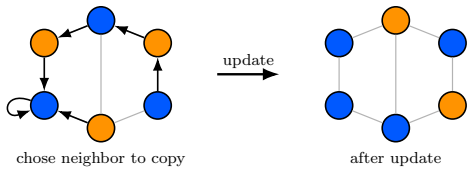
The voter model is a classical stochastic process that models how opinions might spread through a network: at each step, every node lazily adopts the opinion of a random neighbour; eventually all nodes share the same opinion (consensus). Stronger connectivity should yield faster consensus. Berenbrink, Giakkoupis, Kermarrec, and Mallmann-Trenn (ICALP 2016) make this precise via the network's conductance: if the network has $m$ edges, minimum degree $d_{\min}$, and conductance at least $\phi$, then the voter model reaches consensus in expected $O(m/(d_{\min}\phi))$ steps. Their results extend to dynamic networks with fixed vertex degrees by considering the network's conductance at each time step. We introduce temporal conductance $\Phi$, a more general connectivity measure for dynamic networks. Unlike static conductance, which collapses to $0$ whenever some snapshot is disconnected, $\Phi$ captures connectivity through edges that appear at different times. We generalise the results of Berenbrink et al. from static conductance to temporal conductance, showing that the expected consensus time of the standard voter model is at most $O(m/(d_{\min}\Phi))$. Moreover, we prove that this bound is tight up to constant factors. We expect temporal conductance to be a useful primitive for analysing other dynamics on temporal networks, and potentially time-inhomogeneous Markov chains more generally.
Editorial analysis
A structured set of objections, weighed in public.
Referee Report
Summary. The manuscript defines temporal conductance Φ for dynamic networks with fixed vertex degrees, a measure that remains positive even when individual snapshots are disconnected by capturing connectivity across time-varying edges. It generalizes the Berenbrink et al. (ICALP 2016) bound, showing that the expected consensus time of the standard voter model is at most O(m/(d_min Φ)), and proves a matching lower bound construction establishing tightness up to constant factors.
Significance. If the derivation holds, the result supplies a natural, non-collapsing connectivity primitive for temporal networks and demonstrates its utility on the voter model. The explicit tightness construction is a strength, as is the potential applicability to other time-inhomogeneous Markov chains noted in the abstract.
major comments (2)
- [§3] §3 (definition of Φ): the manuscript must make explicit how Φ reduces to the static conductance φ when the network is time-invariant; without this reduction shown, it is unclear whether the claimed generalization is strict or merely recovers the prior bound by construction.
- [Theorem 4.1] Theorem 4.1 (upper bound): the proof sketch relies on a coupling or potential-function argument that treats the temporal edges as a single effective graph; the step that bounds the meeting time of two random walks by 1/Φ requires a concrete inequality relating the temporal edge-arrival process to the static conductance of the union graph.
minor comments (2)
- [§2] The notation d_min is used both for the minimum degree in any snapshot and for the global minimum; a single clarifying sentence in §2 would remove ambiguity.
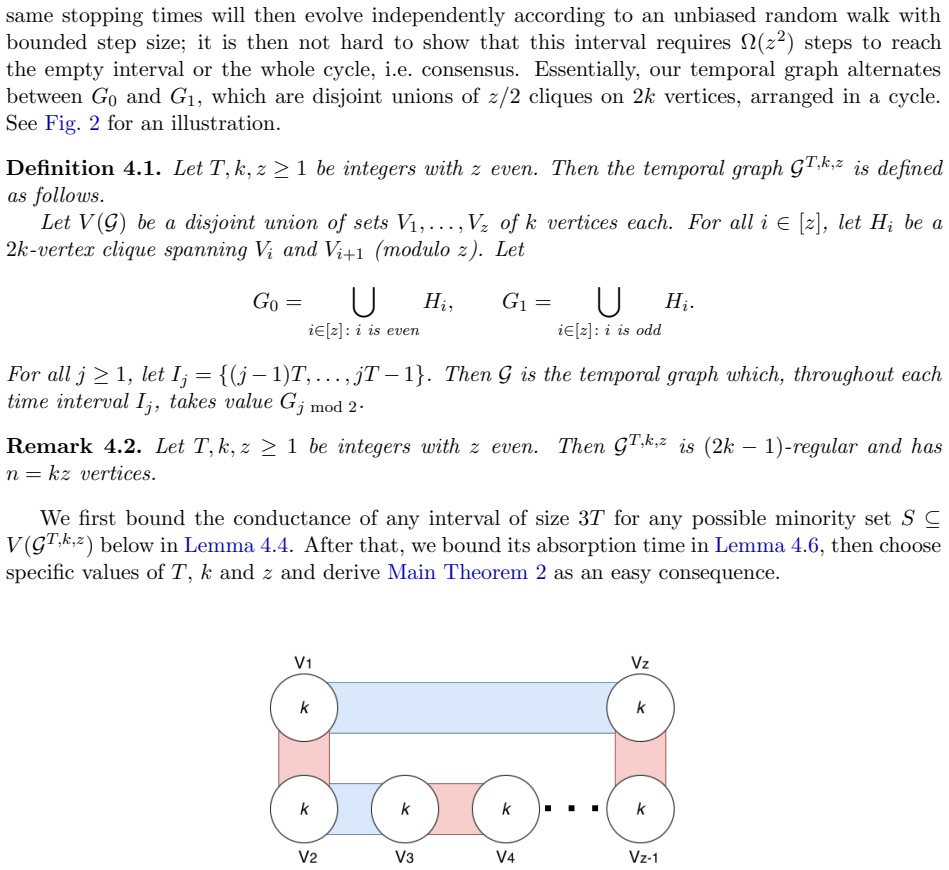
- [Figure 1] Figure 1 (lower-bound construction): the caption should state the exact value of Φ achieved by the periodic edge schedule so that the Ω(m/(d_min Φ)) claim can be verified by inspection.
Simulated Author's Rebuttal
We thank the referee for the careful reading, positive assessment, and constructive suggestions. We address each major comment below.
read point-by-point responses
-
Referee: [§3] §3 (definition of Φ): the manuscript must make explicit how Φ reduces to the static conductance φ when the network is time-invariant; without this reduction shown, it is unclear whether the claimed generalization is strict or merely recovers the prior bound by construction.
Authors: We agree that an explicit reduction is necessary for clarity. In the revised manuscript we will insert a short proposition (or remark) in §3 proving that, for any time-invariant network, the temporal conductance Φ equals the classical static conductance φ. This establishes that the definition is a strict generalization rather than a notational variant. revision: yes
-
Referee: [Theorem 4.1] Theorem 4.1 (upper bound): the proof sketch relies on a coupling or potential-function argument that treats the temporal edges as a single effective graph; the step that bounds the meeting time of two random walks by 1/Φ requires a concrete inequality relating the temporal edge-arrival process to the static conductance of the union graph.
Authors: The complete proof of Theorem 4.1 (contained in the appendix) already derives the meeting-time bound from the definition of Φ by aggregating the temporal edge process into an effective static graph whose conductance is at least Φ. To make the argument fully transparent we will add the explicit inequality (relating the temporal arrival probabilities to the edge measure of the union graph) as a displayed lemma immediately preceding the meeting-time calculation. This is a clarification rather than a change to the result. revision: yes
Circularity Check
No significant circularity in derivation chain
full rationale
The paper defines temporal conductance Φ as a new connectivity measure for fixed-degree dynamic networks that aggregates connectivity across time-varying edges (unlike static conductance, which is zero on disconnected snapshots). It then derives an upper bound of O(m/(d_min Φ)) on expected voter-model consensus time by generalizing the static-conductance analysis of Berenbrink et al. (ICALP 2016), and separately constructs a matching lower bound. No step reduces the claimed bound to a fitted parameter, a self-citation, or a renaming of the input; the central result is obtained from the newly introduced definition plus standard Markov-chain techniques. The cited prior work is external and the derivation remains self-contained.
Axiom & Free-Parameter Ledger
Reference graph
Works this paper leans on
-
[1]
Noga Alon and V. D. Milman.λ 1, isoperimetric inequalities for graphs, and superconcentrators. J. Comb. Theory B, 38(1):73–88, 1985.doi:10.1016/0095-8956(85)90092-9
-
[2]
A temporal network model for livestock trade systems
Sara Ansari, Jobst Heitzig, Laura Brzoska, Hartmut HK Lentz, Jakob Mihatsch, J¨ org Fritze- meier, and Mohammad R Moosavi. A temporal network model for livestock trade systems. Frontiers in veterinary science, 8:766547, 2021
2021
-
[3]
Sanjeev Arora, Satish Rao, and Umesh V. Vazirani. Expander flows, geometric embeddings and graph partitioning.J. ACM, 56(2):5:1–5:37, 2009.doi:10.1145/1502793.1502794
-
[4]
Cover time and mixing time of random walks on dynamic graphs.Random Struct
Chen Avin, Michal Kouck´ y, and Zvi Lotker. Cover time and mixing time of random walks on dynamic graphs.Random Struct. Algorithms, 52(4):576–596, 2018.doi:10.1002/RSA.20752
-
[5]
Bounds on the voter model in dynamic networks
Petra Berenbrink, George Giakkoupis, Anne-Marie Kermarrec, and Frederik Mallmann-Trenn. Bounds on the voter model in dynamic networks. In Ioannis Chatzigiannakis, Michael Mitzen- macher, Yuval Rabani, and Davide Sangiorgi, editors,43rd International Colloquium on Au- tomata, Languages, and Programming, ICALP 2016, Rome, Italy, July 11-15, 2016, vol- ume 5...
-
[6]
Statistical Physics of Social Dynamics
Claudio Castellano, Santo Fortunato, and Vittorio Loreto. Statistical physics of social dynam- ics.Reviews of Modern Physics, 81(2):591–646, 2009.doi:10.1103/RevModPhys.81.591
-
[7]
Andrea E. F. Clementi, Claudio Macci, Angelo Monti, Francesco Pasquale, and Riccardo Sil- vestri. Flooding time of edge-markovian evolving graphs.SIAM J. Discret. Math., 24(4):1694– 1712, 2010.doi:10.1137/090756053
-
[8]
A model for spatial conflict.Biometrika, 60(3):581–588, 1973.doi:10.1093/biomet/60.3.581
Peter Clifford and Aidan Sudbury. A model for spatial conflict.Biometrika, 60(3):581–588, 1973.doi:10.1093/biomet/60.3.581
-
[9]
Coalescing random walks and voting on connected graphs.SIAM J
Colin Cooper, Robert Els¨ asser, Hirotaka Ono, and Tomasz Radzik. Coalescing random walks and voting on connected graphs.SIAM J. Discret. Math., 27(4):1748–1758, 2013. doi:10.1137/120900368
-
[10]
Colin Cooper, Alan M. Frieze, and Tomasz Radzik. Multiple random walks in random regular graphs.SIAM J. Discret. Math., 23(4):1738–1761, 2009.doi:10.1137/080729542
-
[11]
DiTursi, Gaurav Ghosh, and Petko Bogdanov
Daniel J. DiTursi, Gaurav Ghosh, and Petko Bogdanov. Local community detection in dy- namic networks. In Vijay Raghavan, Srinivas Aluru, George Karypis, Lucio Miele, and Xin- dong Wu, editors,2017 IEEE International Conference on Data Mining, ICDM 2017, New Orleans, LA, USA, November 18-21, 2017, pages 847–852. IEEE Computer Society, 2017. doi:10.1109/ICD...
-
[12]
Voter models on subcritical scale-free random graphs
John Fernley and Marcel Ortgiese. Voter models on subcritical scale-free random graphs. Random Struct. Algorithms, 62(2):376–429, 2023.arXiv:1911.13187,doi:10.1002/rsa.21107
-
[13]
Logarithmic mixing of random walks on dynamical random cluster models, 2026.arXiv:2605.06511
Andreas Galanis, Leslie Ann Goldberg, and Xandru Mifsud. Logarithmic mixing of random walks on dynamical random cluster models, 2026.arXiv:2605.06511
Pith/arXiv arXiv 2026
-
[14]
Randomized rumor spread- ing in dynamic graphs
George Giakkoupis, Thomas Sauerwald, and Alexandre Stauffer. Randomized rumor spread- ing in dynamic graphs. In Javier Esparza, Pierre Fraigniaud, Thore Husfeldt, and Elias Kout- soupias, editors,Automata, Languages, and Programming - 41st International Colloquium, ICALP 2014, Copenhagen, Denmark, July 8-11, 2014, Proceedings, Part II, Lecture Notes in Co...
-
[15]
Yehuda Hassin and David Peleg. Distributed probabilistic polling and applications to proportionate agreement.Information and Computation, 171(2):248–268, 2001. doi:10.1006/inco.2001.3088
-
[16]
Richard A. Holley and Thomas M. Liggett. Ergodic theorems for weakly interacting infinite systems and the voter model.The Annals of Probability, 3(4):643–663, 1975. doi:10.1214/aop/1176996306
-
[17]
Mark Jerrum and Alistair Sinclair. Conductance and the rapid mixing property for Markov chains: the approximation of the permanent resolved (preliminary version). In Janos Simon, editor,Proceedings of the 20th Annual ACM Symposium on Theory of Computing, May 2-4, 1988, Chicago, Illinois, USA, pages 235–244. ACM, 1988.doi:10.1145/62212.62234
-
[18]
On coalescence time in graphs: When is coalescing as fast as meeting?ACM Trans
Varun Kanade, Frederik Mallmann-Trenn, and Thomas Sauerwald. On coalescence time in graphs: When is coalescing as fast as meeting?ACM Trans. Algorithms, 19(2), April 2023. doi:10.1145/3576900. 33
-
[19]
Gregory F. Lawler and Alan D. Sokal. Bounds on theL 2 spectrum for Markov chains and Markov processes: A generalization of Cheeger’s inequality.Transactions of the American Mathematical Society, 309(2):557–580, 1988.doi:10.2307/2000925
-
[20]
Johannes Lengler. Drift analysis. In Benjamin Doerr and Frank Neumann, editors,The- ory of Evolutionary Computation - Recent Developments in Discrete Optimization, Natural Computing Series, pages 89–131. Springer, 2020.doi:10.1007/978-3-030-29414-4˙2
-
[21]
Levin and Yuval Peres.Markov Chains and Mixing Times
David A. Levin and Yuval Peres.Markov Chains and Mixing Times. MBK. American Math- ematical Society, 2017.doi:10.1090/mbk/107
-
[22]
Thomas M. Liggett.Stochastic Interacting Systems: Contact, Voter and Exclusion Pro- cesses, volume 324 ofGrundlehren der mathematischen Wissenschaften. Springer, 1999. doi:10.1007/978-3-662-03990-8
-
[23]
Springer, 1985
Thomas Milton Liggett and Thomas M Liggett.Interacting particle systems, volume 2. Springer, 1985
1985
-
[24]
Conductance and convergence of Markov chains—A combinatorial treatment of expanders
Milena Mihail. Conductance and convergence of Markov chains—A combinatorial treatment of expanders. In30th Annual Symposium on Foundations of Computer Science, Research Triangle Park, North Carolina, USA, 30 October - 1 November 1989, pages 526–531. IEEE Computer Society, 1989.doi:10.1109/SFCS.1989.63529
-
[25]
Random walks on dynamic graphs: Mixing times, hitting times, and return probabilities
Thomas Sauerwald and Luca Zanetti. Random walks on dynamic graphs: Mixing times, hitting times, and return probabilities. In Christel Baier, Ioannis Chatzigiannakis, Paola Flocchini, and Stefano Leonardi, editors,46th International Colloquium on Automata, Languages, and Programming, ICALP 2019, Patras, Greece, July 9-12, 2019, LIPIcs, pages 93:1–93:15. Sc...
-
[26]
Approximate counting, uniform generation and rapidly mixing Markov chains.Inf
Alistair Sinclair and Mark Jerrum. Approximate counting, uniform generation and rapidly mixing Markov chains.Inf. Comput., 82(1):93–133, 1989.doi:10.1016/0890-5401(89)90067-9
-
[27]
Voter Model on Heterogeneous Graphs
V. Sood and S. Redner. Voter model on heterogeneous graphs.Phys. Rev. Lett., 94:178701, 2005.arXiv:cond-mat/0412599,doi:10.1103/PhysRevLett.94.178701
work page internal anchor Pith review Pith/arXiv arXiv doi:10.1103/physrevlett.94.178701 2005
-
[28]
Nonlinear bias toward complex contagion in uncertain transmission settings.Proceedings of the National Academy of Sciences, 121(1):e2312202121, 2024
Guillaume St-Onge, Laurent H´ ebert-Dufresne, and Antoine Allard. Nonlinear bias toward complex contagion in uncertain transmission settings.Proceedings of the National Academy of Sciences, 121(1):e2312202121, 2024. 34
2024
discussion (0)
Sign in with ORCID, Apple, or X to comment. Anyone can read and Pith papers without signing in.