REVIEW 4 major objections 7 minor 49 references
Efficient and accurate simulation of the Smith-Zener pinning mechanism during grain growth using a front-tracking numerical framework
T0 review · 4 major / 7 minor · reviewed 2026-08-10 · deepseek-v4-flash
Pith's one-line read A Lagrangian front-tracking model reproduces level-set accuracy for Smith-Zener pinning at lower computational cost, and a Z-Nodes variant extends full-field simulation to particles a few tens of nanometers wide.
desk verdict A real front-tracking capability advance for Zener pinning, but the central accuracy claim needs an h-convergence check. read the letter →
The pith
A machine-rendered reading of the paper's core claim, the machinery that carries it, and where it could break.
The reading
What carries the argument
The load-bearing objects are the discretized circular particle and the Z-Node. The discretized particle is a circle stored by center and radius and embedded into the mesh by cutting every segment its boundary crosses and reassigning interior elements to a particle surface; nodes on its boundary move under the grain-boundary velocity and are then projected radially onto the circle, which is what produces sliding, pinning, and unpinning at triple junctions. The Z-Node is an immovable mesh node that cannot be removed by node collapse and cannot collide with another Z-Node, acting as the classical vertex-style pinning site and allowing a coarse mesh to stand in for a particle too small to discretize. The combination of the two objects is what lets one simulation resolve large particles while representing fine ones as points.
What would settle it
Fix one polycrystal and one particle population, then repeat the discretized-particle simulation with progressively finer meshes, for example r = 2 µm with h = 500 nm, 250 nm, and 125 nm, keeping the time step small enough that it is not the limiting factor; if the final mean grain size or the limiting grain size shifts by more than the spread across four initial tessellations, the claim that the physics is mesh-independent fails. A complementary check is a single grain boundary pinned by one particle with the analytical Smith-Zener angle measured as a function of h and dt.
Extended reading notes
Core claim
The paper's central claim is that a front-tracking model can deliver level-set-level accuracy for the Smith-Zener pinning mechanism at lower cost, and that a point-pinning variant extends full-field simulation to particle sizes that front-capturing methods cannot reach in reasonable time. The key working is a migration-projection cycle: during each time step, nodes on grain-boundary/particle interfaces move by curvature flow, and nodes belonging to a particle are then projected radially back onto the exact circle, so triple junctions slide along the particle and naturally produce the 90°-180°-90° equilibrium angles expected for incoherent particles. In the validation cases the front-tracking curves for mean equivalent circle radius stay close to the level-set curves for no particles, static particles, and dissolving particles; in the large 50,000-grain comparison the simulation was about twice as fast as the level-set reference. For the smallest particles, the Z-Nodes strategy predicts final mean grain sizes within about 1 µm of the discretized-particle runs while cutting CPU time from 23 h to 3 h at 250 nm and from 38 h 30 min to 35 min at 125 nm.
Load-bearing premise
The load-bearing premise is that the simulated pinning and unpinning events are controlled by the grain-boundary dynamics and particle geometry, not by the local mesh size and time step, yet the paper's own description makes unpinning depend on the mesh size imposed near the grain boundary and particle, and no convergence study of the predicted limiting grain size is shown.
Editorial extensions
If this is right
- In 2D polycrystals with particle populations, the front-tracking method can replace the more expensive level-set approach for predicting grain-size evolution under Smith-Zener pinning, for both static and dissolving particles.
- Z-Nodes open full-field simulation to particles of a few tens of nanometers in millimeter-scale domains, a range previously restricted to mean-field or vertex models because of computational cost.
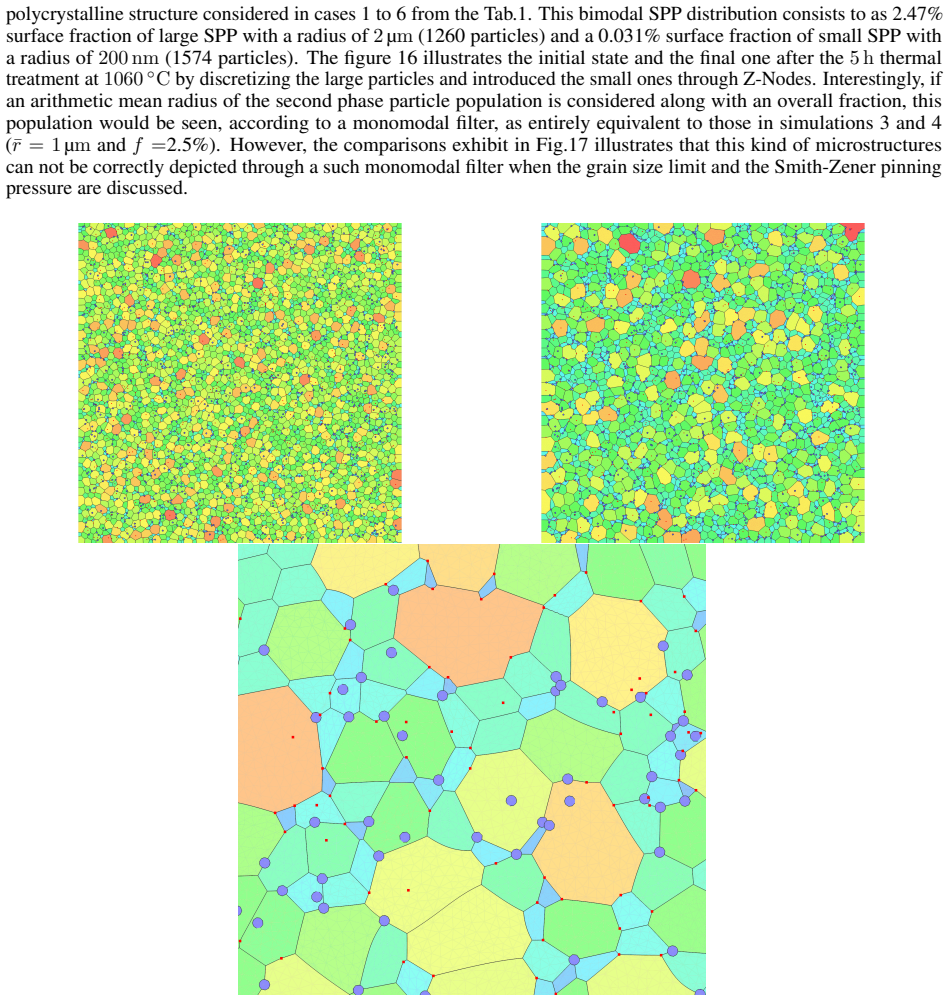
- A hybrid strategy can handle bimodal or trimodal particle populations by discretizing particles comparable to the grain size and using Z-Nodes for the fine population, with results that a monomodal average treatment fails to reproduce.
- The framework provides a tool to test classical Zener limiting-grain-size formulas in the 10-1000 nm particle-size range, where full-field data have been missing.
Reading between the lines
- The speed advantage is not universal: the paper itself shows the cost ratio with the level-set method dropping from up to 150x in pure grain growth to about 2x with dense particles, so one inference is that front-tracking's benefit concentrates in dilute or multimodal particle systems.
- A natural extension is to use the discretized-particle machinery for ellipsoidal or faceted precipitates by projecting onto the nearest point of the reconstructed shape, which would make the method applicable to real precipitate morphologies.
- The front-tracking property that a flat interface between two particles cannot move in 2D suggests a systematic tendency toward stronger pinning than level-set methods; checking this against a well-characterized alloy would tell which bias is physical.
- The Z-Node/discretized-particle agreement as particle size decreases implies an adaptive criterion (discretize above roughly four mesh spacings, use Z-Nodes below) could be built into a single simulation without user choices.
Signed reviews
Editorial analysis
A structured set of objections, weighed in public.
Referee Report
Summary. This paper extends the 2D front-tracking ToRealMotion (TRM) grain-growth framework to simulate the Smith-Zener pinning mechanism. Second-phase particles are represented either as explicitly discretized circles, whose boundaries are tracked with a body-fitted mesh and projected after each free-movement step, or as point-like 'Z-Nodes' intended for particles much smaller than the grains. The authors compare mean grain size (ECR) and grain-size distributions with the level-set model of Alvarado et al. for four initial tessellations, under static and dissolving particle populations, and they report a domain-size study and CPU-time comparisons. They further propose a hybrid treatment of bimodal particle populations. The central claims are that the discretized-particle front-tracking approach is 'just as accurate while being faster' than the level-set reference, and that Z-Nodes keeps 'reasonable computation times' for particles as small as about 125 nm.
Significance. If the central claims are established, the contribution is significant: it would give the front-tracking family a way to handle particle pinning with explicit particle geometry at polycrystal scale, filling a gap between vertex models (which use point pinning nodes regardless of particle size) and front-capturing methods (which become expensive for fine particles). The paper has clear strengths: comparisons over four initial tessellations, a documented domain-size convergence study, and a concrete large-scale demonstration with 50,000 grains. However, the main accuracy claim rests on a numerical operator whose unpinning behavior is admitted in the text to depend on the local mesh size; no mesh or time-step convergence study is supplied. The stress-test concern is therefore well founded. The validation reference is also from the same group, which weakens the independence of the benchmark even though there is no fitting to the level-set results.
major comments (4)
- [§2.2, Fig. 4, §3.2, §4.3] The manuscript explicitly states in §2.2 that 'since all these operations depend on the mesh size parameters imposed in the vicinity of the GB and particle, the unpinning events is linked to the local mesh size used on the GB.' This admission makes the central accuracy claim of §5 ('just as accurate while being faster') contingent on a mesh-convergence study that is not provided. The r/h >= 4 criterion in §4.3 only guarantees conservation of SPPs (less than 0.5% disappearance); it says nothing about convergence of the pinning pressure, the critical unpinning configuration, or the limiting mean grain size. The domain-size study in §3.2 keeps the local h/r ratio fixed, so it cannot expose mesh-controlled unpinning. I request a systematic h-refinement study, with the time step scaled accordingly, for at least one of the §3.1 configurations, reporting ECR_f and, ideally, the critical particle/GB geometry at unpinning. If the simulated pinning behavior changes with h, the central accuracy claim fails; if it converges, the concern is resolved.
- [§3.1, §3.2, §5] The quantitative validation is performed against the level-set model of Alvarado et al. (refs [26,27,44]), which shares authors with the present paper. This is not circular in a fitting sense, but it is a single benchmark from the same group, and §3.2 itself acknowledges that the level-set reference has its own mesh sensitivity ('the error made by the LS approach, obviously dependent on the fineness of the finite element mesh used'). Agreement with that reference therefore does not independently establish accuracy. I recommend adding at least one independent comparison, e.g., against the analytical Smith-Zener limiting-grain-size relation or a phase-field simulation, or clearly qualifying the claim as agreement with a specific reference implementation.
- [§4.2, §4.3, Table 1] The Z-Nodes comparison is not fully controlled. In Table 1, each pair (2p+1, 2p+2) compares a discretized-particle simulation, where particles occupy a finite area, with a Z-Nodes simulation where the same number of point-like nodes occupy zero area; as the authors note in §4.2, the initial grain size distribution is therefore shifted for the Z-Nodes case. The observed agreement in final ECR_f and distributions is thus obtained under different initial matrix areas and different effective pinning geometries. This does not invalidate the demonstration, but it weakens the interpretation that Z-Nodes is 'similar in accuracy' for small particles. A cleaner test would match initial matrix volume fractions or compare the Z-Nodes results against an extremely fine discretized-particle simulation as ground truth.
- [§5, Table 1] The concluding claim of 'reasonable computation times ... for millimeter-scale computational domains and second-phase particles as small as a few tens of nanometers' is not supported by the results as presented. The finest particle case (r = 125 nm, cases 9 and 10 in Table 1) uses a 0.25 mm x 0.25 mm domain, while the millimeter-scale cases have particle radii between 500 nm and 2000 nm. If the intended message is scale-bridging, the paper should either provide a case combining a millimeter-scale domain with the smallest particles or state clearly that the two extremes were not simulated simultaneously and that the extrapolation is an expectation rather than a demonstrated result.
minor comments (7)
- [Title/header] The title in the manuscript header reads 'SMITH -Z ENER' but should read 'SMITH-ZENER'.
- [Figure 8 caption] The caption of Figure 8 says 'by considering static SPP', but the text describes this case as the evolutive (dissolving) SPP case; the caption should be corrected.
- [References] Several references are duplicated: refs [26] and [44] are the same Alvarado et al. article; refs [6] and [47] are the same Manohar et al. article; refs [28] and [49] are the same Bernacki review. These should be consolidated to avoid citation inconsistencies.
- [§3.2] The 'L2 error' reported in Figure 10c is not defined; please specify whether it is an L2 norm in time of the mean ECR difference, an L2 norm of the ECR distributions, or a spatial field norm, and identify the reference case.
- [Table 1] In Table 1, the '×' entries for particle radius and fraction in the Z-Nodes cases should be explicitly defined, and the CPU times should state the hardware and, ideally, the number of cores; otherwise the timing comparisons cannot be reproduced.
- [§2.2] The sentence 'the unpinning events is linked to the local mesh size used on the GB' has a subject-verb agreement error and would benefit from rewriting, e.g., 'the unpinning event is linked to the local mesh size on the GB.'
- [Fig. 4] Figure 4 is difficult to read at print size; a higher-resolution figure with labels for each state would help the reader follow the described collapse, splitting, and unpinning sequence.
Circularity Check
No significant circularity: the TRM and Z-Nodes predictions are not fitted to the level-set reference, and the same-group benchmark is independent support rather than a derivation input.
full rationale
The paper's claimed derivation chain is self-contained. Grain-boundary motion follows the standard curvature-flow kinetics v = -mu*gamma*kappa*n (Eq. 1) with material parameters taken from prior AD730 studies, and particle interaction is implemented through free movement, radial projection onto circular particle interfaces, and node collapse/splitting operations (Sec. 2.2, Figs. 4-5). No parameter in these rules is fitted to the level-set results used for comparison; the ECD/ECR trajectories in Figs. 9, 14, and 15 are outputs of the model, not inputs. The main self-citation is the use of the level-set formulation of Alvarado et al. [26,27] as the "reference" for validation, as well as the TRM model basis [34-39]. However, the level-set code is a prior, independently implemented front-capturing method with its own published validation, and the present paper does not invoke a uniqueness theorem or adopt an ansatz from those papers to force the result. The strongest caveat in the text is Sec. 2.2: "since all these operations depend on the mesh size parameters imposed in the vicinity of the GB and particle, the unpinning events is linked to the local mesh size used on the GB," and Sec. 4.3's r/h >= 4 rule only guarantees conservation of particles (less than 0.5% disappearance), not mesh convergence of the pinning pressure or limiting grain size. That is a numerical-convergence risk, not a circular reduction, because it does not make the predicted mean grain size equal to an input by construction. The domain-size study in Sec. 3.2 varies grain and particle counts at a fixed local h/r ratio, so it cannot expose mesh-controlled unpinning, but again this is a completeness gap rather than circularity. Under the definition used here (a prediction equivalent to its inputs by construction, or a load-bearing claim supported only by a same-author citation that is itself unverified), the paper exhibits no such step, so the circularity score is low.
Assumptions & free parameters
free parameters (3)
- Mesh size to particle radius ratio (r/h) =
>= 4 (rule of thumb)
- Dissolution velocity vspp =
2e-7 mm/s
- Time step Δt =
10 s (most cases)
assumptions (4)
- domain assumption Grain boundary migration follows curvature flow v = -μγκ n with homogeneous μ and γ
- domain assumption Triple junctions satisfy Young's equilibrium: 120-120-120 between grains and 90-180-90 at grain/particle/grain contacts
- domain assumption Second-phase particles are circular with incoherent interfaces and are static or shrink at constant velocity
- ad hoc to paper The free-movement/projection cycle with small time steps reproduces physical pinning and unpinning
invented entities (1)
-
Z-Nodes
Cite this review
Pith. "Pith review of Efficient and accurate simulation of the Smith-Zener pinning mechanism during grain growth using a front-tracking numerical framework." pith.science (2026). https://pith.science/paper/WQGCQH5K
@misc{pith2026250111130,
  author       = {Pith},
  title        = {Pith review of: Efficient and accurate simulation of the Smith-Zener pinning mechanism during grain growth using a front-tracking numerical framework},
  year         = {2026},
  howpublished = {\url{https://pith.science/paper/WQGCQH5K}},
  note         = {Machine review of arXiv:2501.11130}
}
read the original abstract
This study proposes a new full-field approach for modeling grain boundary pinning by second phase particles in two-dimensional polycrystals. These particles are of great importance during thermomechanical treatments, as they produce deviations from the microstructural evolution that the alloy produces in the absence of particles. This phenomenon, well-known as Smith-Zener pinning, is widely used by metallurgists to control the grain size during the metal forming process of many alloys. Predictive tools are then needed to accurately model this phenomenon. This article introduces a new methodology for the simulation of microstructural evolutions subjected to the presence of second phase particles. The methodology employs a Lagrangian 2D front-tracking methodology, while the particles are modeled using discretized circular shapes or pinning nodes. The evolution of the particles can be considered and modeled using a constant velocity of particle shrinking. This approach has the advantages of improving the limited description made of the phenomenon in vertex approaches, to be usable for a wide range of second-phase particle sizes and to improve calculation times compared to front-capturing type approaches.
Figures


Figures from the paper (14 more)



Reference graph
Works this paper leans on
-
[1]
A. Rollett, G. S. Rohrer, J. Humphreys, Recrystallization and Related Annealing Phenomena, Newnes, 2017
work page 2017
-
[2]
C. Smith, Introduction to grains, phases and interfaces - An interpretation of microstructure, Transactions of the Metallurgical Society of AIME 175 (1948) 15–51
work page 1948
-
[3]
C. Zener, Theory of growth of spherical precipitates from solid solution, Journal of Applied Physics 20 (10) (1949) 950–953. doi:10.1063/1.1698258
-
[4]
N. Louat, The resistance to normal grain growth from a dispersion of spherical particles, Acta Metallurgica 30 (7) (1982) 1291–1294. doi:10.1016/0001-6160(82)90147-X
-
[5]
T. Nishizawa, I. Ohnuma, K. Ishida, Examination of the zener relationship between grain size and particle dispersion (1997). doi:10.2320/matertrans1989.38.950
-
[6]
P. A. Manohar, M. Ferry, T. Chandra, Five Decades of the Zener Equation, ISIJ International 38 (1998) 913–924
work page 1998
-
[7]
M. Bignon, M. Bernacki, Particle pinning during grain growth—a new analytical model for predicting the mean limiting grain size but also grain size heterogeneity in a 2d polycrystalline context, Acta Materialia 277 (2024) 120174. doi:https://doi.org/10.1016/j.actamat.2024.120174. URL https://www.sciencedirect.com/science/article/pii/S1359645424005251
-
[8]
D. J. Srolovitz, M. P. Anderson, G. S. Grest, P. S. Sahni, Computer simulation of grain growth-III. Influence of a particle dispersion, Acta Metallurgica 32 (9) (1984) 1429–1438. doi:10.1016/0001-6160(84)90089-0
Show all 49 references
-
[9]
M. P. Anderson, D. J. Srolovitz, G. S. Grest, P. S. Sahni, Computer simulation of grain growth-I. Kinetics, Acta Metallurgica 32 (5) (1984) 783–791. doi:10.1016/0001-6160(84)90151-2 . 21
1984 doi
-
[10]
M. P. Anderson, G. S. Grest, R. D. Doherty, K. Li, D. J. Srolovitz, Inhibition of grain growth by second phase particles: Three dimensional Monte Carlo computer simulations, Scripta Metallurgica 23 (5) (1989) 753–758. doi:10.1016/0036-9748(89)90525-5
1989 doi
-
[11]
Hassold, E
G. Hassold, E. Holm, D. Srolovitz, Effects of particle size on inhibited grain growth, Scripta Metallurgica et Materialia 24 (1) (1990) 101–106
1990
-
[12]
J. Gao, R. G. Thompson, B. R. Patterson, Computer simulation of grain growth with second phase particle pinning, Acta Materialia 45 (9) (1997) 3653–3658
1997
-
[13]
B. K. Kad, P. M. Hazzledine, Monte carlo simulations of grain growth and zener pinning, Materials Science and Engineering: A 238 (1) (1997) 70–77
1997
-
[14]
K. R. Phaneesh, A. Bhat, P. Mukherjee, K. T. Kashyap, On the zener limit of grain growth through 2D Monte Carlo simulation, Computational Materials Science 58 (2012) 188–191
2012
-
[15]
Weygand, Y
D. Weygand, Y . Bréchet, J. Lépinoux, Zener pinning and grain growth: A two-dimensional vertex computer simulation, Acta Materialia 47 (3) (1999) 961–970. doi:10.1016/S1359-6454(98)00383-8
1999 doi
-
[16]
Couturier, C
G. Couturier, C. Maurice, R. Fortunier, Three-dimensional finite-element simulation of Zener pinning dynamics, Philosophical Magazine 83 (30) (2003) 3387–3405. doi:10.1080/1478643031000152771
2003 doi
-
[17]
Chang, W
K. Chang, W. Feng, L. Q. Chen, Effect of second-phase particle morphology on grain growth kinetics, Acta Materialia 57 (17) (2009) 5229–5236. doi:10.1016/j.actamat.2009.07.025
2009 doi
-
[18]
Tonks, Y
M. Tonks, Y . Zhang, A. Butterfield, X. Bai, Development of a grain boundary pinning model that considers particle size distribution using the phase field method, Modelling and Simulation in Materials Science and Engineering 23 (4) (2015) 045009
2015
-
[19]
Moelans, B
N. Moelans, B. Blanpain, P. Wollants, Phase field simulations of grain growth in two-dimensional systems containing finely dispersed second-phase particles, Acta Materialia 54 (4) (2006) 1175–1184
2006
-
[20]
Chang, N
K. Chang, N. Moelans, Effect of grain boundary energy anisotropy on highly textured grain structures studied by phase-field simulations, Acta Materialia 64 (2014) 443–454. doi:10.1016/j.actamat.2013.10.058. URL http://dx.doi.org/10.1016/j.actamat.2013.10.058
2014 doi
-
[21]
Agnoli, M
A. Agnoli, M. Bernacki, R. Logé, J. Franchet, J. Laigo, N. Bozzolo, Understanding and modeling of grain boundary pinning in Inconel 718, in: Superalloys 2012 : The 12th international symposium on superalloys, Pennsylvania : United States, 2012
2012
-
[22]
Agnoli, N
A. Agnoli, N. Bozzolo, R. Logé, J.-M. Franchet, J. Laigo, M. Bernacki, Development of a level set methodology to simulate grain growth in the presence of real secondary phase particles and stored energy – Application to a nickel-base superalloy, Computational Materials Science...
2014
-
[23]
Agnoli, M
A. Agnoli, M. Bernacki, R. Logé, J. M. Franchet, J. Laigo, N. Bozzolo, Selective Growth of Low Stored Energy Grains During δ Sub-solvus Annealing in the Inconel 718 Nickel-Based Superalloy, Metallurgical and Materials Transactions A: Physical Metallurgy and Materials Science 4...
2015 doi
-
[24]
Scholtes, D
B. Scholtes, D. Ilin, A. Settefrati, N. Bozzolo, A. Agnoli, M. Bernacki, Full field modeling of the Zener pinning phenomenon in a level set framework - discussion of classical limiting mean grain size equation, Proceedings of the 13th International Symposium on Superalloys (2016)
2016
-
[25]
Villaret, B
F. Villaret, B. Hary, Y . de Carlan, T. Baudin, R. Logé, L. Maire, M. Bernacki, Probabilistic and deterministic full field approaches to simulate recrystallization in ODS steels, Computational Materials Science 179 (2020) 109646
2020
-
[26]
Alvarado, S
K. Alvarado, S. Florez, B. Flipon, N. Bozzolo, M. Bernacki, A level set approach to simulate grain growth with an evolving population of second phase particles, Modelling and Simulation in Materials Science and Engineering 29 (3) (2021) 035009
2021
-
[27]
Alvarado, I
K. Alvarado, I. Janeiro, S. Florez, B. Flipon, J.-M. Franchet, D. Locq, C. Dumont, N. Bozzolo, M. Bernacki, Dissolution of the primary γ′ precipitates and grain growth during solution treatment of three nickel base superalloys, Metals 11 (12) (2021)
2021
-
[28]
M. Bernacki, Kinetic equations and level-set approach for simulating solid-state microstructure evolutions at the mesoscopic scale: State of the art, limitations, and prospects, Progress in Materials Science 142 (2024) 101224. doi:https://doi.org/10.1016/j.pmatsci.2023.101224
2024
-
[29]
Weygand, Y
D. Weygand, Y . Bréchet, J. Lépinoux, A vertex dynamics simulation of grain growth in two dimensions, Philo- sophical Magazine B 78 (4) (1998) 329–352. doi:10.1080/13642819808206731. URL https://www.tandfonline.com/doi/full/10.1080/13642819808206731 22
1998 doi
-
[30]
Lépinoux, D
J. Lépinoux, D. Weygand, M. Verdier, Modeling grain growth and related phenomena with vertex dynamics, Comptes Rendus Physique 11 (3-4) (2010) 265–273. doi:10.1016/j.crhy.2010.07.015. URL https://linkinghub.elsevier.com/retrieve/pii/S1631070510000800
2010 doi
-
[31]
Couturier, C
G. Couturier, C. Maurice, R. Fortunier, R. Doherty, J. H. Driver, Finite element simulations of 3D Zener pinning, in: Materials Science Forum, V ol. 467-470, 2004, pp. 1009–1018.doi:10.4028/www.scientific.net/msf. 467-470.1009
2004 doi
-
[32]
Couturier, R
G. Couturier, R. Doherty, C. Maurice, R. Fortunier, 3D finite element simulation of the inhibition of normal grain growth by particles, Acta Materialia 53 (4) (2005) 977–989. doi:10.1016/j.actamat.2004.10.044
2005 doi
-
[33]
Mohles, 3-d front tracking model for interfaces with anisotropic energy, Computational Materials Science 176 (2020) 109534
V . Mohles, 3-d front tracking model for interfaces with anisotropic energy, Computational Materials Science 176 (2020) 109534
2020
-
[34]
Florez, M
S. Florez, M. Shakoor, T. Toulorge, M. Bernacki, A new finite element strategy to simulate microstructural evolutions, Computational Materials Science 172 (2020) 109335. doi:10.1016/J.COMMATSCI.2019.109335
2020
-
[35]
Florez, K
S. Florez, K. Alvarado, D. P. Muñoz, M. Bernacki, A novel highly efficient Lagrangian model for massively multidomain simulation applied to microstructural evolutions, Computer Methods in Applied Mechanics and Engineering 367 (2020) 113107. doi:10.1016/j.cma.2020.113107
2020
-
[36]
Florez, J
S. Florez, J. Fausty, K. Alvarado, B. Murgas, M. Bernacki, Parallelization of an efficient 2d-lagrangian model for massive multi-domain simulations, Modelling and Simulation in Materials Science and Engineering 29 (6) (2021) 065005
2021
-
[37]
Florez, K
S. Florez, K. Alvarado, M. Bernacki, A new front-tracking lagrangian model for the modeling of dynamic and post-dynamic recrystallization, Modelling and Simulation in Materials Science and Engineering 29 (3) (2021) 035004. doi:10.1088/1361-651x/abd837
2021 doi
-
[38]
Florez, J
S. Florez, J. Fausty, K. Alvarado, B. Murgas, M. Bernacki, A 2d front-tracking lagrangian model for the modeling of anisotropic grain growth, Materials 14 (15) (2021). doi:10.3390/ma14154219
2021 doi
-
[39]
Florez, K
S. Florez, K. Alvarado, B. Murgas, N. Bozzolo, D. Chatain, C. E. Krill III, M. Wang, G. S. Rohrer, M. Bernacki, Statistical behaviour of interfaces subjected to curvature flow and torque effects applied to microstructural evolutions., Acta Materialia (117459, 2021)
2021
-
[40]
L. A. Barrales Mora, 2D vertex modeling for the simulation of grain growth and related phenomena, Mathematics and Computers in Simulation 80 (7) (2010) 1411–1427. doi:10.1016/j.matcom.2009.08.005. URL http://dx.doi.org/10.1016/j.matcom.2009.08.005
2010 doi
-
[41]
Florez, K
S. Florez, K. Alvarado, B. Murgas, N. Bozzolo, D. Chatain, C. E. Krill, M. Wang, G. S. Rohrer, M. Bernacki, Statistical behaviour of interfaces subjected to curvature flow and torque effects applied to microstructural evolutions, Acta Materialia 222 (2022) 117459
2022
-
[42]
Hitti, P
K. Hitti, P. Laure, T. Coupez, L. Silva, M. Bernacki, Precise generation of complex statistical Representative V olume Elements (RVEs) in a finite element context, Computational Materials Science 61 (2012) 224–238. doi:10.1016/j.commatsci.2012.04.011
2012 doi
-
[43]
Alvarado, I
K. Alvarado, I. Janeiro, S. Florez, B. Flipon, J.-M. Franchet, D. Locq, C. Dumont, N. Bozzolo, M. Bernacki, Dissolution of the primary γ′ precipitates and grain growth during solution treatment of three nickel base superalloys: mean-field and full-field simulations, Metals 11 ...
2021
-
[44]
Alvarado, S
K. Alvarado, S. Florez, B. Flipon, N. Bozzolo, M. Bernacki, A level set approach to simulate grain growth with an evolving population of second phase particles, Modelling and Simulation in Materials Science and Engineering 29 (3) (2021) 035009. doi:10.1088/1361-651X/abe0a7
2021 doi
-
[45]
Nguyen, D
C.-T. Nguyen, D. Galy, J.-M. Franchet, J. Blaizot, C. Dumont, L. Le Saché, J. De Jaeger, B. Flipon, N. Bozzolo, M. Bernacki, Full-field microstructure modeling during forging a polycrystalline γ-γ′ nickel-based superalloy, Superalloys 2024: Proceedings of the 15th Internationa...
2024
-
[46]
Humphreys, G
J. Humphreys, G. S. Rohrer, A. Rollett, Recrystallization and Related Annealing Phenomena (Third Edition), Elsevier, 2017. doi:10.1016/B978-0-08-098235-9.00004-5
2017 doi
-
[47]
P. A. Manohar, M. Ferry, T. Chandra, Five decades of the zener equation, ISIJ International 38 (9) (1998) 913–924. doi:10.2355/isijinternational.38.913
1998 doi
-
[48]
Bernacki, S
M. Bernacki, S. Forest, Digital Materials: Continuum Numerical Methods at the Mesoscopic Scale, John Wiley & Sons, 2024
2024
-
[49]
Kinetic equations and level-set approach for simulating solid-state microstructure evolutions at the mesoscopic scale: State of the art, limitations, and prospects, Progress in Materials Science 142 (2024) 101224. 23
2024
Reviewed August 10, 2026 · model on record in the stance chip above.
Discussion (0). Continue with ORCID to comment.