REVIEW 3 major objections 5 minor 1 cited by
Linearization of ergodic McKean SDEs and applications
T0 review · 3 major / 5 minor · reviewed 2026-08-10 · deepseek-v4-flash
Pith's one-line read A nonlinear McKean diffusion can be replaced, at long times, by a linear diffusion: their laws converge exponentially fast in relative entropy and Wasserstein distance.
desk verdict The linearization idea is sound and useful, but the LSI constants in Lemma 2.6 and 2.18 are wrong by factors, so the printed rates need correction before the theorems are usable. read the letter →
The pith
A machine-rendered reading of the paper's core claim, the machinery that carries it, and where it could break.
The reading
What carries the argument
The engine of the proof is the entropy-production estimate $H(\mu_t|\nu_t) + \frac{1}{2\beta}\int_0^t I(\mu_s|\nu_s)\,ds \le H(\mu_0|\nu_0) + \frac{\beta}{2}\int_0^t \int |\nabla W * (\mu_s - \mu_\infty)|^2 \mu_s\,dx\,ds$, taken from entropy estimates for Fokker–Planck equations, combined with a logarithmic Sobolev inequality (LSI, $H\le \frac{\lambda}{4}I$) for the Gibbs measure and for the time-marginals of both processes. The LSI converts the relative Fisher information into relative entropy, while the exponential $L^1$ relaxation of $f_t$ to $f_\infty$, which follows from convexity on $\mathbb{R}^d$ or from a new nonlinear-LSI argument on the torus, bounds the convolution error. Grönwall's inequality then yields the explicit exponential rates.
What would settle it
Take the Desai–Zwanzig model on the torus below the phase transition with a deterministic initial condition (a point mass, as used in the numerics) and compute numerically the relative entropy between the nonlinear and linearized laws; if it does not decay exponentially, the assumption that initial densities are bounded away from zero is essential. Alternatively, run the linearized MLE on a single nonstationary path with a non-affine drift and check whether the estimator deviates from the true parameter at a rate slower than the theory predicts.
Extended reading notes
Core claim
The central discovery is the exponential closeness theorem: under uniform convexity of $V$ and $W$ on $\mathbb{R}^d$ (or an H-stability/smallness condition on the torus with a confining potential), the law $\mu_t$ of the McKean process $X_t$ and the law $\nu_t$ of the linearized process $Y_t$, defined by $dY_t = -\nabla V(Y_t)\,dt - (\nabla W * f_\infty)(Y_t)\,dt + \sqrt{2\beta^{-1}}\,dB_t$, satisfy $H(\mu_t|\nu_t) \le \rho_\Lambda(t)$ with $\rho_\Lambda(t)$ decaying exponentially, and $W_2(\mu_t,\nu_t) \le \sqrt{\Lambda \rho_\Lambda(t)}$. On $\mathbb{R}^d$ it also proves that $\mathbb{E}[|X_t - Y_t|^2]$ decays at rate $e^{-\alpha t/2}$ through a coupling argument. As applications, the linearized maximum-likelihood estimator is asymptotically unbiased, and the diffusive-mean field central limit theorem holds for the linearized process with the same covariance matrix $D = \mathbb{E}_{\phi_\infty}[(I+\nabla\Phi)(I+\nabla\Phi)^\top]$ as for the nonlinear process.
Load-bearing premise
Everything rests on the system having a unique invariant measure and on conditions that force exponentially fast relaxation to it—uniform convexity on the whole space, and on the torus, initial densities bounded away from zero together with a smallness bound on the interaction.
Editorial extensions
If this is right
- Long-time properties of the nonlinear process, such as asymptotic variances, first-passage quantities, and invariant functionals, can be computed from the simpler linearized Markov process.
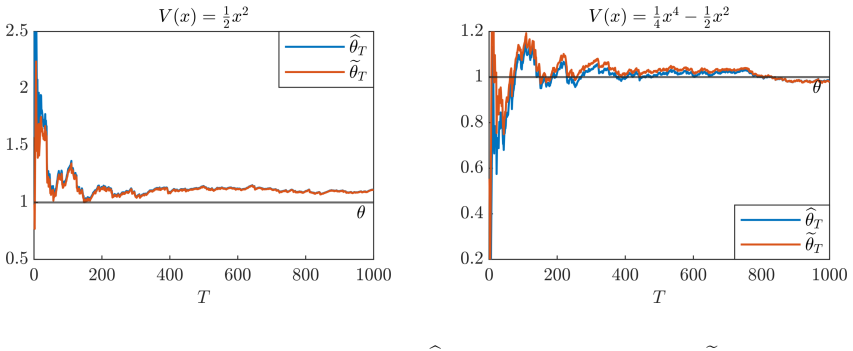
- The linearized MLE $\tilde\theta_T$, evaluated along a single path of the nonlinear SDE, is consistent, so parameter inference does not require observing the full particle system or the time-dependent expectation $\mathbb{E}[X_t]$.
- In the diffusive-mean field limit on the torus, the central limit theorem and invariance principle hold for the linearized process with the same diffusion matrix as the nonlinear process, confirming commutativity of the two limits in the unique-steady-state regime.
- The explicit rates, depending on convexity parameters, inverse temperature, and LSI constants, tell the user in practice when the linearization is accurate at a given time horizon.
Reading between the lines
- A practical diagnostic follows from the theorem: if a numerical simulation of the particle system shows that relative entropy to the linearized law does not decay exponentially, the system is likely in a multi-stable or phase-transition regime where linearization around a single invariant measure is not valid.
- The linearized MLE requires only one trajectory, whereas the nonlinear likelihood needs the full mean-field expectation; this gives a concrete reduction in data requirements for real interacting-particle systems.
- The torus smallness condition $C_i/a_i < W(1)$ involving the Lambert function could be tested numerically; finding the threshold where convergence breaks down would delimit the scope of the nonlinear LSI proof.
- The same entropy-plus-LSI mechanism might extend to kinetic (underdamped) McKean equations and to multiple invariant measures selected by basin of attraction, but each extension needs new estimates beyond this paper's assumptions.
Editorial analysis
A structured set of objections, weighed in public.
Referee Report
Summary. The paper studies the long-time comparison between the McKean SDE (1.2) and the linear diffusion (1.5) obtained by freezing the convolution at the invariant density f∞. Under convexity assumptions on R^d and a uniqueness/weak-interaction assumption on T^d, it claims exponential-in-time bounds on the relative entropy H(μt|νt) and the Wasserstein distance W2(μt,νt), with proofs based on relative-entropy estimates, LSIs, and Grönwall arguments. It then applies the linearization to construct a 'linearized' MLE for the McKean SDE (Theorem 3.3, a.s. convergence of the estimator) and to recover the diffusive-mean field CLT and invariance principle for the linearized process (Theorems 3.9 and 3.10), with numerical illustrations. I did not find a circularity in the MLE argument: the proof uses the independent L1 convergence of ft to f∞ from [41] and does not presuppose the exponential-closeness theorem.
Significance. If the quantitative claims hold, the paper's central message—that an ergodic McKean dynamics can be replaced at long times by a Markov diffusion with the same invariant measure—is useful and goes beyond the heuristic uses in [51] and [22]. The paper provides explicit rates, treats both R^d and T^d, adds a confining potential to the torus analysis, and gives a clean identifiability condition for the MLE application. The entropy-based proof architecture is transparent, and the numerical experiments usefully illustrate the applications. However, the explicit constants in the two main linearization theorems are not reliable as stated: Lemma 2.6 has a factor-4 error in the LSI constant, Lemma 2.18 has a missing factor in the Holley–Stroock step, and the torus exponential-convergence propositions require positivity of the rates ζ and η, which is not part of the standing assumptions. These issues can be repaired, but they affect the quantitative content of the central theorems.
major comments (3)
- [§2.2, Lemma 2.6 and Theorem 2.7] The LSI constant in Lemma 2.6 is inconsistent with the convention (2.2). For the exactly solvable case V(x)=|x|^2/2, W=0, β=1, α=1, γ=0, the invariant measure is N(0,1). Taking μ=N(1,1) gives H(μ|ν)=1/2 and I(μ|ν)=1, so the sharp constant in (2.2) is λ=2. Lemma 2.6 instead gives Λ=1/2, which would imply the false bound H(μ|ν)≤I(μ|ν)/8. The correct asymptotic constant is 2/(β(α+γ)), a factor 4 larger. Since (2.5) uses I≥(4/Λ)H, the case split, rate, and prefactor in Theorem 2.7 and the Wasserstein bound in Corollary 2.8 are not justified as stated. The proof can be repaired by correcting the constant, but all quantitative claims in Section 2.2 need to be revisited.
- [§2.3.2, Lemma 2.18 and Theorem 2.19] The Holley–Stroock application after (2.20) drops a factor. From (2.20), sup φt / inf φt = κ^2Γ^2. Given the LSI constant Γ/(2π^2) for μ∞ from Lemma 2.12, Holley–Stroock applied to νt = φt μ∞ gives Ξ = κ^2Γ^3/(2π^2), not κΓ^2/(2π^2). Similarly, the bound for ψt in (2.27) gives sup ψt / inf ψt of order κ^2Γ^2 e^{Ci/ai}/(1-(Ci/ai)e^{Ci/ai}), so the stated constant ~Ξi has the same missing factor and also misses the exponential factor in the numerator. These constants propagate into Theorem 2.19 and Corollary 2.20. The qualitative exponential-closeness conclusion survives, but the explicit torus constants are wrong.
- [§2.3.1, Propositions 2.14–2.15 and Corollary 2.17] The statements that ft converges to f∞ exponentially in L2 and in relative entropy are not valid under Assumption 2.11 alone, because the rates ζ in (2.11) and η in (2.14) can be negative, e.g., for large ∥∇V∥∞ or ∥∆W∥∞. The proofs produce d/dt ≤ −ζ∥ft−f∞∥^2 and d/dt ≤ −ηH(ft|f∞), which only give useful bounds when ζ,η>0. Remark 2.16 acknowledges that positivity is a high-temperature phenomenon, but the formal statements of Propositions 2.14, 2.15, and Corollary 2.17, and hence Theorem 2.19, do not include it. The torus main theorem should either assume ζ,η>0 explicitly or be formulated under a smallness condition that guarantees them.
minor comments (5)
- [§3.1.1, proof of Lemma 3.5] In the estimate for I_T^(2), the factor e^{−αt/2} is written outside the time integral; the correct bound has the exponential inside the integral, and the convergence to zero then follows from the uniform moment bound (2.4).
- [Theorem 3.3 and abstract] Theorem 3.3 proves strong consistency (almost sure convergence of ~θT to θ0), not asymptotic unbiasedness in the usual sense of convergence of expectations. The terminology 'asymptotically unbiased' appears in the abstract, introduction, and theorem statement; please align the wording.
- [§2.3, Proposition 2.14] If the torus has side length 1, the optimal Poincaré constant is 1/(4π^2) in the inequality ∥δ∥^2≤C∥∇δ∥^2, not 4/π^2; the constant 4/π^2 is valid but not optimal, so the phrase 'optimal constant' and the resulting rate ζ in (2.11) should be corrected or clarified.
- [§3.2, numerical experiments] The numerical experiments in Section 3.2.2 use the deterministic initial condition δ0, which does not satisfy the lower bound in (2.17). Please clarify that those simulations verify the CLT result and are not intended as numerical evidence for the torus entropy estimates of Theorems 2.19–2.20.
- [Throughout] There are several typos: 'dynanics' in Section 1, 'Poison equation' should be 'Poisson equation' in Section 3.2, and 'Preperint' in reference [12].
Circularity Check
No significant circularity: the exponential-closeness theorem is proved from independent external entropy estimates, LSI results, and ergodic convergence, not from the definition of the linearized process.
full rationale
The paper defines the linearized process Y_t by replacing f_t with the invariant density f_infinity in the convolution (Eq. 1.5), but the main theorem does not assume the conclusion. The proof of Theorem 2.7 uses the entropy estimate from Lacker--Le Flem [39, Lemma 3.1], an LSI for the linearized semigroup imported from [43, Proposition 1.1] via Lemma 2.6, and the independent exponential L1 convergence of f_t to f_infinity from Malrieu [41] (Eq. 2.3). The forcing term in the entropy inequality is bounded by this independent convergence, so the exponential decay of H(mu_t|nu_t) is derived, not built in. The torus results similarly rest on Proposition 2.15 and Holley--Stroock estimates, with external convergence inputs. The linearized MLE section uses a standard identifiability condition, Assumption 3.1(iii), on the limiting contrast function, and the consistency proof follows the usual martingale/ergodic argument; no parameter is fitted to a subset and then relabelled as a prediction. The diffusive-mean field limit section derives the CLT for the linearized process from the Poisson equation (3.11), obtaining the same diffusion matrix as the known nonlinear CLT, which is a comparison, not a renaming. Though the authors cite their own earlier works [14,22,51], those citations are used as background, for the uniqueness/phase-transition context, or as motivation for the linearization methodology; the load-bearing quantitative estimates come from external sources [39,41,43] and are not self-citations. The possible factor-of-four discrepancy in the LSI constants in Lemma 2.6 or Lemma 2.18 would be a mathematical correctness issue, not circularity: an incorrect constant would invalidate or weaken the explicit rates without making the conclusion equivalent to the assumptions. Overall, the derivation chain is self-contained in the relevant sense and no prediction reduces by construction to its inputs.
Assumptions & free parameters
assumptions (12)
- standard math [39, Lemma 3.1]: entropy estimate relating two Fokker-Planck solutions
- standard math [43, Proposition 1.1]: time-uniform LSI propagation for McKean-Vlasov equations
- standard math Talagrand transport inequality [48, Theorem 1]
- standard math Holley-Stroock perturbation lemma and Poincaré inequality on the torus
- standard math Csiszár-Kullback-Pinsker inequality
- standard math Ergodic theorem and strong law of large numbers for martingales
- standard math [11, Theorem 3.1]: uniform continuity of the averaged martingale term in θ
- domain assumption Uniform convexity of V and W (Assumption 2.3(iii))
- domain assumption H-stability or small L∞ norm of W on the torus (Assumption 2.11(iii))
- domain assumption Initial densities bounded away from zero and above (2.17) and Ci/ai < W(1) (Lemma 2.18)
- domain assumption Initial LSI with constant λ0 (Lemma 2.6)
- domain assumption Compactness, Lipschitz in θ, and identifiability (Assumption 3.1)
Cite this review
Pith. "Pith review of Linearization of ergodic McKean SDEs and applications." pith.science (2026). https://pith.science/paper/WQMSJQF7
@misc{pith2026250113655,
  author       = {Pith},
  title        = {Pith review of: Linearization of ergodic McKean SDEs and applications},
  year         = {2026},
  howpublished = {\url{https://pith.science/paper/WQMSJQF7}},
  note         = {Machine review of arXiv:2501.13655}
}
read the original abstract
In this article, we consider McKean stochastic differential equations, as well as their corresponding McKean-Vlasov partial differential equations, which admit a unique stationary state, and we study the linearized It\^o diffusion process that is obtained by replacing the law of the process in the convolution term with the unique invariant measure. We show that the law of the nonlinear McKean process converges to the law of this linearized process exponentially fast in time, both in relative entropy and in Wasserstein distance. We study the problem in both the whole space and the torus. We then show how we can employ the resulting linear (in the sense of McKean) Markov process to analyze properties of the original nonlinear and nonlocal dynamics that depend on their long-time behavior. In particular, we propose a linearized maximum likelihood estimator for the nonlinear process which is asymptotically unbiased, and we study the joint diffusive-mean field limit of the underlying interacting particle system.
Figures


Forward citations
Cited by 1 Pith paper
-
Multi-species McKean-Vlasov dynamics in non-convex landscapes
Multi-species mean-field particle systems with quadratic interactions are shown to exhibit phase transitions, with unique or multiple stationary states depending on noise, under a structural assumption that reduces th...
Reference graph
Works this paper leans on
-
[41]
Malrieu, Logarithmic Sobolev inequalities for some nonlinear PDE’s, Stochastic Process
F. Malrieu, Logarithmic Sobolev inequalities for some nonlinear PDE’s, Stochastic Process. Appl., 95 (2001), pp. 109–132
work page 2001
-
[51]
G. A. Pavliotis and A. Zanoni, Eigenfunction martingale estimators for interacting particle systems and their mean field limit, SIAM J. Appl. Dyn. Syst., 21 (2022), pp. 2338–2370
work page 2022
-
[22]
M. G. Delgadino, R. S. Gvalani, and G. A. Pavliotis, On the diffusive-mean field limit for weakly interacting diffusions exhibiting phase transitions, Arch. Ration. Mech. Anal., 241 (2021), pp. 91–148
work page 2021
-
[1]
Polynomial rates via deconvolution for nonparametric estimation in McKean-Vlasov SDEs
C. Amorino, D. Belomestny, V. Pilipauskait˙e, M. Podolskij, and S.-Y. Zhou, Polynomial rates via deconvolution for nonparametric estimation in McKean- Vlasov SDEs. Preprint arXiv:2401.04667, 2024
work page Pith review arXiv 2024
- [2]
-
[3]
F. Bavaud, Equilibrium properties of the Vlasov functional: the generalized Poisson- Boltzmann-Emden equation, Rev. Modern Phys., 63 (1991), pp. 129–148
work page 1991
-
[4]
Z. W. Bezemek and K. Spiliopoulos, Rate of homogenization for fully-coupled McKean-Vlasov SDEs, Stoch. Dyn., 23 (2023), pp. Paper No. 2350013, 65
work page 2023
- [5]
Show all 64 references
-
[6]
Binney and S
J. Binney and S. Tremaine, Galactic Dynamics, Princeton University Press, Princeton, second ed., 2008
2008
-
[7]
J. P. N. Bishwal, Estimation in interacting diffusions: continuous and discrete sampling, Appl. Math. (Irvine), 2 (2011), pp. 1154–1158
2011
-
[8]
V. I. Bogachev, M. Röckner, and S. V. Shaposhnikov, Distances between transition probabilities of diffusions and applications to nonlinear Fokker-Planck- Kolmogorov equations, J. Funct. Anal., 271 (2016), pp. 1262–1300. 31
2016
-
[9]
V. I. Bogachev, S. V. Shaposhnikov, and A. Y. Veretennikov, Differentiabil- ity of solutions of stationary Fokker-Planck-Kolmogorov equations with respect to a parameter, Discrete Contin. Dyn. Syst., 36 (2016), pp. 3519–3543
2016
-
[10]
Bolley and C
F. Bolley and C. Villani, Weighted Csiszár-Kullback-Pinsker inequalities and applications to transportation inequalities, Ann. Fac. Sci. Toulouse Math. (6), 14 (2005), pp. 331–352
2005
-
[11]
Borkar and A
V. Borkar and A. Bagchi, Parameter estimation in continuous-time stochastic processes, Stochastics, 8 (1982/83), pp. 193–212
1982
-
[12]
Bruno, F
G. Bruno, F. Pasqualotto, and A. Agazzi, Emergence of meta-stable clustering in mean-field transformer models. Preperint arXiv:2410.23228, 2024
2024 arXiv
-
[13]
J. A. Carrillo, M. G. Delgadino, and G. A. Pavliotis, A λ-convexity based proof for the propagation of chaos for weakly interacting stochastic particles, J. Funct. Anal., 279 (2020), p. 108734
2020
-
[14]
J. A. Carrillo, R. S. Gvalani, G. A. Pavliotis, and A. Schlichting, Long- time behaviour and phase transitions for the McKean-Vlasov equation on the torus, Arch. Ration. Mech. Anal., 235 (2020), pp. 635–690
2020
-
[15]
J. A. Carrillo, F. Hoffmann, A. M. Stuart, and U. Vaes, Consensus-based sampling, Stud. Appl. Math., 148 (2022), pp. 1069–1140
2022
-
[16]
J. A. Carrillo, S. Jin, H. Zhang, and Y. Zhu, An interacting particle consensus method for constrained global optimization. Preprint arXiv:2405.00891, 2024
2024
-
[17]
Chazelle, Q
B. Chazelle, Q. Jiu, Q. Li, and C. Wang, Well-posedness of the limiting equation of a noisy consensus model in opinion dynamics, J. Differential Equations, 263 (2017), pp. 365–397
2017
-
[18]
Comte, V
F. Comte, V. Genon-Catalot, and C. Larédo, Nonparametric moment method for scalar McKean-Vlasov stochastic differential equations. Preprint hal-04460327v2, 2024
2024
-
[19]
D. A. Dawson, Critical dynamics and fluctuations for a mean-field model of coopera- tive behavior, J. Statist. Phys., 31 (1983), pp. 29–85
1983
-
[20]
D. S. Dean, Langevin equation for the density of a system of interacting Langevin processes, J. Phys. A, 29 (1996), pp. L613–L617
1996
-
[21]
Delarue and A
F. Delarue and A. Tse, Uniform in time weak propagation of chaos on the torus. Preprint arXiv:2104.14973, 2024
2024 arXiv
-
[23]
M. G. Delgadino, R. S. Gvalani, G. A. Pavliotis, and S. A. Smith, Phase transitions, logarithmic Sobolev inequalities, and uniform-in-time propagation of chaos for weakly interacting diffusions, Comm. Math. Phys., 401 (2023), pp. 275–323
2023
-
[24]
Della Maestra and M
L. Della Maestra and M. Hoffmann, The LAN property for McKean-Vlasov models in a mean-field regime, Stochastic Process. Appl., 155 (2023), pp. 109–146. 32
2023
-
[25]
Dressler, Stationary solutions of the Vlasov-Fokker-Planck equation, Math
K. Dressler, Stationary solutions of the Vlasov-Fokker-Planck equation, Math. Methods Appl. Sci., 9 (1987), pp. 169–176
1987
-
[26]
M. H. Duong, A. Lamacz, M. A. Peletier, A. Schlichting, and U. Sharma, Quantification of coarse-graining error in Langevin and overdamped Langevin dynamics, Nonlinearity, 31 (2018), pp. 4517–4566
2018
-
[27]
Eberle, A
A. Eberle, A. Guillin, and R. Zimmer, Couplings and quantitative contraction rates for Langevin dynamics, Ann. Probab., 47 (2019), pp. 1982–2010
2019
-
[28]
Garnier, G
J. Garnier, G. Papanicolaou, and T.-W. Yang, Consensus convergence with stochastic effects, Vietnam J. Math., 45 (2017), pp. 51–75
2017
-
[29]
B. Gess, R. S. Gvalani, and V. Konarovskyi, Conservative spdes as fluctuating mean field limits of stochastic gradient descent. Preprint arXiv:2207.05705, 2022
2022 arXiv
-
[30]
B. D. Goddard, B. Gooding, H. Short, and G. A. Pavliotis, Noisy bounded confidence models for opinion dynamics: the effect of boundary conditions on phase transitions, IMA J. Appl. Math., 87 (2022), pp. 80–110
2022
-
[31]
Golse, On the dynamics of large particle systems in the mean field limit, in Macroscopic and large scale phenomena: coarse graining, mean field limits and ergodicity, vol
F. Golse, On the dynamics of large particle systems in the mean field limit, in Macroscopic and large scale phenomena: coarse graining, mean field limits and ergodicity, vol. 3 of Lect. Notes Appl. Math. Mech., Springer, [Cham], 2016, pp. 1–144
2016
-
[32]
Gomes and G
S. Gomes and G. Pavliotis, Mean field limits for interacting diffusions in a two-scale potential, J. Nonlin. Sci., 28 (2018), pp. 905–941
2018
-
[33]
Guillin, P
A. Guillin, P. Le Bris, and P. Monmarché, Uniform in time propagation of chaos for the 2D vortex model and other singular stochastic systems, J. Eur. Math. Soc., (2024)
2024
-
[34]
R. A. Kasonga, Maximum likelihood theory for large interacting systems, SIAM J. Appl. Math., 50 (1990), pp. 865–875
1990
-
[35]
Kawasaki, Microscopic analyses of the dynamical density functional equation of dense fluids, J
K. Kawasaki, Microscopic analyses of the dynamical density functional equation of dense fluids, J. Statist. Phys., 93 (1998), pp. 527–546
1998
-
[36]
Kessler and M
M. Kessler and M. Sø rensen, Estimating equations based on eigenfunctions for a discretely observed diffusion process, Bernoulli, 5 (1999), pp. 299–314
1999
-
[37]
Komorowski, C
T. Komorowski, C. Landim, and S. Olla, Fluctuations in Markov processes, vol. 345 of Grundlehren der mathematischen Wissenschaften [Fundamental Principles of Mathematical Sciences], Springer, Heidelberg, 2012. Time symmetry and martingale approximation
2012
-
[38]
Konarovskyi, T
V. Konarovskyi, T. Lehmann, and M.-K. von Renesse, Dean-Kawasaki dynam- ics: ill-posedness vs. triviality, Electron. Commun. Probab., 24 (2019), pp. Paper No. 8, 9
2019
-
[39]
Lacker and L
D. Lacker and L. Le Flem, Sharp uniform-in-time propagation of chaos, Probab. Theory Related Fields, 187 (2023), pp. 443–480
2023
-
[40]
Liu and H
M. Liu and H. Qiao, Parameter estimation of path-dependent McKean-Vlasov stochastic differential equations, Acta Math. Sci. Ser. B (Engl. Ed.), 42 (2022), pp. 876– 886. 33
2022
-
[42]
S. Mei, A. Montanari, and P.-M. Nguyen, A mean field view of the landscape of two-layer neural networks, Proc. Natl. Acad. Sci. USA, 115 (2018), pp. E7665–E7671
2018
-
[43]
Monmarché, Z
P. Monmarché, Z. Ren, and S. Wang, Time-uniform log-Sobolev inequalities and applications to propagation of chaos. Preprint arXiv:2401.07966, 2024
2024 arXiv
-
[44]
Monmarché and J
P. Monmarché and J. Reygner, Local convergence rates for Wasserstein gradient flows and McKean-Vlasov equations with multiple stationary solutions. Preprint arXiv:2404.15725, 2024
2024 arXiv
-
[45]
Nickl, G
R. Nickl, G. A. Pavliotis, and K. Ray, Bayesian nonparametric inference in McKean-Vlasov models. Preprint arXiv:2404.16742, 2024
2024 arXiv
-
[46]
Oelschläger, A martingale approach to the law of large numbers for weakly interacting stochastic processes, Ann
K. Oelschläger, A martingale approach to the law of large numbers for weakly interacting stochastic processes, Ann. Probab., 12 (1984), pp. 458–479
1984
-
[47]
Olla, Homogenization of Diffusion Processes in Random Fields, Ecole Polytech- nique, 1994
S. Olla, Homogenization of Diffusion Processes in Random Fields, Ecole Polytech- nique, 1994
1994
-
[48]
Otto and C
F. Otto and C. Villani, Generalization of an inequality by Talagrand and links with the logarithmic Sobolev inequality, J. Funct. Anal., 173 (2000), pp. 361–400
2000
-
[49]
Pavliotis and A
G. Pavliotis and A. Stuart, Multiscale methods, vol. 53 of Texts in Applied Mathematics, Springer, New York, 2008. Averaging and homogenization
2008
-
[50]
G. A. Pavliotis, Stochastic processes and applications, vol. 60 of Texts in Applied Mathematics, Springer, New York, 2014. Diffusion processes, the Fokker-Planck and Langevin equations
2014
-
[52]
G. A. Pavliotis and A. Zanoni, A method of moments estimator for interacting particle systems and their mean field limit, SIAM/ASA J. Uncertain. Quantif., 12 (2024), pp. 262–288
2024
-
[53]
P. Ren, M. Röckner, and F.-Y. Wang, Linearization of nonlinear Fokker-Planck equations and applications, J. Differential Equations, 322 (2022), pp. 1–37
2022
-
[54]
G. M. Rotskoff and E. Vanden-Eijnden, Trainability and accuracy of artificial neural networks: an interacting particle system approach, Comm. Pure Appl. Math., 75 (2022), pp. 1889–1935
2022
-
[55]
Ruelle, Statistical mechanics, World Scientific Publishing Co., Inc., River Edge, NJ; Imperial College Press, London, 1999
D. Ruelle, Statistical mechanics, World Scientific Publishing Co., Inc., River Edge, NJ; Imperial College Press, London, 1999. Rigorous results, Reprint of the 1989 edition
1999
-
[56]
Sharrock, N
L. Sharrock, N. Kantas, P. Parpas, and G. A. Pavliotis, Online parameter estimation for the McKean-Vlasov stochastic differential equation, Stochastic Process. Appl., 162 (2023), pp. 481–546. 34
2023
-
[57]
Sirignano and K
J. Sirignano and K. Spiliopoulos, Mean field analysis of neural networks: a law of large numbers, SIAM J. Appl. Math., 80 (2020), pp. 725–752
2020
-
[58]
Suzuki, Free energy and self-interacting particles, vol
T. Suzuki, Free energy and self-interacting particles, vol. 62 of Progress in Nonlinear Differential Equations and their Applications, Birkhäuser Boston, Inc., Boston, MA, 2005
2005
-
[59]
Sznitman, Topics in propagation of chaos, in École d’Été de Probabilités de Saint-Flour XIX—1989, vol
A.-S. Sznitman, Topics in propagation of chaos, in École d’Été de Probabilités de Saint-Flour XIX—1989, vol. 1464 of Lecture Notes in Math., Springer, Berlin, 1991, pp. 165–251
1989
-
[60]
Tamura, On asymptotic behaviors of the solution of a nonlinear diffusion equation, J
Y. Tamura, On asymptotic behaviors of the solution of a nonlinear diffusion equation, J. Fac. Sci. Univ. Tokyo Sect. IA Math., 31 (1984), pp. 195–221
1984
-
[61]
A. B. Tsybakov, Introduction to nonparametric estimation, Springer Series in Statistics, Springer, New York, 2009. Revised and extended from the 2004 French original, Translated by Vladimir Zaiats
2009
-
[62]
Tugaut, Self-stabilizing processes in multi-wells landscape inRd-invariant proba- bilities, J
J. Tugaut, Self-stabilizing processes in multi-wells landscape inRd-invariant proba- bilities, J. Theoret. Probab., 27 (2014), pp. 57–79
2014
-
[63]
J. H. van Zanten, A note on consistent estimation of multivariate parameters in ergodic diffusion models, Scand. J. Statist., 28 (2001), pp. 617–623
2001
-
[64]
Zhang, Existence and non-uniqueness of stationary distributions for distribution dependent SDEs, Electron
S.-Q. Zhang, Existence and non-uniqueness of stationary distributions for distribution dependent SDEs, Electron. J. Probab., 28 (2023), pp. Paper No. 93, 34. 35
2023
Reviewed August 10, 2026 · model on record in the stance chip above.
Discussion (0). Continue with ORCID to comment.