REVIEW 4 major objections 5 minor 38 references
Optimization of geometric hypergraph embedding
T0 review · 4 major / 5 minor · reviewed 2026-08-15 · deepseek-v4-flash
Pith's one-line read This paper claims that the hidden Euclidean geometry behind hypergraph connections can be recovered by minimizing a differentiable reconstruction loss with gradient descent.
desk verdict Solid algorithmic contribution; the geometry-recovery claim is currently supported only by incidence reconstruction, not by any comparison to planted coordinates. read the letter →
The pith
A machine-rendered reading of the paper's core claim, the machinery that carries it, and where it could break.
The reading
What carries the argument
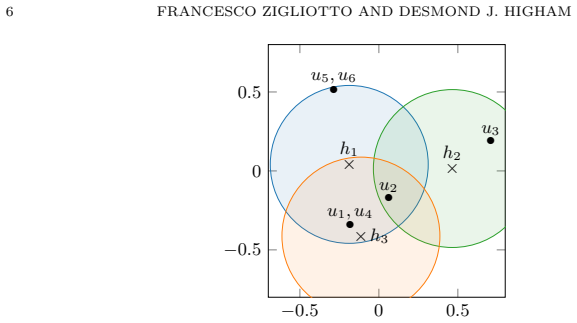
The machinery is a differentiable surrogate for reconstruction error. Given a hypergraph's incidence matrix $B^{(0)}$, an embedding $Y$ of node and hyperedge-centre positions, and a radius $r$, the true loss $L(Y,r)$ counts the relative number of entries where a thresholded distance matrix, with an edge whenever $\|Y(u_i)-Y(h_j)\|\le r$, differs from $B^{(0)}$. To make this piecewise-constant count optimizable, the paper replaces the step with $f_\tau(x,r) = 1/(1+\exp(\tau^2(x^2-r^2)))$, obtaining the smoothed loss $L_\tau$; Theorem 1 expresses its gradient with respect to the bipartite weight matrix via eigenvector derivatives from spectral perturbation theory, and the derivatives with respect to $Y$ follow by the chain rule. GDSE iterates spectral embeddings of modified weight matrices, while GDE relaxes the spectral constraint and directly gradient-descents $Y$, $r$, and $\tau$, making large sparse hypergraphs tractable.
What would settle it
Take a hypergraph sampled from the random geometric model with known node and centre coordinates and true dimension $D$, run GDE with that $D$, and check whether the recovered incidence matrix approaches the planted one: if the best reconstruction loss stays well above the $0.009$-level reported on the largest synthetic test, the recovery claim fails. A complementary check is to run GDE on a non-geometric hypergraph, such as one with independent random memberships; if its loss still drops near zero, then low loss does not actually certify geometry.
Extended reading notes
Core claim
On the paper's own terms, the discovery is that the hidden geometry of a hypergraph can be learned by optimizing a smoothed reconstruction loss rather than relying on a one-shot spectral embedding. Using the bipartite incidence graph, each hyperedge is treated as an unknown centre point; an embedding $Y$ and radius $r$ generate a predicted incidence matrix by thresholding distances. The paper proves differentiability of the smoothed loss $L_\tau$ with respect to the spectral weight matrix, the radius, and the smoothing parameter, and implements gradient descent in two variants. The numerical claim is that this recovers the planted structure in random geometric hypergraphs, achieving perfect reconstruction on the smallest synthetic test and a reconstruction error of $0.009$ on the largest, and that the resulting per-pair scores identify deliberately inserted spurious or missing memberships with AUC values around $0.9$--$0.98$, while K-means on the embedding improves clustering accuracy on school-contact hypergraphs beyond the earlier spectral method.
Load-bearing premise
The load-bearing premise is that the observed hypergraph was produced, at least approximately, by a random geometric model: nodes and a small number of hyperedge centres live in one $D$-dimensional Euclidean space and every hyperedge contains exactly the nodes within a single global radius $r$ of its centre.
Editorial extensions
If this is right
- For a hypergraph that truly follows the geometric model, the final loss value is a direct measure of how well a single radius around centres explains the data, so GDE's reconstruction error can be read as a geometricity score.
- The $[\tilde{B}_\tau]_{ij}$ values produced by the embedding are usable as confidence scores: thresholding them flags spurious and missing node-hyperedge memberships without retraining a classifier.
- GDE's stochastic gradient and clique-expansion initialization make the approach feasible for large sparse hypergraphs where full spectral embeddings are too expensive.
- Clustering based on the optimized embeddings improves community recovery relative to a one-shot spectral embedding on real contact hypergraphs.
- GDSE and GDE trade off the orthogonality and spectral guarantees of the former against the scalability of the latter, while both solve the same inverse problem.
Reading between the lines
- The smoothed loss $L_\tau$ is close to a likelihood for the geometric model, so the same machinery could score competing generative hypotheses, geometric versus random membership, by comparing losses on held-out hyperedges.
- The spurious/missing detector's threshold and learned radius are dataset-dependent; a natural extension is to calibrate $\alpha$ on a validation set and to study how the final loss varies with embedding dimension $D$, yielding a principled dimension-selection rule.
- Because each hyperedge is represented by a centre point, the embedding also suggests a way to predict entirely new hyperedges: a hypothetical centre placed near a group of nodes would predict a future joint membership.
- Comparisons of the final reconstruction loss across different real hypergraphs would quantify how geometric each dataset is, even though the single-radius model is only an approximation.
Signed reviews
Editorial analysis
A structured set of objections, weighed in public.
Referee Report
Summary. The paper considers the inverse problem of recovering a Euclidean embedding of the nodes and hyperedge centres of a hypergraph under the assumption that hyperedges arise from a random geometric hypergraph model, in which nodes are connected to centres within a fixed radius r. The authors define a reconstruction loss L(Y,r) that measures the Frobenius discrepancy between the incidence matrix induced by the embedding and the observed incidence matrix, and a smoothed version L_tau using a logistic function. They propose two gradient-descent algorithms: GDSE, which optimizes a weight matrix B subject to Y being the spectral embedding of the associated bipartite graph, and GDE, which directly optimizes Y. Theorem 1 provides the gradients of L_tau with respect to B, r, and tau. The paper reports experiments on three synthetic RGH hypergraphs and three real hypergraphs (senate committees, two school contact networks), showing low reconstruction error, AUC values for spurious/missing membership detection, and ARI for community detection.
Significance. The paper supplies a clear and original algorithmic framework: it turns a generative geometric assumption into a differentiable objective, derives the gradients using standard eigenvector perturbation theory, and makes code available. The reported AUC values (up to 0.977) and ARI results (compared favourably to [17]) indicate practical potential. However, the central claim that the method 'accurately reveals geometric structure that is planted in the data' is not backed by the reported metric: L measures incidence reconstruction, not agreement with planted coordinates. The empirical evaluation also lacks error bars, baselines, and out-of-sample validation. If the authors add the missing evaluations or appropriately reframe the claims, the contribution would be solid; in its current form the significance is overstated.
major comments (4)
- [Abstract; §4.1] The claim that synthetic tests show the approach 'accurately reveals geometric structure that is planted in the data' is not supported by the reported loss L(Y,r). This loss compares the reconstructed incidence matrix B̃(Y,r) with the original B(0) (Equation in §3.1); it does not compare the recovered coordinates Y with the planted node positions or hyperedge centres. Since the RGH construction (2) is defined by a radius threshold, many different point configurations can induce the same incidence pattern, so L≈0 is consistent with embeddings that are far from the true geometry. The paper never reports any measure of agreement between Y and the ground-truth coordinates for the synthetic experiments. I recommend either adding a geometric-fidelity evaluation on synthetic data (e.g., Procrustes-aligned correlation between Y and the planted coordinates, or comparison of pairwise distance matrices) or replacing the 'reveals geometry' phrasing with 'reconstructs the hypergraph incidence structure.'
- [§4.1, Table 1] The empirical support rests on single runs with no error bars. For the synthetic hypergraphs, the embedding dimension D is set to the true generating dimension, which is an oracle choice not available in practice. Moreover, the paper does not compare against a baseline, such as the basic spectral embedding described in §3.2 or a random embedding with a fitted radius, so the statement that the new algorithms improve on 'basic spectral embedding' is not quantified. Please report means and standard deviations over multiple RGH realizations and include at least the §3.2 spectral baseline and a null model in Table 1.
- [§4.2, Table 2] The AUC values for detecting spurious or missing memberships are computed from an embedding trained on the same hypergraph H+ whose corrupted entries are being scored. Because the loss L_tau (9) uses every entry of B(0), the values [B̃τ]ij for the anomalous entries are in-sample quantities, which makes the AUC optimistically biased. A valid evaluation would hide or mask the corrupted entries during training and test on those entries (or use a cross-validation scheme). Table 2 should also include error bars, since the corruption process is random.
- [§4.1, real-data paragraph] The statement that on real hypergraphs the reconstruction error measures 'the extent to which geometric structure is present in the data' is an interpretation that is not justified by the experiment. L is a training error of a model with many free parameters (the whole embedding Y, plus r and tau); without a null model (e.g., a configuration model preserving degrees, or a random embedding baseline) or a statistical testing procedure, a low value of L cannot be attributed to geometric structure. If this interpretation is to be kept, the authors need to add an appropriate baseline or reformulate the claim.
minor comments (5)
- [§3.3, Theorem 1] The displayed formula for ∂Lτ/∂B has notation errors: the sum over h runs to N instead of N−1 (there is no eigenvector v^{(N)}), and the proof later writes 'n X h=D+1' in place of the eigenvector sum. The intended formula is clear from the derivation, but the statement should be corrected.
- [§3.2, Proposition 1] The minimization in (4) is stated over all Y∈R^{n×D} without an orthogonality or scale constraint, yet without such a constraint the objective is unbounded (scaling Y by a constant multiplies the objective). Remark 2 mentions column normalization, but this should be part of the proposition's statement.
- [§4.3] Reporting only the best of 50 K-means runs per GDE iteration overstates clustering performance; a mean or median with standard deviation would be a more honest summary, or the paper should justify the 'best-of-50' protocol.
- [§4.1, Table 1; throughout] The acronym for Gradient-Descent Spectral Embedding is used inconsistently: the text and Table 1 use 'GSDE' in places (Section 4.1, Table 1), while the algorithm is defined as 'GDSE' (Listing 1, Section 5). Please standardize.
- [§4.2] The term 'Receiver Operator Characteristic' should be 'Receiver Operating Characteristic'.
Circularity Check
No significant circularity: the optimization derivations are self-contained, and the paper's most informative evaluations (AUC, ARI) are external; the synthetic reconstruction metric is the optimized loss itself, which is an in-sample check rather than independent geometry recovery.
full rationale
The paper's derivation chain is not circular. The loss L(Y,r) in Section 3.1 is defined from the incidence matrix B(0) and a reconstructed incidence matrix ~B(Y,r); GDSE and GDE are derived to minimize the smoothed version Lτ, with gradient formulas obtained from standard eigenvector perturbation theory (Theorem 1 and Eq. (10)). No step in this derivation assumes the conclusion. The synthetic 'geometry recovery' results in Table 1 report L, which is exactly the quantity being optimized; Remark 3 notes that the planted configuration is a zero-loss solution, so low L is an in-sample feasibility check, not a measurement of coordinate recovery. This is an overinterpretation in the abstract ('synthetic tests show that this approach accurately reveals geometric structure that is planted in the data'), but it is an evidence gap, not a logical circularity. The paper's downstream evaluations are genuinely external: AUC for spurious/missing memberships (Section 4.2) and ARI against ground-truth community labels (Section 4.3) use labels not present in the loss. Self-citations to the RGH model [23] and prior spectral work [17] are used as background, model definition, or comparison baseline, not as the sole justification for the central claim. Under the hard rules, this warrants a low score of 2 for minor self-citation, not a circularity finding.
Assumptions & free parameters
free parameters (5)
- Radius r =
Optimized via gradient descent; initial value r(0) about 0.1 (Listings 1 and 2)
- Smoothing steepness tau =
Optimized via gradient descent; initialized around 5 or 10
- Embedding dimension D =
3 for RGH1, 6 for RGH2/RGH3, 32 for senate, 64 for contact hypergraphs, 16 for clustering
- Learning rates =
Example values gamma_B=1, gamma_r=0.001, gamma_tau=1; GDE uses Armijo-Goldstein line search
- Detection threshold alpha =
0.4 in the spurious detection example
assumptions (5)
- domain assumption Random geometric hypergraph model with a single global radius r
- standard math Spectral embedding minimizes the pairwise weighted distance objective
- standard math First-order eigenvector perturbation theory applies with distinct eigenvalues
- domain assumption Sigmoid approximation f_tau is a valid surrogate for the hard threshold
- domain assumption Gradient descent reaches a good local optimum of the nonconvex loss
Cite this review
Pith. "Pith review of Optimization of geometric hypergraph embedding." pith.science (2026). https://pith.science/paper/WQR62ZZI
@misc{pith2026250908772,
  author       = {Pith},
  title        = {Pith review of: Optimization of geometric hypergraph embedding},
  year         = {2026},
  howpublished = {\url{https://pith.science/paper/WQR62ZZI}},
  note         = {Machine review of arXiv:2509.08772}
}
read the original abstract
We consider the problem of embedding the nodes of a hypergraph into Euclidean space under the assumption that the interactions arose through closeness to unknown hyperedge centres. In this way, we tackle the inverse problem associated with the generation of geometric random hypergraphs. We propose two new spectral algorithms; both of these exploit the connection between hypergraphs and bipartite graphs. The assumption of an underlying geometric structure allows us to define a concrete measure of success that can be used to optimize the embedding via gradient descent. Synthetic tests show that this approach accurately reveals geometric structure that is planted in the data, and tests on real hypergraphs show that the approach is also useful for the downstream tasks of detecting spurious or missing data and node clustering.
Figures


Figures from the paper (6 more)


Reference graph
Works this paper leans on
-
[17]
Generative hypergraph models and spectral embedding
X. Gong, D. J. Higham, and K. Zygalakis. “Generative hypergraph models and spectral embedding”. In:Scientific Reports13.1 (Jan. 11, 2023), p. 540. url:https://doi.org/10.1038/s41598-023-27565-9
-
[23]
Connectivity of Random Geometric Hypergraphs
H.-L. de Kergorlay and D. J. Higham. “Connectivity of Random Geometric Hypergraphs”. In:Entropy (Basel, Switzerland)25.11 (2023), p. 1555
work page 2023
-
[1]
Evolutionary dynamics of higher-order interactions in social networks
U. Alvarez-Rodriguez, F. Battiston, G. F. de Arruda, Y. Moreno, M. Perc, and V. Latora. “Evolutionary dynamics of higher-order interactions in social networks”. In:Nat. Hum. Behav.(2021)
work page 2021
-
[2]
A Survey on Hypergraph Representation Learning
A. Antelmi, G. Cordasco, M. Polato, V. Scarano, C. Spagnuolo, and D. Yang. “A Survey on Hypergraph Representation Learning”. In:ACM Comput. Surv. 56.1 (Aug. 2023).url:https://doi.org/10.1145/3605776
doi:10.1145/3605776 2023
-
[3]
Minimization of functions having Lipschitz continuous first partial derivatives
L. Armijo. “Minimization of functions having Lipschitz continuous first partial derivatives.” In:Pacific Journal of Mathematics16.1 (1966), pp. 1–3
work page 1966
-
[4]
Class of models for random hypergraphs
M. Barthelemy. “Class of models for random hypergraphs”. In:Phys. Rev. E 106 (6 2022), p. 064310
work page 2022
-
[5]
The physics of higher-order interactions in complex systems
F. Battiston, E. Amico, A. Barrat, G. Bianconi, G. Ferraz de Arruda, B. Franceschiello, I. Iacopini, S. K´ efi, V. Latora, Y. Moreno, M. M. Murray, T. P. Peixoto, F. Vaccarino, and G. Petri. “The physics of higher-order interactions in complex systems”. In:Nature Physics17 (2021), pp. 1093–1098
work page 2021
-
[6]
Networks beyond pairwise interactions: Structure and dynamics
F. Battiston, G. Cencetti, I. Iacopini, V. Latora, M. Lucas, A. Patania, J. -G. Young, and G. Petri. “Networks beyond pairwise interactions: Structure and dynamics”. In:Physics Reports874 (2020), pp. 1–92
work page 2020
Show all 38 references
-
[7]
Towards a theoretical foundation for Laplacian- based manifold methods
M. Belkin and P. Niyogi. “Towards a theoretical foundation for Laplacian- based manifold methods”. In:Journal of Computer and System Sciences74 (2008), pp. 1289–1308
2008
-
[8]
Higher-order organization of complex networks
A. R. Benson, D. F. Gleich, and J. Leskovec. “Higher-order organization of complex networks”. In:Science353.6295 (2016), pp. 163–166
2016
-
[9]
Three Hypergraph Eigenvector Centralities
A. R. Benson. “Three Hypergraph Eigenvector Centralities”. In:SIAM Journal on Mathematics of Data Science1.2 (2019), pp. 293–312.url: https://doi. org/10.1137/18M1203031
2019 doi
-
[10]
What Are Higher- Order Networks?
C. Bick, E. Gross, H. A. Harrington, and M. T. Schaub. “What Are Higher- Order Networks?” In:SIAM Review65.3 (2023), pp. 686–731
2023
-
[11]
The use of the area under the ROC curve in the evaluation of machine learning algorithms
A. P. Bradley. “The use of the area under the ROC curve in the evaluation of machine learning algorithms”. In:Pattern Recognition30.7 (1997), pp. 1145– 1159
1997
-
[12]
Hypergraph clustering: from blockmodels to modularity
P. S. Chodrow, N. Veldt, and A. R. Benson. “Hypergraph clustering: from blockmodels to modularity”. In:Science Advances(2021)
2021
-
[13]
A spatial hypergraph model where epidemic spread demonstrates clear higher-order effects
O. Eldaghar, Y. Zhu, and D. F. Gleich. “A spatial hypergraph model where epidemic spread demonstrates clear higher-order effects”. In:The 13th Inter- national Conference on Complex Networks and their Applications. 2024
2024
-
[14]
Estimating the intrinsic dimension of datasets by a minimal neighbourhood information
E. Facco, M. d’Errico, A. Rodriguez, and A. Laio. “Estimating the intrinsic dimension of datasets by a minimal neighbourhood information”. In:Sci. Rep. 7 (2017), p. 12140
2017
-
[15]
A Representation of Hypergraphs in the Euclidean Space
K. Fukunaga, S. Yamada, H. S. Stone, and T. Kasai. “A Representation of Hypergraphs in the Euclidean Space”. In:IEEE Transactions on Computers C-33.4 (1984), pp. 364–367
1984
-
[16]
Random plane networks
E. N. Gilbert. “Random plane networks”. In:Journal of the Society for Industrial and Applied Mathematics9 (1961), pp. 533–543. 16 FRANCESCO ZIGLIOTTO AND DESMOND J. HIGHAM
1961
-
[18]
Estimating network dimension when the spectrum struggles
P. Grindrod, D. J. Higham, and H. -L. de Kergorlay. “Estimating network dimension when the spectrum struggles”. In:Royal Society Open Science11 (2024)
2024
-
[19]
Periodic reordering
P. Grindrod, D. J. Higham, and G. Kalna. “Periodic reordering”. In:IMA Journal of Numerical Analysis30.1 (2010), pp. 195–207
2010
-
[20]
Epidemics on hypergraphs: Spectral thresholds for extinction
D. J. Higham and H. -L. De Kergorlay. “Epidemics on hypergraphs: Spectral thresholds for extinction”. In:Proceedings of the Royal Society A477.2252 (2021), p. 20210232
2021
-
[21]
Spectral clustering and its use in bioinformatics
D. J. Higham, G. Kalna, and M. J. Kibble. “Spectral clustering and its use in bioinformatics”. In:Journal of Computational and Applied Mathematics204 (2007), pp. 25–37
2007
-
[22]
Comparing partitions
L. Hubert and P. Arabie. “Comparing partitions”. In:Journal of Classifi- cation2.1 (Dec. 1, 1985), pp. 193–218.url: https://doi.org/10.1007/ BF01908075
1985
-
[24]
Signed Laplacian for spectral clustering revisited
A. V. Knyazev. “Signed Laplacian for spectral clustering revisited”. In: ArXivabs/1701.01394 (2017).url: https://api.semanticscholar.org/ CorpusID:4475548
2017 arXiv
-
[25]
The effect of heterogeneity on hypergraph contagion models
N. W. Landry and J. G. Restrepo. “The effect of heterogeneity on hypergraph contagion models”. In:Chaos30.10 (2020)
2020
-
[26]
Spectral Analysis of Signed Graphs for Clustering, Prediction and Visualiza- tion
E. Luca, S. Schmidt, A. Lommatzsch, J. Lerner, S. Albayrak, and J. Kunegis. “Spectral Analysis of Signed Graphs for Clustering, Prediction and Visualiza- tion”. English. In:Proc. SIAM Int. Conf. on Data Mining. 2010, pp. 559– 570
2010
-
[27]
A tutorial on spectral clustering
U. Luxburg. “A tutorial on spectral clustering”. eng. In:Statistics and Com- puting17.4 (2007), pp. 395–416
2007
-
[28]
Contact Patterns in a High School: A Comparison between Data Collected Using Wearable Sensors, Contact Diaries and Friendship Surveys
R. Mastrandrea, J. Fournet, and A. Barrat. “Contact Patterns in a High School: A Comparison between Data Collected Using Wearable Sensors, Contact Diaries and Friendship Surveys”. In:PLOS ONE10.9 (2015). Ed. by C. Viboud, e0136497.url:https://doi.org/10.1371/journal.pone.0136497
2015 doi
-
[29]
Derivatives and Perturbations of Eigen- vectors
C. D. Meyer and G. W. Stewart. “Derivatives and Perturbations of Eigen- vectors”. In:SIAM Journal on Numerical Analysis25.3 (1988), pp. 679–691. url:https://doi.org/10.1137/0725041
1988 doi
-
[30]
Learning the effective order of a hypergraph dynamical system
L. Neuh¨ auser, M. Scholkemper, F. Tudisco, and M. T. Schaub. “Learning the effective order of a hypergraph dynamical system”. In:Science Advances 10.19 (2024), eadh4053.url: https://www.science.org/doi/abs/10.1126/ sciadv.adh4053
2024
-
[31]
High-Resolution Measurements of Face-to-Face Contact Patterns in a Primary School
J. Stehl´ e, N. Voirin, A. Barrat, C. Cattuto, L. Isella, J.-F. Pinton, M. Quag- giotto, W. V. den Broeck, C. R´ egis, B. Lina, and P. Vanhems. “High-Resolution Measurements of Face-to-Face Contact Patterns in a Primary School”. In: PLoS ONE6.8 (2011). Ed. by C. Viboud, e23176...
2011 doi
-
[32]
First- and High-Order Bipartite Embeddings
J. Sybrandt and I. Safro. “First- and High-Order Bipartite Embeddings”. In: arXiv:1905.10953(2020)
2020 arXiv
-
[33]
The why, how, and when of representations for complex systems
L. Torres, A. S. Blevins, D. S. Bassett, and T. Eliassi-Rad. “The why, how, and when of representations for complex systems”. In:SIAM Review63 (2021), pp. 435–485. OPTIMIZATION OF GEOMETRIC HYPERGRAPH EMBEDDING 17
2021
-
[34]
Wilkinson and J
J. Wilkinson and J. Wilkinson.The Algebraic Eigenvalue Problem. Monographs on numerical analysis. Clarendon Press, 1988.url: https://books.google. it/books?id=5wsK1OP7UFgC
1988
-
[35]
A novel hypergraph convolution network-based approach for predicting the material removal rate in chemi- cal mechanical planarization
L. Xia, P. Zheng, X. Huang, and C. Liu. “A novel hypergraph convolution network-based approach for predicting the material removal rate in chemi- cal mechanical planarization”. In:Journal of Intelligent Manufacturing33.8 (2022), pp. 2295–2306
2022
-
[36]
Hypergraph Convolutional Recurrent Neural Network
J. Yi and J. Park. “Hypergraph Convolutional Recurrent Neural Network”. In: Proceedings of the 26th ACM SIGKDD International Conference on Knowledge Discovery & Data Mining. KDD ’20. Virtual Event, CA, USA: Association for Computing Machinery, 2020, pp. 3366–3376.url: https://...
2020
-
[37]
Modeling signed social networks using spectral embedding
Q. Zheng and D. B. Skillicorn. “Modeling signed social networks using spectral embedding”. In:Social Network Analysis and Mining11.1 (Jan. 17, 2021), p. 13.url:https://doi.org/10.1007/s13278-020-00718-8
2021 doi
-
[38]
Heterogeneous hypergraph embedding for document recommendation
Y. Zhu, Z. Guan, S. Tan, H. Liu, D. Cai, and X. He. “Heterogeneous hypergraph embedding for document recommendation”. In:Neurocomputing216 (2016), pp. 150–162.url: https://www.sciencedirect.com/science/article/ pii/S0925231216307755. Scuola Normale Superiore. Pisa, PI 56126, I...
2016
Reviewed August 15, 2026 · model on record in the stance chip above.
Discussion (0). Continue with ORCID to comment.