REVIEW 3 major objections 4 minor 14 references
Combined Search for Neutrinos from Dark Matter Annihilation in the Galactic Centre using ANTARES and IceCube
T0 review · 3 major / 4 minor · reviewed 2026-08-14 · deepseek-v4-flash
Pith's one-line read A first combined ANTARES–IceCube search for neutrinos from dark matter annihilation in the Galactic Centre finds no signal, and sets 90% upper limits lower than either experiment's published limits for most channels in the 50 GeV–1 TeV…
desk verdict The first combined ANTARES+IceCube Galactic Centre dark-matter search is a sensible technical template, but the claimed improvement over ANTARES rests on an asymmetric under-fluctuation treatment that makes the headline comparison unreliable. read the letter →
The pith
A machine-rendered reading of the paper's core claim, the machinery that carries it, and where it could break.
The reading
What carries the argument
The load-bearing object is the combined binned Poisson likelihood. Each telescope contributes its own likelihood built from signal and background probability density functions, and the combined likelihood is the product of the two. A single parameter, the joint signal fraction $\mu = N_{\rm sig}/N_{\rm tot}$, is maximized, and each experiment's individual signal fraction is expressed as $\mu_k = w_k \mu$, where the weight $w_k$ encodes that sample's relative signal efficiency and background efficiency; the weights determine how much each detector pulls the shared limit. Around this core, the analysis unifies the physical inputs: the J-factor, the line-of-sight integral of the squared dark-matter density, is computed for the NFW and Burkert profiles with common parameters, and the neutrino energy spectra for all four annihilation channels come from the same published tables. The final step converts the fitted signal fraction into a 90% upper limit on $\langle \sigma_A \upsilon \rangle$ using the Feldman-Cousins prescription.
What would settle it
Recompute the 90% limits twice: once with under-fluctuating limits kept at their raw likelihood values for both the individual and combined analyses, and once with all such limits raised to the expected sensitivity; if the combined curve no longer lies below the individual curves for most channels in the 50 GeV–1 TeV range under both treatments, the paper's central claim of improved limits fails. A supporting check is to compare median expected limits rather than observed limits, which removes under-fluctuation effects entirely.
Extended reading notes
Core claim
The discovery the paper argues for is that a likelihood-level combination of the ANTARES and IceCube data sets improves the 90% upper limits on the thermally-averaged dark-matter self-annihilation cross section $\langle \sigma_A \upsilon \rangle$ over the WIMP (weakly interacting massive particle) mass range 50 GeV to 1 TeV, compared with the limits each experiment had previously published on the same data. The improvement is obtained by eliminating the main differences between the two analyses: the same NFW and Burkert halo profiles with common parameters, the same neutrino energy spectra for annihilation into $W^+W^-$, $\tau^+\tau^-$, $\mu^+\mu^-$, and $b\bar{b}$, and a single combined Poisson likelihood with one shared signal-fraction parameter. Since the observed events are consistent with background, the output is upper limits rather than a detection. The improvement holds for nearly all channels and both halo profiles; the $b\bar{b}$ channel with the Burkert profile is the exception because IceCube alone already dominates the limit across the whole mass range. The paper notes a caveat in the comparison: under-fluctuations of the background were treated differently from the ANTARES publication, with this combined analysis keeping limits that fall below sensitivity at their raw likelihood values while the ANTARES limits were raised to the expected sensitivity.
Load-bearing premise
The claim of improved limits rests on comparing the combined limits with ANTARES limits that were raised to the expected sensitivity whenever the data fluctuated low, while the combined analysis kept its own low-fluctuation limits at the raw likelihood values; if the two sides were treated identically, the improvement could shrink or disappear.
Editorial extensions
If this is right
- For WIMP masses from 50 GeV to 1 TeV, the combined limits are lower than the individual ANTARES and IceCube limits for almost all annihilation channels and for both halo profiles, so pooling the two data sets yields a direct sensitivity gain.
- The unified likelihood, halo parameters, and spectra provide a common benchmark: future dark-matter analyses by the two experiments can be compared on equal footing, and the same combination recipe can be applied to additional years of data without re-deriving the model inputs.
- Because no neutrino excess is observed, the combined limits strengthen the exclusion region for WIMP annihilation in the Galactic Centre, sitting alongside limits from gamma-ray instruments in the same mass range.
- The $b\bar{b}$/Burkert case shows where the method adds least: when one detector already dominates the sensitivity over the full mass range, the combined result inherits that detector's limit and the combination contributes little.
Reading between the lines
- Editorial inference: the most direct test of the claimed improvement is to recompute both the combined and the individual limits with identical under-fluctuation handling; the paper's caption suggests that the size of the improvement, and possibly its existence for some channels, depends on this choice.
- Editorial inference: the shared-likelihood recipe transfers to other targets visible to both telescopes, such as dwarf spheroidal galaxies or the extended Milky Way halo, and to next-generation detectors, since the unified spectra and halo parameters would carry over unchanged.
- Editorial inference: one could predict where combination pays most by computing the per-experiment weight ratio $w_A/w_I$ as a function of WIMP mass and annihilation channel; channels with comparable weights should show the largest gain over the stronger single detector, which could guide future exposure allocation.
Signed reviews
Editorial analysis
A structured set of objections, weighed in public.
Referee Report
Summary. This manuscript (arXiv:1908.07300, ICRC2019 proceedings) presents the first combined search for neutrinos from dark matter annihilation in the Galactic Centre using ANTARES (2101.6 days, 2007-2015) and IceCube (1007 days, IC86). The analysis uses a binned Poisson likelihood with a shared signal fraction mu, common NFW and Burkert halo profiles, and common PPPC4 neutrino spectra, and sets 90% CL upper limits on <sigma_A v> for WIMP masses from 50 GeV to 1 TeV in the W+W-, tau+tau-, mu+mu-, and b bbar channels. No significant excess is observed. The central claim, stated in the abstract and in Section 6, is that the combined limits improve on the previously published ANTARES and IceCube limits over most of the mass range and for most channels and profiles. The paper explicitly notes in the Figure 5 caption that under-fluctuations were treated differently for the combined curve than for the ANTARES curve; this convention asymmetry directly affects the comparison that supports the headline claim.
Significance. The paper is significant as a benchmark: it is the first joint ANTARES+IceCube dark matter search toward the Galactic Centre, and it unifies choices (spectra, halo parameters, likelihood) that previously differed between the collaborations. The combined-likelihood construction in Section 5.3 is coherent for a fixed signal model, and the use of already published event samples makes the result checkable. The four annihilation channels and two halo profiles give a useful survey. However, the headline quantitative claim is not yet demonstrated because the comparison to ANTARES uses an asymmetric convention for handling downward fluctuations. The paper should therefore be revised to present a like-for-like comparison; once that is done, the result would serve as a useful reference point for future combined indirect dark matter searches.
major comments (3)
- [Section 6 / Figure 5 caption] Figure 5 caption explicitly states: 'this combined analysis treated under-fluctuations differently than what is presented in the ANTARES paper. When obtaining limits with lower values than sensitivities, this joint analysis kept the limit as obtained from the likelihood method while the limits were moved to sensitivities for ANTARES.' Because a downward fluctuation in observed counts can produce a likelihood limit that is stronger than the experiment's actual sensitivity, comparing a raw combined limit with a sensitivity-floored ANTARES limit can manufacture an apparent improvement. This asymmetry bears directly on the abstract's claim of 'improved limits' and on the Section 6 statement that 'the combined limits show improvements.' Please recompute both the combined and the ANTARES curves under a single convention (either both raw likelihood limits or both floored to sensitivity) and reassess the improvement claim; if the asymmetric convention is retained, the claim should be rephrased to avoid implying an equivalent comparison.
- [Section 6] The text claims improvements 'for almost all annihilation channels and the two DM halo profiles', but Figure 5 shows only the tau+tau- and b bbar channels for the NFW profile. The evidence base for the claim is therefore not fully presented. Please add comparison panels or a table for W+W-, mu+mu-, and the Burkert profile, or restrict the claim to the cases actually shown.
- [Sections 5 and 6] The manuscript does not discuss systematic uncertainties. The published ANTARES and IceCube limits to which the comparison is made typically include detector-related and J-factor effects, and a combined limit should state whether these are propagated. If the limits shown are statistical only, the text should say so explicitly; otherwise the comparison to published limits is not apples-to-apples. At minimum, the dominant systematic (for example the J-factor uncertainty for the Galactic Centre) should be listed and, if feasible, included or shown in the figures.
minor comments (4)
- [Equation (5.1)] The product limits in Eq. (5.1) are written as 'max' and 'min' subscripts; this should be rendered as i = min to max (or simply as a product over bins) for readability.
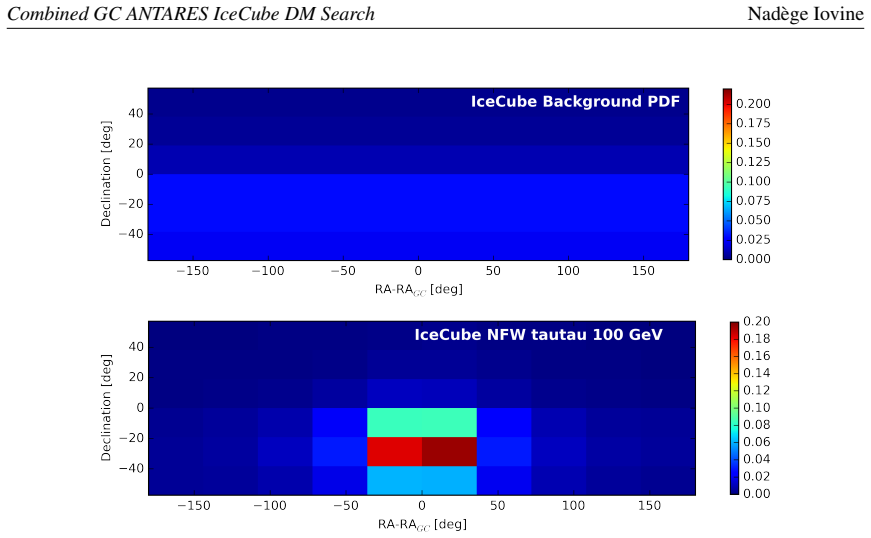
- [Section 5.2 / Figure 2] The IceCube PDF binning in right ascension is stated as '-2pi to 2pi' with 10 bins; since right ascension is cyclic, please clarify whether this is a wrapped interval and how the background PDF normalization handles periodicity.
- [Section 5.2] In the description of the ANTARES QFit histograms, bins are said to range over Delta cos(theta) '-1 to 0.14 rad'; Delta cos(theta) is dimensionless, so the unit 'rad' appears to be a typo.
- [Section 2] Equation (2.1) uses a factor 1/2 for self-conjugate dark matter; please confirm that this convention is consistently applied in the ANTARES and IceCube signal normalizations, since the relative normalization affects the combined limit.
Circularity Check
No circularity: combined-limit derivation is self-contained; comparison caveats are statistical, not definitional.
full rationale
The paper's central result is a combined upper limit on the dark matter annihilation cross section obtained from a binned Poisson likelihood using observed event counts in ANTARES and IceCube samples. The signal expectation is built from fixed external inputs: the annihilation spectra from PPPC4 tables [7], the J-factor computed from NFW and Burkert profiles with parameters from [5], and the detector-specific signal and background PDFs derived from data. The likelihood in Eqs. (5.1)-(5.3) is maximized over the signal fraction mu, and the limit on mu is converted into a limit on <sigma_A v> via the expected signal count from Eq. (2.1). No fitted parameter is renamed as a prediction, and no step defines the combined result in terms of the individual limits it is compared against. The comparison to the previously published ANTARES and IceCube limits is an external benchmark using the same data sets, which is appropriate for claiming improvement. The Figure 5 caption explicitly notes that under-fluctuations were treated differently than in the ANTARES paper: the joint analysis kept likelihood-based limits below sensitivity while the ANTARES curve was raised to sensitivity. This is a legitimate caveat about the fairness and interpretation of the comparison, but it is not circular reasoning because the convention does not enter the construction of the combined limit through any fitted parameter or prior result. The cited prior work [1,2] provides the data sets and earlier limits rather than the load-bearing derivation; the halo profiles and spectra are external physical inputs, not outputs of this analysis. No self-citation chain is invoked to forbid alternatives or to define the claimed result. The derivation is therefore self-contained, and any concerns about under-fluctuation handling belong to statistical robustness, not circularity.
Assumptions & free parameters
assumptions (4)
- domain assumption Dark matter is composed of WIMPs that annihilate to Standard Model particles with a 100% branching ratio to one specific channel (W+W-, tau+tau-, mu+mu-, or bb).
- domain assumption The Milky Way dark matter halo follows either an NFW or Burkert profile with parameters taken from Nesti and Salucci (2013).
- domain assumption The PPPC4 neutrino energy spectra (Cirelli et al. 2011) accurately describe the neutrino yield from dark matter annihilation.
- standard math Poisson statistics and the Feldman-Cousins prescription yield valid confidence intervals for the signal fraction mu.
Cite this review
Pith. "Pith review of Combined Search for Neutrinos from Dark Matter Annihilation in the Galactic Centre using ANTARES and IceCube." pith.science (2026). https://pith.science/paper/WQTUPHEZ
@misc{pith2026190807300,
  author       = {Pith},
  title        = {Pith review of: Combined Search for Neutrinos from Dark Matter Annihilation in the Galactic Centre using ANTARES and IceCube},
  year         = {2026},
  howpublished = {\url{https://pith.science/paper/WQTUPHEZ}},
  note         = {Machine review of arXiv:1908.07300}
}
abstract
The ANTARES and IceCube neutrino telescopes have both searched for neutrinos from dark matter annihilation in the Galactic Centre, putting limits on the thermally-averaged dark matter self-annihilation cross section $\langle \sigma_A \upsilon \rangle$. For WIMP masses above 100 GeV, the most stringent limits were obtained by the ANTARES neutrino telescope, while for lower masses, limits achieved by IceCube are more competitive. The limits obtained by the two detectors are of comparable order of magnitude for WIMP masses going from 50 to 1000 GeV, making this mass range particularly interesting for a combined analysis. In this contribution, we present the limits of the first combined search for dark matter self-annihilation in the centre of the Milky Way using ANTARES and IceCube. The model parameters and the likelihood method were unified, thereby providing a benchmark for future dark matter searches conducted by each collaboration. By combining data of both detectors, we obtained improved limits with respect to the original limits published by the two collaborations.
Figures


Figures from the paper (2 more)


Reference graph
Works this paper leans on
-
[1]
Albert et al., Phys
ANTARES Collaboration, A. Albert et al., Phys. Lett. B 769 (2017) 249. [Erratum: Phys. Lett.B(2019)]
2017
-
[2]
IceCube Collaboration, M. G. Aartsen et al., Eur . Phys. J. C77 (2017) 627
2017
-
[3]
J. F. Navarro, C. S. Frenk, and S. D. M. White, Astrophys. J. 462 (1996) 563
1996
-
[4]
Burkert, Astrophys
A. Burkert, Astrophys. J. 447 (1995) L25
1995
-
[5]
F. Nesti and P. Salucci, JCAP 1307 (2013) 016. 7 Combined GC ANTARES IceCube DM Search Nadège Iovine Figure 5: Limit on the thermally-averaged dark matter annihilation cross section ⟨σAυ⟩ obtained for the combined analysis as a function of the WIMP mass mχ assuming the NFW halo profile for the τ +τ− (left) and b¯b (right) annihilation channel. Also shown a...
work page 2013
-
[6]
Hütten, C
M. Hütten, C. Combet, and D. Maurin, Comput. Phys. Commun. 235 (2019) 336
2019
-
[7]
Cirelli, G
M. Cirelli, G. Corcella, A. Hektor, G. Hutsi, M. Kadastik, P. Panci, M. Raidal, F. Sala, and A. Strumia, JCAP 1103 (2011) 051. [Erratum: JCAP1210,E01(2012)]
2011
-
[8]
T. Sjöstrand, P. Eden, C. Friberg, G. Miu, L. Lönnblad, S. Mrenna, and E. Norrbin, Comput. Phys. Commun. 135 (2001) 238
work page 2001
Show all 14 references
-
[9]
Ageron et al., Nucl.Instrum.Meth
ANTARES Collaboration, M. Ageron et al., Nucl.Instrum.Meth. A656 (2011) 11–38
2011
-
[10]
IceCube Collaboration, M. G. Aartsen et al., JINST 12 (2017) P03012
2017
-
[11]
G. J. Feldman and R. D. Cousins, Phys. Rev. D57 (1998) 3873–3889
1998
-
[12]
Archambault et al., Phys
VERITAS Collaboration, S. Archambault et al., Phys. Rev. D 95 (2017) 082001
2017
-
[13]
MAGIC, Fermi-LA TCollaboration, M. L. Ahnen et al., JCAP 02 (2016)
2016
-
[14]
Collaboration, H
H.E.S.S. Collaboration, H. Abdallah et al., Phys. Rev. Lett. 117 (2016) 111301. 8
2016
Reviewed August 14, 2026 · model on record in the stance chip above.
Discussion (0). Continue with ORCID to comment.