REVIEW 2 major objections 6 minor 47 references
Precision Positronium Spectroscopy as a Test of the Helium Ionization Energy Anomaly
T0 review · 2 major / 6 minor · reviewed 2026-08-16 · deepseek-v4-flash
Pith's one-line read If a new scalar force explains the helium anomaly, positronium's 1S–2S interval must shift by 0.25–0.85 MHz, a detectable signal.
desk verdict A clean conditional prediction that converts the He anomaly into a Ps spectroscopy target; the one soft spot that matters is the unquantified helium matrix element. read the letter →
The pith
A machine-rendered reading of the paper's core claim, the machinery that carries it, and where it could break.
The reading
What carries the argument
The machinery is the first-order perturbation formula $\Delta E_{n\ell}=-g_e^2/(\hbar c)\,4\pi F_{n\ell}(\lambda)$ for a Yukawa potential $V(r)=-g_e^2/(\hbar c)\,4\pi e^{-r/\lambda}/r$, together with the ratio identity $\Delta\nu_{\mathrm{Ps}} = \Delta E_{\mathrm{He}}/h \cdot F_{n\ell}(\lambda)/C_{\mathrm{He}}(\lambda)$. Here $F_{n\ell}(\lambda)$ is the radial integral $\int_0^\infty |R_{n\ell}(r)|^2 e^{-r/\lambda} r\,dr$, evaluated analytically for hydrogenic positronium (with $a_{\mathrm{Ps}}=2a_0$), and $C_{\mathrm{He}}(\lambda)=\langle e^{-r_{12}/\lambda}/r_{12}\rangle_{2^3S}$ is the corresponding matrix element in the metastable helium $2\,^3S$ state, computed numerically. This identity is what carries the argument: it converts the measured helium anomaly into a specific, mass-dependent shift for every positronium transition, with no free parameters beyond the mediator mass.
What would settle it
Measure the positronium $1\,^3S_1\to2\,^3S_1$ interval with total uncertainty at or below 100 kHz (requiring a next-generation QED calculation) and compare to the updated QED prediction: if the measured value agrees with QED to within 100 kHz across the mediator-mass range 0–800 eV, the predicted 0.250–0.850 MHz shift is ruled out, disfavoring the scalar-boson interpretation of the helium anomaly.
Extended reading notes
Core claim
The central discovery is a quantitative link between the helium ionization-energy anomaly and observable positronium spectra: the frequency shift of a positronium transition is exactly the helium anomaly times the ratio of a positronium radial integral $F_{n\ell}(\lambda)$ to the helium matrix element $C_{\mathrm{He}}(\lambda)$. The positronium integrals are analytic for a Yukawa perturbation, and the helium matrix element is computed numerically, so the ratio turns the measured helium shift into a definite prediction for positronium for every mediator mass. Over the mediator masses that can explain the anomaly (up to 800 eV), the $1\,^3S_1\to2\,^3S_1$ shift is 0.250–0.850 MHz, and the $2\,^3S_1$ ionization shift is 0.14–0.21 MHz. The paper concludes that the 1S–2S interval is the most sensitive probe, that the 2S-ionization measurement can independently constrain the radial form of the interaction, and that the 2S–2P fine-structure transitions are insensitive to light mediators.
Load-bearing premise
The predictions assume the numerical helium matrix element $C_{\mathrm{He}}(\lambda)$ — computed with the wavefunction of Ref. [24] — is accurate, and the paper assigns it no uncertainty; because the predicted positronium shifts scale inversely with $C_{\mathrm{He}}$, any error in that matrix element changes all predicted shifts proportionally.
Editorial extensions
If this is right
- If the scalar-boson interpretation is correct, a positronium $1\,^3S_1\to2\,^3S_1$ measurement with ~100 kHz total uncertainty will see a shift between 0.250 and 0.850 MHz for mediator masses below 800 eV.
- A null positronium result—no shift beyond QED uncertainty—would strongly disfavor the scalar-boson explanation of the helium anomaly.
- A measurement of the $2\,^3S_1$ ionization energy probes a different combination of states, so its 0.14–0.21 MHz shift would independently test the radial form of the interaction.
- The $2\,^3S_1\to2\,^3P_J$ fine-structure transitions are insensitive to very light scalar mediators because the $2S$ and $2P$ shifts cancel in the $\lambda\to\infty$ limit, so they are not a viable test.
- Reducing the theoretical QED uncertainty for positronium from 580 kHz toward 100 kHz is necessary to test the full mediator-mass range and would make the projected experimental sensitivity competitive with or stronger than the helium-anomaly constraint.
Reading between the lines
- The same ratio method could be applied to muonium, whose different reduced mass would give different radial overlaps; comparing positronium and muonium shifts could separate electron-only couplings from flavor-dependent couplings.
- The exact analytic $F_{n\ell}(\lambda)$ expressions are generic response functions for any short-range perturbation of a hydrogenic system, so they could be reused to forecast shifts from other hypothetical forces (e.g., dark-photon or axion-like exchanges) in positronium and hydrogen.
- A paired measurement of the 1S–2S and 2S-ionization shifts would not only test the scalar hypothesis but, if both are seen, would determine the mediator mass from their ratio, since that ratio is a known function of $\lambda$.
- The existing 5.7 MHz offset between the current best positronium 1S–2S measurement and QED theory is much larger than the predicted scalar shift; resolving that offset is a prerequisite for using positronium to test the helium anomaly, a point the paper leaves implicit.
Signed reviews
Editorial analysis
A structured set of objections, weighed in public.
Referee Report
Summary. This paper takes the recently reported discrepancy between measured and calculated 2^3S_1 ionization energies of metastable helium as motivation for the scalar-boson interpretation proposed in Ref. [6]. Starting from a finite-range Yukawa potential (Eq. (1)), the authors compute first-order energy shifts for positronium n=1 and n=2 states, using analytic hydrogenic matrix elements (Eqs. (4)-(6)) together with a numerical helium matrix element C_He(λ) (Eq. (8)). Combining the helium anomaly with the ratio F_nl/C_He (Eq. (9)), they predict a 1^3S_1→2^3S_1 shift of 0.250–0.850 MHz and a 2^3S_1 ionization shift of 0.14–0.21 MHz for mediator masses below 800 eV. The paper then assesses the experimental feasibility of testing these shifts, including 1S–2S two-photon spectroscopy, Rydberg-ionization measurements, and n=2 fine-structure transitions, concluding that the 1S–2S interval is the most promising probe.
Significance. If the calculation is correct, the paper provides a concrete, falsifiable bridge between a proposed new-physics explanation of the helium anomaly and an independent leptonic system. The analytic positronium matrix elements are simple to verify, the conversion in Eq. (9) does not involve fitting to positronium data, and the experimental discussion is realistic and well grounded in the literature. The main weakness is that the numerical helium matrix element C_He(λ) is presented without a quantitative uncertainty estimate or benchmark, despite the abstract's claim of a 'benchmarked correlated calculation.' Because C_He appears in the denominator of Eq. (9), its uncertainty maps directly onto all quoted shifts. With that gap filled, the paper would be a valuable contribution to the search for new leptonic forces; in its present form, the central numerical input is not yet adequately supported.
major comments (2)
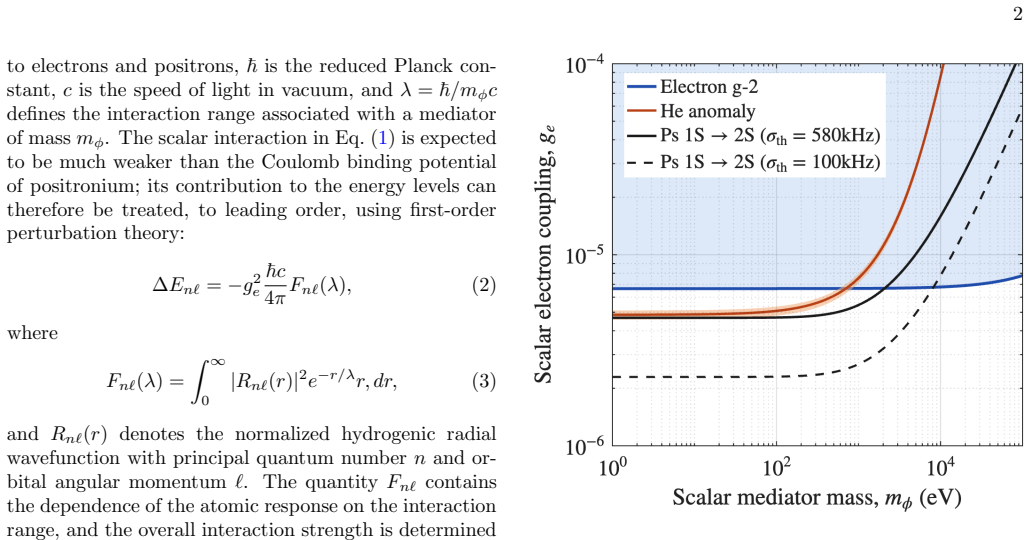
- [He-positronium conversion (Eqs. (7)-(9), Fig. 2)] The numerical matrix element C_He(λ) is the only input connecting the helium anomaly to the predicted positronium shifts, but the manuscript provides no uncertainty estimate, no convergence study, and no benchmark for this quantity. The abstract and introduction describe a 'benchmarked correlated calculation,' yet no benchmark data appear in the body of the paper. Since C_He appears in the denominator of Eq. (9), any fractional error in C_He propagates one-to-one into every quoted shift, and any error in its λ-dependence distorts the curves in Fig. 2. The authors should provide a quantitative uncertainty on C_He(λ), for example by comparing the wavefunction of Ref. [24] with an independent high-accuracy correlated wavefunction, and by checking the λ→∞ limit against a known high-precision value of ⟨1/r12⟩ for the He 2^3S state. This uncertainty must be propagated into the shaded bands of Fig. 2 and into the headline ranges 0.250–0.850 MHz and 0.14–0.21 MHz.
- [Numerical evaluation of C_He (Eq. (8))] The statement that C_He(λ) 'is evaluated numerically using the He wave function of Ref [24]' is insufficient for reproducibility. The authors should specify the form of the wavefunction (basis type and number of terms), the integration method, and the numerical precision. This matters because the operator e^{-r12/λ}/r12 emphasizes short electron-electron separations, and the accuracy of the Ref. [24] wavefunction for this operator is not established by the original paper's intended use. Without this information, Eq. (9) cannot be independently checked, and the reliability of the central prediction remains unverified.
minor comments (6)
- [Eq. (3)] There is a typographical error in the integrand: 'r,dr' should be replaced by the correct integration measure, presumably e^{-r/λ} r dr (with all variables defined).
- [Fig. 1 and text] The 'projected sensitivity' curves should state the confidence level or statistical criterion used, so that the reader can interpret the exclusion power of a future 100 kHz measurement.
- [Fig. 2 and text] The quantity referred to as the '2^3S_1 ionization shift' should be defined precisely, for example as the shift of the 2^3S_1 binding energy relative to the free e+e- threshold, and the theoretical uncertainty assigned to this observable should be stated explicitly.
- [Eq. (9) and Fig. 2] The propagation of the asymmetric ΔE_He uncertainty used for the shaded bands is described only as 'independently for its upper and lower bounds'; please state the exact formula used so that the bands can be reproduced.
- [References] The citation [24] is a paper on exotic spin-dependent interactions; please clarify whether it contains the wavefunction used here or whether it should be supplemented by a more direct citation to the original helium wavefunction calculation.
- [Abstract and text] The '0–800 eV' mediator-mass range should be more carefully motivated; the authors should state that this range is inherited from Ref. [6] and briefly list the criteria defining its upper limit.
Circularity Check
No significant circularity: the positronium shifts are derived from the measured helium anomaly via independent matrix-element calculations, with no fitting to positronium data.
full rationale
The paper's central derivation is not circular. Equation (9) maps the measured helium ionization-energy anomaly to a predicted positronium frequency shift through the ratio F_nl(lambda)/C_He(lambda), where F_nl is an exact hydrogenic integral for positronium and C_He is a numerical helium matrix element taken from Ref. [24]. No positronium data are used to set the coupling or to normalize the prediction; the positronium observables are genuinely predicted from the helium anomaly and the assumed scalar Yukawa form. The paper does not fit any parameter to the target Ps transitions, and the analytic F_nl expressions are standard and self-contained. The self-citations appear only for context, projected sensitivity comparisons, and references to ongoing QED work; they are not load-bearing for the derivation. The main concerns raised by a skeptical reader, such as the absence of an uncertainty estimate for the numerical matrix element C_He(lambda), are correctness risks rather than circularity: an error in C_He would shift the predictions, but it would not make the derivation equivalent to its inputs. The derivation is therefore self-contained with respect to circularity, and the appropriate score is 0.
Assumptions & free parameters
free parameters (2)
- Scalar-electron coupling g_e =
not fitted; eliminated via Eq. (9) using measured ΔE_He
- Mediator mass m_phi =
0-800 eV (scanned range from Ref. [6])
assumptions (5)
- domain assumption The helium ionization anomaly is caused by a single scalar Yukawa interaction between leptons.
- domain assumption First-order perturbation theory is adequate for the scalar potential.
- domain assumption The helium wavefunction of Ref. [24] accurately represents the 2^3S state for the C_He matrix element.
- domain assumption The positronium QED theory uncertainties quoted from Ref. [21] (580 kHz) and projected in Refs. [22,23] (100 kHz) are reliable inputs for sensitivity estimates.
- standard math Positronium is an exactly hydrogenic two-body system with Bohr radius a_Ps = 2 a_0.
invented entities (1)
-
New scalar boson φ with mass m_phi coupled to electrons and positrons
independent evidence
Cite this review
Pith. "Pith review of Precision Positronium Spectroscopy as a Test of the Helium Ionization Energy Anomaly." pith.science (2026). https://pith.science/paper/WQVXQKT6
@misc{pith2026260812747,
  author       = {Pith},
  title        = {Pith review of: Precision Positronium Spectroscopy as a Test of the Helium Ionization Energy Anomaly},
  year         = {2026},
  howpublished = {\url{https://pith.science/paper/WQVXQKT6}},
  note         = {Machine review of arXiv:2608.12747}
}
abstract
Precise measurements of the metastable helium (1s)(2s)$\,^3S_1$ ionization energy have revealed a 9$\sigma$ discrepancy with QED theory that persists in isotopic measurements, suggesting a leptophilic bosonic interaction as a possible explanation. A subsequent investigation of such interactions has concluded that only a scalar boson interaction is consistent with the He observations. Taking this as a starting point, we derive the response of positronium energy levels to the corresponding finite-range Yukawa potential, using exact hydrogenic matrix elements and a numerical helium calculation. Across the viable mediator-mass range of 0-800 eV, the He anomaly interpreted in this way implies a positronium 1$^3$S$_1 \rightarrow 2^3$S$_1$ shift ranging from 0.250-0.850 MHz, and a 2S-ionization shift of 0.14-0.21 MHz. We discuss the feasibility of observing these shifts experimentally.
Figures

Reference graph
Works this paper leans on
-
[24]
Filip Ficek, Derek F. Jackson Kimball, Mikhail G. Ko- zlov, Nathan Leefer, Szymon Pustelny, and Dmitry Budker, “Constraints on exotic spin-dependent interac- tions between electrons from helium fine-structure spec- troscopy,” Phys. Rev. A95, 032505 (2017)
work page 2017
-
[6]
Testing exotic electron– electron interactions with the helium ionization-energy anomaly,
Lei Cong, Filip Ficek, Rinat Abdullin, Mikhail G. Ko- zlov, and Dmitry Budker, “Testing exotic electron– electron interactions with the helium ionization-energy anomaly,” (2026), arXiv:2602.09743 [physics.atom-ph]
arXiv 2026
-
[1]
Precision physics of simple atoms: QED tests, nuclear structure and fundamental con- stants,
S. G. Karshenboim, “Precision physics of simple atoms: QED tests, nuclear structure and fundamental con- stants,” Physics Reports422, 1 – 63 (2005)
work page 2005
-
[2]
Gordon W. F. Drake, ed.,Springer Handbook of Atomic, Molecular, and Optical Physics, 2nd ed., Springer Hand- books (Springer, Cham, Switzerland, 2023)
work page 2023
-
[3]
Gloria Clausen and Fr´ ed´ eric Merkt, “Ionization energy of metastable 3he (2 3s1) and the alpha- and helion-particle charge-radius difference from precision spectroscopy of thenprydberg series,” Physical Review Letters134, 223001 (2025)
work page 2025
-
[4]
Completeα 7mlamb shift of helium triplet states,
Vojt ˇ ech Patk´ oˇ s, Vladimir A. Yerokhin, and Krzysztof Pachucki, “Completeα 7mlamb shift of helium triplet states,” Phys. Rev. A103, 042809 (2021)
work page 2021
-
[5]
The ionization energy of metastable triplet helium,
Gloria Clausen, Kai Gamlin, Josef A. Agner, Hansj¨ urg Schmutz, and Fr´ ed´ eric Merkt, “The ionization energy of metastable triplet helium,” Physical Review A111, 012817 (2025)
work page 2025
-
[7]
K. Steinebach, J. C. J. Koelemeij, H. L. Bethlem, and K. S. E. Eikema, “Spectroscopy of 4He at 0.25 ppt un- certainty and improved alpha-helion charge-radius dif- ference determination,” Phys. Rev. Lett.136, 243001 (2026)
work page 2026
Show all 47 references
-
[8]
Precision physics of simple atoms and constraints on a light boson with ultraweak cou- pling,
S. G. Karshenboim, “Precision physics of simple atoms and constraints on a light boson with ultraweak cou- pling,” Phys. Rev. Lett.104, 220406 (2010)
2010
-
[9]
New measurement of the 1s−3stransition frequency of hydrogen: Contribution to the proton charge radius puzzle,
H´ el` ene Fleurbaey, Sandrine Galtier, Simon Thomas, Marie Bonnaud, Lucile Julien, Fran ¸ cois Biraben, Fran ¸ cois Nez, Michel Abgrall, and Jocelyne Gu´ ena, “New measurement of the 1s−3stransition frequency of hydrogen: Contribution to the proton charge radius puzzle,” Phys...
2018
-
[10]
A measurement of the atomic hydrogen lamb shift and the proton charge radius,
N. Bezginov, T. Valdez, M. Horbatsch, A. Marsman, A. C. Vutha, and E. A. Hessels, “A measurement of the atomic hydrogen lamb shift and the proton charge radius,” Science365, 1007–1012 (2019)
2019
-
[11]
Precision- spectroscopic determination of the binding energy of a two-body quantum system: The hydrogen atom and the proton-size puzzle,
Simon Scheidegger and Fr´ ed´ eric Merkt, “Precision- spectroscopic determination of the binding energy of a two-body quantum system: The hydrogen atom and the proton-size puzzle,” Phys. Rev. Lett.132, 113001 (2024)
2024
-
[12]
Sub-part-per-trillion test of the Stan- dard Model with atomic hydrogen,
Lothar Maisenbacher, Vitaly Wirthl, Arthur Matveev, Alexey Grinin, Randolf Pohl, Theodor W. H¨ ansch, and Thomas Udem, “Sub-part-per-trillion test of the Stan- dard Model with atomic hydrogen,” Nature650, 845–851 (2026)
2026
-
[13]
Precision spectroscopy of 2s-ns transitions in atomic hydrogen: A determination of the proton charge radius,
R. G. Bullis, W. L. Tavis, M. R. Weiss, J. Orellana Cisneros, A. J. Cheeseman, U. D. Jentschura, and D. C. Yost, “Precision spectroscopy of 2s-ns transitions in atomic hydrogen: A determination of the proton charge radius,” Phys. Rev. Lett.136, 123001 (2026)
2026
-
[14]
Improved measure- ment of the hydrogen 1S−2Stransition frequency,
Christian G. Parthey, Arthur Matveev, Janis Alnis, Bir- gitta Bernhardt, Axel Beyer, Ronald Holzwarth, Aliak- sei Maistrou, Randolf Pohl, Katharina Predehl, Thomas Udem, Tobias Wilken, Nikolai Kolachevsky, Michel Ab- grall, Daniele Rovera, Christophe Salomon, Philippe Laurent,...
2011
-
[15]
Polyelectrons,
J. A. Wheeler, “Polyelectrons,” Annals of the New York Academy of Sciences48, 219–238 (1946)
1946
-
[16]
Precision spectroscopy of positronium: Testing bound-state QED theory and the search for physics be- yond the standard model,
Gregory S. Adkins, David B. Cassidy, and Jes´ us P´ erez- R´ ıos, “Precision spectroscopy of positronium: Testing bound-state QED theory and the search for physics be- yond the standard model,” Physics Reports975, 1–61 (2022)
2022
-
[17]
H. A. Bethe and E. E. Salpeter,Quantum Mechanics of One- and Two-Electron Atoms(Springer, Berlin, 1957)
1957
-
[18]
Current and future perspectives of positronium and muonium spectroscopy as dark sectors probe,
Claudia Frugiuele, Jes´ us P´ erez-R´ ıos, and Clara Peset, “Current and future perspectives of positronium and muonium spectroscopy as dark sectors probe,” Phys. Rev. D100, 015010 (2019)
2019
-
[19]
Probing new spin-independent interac- tions through precision spectroscopy in atoms with few electrons,
C´ edric Delaunay, Claudia Frugiuele, Elina Fuchs, and Yotam Soreq, “Probing new spin-independent interac- tions through precision spectroscopy in atoms with few electrons,” Physical Review D96, 115002 (2017)
2017
-
[20]
Con- straints on new physics in electrong−2 from a search for invisible decays of a scalar, pseudoscalar, vector, and axial vector,
Yu. M. Andreevet al.(NA64 Collaboration), “Con- straints on new physics in electrong−2 from a search for invisible decays of a scalar, pseudoscalar, vector, and axial vector,” Phys. Rev. Lett.126, 211802 (2021)
2021
-
[21]
PositroniumS-state spectrum: Analytic results ato(mα 6),
Andrzej Czarnecki, Kirill Melnikov, and Alexander Yelkhovsky, “PositroniumS-state spectrum: Analytic results ato(mα 6),” Phys. Rev. A59, 4316–4330 (1999)
1999
-
[22]
Higher order corrections to positronium energy levels,
G. S. Adkins, “Higher order corrections to positronium energy levels,” Journal of Physics: Conference Series 1138, 012005 (2018)
2018
-
[23]
Calculation of higher order corrections to positronium energy levels,
Gregory Adkins, Benjamin Akers, Md Faisal Alam, Lam M. Tran, and Xuan Zhang, “Calculation of higher order corrections to positronium energy levels,” PoS FFK2019, 004 (2019)
2019
-
[25]
Excitation of the Positro- nium 13S1→2 3S1 Two-Photon Transition,
S. Chu and A. P. Mills, Jr., “Excitation of the Positro- nium 13S1→2 3S1 Two-Photon Transition,” Phys. Rev. Lett.48, 1333–1337 (1982)
1982
-
[26]
Measurement of the positronium 1 3s1–2 3s1 interval by doppler-free two- photon spectroscopy,
Steven Chu and Jr. Mills, Allen P., “Measurement of the positronium 1 3s1–2 3s1 interval by doppler-free two- photon spectroscopy,” Physical Review Letters52, 1689– 1692 (1984)
1984
-
[27]
Measurement of the positronium 1 3s1–2 3s1 inter- val by continuous-wave two-photon excitation,
M. S. Fee, Jr. Mills, A. P., S. Chu, E. D. Shaw, K. Danzmann, R. J. Chichester, and D. M. Zucker- man, “Measurement of the positronium 1 3s1–2 3s1 inter- val by continuous-wave two-photon excitation,” Physical Review Letters70, 1397–1400 (1993)
1993
-
[28]
Measurement of the positronium 1 3s1–2 3s1 interval by continuous-wave two-photon excitation,
M. S. Fee, S. Chu, Jr. Mills, A. P., R. J. Chichester, E. D. Shaw, K. Danzmann, and D. M. Zuckerman, “Measurement of the positronium 1 3s1–2 3s1 interval by continuous-wave two-photon excitation,” Physical Re- view A48, 192–219 (1993)
1993
-
[29]
Precision continuous-wave laser measurement of the 13S1→2 3S1 interval in positro- nium,
Lucas de Sousa Borges, Edward Thorpe-Woods, Evans Javary, and Paolo Crivelli, “Precision continuous-wave laser measurement of the 13S1→2 3S1 interval in positro- nium,” Phys. Rev. A113, 032804 (2026)
2026
-
[30]
Experimental progress in positronium laser physics,
D. B. Cassidy, “Experimental progress in positronium laser physics,” The European Physical Journal D72, 53 (2018)
2018
-
[31]
Observation of 6 positronium annihilation in the 2sstate: Towards a new measurement of the 1s–2stransition frequency,
D. A. Cooke, P. Crivelli, J. Alnis, A. Antognini, B. Brown, S. Friedreich, A. Gabard, T. W. H”ansch, K. Kirch, A. Rubbia, and V. Vrankovic, “Observation of 6 positronium annihilation in the 2sstate: Towards a new measurement of the 1s–2stransition frequency,” Hyper- fine Inter...
2015
-
[32]
Decelerating and cooling positronium for high-precision 1S–2S spectroscopy,
Allen P. Mills, Jr., “Decelerating and cooling positronium for high-precision 1S–2S spectroscopy,” inAdvances in Atomic, Molecular, and Optical Physics, Vol. 65, edited by Ennio Arimondo, Chun C. Lin, and Susanne F. Yelin (Academic Press, 2016) pp. 265–311
2016
-
[33]
Positro- nium laser cooling via the 1 3S−23Ptransition with a broadband laser pulse,
L. T. Gl¨ oggleret al.(AE¯ gIS Collaboration), “Positro- nium laser cooling via the 1 3S−23Ptransition with a broadband laser pulse,” Phys. Rev. Lett.132, 083402 (2024)
2024
-
[34]
Cooling positronium to ul- tralow velocities with a chirped laser pulse train,
K. Shu, Y. Tajima, R. Uozumi, N. Miyamoto, S. Shi- raishi, T. Kobayashi, A. Ishida, K. Yamada, R. W. Gladen, T. Namba, S. Asai, K. Wada, I. Mochizuki, T. Hyodo, K. Ito, K. Michishio, B. E. O’Rourke, N. Os- hima, and K. Yoshioka, “Cooling positronium to ul- tralow velocities wi...
2024
-
[35]
Measurement of the 1 3s1→2 3s1 interval in positronium using field ioniza- tion of rydberg states,
Michael W. Heiss, Lucas de Sousa Borges, Artem Golovizin, and Paolo Crivelli, “Measurement of the 1 3s1→2 3s1 interval in positronium using field ioniza- tion of rydberg states,” Physical Review A111, 012810 (2025)
2025
-
[36]
Two-photon optical ramsey–doppler spectroscopy of positronium and muonium,
Evans Javary, Edward Thorpe-Woods, Irene Cortino- vis, Marcus M¨ ahring, Lucas de Sousa Borges, and Paolo Crivelli, “Two-photon optical ramsey–doppler spectroscopy of positronium and muonium,” The Euro- pean Physical Journal D79, 15 (2025)
2025
-
[37]
A new broadly tunable (7.4–10.2ev) laser based vuv light source and its first application to aerosol mass spectrometry,
S.J. Hanna, P. Campuzano-Jost, E.A. Simpson, D.B. Robb, I. Burak, M.W. Blades, J.W. Hepburn, and A.K. Bertram, “A new broadly tunable (7.4–10.2ev) laser based vuv light source and its first application to aerosol mass spectrometry,” International Journal of Mass Spec- trometry...
2009
-
[38]
First observation of resonant excitation of high-nstates in positronium,
K. P. Ziock, R. H. Howell, F. Magnotta, R. A. Failor, and K. M. Jones, “First observation of resonant excitation of high-nstates in positronium,” Phys. Rev. Lett.64, 2366–2369 (1990)
1990
-
[39]
Efficient Production of Rydberg Positro- nium,
D. B. Cassidy, T. H. Hisakado, H. W. K. Tom, and A. P. Mills, Jr., “Efficient Production of Rydberg Positro- nium,” Phys. Rev. Lett.108, 043401 (2012)
2012
-
[40]
Selective Production of Rydberg-Stark States of Positronium,
T. E. Wall, A. M. Alonso, B. S. Cooper, A. Deller, S. D. Hogan, and D. B. Cassidy, “Selective Production of Rydberg-Stark States of Positronium,” Phys. Rev. Lett. 114, 173001 (2015)
2015
-
[41]
Laser excita- tion of then= 3 level of positronium for antihydrogen production,
S. Aghionet al.(AEgIS Collaboration), “Laser excita- tion of then= 3 level of positronium for antihydrogen production,” Phys. Rev. A94, 012507 (2016)
2016
-
[42]
Excitation of positronium: from the ground state to Rydberg levels,
C J Baker, D Edwards, C A Isaac, H H Telle, D P van der Werf, and M Charlton, “Excitation of positronium: from the ground state to Rydberg levels,” Journal of Physics B: Atomic, Molecular and Optical Physics51, 035006 (2018)
2018
-
[43]
T. F. Gallagher,Rydberg Atoms(Cambridge University Press, Cambridge, UK, 1994)
1994
-
[44]
Metrology of rydberg states of the hydrogen atom,
Simon Scheidegger, Josef A. Agner, Hansj¨ urg Schmutz, and Fr´ ed´ eric Merkt, “Metrology of rydberg states of the hydrogen atom,” Physical Review A108, 042803 (2023)
2023
-
[45]
Precision microwave spectroscopy of the positron- iumn= 2 fine structure,
L. Gurung, T. J. Babij, S. D. Hogan, and D. B. Cas- sidy, “Precision microwave spectroscopy of the positron- iumn= 2 fine structure,” Phys. Rev. Lett.125, 073002 (2020)
2020
-
[46]
Precision microwave spectroscopy of the positronium 2 3S1→2 3P2 interval,
R. E. Sheldon, T. J. Babij, S. H. Reeder, S. D. Hogan, and D. B. Cassidy, “Precision microwave spectroscopy of the positronium 2 3S1→2 3P2 interval,” Phys. Rev. Lett.131, 043001 (2023)
2023
-
[47]
Phase-variation ram- sey spectroscopy of the 2 3s1→2 3p2 interval in positron- ium,
D. M. Newson and D. B. Cassidy, “Phase-variation ram- sey spectroscopy of the 2 3s1→2 3p2 interval in positron- ium,” Phys. Rev. Lett.136, 033001 (2026)
2026
Reviewed August 16, 2026 · model on record in the stance chip above.
Discussion (0). Continue with ORCID to comment.