Multilevel Isogeometric Projection Stabilization via Quasi-Interpolation for Advection-Dominated Problems
Pith reviewed 2026-05-22 09:19 UTC · model grok-4.3
The pith
A linear multilevel quasi-interpolation method stabilizes advection-dominated isogeometric problems with reduced parameter sensitivity.
A machine-rendered reading of the paper's core claim, the machinery that carries it, and where it could break.
Core claim
The central discovery is a multilevel projection stabilization method that penalizes fine-scale fluctuations extracted via continuous B-spline quasi-interpolants applied hierarchically across nested discrete spaces, yielding robust control of spurious oscillations in advection-dominated regimes while maintaining a fully linear formulation and using a global parameter scaling that reduces problem-dependent tuning.
What carries the argument
Multilevel projection-based stabilization via continuous B-spline quasi-interpolants that hierarchically penalizes fine-scale fluctuations using explicit mesh-dependent weights.
Load-bearing premise
The discrete inf-sup condition holds under a numerically validated stability hypothesis ensuring robust streamline derivative control in the one-dimensional setting with constant advection.
What would settle it
Observing failure to satisfy the inf-sup condition or excessive oscillations in a one-dimensional constant advection test case with the proposed method would falsify the stability claim.
Figures





read the original abstract
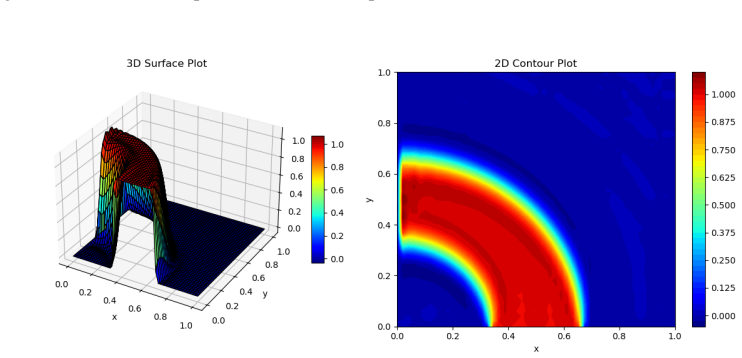
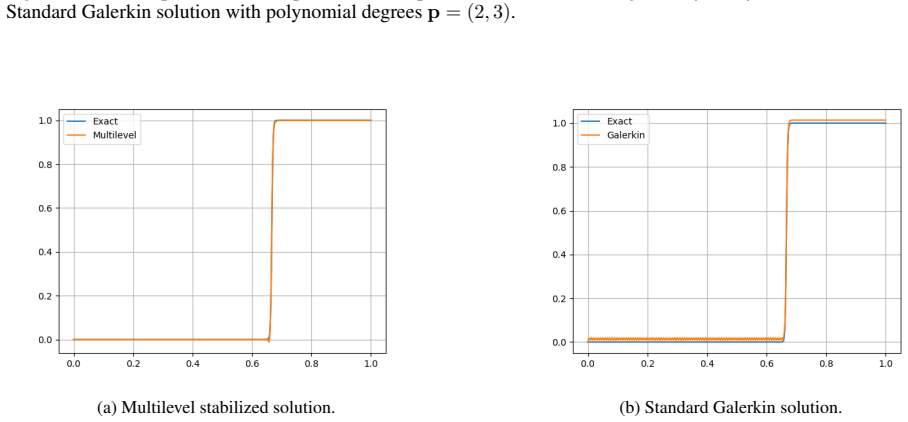
This paper presents a novel multilevel projection-based stabilization method for advection-dominated convection--diffusion problems within the framework of Isogeometric Analysis. The proposed approach extracts and penalizes fine-scale fluctuations using continuous B-spline quasi-interpolants, avoiding both the highly sensitive parameters used in residual-based stabilization methods and the discontinuous auxiliary spaces required by classical Local Projection Stabilization. Stabilization is applied hierarchically across nested levels of the discrete space via explicit mesh-dependent weights. We establish the theoretical foundation of the method by deriving a priori error estimates, supplemented by a discrete inf-sup condition established for the one-dimensional setting with constant advection under a numerically validated stability hypothesis that ensures robust streamline derivative control. Numerical experiments on stringent benchmarks demonstrate the method's ability to significantly reduce spurious oscillations across a variety of regimes, including the limiting cases of pure advection and advection--reaction. Notably, despite being a fully linear formulation, the method achieves significant reduction of undershoots near sharp layers, providing an effective stabilization mechanism without requiring complex nonlinear terms. Furthermore, by utilizing a robust global parameter scaling, the proposed approach significantly alleviates the parameter sensitivity that typically affects residual-based alternatives, reducing the strong dependence on problem-dependent tuning.
Editorial analysis
A structured set of objections, weighed in public.
Referee Report
Summary. The manuscript introduces a multilevel projection-based stabilization method for advection-dominated convection-diffusion problems within Isogeometric Analysis. It employs continuous B-spline quasi-interpolants to extract and penalize fine-scale fluctuations hierarchically across nested levels using explicit mesh-dependent weights. The authors derive a priori error estimates and establish a discrete inf-sup condition under a stability hypothesis for the one-dimensional constant-advection case that is numerically validated to ensure robust streamline derivative control. Numerical experiments on benchmarks, including pure advection and advection-reaction limits, demonstrate significant reduction of spurious oscillations and undershoots near sharp layers, with performance comparable to nonlinear shock-capturing schemes and reduced sensitivity via robust global parameter scaling.
Significance. If the stability hypothesis extends to the multidimensional and variable-coefficient regimes in the benchmarks, this would represent a useful contribution by providing a fully linear stabilization approach in IGA that achieves oscillation control comparable to nonlinear methods while avoiding highly sensitive parameters and discontinuous auxiliary spaces. The emphasis on a robust global parameter scaling and the numerical results on stringent benchmarks are strengths that could support practical adoption in advection-dominated problems.
major comments (2)
- [Abstract and theoretical foundation section on discrete inf-sup condition] The discrete inf-sup condition and a priori error estimates are derived under a stability hypothesis that ensures robust streamline derivative control and is numerically validated only for the one-dimensional setting with constant advection (as stated in the abstract and the theoretical foundation section). This hypothesis directly supports the central theoretical claims, yet the numerical benchmarks include multidimensional problems; without additional validation or proof that the hypothesis carries over, the justification for robustness in the claimed regimes is incomplete.
- [Numerical experiments section] The numerical experiments section reports performance on benchmarks but does not include explicit error bars, multiple-run statistics, or details on data exclusion criteria. This weakens the strength of the claims regarding significant reduction of undershoots and comparability to nonlinear schemes, as quantitative reliability measures are needed to support the central numerical validation.
minor comments (2)
- [Method description] The notation for the global parameter scaling and mesh-dependent weights should be defined with explicit formulas early in the method section to enhance clarity and reproducibility.
- [Figures in numerical section] Figure captions for the benchmark results could be expanded to specify the exact parameter values used in the global scaling for each test case.
Simulated Author's Rebuttal
We thank the referee for the careful and constructive review of our manuscript. We address the major comments point by point below, indicating the revisions we intend to make.
read point-by-point responses
-
Referee: [Abstract and theoretical foundation section on discrete inf-sup condition] The discrete inf-sup condition and a priori error estimates are derived under a stability hypothesis that ensures robust streamline derivative control and is numerically validated only for the one-dimensional setting with constant advection (as stated in the abstract and the theoretical foundation section). This hypothesis directly supports the central theoretical claims, yet the numerical benchmarks include multidimensional problems; without additional validation or proof that the hypothesis carries over, the justification for robustness in the claimed regimes is incomplete.
Authors: We agree that the discrete inf-sup condition and the supporting stability hypothesis are established and numerically validated only for the one-dimensional constant-advection case, as explicitly stated in the manuscript. The a priori error estimates are derived under this hypothesis. For the multidimensional and variable-coefficient benchmarks, robustness is demonstrated through the numerical results, which show effective control of oscillations and undershoots. While a complete theoretical extension to higher dimensions would strengthen the claims, the existing numerical evidence across the reported benchmarks supports the method's performance in those regimes. In the revised version, we will clarify the scope of the theoretical analysis in the relevant sections and emphasize that multidimensional robustness relies on numerical validation. revision: partial
-
Referee: [Numerical experiments section] The numerical experiments section reports performance on benchmarks but does not include explicit error bars, multiple-run statistics, or details on data exclusion criteria. This weakens the strength of the claims regarding significant reduction of undershoots and comparability to nonlinear schemes, as quantitative reliability measures are needed to support the central numerical validation.
Authors: The numerical experiments consist of deterministic finite-element simulations of the underlying PDEs. Consequently, there is no stochastic variability, and statistics such as error bars from multiple independent runs or data exclusion criteria are not applicable. All simulation results are reported without selective omission. We will add an explicit statement in the numerical experiments section of the revised manuscript clarifying the deterministic character of the computations to address this point. revision: yes
Circularity Check
No significant circularity detected in derivation chain
full rationale
The paper derives a priori error estimates after establishing a discrete inf-sup condition under a numerically validated stability hypothesis for the 1D constant-advection case. This is a conditional theoretical result resting on an external numerical check rather than any self-referential reduction where a claimed prediction or first-principles result equals its own inputs by construction. No self-definitional steps, fitted inputs renamed as predictions, load-bearing self-citations, uniqueness theorems imported from the authors' prior work, or ansatzes smuggled via citation appear in the provided text. The central claims are supported by independent numerical benchmarks on stringent test cases, keeping the derivation self-contained against external validation.
Axiom & Free-Parameter Ledger
free parameters (2)
- global parameter scaling
- mesh-dependent weights
axioms (1)
- domain assumption Stability hypothesis ensuring robust streamline derivative control in 1D constant advection case
discussion (0)
Sign in with ORCID, Apple, or X to comment. Anyone can read and Pith papers without signing in.