REVIEW 4 major objections 4 minor 57 references
Blocks: Collaborative and Persistent Augmented Reality Experiences
T0 review · 4 major / 4 minor · reviewed 2026-08-14 · deepseek-v4-flash
Pith's one-line read Blocks, a mobile AR app, demonstrates that non-experts can co-create persistent block structures across every space-time collaboration mode, and the studies show colocated synchronous building is the most enjoyable while location-free…
desk verdict Solid system and a careful lab study, but the headline field-study claim about location-independence driving activity is confounded by day and site and needs to be re-analyzed or substantially softened. read the letter →
The pith
A machine-rendered reading of the paper's core claim, the machinery that carries it, and where it could break.
The reading
What carries the argument
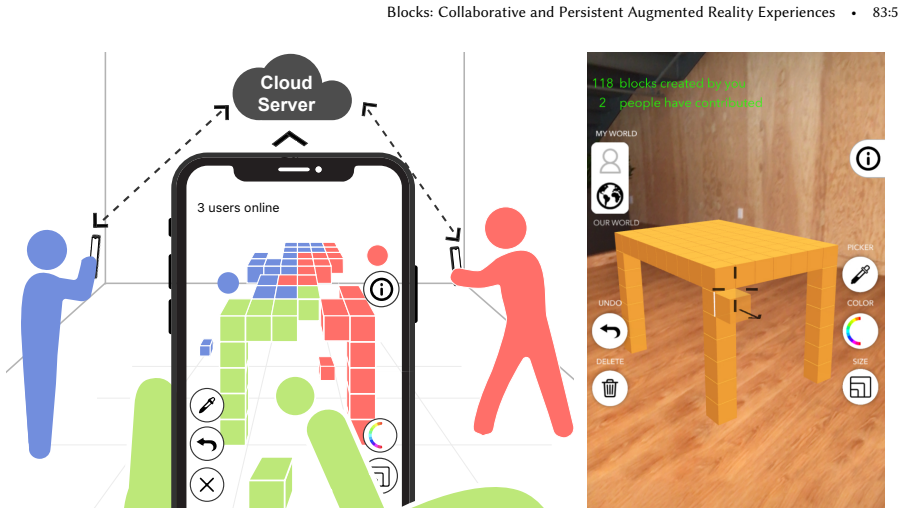
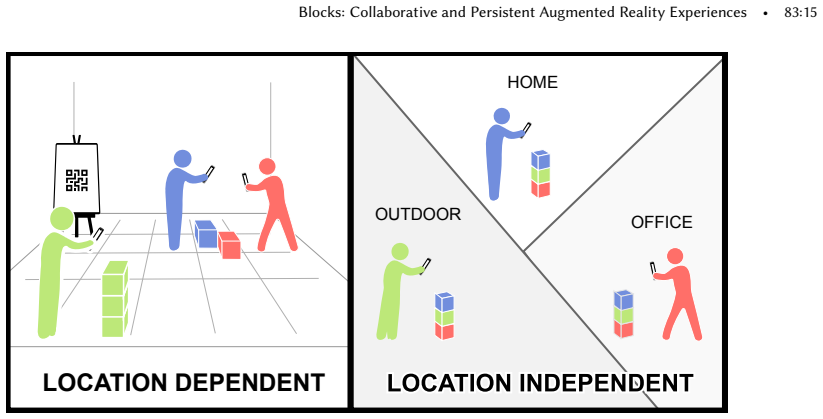
The key mechanism is Blocks' persistence architecture: a cloud database stores every block's position, size, color, and anonymous owner, so structures survive across app sessions and device changes. Image markers anchor location-dependent structures to a fixed spot and re-calibrate them on re-detection, while world tracking places blocks on real surfaces. Live awareness comes from shared cursors, recent-change highlighting, and an online-user counter, and the split between a personal sandbox and a shared OurWorld lets newcomers practice before contributing.
What would settle it
Re-run the field study as a within-site crossover that alternates location-dependent and location-independent conditions on the same day and same poster, then compare sessions per user and repeat-use rates; if the advantage of location independence disappears or tracks the day or site, the paper's central design recommendation is not supported.
Extended reading notes
Core claim
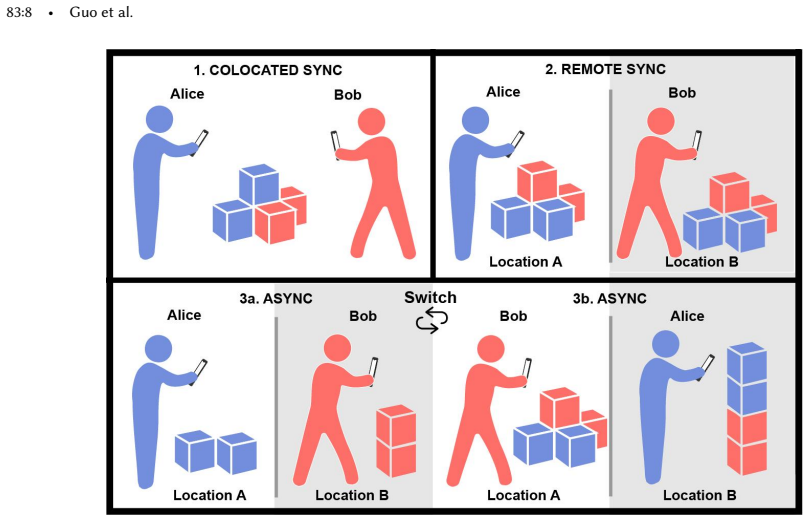
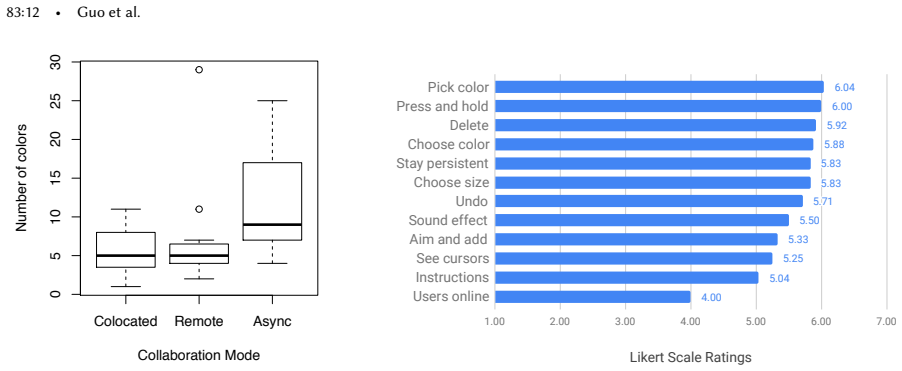
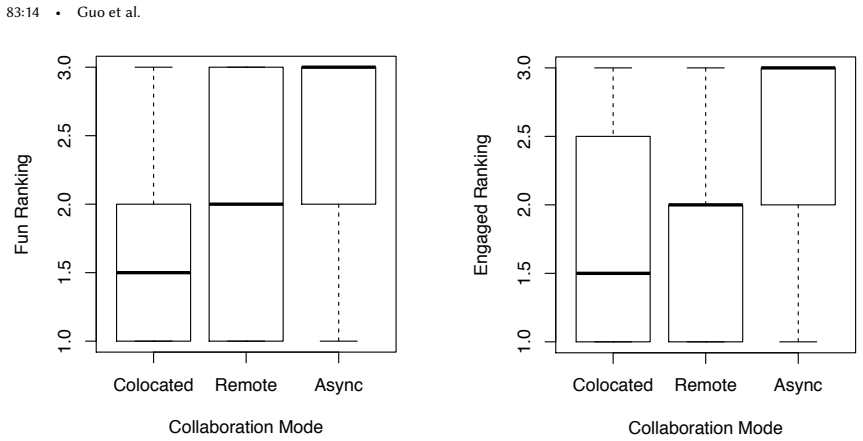
The central claim is that a single mobile AR tool can cover all four combinations of space and time, and that the two dimensions pull in different directions. In the lab, colocated synchronous collaboration ranked highest for fun, engagement, and awareness of a partner's actions, while asynchronous collaboration produced more blocks and more color variety. In the field, the location-independent condition drew more sessions per user and more repeat use, while the location-dependent condition drew more blocks per session. The paper concludes that the most promising design configuration combines the enjoyment of colocated synchronous work with the participation boost of location-independent access.
Load-bearing premise
The claim that location-independent structures increase engagement rests on field data in which the location-dependent and location-independent conditions ran on different days and in different physical sites, so day, site, or novelty effects could account for the higher session counts instead of the AR location design.
Editorial extensions
If this is right
- Designers who want both positive experience and high participation should consider a configuration that is location-independent at the level of access while keeping synchronous colocated creation as the core activity.
- Persistent structures reliably bring users back: repeat-use rates reached 74 percent in the field study and 67 percent in the extended deployment.
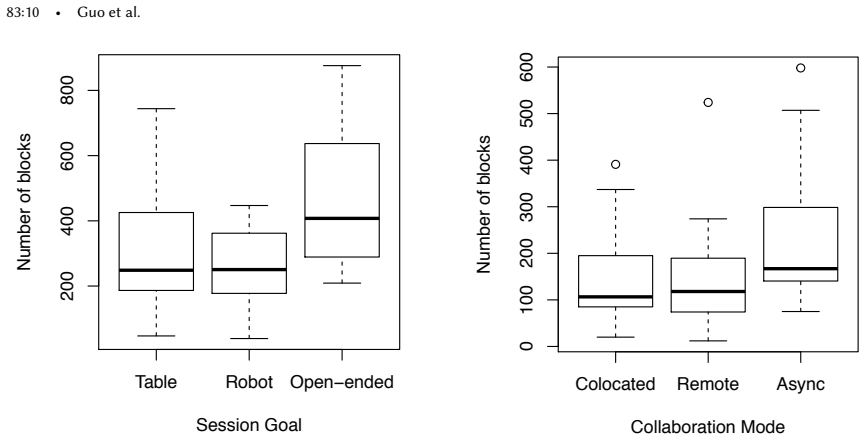
- Open-ended creation goals increase output, with pairs adding roughly 465 blocks in open-ended sessions versus 260 for robots and 306 for tables.
- Asynchronous collaboration changes how people build: it yields more blocks and more colors, less deletion of a partner's work, and more planning time, suggesting it suits independent creative contributions rather than tight coordination.
- Persistent public editing creates governance needs, since participants asked future creators not to alter their work and noted that space can become cluttered over time, motivating permissions, moderation, and expiry controls.
Reading between the lines
- Because the field comparison ran location-dependent and location-independent conditions on different days and at different sites, a cleaner test would hold the site and day constant while toggling location dependence; this would tell whether the session-count advantage is really about AR location design and not about calendar or novelty effects.
- If the patterns generalize, persistent collaborative AR could follow the same arc as Web 2.0, shifting end users from viewers of expert-made content to producers of an embedded digital layer over the physical world, with all the ownership, moderation, and curation problems that shift will bring.
- The contrast between the lab's enjoyment result and the field's participation result suggests there may be two distinct audiences or two distinct motivational routes, one driven by live social presence and one by flexible access; a useful next study would measure both dimensions within the same participants over time.
- The voxel grammar is simple enough that Blocks' persistence model could transfer to other persistent AR applications such as collaborative annotations, accessible signage, or navigation aids, where the shared object is not a sculpture but a community-maintained layer of information.
Signed reviews
Editorial analysis
A structured set of objections, weighed in public.
Referee Report
Summary. Blocks is a mobile AR application for collaborative creation of persistent block-based structures, presented as the first tool to cover all combinations of synchronous/asynchronous collaboration with colocated/remote users, and with AR structures that are either tied to a physical location or available anywhere. The paper reports a 24-participant lab study comparing colocated-sync, remote-sync, and async creation; a 68-participant three-day field study comparing location-dependent and location-independent deployments; and a 70-participant five-day extended deployment. The main reported findings are that participants prefer synchronous colocated collaboration and that participation, measured by session counts, is higher when structures are location-independent. The paper contributes design implications centered on location-independent, colocated synchronous experiences.
Significance. The contribution is an early, systematic empirical exploration of two collaborative dimensions in a single persistent AR creation tool. The lab study is methodologically stronger than typical system papers: within-subject counterbalanced conditions, ANOVA and Friedman tests with Holm-Bonferroni corrections, and server-log plus survey measures. The field and extended deployments provide realistic usage data and rich qualitative observations. If the field comparison were causally identified, the location-independence engagement claim would be an important design guideline. As it stands, the system and the lab preference results are likely to interest the IMWUT/UbiComp community, but the headline activity claim requires additional support or a tempered framing.
major comments (4)
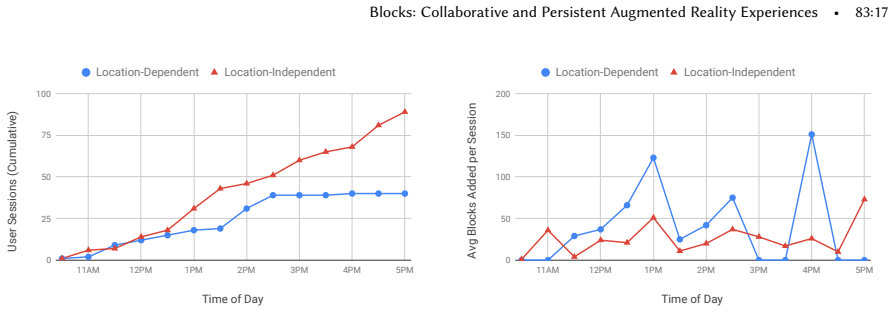
- [§6.1, §7.1, Table 2, Fig. 14] The claim that location-independent scenarios produce more activity is not supported by a controlled or statistically modeled comparison. The location-dependent condition ran on Day 1 (lobby) and Day 3 morning (cafeteria), while the location-independent condition ran on Day 2 (lobby) and Day 3 afternoon (cafeteria). Session counts (91 vs. 131) are thus entangled with calendar day, physical site, and time of day; novelty, foot traffic, or diurnal patterns could explain the difference. No inferential test is reported for these counts, in contrast to the lab study. This is load-bearing because §9.1 and §11 generalize to a recommendation to prefer location-independent experiences for participation. The paper should at minimum analyze the Day 3 within-site morning/afternoon split, model day and site as random effects, or substantially temper the causal wording; the Limitations section (§10) currently does not address this confound.
- [§7.1, Table 2] The activity finding is metric-dependent. In Table 2, location-dependent sessions have substantially more blocks per session (58 vs. 35) and similar total OurWorld blocks to location-independent (1,722 vs. 1,936); only the number of user sessions is higher. The abstract's phrase 'most active' therefore conflates session frequency with total contribution. The authors should report and test per-user and per-session productivity measures, and state explicitly which dimension of activity the design recommendation targets.
- [§8] The five-day extended deployment is presented as consistent with earlier findings, but it does not manipulate the location dimension; participants could experience structures both at the installation and anywhere. It therefore cannot provide independent evidence for the location-independence effect. This is not itself a flaw, but it should not be cited in support of the causal claim about location-independence increasing participation.
- [§9.1, §5.3.3, §7.1] The design recommendation for a location-independent, colocated synchronous experience is a conjunctive extrapolation that is not directly tested. The lab study varied the location of people across synchronous and asynchronous conditions but did not vary whether structures were location-dependent or independent; the field study varied structure persistence across locations but did not manipulate whether collaborators were colocated or remote. The paper should present the combined recommendation as an inference from two separate studies, not as an empirically validated combination.
minor comments (4)
- [§6.1] The sentence 'On Day 2, we deployed the location-independent scenario was deployed' contains a duplicated verb phrase; it should likely read 'On Day 2, we deployed the location-independent scenario, where...'.
- [Fig. 14, Fig. 15] Plotting cumulative sessions and average blocks against time of day for conditions that ran on different days may visually suggest a within-day comparison; adding day and site annotations would improve clarity.
- [§5.2.2] The post-hoc comparison for blocks added in the async condition versus the colocated-sync condition reports adjusted p = 0.139; the text should state clearly that this difference is not significant after the Holm-Bonferroni correction, since the current phrasing 'post-hoc analyses revealed' could be misread.
- [§2.2, Table 1] The phrase 'space and time' is used for two distinct dimensions: the location of the people and the location of the AR structures. Consider distinguishing these dimensions more explicitly in Table 1 and the surrounding text to avoid conceptual ambiguity.
Circularity Check
No circularity: the paper is an empirical user study whose claims are supported by external measurements, not by fitted parameters or self-referential definitions.
full rationale
This paper reports a system design and empirical evaluations (lab study, field study, and extended deployment) of an AR co-creation application. The central claims are behavioral: participants preferred colocated synchronous collaboration, and they were most active in the location-independent scenario. These claims are grounded in observed measurements such as Likert ratings, rankings, session counts, block counts, and server logs. None of the paper's contributions are derived from an analytic model, a fitted parameter, or a theorem. The design choices are informed by prior literature, but the outcome measures are external to the hypotheses and were not used to define the hypotheses. The only notable weakness is a validity concern in the field study: the location-dependent and location-independent conditions were entangled with day, physical site, and time of day, and the paper does not statistically model this confound. That is a methodological threat to causal inference, not a circularity. The paper also cites some prior work by its own authors (e.g., VizLens, Facade, Crowd Research), but these citations are contextual or methodological and are not load-bearing for the empirical conclusions. There is no equation in which an output equals an input by construction, no re-labeling of a fitted value as a prediction, and no self-citation chain that forces the result. Therefore the appropriate circularity score is 0.
Assumptions & free parameters
assumptions (4)
- domain assumption Seven-point Likert scales can be treated as equal-interval data and analyzed with parametric tests.
- domain assumption The number of blocks added is a valid proxy for structural complexity and participation, analogous to word count in collaborative writing.
- domain assumption Findings from company employees (engineers, designers, PMs, technicians, financial analysts) generalize to a broader population of end users.
- domain assumption Apple ARKit world tracking and image markers maintain persistent, accurate alignment of virtual structures across sessions and devices.
Cite this review
Pith. "Pith review of Blocks: Collaborative and Persistent Augmented Reality Experiences." pith.science (2026). https://pith.science/paper/WT3QGAIK
@misc{pith2026190802409,
  author       = {Pith},
  title        = {Pith review of: Blocks: Collaborative and Persistent Augmented Reality Experiences},
  year         = {2026},
  howpublished = {\url{https://pith.science/paper/WT3QGAIK}},
  note         = {Machine review of arXiv:1908.02409}
}
read the original abstract
We introduce Blocks, a mobile application that enables people to co-create AR structures that persist in the physical environment. Using Blocks, end users can collaborate synchronously or asynchronously, whether they are colocated or remote. Additionally, the AR structures can be tied to a physical location or can be accessed from anywhere. We evaluated how people used Blocks through a series of lab and field deployment studies with over 160 participants, and explored the interplay between two collaborative dimensions: space and time. We found that participants preferred creating structures synchronously with colocated collaborators. Additionally, they were most active when they created structures that were not restricted by time or place. Unlike most of today's AR experiences, which focus on content consumption, this work outlines new design opportunities for persistent and collaborative AR experiences that empower anyone to collaborate and create AR content.
Figures

Figures from the paper (7 more)

Reference graph
Works this paper leans on
-
[1]
Apple Inc. 2019. ARKit. https://developer.apple.com/arkit/
work page 2019
-
[2]
Archery Inc. 2018. Arrow - Augmented Reality. https://itunes.apple.com/app/arrow-ar-texts-emojis/id1296755150
work page 2018
-
[3]
Arthur Aron, Elaine N Aron, and Danny Smollan. 1992. Inclusion of other in the self scale and the structure of interpersonal closeness. Journal of personality and social psychology 63, 4 (1992), 596
1992
-
[4]
Yochai Benkler. 2006. The wealth of networks: How social production transforms markets and freedom . Yale University Press
work page 2006
-
[5]
Po Bhattacharyya, Radha Nath, Yein Jo, Ketki Jadhav, and Jessica Hammer. 2019. Brick: Toward A Model for Designing Synchronous Colocated Augmented Reality Games. In Proceedings of the 2019 CHI Conference on Human Factors in Computing Systems (CHI ’19) . ACM, New York, NY, USA, Article 323, 9 pages. https://doi.org/10.1145/3290605.3300553
arXiv 2019
-
[6]
Mark Billinghurst, Adrian Clark, and Gun Lee. 2015. A Survey of Augmented Reality. Found. Trends Hum.-Comput. Interact. 8, 2-3 (March 2015), 73–272. https://doi.org/10.1561/1100000049
-
[7]
Mark Billinghurst, Ivan Poupyrev, Hirokazu Kato, and Richard May. 2000. Mixing Realities in Shared Space: An Augmented Reality Interface for Collaborative Computing.. In IEEE International Conference on Multimedia and Expo (III) . Citeseer, 1641–1644
work page 2000
-
[8]
Tobias Brockmann, Nina Krüger, Stefan Stieglitz, and Immo Bohlsen. 2013. A Framework for Collaborative Augmented Reality Applications. (2013)
work page 2013
Show all 57 references
-
[9]
Su Cai, Xu Wang, and Feng-Kuang Chiang. 2014. A case study of Augmented Reality simulation system application in a chemistry course. Computers in Human Behavior 37 (2014), 31–40
2014
-
[10]
Areti Damala, Pierre Cubaud, Anne Bationo, Pascal Houlier, and Isabelle Marchal. 2008. Bridging the gap between the digital and the physical: design and evaluation of a mobile augmented reality guide for the museum visit. In Proceedings of the 3rd international conference on D...
2008
-
[11]
Experiments with Google. 2018. Garden Friends. https://experiments.withgoogle.com/garden-friends Proc. ACM Interact. Mob. Wearable Ubiquitous Technol., Vol. 3, No. 3, Article 83. Publication date: September 2019. Blocks: Collaborative and Persistent Augmented Reality Experienc...
2018
-
[12]
Cole Gleason, Anhong Guo, Gierad Laput, Kris Kitani, and Jeffrey P. Bigham. 2016. VizMap: Accessible Visual Information Through Crowdsourced Map Reconstruction. In Proceedings of the 18th International ACM SIGACCESS Conference on Computers and Accessibility (ASSETS ’16). ACM, ...
2016
-
[13]
Google. 2019. Google Docs. https://www.google.com/docs/about/
2019
-
[14]
Google Developers. 2019. ARCore. https://developers.google.com/ar/
2019
-
[15]
Greg Guest, Kathleen M MacQueen, and Emily E Namey. 2011. Applied thematic analysis. sage
2011
-
[17]
Hudson, Jennifer Mankoff, and Jeffrey P
Anhong Guo, Jeeeun Kim, Xiang ‘Anthony’ Chen, Tom Yeh, Scott E. Hudson, Jennifer Mankoff, and Jeffrey P. Bigham. 2017. Facade: Auto-generating Tactile Interfaces to Appliances. In Proceedings of the 2017 CHI Conference on Human Factors in Computing Systems (CHI ’17). ACM, New ...
2017
-
[18]
Taejin Ha, Woontack Woo, Youngho Lee, Junhun Lee, Jeha Ryu, Hankyun Choi, and Kwanheng Lee. 2010. ARtalet: tangible user interface based immersive augmented reality authoring tool for Digilog book. In Ubiquitous Virtual Reality (ISUVR), 2010 International Symposium on. IEEE, 40–43
2010
-
[19]
Anders Henrysson, Mark Billinghurst, and Mark Ollila. 2005. Face to face collaborative AR on mobile phones. In Proceedings of the 4th IEEE/ACM international symposium on mixed and augmented reality . IEEE Computer Society, 80–89
2005
-
[20]
Inter IKEA Systems. 2017. IKEA Place. https://highlights.ikea.com/2017/ikea-place/
2017
-
[21]
Henry Jenkins. 2006. Convergence culture: Where old and new media collide . NYU press
2006
-
[22]
Kangsoo Kim, Mark Billinghurst, Gerd Bruder, Henry Been-Lirn Duh, and Gregory F Welch. 2018. Revisiting Trends in Augmented Reality Research: A Review of the 2nd Decade of ISMAR (2008–2017). IEEE transactions on visualization and computer graphics 24, 11 (2018), 2947–2962
2018
-
[23]
Kiyoshi Kiyokawa, Mark Billinghurst, Sohan E Hayes, Anoop Gupta, Yuki Sannohe, and Hirokazu Kato. 2002. Communication behaviors of co-located users in collaborative AR interfaces. In Proceedings of the 1st International Symposium on Mixed and Augmented Reality . IEEE Computer ...
2002
-
[24]
Vojtěch Krs, Ersin Yumer, Nathan Carr, Bedrich Benes, and Radomír Měch. 2017. Skippy: Single View 3D Curve Interactive Modeling. ACM Trans. Graph. 36, 4, Article 128 (July 2017), 12 pages. https://doi.org/10.1145/3072959.3073603
2017
-
[25]
Lasecki, Kyle I
Walter S. Lasecki, Kyle I. Murray, Samuel White, Robert C. Miller, and Jeffrey P. Bigham. 2011. Real-time Crowd Control of Existing Interfaces. In Proceedings of the 24th Annual ACM Symposium on User Interface Software and Technology (UIST ’11) . ACM, New York, NY, USA, 23–32....
2011
-
[26]
Bibb Latané, Kipling Williams, and Stephen Harkins. 1979. Many hands make light the work: The causes and consequences of social loafing. Journal of personality and social psychology 37, 6 (1979), 822
1979
-
[27]
Jean Lave, Etienne Wenger, and Etienne Wenger. 1991. Situated learning: Legitimate peripheral participation . Vol. 521423740. Cambridge university press Cambridge
1991
-
[28]
Lee, Gerard J
Gun A. Lee, Gerard J. Kim, and Mark Billinghurst. 2005. Immersive Authoring: What You eXperience Is What You Get (WYXIWYG). Commun. ACM 48, 7 (July 2005), 76–81. https://doi.org/10.1145/1070838.1070840
2005
-
[29]
Lee, Claudia Nelles, Mark Billinghurst, and Gerard Jounghyun Kim
Gun A. Lee, Claudia Nelles, Mark Billinghurst, and Gerard Jounghyun Kim. 2004. Immersive Authoring of Tangible Augmented Reality Applications. In Proceedings of the 3rd IEEE/ACM International Symposium on Mixed and Augmented Reality (ISMAR ’04) . IEEE Computer Society, Washing...
2004 doi
-
[30]
David Lindlbauer and Andy D. Wilson. 2018. Remixed Reality: Manipulating Space and Time in Augmented Reality. In Proceedings of the 2018 CHI Conference on Human Factors in Computing Systems (CHI ’18) . ACM, New York, NY, USA, Article 129, 13 pages. https://doi.org/10.1145/3173...
2018
-
[31]
Mark Mabrito. 2006. A study of synchronous versus asynchronous collaboration in an online business writing class. The American Journal of Distance Education 20, 2 (2006), 93–107
2006
-
[32]
Microsoft. 2018. Microsoft Maquette. https://www.maquette.ms
2018
-
[33]
Microsoft. 2019. Minecraft. https://minecraft.net/
2019
-
[34]
Stephan Müller, Mubbasir Kapadia, Seth Frey, S Klinger, Richard P Mann, Barbara Solenthaler, Robert W Sumner, and Markus Gross
-
[35]
Niantic, Inc. 2016. Pokémon Go. https://www.pokemongo.com/
2016
-
[36]
Olson, Dakuo Wang, Gary M
Judith S. Olson, Dakuo Wang, Gary M. Olson, and Jingwen Zhang. 2017. How People Write Together Now: Beginning the Investigation with Advanced Undergraduates in a Project Course. ACM Trans. Comput.-Hum. Interact. 24, 1, Article 4 (March 2017), 40 pages. https://doi.org/10.1145/3038919
2017 doi
-
[37]
Davidson, Sameh Khamis, Mingsong Dou, Vladimir Tankovich, Charles Loop, Qin Cai, Philip A
Sergio Orts-Escolano, Christoph Rhemann, Sean Fanello, Wayne Chang, Adarsh Kowdle, Yury Degtyarev, David Kim, Philip L. Davidson, Sameh Khamis, Mingsong Dou, Vladimir Tankovich, Charles Loop, Qin Cai, Philip A. Chou, Sarah Mennicken, Julien Valentin, Vivek Proc. ACM Interact. ...
2019
-
[38]
Ye Pan, David Sinclair, and Kenny Mitchell. 2018. Empowerment and embodiment for collaborative mixed reality systems. Computer Animation and Virtual Worlds 29, 3-4 (2018), e1838
2018
-
[39]
Rémi Paucher and Matthew Turk. 2010. Location-based augmented reality on mobile phones. In Computer Vision and Pattern Recognition Workshops (CVPRW), 2010 IEEE Computer Society Conference on . IEEE, 9–16
2010
-
[40]
Niranjini Rajagopal, John Miller, Krishna Kumar Reghu Kumar, Anh Luong, and Anthony Rowe. 2018. Welcome to My World: Demystifying Multi-user AR with the Cloud: Demo Abstract. InProceedings of the 17th ACM/IEEE International Conference on Information Processing in Sensor Networ...
2018
-
[41]
Gerhard Reitmayr and Dieter Schmalstieg. 2003. Location Based Applications for Mobile Augmented Reality. In Proceedings of the Fourth Australasian User Interface Conference on User Interfaces 2003 - Volume 18 (AUIC ’03) . Australian Computer Society, Inc., Darlinghurst, Austra...
2003
-
[42]
Mitchel Resnick and Brian Silverman. 2005. Some Reflections on Designing Construction Kits for Kids. In Proceedings of the 2005 Conference on Interaction Design and Children (IDC ’05) . ACM, New York, NY, USA, 117–122. https://doi.org/10.1145/1109540.1109556
2005
-
[43]
Scott D Roth. 1982. Ray casting for modeling solids. Computer graphics and image processing 18, 2 (1982), 109–144
1982
-
[44]
Maria Roussos, Andrew Johnson, Thomas Moher, Jason Leigh, Christina Vasilakis, and Craig Barnes. 1999. Learning and building together in an immersive virtual world. Presence: Teleoperators & Virtual Environments 8, 3 (1999), 247–263
1999
-
[45]
Snap, Inc. 2019. Snapchat. https://whatis.snapchat.com/
2019
-
[46]
Misha Sra, Aske Mottelson, and Pattie Maes. 2018. Your Place and Mine: Designing a Shared VR Experience for Remotely Located Users. In Proceedings of the 2018 Designing Interactive Systems Conference (DIS ’18) . ACM, New York, NY, USA, 85–97. https://doi.org/10.1145/ 3196709.3196788
2018
-
[47]
Thad Starner, Steve Mann, Bradley Rhodes, Jeffrey Levine, Jennifer Healey, Dana Kirsch, Rosalind W Picard, and Alex Pentland. 1997. Augmented reality through wearable computing. Presence: Teleoperators & Virtual Environments 6, 4 (1997), 386–398
1997
-
[48]
Ivan D Steiner. 2007. Group process and productivity (social psychological monograph). (2007)
2007
-
[49]
The LEGO Group. 2019. LEGO. https://www.lego.com/
2019
-
[50]
Kathleen Tuite, Adam M Smith, and Expressive Intelligence Studio. 2012. Emergent remix culture in an anonymous collaborative art system. In Proceedings of the 8th AAAI Artificial Intelligence and Interactive Digital Entertainment Conference (Toronto, Canada, 2012) . 16–23
2012
-
[51]
Gaikwad, Geza Kovacs, Andreas Veit, Ranjay Krishna, Imanol Arrieta Ibarra, Camelia Simoiu, Michael Wilber, Serge Belongie, Sharad Goel, James Davis, and Michael S
Rajan Vaish, Snehalkumar (Neil) S. Gaikwad, Geza Kovacs, Andreas Veit, Ranjay Krishna, Imanol Arrieta Ibarra, Camelia Simoiu, Michael Wilber, Serge Belongie, Sharad Goel, James Davis, and Michael S. Bernstein. 2017. Crowd Research: Open and Scalable University Laboratories. In...
2017
-
[52]
Jia Wang, Owen Leach, and Robert W Lindeman. 2013. DIY World Builder: an immersive level-editing system. In 3D User Interfaces (3DUI), 2013 IEEE Symposium on . IEEE, 195–196
2013
-
[53]
Xu Wang, Miaomiao Wen, and Carolyn Rose. 2017. Contrasting explicit and implicit support for transactive exchange in team oriented project based learning. In International Conference on Computer Supported Collaborative Learning (CSCL ’17) . Philadelphia, PA: International Soci...
2017
-
[54]
wiARframe, Inc. 2018. wiARframe. https://www.wiarframe.com
2018
-
[55]
Haijun Xia, Sebastian Herscher, Ken Perlin, and Daniel Wigdor. 2018. Spacetime: Enabling Fluid Individual and Collaborative Editing in Virtual Reality. In Proceedings of the 31st Annual ACM Symposium on User Interface Software and Technology (UIST ’18) . ACM, New York, NY, USA...
2018
-
[56]
Zappar Ltd. 2019. ZapWorks. https://zap.works/
2019
-
[57]
Feng Zhou, Henry Been-Lirn Duh, and Mark Billinghurst. 2008. Trends in augmented reality tracking, interaction and display: A review of ten years of ISMAR. In Proceedings of the 7th IEEE/ACM International Symposium on Mixed and Augmented Reality . IEEE Computer Society, 193–20...
2008
-
[2015]
In Proceedings of the 10th International Conference on the Foundations of Digital Games
Statistical analysis of player behavior in Minecraft. In Proceedings of the 10th International Conference on the Foundations of Digital Games. Society for the Advancement of the Science of Digital Games
Reviewed August 14, 2026 · model on record in the stance chip above.
Discussion (0). Continue with ORCID to comment.