REVIEW 3 major objections 6 minor 18 references
A Two-Ray Multipath Model for Frequency Diverse Array-Based Directional Modulation in MISOME Wiretap Channels
T0 review · 3 major / 6 minor · reviewed 2026-08-14 · deepseek-v4-flash
Pith's one-line read A ground-reflected path can be exploited, not fought, to create a focused secure zone in frequency-diverse-array directional modulation.
desk verdict A mostly sound FDA-DM extension to two-ray multipath, but the Bob-side cancellation is only instantaneous—needs a symbol-duration condition. read the letter →
The pith
A machine-rendered reading of the paper's core claim, the machinery that carries it, and where it could break.
The reading
What carries the argument
The central object is the two-ray multipath FDA-DM model: a symmetric $(2N+1)$-element frequency diverse array (an array whose elements radiate at slightly different frequencies, creating a range-and-angle-dependent pattern) placed at height $h_0$ above a flat perfect ground, with each receiver seeing a direct line-of-sight path plus a ground-reflected path. The reflected path is treated through image theory, so its geometry is the same as radiation from a mirror array below ground, and the sum of the two paths collapses each element's contribution to $a_n x_n \mu_n \varepsilon_n \rho_n$ with $\rho_n = j2\sin(2\pi f_n h_0 v/c)$. The load-bearing identity is the pair of constraints at Bob, $\sum_n a_n \mu_B^n \varepsilon_B^n \rho_B^n = 1$ and $\sum_n a_n b_n \mu_B^n \varepsilon_B^n \rho_B^n = 0$, which jointly enforce a unit useful-signal response and exact artificial-noise cancellation at Bob. This is the mechanism that converts the multipath geometry into a secure transmission design.
What would settle it
Run the same FDA-DM design at $f_0 = 10$ GHz, $h_0 = 4.25\lambda_0$, with Bob at the paper's location, over ground with measured roughness or a finite dielectric; if the artificial noise cancellation at Bob degrades by more than the model's predicted margin, or if an eavesdropper at an angle where $\sin(2\pi f_n h_0 v/c) \approx 0$ still recovers the symbol, the two-ray assumption is falsified. A simpler check is to numerically simulate the full-wave pattern over a lossy half-space and compare the BER lobe width with the two-ray prediction.
Extended reading notes
Core claim
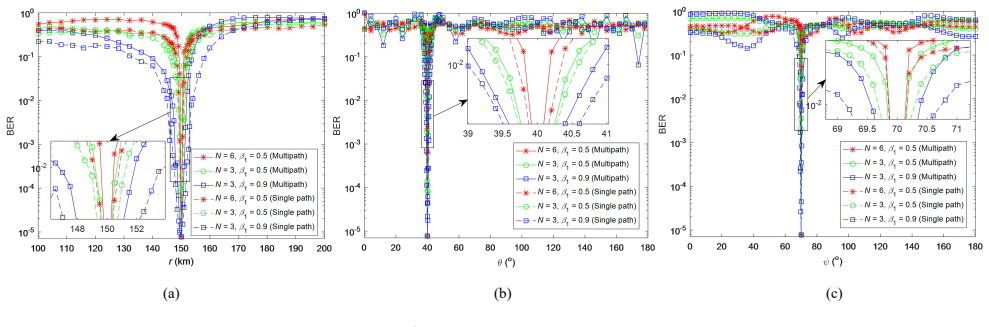
The paper's central claim is that a two-ray multipath environment, modeled by replacing the ground with an image antenna array, is not an obstacle to FDA-based directional modulation but a resource. Modeling the reflected path as an image FDA with a $-1$ reflection coefficient, the total received signal at any point becomes the single-path signal with each element's contribution multiplied by $\rho_n = j2\sin(2\pi f_n h_0 v/c)$, where $h_0$ is the array height and $v = \sin\theta$ depends on elevation. This makes the effective channel elevation-dependent. Choosing excitation factors $\{a_n\}$ and artificial noise weights $\{b_n\}$ to satisfy $\kappa_B = 1$ and $\eta_B = 0$ at Bob's location leaves Bob with exactly $\sqrt{P_s}\beta_1 s$, free of artificial noise, while eavesdroppers elsewhere fail these constraints and see both a distorted signal and interference. The paper verifies by BER and secrecy-rate simulations that this yields a more tightly focused secure region than the single-path FDA-DM model.
Load-bearing premise
The design collapses if the environment is not well described by a flat, perfectly conducting ground plane: the path-length approximations and the $-1$ reflection coefficient are what make equations (5), (6), and the design constraints (15) hold exactly.
Editorial extensions
If this is right
- Bob's receiver sees no artificial noise and full useful-signal power, so the demodulator works exactly as in a clean channel.
- Eavesdroppers at any location other than Bob's must contend with both a distorted useful signal and residual artificial noise, so their achievable rate is lower.
- The secure region shrinks as the number of array elements $N$ grows or the signal power split $\beta_1$ decreases, giving a concrete design trade-off between array size and security focus.
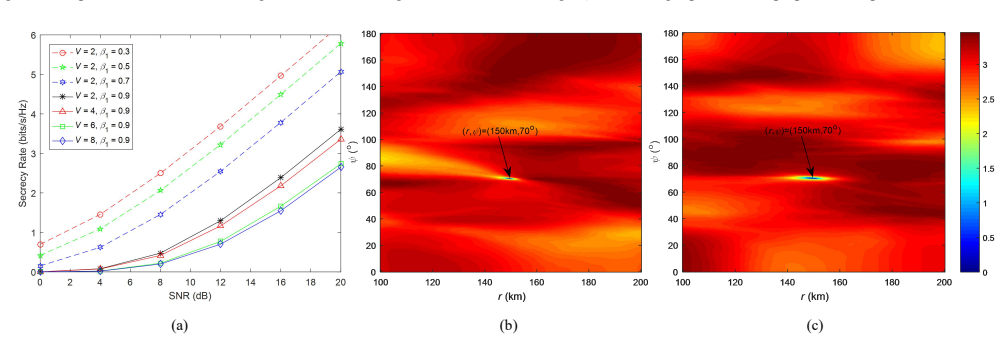
- Secrecy rate rises with SNR and falls with the number of eavesdroppers, matching standard physical-layer-security intuition.
Reading between the lines
- If the two-ray approximation transfers to other flat-reflector settings such as walls, water surfaces, or building facades, the same sine-factor design could be re-derived with a complex reflection coefficient and a different image height, giving a testable family of secure-zone shapes.
- The elevation-dependent $\rho_n$ suggests that height $h_0$ and elevation angle could be tuned to place artificial-noise suppression at Bob while creating a natural noise floor at many Eve locations, a degree of freedom the single-path model lacks.
- The paper does not study robustness to imperfect Bob position knowledge; a natural extension is to quantify how much the constraints (15) degrade under small errors in range or angle, which would tell whether the narrow secure lobe survives in practice.
- Extending to a moving Bob or to correlated Eve positions near Bob would require re-solving the constraints per block or adding randomization, which the proposed dynamic random generation of $\{a_n\}$ and $\{b_n\}$ already makes plausible.
Signed reviews
Editorial analysis
A structured set of objections, weighed in public.
Referee Report
Summary. The paper extends frequency-diverse-array directional modulation (FDA-DM) to a two-ray multipath environment, modeled with a perfectly conducting ground plane and image theory. The authors jointly design the FDA excitation factors {a_n} and the artificial-noise weights {b_n} so that, at the intended receiver Bob, the AN cancels and the useful signal is normalized (constraints (15)). They then define SNR and SINR-based rates ((17)–(20)) and a corresponding 'secrecy rate' ((21)), and present BER and secrecy-rate simulations to argue that the two-ray FDA-DM scheme enables physical-layer secure transmission and yields a more focused secure area than the single-path model.
Significance. If the results are valid, this is a useful extension of FDA-DM from idealized free-space channels to a two-ray multipath scenario, with an explicit, non-iterative design procedure that gives Bob a clean signal while injecting AN into other locations. The paper includes a concrete numerical solution for the design constraints (Table I) and reproduces standard SNR/SINR formulas, which are self-consistent within the stated model. However, the central claims rest on two load-bearing points that need strengthening: the time-varying nature of the FDA phase terms is not handled, and the 'secrecy rate' is an SINR heuristic rather than a proven information-theoretic quantity. The claimed advantage over the single-path model is currently supported only by a few simulation examples.
major comments (3)
- [Section II, Eqs. (8b), (15), (16)] The design constraints (15) are solved at a single time instant, but ε_B^n(t)=exp{j2πΔf_n(t−(r_B−d_n u_B)/c)} depends explicitly on t, and Δf_n differ across elements. Consequently κ_B(t) and η_B(t) are time-varying, so the equality y_Total(⃗r_B)=√Ps β1 s in (16) holds only at the instant at which (15) is imposed, not over a finite symbol duration. The paper does not specify a symbol duration T or a condition such as max_n |Δf_n| T ≪ 1 that would justify treating the coefficients as quasi-static. Because the SNR/SINR analysis in Section III and the simulations use these snapshot values, the claim that the inserted AN has no impact on Bob is not established for practical finite-duration symbols.
- [Section III, Eqs. (17)–(21)] The quantity called 'secrecy rate' in (21) is defined as a difference of pointwise rates ζ(⃗r)=log2(1+SINR(⃗r)), where the AN is treated as Gaussian interference at the eavesdroppers and is assumed perfectly canceled at Bob. This is an SINR-based heuristic; the paper does not show that this ζ_sec is an achievable secrecy rate, a lower bound on secrecy capacity, or even the rate of a specific wiretap code. Furthermore, the minimization in (21) is only over the V eavesdroppers present in the simulation, not over all possible Eve locations, so the claim that the scheme 'is capable of wireless PLS transmission' is not supported as a worst-case guarantee. The paper should either present a proper information-theoretic secrecy formulation or explicitly state that ζ_sec is a DM-system performance metric rather than a proven secrecy rate.
- [Section IV, Figs. 2 and 3] The central comparative claim that the two-ray multipath model achieves a 'more focused secure area' than the single-path model is based only on a few simulation examples with fixed parameters (f0=10 GHz, Δf=2 kHz, h0=4.25λ0, and one Bob location). No analytical expression for the beamwidth or secure area is derived, no metric for 'secure area' is defined, and no sensitivity analysis is provided. As this comparative claim appears in the abstract and conclusion, it needs stronger support—for example, an analytical comparison or a systematic simulation sweep showing that the effect is not an artifact of the particular parameter choices.
minor comments (6)
- [Section II, Eq. (11c)] The abbreviation 'LP' for low-pass filtering is not defined; the authors should state that a low-pass filter removes the carrier term exp{j2πf0t}.
- [Section II, Eq. (5) and (6)] The approximation r_LoS ≈ r − d_n u − h0 v and r_NLoS ≈ r − d_n u + h0 v is stated without a derivation of its validity regime; citing [17] is fine, but a brief comment on when the far-field approximation is accurate (e.g., r ≫ array aperture) would improve clarity.
- [Section II, after Eq. (15)] The authors say that 'multiple solutions' for {a_n} and {b_n} exist and Table I gives one with N=3, but no numerical method or heuristic for finding these solutions is described. A short explanation of how Table I was obtained would help reproducibility.
- [Section IV, Fig. 3(a)] The text states that secrecy rate increases with smaller β1, but Bob's signal-to-noise ratio in (20) decreases when β1 is smaller. The reason the net secrecy rate increases (presumably because Eve's interference grows faster) should be explained to avoid an apparent contradiction.
- [Section II, Eq. (3)] The artificial noise z is a single scalar complex Gaussian injected onto every array element with different weights b_n. This is a valid architecture, but the paper should clarify that this is not a multi-dimensional AN vector, as in some other AN-aided schemes.
- [Throughout] Several equations, such as (1), (5), and (6), use the notation '⃗r_Ante^n' which is a vector position; the dot product in (5) is clear but could be written more explicitly as ⃗e_r · ⃗r_Ante^n = d_n u + h0 v for readers unfamiliar with the notation.
Circularity Check
No circularity: the design constraints are solved-for conditions and the secrecy-rate analysis follows from standard formulas.
full rationale
The paper's derivation chain is self-contained and does not reduce to its own inputs. The FDA excitation factors {a_n} and AN weights {b_n} are chosen to satisfy the two constraints in (15): kappa_B = 1 and eta_B = 0. These are explicitly imposed design conditions, not fitted parameters disguised as predictions. Equation (16), which states that Bob receives sqrt(Ps) beta1 s, is a direct algebraic consequence of substituting (15) into (13b); the secrecy rate at Bob in (20) is then obtained by substituting the same constraints into the standard SINR expression (18). The eavesdropper rates are computed from the same model at different locations without imposing any condition that forces a desired secrecy rate, so the claim that Eves are distorted is a genuine consequence of the two-ray channel model rather than an assumed outcome. The only self-references are to prior FDA-DM works [13], [15] for background, and the two-ray multipath extension is derived independently from image theory and the stated geometry. The infinite perfectly conducting ground assumption and the far-field approximations in (5) and (6) are stated modeling assumptions, not circular imports. A skeptical concern that the t-dependence of epsilon_n in (8b) means the constraints (15) hold only instantaneously is a correctness and robustness issue about the finite-symbol-duration validity of the design, not a circularity issue under the rules of this review. No equation is defined in terms of the very quantity it is said to predict, and no fitted input is relabeled as a prediction. Therefore the circularity score is 0.
Assumptions & free parameters
assumptions (6)
- domain assumption The ground is an infinite, perfectly conducting plane, so image theory applies and the reflected NLoS path has a -1 reflection coefficient.
- domain assumption Far-field planar approximations r_LoS_n ≈ r - d_n u - h0 v and r_NLoS_n ≈ r - d_n u + h0 v.
- domain assumption The artificial noise z is circularly symmetric complex Gaussian with unit variance, independent of s.
- domain assumption Eavesdroppers are passive and treat the artificial noise as additive interference when computing achievable rates.
- domain assumption Alice perfectly knows Bob's location (r_B, θ_B, ψ_B).
- domain assumption The channel is normalized; AWGN is added at the receiver with variance σ_ξ^2.
Cite this review
Pith. "Pith review of A Two-Ray Multipath Model for Frequency Diverse Array-Based Directional Modulation in MISOME Wiretap Channels." pith.science (2026). https://pith.science/paper/WTQP6DFE
@misc{pith2026190804648,
  author       = {Pith},
  title        = {Pith review of: A Two-Ray Multipath Model for Frequency Diverse Array-Based Directional Modulation in MISOME Wiretap Channels},
  year         = {2026},
  howpublished = {\url{https://pith.science/paper/WTQP6DFE}},
  note         = {Machine review of arXiv:1908.04648}
}
read the original abstract
A two-ray multipath model for frequency diverse array (FDA)-based directional modulation (DM) is proposed in multi-input single-output multi-eavesdropper (MISOME) wiretap channels for the first time. The excitation factors of the FDA and the weighting coefficients of the inserted artificial noise (AN) are jointly designed in a way which imposes no impact on the desired receiver while simultaneously distorting the received signals of eavesdroppers. Secrecy rate is analyzed for the proposed two-ray multipath FDA-based DM model. Numerical simulations verify the capability of physical layer secure (PLS) transmissions of the proposed FDA-DM model in two-ray multipath MISOME wiretap channels.
Figures

Reference graph
Works this paper leans on
-
[1]
Directional modulation technique for phased arrays,
M. P. Daly and J. T. Bernhard, “Directional modulation technique for phased arrays,” IEEE Tran. Ante. & Prop., vol. 57, no. 9, pp. 2633-2640, Sep. 2009
work page 2009
-
[2]
A review of directional modulation technology,
Y . Ding and V . Fusco, “A review of directional modulation technology,” International J. Microw. & Wirel. Techn., vol. 8, no. 7, pp. 981-993, 2016
work page 2016
-
[3]
Frequency Diverse Array Radars,
P. Antonik, M. C. Wicks, H. D. Griffiths, and C. J. Baker, “Frequency Diverse Array Radars,”Proc. 2006 IEEE Radar Conf., 2006, pp. 215-217
work page 2006
-
[4]
Transmit subaperturing for range and angle estimation in frequency diverse array radar,
W.-Q. Wang and H. C. So, “Transmit subaperturing for range and angle estimation in frequency diverse array radar,” IEEE Trans. Signal Processing, vol. 62, no. 8, pp. 2000-2011, Apr. 2014
work page 2000
-
[5]
Frequency diverse array radar with logarithmically increasing frequency offset,
W. Khan, I. M. Qureshi, and S. Saeed, “Frequency diverse array radar with logarithmically increasing frequency offset,” IEEE Ante. & Wirel. Prop. Lett., vol. 14, pp. 499-502, 2015
work page 2015
-
[6]
Dot-shaped range- angle beampattern synthesis for frequency diverse array,
H. Shao, J. Dai, J. Xiong, H. Chen, and W.-Q. Wang, “Dot-shaped range- angle beampattern synthesis for frequency diverse array,” IEEE Ante. & Wirel. Prop. Lett., vol. 15, pp. 1703-1706, 2016
work page 2016
-
[7]
Y . Liu, H. Ruan, L. Wang, and A. Nehorai, “The random frequency diverse array: a new antenna structure for uncoupled direction-range indication in active sensing,” IEEE J. Sel. Topics in Signal Processing , vol. 11, no. 2, pp. 295-308, Mar. 2017
work page 2017
-
[8]
Frequency diverse array transmit beampattern optimization with genetic algorithm,
J. Xiong, W.-Q. Wang, H. Shao, and H. Chen, “Frequency diverse array transmit beampattern optimization with genetic algorithm,” IEEE Ante. & Wirel. Prop. Lett. , vol. 16, pp. 469-472, 2017
work page 2017
Show all 18 references
-
[9]
Development of frequency diverse array radar technology: a review,
A. Basit, W. Khan, S. Khan, and I. M. Qureshi, “Development of frequency diverse array radar technology: a review,” IET Radar, Sonar and Navigation, vol. 12, no. 2, pp. 165-175, Feb. 2018
2018
-
[10]
Directional modulation using frequency diverse array for secure communications,
J. Xiong, S. Y . Nusenu, and W.-Q. Wang, “Directional modulation using frequency diverse array for secure communications,” Wirel. Personal Commun., vol. 95, no. 3, pp. 2679-2689, Aug. 2017
2017
-
[11]
DM using FDA antenna for secure transmission,
W.-Q. Wang, “DM using FDA antenna for secure transmission,” IET Microw. Ante. & Prop., vol. 11, no. 3, pp. 336-345, 2017
2017
-
[12]
Artificial-noise- aided secure transmission with directional modulation based on random frequency diverse arrays,
J. Hu, S. Yan, F. Shu, J. Wang, J. Li, and Y . Zhang, “Artificial-noise- aided secure transmission with directional modulation based on random frequency diverse arrays,” IEEE Access, vol. 5, pp. 1658-1667, Jan. 2017
2017
-
[13]
Time-invariant angle-range dependent directional modulation based on time-modulated frequency diverse arrays,
Q. Cheng, J. Zhu, T. Xie, J. Luo, and Z. Xu, “Time-invariant angle-range dependent directional modulation based on time-modulated frequency diverse arrays,” IEEE Access, vol. 5, pp. 26279-26290, Nov. 2017
2017
-
[14]
Secrecy capacity analysis of AN-aided FDA communication over Nakagami-m fading,
S. Ji, W.-Q. Wang, H. Chen, and Z. Zheng, “Secrecy capacity analysis of AN-aided FDA communication over Nakagami-m fading,” IEEE Wirel. Commun. Lett., vol. 7, no. 6, pp. 1034-1037, Dec. 2018
2018
-
[15]
Secure point-to-multipoint communication using the spread spectrum assisted orthogonal frequency diverse array in free space,
T. Xie, J. Zhu, Q. Cheng, and Y . Guan, “Secure point-to-multipoint communication using the spread spectrum assisted orthogonal frequency diverse array in free space,” IEICE Trans. Commun., vol. E102.B, no. 6, pp. 1188-1197, 2019
2019
-
[16]
Physical-layer security for proximal legitimate user and eavesdropper: a frequency diverse array beamforming approach,
J. Lin, Q. Li, J. Yang, H. Shao, and W.-Q. Wang, “Physical-layer security for proximal legitimate user and eavesdropper: a frequency diverse array beamforming approach,” IEEE Trans. Inform. Forensics Security, vol. 13, no. 3, pp. 671-684, Mar. 2018
2018
-
[17]
Multipath characteristics of frequency diverse arrays over a ground plane,
C. Cetintepe and S. Demir, “Multipath characteristics of frequency diverse arrays over a ground plane,” IEEE Trans. Ante. & Prop. , vol. 62, no. 7, pp. 3567-3574, Jul. 2014
2014
-
[18]
Establishing metrics for assessing the perfor- mance of directional modulation systems,
Y . Ding and V . Fusco, “Establishing metrics for assessing the perfor- mance of directional modulation systems,” IEEE Trans. Ante. & Prop. , vol. 62, no. 5, pp. 2745-2755, May 2014
2014
Reviewed August 14, 2026 · model on record in the stance chip above.
Discussion (0). Continue with ORCID to comment.