A Pedagogical Introduction to the Unified Transform Method: The Heat Equation on a Finite Interval
Pith reviewed 2026-06-26 05:48 UTC · model grok-4.3
The pith
The Unified Transform Method produces a contour-integral solution for the heat equation on a finite interval that evaluates to machine precision on the boundary data.
A machine-rendered reading of the paper's core claim, the machinery that carries it, and where it could break.
Core claim
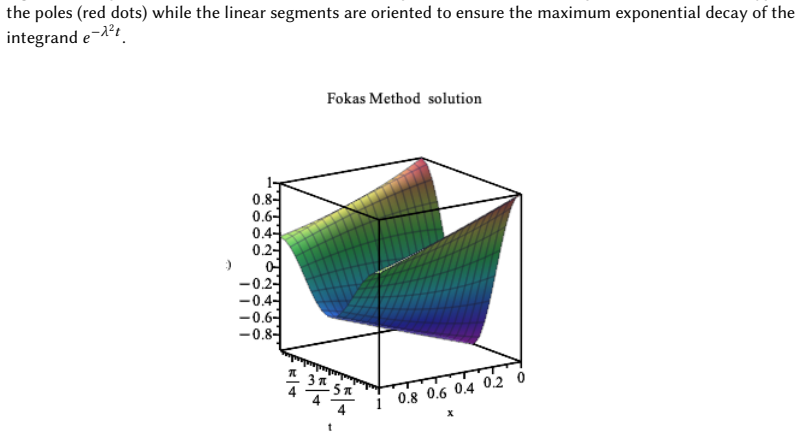
The Unified Transform Method applied to the heat equation on the interval [0,1] with Dirichlet boundary conditions yields an integral representation of the solution obtained from the global relation after elimination of unknown boundary values via the symmetry λ ↦ -λ; when the integrand is integrated over the contour ∂D⁺ using a trapezoidal parametrization, the representation satisfies the initial condition and both Dirichlet conditions to machine precision for the exponential initial datum and cosine boundary data.
What carries the argument
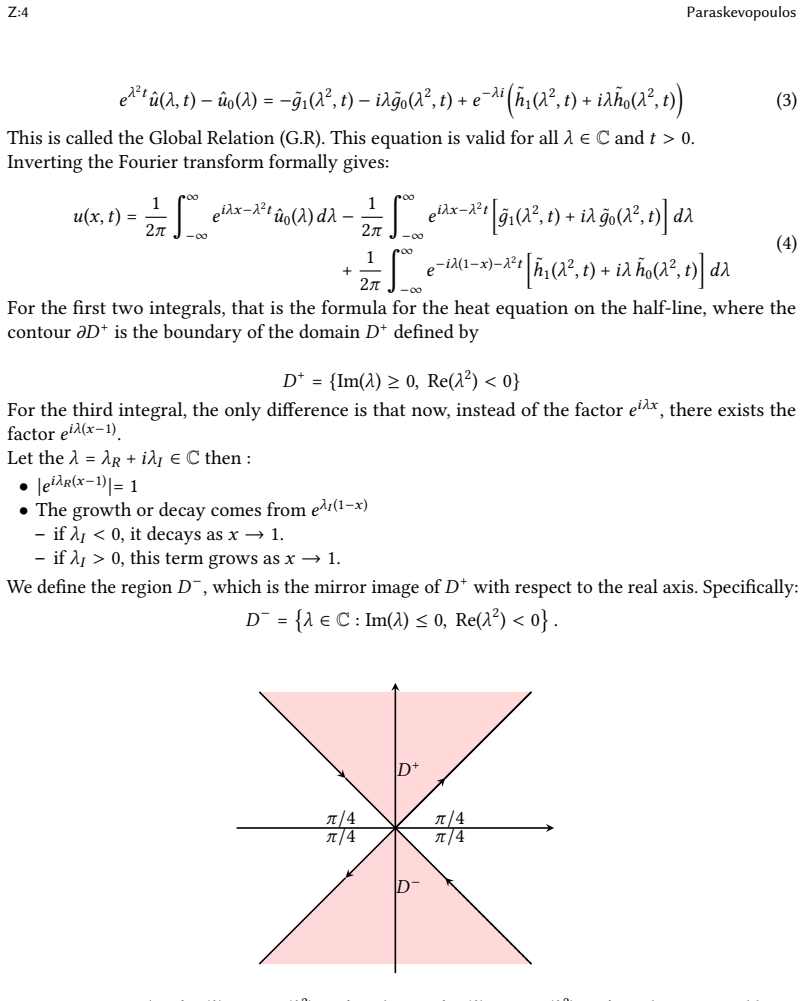
The global relation, an algebraic identity obtained from the generalized spatial Fourier transform with complex parameter λ, which is reduced by λ ↦ -λ symmetry to a contour integral over ∂D⁺ whose integrand encodes the initial and boundary data.
If this is right
- The unknown Neumann boundary values need not be computed separately; they cancel exactly once the symmetry is applied.
- Contour deformation from the real line to ∂D⁺ is justified by Cauchy's theorem and Jordan's lemma because of the analyticity and decay properties of the integrand.
- The trapezoidal rule on the chosen contour produces a stable numerical scheme whose error is exponentially small rather than algebraic.
- The same global-relation procedure applies verbatim to any linear constant-coefficient evolution equation on a finite interval once the appropriate spectral parameter region is identified.
Where Pith is reading between the lines
- The numerical success for this parabolic example indicates that the method could serve as a benchmark for testing other high-order numerical schemes on initial-boundary value problems.
- Because the contour choice depends only on the symbol of the PDE, the same analytic framework may extend directly to higher-order or systems of linear PDEs without reformulation of the boundary conditions.
- If the symmetry property survives in certain nonlinear integrable equations, the global-relation step could still produce a closed contour-integral representation even when separation of variables fails.
Load-bearing premise
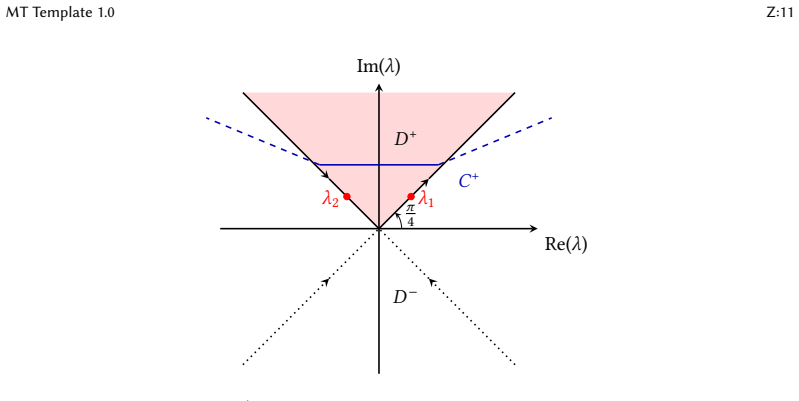
The integrand must possess sufficient analyticity and exponential decay in the complex plane to permit contour deformation without introducing errors that affect the final numerical match.
What would settle it
Numerical evaluation of the derived contour integral for u₀(x) = e^{-x}, g₀(t) = cos(t), h₀(t) = e^{-1} cos(t) failing to recover the Dirichlet data to within machine precision (approximately 10^{-15} relative error) over x ∈ [0,1], t ∈ [0,2π].
Figures
read the original abstract
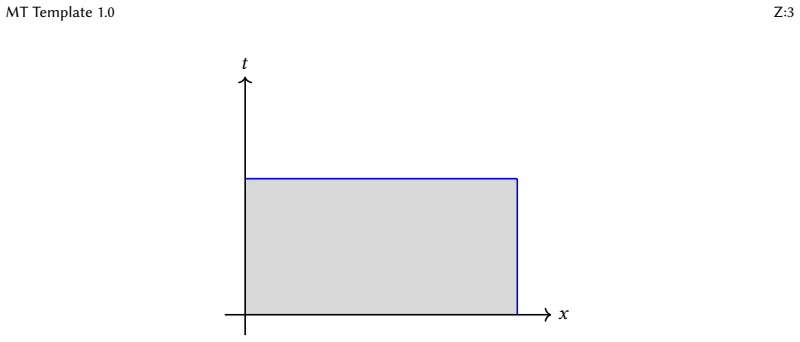
This paper presents a detailed application of the Unified Transform Method (Fokas method) to the one-dimensional heat equation on $[0,1]$ with Dirichlet boundary conditions. The analysis formulates the Initial-Boundary Value Problem and derives an integral representation of the solution via a generalised spatial Fourier transform with complex spectral parameter $\lambda \in \mathbb{C}$, yielding the Global Relation -- an algebraic identity coupling the initial datum, prescribed boundary values, and unknown Neumann data. The unknowns are eliminated by exploiting the symmetry $\lambda \mapsto -\lambda$, reducing the solution to a contour integral over $\partial D^+$. An explicit evaluation is carried out for exponential initial datum $u_0(x)=e^{-x}$ and Dirichlet conditions $g_0(t)=\cos(t)$, $h_0(t)=e^{-1}\cos(t)$. The integral representation is analysed in the complex plane, with emphasis on exponential decay and analyticity, providing rigorous justification for contour deformation via Cauchy's Theorem and Jordan's Lemma. Numerical implementation in Maple uses a trapezoidal contour parametrisation ensuring exponential decay along each segment; the solution over $x\in[0,1]$, $t\in[0,2\pi]$ matches prescribed data to machine precision. The results confirm the analytical and numerical efficacy of the Unified Transform for classical parabolic problems and illustrate how rigorous contour analysis yields stable, accurate solutions.
Editorial analysis
A structured set of objections, weighed in public.
Referee Report
Summary. The manuscript presents a pedagogical derivation of the Unified Transform Method for the heat equation on [0,1] with Dirichlet boundary conditions. It formulates the IBVP, obtains the global relation via a complex Fourier transform, eliminates the unknown Neumann data by the λ ↦ −λ symmetry, reduces the solution to a contour integral over ∂D⁺, and for the explicit data u₀(x)=e^{-x}, g₀(t)=cos(t), h₀(t)=e^{-1}cos(t) supplies a detailed analysis of the integrand’s analyticity and exponential decay to justify contour deformation by Cauchy’s theorem and Jordan’s lemma. The resulting integral is evaluated numerically on a trapezoidal contour in Maple and reported to recover the Dirichlet data to machine precision over x∈[0,1], t∈[0,2π].
Significance. If the numerical agreement holds, the work supplies a clear, self-contained example that pairs rigorous justification of the contour deformation with concrete numerical verification. The explicit treatment of analyticity and decay for this specific integrand, together with the reproducible Maple implementation, constitutes a useful pedagogical contribution that illustrates the stability of the method for a classical parabolic problem.
minor comments (2)
- [Abstract] The abstract states that the numerical solution “matches prescribed data to machine precision”; it would be helpful to clarify in §4 or the caption of the relevant figure whether this verification is performed only on the Dirichlet boundary values or also includes a check against the initial condition at t=0.
- The trapezoidal contour parametrisation is described as “ensuring exponential decay along each segment”; a short remark on the concrete choice of the truncation radius or the angle of the rays (e.g., the value of the parameter controlling the contour) would make the numerical procedure fully reproducible from the text alone.
Simulated Author's Rebuttal
We thank the referee for their thorough reading of the manuscript and for the positive evaluation. We are pleased that the pedagogical derivation, contour analysis, and numerical verification were found to constitute a useful contribution, and we appreciate the recommendation to accept.
Circularity Check
No significant circularity; derivation self-contained with independent verification
full rationale
The paper follows the standard Unified Transform Method steps to derive the integral representation from the global relation, exploits the λ ↦ -λ symmetry to eliminate unknowns, and supplies explicit analysis of analyticity plus exponential decay for the specific integrand (u0(x)=e^{-x}, cosine boundary data) to justify contour deformation by Cauchy's theorem and Jordan's lemma. The trapezoidal-contour numerical evaluation in Maple recovers the prescribed Dirichlet data to machine precision; this constitutes an external benchmark check rather than a fitted prediction or self-definitional reduction. No load-bearing self-citation, ansatz smuggling, or renaming of known results appears in the central chain. The result is therefore self-contained against the boundary conditions.
Axiom & Free-Parameter Ledger
axioms (2)
- domain assumption Symmetry λ ↦ -λ eliminates unknown Neumann data from the Global Relation
- domain assumption The integrand is analytic inside the contour and decays exponentially on the relevant rays, permitting deformation by Cauchy's theorem and Jordan's lemma
Reference graph
Works this paper leans on
-
[1]
Patricia S. Abril and Robert Plant. The patent holder's dilemma: Buy, sell, or troll?. Communications of the ACM. 2007. doi:10.1145/1188913.1188915
-
[2]
Deciding equivalances among conjunctive aggregate queries
Sarah Cohen and Werner Nutt and Yehoshua Sagic. Deciding equivalances among conjunctive aggregate queries. doi:10.1145/1219092.1219093
-
[3]
Understanding Policy-Based Networking
David Kosiur. Understanding Policy-Based Networking. 2001
2001
-
[6]
The title of book two. 2008. doi:10.1007/3-540-09237-4
-
[7]
Asad Z. Spector. Achieving application requirements. Distributed Systems. 1990. doi:10.1145/90417.90738
-
[8]
Douglass and David Harel and Mark B
Bruce P. Douglass and David Harel and Mark B. Trakhtenbrot. Statecarts in use: structured analysis and object-orientation. Lectures on Embedded Systems. 1998. doi:10.1007/3-540-65193-4_29
-
[9]
Donald E. Knuth. The Art of Computer Programming, Vol. 1: Fundamental Algorithms (3rd. ed.). 1997
1997
-
[10]
Donald E. Knuth. The Art of Computer Programming. 1998
1998
-
[11]
Partial Differential Equations in Applied Mathematics , volume=
The Fokas method for evolution partial differential equations , author=. Partial Differential Equations in Applied Mathematics , volume=. 2025 , publisher=
2025
-
[12]
2003 , publisher=
Complex Variables: Introduction and Applications , author=. 2003 , publisher=
2003
-
[13]
Proceedings of the Royal Society of London
A unified transform method for solving linear and certain nonlinear PDEs , author=. Proceedings of the Royal Society of London. Series A: Mathematical, Physical and Engineering Sciences , volume=. 1997 , publisher=
1997
-
[14]
2008 , publisher=
A Unified Transform Method for Boundary Value Problems: Applications and Analysis , author=. 2008 , publisher=
2008
-
[15]
The numerical solution of boundary value problems for linear evolution equations using the
Flyer, Natasha and Fokas, Athanassios S , journal=. The numerical solution of boundary value problems for linear evolution equations using the. 2008 , publisher=
2008
-
[16]
Structured Variational Inference Procedures and their Realizations (as incol)
Dan Geiger and Christopher Meek. Structured Variational Inference Procedures and their Realizations (as incol). Proceedings of Tenth International Workshop on Artificial Intelligence and Statistics, The Barbados
-
[17]
Stan W. Smith. An experiment in bibliographic mark-up: Parsing metadata for XML export. Proceedings of the 3rd. annual workshop on Librarians and Computers. 2010. doi:99.9999/woot07-S422
2010
-
[18]
Catch me, if you can: Evading network signatures with web-based polymorphic worms
Matthew Van Gundy and Davide Balzarotti and Giovanni Vigna. Catch me, if you can: Evading network signatures with web-based polymorphic worms. Proceedings of the first USENIX workshop on Offensive Technologies
-
[19]
Sten Andler. Predicate Path expressions. Proceedings of the 6th. ACM SIGACT-SIGPLAN symposium on Principles of Programming Languages. 1979. doi:10.1145/567752.567774
-
[20]
LOGICS of Programs: AXIOMATICS and DESCRIPTIVE POWER
David Harel. LOGICS of Programs: AXIOMATICS and DESCRIPTIVE POWER. 1978
1978
-
[21]
Anisi , title =
David A. Anisi , title =
-
[22]
Clarkson
Kenneth L. Clarkson. Algorithms for Closest-Point Problems (Computational Geometry). 1985
1985
-
[23]
Introduction to Bayesian Statistics
Harry Thornburg. Introduction to Bayesian Statistics. 2001
2001
-
[24]
Stats and Analysis
Poker-Edge.Com. Stats and Analysis. 2006
2006
-
[25]
A more perfect union
Barack Obama. A more perfect union. 2008
2008
-
[26]
The fountain of youth
Joseph Scientist. The fountain of youth. 2009
2009
-
[27]
Solder man
Dave Novak. Solder man. ACM SIGGRAPH 2003 Video Review on Animation theater Program: Part I - Vol. 145 (July 27--27, 2003). 2003. doi:99.9999/woot07-S422
2003
-
[28]
Interview with Bill Kinder: January 13, 2005
Newton Lee. Interview with Bill Kinder: January 13, 2005. Comput. Entertain. 2005. doi:10.1145/1057270.1057278
-
[29]
The Enabling of Digital Libraries
Bernard Rous. The Enabling of Digital Libraries. Digital Libraries. 2008
2008
-
[31]
(new) Finding minimum congestion spanning trees , journal =
Werneck, Renato and Setubal, Jo\. (new) Finding minimum congestion spanning trees , journal =. doi:10.1145/351827.384253 , acmid = 384253, publisher =
-
[33]
Conti, Mauro and Di Pietro, Roberto and Mancini, Luigi V. and Mei, Alessandro , title =. Inf. Fusion , volume =. 2009 , issn =. doi:10.1016/j.inffus.2009.01.002 , acmid =
-
[34]
Li, Cheng-Lun and Buyuktur, Ayse G. and Hutchful, David K. and Sant, Natasha B. and Nainwal, Satyendra K. , title =. CHI '08 extended abstracts on Human factors in computing systems , year =. doi:10.1145/1358628.1358946 , acmid =
-
[35]
, title =
Hollis, Billy S. , title =. 1999 , isbn =
1999
-
[36]
Goossens, Michel and Rahtz, S. P. and Moore, Ross and Sutor, Robert S. , title =. 1999 , isbn =
1999
-
[37]
and Rosenberg, Arnold L
Buss, Jonathan F. and Rosenberg, Arnold L. and Knott, Judson D. , title =. 1987 , source =
1987
-
[38]
CHI '08: CHI '08 extended abstracts on Human factors in computing systems , year =
, note =. CHI '08: CHI '08 extended abstracts on Human factors in computing systems , year =
-
[39]
Algorithms for Closest-Point Problems (Computational Geometry) , year =
Clarkson, Kenneth Lee , advisor =. Algorithms for Closest-Point Problems (Computational Geometry) , year =
-
[40]
SIGCOMM Comput. Commun. Rev. , year =
-
[41]
IEEE TCSC Executive Committee , booktitle =. 2004 , isbn =. doi:http://dx.doi.org/10.1109/ICWS.2004.64 , acmid =
-
[42]
Distributed systems (2nd Ed.) , year =
-
[43]
, title =
Petrie, Charles J. , title =. 1986 , source =
1986
-
[44]
Donald E. Knuth. Seminumerical Algorithms. 1981
1981
-
[45]
E-commerce and cultural values , year =
Kong, Wei-Chang , Title =. E-commerce and cultural values , year =
-
[46]
E-commerce and cultural values , year =
Kong, Wei-Chang , type =. E-commerce and cultural values , year =
-
[47]
Chapter 9 , booktitle =
Kong, Wei-Chang , editor =. Chapter 9 , booktitle =. 2002 , address =
2002
-
[48]
E-commerce and cultural values , editor =
Kong, Wei-Chang , title =. E-commerce and cultural values , editor =. 2003 , isbn =
2003
-
[49]
E-commerce and cultural values - (InBook-num-in-chap) , chapter =
Kong, Wei-Chang , editor =. E-commerce and cultural values - (InBook-num-in-chap) , chapter =. 2004 , address =
2004
-
[50]
E-commerce and cultural values (Inbook-text-in-chap) , chapter =
Kong, Wei-Chang , editor =. E-commerce and cultural values (Inbook-text-in-chap) , chapter =. 2005 , address =
2005
-
[51]
E-commerce and cultural values (Inbook-num chap) , chapter =
Kong, Wei-Chang , editor =. E-commerce and cultural values (Inbook-num chap) , chapter =. 2006 , address =
2006
-
[52]
Microelectron
Mehdi Saeedi and Morteza Saheb Zamani and Mehdi Sedighi , title =. Microelectron. J. , volume =. 2010 , pages =
2010
-
[53]
Mehdi Saeedi and Morteza Saheb Zamani and Mehdi Sedighi and Zahra Sasanian , title =. J. Emerg. Technol. Comput. Syst. , volume =
-
[54]
Kirschmer, Markus and Voight, John , title =. SIAM J. Comput. , issue_date =. 2010 , issn =. doi:https://doi.org/10.1137/080734467 , acmid =
-
[55]
Hoare, C. A. R. , title =. Structured programming (incoll) , editor =. 1972 , isbn =
1972
-
[56]
History of programming languages I (incoll) , editor =
Lee, Jan , title =. History of programming languages I (incoll) , editor =. 1981 , isbn =. doi:http://doi.acm.org/10.1145/800025.1198348 , acmid =
-
[57]
, title =
Dijkstra, E. , title =. Classics in software engineering (incoll) , year =
-
[58]
Wenzel, Elizabeth M. , title =. Multimedia interface design (incoll) , year =. doi:10.1145/146022.146089 , acmid =
-
[59]
, title =
Mumford, E. , title =. Critical issues in information systems research (incoll) , year =
-
[60]
and Golden, Donald G
McCracken, Daniel D. and Golden, Donald G. , title =. 1990 , isbn =
1990
-
[61]
The analysis of linear partial differential operators
H. The analysis of linear partial differential operators. 1985 , PAGES =
1985
-
[62]
IEEE", address =
A. Adya and P. Bahl and J. Padhye and A.Wolman and L. Zhou , title =. Proceedings of the IEEE 1st International Conference on Broadnets Networks (BroadNets'04) , publisher = "IEEE", address = "Los Alamitos, CA", year =
-
[63]
I. F. Akyildiz and W. Su and Y. Sankarasubramaniam and E. Cayirci , title =. Comm. ACM , volume = 38, number = "4", year =
-
[64]
I. F. Akyildiz and T. Melodia and K. R. Chowdhury , title =. Computer Netw. , volume = 51, number = "4", year =
-
[65]
ACM", address =
P. Bahl and R. Chancre and J. Dungeon , title =. Proceeding of the 10th International Conference on Mobile Computing and Networking (MobiCom'04) , publisher = "ACM", address = "New York, NY", year =
-
[66]
8 (Special Issue on Sensor Networks)
D. Culler and D. Estrin and M. Srivastava , title =. IEEE Comput. , volume = 37, number = "8 (Special Issue on Sensor Networks)", publisher = "IEEE", address = "Los Alamitos, CA", year =
-
[67]
Natarajan and M
A. Natarajan and M. Motani and B. de Silva and K. Yap and K. C. Chua , title =. Network Architectures , editor =. 960935712
-
[68]
Tzamaloukas and J
A. Tzamaloukas and J. J. Garcia-Luna-Aceves , title =
-
[69]
Zhou and J
G. Zhou and J. Lu and C.-Y. Wan and M. D. Yarvis and J. A. Stankovic , title =
-
[70]
Mapping Powerlists onto Hypercubes
Jacob Kornerup. Mapping Powerlists onto Hypercubes. 1994
1994
-
[71]
Automatic Parallelization for Distributed-Memory Multiprocessing Systems
Michael Gerndt. Automatic Parallelization for Distributed-Memory Multiprocessing Systems
-
[72]
J. E. Archer, Jr. and R. Conway and F. B. Schneider. User recovery and reversal in interactive systems. ACM Trans. Program. Lang. Syst
-
[73]
D. D. Dunlop and V. R. Basili. Generalizing specifications for uniformly implemented loops. ACM Trans. Program. Lang. Syst
-
[74]
Heering and P
J. Heering and P. Klint. Towards monolingual programming environments. ACM Trans. Program. Lang. Syst
-
[75]
Donald E. Knuth. The book
-
[76]
Korach and D
E. Korach and D. Rotem and N. Santoro. Distributed algorithms for finding centers and medians in networks. ACM Trans. Program. Lang. Syst
-
[77]
: A Document Preparation System
Leslie Lamport. : A Document Preparation System
-
[78]
F. Nielson. Program transformations in a denotational setting. ACM Trans. Program. Lang. Syst
-
[79]
Brian K. Reid. A high-level approach to computer document formatting. Proceedings of the 7th Annual Symposium on Principles of Programming Languages
-
[80]
Zhou, Gang and Wu, Yafeng and Yan, Ting and He, Tian and Huang, Chengdu and Stankovic, John A. and Abdelzaher, Tarek F. , title =. ACM Trans. Embed. Comput. Syst. , issue_date =. doi:10.1145/1721695.1721705 , acmid = 1721705, publisher =
-
[81]
Institutional members of the Users Group
-
[82]
Boris Veytsman , title =
-
[83]
and Peterson, Larry L
Bowman, Mic and Debray, Saumya K. and Peterson, Larry L. , title =. ACM Trans. Program. Lang. Syst. , volume =. 1993 , doi =
1993
-
[84]
TUGboat , volume =
Braams, Johannes , title =. TUGboat , volume =
discussion (0)
Sign in with ORCID, Apple, or X to comment. Anyone can read and Pith papers without signing in.