Ambiguity-Free Inertial Measurement with Multi-Wavelength Atom Interferometry
Pith reviewed 2026-06-27 07:57 UTC · model grok-4.3
The pith
Multi-wavelength atom interferometry localizes interference envelopes to enable ambiguity-free inertial measurements.
A machine-rendered reading of the paper's core claim, the machinery that carries it, and where it could break.
Core claim
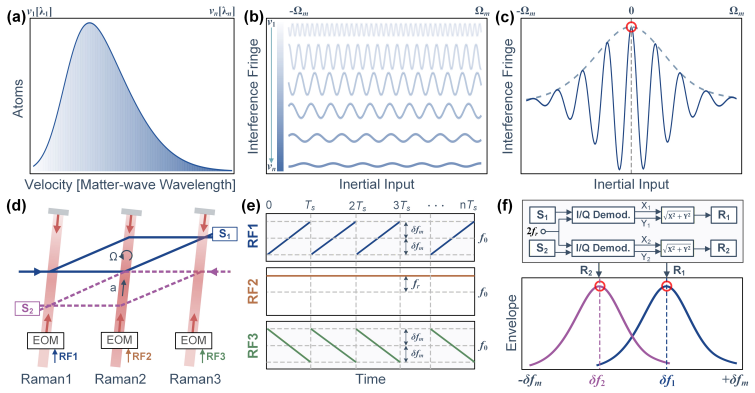
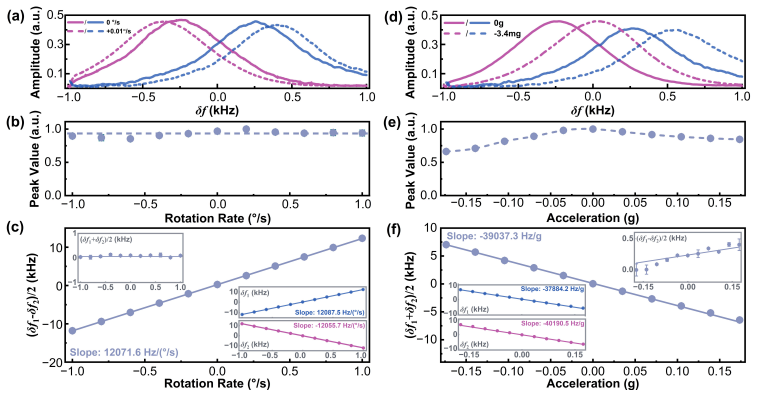
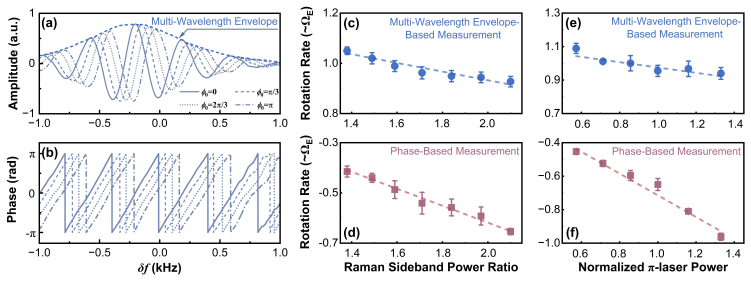
By exploiting counter-propagating atomic beams as multi-wavelength matter wave sources and synthesizing interference envelopes from their spectral components, inertial measurements are realized based on envelope localization rather than conventional fringe-phase estimation. The resulting multi-scale interferometric response provides ambiguity-free operation, a well-defined rotational scale factor, and reduced sensitivity to initial phase bias, demonstrated through simultaneous dual-axis rotation and acceleration sensing and direct resolution of phase ambiguity in open-loop atom interferometers.
What carries the argument
Synthesis of interference envelopes from spectral components of counter-propagating atomic beams, which shifts readout from fringe-phase estimation to envelope localization.
If this is right
- Ambiguity-free inertial measurements are achieved without reliance on fringe-phase estimation.
- A well-defined rotational scale factor becomes available for rotation sensing.
- Sensitivity to initial phase bias is reduced compared with conventional methods.
- Simultaneous dual-axis rotation and acceleration sensing is demonstrated.
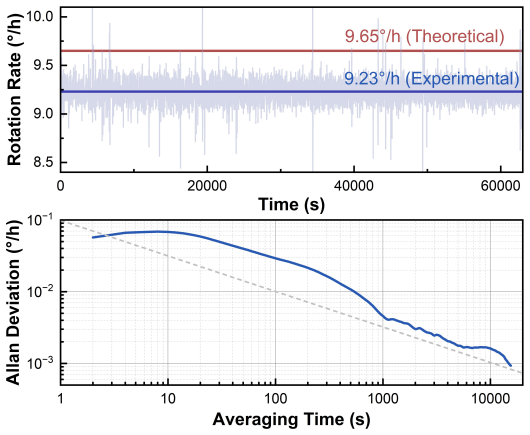
- Earth's rotation is measured with 4.3 percent relative error and 93 ppm long-term stability at 15,000 s averaging time.
Where Pith is reading between the lines
- The envelope method could support continuous operation in navigation systems where periodic phase resets are difficult.
- The same synthesis approach might be tested in other matter-wave sensors such as gravimeters to extend their unambiguous range.
- Combining envelope localization with occasional phase measurements could increase overall precision while retaining the ambiguity-free property.
Load-bearing premise
Counter-propagating atomic beams can serve as multi-wavelength matter wave sources whose spectral components can be synthesized to form interference envelopes that enable unambiguous inertial measurements.
What would settle it
An experiment in which the location of the synthesized envelope fails to shift in proportion to applied rotation or acceleration, or in which phase-wrapping ambiguities persist in the recorded signals.
Figures
read the original abstract
White-light interferometry enables ambiguity-free localization by synthesizing interference envelopes from multiple optical wavelengths, but no analogous capability has been realized for coherent matter waves. Here we report the first experimental demonstration of multi-wavelength atom interferometry, establishing the matter-wave counterpart of white-light interferometry. By exploiting counter-propagating atomic beams as multi-wavelength matter wave sources and synthesizing interference envelopes from their spectral components, we realize inertial measurements based on envelope localization rather than conventional fringe-phase estimation. The resulting multi-scale interferometric response provides ambiguity-free operation, a well-defined rotational scale factor, and reduced sensitivity to initial phase bias. As a proof of principle, we demonstrate simultaneous dual-axis rotation and acceleration sensing and directly resolve the phase ambiguity that fundamentally limits conventional open-loop atom interferometers. We further measure the Earth's rotation with a relative error of 4.3% and a long-term stability of 93 ppm at an averaging time of 15,000 s. Our results establish multi-wavelength atom interferometry as a new paradigm for coherent matter-wave sensing, extending the principles of white-light interferometry to atom optics and opening new opportunities for inertial sensing, geodesy, precision metrology, and inertial navigation.
Editorial analysis
A structured set of objections, weighed in public.
Referee Report
Summary. The manuscript reports the first experimental demonstration of multi-wavelength atom interferometry. By using counter-propagating atomic beams as multi-wavelength matter-wave sources and synthesizing interference envelopes from their spectral components, the authors realize inertial measurements based on envelope localization rather than fringe-phase estimation. This yields ambiguity-free operation, a well-defined rotational scale factor, and reduced sensitivity to initial phase bias. As a proof of principle, they demonstrate simultaneous dual-axis rotation and acceleration sensing, directly resolve phase ambiguity, and measure Earth's rotation with 4.3% relative error and 93 ppm long-term stability at 15,000 s averaging time.
Significance. If the experimental results hold, the work establishes a new paradigm for coherent matter-wave sensing by extending white-light interferometry principles to atom optics. The approach addresses a fundamental limitation of conventional open-loop atom interferometers (phase ambiguity) while supplying a defined scale factor and bias insensitivity. The reported Earth-rotation measurement provides concrete performance metrics supporting the claims, with potential impact on inertial navigation, geodesy, and precision metrology. The experimental nature of the demonstration is a clear strength.
major comments (2)
- [Methods / Experimental Setup] The central experimental claim rests on synthesizing interference envelopes from counter-propagating beams (abstract and implied §3–4). More quantitative detail is required on the beam velocity distribution, Raman laser parameters, and the precise algorithm used to combine spectral components into the envelope; without this, it is difficult to assess how unambiguously the localization determines the inertial phase.
- [Results] Table or figure reporting the Earth-rotation result (4.3 % relative error, 93 ppm at 15 000 s): the stability figure should be accompanied by an explicit Allan-deviation analysis that separates statistical from systematic contributions and states the reference against which the 4.3 % error is computed.
minor comments (3)
- [Introduction] The abstract states 'first experimental demonstration'; the introduction should explicitly cite the closest prior multi-wavelength or envelope-based atom-interferometry attempts to substantiate novelty.
- [Theory] Notation for the synthesized envelope function and the rotational scale factor should be defined once in the main text rather than only in supplementary material.
- [Figures] Figure captions for the dual-axis data should include the integration time and number of experimental runs used to generate each trace.
Simulated Author's Rebuttal
We thank the referee for the positive assessment of our work and the recommendation for minor revision. We address each major comment below.
read point-by-point responses
-
Referee: [Methods / Experimental Setup] The central experimental claim rests on synthesizing interference envelopes from counter-propagating beams (abstract and implied §3–4). More quantitative detail is required on the beam velocity distribution, Raman laser parameters, and the precise algorithm used to combine spectral components into the envelope; without this, it is difficult to assess how unambiguously the localization determines the inertial phase.
Authors: We agree that expanded quantitative detail will improve clarity. In the revised manuscript we will augment the Methods section with the measured atomic beam velocity distribution, the full set of Raman laser parameters (wavelengths, intensities, detunings, and pulse durations), and an explicit description of the envelope-synthesis algorithm, including the mathematical combination of spectral components and its relation to inertial-phase localization. revision: yes
-
Referee: [Results] Table or figure reporting the Earth-rotation result (4.3 % relative error, 93 ppm at 15 000 s): the stability figure should be accompanied by an explicit Allan-deviation analysis that separates statistical from systematic contributions and states the reference against which the 4.3 % error is computed.
Authors: We will revise the Results section to include an explicit Allan-deviation plot for the reported stability. The analysis will distinguish statistical and systematic contributions to the extent supported by the data, and we will state that the 4.3 % relative error is computed against the independently known local value of Earth’s rotation rate. revision: yes
Circularity Check
No significant circularity
full rationale
The manuscript is an experimental demonstration of multi-wavelength atom interferometry using counter-propagating atomic beams to synthesize interference envelopes for ambiguity-free inertial sensing. All load-bearing claims (ambiguity resolution, rotational scale factor, Earth-rotation measurement with 4.3% error and 93 ppm stability) are presented as direct experimental outcomes rather than derivations or predictions. No equations, self-citations, or ansatzes are invoked that reduce the reported results to fitted inputs or prior self-referential statements by construction. The work is self-contained against external benchmarks via measured performance metrics.
Axiom & Free-Parameter Ledger
axioms (1)
- domain assumption The principles of atom interferometry and coherence in matter waves apply to the multi-wavelength configuration described.
Reference graph
Works this paper leans on
-
[1]
Taking atom interferometric quantum sensors from the laboratory to real-world applications,
K. Bongs, M. Holynski, J. Vovrosh,et al., “Taking atom interferometric quantum sensors from the laboratory to real-world applications,” Nat. Rev. Phys.1, 731–739 (2019)
2019
-
[2]
Advances toward fieldable atom interferometers,
F. A. Narducci, A. T. Black, and J. H. Burke, “Advances toward fieldable atom interferometers,” Adv. Physics: X7, 1946426 (2022)
2022
-
[3]
Partiallycoherentsourcesininterferometricsensors,
S.Al-Chalabi,B.Culshaw,andD.Davies,“Partiallycoherentsourcesininterferometricsensors,”inFirst International Conference on Optical Fibre Sensors,(1983), pp. 26–28
1983
-
[4]
White-light phase-stepping interferometry for surface profiling,
P. Hariharan and M. Roy, “White-light phase-stepping interferometry for surface profiling,” J. Mod. Opt.41, 2197–2201 (1994)
1994
-
[5]
Fringe modulation skewing effect in white-light vertical scanning interferometry,
A. Harasaki and J. C. Wyant, “Fringe modulation skewing effect in white-light vertical scanning interferometry,” Appl. Opt.39, 2101–2106 (2000)
2000
-
[6]
Noise reduction in coherence scanning interferometry for surface topography measurement,
C. Gomez, R. Su, P. De Groot, and R. Leach, “Noise reduction in coherence scanning interferometry for surface topography measurement,” Nanomanuf. Metrol.3, 68–76 (2020)
2020
-
[7]
Hybridizing matter-wave and classical accelerometers,
J. Lautier, L. Volodimer, T. Hardin,et al., “Hybridizing matter-wave and classical accelerometers,” Appl. Phys. Lett. 105, 144102 (2014)
2014
-
[8]
Operating an atom interferometer beyond its linear range,
S. Merlet, J. Le Gouët, Q. Bodart,et al., “Operating an atom interferometer beyond its linear range,” Metrologia46, 87 (2009)
2009
-
[9]
Navigation-compatible hybrid quantum accelerometer using a kalman filter,
P. Cheiney, L. Fouché, S. Templier,et al., “Navigation-compatible hybrid quantum accelerometer using a kalman filter,” Phys. Rev. Appl.10, 034030 (2018)
2018
-
[10]
New concepts of inertial measurements with multi-species atom interferometry,
A. Bonnin, C. Diboune, N. Zahzam,et al., “New concepts of inertial measurements with multi-species atom interferometry,” Appl. Phys. B124, 181 (2018)
2018
-
[11]
Composite-Fringe Atom Interferometry for High- Dynamic-Range Sensing,
C. Avinadav, D. Yankelev, O. Firstenberg, and N. Davidson, “Composite-Fringe Atom Interferometry for High- Dynamic-Range Sensing,” Phys. Rev. Appl.13, 054053 (2020)
2020
-
[12]
Atom interferometry with thousand-fold increase in dynamic range,
D. Yankelev, C. Avinadav, N. Davidson, and O. Firstenberg, “Atom interferometry with thousand-fold increase in dynamic range,” Sci. Adv. (2020)
2020
-
[13]
Velocity-modulated atom interferometry with enhanced dynamic range,
A. T. Black and J. M. Kwolek, “Velocity-modulated atom interferometry with enhanced dynamic range,” inQuantum Sensing, Imaging, and Precision Metrology,vol. 12447 (SPIE, 2023), pp. 179–183
2023
-
[14]
Self-calibrated atom-interferometer gyroscope by modulating atomic velocities,
H.-H. Chen, Z.-W. Yao, Z.-X. Lu,et al., “Self-calibrated atom-interferometer gyroscope by modulating atomic velocities,” Rev. Sci. Instrum.95(2024)
2024
-
[15]
Atom interferometry at arbitrary orientations and rotation rates,
Q. d’Armagnac de Castanet, C. Des Cognets, R. Arguel,et al., “Atom interferometry at arbitrary orientations and rotation rates,” Nat. Commun.15, 6406 (2024)
2024
-
[16]
Closed-loop measurements in an atom-interferometer gyroscope with compensation for velocity-dependent phase dispersion,
T. Sato, N. Nishimura, N. Kaku,et al., “Closed-loop measurements in an atom-interferometer gyroscope with compensation for velocity-dependent phase dispersion,” Phys. Rev. Appl.23, 044001 (2025)
2025
-
[17]
Closed-loop dual-channel atomic beam interferometry beyond the half-fringe limit,
W.-C. Jia, Y. Xin, K. Shen,et al., “Closed-loop dual-channel atomic beam interferometry beyond the half-fringe limit,” arXiv preprint arXiv:2603.14777 (2026)
arXiv 2026
-
[18]
Atomic interferometry using stimulated raman transitions,
M. Kasevich and S. Chu, “Atomic interferometry using stimulated raman transitions,” Phys. Rev. Lett.67, 181 (1991)
1991
-
[19]
A continuous dual-axis atomic interferometric inertial sensor,
P.-Q. Yan, W.-C. Jia, K. Shen,et al., “A continuous dual-axis atomic interferometric inertial sensor,” IEEE Trans. Instrum. Meas.74, 1–11 (2025)
2025
-
[20]
Long-term stability of an area-reversible atom-interferometer sagnac gyroscope,
D. Durfee, Y. Shaham, and M. Kasevich, “Long-term stability of an area-reversible atom-interferometer sagnac gyroscope,” Phys. Rev. Lett.97, 240801 (2006)
2006
discussion (0)
Sign in with ORCID, Apple, or X to comment. Anyone can read and Pith papers without signing in.