REVIEW 3 major objections 4 minor 86 references
Exploring the Mass Segregation Effect of X-ray Sources in Globular Clusters. II. The Case of Terzan 5
T0 review · 3 major / 4 minor · reviewed 2026-08-14 · deepseek-v4-flash
Pith's one-line read The radial distribution of X-ray sources in the globular cluster Terzan 5 shows mass segregation, with bright sources heavier and more centrally concentrated than faint ones.
desk verdict Solid catalog and a likely real mass-segregation signal, but the model-dependent masses and an error-bar-free dynamical-age comparison keep this short of a clean accept. read the letter →
The pith
A machine-rendered reading of the paper's core claim, the machinery that carries it, and where it could break.
The reading
What carries the argument
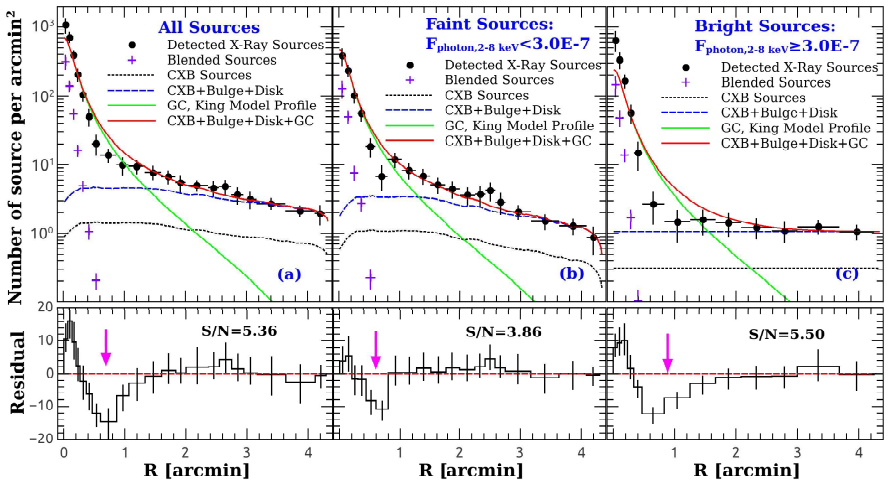
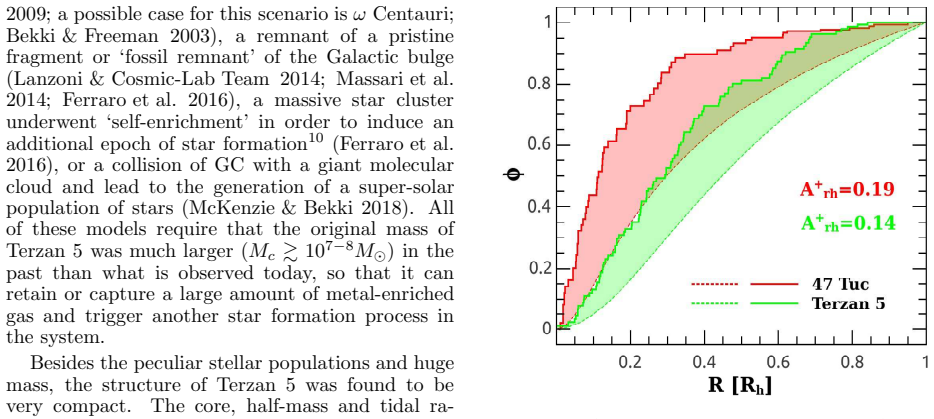
The load-bearing tool is the generalized King model, a projected surface-density profile $S(R)=S_0\left[1+(R/R_c)^2\right]^{(1-3q)/2}$, where $q$ is the ratio of the mean mass of the X-ray sources to that of reference main-sequence turnoff stars. Fitting cumulative radial distributions within $R<31$ arcsec, where the sources are assumed dynamically relaxed and in thermal equilibrium with normal stars, yields $q$ for the bright and faint groups. The companion diagnostic is the distribution dip: the radius and width where the observed X-ray surface density falls below the King-model stellar profile, which traces how far the heavy population has segregated. The $A^+$ parameter, the area between the cumulative distributions of X-ray sources and reference stars, is then used to compare dynamical ages between clusters.
What would settle it
One concrete check is to measure radial velocities or proper motions of the X-ray sources: if the bright sources' velocity dispersion is lower than that of faint sources, the thermal-equilibrium assumption is supported, whereas equality or an inverted trend would break it. Alternatively, a deeper, higher-resolution observation that resolves the apparent deficit of sources near 40 arcsec into faint undetected sources would remove the dip and with it the mass-segregation signal.
Extended reading notes
Core claim
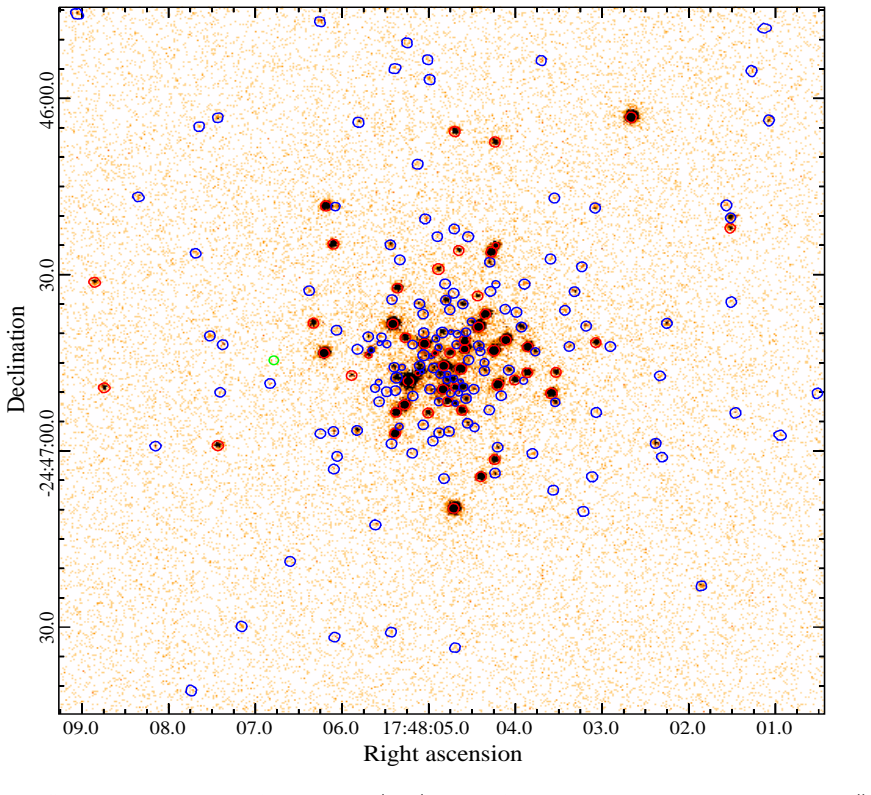
Using 18 merged archival X-ray observations with a total effective exposure of 734 ks, the authors build a catalog of 489 point sources within 4.3 arcmin of Terzan 5. They report a bimodal radial distribution: the surface density peaks in the core, dips near R ∼ 40 arcsec (with the bright sample dipping near 70 arcsec over a width of about 130 arcsec and the faint sample near 35 arcsec over about 30 arcsec), and recovers outward. They interpret this as delayed sedimentation: heavier X-ray binaries sink toward the center faster than lighter ones. Fitting with the generalized King model gives mass ratios q = 1.61 ± 0.12 for bright and q = 1.38 ± 0.14 for faint sources relative to turnoff stars, corresponding to 1.48 ± 0.11 and 1.27 ± 0.13 solar masses. The paper further argues that Terzan 5's dynamical age, measured by the A+ parameter, is younger than 47 Tuc despite a shorter two-body relaxation timescale, implicating tidal stripping as an accelerator of the cluster's dynamical evolution.
Load-bearing premise
The result rests on the assumption that the X-ray sources inside 31 arcsec are dynamically relaxed and in thermal equilibrium with the normal stars; if they are not, the fitted masses are not valid, though the qualitative concentration difference might survive.
Editorial extensions
If this is right
- If the finding generalizes, the radial distribution of X-ray sources can serve as a mass-segregation clock for globular clusters, complementing blue straggler studies.
- The luminosity dependence of the dip locations implies that sedimentation is a continuous process: heavier X-ray sources reach the core first, leaving a measurable gap between bright and faint populations.
- Terzan 5's dynamically young state despite its short relaxation timescale points to tidal stripping as a significant driver of evolution for clusters on tight Galactic orbits.
- The agreement between the mass ratio of bright X-ray sources and millisecond pulsars supports a shared dynamical formation channel for these objects.
- With two clusters now showing the effect, the universality claim for X-ray source mass segregation can be tested by applying the same analysis to other globular clusters with deep X-ray surveys.
Reading between the lines
- A direct extension would be to measure proper motions or radial velocities of the X-ray sources: if the bright sources' velocity dispersion is not lower than the faint sources', the thermal-equilibrium assumption behind the generalized King model fails, although a qualitatively different radial distribution might survive.
- The generalized King model assumes equipartition, which is unlikely to hold perfectly in a cluster the authors themselves argue is dynamically young; the quoted masses may therefore be biased even if the qualitative segregation signal is real.
- The faint-source bump near 150 arcsec could indicate contamination from background galaxies or foreground stars; deeper multi-wavelength follow-up would test whether the faint-source mass estimate is affected.
- If X-ray source mass segregation is universal, the dip radius should scale with cluster relaxation state, a prediction that can be checked by comparing several clusters with existing archival data.
Signed reviews
Editorial analysis
A structured set of objections, weighed in public.
Referee Report
Summary. This paper presents an updated Chandra catalog of 489 point sources in the globular cluster Terzan 5, built from 18 ACIS observations with a combined effective exposure of 734 ks and covering R ≤ 4.3 arcmin; more than 75% of the sources are new detections. The authors construct radial surface-density profiles for bright and faint X-ray sources, identify significant dips at intermediate radii, and fit the cumulative radial distributions with a 'generalized King model' to infer average masses of 1.48 ± 0.11 M_sun (bright) and 1.27 ± 0.13 M_sun (faint). They compare the results with 47 Tuc to argue for a universal mass-segregation effect for X-ray sources in globular clusters, and use A+_rh values to conclude that Terzan 5 is dynamically younger than 47 Tuc despite its much shorter two-body relaxation time, attributing the difference to tidal stripping.
Significance. If the quantitative mass estimates hold, this would provide the second clear case of mass segregation of X-ray sources in a globular cluster and would extend the phenomenon to a very dense, dynamically active system. The paper has genuine strengths: a carefully constructed source catalog with explicit sensitivity maps, blending corrections, Monte Carlo tests for the significance of the radial dips, and an independent MSP cross-check of the mass-ratio interpretation. The qualitative bright-versus-faint concentration difference and the catalog itself are likely robust; the model-dependent masses and the dynamical-age comparison are the parts that need further support. The paper is therefore a useful contribution to the field, but the central quantitative conclusions currently rest on assumptions that are stated rather than demonstrated.
major comments (3)
- [Section 5.1, Eq. (6)] The inferred average masses assume that X-ray sources within R ≤ 31 arcsec are dynamically relaxed and in thermal equilibrium with reference normal stars, but this is not demonstrated. The text justifies the fitting radius only as 'slightly smaller than the distribution dip'; no local two-body relaxation time at R = 31 arcsec is computed from Eq. (5) using the adopted King-model density and velocity-dispersion profiles. This is load-bearing because q = M_X/M_* in Eq. (6) is interpreted as a physical mass ratio; if relaxation/equipartition has not actually been established, q is merely a fitted concentration parameter and the quoted masses (1.48 ± 0.11 and 1.27 ± 0.13 M_sun) do not follow. The internal tension with Section 5.2, where A+_rh = 0.14 is used to conclude that Terzan 5 is dynamically younger than 47 Tuc, makes the relaxation assumption even less self-evident. Please compute trelax at R = 31 arcsec from Eq. (5), or demonstrate equipartition empirically, and add a systematic error on the masses that reflects this assumption.
- [Section 5.1, reference mass] The conversion from fitted q to physical mass uses a single main-sequence turnoff mass of 0.92 M_sun for the 12 Gyr sub-solar component, but Terzan 5 hosts at least two stellar populations (a 12 Gyr sub-solar population and a 4.5 Gyr super-solar population). If the reference population in the King model is a mixture of these components, the effective turnoff mass could differ, and the quoted absolute masses scale linearly with the adopted M_TO. Please either justify that the sub-solar component dominates the reference stars inside R ≤ 31 arcsec or quote a systematic uncertainty on M_X from this choice.
- [Section 5.2, Eq. (7) and Figure 7] The conclusion that Terzan 5 is dynamically younger than 47 Tuc rests on the comparison A+_rh = 0.14 versus 0.19, but no uncertainties are quoted for these A+ values. Since the sample sizes, blending corrections, and background subtraction are all uncertain, a bootstrap or Monte Carlo estimate should be feasible; without error bars, the claim that the two values are significantly different is not established. Please provide confidence intervals for A+_rh in both clusters.
minor comments (4)
- [Table 1 caption] The cluster name is misspelled as 'Teran 5' in the table note; this should be corrected to 'Terzan 5'.
- [Section 5.1] There is a duplicated article in the sentence 'that the the locations and widths of the distribution dips...'; this should be fixed.
- [Section 4] The text gives median dip locations and widths (e.g., Rdip ~ 40'', ΔRdip ~ 70'') while Table 3 lists annulus ranges (e.g., 39-46 arcsec); please clarify how 'width' is defined and how the two quantities are related.
- [References] The entries for Hénon (1961, 1965) contain LaTeX accent artifacts ('H´ enon'); these should be typeset correctly in the published version.
Circularity Check
No significant circularity: the mass estimates are explicitly fitted via an external model, and the Terzan 5 data are new.
full rationale
The derivation chain is self-contained and contains no step that reduces to its own inputs. The central quantitative claim—average masses of 1.48 and 1.27 solar masses for the bright and faint X-ray sources—is explicitly obtained by maximum-likelihood fitting of the cumulative radial distributions with Eq. (6), a generalized King model whose form (Grindlay et al. 1984, 2002; Heinke et al. 2005) and parameters (Rc = 9 arcsec from Lanzoni et al. 2010; M_TO = 0.92 solar masses from Lanzoni et al. 2010 and Ferraro et al. 2016) are external to this paper. The fitted parameter q is labeled an 'estimated' mass ratio, not a predicted one. The dip significance in Table 3 is computed against background-plus-King-model expectations and tested with 1000 Poisson simulations, so the existence of the dips is an empirical, model-independent result. The choice of fitting region R <= 31 arcsec is justified by the faint-group dip position, but the fit itself uses the inner cumulative distribution rather than the dip annulus, so the mass estimate is not derived from the dip by construction. The comparison with 47 Tuc uses Cheng et al. (2019) as an external data set; although the same group performed that analysis, the Terzan 5 observations, source catalog, and dip measurements are new, and the comparison is not used to force the mass values. The A+ dynamical-age comparison relies on Alessandrini et al. (2016) and Ferraro et al. (2018), not on the authors' own theorems. The MSP mass-ratio cross-check (q = 1.57 +/- 0.15) is cited from Prager et al. (2017), an independent group. The main vulnerability—the unverified assumption that sources inside 31 arcsec are dynamically relaxed—is a correctness risk, not circularity, because the paper does not define relaxation in terms of the target masses. Overall, no predicted quantity is equivalent by construction to an input, and no load-bearing argument reduces to a self-citation.
Assumptions & free parameters
free parameters (3)
- q_bright (mass ratio of bright X-ray sources to reference stars) =
1.61 +/- 0.12
- q_faint (mass ratio of faint X-ray sources to reference stars) =
1.38 +/- 0.14
- Galactic background normalization (NG) =
not quoted
assumptions (6)
- domain assumption X-ray sources within R < 31 arcsec are dynamically relaxed and in thermal equilibrium with the reference stars
- domain assumption The reference normal stars follow a King model with Rc = 9 arcsec and c = 1.49, with turnoff mass M_TO = 0.92 Msun
- domain assumption The CXB source counts follow the Kim et al. (2007) logN-logS relations with the assumed photon index and column density
- domain assumption Galactic foreground and bulge X-ray sources are uniformly distributed with no significant cluster contribution beyond R = 175 arcsec
- domain assumption The A+ parameter measured within the half-light radius is a reliable binning-independent indicator of dynamical age
- standard math The two-body relaxation timescale formula (Eq. 5) with Coulomb logarithm lnLambda = ln(0.11N) is valid for these clusters
Cite this review
Pith. "Pith review of Exploring the Mass Segregation Effect of X-ray Sources in Globular Clusters. II. The Case of Terzan 5." pith.science (2026). https://pith.science/paper/WVL6MIHQ
@misc{pith2026190806392,
  author       = {Pith},
  title        = {Pith review of: Exploring the Mass Segregation Effect of X-ray Sources in Globular Clusters. II. The Case of Terzan 5},
  year         = {2026},
  howpublished = {\url{https://pith.science/paper/WVL6MIHQ}},
  note         = {Machine review of arXiv:1908.06392}
}
abstract
Using archival {\it Chandra} observations with a total effective exposure of 734 ks, we derive an updated catalog of point sources in the massive globular cluster Terzan 5. Our catalog covers an area of $58.1\, \rm arcmin^{2}$ ($R\leq 4.3 \, \rm arcmin$) with 489 X-ray sources, and more than $75\%$ of these sources are first detected in this cluster. We find significant dips in the radial distribution profiles of X-ray sources in Terzan 5, with the projected distance and width of the distribution dips for bright ($L_{X} \gtrsim 9.5\times 10^{30} {\rm\ erg\ \,s^{-1}}$) X-ray sources are larger than that of the faint ($L_{X} \lesssim 9.5\times 10^{30} {\rm\ erg\ \,s^{-1}}$) sources. By fitting the radial distribution of the X-ray sources with a"generalized King model", we estimated an average mass of $1.48\pm0.11\,M_{\odot}$ and $1.27\pm0.13\,M_{\odot}$ for the bright and faint X-ray sources, respectively. These results are in agreement with that observed in 47 Tuc, which may suggest a universal mass segregation effect for X-ray sources in GCs. Compared with 47 Tuc, we show that the two-body relaxation timescale of Terzan 5 is much smaller, but its dynamical age is significantly younger than 47 Tuc. These features suggest that the evolution of Terzan 5 is not purely driven by two-body relaxation, and tidal stripping effect also plays an important role in accelerating the dynamical evolution of this cluster.
Figures


Figures from the paper (4 more)


Reference graph
Works this paper leans on
-
[1]
R., Miocchi, P., & Vesperini, E.\ 2016, , 833, 252
Alessandrini, E., Lanzoni, B., Ferraro, F. R., Miocchi, P., & Vesperini, E.\ 2016, , 833, 252
2016
-
[2]
Askar, A., Szkudlarek, M., Gondek-Rosi \'n ska, D., Giersz, M., & Bulik, T.\ 2017, , 464, L36
2017
-
[3]
O., Sivakoff, G.R., & Gladstone, J.C
Bahramian, A., Heinke, C. O., Sivakoff, G.R., & Gladstone, J.C. 2013, , 766, 136
2013
-
[4]
O., Sivakoff, G
Bahramian, A., Heinke, C. O., Sivakoff, G. R., et al.\ 2014, , 780, 127
2014
-
[5]
Bastian, N., & Lardo, C.\ 2015, , 453, 357
2015
-
[6]
Bastian, N., & Lardo, C.\ 2018, , 56, 83
2018
-
[7]
Baumgardt, H., & Hilker, M.\ 2018, , 478, 1520
work page 2018
-
[8]
Baumgardt, H., Hilker, M., Sollima, A., & Bellini, A.\ 2019, , 482, 5138
work page 2019
Show all 86 references
-
[9]
E., et al.\ 2019, , 483, 315
Belloni, D., Giersz, M., Rivera Sandoval, L. E., et al.\ 2019, , 483, 315
2019
-
[10]
S., Townsley L
Broos P. S., Townsley L. K., Feigelson E. D., Getman K. V., Bauer F. E., Garmire G. P., 2010, , 714, 1582
2010
-
[11]
C.\ 2003, , 346, L11
Bekki, K., & Freeman, K. C.\ 2003, , 346, L11
2003
-
[12]
M., Freire, P
Cadelano, M., Ransom, S. M., Freire, P. C. C., et al.\ 2018, , 855, 125
2018
-
[13]
Camilo, F., & Rasio, F. A. 2005, in ASP Conf. Ser. 328, Binary Radio Pulsars (San Francisco, CA: ASP), 147
2005
-
[14]
M., Umbreit, S., & Rasio, F
Chatterjee, S., Fregeau, J. M., Umbreit, S., & Rasio, F. A.\ 2010, , 719, 915
2010
-
[15]
Cheng, Z., Li, Z., Xu, X., & Li, X.\ 2018a, , 858, 33
-
[16]
Cheng, Z., Li, Z., Xu, X., et al.\ 2018b, , 869, 52
-
[17]
Cheng, Z., Li, Z., Li, X., Xu, X., & Fang, T.\ 2019, , 876, 59
2019
-
[18]
Clark, G. W. 1975, , 199, L143
1975
-
[19]
B.\ 1997, , 288, 117
Davies, M. B.\ 1997, , 288, 117
1997
-
[20]
D., Gilliland, R
Edmonds, P. D., Gilliland, R. L., Heinke, C. O., & Grindlay, J. E. 2003a, , 596, 1177
-
[21]
D., Gilliland, R
Edmonds, P. D., Gilliland, R. L., Heinke, C. O., & Grindlay, J. E. 2003b, , 596, 1197
-
[22]
R., Dalessandro, E., Mucciarelli, A., et al.\ 2009, , 462, 483
Ferraro, F. R., Dalessandro, E., Mucciarelli, A., et al.\ 2009, , 462, 483
2009
-
[23]
R., Lanzoni, B., Dalessandro, E., et al
Ferraro, F. R., Lanzoni, B., Dalessandro, E., et al. 2012, , 492, 393
2012
-
[24]
R., Massari, D., Dalessandro, E., et al.\ 2016, , 828, 75
Ferraro, F. R., Massari, D., Dalessandro, E., et al.\ 2016, , 828, 75
2016
-
[25]
R., Lanzoni, B., Raso, S., et al.\ 2018, , 860, 36
Ferraro, F. R., Lanzoni, B., Raso, S., et al.\ 2018, , 860, 36
2018
-
[26]
A., & Bridges, T.\ 2010, , 404, 1203
Forbes, D. A., & Bridges, T.\ 2010, , 404, 1203
2010
-
[27]
M., Cheung, P., Portegies Zwart, S
Fregeau, J. M., Cheung, P., Portegies Zwart, S. F., & Rasio, F. A.\ 2004, , 352, 1
2004
-
[28]
M., G \"u rkan, M
Fregeau, J. M., G \"u rkan, M. A., Joshi, K. J., & Rasio, F. A.\ 2003, , 593, 772
2003
-
[29]
Gao, B., Goodman, J., Cohn, H., & Murphy, B.\ 1991, , 370, 567
1991
-
[30]
Gehrels, N.\ 1986, , 303, 336
1986
-
[31]
C., & Zhao, H.\ 2011, , 413, 2509
Gieles, M., Heggie, D. C., & Zhao, H.\ 2011, , 413, 2509
2011
-
[32]
Y., Lee, H
Gnedin, O. Y., Lee, H. M., & Ostriker, J. P.\ 1999, , 522, 935
1999
-
[33]
E., Hertz, P., et al
Grindlay, J. E., Hertz, P., et al. 1984, , 282, 13
1984
-
[34]
E., Heinke, C
Grindlay, J. E., Heinke, C. O., Edmonds, P. D., et al. 2001, Science, 292, 2290
2001
-
[35]
E., Camilo, F., Heinke, C
Grindlay, J. E., Camilo, F., Heinke, C. O., et al.\ 2002, , 581, 470
2002
-
[36]
Harris, W. E. 1996(2010 edition), , 112, 1487
1996
-
[37]
H \'e non, M.\ 1961, Annales d'Astrophysique, 24, 369
1961
-
[38]
H \'e non, M.\ 1965, Annales d'Astrophysique, 28, 62
1965
-
[39]
C., 1975, , 173, 729
Heggie, D. C., 1975, , 173, 729
1975
-
[40]
C., Hut P
Heggie D. C., Hut P. 2003, The Gravitational Million-Body Problem: A Multidisciplinary Approach to Star Cluster Dynamics (Cambridge: Cambridge University Press)
2003
-
[41]
O., Grindlay, J
Heinke, C. O., Grindlay, J. E., Cohn, H. N., et al. 2005, , 625, 796
2005
-
[42]
O., Wijnands, R., Cohn, H
Heinke, C. O., Wijnands, R., Cohn, H. N., et al.\ 2006, , 651, 1098
2006
-
[43]
G., 1975, , 80, 809
Hills, J. G., 1975, , 80, 809
1975
-
[44]
G.\ 1976, , 175, 1P
Hills, J. G.\ 1976, , 175, 1P
1976
-
[45]
Hut, P.\ 1983, , 272, L29
1983
-
[46]
1992, , 104, 981
Hut, P., McMillan, S., Goodman, J., et al. 1992, , 104, 981
1992
-
[47]
W.\ 1992, , 389, 527
Hut, P., McMillan, S., & Romani, R. W.\ 1992, , 389, 527
1992
-
[48]
Hong, J., Vesperini, E., Belloni, D., & Giersz, M.\ 2017, , 464, 2511
2017
-
[49]
Hut, P., 1993, , 403, 256
1993
-
[50]
O., Rasio, F
Ivanova, N., Heinke, C. O., Rasio, F. A., et al.\ 2006, , 372, 1043
2006
-
[51]
O., Rasio, F
Ivanova, N., Heinke, C. O., Rasio, F. A., Belczynski, K., & Fregeau, J. M.\ 2008, , 386, 553
2008
-
[52]
M., & Verbunt, F.\ 1996, , 312, 80
Ivanova, N., Chaichenets, S., Fregeau, J., et al.\ 2010, , 717, 948 Johnston, H. M., & Verbunt, F.\ 1996, , 312, 80
2010
-
[53]
Jiang, L., & Li, X.-D.\ 2013, , 772, 6
2013
-
[54]
Katz, J. I. 1975, , 253, 698
1975
-
[55]
J., Kim, D.-W., et al
Kim, M., Wilkes, B. J., Kim, D.-W., et al. 2007, , 659, 29
2007
-
[56]
King, I., 1962, , 67, 471
1962
-
[57]
R., Dalessandro, E., et al.\ 2010, , 717, 653
Lanzoni, B., Ferraro, F. R., Dalessandro, E., et al.\ 2010, , 717, 653
2010
-
[58]
Lanzoni, B., & Cosmic-Lab Team 2014, , 85, 536
2014
-
[59]
R., Alessandrini, E., et al.\ 2016, , 833, L29
Lanzoni, B., Ferraro, F. R., Alessandrini, E., et al.\ 2016, , 833, L29
2016
-
[60]
N., Xue, Y
Luo, B., Brandt, W. N., Xue, Y. Q., et al.\ 2017, , 228, 2
2017
-
[61]
Mapelli, M., & Zampieri, L.\ 2014, , 794, 7
2014
-
[62]
Massari, D., Mucciarelli, A., Dalessandro, E., et al.\ 2012, , 755, L32
2012
-
[63]
R., et al.\ 2014, , 795, 22
Massari, D., Mucciarelli, A., Ferraro, F. R., et al.\ 2014, , 795, 22
2014
-
[64]
McKenzie, M., & Bekki, K.\ 2018, , 479, 3126
2018
-
[65]
E., Anderson, J., Meylan, G., et al
McLaughlin, D. E., Anderson, J., Meylan, G., et al. 2006, , 166, 249
2006
-
[66]
P., Piotto, G., Renzini, A., et al.\ 2017, , 464, 3636
Milone, A. P., Piotto, G., Renzini, A., et al.\ 2017, , 464, 3636
2017
-
[67]
Moretti, A., Pagani, C., Cusumano, G., et al.\ 2009, , 493, 501
2009
-
[68]
M., & Rasio, F
Morscher, M., Umbreit, S., Farr, W. M., & Rasio, F. A.\ 2013, , 763, L15
2013
-
[69]
A., & Umbreit, S.\ 2015, , 800, 9
Morscher, M., Pattabiraman, B., Rodriguez, C., Rasio, F. A., & Umbreit, S.\ 2015, , 800, 9
2015
-
[70]
Papitto, A., D'A \`i , A., Motta, S., et al.\ 2011, , 526, L3
2011
-
[71]
Pooley, D., Lewin, W. H. G., Homer L., et al. 2002, , 569, 405
2002
-
[72]
2003, , 591, 131
Pooley, D., et al. 2003, , 591, 131
2003
-
[73]
2006, , 646, 143
Pooley, D., & Hut, P. 2006, , 646, 143
2006
-
[74]
J., Ransom, S
Prager, B. J., Ransom, S. M., Freire, P. C. C., et al.\ 2017, , 845, 148
2017
-
[75]
M., Hessels, J
Ransom, S. M., Hessels, J. W. T., Stairs, I. H., et al.\ 2005, Science, 307, 892
2005
-
[76]
Ransom, S. M. 2008, in AIP Conf. Ser. 983, 40 Years of Pulsars: Millisecond Pulsars, Magnetars and More (Melville, NY: AIP), 415
2008
-
[77]
A., Pfahl, E
Rasio, F. A., Pfahl, E. D., & Rappaport, S.\ 2000, , 532, L47
2000
-
[78]
Reina-Campos, M., Kruijssen, J. M. D., Pfeffer, J., et al.\ 2018, , 481, 2851
2018
-
[79]
R., 1953, , 58, 61
Sandage, A. R., 1953, , 58, 61
1953
-
[80]
Sigurdsson, S., & Hernquist, L.\ 1993, , 364, 423
1993
-
[81]
Spitzer, L.\ 1987, Princeton, NJ, Princeton University Press, 1987, 191 p.,
1987
-
[82]
E., & Markwardt, C
Strohmayer, T. E., & Markwardt, C. B.\ 2010, The Astronomer's Telegram, 2929,
2010
-
[83]
R., & Origlia, L.\ 2007, , 133, 1287
Valenti, E., Ferraro, F. R., & Origlia, L.\ 2007, , 133, 1287
2007
-
[84]
125, The Origin and Evolution of Neutron Stars, ed
Verbunt, F., & Hut, P.\ 1987, IAU Symp. 125, The Origin and Evolution of Neutron Stars, ed. D. J. Helfand & J. H. Huang (Dordrecht: Reidel), 187
1987
-
[85]
C., Wu, K., Trimble, V., et al.\ 2007, , 657, 1026
Weisskopf, M. C., Wu, K., Trimble, V., et al.\ 2007, , 657, 1026
2007
-
[86]
Q., Luo, B., Brandt, W
Xue, Y. Q., Luo, B., Brandt, W. N., et al.\ 2011, , 195, 10
2011
Reviewed August 14, 2026 · model on record in the stance chip above.
Discussion (0). Continue with ORCID to comment.