REVIEW 4 major objections 4 minor 137 references
Binary evolution at the extremes of mass-transfer efficiency: Contact, mergers, and population signatures
T0 review · 4 major / 4 minor · reviewed 2026-08-06 · deepseek-v4-flash
Pith's one-line read Fully conservative mass transfer increases contact incidence by a factor of six and stellar mergers by more than a factor of two, implying that mass-transfer efficiency is configuration-dependent.
desk verdict A useful two-extreme grid with an honest caveat, but the comparison is not a pure variation of mass-transfer efficiency because rotation and tides were dropped along with it. read the letter →
The pith
A machine-rendered reading of the paper's core claim, the machinery that carries it, and where it could break.
The reading
What carries the argument
The load-bearing instrument is a new grid of 5,957 one-dimensional binary evolution models sampled identically to an earlier grid in initial primary mass (0.8–20.0 solar masses), initial mass ratio (0.1–0.97), and orbital separation (covering Case A, early/late Case B, and Case C mass transfer), with the two grids differing only in how mass transfer is treated. In the rotation-limited-accretion grid, the secondary stops accreting at 97% of critical rotation and loses the rest; in the fully conservative grid, no rotation or tides are modelled, so accretion is never quenched and transferred mass is retained. The comparison isolates the effect of mass-transfer efficiency through physical outcomes (accretor expansion, runaway mass transfer, L2-overflow) and, for the population-level comparison, through an observation probability that includes eclipses and a constant star-formation birth weight.
What would settle it
Run a third grid with fully conservative accretion while keeping rotation and tides; if its contact incidence falls well below 62% toward the 11% level, the large change is not an effect of mass-transfer efficiency alone. Alternatively, measure the mass ratios of long-period Algols: if their mass ratios match fully conservative predictions, the claimed need for configuration-dependent efficiency would be contradicted.
Extended reading notes
Core claim
The central discovery is that fully conservative mass transfer is not a mild adjustment but a qualitative switch in binary fate. With rotation-limited accretion, most initially wide Case-B systems keep their companions from growing and avoid contact; with fully conservative mass transfer, the accretor expands on a thermal timescale, fills its Roche lobe, and drives the system into contact—often in wide configurations containing two giant-like stars (double-core common envelopes) that never appear in the rotation-limited grid. Counting outcomes with birth probabilities for solar-metallicity binaries with initial primary masses 4.8–20.8 solar masses, contact incidence rises from 11% to 62% and merger incidence from 16% to 38%, the latter treated as an upper limit that may still be underestimated. Comparing synthetic populations with observed Algols and stripped-star binaries, conservative transfer is favoured by stripped-star systems, while longer-period Algols require lower efficiency; the paper concludes that mass-transfer efficiency depends on binary configuration and cannot be a single value.
Load-bearing premise
The comparison assumes the two grids differ only in mass-transfer efficiency, but the fully conservative grid also leaves out rotation and tides, which change stellar radii and orbital evolution by themselves.
Editorial extensions
If this is right
- For solar-metallicity binaries with 4.8–20.8 solar-mass primaries, the stellar merger fraction is bracketed between about 16% and 38%, so merger and transient rates inherit at least a factor-of-two uncertainty from mass-transfer efficiency alone.
- Conservative mass transfer is favoured for forming observed stripped-star binaries, while Algol binaries with orbital periods beyond about 3 days favour low efficiency; population models that assume one global efficiency will mis-match one of these populations.
- Fully conservative mass transfer produces contact through accretion expansion in initially wide systems, including double-core common envelopes, which standard one-giant common-envelope channels do not produce.
- Case-A contact binaries with mass ratio below about 0.5 merge through L2-overflow, while more equal-mass systems can avoid it, offering an explanation for why massive contact binaries are observed almost exclusively near equal masses.
- Physically motivated accretion prescriptions—for example derived from 3D simulations—are needed in 1D binary codes to cover the range of configurations.
Reading between the lines
- Because the fully conservative grid also drops rotation and tides, part of the factor-of-six contact increase may come from those omissions rather than from mass-transfer efficiency; a grid with conservative accretion plus rotation would test this.
- If efficiency is indeed configuration-dependent, then published population syntheses that assume a constant efficiency parameter are systematically biased in their predicted rates of mergers, common envelopes, and stripped-star binaries, not just in their detailed distributions.
- An intermediate-efficiency grid (e.g., half of the transferred mass accreted) with rotation and tides could simultaneously match stripped-star and Algol populations; its failure would strengthen the paper's conclusion that no single efficiency works.
- The 38% merger incidence counts only first-contact mergers and excludes common-envelope mergers, so the true merger fraction may exceed the upper bracket; cluster observations of merger products (blue stragglers, chemically peculiar stars) could provide an external check.
Editorial analysis
A structured set of objections, weighed in public.
Referee Report
Summary. The paper presents a new grid of 5,957 1D MESA binary evolution models computed under fully conservative mass transfer (FCMT) and compares it to an earlier grid from Henneco et al. (2024) that employed rotation-limited accretion (RLA). The authors report that FCMT raises the incidence of contact phases among mass-transferring binaries from about 11% to 62% and the stellar merger incidence from 16% to 38%, introduces double-core common-envelope phases, and shifts the mass-ratio distributions of Algol and stripped-star populations. They combine the two grids into synthetic populations and compare them with observed Algol, sdOB+Be, and contact binaries, concluding that no single mass-transfer efficiency can explain all observed systems and that the efficiency depends on binary configuration.
Significance. If the reported factors are correct, this is a significant contribution to binary evolution: it brackets the merger fraction in the 4.8–20.8 solar-mass range between 16% and 38%, identifies a new channel (double-core CEs) that is absent in RLA models, and provides a clear falsifiable distinction between the two limiting mass-transfer efficiencies. The work is technically careful: the grid is large, the input physics is documented in detail, and the full outcome table and input files are publicly released on Zenodo. The paper also explicitly acknowledges several limitations of the FCMT setup, which is to its credit. However, the headline quantitative claims are not fully supported because the FCMT grid differs from the RLA grid in more than just mass-transfer efficiency.
major comments (4)
- [Section 2 (first paragraph) and Section 3.1] The paper repeatedly describes the comparison as a one-to-one test of mass-transfer efficiency, but the FCMT grid was computed without rotation and, consequently, without tides, while the RLA grid includes both. Section 3.1 explicitly states that the Case-A/Be boundary shifts because non-rotating models have smaller radii, so some systems that undergo mass transfer in the RLA grid do not undergo mass transfer at all in the FCMT grid. Thus the factor-of-6 contact increase and the factor-of-2 merger increase in the abstract and Section 3.4 conflate mass-transfer efficiency with the presence/absence of rotation and tides. This is load-bearing because these factors are the central quantitative claims. The authors should either repeat the FCMT grid with rotation and tides included (while keeping accretion fully conservative), or reframe the comparison as two different model sets with different physical assumptions and remove the unqualified 'one-to-one comparison' from the abstract and conclusions.
- [Section 2 (first paragraph) and Section 2.1] Beyond rotation and tides, the FCMT grid also changes the numerical treatment of accretor overfilling: the authors state that they now allow the model to continue evolving by switching to the contact scheme once the accretor overfills its Roche lobe, regardless of the donor's evolutionary state, and they no longer limit the accretion rate to alleviate numerical issues. These are additional differences between the two grids that are not part of the physical mass-transfer efficiency. The abstract's statement that the grids have 'identical initial conditions' is true only in the sense of the initial orbital-parameter sampling; the model physics and stopping criteria differ. The quantitative comparison should be labeled as comparing two model variants, not isolating the efficiency parameter.
- [Section 3.4 and Fig. 2] The incidence numbers (62% vs 11% for contact; 38% vs 16% for mergers) depend on how models with numerical issues are classified: the figure caption states that such models are 'assigned expected outcomes based on their position in the initial mass ratio-separation plane.' Since 8% of FCMT models and 21% of RLA models are affected, the reported factors are sensitive to this ad-hoc assignment. The paper provides no robustness test. The authors should bracket the incidences by, for example, assigning all numerical-issue models to contact/merger versus no-contact/no-merger, or by showing the incidences with these models excluded. Without such a sensitivity analysis, the precision of the factor-of-6 and factor-of-2 claims is overstated.
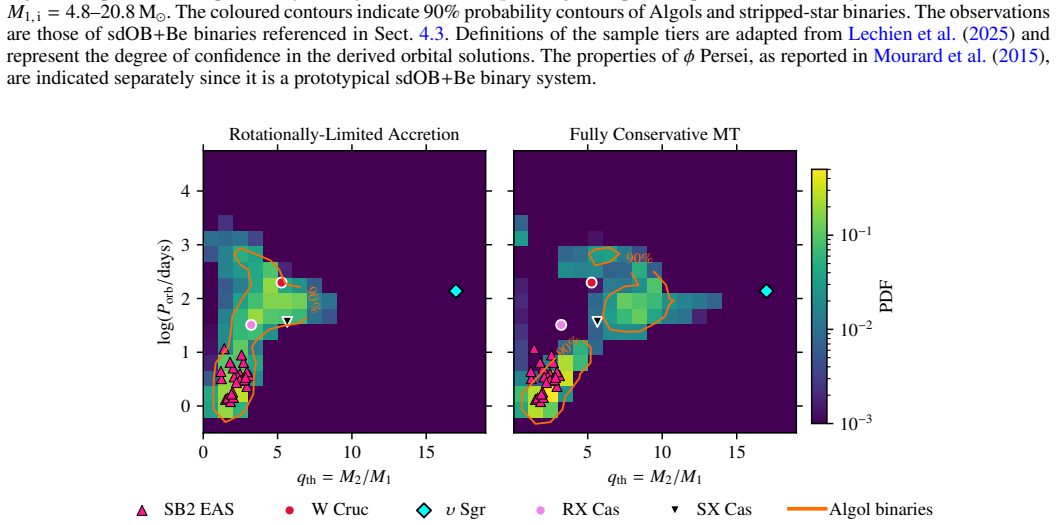
- [Section 4.3, Fig. 7] The conclusion that 'the observed population of Algol binaries cannot be explained by a single mass-transfer efficiency' is based on a qualitative comparison of 90% contours with a heterogeneous observed sample. In the critical long-period region (P_orb ≳ 30 d), the comparison rests on only three systems (W Crucis, RX Cassiopeiae, and SX Cassiopeiae). The paper should provide a quantitative measure of overlap (e.g., a likelihood or a two-sample test) and should discuss how the selection function for the observed Algols is modeled beyond the eclipse bias. This is not fatal for the qualitative conclusion, but it would strengthen the claim and is needed because the observed sample is small in the region that drives the conclusion.
minor comments (4)
- [Section 2.3] Typo: 'the reader is refereed to Izzard & Halabi (2018)' should be 'the reader is referred to Izzard & Halabi (2018)'.
- [Section 2.1] Stopping condition (2) reads 'the accretor overfilled its Roche lobe by more than its own Roche-lobe radius R_RL,2'; this is ambiguous and should be rephrased as 'by more than its Roche-lobe radius' or 'by an amount exceeding R_RL,2'.
- [Section 3.4 and Fig. 2] The sunburst chart is dense and the percentages in the text are not all immediately traceable to the figure; please add a table or a more detailed legend mapping each percentage to the corresponding slice, especially for the 9% classical CE and 25% double-core CE values.
- [References] The citation 'Jin et al. (2026)' appears without a journal or status (accepted, in press, or in preparation); please update the reference entry or mark it as submitted, and do the same for any other items without publication details.
Circularity Check
No circularity found: the contact and merger incidences are emergent MESA grid outcomes, the Algol and stripped-star comparison is an external benchmark, and the self-citations to Paper I are independent computational evidence.
full rationale
The central claims of the paper are genuine computational outcomes of two separately computed MESA grids, not reductions of outputs to inputs. The abstract's factor-of-6 contact increase (11% to 62%) and factor-of-2 merger increase (16% to 38%) are emergent results: despite fully conservative accretion being the defining assumption of the FCMT grid, Section 3.4 reports that 17% of mass-transferring systems in that grid still avoid contact, so the 62% figure is not implied by the conservative-mass-transfer definition alone; it depends on computed accretor thermal responses, orbital evolution, and the sampled initial-parameter space. No parameter is fitted to the observed Algol or stripped-star data; Section 4.3 overlays external compilations (Sen et al. 2022; Lechien et al. 2025) onto independently constructed 2D PDFs, and the paper openly reports systems (HR 6819, HR 2142) that match neither extreme of mass-transfer efficiency, which would be impossible if the conclusions were forced by construction. The RLA baseline (11%, 16%) is taken from Paper I (Henneco et al. 2024), a same-group prior grid, but this self-citation is real evidence under the review rules: it is a code-reproduced, parameter-free computational result with stated assumptions that do not include the present target results, and the present paper computes the comparison grid fresh rather than re-deriving Paper I's numbers. The legitimate weakness - that the FCMT grid also omits rotation and tides ('by not modelling rotation', 'we did not model the effect of tides'), shifting the Case-A/Be boundary because non-rotating models 'have, in general, smaller radii' - is a confounding-variables and validity concern about attributing the incidence changes to mass-transfer efficiency alone, not a circularity: the 62% value is not equivalent by definition to the 100% accretion assumption, and the paper discloses the confound explicitly in Sections 2 and 3.1. The double-core CE category is a classification following Ropke & De Marco (2023), not a renamed prediction, and the concluding claim that a single mass-transfer efficiency cannot explain both Algol and stripped-star populations follows from an external two-population comparison rather than from the grid definitions. The comparison against observed contact binaries (Section 3.5), stripped stars, and Algols makes the work self-contained against external benchmarks, so no circular step can be exhibited.
Assumptions & free parameters
free parameters (6)
- alpha_mlt (mixing length parameter) =
2.0
- alpha_sc (semi-convective mixing efficiency) =
10.0
- alpha_th (thermohaline mixing efficiency) =
1.0
- convective boundary mixing overshoot lengths =
0.20 Hp (H-burning cores), 0.05 Hp (convective envelopes), 0.005 Hp (post-MS cores)
- mass-transfer efficiency =
1.0 (fully conservative)
- metallicity and helium abundance =
Z=0.0142, Y=0.2703
assumptions (6)
- domain assumption All models remain in hydrostatic equilibrium; dynamical-timescale mass transfer is not simulated
- domain assumption L2-overflow in contact configurations implies a merger or common-envelope phase
- domain assumption The contact scheme is applicable to Case-Be, and to a lesser extent Case-Bl and Case-C, mass transfer
- domain assumption Omitting rotation and tides leaves the one-to-one comparison with Paper I valid
- ad hoc to paper Models with numerical issues can be assigned outcomes from their position in the initial parameter plane
- domain assumption Population weighting uses a Kroupa IMF and uniform mass ratio and log-period distributions
Cite this review
Pith. "Pith review of Binary evolution at the extremes of mass-transfer efficiency: Contact, mergers, and population signatures." pith.science (2026). https://pith.science/paper/WVWBRJBO
@misc{pith2026260805001,
  author       = {Pith},
  title        = {Pith review of: Binary evolution at the extremes of mass-transfer efficiency: Contact, mergers, and population signatures},
  year         = {2026},
  howpublished = {\url{https://pith.science/paper/WVWBRJBO}},
  note         = {Machine review of arXiv:2608.05001}
}
read the original abstract
Binary star evolution remains inherently uncertain, and several physical processes are not well understood. These open questions in binary physics come in addition to major uncertainties in single-star evolution, such as angular momentum transport and interior mixing. For example, the efficiency of mass transfer (MT) -- which is the fraction of transferred mass that is actually accreted -- is one of the main uncertainties in binary evolution. We present a grid of 1D binary evolution models with identical initial conditions to an earlier grid in which MT was limited by the spin-up of the accretors. Now we employ fully conservative MT, allowing for a one-to-one comparison between the two grids, and covering the full range from highly non-conservative to fully conservative MT. We explore how these two maximally different MT efficiencies change the occurrence and incidence of contact phases, stellar mergers and common envelope phases, and how they affect the present-day population of (post-)mass-transferring binaries. We find that fully conservative MT increases the incidence of contact systems by roughly a factor of 6 (from 11% to 62%), and the stellar merger incidence by more than a factor of 2 (from 16% to 38%). We also find the emergence of double-core CE phases, which are absent for lower MT efficiencies. Comparing two synthetic binary populations built using the two grids with observed Algol and stripped-star binaries reveals that even though conservative MT is favoured to reproduce the observed stripped-star binaries, the observed population of Algol binaries cannot be explained by a single MT efficiency. We conclude that the MT efficiency depends on the configuration of binary systems and cannot be described by a single value. Our work highlights the need for a better understanding of binary MT and indicates that current binary-star models are incomplete.
Figures


Figures from the paper (4 more)


Reference graph
Works this paper leans on
-
[1]
R., Müller, B., Antoniadis, J., et al
Aguilera-Dena, D. R., Müller, B., Antoniadis, J., et al. 2023, A&A, 671, A134
2023
-
[2]
2007, A&A, 463, 233
Ak, H., Chadima, P., Harmanec, P., et al. 2007, A&A, 463, 233
2007
-
[3]
1989, A&A, 215, 272
Andersen, J., Pavlovski, K., & Piirola, V . 1989, A&A, 215, 272
1989
-
[4]
C., Bellinger, E
Angelou, G. C., Bellinger, E. P., Hekker, S., et al. 2020, MNRAS, 493, 4987
2020
-
[5]
Armitage, P. J. & Livio, M. 1998, ApJ, 493, 898
1998
-
[6]
J., & Scott, P
Asplund, M., Grevesse, N., Sauval, A. J., & Scott, P. 2009, ARA&A, 47, 481 Astropy Collaboration, Price-Whelan, A. M., Lim, P. L., et al. 2022, ApJ, 935, 167 Astropy Collaboration, Price-Whelan, A. M., Sip˝ocz, B. M., et al. 2018, AJ, 156, 123 Astropy Collaboration, Robitaille, T. P., Tollerud, E. J., et al. 2013, A&A, 558, A33
2009
-
[7]
G., Gies, D
Bagnuolo, Jr., W. G., Gies, D. R., Hahula, M. E., Wiemker, R., & Wiggs, M. S. 1994, ApJ, 423, 446
1994
-
[8]
2016, ARA&A, 54, 491
Bally, J. 2016, ARA&A, 54, 491
2016
Show all 137 references
-
[9]
A., Kilkenny, D., & Malcolm, G
Bell, S. A., Kilkenny, D., & Malcolm, G. J. 1987, MNRAS, 226, 879
1987
-
[10]
1995, A&A, 297, 727
Bloecker, T. 1995, A&A, 297, 727
1995
-
[11]
2020, A&A, 641, A43 Böhm-Vitense, E
Bodensteiner, J., Shenar, T., Mahy, L., et al. 2020, A&A, 641, A43 Böhm-Vitense, E. 1958, ZAp, 46, 108
2020
-
[12]
2015, MNRAS, 448, 3784
Budding, E., Butland, R., & Blackford, M. 2015, MNRAS, 448, 3784
2015
-
[13]
2004, A&A, 417, 263
Budding, E., Erdem, A., Çiçek, C., et al. 2004, A&A, 417, 263
2004
-
[14]
& Pejcha, O
Cehula, J. & Pejcha, O. 2023, MNRAS, 524, 471
2023
-
[15]
Claeys, J. S. W., de Mink, S. E., Pols, O. R., Eldridge, J. J., & Baes, M. 2011, A&A, 528, A131
2011
-
[16]
Cox, J. P. & Giuli, R. T. 1968, Principles of stellar structure (Gordon and Breach)
1968
-
[17]
Crowther, P. A. 2007, ARA&A, 45, 177
2007
-
[18]
& Fang, Y .-L
Dalcin, L. & Fang, Y .-L. L. 2021, Computing in Science & Engineering, 23, 47 Dalcín, L., Paz, R., & Storti, M. 2005, Journal of Parallel and Distributed Com- puting, 65, 1108 de Mink, S. E., Pols, O. R., & Hilditch, R. W. 2007, A&A, 467, 1181
2021
-
[19]
Deloye, C. J. & Taam, R. E. 2010, ApJ, 719, L28
2010
-
[20]
1993, Ap&SS, 208, 85 Djuraševi´c, G., Vince, I., Khruzina, T
Djurasevic, G. 1993, Ap&SS, 208, 85 Djuraševi´c, G., Vince, I., Khruzina, T. S., & Rovithis-Livaniou, E. 2009, MN- RAS, 396, 1553
1993
-
[21]
R., Götberg, Y ., Ludwig, B
Drout, M. R., Götberg, Y ., Ludwig, B. A., et al. 2023, Science, 382, 1287
2023
-
[22]
2024, A&A, 685, A58
Ercolino, A., Jin, H., Langer, N., & Dessart, L. 2024, A&A, 685, A58
2024
-
[23]
Evans, R. G. 1974, MNRAS, 167, 517
1974
-
[24]
W., Alexander, D
Ferguson, J. W., Alexander, D. R., Allard, F., et al. 2005, ApJ, 623, 585
2005
-
[25]
J., Bodensteiner, J., Rivinius, T., et al
Frost, A. J., Bodensteiner, J., Rivinius, T., et al. 2022, A&A, 659, L3
2022
-
[26]
A., Chen, X., et al
Ge, H., Tout, C. A., Chen, X., et al. 2023, ApJ, 945, 7
2023
-
[27]
A., Chen, X., et al
Ge, H., Tout, C. A., Chen, X., et al. 2024, ApJ, 975, 254
2024
-
[28]
F., Chen, X., & Han, Z
Ge, H., Webbink, R. F., Chen, X., & Han, Z. 2015, ApJ, 812, 40
2015
-
[29]
F., Chen, X., & Han, Z
Ge, H., Webbink, R. F., Chen, X., & Han, Z. 2020, ApJ, 899, 132, aDS Bibcode: 2020ApJ...899..132G
2020
-
[30]
& Shenar, T
Gilkis, A. & Shenar, T. 2023, MNRAS, 518, 3541 Götberg, Y ., de Mink, S. E., Groh, J. H., et al. 2018, A&A, 615, A78
2023
-
[31]
1996, A&A, 312, 879
Harmanec, P., Morand, F., Bonneau, D., et al. 1996, A&A, 312, 879
1996
-
[32]
J., Hilditch, R
Harries, T. J., Hilditch, R. W., & Howarth, I. D. 2003, MNRAS, 339, 157
2003
-
[33]
R., Millman, K
Harris, C. R., Millman, K. J., van der Walt, S. J., et al. 2020, Nature, 585, 357
2020
-
[34]
Hastings, B., Langer, N., Wang, C., Schootemeijer, A., & Milone, A. P. 2021, A&A, 653, A144
2021
-
[35]
2020, A&A, 633, A165
Hastings, B., Wang, C., & Langer, N. 2020, A&A, 633, A165
2020
-
[36]
2016, PASP, 128, 082001
Heber, U. 2016, PASP, 128, 082001
2016
-
[37]
Henneco, J., Schneider, F. R. N., & Laplace, E. 2024, A&A, 682, A169
2024
-
[38]
W., Hill, G., & Lister, T
Hilditch, R. W., Hill, G., & Lister, T. A. 2007, The Observatory, 127, 33
2007
-
[39]
W., Howarth, I
Hilditch, R. W., Howarth, I. D., & Harries, T. J. 2005, MNRAS, 357, 304
2005
-
[40]
L., Nordsieck, K
Hoffman, J. L., Nordsieck, K. H., & Fox, G. K. 1998, AJ, 115, 1576
1998
-
[41]
2025, A&A, 697, A239
Hovis-Afflerbach, B., Götberg, Y ., Schootemeijer, A., et al. 2025, A&A, 697, A239
2025
-
[42]
Hunter, J. D. 2007, Computing in Science & Engineering, 9, 90
2007
-
[43]
2013, New A, 25, 68
Ibanoglu, C., Çakırlı, Ö., & Sipahi, E. 2013, New A, 25, 68
2013
-
[44]
Iglesias, C. A. & Rogers, F. J. 1993, ApJ, 412, 752
1993
-
[45]
Iglesias, C. A. & Rogers, F. J. 1996, ApJ, 464, 943
1996
-
[46]
2013, A&A Rev., 21, 59
Ivanova, N., Justham, S., Chen, X., et al. 2013, A&A Rev., 21, 59
2013
-
[47]
2024, ApJ, 971, 64
Ivanova, N., Kundu, S., & Pourmand, A. 2024, ApJ, 971, 64
2024
-
[48]
Izzard, R. G. & Halabi, G. M. 2018, arXiv e-prints, arXiv:1808.06883
2018 arXiv
-
[49]
2021, A&A, 646, A33
Janssens, S., Shenar, T., Mahy, L., et al. 2021, A&A, 646, A33
2021
-
[50]
Jin, H., Langer, N., Ercolino, A., & de Mink, S. E. 2026, A comprehensive grid of massive binary evolution models for the Galaxy: Surface properties of post- mass-transfer stars
2026
-
[51]
2013, Stellar Structure and Evolution (Springer Berlin, Heidelberg)
Kippenhahn, R., Weigert, A., & Weiss, A. 2013, Stellar Structure and Evolution (Springer Berlin, Heidelberg)
2013
-
[52]
2022, ApJ, 940, 86
Klement, R., Baade, D., Rivinius, T., et al. 2022, ApJ, 940, 86
2022
-
[53]
2025, A&A, 694, A208
Klement, R., Rivinius, T., Baade, D., et al. 2025, A&A, 694, A208
2025
-
[54]
R., et al
Klement, R., Rivinius, T., Gies, D. R., et al. 2024, ApJ, 962, 70
2024
-
[55]
& Ritter, H
Kolb, U. & Ritter, H. 1990, A&A, 236, 385 Koubský, P., Harmanec, P., Yang, S., et al. 2006, A&A, 459, 849
1990
-
[56]
2001, MNRAS, 322, 231, aDS Bibcode: 2001MNRAS.322..231K Article number, page 13 A&A proofs:manuscript no
Kroupa, P. 2001, MNRAS, 322, 231, aDS Bibcode: 2001MNRAS.322..231K Article number, page 13 A&A proofs:manuscript no. main
2001
-
[57]
Kunze, S., Speith, R., & Hessman, F. V . 2001, MNRAS, 322, 499
2001
-
[58]
2012, ARA&A, 50, 107
Langer, N. 2012, ARA&A, 50, 107
2012
-
[59]
C., Petrovic, J., & Heger, A
Langer, N., Yoon, S. C., Petrovic, J., & Heger, A. 2003, arXiv e-prints, astro
2003
-
[60]
Lau, M. Y . M., Hirai, R., Mandel, I., & Tout, C. A. 2024, ApJ, 966, L7
2024
-
[61]
E., Valli, R., et al
Lechien, T., de Mink, S. E., Valli, R., et al. 2025, ApJ, 990, L51
2025
-
[62]
2023, A&A, 669, A82
Li, Z., Chen, X., Ge, H., Chen, H.-L., & Han, Z. 2023, A&A, 669, A82
2023
-
[63]
W., et al
Liu, J., Zhang, H., Howard, A. W., et al. 2019, Nature, 575, 618
2019
-
[64]
Z., van Paradijs, J., & van den Heuvel, E
Liu, Q. Z., van Paradijs, J., & van den Heuvel, E. P. J. 2006, A&A, 455, 1165
2006
-
[65]
1994, A&A, 291, 185
Lorenz, R., Mayer, P., & Drechsel, H. 1994, A&A, 291, 185
1994
-
[66]
R., Gotberg, Y ., Lang, D., & Laroche, A
Ludwig, B., Drout, M. R., Gotberg, Y ., Lang, D., & Laroche, A. 2025, arXiv e-prints, arXiv:2505.18632
2025 arXiv
-
[67]
A., Sana, H., et al
Mahy, L., Almeida, L. A., Sana, H., et al. 2020, A&A, 634, A119
2020
-
[68]
F., & Bouret, J
Mahy, L., Martins, F., Machado, C., Donati, J. F., & Bouret, J. C. 2011, A&A, 533, A9
2011
-
[69]
& Farmer, A
Mandel, I. & Farmer, A. 2022, Phys. Rep., 955, 1
2022
-
[70]
& Bodensteiner, J
Marchant, P. & Bodensteiner, J. 2024, ARA&A, 62, 21
2024
-
[71]
M., & Moriya, T
Marchant, P., Langer, N., Podsiadlowski, P., Tauris, T. M., & Moriya, T. J. 2016, A&A, 588, A50
2016
-
[72]
Marchant, P., Pappas, K. M. W., Gallegos-Garcia, M., et al. 2021, A&A, 650, A107
2021
-
[73]
2021, A&A, 648, A126
Martinet, S., Meynet, G., Ekström, S., et al. 2021, A&A, 648, A126
2021
-
[74]
2017, A&A, 607, A82
Martins, F., Mahy, L., & Hervé, A. 2017, A&A, 607, A82
2017
-
[75]
& Vanbeveren, D
Mennekens, N. & Vanbeveren, D. 2017, A&A, 599, A84
2017
-
[76]
E., Djuraševi´c, G., Petrovi´c, J., et al
Mennickent, R. E., Djuraševi´c, G., Petrovi´c, J., et al. 2022, A&A, 666, A51
2022
-
[77]
E., et al
Menon, A., Langer, N., de Mink, S. E., et al. 2021, MNRAS, 507, 5013, aDS Bibcode: 2021MNRAS.507.5013M
2021
-
[78]
P., Marino, A
Milone, A. P., Marino, A. F., Di Criscienzo, M., et al. 2018, MNRAS, 477, 2640
2018
-
[79]
M., Zapartas, E., & Aguilera-Dena, D
Misra, D., Fragos, T., Tauris, T. M., Zapartas, E., & Aguilera-Dena, D. R. 2020, A&A, 642, A174
2020
-
[80]
D., Meilland, A., et al
Mourard, D., Monnier, J. D., Meilland, A., et al. 2015, A&A, 577, A51
2015
-
[81]
& de Jager, C
Nieuwenhuijzen, H. & de Jager, C. 1990, A&A, 231, 134
1990
-
[82]
Ostrov, P. G. 2001, MNRAS, 321, L25
2001
-
[83]
1981, A&A, 102, 17 Paczy´nski, B
Packet, W. 1981, A&A, 102, 17 Paczy´nski, B. 1971, ARA&A, 9, 183
1981
-
[84]
1977, ApJ, 216, 822
Paczynski, B. 1977, ApJ, 216, 822
1977
-
[85]
1991, ApJ, 370, 597, aDS Bibcode: 1991ApJ...370..597P
Paczynski, B. 1991, ApJ, 370, 597, aDS Bibcode: 1991ApJ...370..597P
1991
-
[86]
2006, A&A, 454, 855
Pavlovski, K., Burki, G., & Mimica, P. 2006, A&A, 454, 855
2006
-
[87]
& Ivanova, N
Pavlovskii, K. & Ivanova, N. 2015, MNRAS, 449, 4415
2015
-
[88]
2011, ApJS, 192, 3
Paxton, B., Bildsten, L., Dotter, A., et al. 2011, ApJS, 192, 3
2011
-
[89]
2013, ApJS, 208, 4
Paxton, B., Cantiello, M., Arras, P., et al. 2013, ApJS, 208, 4
2013
-
[90]
2015, ApJS, 220, 15
Paxton, B., Marchant, P., Schwab, J., et al. 2015, ApJS, 220, 15
2015
-
[91]
B., et al
Paxton, B., Schwab, J., Bauer, E. B., et al. 2018, ApJS, 234, 34
2018
-
[92]
2019, ApJS, 243, 10
Paxton, B., Smolec, R., Schwab, J., et al. 2019, ApJS, 243, 10
2019
-
[93]
J., Gies, D
Peters, G. J., Gies, D. R., Grundstrom, E. D., & McSwain, M. V . 2008, ApJ, 686, 1280
2008
-
[94]
2025, arXiv e-prints, arXiv:2509.21521
Picco, A., Marchant, P., Sana, H., et al. 2025, arXiv e-prints, arXiv:2509.21521
2025
-
[95]
Piirola, V ., Berdyugin, A., Mikkola, S., & Coyne, G. V . 2005, ApJ, 632, 576
2005
-
[96]
C., & Hsu, J
Podsiadlowski, P., Joss, P. C., & Hsu, J. J. L. 1992, ApJ, 391, 246
1992
-
[97]
Pols, O. R. 1994, A&A, 290, 119
1994
-
[98]
1996, ApJ, 467, 749
Popham, R. 1996, ApJ, 467, 749
1996
-
[99]
& Narayan, R
Popham, R. & Narayan, R. 1991, ApJ, 370, 604, aDS Bibcode: 1991ApJ...370..604P
1991
-
[100]
J., & Hartmann, L
Popham, R., Narayan, R., Kenyon, S. J., & Hartmann, L. 1995, in Revista Mex- icana de Astronomia y Astrofisica Conference Series, V ol. 1, Revista Mexi- cana de Astronomia y Astrofisica Conference Series, ed. S. Lizano & J. M. Torrelles, 229
1995
-
[101]
1998, Astronomical and Astrophysical Transactions, 15, 357
Pustylnik, I. 1998, Astronomical and Astrophysical Transactions, 15, 357
1998
-
[102]
Raguzova, N. V . & Popov, S. B. 2005, Astronomical and Astrophysical Transac- tions, 24, 151
2005
-
[103]
Rasio, F. A. 1995, ApJ, 444, L41, aDS Bibcode: 1995ApJ...444L..41R
1995
-
[104]
1975, Memoires of the Societe Royale des Sciences de Liege, 8, 369 Röpke, F
Reimers, D. 1975, Memoires of the Societe Royale des Sciences de Liege, 8, 369 Röpke, F. K. & De Marco, O. 2023, Living Reviews in Computational Astro- physics, 9, 2
1975
-
[105]
C., Breivik, K., Badenes, C., et al
Rubio, A. C., Breivik, K., Badenes, C., et al. 2025, arXiv e-prints, arXiv:2505.15893
2025
-
[106]
Sander, A. A. C. & Vink, J. S. 2020, MNRAS, 499, 873
2020
-
[107]
2025, arXiv e-prints, arXiv:2510.24127
Scherbak, P., Lu, W., & Fuller, J. 2025, arXiv e-prints, arXiv:2510.24127
2025 arXiv
-
[108]
Schneider, F. R. N. 2025, arXiv e-prints, arXiv:2509.18421
2025
-
[109]
Schneider, F. R. N., Izzard, R. G., Langer, N., & de Mink, S. E. 2015, ApJ, 805, 20
2015
-
[110]
Schneider, F. R. N., Laplace, E., & Podsiadlowski, P. 2025, A&A, 700, A253
2025
-
[111]
Schneider, F. R. N., Podsiadlowski, P., & Laplace, E. 2024, A&A, 686, A45
2024
-
[112]
Schneider, F. R. N., Podsiadlowski, P., & Müller, B. 2021, A&A, 645, A5
2021
-
[113]
J., & Wang, C
Schootemeijer, A., Langer, N., Grin, N. J., & Wang, C. 2019, A&A, 625, A132 Schürmann, C. & Langer, N. 2024, arXiv e-prints, arXiv:2404.08615
2019 arXiv
-
[114]
2022, A&A, 659, A98
Sen, K., Langer, N., Marchant, P., et al. 2022, A&A, 659, A98
2022
-
[115]
2020, A&A, 639, L6
Shenar, T., Bodensteiner, J., Abdul-Masih, M., et al. 2020, A&A, 639, L6
2020
-
[116]
R., Schaefer, G
Shepard, K., Gies, D. R., Schaefer, G. H., et al. 2024, ApJ, 977, 236
2024
-
[117]
2017, Nature Communica- tions, 8, 14906
Stevenson, S., Vigna-Gómez, A., Mandel, I., et al. 2017, Nature Communica- tions, 8, 14906
2017
-
[118]
J., Lloyd, C., Pachoulakis, I., & Koch, R
Stickland, D. J., Lloyd, C., Pachoulakis, I., & Koch, R. H. 1998, The Observa- tory, 118, 356
1998
-
[119]
& Kang, Y
Surina, F. & Kang, Y . W. 2009, in Astronomical Society of the Pacific Confer- ence Series, V ol. 404, The Eighth Pacific Rim Conference on Stellar Astro- physics: A Tribute to Kam-Ching Leung, ed. S. J. Murphy & M. S. Bessell, 178
2009
-
[120]
Surkova, L. P. & Svechnikov, M. A. 2004, VizieR Online Data Catalog: Semi- detached eclipsing binaries (Surkova+, 2004), VizieR On-line Data Catalog: V/115
2004
-
[121]
M., Kramer, M., Freire, P
Tauris, T. M., Kramer, M., Freire, P. C. C., et al. 2017, ApJ, 846, 170
2017
-
[122]
D., Pols, O
Temmink, K. D., Pols, O. R., Justham, S., & Blagorodnova, N. 2025, arXiv e- prints, arXiv:2509.09492
2025
-
[123]
D., Pols, O
Temmink, K. D., Pols, O. R., Justham, S., Istrate, A. G., & Toonen, S. 2023, A&A, 669, A45
2023
-
[124]
2005, MNRAS, 360, 583 Tüysüz, M., Soydugan, F., Bilir, S., et al
Terrell, D., Munari, U., Zwitter, T., & Wolf, G. 2005, MNRAS, 360, 583 Tüysüz, M., Soydugan, F., Bilir, S., et al. 2014, New A, 28, 44
2005
-
[125]
Umana, G., Maxted, P. F. L., Trigilio, C., et al. 2000, A&A, 358, 229 Vigna-Gómez, A., Neijssel, C. J., Stevenson, S., et al. 2018, MNRAS, 481, 4009
2000
-
[126]
Vink, J. S. 2017, A&A, 607, L8
2017
-
[127]
S., de Koter, A., & Lamers, H
Vink, J. S., de Koter, A., & Lamers, H. J. G. L. M. 2000, A&A, 362, 295
2000
-
[128]
E., et al
Virtanen, P., Gommers, R., Oliphant, T. E., et al. 2020, Nature Methods, 17, 261
2020
-
[129]
2020, ApJ, 888, L12
Wang, C., Langer, N., Schootemeijer, A., et al. 2020, ApJ, 888, L12
2020
-
[130]
Wang, C., Lau, M. Y . M., Li, X.-D., et al. 2026, A&A, 707, A14
2026
-
[131]
R., & Peters, G
Wang, L., Gies, D. R., & Peters, G. J. 2017, ApJ, 843, 60
2017
-
[132]
R., Peters, G
Wang, L., Gies, D. R., Peters, G. J., et al. 2021, AJ, 161, 248
2021
-
[133]
2023, ApJ, 958, 138
Willcox, R., MacLeod, M., Mandel, I., & Hirai, R. 2023, ApJ, 958, 138
2023
-
[134]
& Schwab, J
Wolf, W. & Schwab, J. 2017, py_mesa_reader, Python Package Index,https: //billwolf.space/py_mesa_reader/
2017
-
[135]
Woods, T. E. & Ivanova, N. 2011, ApJ, 739, L48
2011
-
[136]
2024, A&A, 683, A37
Yungelson, L., Kuranov, A., Postnov, K., et al. 2024, A&A, 683, A37
2024
-
[137]
2024, MNRAS, 531, L45 Article number, page 14 J
Zhao, Z.-Q., Li, Z.-W., Xiao, L., Ge, H.-W., & Han, Z.-W. 2024, MNRAS, 531, L45 Article number, page 14 J. Henneco et al.: Contact tracing of binary stars with conservative mass transfer Appendix A: Contact tracing results for otherM 1,i Figs. A.1–A.3 contain the contact traci...
2024
Reviewed August 6, 2026 · model on record in the stance chip above.
Discussion (0). Sign in to comment.