When do perturbed Chebyshev--Lobatto points remain Chebyshev?
Pith reviewed 2026-06-26 07:28 UTC · model grok-4.3
The pith
Perturbed Chebyshev-Lobatto points retain logarithmic Lebesgue constants when n σ_n (log n + 1) is bounded by a small constant.
A machine-rendered reading of the paper's core claim, the machinery that carries it, and where it could break.
Core claim
For nodes x_j = cos(j π / n + ε_j) with |ε_j| ≤ σ_n, if n σ_n (log n + 1) is bounded by a sufficiently small constant, then the Lebesgue constant of the associated interpolation operator remains logarithmic in n. The argument proceeds by mapping to the angular variable, expressing the Lebesgue function via trigonometric polynomials, and applying Bernstein's inequality to control its growth under the stated perturbation size.
What carries the argument
Cosine parametrization of the nodes together with Bernstein's inequality for trigonometric polynomials, which directly bounds the Lebesgue function when perturbations are controlled in the angular variable.
If this is right
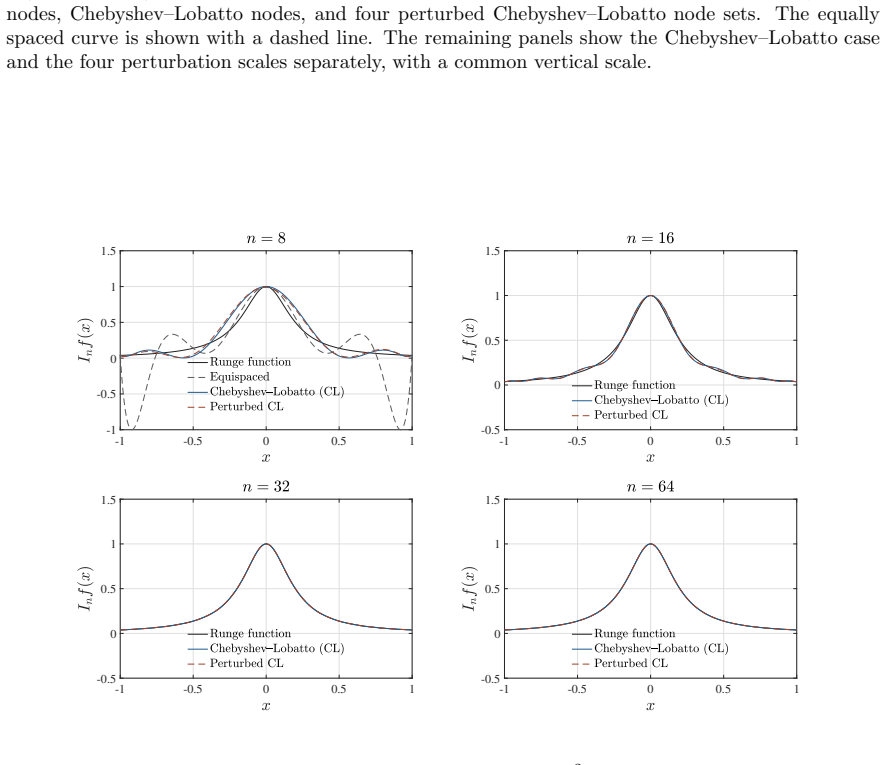
- Analytic interpolation inside Bernstein ellipses remains free of Runge-type divergence when the perturbation condition holds.
- Pseudospectral differentiation errors remain controlled in the regime where the Lebesgue constant stays logarithmic.
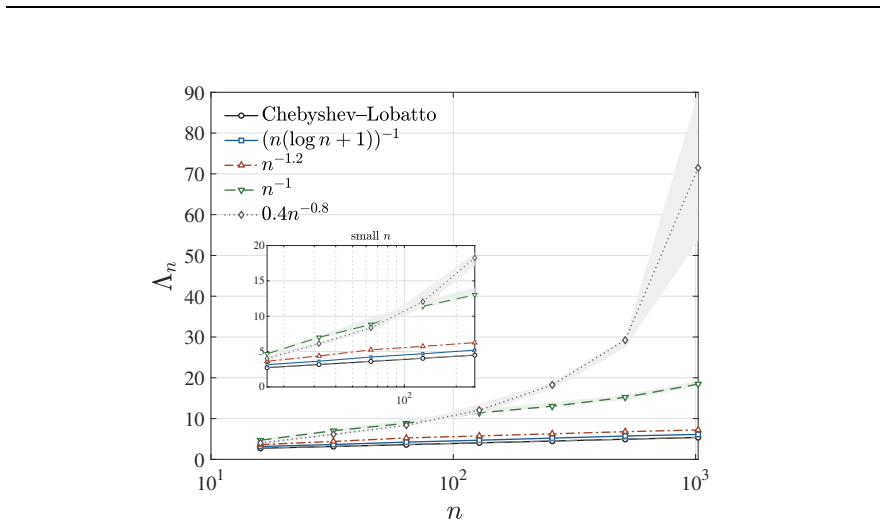
- Uniform perturbations of angular size 1/n produce a worst-case loss of the logarithmic Lebesgue constant.
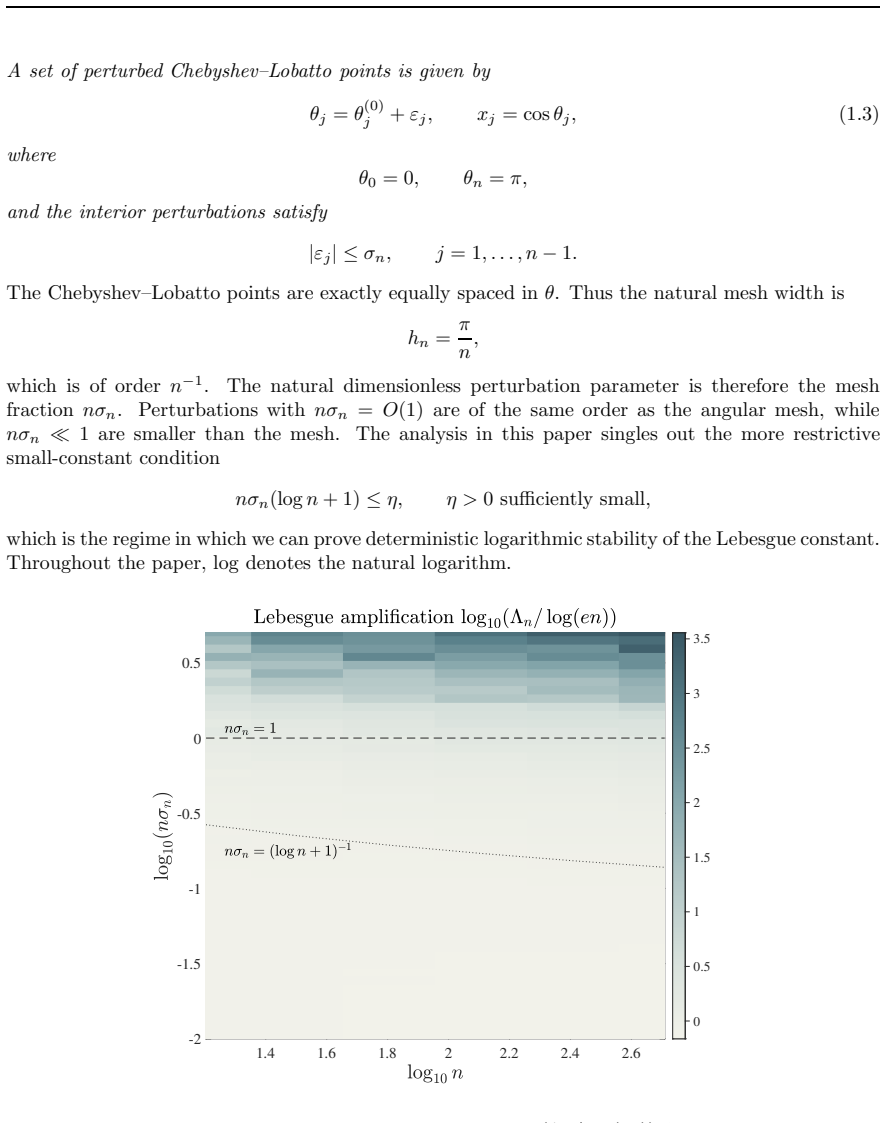
- The transition from stable to unstable Lebesgue constants occurs near n σ_n of order 1 over log n, consistent with the reported numerical experiments.
Where Pith is reading between the lines
- Limited adaptive adjustment of nodes could be performed while keeping the interpolation operator stable, provided the angular shifts respect the derived bound.
- Because the analysis is angular, physical-space perturbations near the endpoints may be larger than those near the center without violating the condition.
- The same angular technique might be tested on other clustered node families, though the required inequalities would differ.
Load-bearing premise
Perturbations are measured uniformly in the angular cosine variable so that Bernstein's inequality for trigonometric polynomials applies directly.
What would settle it
A family of perturbations with n σ_n (log n + 1) bounded but with the maximum of the Lebesgue function growing faster than any fixed multiple of log n would disprove the stability claim.
Figures
read the original abstract
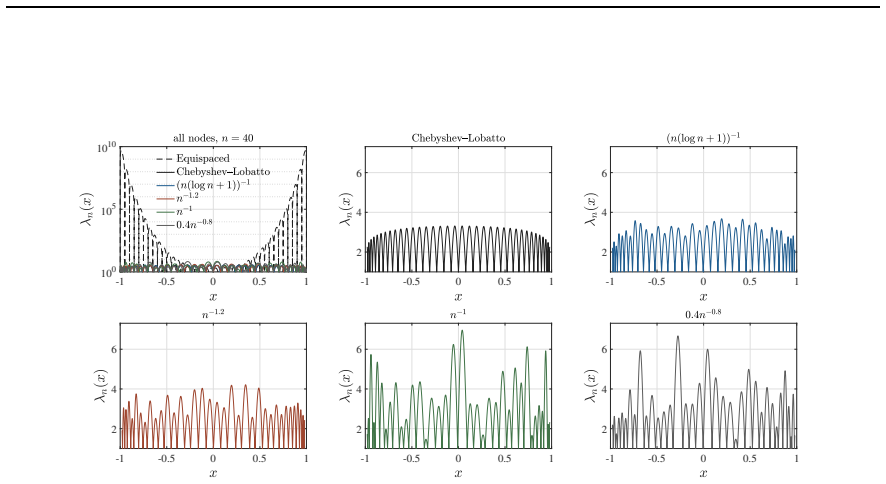
Chebyshev points are distinguished in polynomial interpolation by the logarithmic growth of their Lebesgue constants. This paper asks a simple question: how much can Chebyshev points be perturbed before they cease to behave like Chebyshev points? We study perturbed Chebyshev--Lobatto nodes $x_j=\cos(j\pi/n+\varepsilon_j)$, with angular perturbations $|\varepsilon_j|\leq \sigma_n$. The study is motivated by numerical experiments showing a broad stable region when the mesh fraction $n\sigma_n$ is small and rapid amplification for larger perturbations; the observed transition region is consistent with the curve $n\sigma_n\asymp(\log n)^{-1}$. The main result is a deterministic worst-case stability estimate: if $n\sigma_n(\log n+1)$ is bounded by a sufficiently small constant, then the Lebesgue constant remains logarithmic. The proof uses the cosine parametrization and Bernstein's inequality for trigonometric polynomials, thereby exploiting the angular geometry of the Chebyshev--Lobatto grid rather than a Markov inequality in the physical variable. We also give a worst-case obstruction at the angular mesh scale, showing that perturbations of order $1/n$ cannot be allowed uniformly. Consequences are derived for analytic interpolation in Bernstein ellipses, for the absence of Runge-type divergence in the stable analytic regime, and for pseudospectral differentiation. Numerical experiments illustrate the transition in the Lebesgue constants, the shape of the associated Lebesgue functions, Runge-function interpolants, and finite-precision differentiation errors.
Editorial analysis
A structured set of objections, weighed in public.
Referee Report
Summary. The manuscript studies perturbed Chebyshev-Lobatto nodes x_j = cos(j π / n + ε_j) with angular perturbations |ε_j| ≤ σ_n. It proves a deterministic stability result: if n σ_n (log n + 1) is bounded by a sufficiently small constant, the associated Lebesgue constant remains O(log n). The argument maps to the angular variable and applies Bernstein's inequality for trigonometric polynomials. A matching obstruction is shown at the scale σ_n ∼ 1/n. Consequences are derived for interpolation in Bernstein ellipses, absence of Runge divergence, and pseudospectral differentiation, with numerical experiments illustrating the transition.
Significance. If the central estimate holds, the work supplies a sharp, parameter-free characterization of the perturbation tolerance that preserves the logarithmic Lebesgue constant of Chebyshev-Lobatto points. The angular parametrization together with Bernstein's inequality yields a clean derivation that directly multiplies the classical log n factor by n σ_n; the obstruction result at mesh scale 1/n confirms that the scaling is tight. These features, together with the applications to analytic regimes and differentiation, make the contribution useful for robustness analysis in spectral methods.
minor comments (1)
- [Abstract] Abstract: the transition curve is stated as n σ_n ≍ (log n)^{-1} while the theorem uses the product n σ_n (log n + 1); a short clarifying sentence relating the two forms would improve readability.
Simulated Author's Rebuttal
We thank the referee for the positive summary, significance assessment, and recommendation to accept the manuscript.
Circularity Check
No significant circularity; derivation is self-contained via trigonometric inequalities
full rationale
The central result is a deterministic bound: when n σ_n (log n +1) is sufficiently small, the Lebesgue constant for perturbed Chebyshev-Lobatto nodes x_j = cos(j π /n + ε_j) remains O(log n). The proof maps to the angular variable and applies Bernstein's inequality for trigonometric polynomials to control the growth of the Lebesgue function relative to the equispaced trigonometric case. This produces the factor n σ_n multiplied by the known logarithmic term for unperturbed points. No step reduces by construction to a fitted parameter, self-definition, or load-bearing self-citation. The obstruction at σ_n ~ 1/n is likewise obtained from the same scaling. The derivation is independent of the motivating numerical experiments and relies only on standard external inequalities.
Axiom & Free-Parameter Ledger
axioms (1)
- standard math Bernstein's inequality for trigonometric polynomials
Reference graph
Works this paper leans on
-
[1]
C. An, J. Ran, and H.-N. Wu , The path of hyperinterpolation: A survey , Dolomites Res. Notes Approx., 18 (2025), pp. 135–145, https://doi.org/10.25430/pupj-DRNA-2025-1-11
-
[2]
A. P. Austin and L. N. Trefethen , Trigonometric interpolation and quadrature in per- turbed points, SIAM J. Numer. Anal., 55 (2017), pp. 2113–2122, https://doi.org/10.1137/ 16M1107760. 16
2017
-
[3]
Barycentric Lagrange Interpolation
J.-P. Berrut and L. N. Trefethen , Barycentric Lagrange interpolation , SIAM Rev., 46 (2004), pp. 501–517, https://doi.org/10.1137/S0036144502417715
-
[4]
L. Bos, M. Caliari, S. De Marchi, M. Vianello, and Y. Xu , Bivariate Lagrange inter- polation at the Padua points: the generating curve approach , J. Approx. Theory, 143 (2006), pp. 15–25, https://doi.org/10.1016/j.jat.2006.03.008
-
[5]
L. Bos, S. De Marchi, M. Vianello, and Y. Xu , Bivariate Lagrange interpolation at the Padua points: the ideal theory approach , Numer. Math., 108 (2007), pp. 43–57, https: //doi.org/10.1007/s00211-007-0112-z
-
[6]
H. Ehlich and K. Zeller , Auswertung der Normen von Interpolationsoperatoren , Math. Ann., 164 (1966), pp. 105–112, https://doi.org/10.1007/BF01429047
-
[7]
Erd ˝os, Problems and results on the theory of interpolation
P. Erd ˝os, Problems and results on the theory of interpolation. II , Acta Math. Acad. Sci. Hungar., 12 (1961), pp. 235–244, https://doi.org/10.1007/BF02066686
-
[8]
Piazzon and M
F. Piazzon and M. Vianello , Stability inequalities for Lebesgue constants via Markov- like inequalities, Dolomites Res. Notes Approx., 11 (2018), pp. 1–9, https://doi.org/10.14658/ PUPJ-DRNA-2018-1-1
2018
-
[9]
R. B. Platte, L. N. Trefethen, and A. B. J. Kuijlaars , Impossibility of fast stable approximation of analytic functions from equispaced sampl es, SIAM Rev., 53 (2011), pp. 308– 318, https://doi.org/10.1137/090774707
-
[10]
Runge, ¨Uber empirische Funktionen und die Interpolation zwischen ¨ aquidistanten Ordinaten, Z
C. Runge, ¨Uber empirische Funktionen und die Interpolation zwischen ¨ aquidistanten Ordinaten, Z. Math. Phys., 46 (1901), pp. 224–243
1901
-
[11]
I. H. Sloan , Polynomial interpolation and hyperinterpolation over gen eral regions, J. Approx. Theory, 83 (1995), pp. 238–254, https://doi.org/10.1006/jath.1995.1119
-
[12]
L. N. Trefethen , Spectral methods in MATLAB, vol. 10 of Software, Environments, and Tools, Society for Industrial and Applied Mathematics, Philadelphia, PA, 20 00, https://doi.org/10. 1137/1.9780898719598
-
[13]
L. N. Trefethen , Approximation Theory and Approximation Practice , Society for Industrial and Applied Mathematics, Philadelphia, PA, 2013
2013
-
[14]
W ang, A new and sharper bound for Legendre expansion of differentia ble functions , Appl
H. W ang, A new and sharper bound for Legendre expansion of differentia ble functions , Appl. Math. Lett., 85 (2018), pp. 95–102, https://doi.org/10.1016/j.aml.2018.05.022
-
[15]
W ang, Analysis of error localization of Chebyshev spectral appro ximations, SIAM J
H. W ang, Analysis of error localization of Chebyshev spectral appro ximations, SIAM J. Numer. Anal., 61 (2023), pp. 952–972, https://doi.org/10.1137/22M1481452
-
[16]
W ang, New error bounds for Legendre approximations of differentia ble functions , J
H. W ang, New error bounds for Legendre approximations of differentia ble functions , J. Fourier Anal. Appl., 29 (2023), p. 42, https://doi.org/10.1007/s00041-023-10024-4
-
[17]
H. W ang and S. Xiang , On the convergence rates of Legendre approximation , Math. Comp., 81 (2012), pp. 861–877, https://doi.org/10.1090/S0025-5718-2011-02549-4
-
[18]
Wu, Marcinkiewicz–Zygmund stability of quadrature-based Galerkin schemes, Appl
H.-N. Wu, Marcinkiewicz–Zygmund stability of quadrature-based Galerkin schemes, Appl. Math. Lett., 182 (2026), p. 110033, https://doi.org/10.1016/j.aml.2026.110033
-
[19]
S. Xiang, X. Chen, and H. W ang , Error bounds for approximation in Chebyshev points , Numer. Math., 116 (2010), pp. 463–491, https://doi.org/10.1007/s00211-010-0309-4 . 17
discussion (0)
Sign in with ORCID, Apple, or X to comment. Anyone can read and Pith papers without signing in.