Arm morphology in off-centre barred galaxies
Pith reviewed 2026-05-20 03:38 UTC · model grok-4.3
The pith
Off-centre asymmetric bars distort invariant manifolds to produce arms of unequal density and shape, or a single arm after a critical offset triggers a bifurcation.
A machine-rendered reading of the paper's core claim, the machinery that carries it, and where it could break.
Core claim
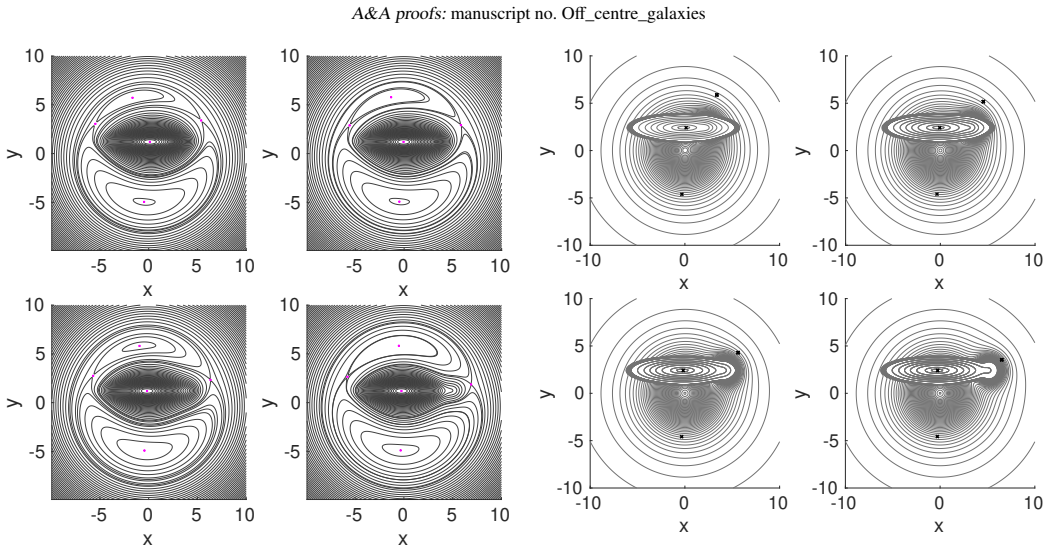
In a barred galaxy model that includes an off-centred and asymmetric bar, the positions, stability, and bifurcations of the Lagrangian equilibrium points are tracked as functions of the displacement of the asymmetric mass along the bar and the offset between the bar and the system's centre of mass. For modest offsets that keep the centre of mass inside the bar, the classical five-equilibrium-point configuration is preserved, yet the invariant manifolds of planar Lyapunov orbits around the unstable points become strongly distorted, producing two arms with different densities and shapes. At the threshold where the galactic centre of mass exits the bar ellipsoid, a pitchfork bifurcation removes
What carries the argument
Invariant manifolds of planar Lyapunov orbits around unstable Lagrangian points in an off-centred asymmetric barred potential, which trace the global paths that form spiral arms.
If this is right
- Modest internal bar lopsidedness and bar-disc offsets that keep the centre of mass inside the bar preserve five equilibrium points but distort manifolds to yield two arms of unequal density and shape.
- When the offset reaches the point at which the centre of mass exits the bar ellipsoid, a pitchfork bifurcation removes the collinear unstable points.
- The resulting three-equilibrium-point configuration is supported by a single unstable point and its manifold, which forms one arm.
- The framework is compatible with the observed correlation between off-centre bars and photometric lopsidedness and explains the strongly asymmetric arm morphology of galaxies such as the LMC.
Where Pith is reading between the lines
- Arm asymmetry in other observed galaxies could serve as a photometric indicator of bar-disc misalignment even when the centre of mass position is not directly measurable.
- Self-consistent N-body simulations that include the vertical structure of real galaxies could test whether the planar manifold predictions remain dominant or are altered by out-of-plane motions.
- The critical offset threshold might be inverted from observed arm properties to estimate the degree of bar-disc misalignment in large photometric surveys.
Load-bearing premise
The invariant manifolds of planar Lyapunov orbits around the unstable points continue to organise arm morphology after the bar is displaced and made asymmetric, without major effects from vertical motions or time-dependent changes in the potential.
What would settle it
A numerical simulation or dynamical model of a barred galaxy with the centre of mass placed outside the bar ellipsoid that still develops two distinct arms matching the modest-offset case, or that retains five equilibrium points, would contradict the predicted bifurcation and single-arm transition.
Figures




read the original abstract
Many barred galaxies, including the Large Magellanic Cloud (LMC), display strong lopsidedness and off-centre bars. The dynamical connection between bar-disc misalignments, internal mass asymmetries, and arm morphology is not yet fully characterised. We investigate how internal mass imbalances within the bar and global offsets between the bar and the centre of mass of the system modify the equilibrium-point structure and the invariant manifolds that organise arms. We construct a barred galaxy model which includes an off-centred and asymmetric in shape bar. Using numerical continuation, we track the position, stability, and bifurcations of the Lagrangian equilibrium points as functions of the displacement of the asymmetric mass component along the bar and of the offset between the bar and the system's centre of mass. For representative configurations we compute the invariant manifolds of planar Lyapunov orbits around unstable points and analyse the resulting arm structures. Internal bar lopsidedness and modest bar-disc offsets that keep the centre of mass inside the bar preserve the classical configuration with five equilibrium points, but strongly distort the associated invariant manifolds, producing two arms with different densities and shapes. The bar-disc offset reaches a threshold at the point at which the galactic centre of mass exits the bar ellipsoid, in which a pitchfork bifurcation removes the collinear unstable points and the system transitions to a three-equilibrium-point configuration in which a single unstable point and its associated manifold supports one arm. This framework is compatible with the observed correlation between off-centre bars and photometric lopsidedness, and it provides a dynamical explanation for the strongly asymmetric arm morphology of galaxies such as the LMC.
Editorial analysis
A structured set of objections, weighed in public.
Referee Report
Summary. The paper constructs a barred galaxy potential with an off-centred and internally asymmetric bar, then uses numerical continuation to follow the positions and stabilities of the Lagrangian equilibria as functions of bar displacement and centre-of-mass offset. For representative parameter values it computes the invariant manifolds of planar Lyapunov orbits around the remaining unstable points and shows that modest offsets produce two arms of unequal density and shape while a threshold offset triggers a pitchfork bifurcation that eliminates the collinear unstable points, leaving a single unstable equilibrium whose manifold supports one arm. The results are presented as a dynamical explanation for the observed correlation between off-centre bars and lopsided arm morphology, including in the LMC.
Significance. If the planar-manifold organisation of arms survives the symmetry breaking, the work supplies a concrete dynamical pathway from bar-disc misalignment to asymmetric spiral structure and thereby links photometric lopsidedness to the equilibrium-point topology. The numerical-continuation approach is parameter-free once the potential form is fixed, and the reported bifurcation threshold is a falsifiable prediction that could be tested against observed bar offsets.
major comments (1)
- The central claim that the invariant manifolds of planar Lyapunov orbits continue to organise global arm density and shape after the bar is displaced and made lopsided rests on an untested extrapolation. No 3-D orbit sampling, vertical-frequency analysis, or comparison with a live N-body disc is described that would confirm the planar structures remain dominant once symmetry is broken; without such a check the reported transition to a single-arm regime cannot be regarded as robust.
Simulated Author's Rebuttal
We thank the referee for their careful reading of the manuscript and for identifying a key limitation in the scope of the analysis. We respond to the major comment below and indicate the revisions we will make.
read point-by-point responses
-
Referee: The central claim that the invariant manifolds of planar Lyapunov orbits continue to organise global arm density and shape after the bar is displaced and made lopsided rests on an untested extrapolation. No 3-D orbit sampling, vertical-frequency analysis, or comparison with a live N-body disc is described that would confirm the planar structures remain dominant once symmetry is broken; without such a check the reported transition to a single-arm regime cannot be regarded as robust.
Authors: We agree that the present study is restricted to the planar potential and does not contain three-dimensional orbit sampling, vertical-frequency analysis, or live N-body comparisons. The work deliberately isolates the effect of bar displacement and internal asymmetry on the planar equilibrium points and their invariant manifolds using numerical continuation. This approach yields a concrete, parameter-controlled demonstration of how modest offsets distort the two-arm manifold structure and how a threshold offset triggers a pitchfork bifurcation to a single-arm configuration. We acknowledge that vertical motions and self-gravity could alter the dominance of these planar structures in a fully three-dimensional, live disc. In the revised manuscript we will add an explicit limitations subsection that states the planar assumption, notes the absence of 3-D validation, and outlines how the reported bifurcation threshold could be tested in future N-body or 3-D orbit studies. We maintain that the planar mechanism remains a useful and falsifiable dynamical pathway even if it is later modified by three-dimensional effects. revision: partial
Circularity Check
Numerical continuation of equilibria and manifolds yields self-contained results with no circular reduction.
full rationale
The derivation proceeds by constructing an explicit parameterized potential for an off-centre asymmetric bar, then applying numerical continuation to locate and track the Lagrangian points and their bifurcations as functions of the displacement and offset parameters. Invariant manifolds are computed directly from planar Lyapunov orbits around the resulting unstable equilibria for representative cases. Arm morphologies emerge as direct outputs of these manifold integrations rather than as quantities fitted to or defined by the same data. No self-citations, ansatzes smuggled via prior work, or renaming of known results appear in the load-bearing steps; the framework remains independent of external fitted inputs and is therefore self-contained.
Axiom & Free-Parameter Ledger
free parameters (2)
- bar displacement parameter
- asymmetric mass component displacement
axioms (2)
- domain assumption The gravitational potential is time-independent and planar motion dominates arm organization
- standard math Numerical continuation accurately tracks stability changes and bifurcations without missing branches
Lean theorems connected to this paper
-
IndisputableMonolith/Foundation/RealityFromDistinction.leanreality_from_one_distinction unclear?
unclearRelation between the paper passage and the cited Recognition theorem.
Using numerical continuation, we track the position, stability, and bifurcations of the Lagrangian equilibrium points as functions of the displacement of the asymmetric mass component along the bar and of the offset between the bar and the system's centre of mass. For representative configurations we compute the invariant manifolds of planar Lyapunov orbits around unstable points
What do these tags mean?
- matches
- The paper's claim is directly supported by a theorem in the formal canon.
- supports
- The theorem supports part of the paper's argument, but the paper may add assumptions or extra steps.
- extends
- The paper goes beyond the formal theorem; the theorem is a base layer rather than the whole result.
- uses
- The paper appears to rely on the theorem as machinery.
- contradicts
- The paper's claim conflicts with a theorem or certificate in the canon.
- unclear
- Pith found a possible connection, but the passage is too broad, indirect, or ambiguous to say the theorem truly supports the claim.
Reference graph
Works this paper leans on
- [1]
-
[2]
Athanassoula, E., Bienayme, O., Martinet, L., & Pfenniger, D. 1983, A&A, 127, 349
work page 1983
-
[3]
Athanassoula, E., Puerari, I., & Bosma, A. 1997, MNRAS, 286, 284
work page 1997
-
[4]
Binney, J. & Tremaine, S. 2011, Galactic Dynamics, 2nd edn. (Princeton, NJ: Princeton University Press)
work page 2011
- [5]
-
[6]
Dankowicz, H. & Schilder, F. 2013, Recipes for continuation (SIAM) de Swardt, B., Sheth, K., Kim, T., et al. 2015, ApJ, 808, 90 De Vaucouleurs, G. & Freeman, K. 1972, Vistas in Astronomy, 14, 163 de Vaucouleurs, G. & Freeman, K. C. 1970, in IAU Symposium, V ol. 38, The Spiral Structure of our Galaxy, ed. W. Becker & G. I. Kontopoulos, 356
work page 2013
-
[7]
Dehnen, W., Semczuk, M., & Schönrich, R. 2023, MNRAS, 518, 2712
work page 2023
-
[8]
2010, The European Physical Journal Special Topics, 186, 91
Efthymiopoulos, C. 2010, The European Physical Journal Special Topics, 186, 91
work page 2010
-
[9]
2019, MNRAS, 484, 1487 El Youssoufi, D., Cioni, M.-R
Efthymiopoulos, C., Kyziropoulos, P., Páez, R., Zouloumi, K., & Gravvanis, G. 2019, MNRAS, 484, 1487 El Youssoufi, D., Cioni, M.-R. L., Bell, C. P., et al. 2019, MNRAS, 490, 1076
work page 2019
-
[10]
Eskridge, P. B., Frogel, J. A., Pogge, R. W., et al. 2002, ApJS, 143, 73
work page 2002
-
[11]
Gidea, M. & Masdemont, J. J. 2007, International journal of bifurcation and chaos, 17, 1151
work page 2007
-
[12]
Grady, J., Belokurov, V ., & Evans, N. W. 2021, ApJ, 909, 150
work page 2021
-
[13]
Harsoula, M., Efthymiopoulos, C., & Contopoulos, G. 2016, MNRAS, 459, 3419
work page 2016
-
[14]
Jacyszyn-Dobrzeniecka, A. M., Skowron, D. M., Mróz, P., et al. 2017, Acta Astron., 67, 1 Jiménez-Arranz, Ó., Horta, D., van der Marel, R., et al. 2025, A&A, 698, A88 Article number, page 11 of 13 A&A proofs:manuscript no. Off_centre_galaxies Jiménez-Arranz, Ó., Roca-Fàbrega, S., Romero-Gómez, M., et al. 2024, A&A, 688, A51 Jiménez-Arranz, Ó., Romero-Gómez...
work page 2017
-
[15]
Jog, C. J. 1997, ApJ, 488, 642
work page 1997
-
[16]
Jog, C. J. & Combes, F. 2009, Physics Reports, 471, 75
work page 2009
-
[17]
Kruk, S. J., Lintott, C. J., Simmons, B. D., et al. 2017, MNRAS, 469, 3363
work page 2017
-
[18]
Levine, S. E. & Sparke, L. S. 1998, ApJ, 496, L13 Łokas, E. L. 2021, A&A, 655, A97 Martínez-García, E. E. 2011, ApJ, 744, 92
work page 1998
- [19]
-
[20]
A., D’Onghia, E., Athanassoula, E., Wilcots, E
Pardy, S. A., D’Onghia, E., Athanassoula, E., Wilcots, E. M., & Sheth, K. 2016, ApJ, 827, 149
work page 2016
-
[21]
Patra, N. N. & Jog, C. J. 2019, MNRAS, 488, 4942
work page 2019
- [22]
-
[23]
Plummer, H. C. 1911, MNRAS, 71, 460
work page 1911
-
[24]
2022, MNRAS, 512, 563 Romero-Gómez, M., Athanassoula, E., Masdemont, J
Ripepi, V ., Chemin, L., Molinaro, R., et al. 2022, MNRAS, 512, 563 Romero-Gómez, M., Athanassoula, E., Masdemont, J. J., & García-Gómez, C. 2007, A&A, 472, 63 Romero-Gómez, M., Masdemont, J. J., Athanassoula, E., & García-Gómez, C. 2006, A&A, 453, 39 Romero-Gómez, M., Masdemont, J. J., García-Gómez, C., & Athanassoula, E. 2009, Comm. Nonlinear Science Nu...
work page 2022
-
[25]
Springel, V ., Pakmor, R., Pillepich, A., et al. 2018, MNRAS, 475, 676
work page 2018
- [26]
-
[27]
2008, MNRAS, 387, 1264 van der Marel, R
Tsoutsis, P., Efthymiopoulos, C., & V oglis, N. 2008, MNRAS, 387, 1264 van der Marel, R. P. 2001, AJ, 122, 1827 van der Marel, R. P. & Kallivayalil, N. 2014, ApJ, 781, 121
work page 2008
-
[28]
Willett, K. W., Lintott, C. J., Bamford, S. P., et al. 2013, MNRAS, 435, 2835
work page 2013
-
[29]
G., Adelman, J., Anderson, Jr., J
York, D. G., Adelman, J., Anderson, Jr., J. E., et al. 2000, AJ, 120, 1579
work page 2000
-
[30]
2013, ApJ, 772, 135 Article number, page 12 of 13 P
Zaritsky, D., Salo, H., Laurikainen, E., et al. 2013, ApJ, 772, 135 Article number, page 12 of 13 P. Sánchez-Martín et al.: Arm morphology in off-centre barred galaxies Appendix A: Appendix A: Influence of the disc centre location To ensure that our results are robust with respect to the choice of placing the geometric centre of the disc at the coordinate...
work page 2013
discussion (0)
Sign in with ORCID, Apple, or X to comment. Anyone can read and Pith papers without signing in.