REVIEW 5 major objections 6 minor 36 references
An Inertial Sequence Learning Framework for Vehicle Speed Estimation via Smartphone IMU
T0 review · 5 major / 6 minor · reviewed 2026-08-07 · deepseek-v4-flash
Pith's one-line read DVSE claims that splitting the inertial speed-estimation problem into a noise-compensation network and a motion-transformation network, trained with random-rotation augmentation and min-alignment loss, gives the best reported…
desk verdict Useful incremental systems paper; the architecture and ablations are sound, but the core accuracy claim over DeepTrack is held up by a small margin on a private GNSS-supervised dataset. read the letter →
The pith
A machine-rendered reading of the paper's core claim, the machinery that carries it, and where it could break.
The reading
What carries the argument
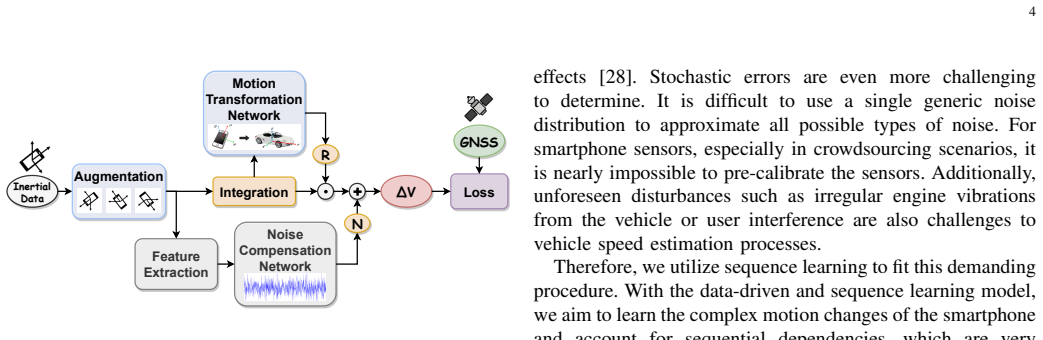
The split architecture is the load-bearing mechanism: a noise compensation network (a GRU with embedding and regression layers) fits the aggregate disturbance term $N$ in the forward-velocity propagation equation, and a motion transformation network (a dilated causal TCN) outputs the three Euler angles that rotate phone-frame acceleration into the vehicle frame. A random-rotation data augmentation rotates each input window by a randomly generated rotation matrix to mimic different phone poses, and a min-alignment SmoothL1 loss compares the model output with either the time-aligned GNSS target or the target shifted by one second, whichever gives the smaller error. This separation lets each network learn a simpler function, and the min-loss absorbs GNSS latency without explicit time-delay calibration.
What would settle it
Collect a test drive through a tunnel or urban canyon while recording an independent wheel-speed or OBD-II reference, run DVSE on the same phone IMU, and compare. If DVSE's velocity MAE over 60 seconds is close to its reported 2.35 m/s, the claim stands; if error grows markedly relative to a GNSS comparison on the same drive, the assumption that GNSS supervision is adequate is violated.
Extended reading notes
Core claim
DVSE's central claim is that explicitly decomposing the inertial speed integration of Eq. (5) into a learned noise term $N$ and a learned phone-to-vehicle rotation $R_v^p$ makes supervised speed estimation both more accurate and more generalizable than learning the whole pipeline end-to-end. A GRU-based noise compensation network estimates the disturbance term from one-second feature summaries of accelerometer and gyroscope data plus a reference velocity, while a TCN-based motion transformation network estimates Euler angles from pre-integrated acceleration and gravity. Random rotation of input windows simulates arbitrary phone placements, and a loss that takes the minimum between aligned and one-second-shifted target comparisons absorbs GNSS timestamp delay. The paper reports that this combination achieves its best results without initialization parameters, and ablation experiments show each module contributes, with data augmentation giving the largest single accuracy gain.
Load-bearing premise
The load-bearing premise is that GNSS-reported speed is accurate enough to serve as both the training target and the evaluation ground truth, despite the paper's motivating scenarios being exactly those where GNSS is degraded or blocked.
Editorial extensions
If this is right
- DVSE can be applied with no initialization or per-driver setup, unlike PCA-based or magnetometer-based baselines.
- Models trained with trajectory-level splits degrade less on unseen phones and poses: DVSE's 60-second velocity MAE rose to 2.26 m/s versus DeepTrack's 4.15 m/s.
- Each module is removable, and ablation shows removing data augmentation hurts most, establishing pose variation as a key generalization bottleneck.
- The loss-matching mechanism tolerates GNSS delays up to about one second, reducing the need for precise timestamp filtering in training data.
- The chosen GRU noise network runs on commodity smartphones with modest memory and inference time, supporting on-device use.
Reading between the lines
- The paper leaves implicit that the same split of pose estimation and noise compensation could transfer to other vehicle-mounted inertial tasks, such as lateral speed or attitude estimation, since Eq. (5) is specific to forward speed.
- An untested but natural extension is to evaluate on GNSS-denied segments such as tunnels and parking garages against wheel-speed or OBD ground truth; the reported GNSS-supervised MAE may understate true error where GNSS itself is inaccurate.
- Because data augmentation gave the largest gain, this suggests that pose diversity, not hardware diversity, is the dominant generalization bottleneck in this crowdsourced regime; whether the same holds for a wider device distribution remains open.
Signed reviews
Editorial analysis
A structured set of objections, weighed in public.
Referee Report
Summary. The paper proposes DVSE, a deep-learning framework for estimating vehicle speed from smartphone IMU data using GNSS-derived speed as supervision. The framework decomposes the task into a GRU-based noise compensation network and a TCN-based motion transformation network, adds random-rotation data augmentation to simulate arbitrary phone poses, and uses a min-of-two loss-matching scheme to tolerate timestamp misalignment between IMU and GNSS. The method is evaluated on a private 200-hour crowdsourced dataset under trajectory-split and traditional-split protocols, compared against AI-IMU, VeTorch, DeepVIP, and DeepTrack, and ablated module by module. The authors report that DVSE achieves the best accuracy without initialization, with a 60-second velocity MAE of 2.35 m/s versus 2.51 m/s for DeepTrack, and also report deployment results on Android phones via ONNX Runtime.
Significance. If the reported results are reliable, the paper makes a useful engineering contribution: the modular separation of pose estimation and noise compensation is well motivated by the motion model in Eqs. (1)-(5), the ablation in Table III shows that every component contributes, and the deployment measurements in Table II and Fig. 9 demonstrate a practical efficiency advantage. The random-rotation augmentation and the sliding loss-matching idea are simple and potentially transferable to other IMU-learning tasks. However, the central claims rest on a private dataset, single-run evaluations without error bars or significance tests, and GNSS-derived speed as both training target and evaluation ground truth. The margins over the strongest baseline are small, and some reported numbers are internally inconsistent. These issues must be resolved before the accuracy and generalization claims can be accepted.
major comments (5)
- [Sec. III-A, Sec. VII-C] The entire supervision and evaluation use GNSS-derived speed as ground truth, but the paper motivates GNSS-degraded environments (tunnels, urban canyons, underground parking) and never quantifies the GNSS error in the 200-hour crowdsourced dataset. No filtering by GNSS quality indicators (e.g., number of satellites, dilution of precision, C/N0) is reported, and no independent reference such as OBD-II/CAN, RTK, or wheel-speed data is used. As a result, the reported MAEs may reflect fidelity to GNSS artifacts (delays, multipath, interpolation) rather than true vehicle speed, especially since the 60-second advantage over DeepTrack is only 0.16 m/s and the 80th-percentile velocity errors are essentially tied (3.62 vs. 3.63 m/s). Please add a validation subset with independent ground truth, or at minimum report GNSS error statistics and quality-filtered results, and show that the main conclusions are stable under plausible GNSS noise.
- [Table I, Table III, Fig. 8] No error bars, confidence intervals, or significance tests are reported for any comparison. The central claim of 'highest accuracy' rests on a 0.16 m/s margin in 60-second velocity MAE, which is smaller than typical seed-to-seed variation for deep inertial models, and the 80th-percentile errors are practically identical. Please report means and variances over multiple training runs (at least five seeds) and perform paired significance tests for the comparisons in Table I, Table III, and Fig. 8. Without this, the claimed superiority over DeepTrack is not statistically established.
- [Sec. VII-D2, Table I] The baseline evaluation protocol is not controlled enough to support the accuracy comparison. AI-IMU results are reported after 'removing the segments that converge during evaluation,' but the number and nature of removed segments are not given, which creates a risk of cherry-picking. VeTorch and DeepTrack are initialized using the first 100 seconds of each test trajectory and use GNSS to identify stationary and forward segments, so Table I does not isolate the claimed advantage 'without the need for initialization parameters'; that advantage is instead supported by Fig. 8, whose numbers do not match Table I. Please specify the exact protocol for every baseline, report how many segments are removed and why, and provide a no-initialization variant for each baseline.
- [Sec. VII-D2, Fig. 8, Table I] The reported results are internally inconsistent. Fig. 8 reports 60-second trajectory-split DVSE errors of 2.26 m/s (velocity) and 49.75 m (distance) and DeepTrack errors of 4.15 m/s and 93.44 m, while Table I reports 60-second values of 2.35/50.84 for DVSE and 2.51/58.56 for DeepTrack under what appears to be the same trajectory-split setting. If the settings differ (e.g., with vs. without initialization, different random splits, or different input configurations), the difference must be stated explicitly; otherwise the reader cannot determine which numbers support the paper's central claim.
- [Sec. IV-C, Sec. VI-B] The reference velocity input Vr creates a train/inference mismatch that is not analyzed. During training Vr is the first-frame GNSS velocity, while during inference it is the model's own previous estimate, so estimation errors can compound over the 30-60 second evaluation horizons. No experiment varies the quality of Vr or measures recursive error growth. Please add an analysis (e.g., oracle Vr versus estimated Vr, and error trajectories over longer horizons) to show that the reported accuracy does not depend on this teacher-forcing shortcut.
minor comments (6)
- [Throughout] There are numerous typographical and grammatical errors that should be corrected in a copyedit: 'introduct', 'drving', 'tenporal', 'varients', 'conducte', 'incorrecttion', 'donate', 'mehthod', and 'Receptive F ield' in Eq. (7).
- [Sec. VI-A, Eq. (13)] The loss weight lambda is set to 0.7 without any sensitivity analysis; please report how the results vary with lambda in a small range around this value.
- [Sec. V-C] The data augmentation description is underspecified: the sentence 'it is important to use the same rotation matrix for each batch of data' is ambiguous, and the distribution/range of the random three-axis Euler angles (alpha_r, beta_r, gamma_r) is never given, even though it is a free hyperparameter of the method.
- [Sec. VII-D2] The phrase 'we remove the segments that converge during evaluation' for AI-IMU is confusing; if the intended meaning is 'segments that do not converge', it should be stated that way, along with the fraction of data removed.
- [Sec. VII-B2] The hardware is described as 'GeForce GTX 2080 Ti'; if the GPU is an RTX 2080 Ti, the name should be corrected. Also, reference [34] is cited for cosine annealing, but the cited paper is about decoupled weight decay; this reference should be replaced or corrected.
- [Table II] The column header 'RAMMAE' appears to be a formatting error; the RAM column should be separated from the MAE columns, and RAM units should be stated consistently (the text mentions KB and the table appears to list KB).
Circularity Check
No circular derivation; DVSE's predictions are learned on held-out IMU data, and self-cited baselines are empirical comparisons, not load-bearing premises.
full rationale
The paper's derivation chain is a standard supervised learning pipeline: Eq. (3)-(5) decompose velocity change into an integration term and a noise term N, a GRU network is trained to fit N from IMU features and a reference velocity, and a motion-transformation network estimates the phone-to-vehicle pose; the whole model is trained end-to-end against GNSS-derived velocity changes. Training and evaluation use disjoint trajectory splits (Sec. VII-B1), so the reported errors are not fits of the test targets. The teacher-forcing reference velocity Vr uses GNSS only at the first frame of a training window and switches to the model's own estimate during inference (Sec. IV-C), so the predicted velocity is not copied from the input by construction. The min-alignment loss of Eq. (14) selects between two temporal alignments to the GNSS target; it does not define the target as the model output. References [4] and [6] are prior works by the same group and are used as baselines and as motivation for the split design; they do not supply an unverified uniqueness or ansatz premise on which the derivation rests, and the comparison in Table I is empirical rather than definitional. The main concerns--GNSS error not quantified, possible unfairness in baseline initialization, and the use of GNSS as both supervision and evaluation ground truth--are correctness/validity issues, not circularity. Thus no circular step is identified; the minor self-citation of prior group work is not load-bearing.
Assumptions & free parameters
free parameters (3)
- lambda (loss weight) =
0.7
- Random rotation augmentation range =
not specified
- Input window length =
10 seconds
assumptions (6)
- domain assumption GNSS-derived speed is accurate enough to act as training target and evaluation ground truth.
- domain assumption The smartphone is relatively fixed to the vehicle during each estimation window.
- domain assumption The GNSS-IMU timestamp mismatch is at most one second.
- ad hoc to paper Randomly rotating IMU windows simulates valid smartphone poses without corrupting vehicle motion semantics.
- ad hoc to paper The learned residual N represents sensor noise rather than absorbing arbitrary modeling error.
- domain assumption One-second pre-integration of acceleration retains enough information for pose estimation.
Cite this review
Pith. "Pith review of An Inertial Sequence Learning Framework for Vehicle Speed Estimation via Smartphone IMU." pith.science (2026). https://pith.science/paper/WWXZTYQW
@misc{pith2026250518490,
  author       = {Pith},
  title        = {Pith review of: An Inertial Sequence Learning Framework for Vehicle Speed Estimation via Smartphone IMU},
  year         = {2026},
  howpublished = {\url{https://pith.science/paper/WWXZTYQW}},
  note         = {Machine review of arXiv:2505.18490}
}
read the original abstract
Accurately estimating vehicle velocity via smartphone is critical for mobile navigation and transportation. This paper introduces a cutting-edge framework for velocity estimation that incorporates temporal learning models, utilizing Inertial Measurement Unit (IMU) data and is supervised by Global Navigation Satellite System (GNSS) information. The framework employs a noise compensation network to fit the noise distribution between sensor measurements and actual motion, and a pose estimation network to align the coordinate systems of the phone and the vehicle. To enhance the model's generalizability, a data augmentation technique that mimics various phone placements within the car is proposed. Moreover, a new loss function is designed to mitigate timestamp mismatches between GNSS and IMU signals, effectively aligning the signals and improving the velocity estimation accuracy. Finally, we implement a highly efficient prototype and conduct extensive experiments on a real-world crowdsourcing dataset, resulting in superior accuracy and efficiency.
Figures


Figures from the paper (5 more)


Reference graph
Works this paper leans on
-
[1]
A comprehensive review of gnss/ins integration techniques for land and air vehicle applications,
N. Boguspayev, D. Akhmedov, A. Raskaliyev, A. Kim, and A. Sukhenko, “A comprehensive review of gnss/ins integration techniques for land and air vehicle applications,” Applied Sciences, vol. 13, no. 8, p. 4819, 2023
work page 2023
-
[2]
K. Liu, F. Jin, J. Hu, R. Xie, F. Gu, S. Guo, and J. Luo, “Towards robust wifi fingerprint-based vehicle tracking in dynamic indoor parking environments: An online learning framework,” IEEE Transactions on Mobile Computing, vol. 22, no. 12, pp. 6970–6984, 2023
work page 2023
-
[3]
M. Brossard, A. Barrau, and S. Bonnabel, “Ai-imu dead-reckoning,” IEEE Transactions on Intelligent Vehicles , vol. 5, no. 4, pp. 585–595, 2020
work page 2020
-
[4]
Glow in the dark: Smartphone inertial odometry for vehicle tracking in gps blocked environments,
R. Gao, X. Xiao, S. Zhu, W. Xing, C. Li, L. Liu, L. Ma, and H. Chai, “Glow in the dark: Smartphone inertial odometry for vehicle tracking in gps blocked environments,” IEEE Internet of Things Journal , vol. 8, no. 16, pp. 12 955–12 967, 2021
work page 2021
-
[5]
Deepvip: Deep learning-based vehicle indoor positioning using smartphones,
B. Zhou, Z. Gu, F. Gu, P. Wu, C. Yang, X. Liu, L. Li, Y . Li, and Q. Li, “Deepvip: Deep learning-based vehicle indoor positioning using smartphones,” IEEE Transactions on Vehicular Technology , vol. 71, no. 12, pp. 13 299–13 309, 2022
work page 2022
-
[6]
Vehicle inertial tracking via mobile crowdsensing: Experience and enhancement,
Y . Tong, S. Zhu, X. Ren, Q. Zhong, D. Tao, C. Li, L. Liu, and R. Gao, “Vehicle inertial tracking via mobile crowdsensing: Experience and enhancement,” IEEE Transactions on Instrumentation and Measurement, vol. 71, pp. 1–13, 2022
work page 2022
-
[7]
High-integrity imm-ekf-based road vehicle navigation with low-cost gps/sbas/ins,
R. Toledo-Moreo, M. A. Zamora-Izquierdo, B. Ubeda-Minarro, and A. F. Gomez-Skarmeta, “High-integrity imm-ekf-based road vehicle navigation with low-cost gps/sbas/ins,” IEEE Transactions on Intelligent Transportation Systems, vol. 8, no. 3, pp. 491–511, 2007
work page 2007
-
[8]
X. Ding, Z. Wang, L. Zhang, and C. Wang, “Longitudinal vehicle speed estimation for four-wheel-independently-actuated electric vehicles based on multi-sensor fusion,” IEEE Transactions on Vehicular Technology , vol. 69, no. 11, pp. 12 797–12 806, 2020
work page 2020
Show all 36 references
-
[9]
Sensing vehicle dynamics for determining driver phone use,
Y . Wang, J. Yang, H. Liu, Y . Chen, M. Gruteser, and R. P. Martin, “Sensing vehicle dynamics for determining driver phone use,” in Pro- ceeding of the 11th annual international conference on Mobile systems, applications, and services , 2013, pp. 41–54
2013
-
[10]
Estimating speed using a side- looking single-radar vehicle detector,
S.-L. Jeng, W.-H. Chieng, and H.-P. Lu, “Estimating speed using a side- looking single-radar vehicle detector,” IEEE Transactions on Intelligent Transportation Systems, vol. 15, no. 2, pp. 607–614, 2014
2014
-
[11]
Some practical vehicle speed estimation methods by a single traffic magnetic sensor,
H. Li, H. Dong, L. Jia, D. Xu, and Y . Qin, “Some practical vehicle speed estimation methods by a single traffic magnetic sensor,” in 2011 14th International IEEE Conference on Intelligent Transportation Systems (ITSC). IEEE, 2011, pp. 1566–1573
2011
-
[12]
Mag- monitor: Vehicle speed estimation and vehicle classification through a magnetic sensor,
Y . Feng, G. Mao, B. Chen, C. Li, Y . Hui, Z. Xu, and J. Chen, “Mag- monitor: Vehicle speed estimation and vehicle classification through a magnetic sensor,” IEEE Transactions on Intelligent Transportation Systems, vol. 23, no. 2, pp. 1311–1322, 2022
2022
-
[13]
Tightly coupled integration of gnss/uwb/vio for reliable and seamless positioning,
T. Liu, B. Li, G. Chen, L. Yang, J. Qiao, and W. Chen, “Tightly coupled integration of gnss/uwb/vio for reliable and seamless positioning,” IEEE Transactions on Intelligent Transportation Systems , vol. 25, no. 2, pp. 2116–2128, 2024
2024
-
[14]
Vehicle positioning using wifi fingerprinting in urban environment,
C.-W. Ang, “Vehicle positioning using wifi fingerprinting in urban environment,” in 2018 IEEE 4th World Forum on Internet of Things (WF-IoT), 2018, pp. 652–657
2018
-
[15]
Doumiati, A
M. Doumiati, A. Charara, A. Victorino, and D. Lechner, Vehicle dynam- ics estimation using Kalman filtering: experimental validation . John Wiley & Sons, 2012
2012
-
[16]
Tightly-coupled fusion of vins and motion constraint for autonomous vehicle,
Z. Yu, L. Zhu, and G. Lu, “Tightly-coupled fusion of vins and motion constraint for autonomous vehicle,” IEEE Transactions on Vehicular Technology, vol. 71, no. 6, pp. 5799–5810, 2022
2022
-
[17]
Smartphone- based real time vehicle tracking in indoor parking structures,
R. Gao, M. Zhao, T. Ye, F. Ye, Y . Wang, and G. Luo, “Smartphone- based real time vehicle tracking in indoor parking structures,” IEEE Transactions on Mobile Computing, vol. 16, no. 7, pp. 2023–2036, 2017
2023
-
[18]
Ionet: Learning to cure the curse of drift in inertial odometry,
C. Chen, X. Lu, A. Markham, and N. Trigoni, “Ionet: Learning to cure the curse of drift in inertial odometry,” in Proceedings of the AAAI Conference on Artificial Intelligence , vol. 32, no. 1, 2018
2018
-
[19]
Ronin: Robust neural inertial navigation in the wild: Benchmark, evaluations, & new methods,
S. Herath, H. Yan, and Y . Furukawa, “Ronin: Robust neural inertial navigation in the wild: Benchmark, evaluations, & new methods,” in 2020 IEEE International Conference on Robotics and Automation (ICRA). IEEE, 2020, pp. 3146–3152
2020
-
[20]
A learning-based model predictive trajectory planning controller for automated driving in unstructured dynamic environments,
Z. Li, P. Zhao, C. Jiang, W. Huang, and H. Liang, “A learning-based model predictive trajectory planning controller for automated driving in unstructured dynamic environments,” IEEE Transactions on Vehicular Technology, 2022
2022
-
[21]
A review of recurrent neural networks: Lstm cells and network architectures,
Y . Yu, X. Si, C. Hu, and J. Zhang, “A review of recurrent neural networks: Lstm cells and network architectures,” Neural computation , vol. 31, no. 7, pp. 1235–1270, 2019
2019
-
[22]
Long short-term memory,
S. Hochreiter and J. Schmidhuber, “Long short-term memory,” Neural computation, vol. 9, no. 8, pp. 1735–1780, 1997
1997
-
[23]
Empirical evaluation of gated recurrent neural networks on sequence modeling,
J. Chung, C. Gulcehre, K. Cho, and Y . Bengio, “Empirical evaluation of gated recurrent neural networks on sequence modeling,” arXiv preprint arXiv:1412.3555, 2014
2014 arXiv
-
[24]
An empirical evaluation of generic convolutional and recurrent networks for sequence modeling,
S. Bai, J. Z. Kolter, and V . Koltun, “An empirical evaluation of generic convolutional and recurrent networks for sequence modeling,” arXiv preprint arXiv:1803.01271, 2018
2018 arXiv
-
[25]
Attention is all you need,
A. Vaswani, N. Shazeer, N. Parmar, J. Uszkoreit, L. Jones, A. N. Gomez, Ł. Kaiser, and I. Polosukhin, “Attention is all you need,” Advances in neural information processing systems , vol. 30, 2017. 11
2017
-
[26]
Informer: Beyond efficient transformer for long sequence time-series forecasting,
H. Zhou, S. Zhang, J. Peng, S. Zhang, J. Li, H. Xiong, and W. Zhang, “Informer: Beyond efficient transformer for long sequence time-series forecasting,” in Proceedings of the AAAI conference on artificial intel- ligence, vol. 35, no. 12, 2021, pp. 11 106–11 115
2021
-
[27]
Noise modeling and analysis of an imu- based attitude sensor: improvement of performance by filtering and sensor fusion,
K. Nirmal, A. Sreejith, J. Mathew, M. Sarpotdar, A. Suresh, A. Prakash, M. Safonova, and J. Murthy, “Noise modeling and analysis of an imu- based attitude sensor: improvement of performance by filtering and sensor fusion,” in Advances in optical and mechanical technologies for...
2016
-
[28]
Maximum likelihood identification of inertial sensor noise model parameters,
J. Nikolic, P. Furgale, A. Melzer, and R. Siegwart, “Maximum likelihood identification of inertial sensor noise model parameters,” IEEE Sensors Journal, vol. 16, no. 1, pp. 163–176, 2015
2015
-
[29]
Teacher forcing recovers reward func- tions for text generation,
Y . Hao, Y . Liu, and L. Mou, “Teacher forcing recovers reward func- tions for text generation,” Advances in Neural Information Processing Systems, vol. 35, pp. 12 594–12 607, 2022
2022
-
[30]
Spatial transformer networks,
M. Jaderberg, K. Simonyan, A. Zisserman et al. , “Spatial transformer networks,” Advances in neural information processing systems , vol. 28, 2015
2015
-
[31]
Vins-mono: A robust and versatile monocular visual-inertial state estimator,
T. Qin, P. Li, and S. Shen, “Vins-mono: A robust and versatile monocular visual-inertial state estimator,” IEEE Transactions on Robotics , vol. 34, no. 4, pp. 1004–1020, 2018
2018
-
[32]
A comprehensive survey of regres- sion based loss functions for time series forecasting,
A. Jadon, A. Patil, and S. Jadon, “A comprehensive survey of regres- sion based loss functions for time series forecasting,” arXiv preprint arXiv:2211.02989, 2022
2022 arXiv
-
[33]
Digging into self-supervised monocular depth estimation,
C. Godard, O. Mac Aodha, M. Firman, and G. J. Brostow, “Digging into self-supervised monocular depth estimation,” in Proceedings of the IEEE/CVF international conference on computer vision, 2019, pp. 3828– 3838
2019
-
[34]
Decoupled weight decay regularization,
I. Loshchilov and F. Hutter, “Decoupled weight decay regularization,” arXiv preprint arXiv:1711.05101 , 2017
2017 arXiv
-
[35]
tf.train.exponentialmovingaverage
TensorFlow, “tf.train.exponentialmovingaverage.” [Online]. Available: https://www.tensorflow.org/api docs/python/tf/train/ ExponentialMovingAverage
-
[36]
Mixed precision training,
P. Micikevicius, S. Narang, J. Alben, G. Diamos, E. Elsen, D. Garcia, B. Ginsburg, M. Houston, O. Kuchaiev, G. Venkatesh et al. , “Mixed precision training,” arXiv preprint arXiv:1710.03740 , 2017
2017 arXiv
Reviewed August 7, 2026 · model on record in the stance chip above.
Discussion (0). Continue with ORCID to comment.