REVIEW 3 major objections 4 minor 43 references
Influence of Kerr Anisotropy in Parametric Amplification
T0 review · 3 major / 4 minor · reviewed 2026-08-07 · deepseek-v4-flash
Pith's one-line read One 1-mm MgO crystal both amplifies a femtosecond pulse 2000-fold and rotates its polarization to 88 degrees from the seed.
desk verdict Worth refereeing for the experimental result, but the model is partly tuned and needs an unexplained 14-degree offset; the rotation itself is likely real. read the letter →
The pith
A machine-rendered reading of the paper's core claim, the machinery that carries it, and where it could break.
The reading
What carries the argument
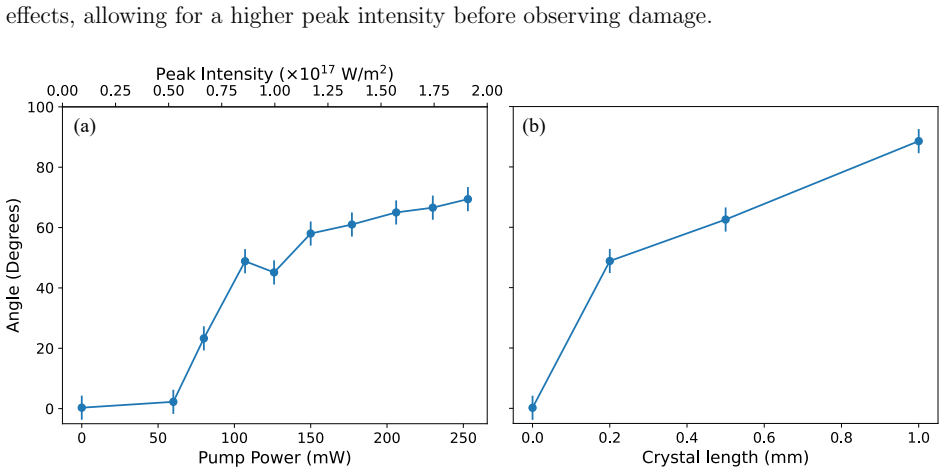
The machinery is the third-order susceptibility tensor of cubic MgO, whose non-zero components $\chi_{xxxx}$, $\chi_{xxyy}$, $\chi_{xyyx}$, $\chi_{xyxy}$ reduce, under the paper's frequency-independence and Kleinman symmetry assumptions, to two numbers: $\chi_{xxxx}$ and $\chi_{xxyy}$. The $\chi_{xxyy}$ term is what couples the two transverse polarizations, producing cross-phase modulation and energy exchange that rotate the amplified field; the ratio $\chi_{xxyy}/\chi_{xxxx}=0.54$ is fitted from the gain difference between the (100) and (110) orientations. Propagation is modeled with the Forward Maxwell Equation in one transverse dimension, and the intensity- and length-dependent rotation is organized by the parameter $\gamma=2\pi n_2 I_p L/\lambda_p$, with a threshold near $\gamma\sim\pi$ above which the polarization jumps from near zero to beyond 45 degrees and then saturates.
What would settle it
Measure the output polarization angle versus crystal length in MgO(100) at a fixed pump intensity; if the length at which the rotation jumps from near zero to beyond 45 degrees does not match the $\gamma\approx\pi$ condition computed with the fitted Kerr coefficients, the proposed mechanism is incomplete. A direct plasma diagnostics measurement showing significant free-electron density at 15 TW/cm2 would also falsify the assumption that plasma effects are negligible.
Extended reading notes
Core claim
The paper's central claim is that the same third-order Kerr nonlinearity that produces broadband parametric gain in MgO also rotates the polarization when the pump is aligned with the (100) crystal axis, and that this rotation is large enough to produce orthogonally polarized amplified pulses. Experimentally, with a vertically polarized pump and seed in MgO(100), the amplified spectrum around 595 nm is rotated by 60 degrees while amplified 20-fold at $7\,\mathrm{TW/cm^2}$; at higher intensity a 0.5 mm crystal gives 5500-fold amplification with a 65-degree rotation and a gain of $20.0\,\mathrm{mm^{-1}}$. In a 1 mm crystal at $7\,\mathrm{TW/cm^2}$ the rotation reaches $88\pm4$ degrees with 2000-fold amplification, i.e. nearly orthogonal to the seed. Rotating the crystal to the (110) axis removes the rotation but raises the gain to 45000-fold ($24.2\,\mathrm{mm^{-1}}$), which the authors attribute to the orientation dependence of the Kerr coefficient; fitting the two orientations gives $\chi_{xxyy}=0.54\chi_{xxxx}$ and $n_2(100)=3.0\times10^{-20}\,\mathrm{m^2/W}$. The same mechanism produces a measured polarization contrast improvement exceeding six orders of magnitude, and simulations with a Forward Maxwell Equation reproduce the qualitative behavior, including the pump- and length-dependent rotation.
Load-bearing premise
The central claim assumes that at 7 to 19 TW/cm2 the only important nonlinearity is the instantaneous third-order Kerr response, so that multiphoton absorption, higher-order susceptibilities, and plasma formation are too weak to change the polarization dynamics.
Editorial extensions
If this is right
- A single parametric amplification stage can now generate femtosecond pulses whose polarization is orthogonal to the seed, demonstrated at 2000x gain in 1 mm MgO(100).
- Pulse contrast in high-power laser systems can be improved by more than six orders of magnitude without a separate cross-polarized wave generation stage.
- The rotation angle is controllable through pump intensity and crystal length via the parameter $\gamma$, with a sharp threshold near $\gamma\sim\pi$, giving a practical design rule for polarization control.
- The amplified seed polarization acts as a probe of the pump pulse's own nonlinear polarization dynamics inside the crystal, opening an observable for studying extreme-intensity propagation.
- The measured gain difference between MgO(100) and MgO(110) fixes the Kerr anisotropy ratio $\chi_{xxyy}/\chi_{xxxx}=0.54$, an input that can refine models of high-harmonic generation and other strong-field processes in MgO.
Reading between the lines
- Inference: if the $\gamma\sim\pi$ threshold is a universal feature of cubic Kerr materials, then crystals with larger anisotropy (such as BaF2) should reach 90-degree rotation at lower intensities or shorter lengths; a comparative length-scaling experiment across cubic crystals would test this directly.
- Inference: the experimentally observed hypersensitivity of the output angle to pump polarization near 0 degrees suggests the system sits near a dynamical instability that the current one-transverse-dimension, frequency-independent model smooths away; a full three-dimensional vector simulation including pump depletion might reproduce the $\pm1$-degree-to-$\pm60$-degree amplification.
- Inference: because the seed follows the pump polarization, a time-gated measurement of the amplified seed's polarization could map the pump's own nonlinear rotation inside the crystal, effectively turning KIA into a self-probing diagnostic for extreme-intensity propagation.
- Inference: the paper's fitted anisotropy ratio assumes Kleinman symmetry and no plasma contribution; if subsequent measurements at 15–19 TW/cm2 show a pump-intensity-dependent $\chi_{xxyy}/\chi_{xxxx}$, that would indicate the onset of higher-order nonlinearities, and the contrast-enhancement scheme would need to be operated below that threshold.
Editorial analysis
A structured set of objections, weighed in public.
Referee Report
Summary. This manuscript reports experiments in which intense femtosecond pump pulses in MgO crystals amplify a supercontinuum seed while rotating its polarization. The authors measure 5500x and 45000x amplification in the (100) and (110) orientations, respectively, rotations up to 88 degrees, and more than six orders of magnitude contrast improvement. They propose a vector Kerr-instability model with an anisotropic third-order susceptibility, fit n2(100) and chi_xxyy/chi_xxxx, and simulate gain, polarization rotation, pump-polarization dependence, and pulse contrast. The paper also explores intensity and length scaling of the rotation and discusses applications to pulse contrast enhancement.
Significance. The experimental observations are novel and potentially useful: a single-stage combination of parametric amplification and cross-polarized wave generation, with a new polarization observable in the extreme-intensity regime. The contrast-enhancement claim is striking and, if fully supported, would be of practical interest for high-power laser systems. The authors are appropriately candid about the model's limitations, which is to their credit. However, the model support for the central mechanism is weakened by parameter fitting and by the need to introduce a 14-degree pump offset to reproduce the rotation; the independent experimental polarization measurements prevent a harsher verdict.
major comments (3)
- [Amplification and Polarization Rotation (p. 8)] The simulation cannot reproduce the observed 65-degree or 88-degree rotation with the nominal pump-seed configuration: the text states that 'the initial pump polarization must be rotated to 14 degrees in the MgO(100) case to rotate the polarization by 61 degrees, significantly more than we experimentally measured.' Since the experiment is performed with pump and seed nominally vertical (0 degrees, with approximately 4 degrees uncertainty), a model requiring a 14-degree offset is not a faithful representation of the configuration. This is load-bearing because the fitted chi_xxyy/chi_xxxx = 0.54 is inferred from gain and rotation data that the model can only match under a changed initial condition. Please either explain the physical origin of the offset, re-fit without this degree of freedom, or present the rotation as an experimentally observed phenomenon whose mechanism is not captured by the current model.
- [Amplification and Polarization Rotation (pp. 7-8)] The parameters n2(100) = 3.0e-20 m2/W and chi_xxyy = 0.54 chi_xxxx are chosen to match the measured (100) and (110) gains, and the quoted simulated amplification values of 6300x and 45000x are therefore consequences of the fit rather than independent predictions. The paper states that 'We find better agreement in our simulations with experiment when n2(100) = 3.0e-20 m2/W; using the above gain ratio leads to chi_xxyy = 0.54 chi_xxxx.' This circularity should be acknowledged explicitly, and the sensitivity of the conclusions to the fitted values should be quantified, ideally by reporting fit residuals and confidence intervals.
- [Power and Length Scaling (p. 11) and Amplification and Polarization Rotation (p. 8)] The model omits multiphoton absorption, higher-order nonlinear susceptibilities, and plasma effects at peak intensities of 7-19 TW/cm2, as the authors acknowledge in the statement that 'the gain at such high intensities will require a more complete physical understanding, including multiphoton absorption anisotropy, higher order nonlinear susceptibilities, and plasma effects.' These omissions matter because the inferred chi_xxyy/chi_xxxx ratio is extracted from gain and rotation data taken in exactly this intensity range. Please provide quantitative estimates, such as an upper bound on the plasma-induced refractive-index change via Eq. (9) with an estimated electron density, so that the reader can judge whether the neglected terms are small compared with the Kerr terms.
minor comments (4)
- [Abstract] The word 'occuring' should be 'occurring'.
- [Amplification and Polarization Rotation (p. 6)] The text states 'I_p = 7e16 m2/W'; the units appear to be inverted, as intensity should be expressed in W/m2 (or TW/cm2).
- [Theory (p. 4) and Amplification and Polarization Rotation (p. 8)] The manuscript gives two values for chi_xxyy/chi_xxxx: 0.482 from the literature n2 in the Theory section, and 0.54 from the fit later. The relationship between these values should be stated explicitly, since the simulations appear to use the fitted value.
- [Initial Polarization Dependence (p. 12)] The paper reports that a 1-degree change in pump polarization rotates the amplified polarization by 60 degrees in experiment but not in simulation; this is a major qualitative discrepancy that is acknowledged but should be highlighted in the Conclusions as an unresolved limitation of the model.
Circularity Check
Simulated gain agreement is calibrated to measured gains; the model's central rotation is not reproduced from the nominal 0° configuration without an ad hoc 14° offset.
-
fitted input called prediction
[Results, 'Amplification and Polarization Rotation' (Fig. 3 discussion)]
"We find better agreement in our simulations with experiment when n2(100) = 3.0×10⁻²⁰ m2/W; using the above gain ratio leads to χ(3)xxyy = 0.54χ(3)xxxx (i.e. n2(110) = 3.7×10⁻²⁰ m2/W). Using these values of the angle-dependent Kerr nonlinearity, we show good agreement with simulations in Fig. 3(b)."
The two simulation parameters are not independently fixed: n2(100) is chosen for 'better agreement' with the measured amplification, and the anisotropy ratio χxxyy/χxxxx is derived from the measured gain ratio g(110)/g(100) = 1.21. The simulations using these fitted values are then said to 'show good agreement' with the same measured gains (6300× for MgO(100), 45000× for MgO(110)). The gain agreement is therefore a calibration check, not an independent prediction. The rotation was not directly fitted, but reproducing even that required adding an unmeasured 14° pump-polarization offset rather than using the described 0° geometry, so the model's validation is substantially tied to inputs derived from the data it is used to 'confirm.'
full rationale
The central experimental observation—2000× amplification into the orthogonal polarization in 1 mm MgO(100), together with intensity- and length-dependent rotation—is a direct measurement and does not depend on the model, so the paper's headline claim is not circular. The circularity is confined to the simulation validation: the nonlinear coefficients used in the simulations are adjusted to, and derived from, the measured gain values, and the simulations are then presented as agreeing with those same measurements. The model's inability to generate the observed rotation from the stated pump/seed 0° geometry without an additional 14° input offset is a serious mechanism gap, but it is a correctness risk rather than a circular step. No load-bearing self-citation or imported uniqueness theorem was found; citations to prior KIA work provide the propagation framework rather than the fitted result. Overall, the derivation chain is partially circular for the gain comparison, but the independent experimental rotation measurement keeps the paper from being wholly circular.
Assumptions & free parameters
free parameters (3)
- n2(100), Kerr coefficient for MgO(100) =
3.0e-20 m2/W
- chi_xxyy / chi_xxxx susceptibility anisotropy ratio =
0.54
- Initial pump polarization offset in simulation =
14 degrees
assumptions (5)
- standard math The third-order susceptibility of MgO (space group m3m) has only the tensor components chi_xxyy, chi_xyyx, chi_xyxy, and chi_xxxx.
- domain assumption Frequency independence and Kleinman symmetry: chi_xyyx = chi_xyxy = chi_xxyy.
- domain assumption The interaction is confined to the xy plane because the relative pump-seed angle is about 3 degrees inside the sample.
- domain assumption Forward Maxwell's Equation with one transverse dimension is adequate for pulse propagation.
- domain assumption Plasma and higher-order nonlinearities are not dominant in the 7 to 19 TW/cm2 regime.
Cite this review
Pith. "Pith review of Influence of Kerr Anisotropy in Parametric Amplification." pith.science (2026). https://pith.science/paper/WXUTSWLY
@misc{pith2026250606871,
  author       = {Pith},
  title        = {Pith review of: Influence of Kerr Anisotropy in Parametric Amplification},
  year         = {2026},
  howpublished = {\url{https://pith.science/paper/WXUTSWLY}},
  note         = {Machine review of arXiv:2506.06871}
}
abstract
Four-wave parametric amplification can be extended to the TW/cm$^2$ regime using femtosecond pump pulses to amplify nearly octave spanning pulses with gain $> 20$~mm$^{-1}$, which we call Kerr instability amplification. Cross-polarized wave generation exploits Kerr anisotropy to induce a transient intensity-dependent polarization evolution. In this work, we combine Kerr instability amplification with cross-polarized wave generation to simultaneously amplify and rotate the output polarization of a signal beam, and we explore laser and crystal parameters to control the resulting polarization. In 1~mm MgO(100), we amplify linearly polarized light by $2000\times$ orthogonal to the pump and seed polarization. The parametric amplification and polarization rotation offers excellent pulse contrast enhancement for future high-power laser systems. Furthermore, the polarization provides an additional observable to study the nonlinear dynamics occuring in this extreme ultrafast light-matter interaction.
Figures


Figures from the paper (3 more)


Reference graph
Works this paper leans on
- [1]
-
[2]
R. Stephens and I. Malitson, Index of refraction of magnesium oxide, J. Res. Natl. Bur. Stand. 49, 249 (1952)
work page 1952
-
[3]
N. B. Manson, W. V. der Ohe, and S. L. Chodos, Second-order raman spectrum of mgo, Phys. Rev. B3, 1968 (1971)
work page 1971
-
[4]
A. Korobenko, T. J. Hammond, C. Zhang, A. Y. Naumov, D. M. Villeneuve, and P. B. Corkum, High-harmonic generation in solids driven by counter-propagating pulses, Opt. Express46, 32630 (2019)
work page 2019
-
[5]
Y. S. You, D. A. Reis, and S. Ghimire, Anisotropic high-harmonic generation in bulk crystals, Nat. Phys.13, 345 (2017)
work page 2017
-
[6]
T. Heinrich, M. Taucer, O. Kfir, P. B. Corkum, A. Staudte, C. Ropers, and M. Sivis, Chiral high-harmonic generation and spectroscopy on solid surfaces using polarization-tailored strong fields, Nat. Commun.12, 3723 (2021)
work page 2021
- [7]
-
[8]
M. Hussain, F. Lima, W. Boutu, H. Merdji, M. Fajardo, and G. O. Williams, Demonstration of nonperturbative and perturbative third-harmonic generation in mgo by altering the electronic structure, Phys. Rev. A105, 053103 (2022)
work page 2022
Show all 43 references
-
[9]
Ghosh, N
S. Ghosh, N. G. Drouillard, and T. J. Hammond, Supercontinuum amplification by kerr in- stability, Phys. Rev. A109, 043508 (2024)
2024
-
[10]
N. G. Drouillard and T. J. Hammond, Novel and simple method for broadband stimulated raman spectroscopy (2025), submitted
2025
-
[11]
Wabnitz, Modulational polarization instability of light in a nonlinear birefringent dispersive medium, Phys
S. Wabnitz, Modulational polarization instability of light in a nonlinear birefringent dispersive medium, Phys. Rev. A38, 2018 (1988)
1988
-
[12]
Millot and S
G. Millot and S. Wabnitz, Nonlinear polarization effects in optical fibers: polarization attrac- tion and modulation instability [invited], J. Opt. Soc. Am. B31, 2754 (2014)
2014
-
[13]
J. F. L. Freitas, C. J. S. de Matos, M. B. C. e Silva, and A. S. L. Gomes, Impact of phase modulation and parametric gain on signal polarization in an anomalously dispersive optical fiber, J. Opt. Soc. Am. B24, 1469 (2007)
2007
-
[14]
Lin and P
Q. Lin and P. Agrawal, Vector theory of four-wave mixing: polarization effects in fiber-optic parametric amplifiers, J. Opt. Soc. Am. B21, 1216 (2004)
2004
-
[15]
Guasoni and S
M. Guasoni and S. Wabnitz, Nonlinear polarizers based on four-wave mixing in high- birefringence optical fibers, J. Opt. Soc. Am. B29, 1511 (2012)
2012
-
[16]
Minkovski, S
N. Minkovski, S. Saltiel, G. Petrov, O. Albert, and J. Etchepare, Polarization rotation induced by cascaded third-order processes, Opt. Lett.27, 2025 (2002)
2002
-
[17]
Minkovski, G
N. Minkovski, G. Petrov, S. Saltiel, O. Albert, and J. Etchepare, Nonlinear polarization ro- tation and orthogonal polarization generation experienced in a single-beam configuration, J. Opt. Soc. Am. B21, 1659 (2004)
2004
-
[18]
Jullien, O
A. Jullien, O. Albert, G. Ch´ eriaux, J. Etchepare, S. Kourtev, N. Minkovski, and S. M. Saltiel, Nonlinear polarization rotation of elliptical light in cubic crystals, with application to cross- polarized wave generation, J. Opt. Soc. Am. B22, 2635 (2005)
2005
-
[19]
Jullien, O
A. Jullien, O. Albert, F. Burgy, G. Hamoniaux, J.-P. Rousseau, J.-P. Chambaret, F. Aug´ e- Rochereau, G. Ch´ eriaux, and J. Etchepare, 10-10 temporal contrast for femtosecond ultrain- tense lasers by cross-polarized wave generation, Opt. Lett.30, 920 (2005)
2005
-
[20]
Jullien, L
A. Jullien, L. Canova, O. Albert, D. Boschetto, L. Antonucci, Y.-H. Cha, J. P. Rousseau, P. Chaudet, G. Ch´ eeriaux, J. Etchepare, S. Kourtev, N. Minkovski, and S. M. Saltiel, Spectral 15 broadening and pulse duration reduction during cross-polarized wave generation: influence...
2007
-
[21]
B. Zhao, X. Zhang, C. Lv, Q. Liu, J. Zhang, M. Ma, and G. Yang, Improved cross polarized wave generation with an aperture, AIP Advances12, 055128 (2022)
2022
-
[22]
L. P. Ramirez, D. Papadopoulos, M. Hanna, A. Pellegrina, F. Friebel, P. Georges, and F. Druon, Compact, simple, and robust cross polarized wave generation source of few-cycle, high-contrast pulses for seeding petawatt-class laser systems, J. Opt. Soc. Am. B , 2607 (2013)
2013
-
[23]
Buberl, A
T. Buberl, A. Alismail, H. Wang, N. Karpowicz, and H. Fattahi, Self-compressed, spectral broadening of a yb:yag thin-disk amplifier, Opt. Express24, 10286 (2016)
2016
-
[24]
Allegre, J
H. Allegre, J. J. Broughton, T. Klee, Y. Li, K. M. Kowalczyk, N. Thatte, D. Lim, J. P. Marangos, M. M. Matthews, and J. W. G. Tisch, Extension of high-harmonic generation cutoff in solids to 50 ev using mgo, Opt. Lett.50, 1492 (2025)
2025
-
[25]
Kourtev, N
S. Kourtev, N. Minkovski, L. Canova, A. Jullien, O. Albert, and S. M. Saltiel, Improved nonlinear cross-polarized wave generation in cubic crystals by optimization of the crystal orientation, J. Opt. Soc. Am. B26, 1269 (2009)
2009
-
[26]
P. N. Butcher and D. Cotter,The elements of nonlinear optics(Cambridge University Press, 1990)
1990
-
[27]
Agrawal,Nonlinear Fiber Optics, 5th ed
G. Agrawal,Nonlinear Fiber Optics, 5th ed. (Academic Press, 2013)
2013
-
[28]
Jullien,G´ en´ eration d’impulsions laser ultra-br` eves et ultra-intenses ` a contraste temporel ´ elev´ e, Ph.D
A. Jullien,G´ en´ eration d’impulsions laser ultra-br` eves et ultra-intenses ` a contraste temporel ´ elev´ e, Ph.D. thesis, Ecole Polytechnique (2006)
2006
-
[29]
D. C. Hutchings, J. S. Aitchison, and J. M. Arnold, Nonlinear refractive coupling and vector solitons in anisotropic cubic media, J. Opt. Soc. Am. B14, 869 (1997)
1997
-
[30]
Husakou and J
A. Husakou and J. Herrmann, Supercontinuum generation of higher-order solitons by fission in photonic crystal fibers, Phys. Rev. Lett.87, 203901 (2001)
2001
-
[31]
Ghosh, N
S. Ghosh, N. G. Drouillard, and T. J. Hammond, Single-stage few-cycle pulse amplification, Phys. Rev. A109, 013511 (2024)
2024
-
[32]
N. G. Drouillard and T. J. Hammond, Phase dependence of kerr-based parametric amplifica- tion, Phys. Rev. A110, 023517 (2024)
2024
-
[33]
Nesrallah, G
M. Nesrallah, G. Vampa, G. Bart, P. B. Corkum, C. R. McDonald, and T. Brabec, Theory of kerr instability amplification, Optica5, 271 (2018). 16
2018
-
[34]
P. V. et al, SciPy 1.0: Fundamental Algorithms for Scientific Computing in Python, Nature Methods17, 261 (2020)
2020
-
[35]
Manozi and G
C. Manozi and G. Cerullo, Design criteria for ultrafast optical parametric amplifiers, J. Opt. 18, 103501 (2016)
2016
-
[36]
N. G. Drouillard, J. Saad, and T. J. Hammond, Kerr coefficient measurements at extreme intensities (in preparation)
-
[37]
Jullien, S
A. Jullien, S. Kourtev, O. Albert, G. Ch´ eriaux, J. Etchepare, N. Minkovski, and S. M. Saltiel, Highly efficient temporal cleaner for femtosecond pulses based on cross polarized wave gener- ation in a dual crystal scheme, Appl. Phys. B84, 409–414 (2006)
2006
-
[38]
Ricci, A
A. Ricci, A. Jullien, J.-P. Rousseau, A. Houard, P. Ramirez, D. Papadopoulos, A. Pelligrina, P. Georges, F. Druon, N. Forget, and R. Lopez-Martens, Energy-scalable temporal clean- ing device for femtosecond laser pulses based on cross-polarized wave generation, Rev. Sci. Instr...
2013
-
[39]
Fattahi, H
H. Fattahi, H. Wang, A. Alismail, G. Arisholm, V. Pervak, A. M. Azzeer, and F. Krausz, Near-phz-bandwidth, phase-stable continua generated from a yb:yag thin-disk amplifier, Opt. Express24, 24337 (2016)
2016
-
[40]
Jullien, O
A. Jullien, O. Albert, G. Ch´ eriaux, J. Etchepare, S. Kourtev, N. Minkovski, and S. M. Saltiel, Two crystal arrangement to fight efficiency saturation in cross-polarized wave generation, Opt. Express14, 2760 (2006)
2006
-
[41]
Canova, S
L. Canova, S. Kourtev, N. Minkovski, A. Jullien, R. Lopez-Martens, O. Albert, and S. M. Saltiel, Efficient generation of cross-polarized femtosecond pulses in cubic crystals with holo- graphic cut orientation, Appl. Phys. Lett.92, 231102 (2008)
2008
-
[42]
C. R. McDonald, G. Vampa, P. B. Corkum, and T. Brabec, Intense-laser solid state physics: Unraveling the difference between semiconductors and dielectrics, Phys. Rev. Lett.118, 173601 (2017)
2017
-
[43]
R. W. Boyd,Nonlinear Optics; 3rd edition(Elsevier Academic Press, 2008). 17
2008
Reviewed August 7, 2026 · model on record in the stance chip above.
Discussion (0). Continue with ORCID to comment.