REVIEW 4 major objections 6 minor 2 references
Walking Through Twitter: Sampling a Language-Based Follow Network of Influential Twitter Accounts
T0 review · 4 major / 6 minor · reviewed 2026-08-14 · deepseek-v4-flash
Pith's one-line read A modified rank degree method, run with the free Twitter standard API, can sample the German Twittersphere's follow network so that it approximates the top 1 to 10 percent of influential accounts.
desk verdict A pragmatic sampling hack with real code and data, but the validation doesn't yet separate the walk from simply grabbing high-follower accounts. read the letter →
The pith
A machine-rendered reading of the paper's core claim, the machinery that carries it, and where it could break.
The reading
What carries the argument
The central object is the rank degree method, a deterministic walk-based graph sampling algorithm. In its original form, a walker repeatedly moves from the current node to the connected node with the highest degree, removes the traversed edge from the graph, and keeps the new node; multiple walkers collapse when they meet. The paper's adaptation makes this scheme work on directed, API-restricted Twitter networks: friends are ranked by follower count instead of total degree, only the last 5,000 friends of an account are fetched in a single API call, edges are burned per directed direction, and walker collapse is dropped in favor of parallel walkers that jump to fresh random seeds when no unburned edge remains. This mechanism is what converts a few local API lookups per account into a sample that, the paper argues, preserves the influential core of the network.
What would settle it
Run the adapted sampler on a network whose true influential users are known, such as a complete national follow network collected before the API closed, and check whether the sampled top accounts have higher overlap with the actual top 10 percent by in-degree, PageRank, or reach than a random sample of the same size. If overlap is no better than random, the method's central claim collapses. A partial and cheaper check is to redraw the coverage test against a fresh random sample of current German-using accounts rather than the 2016 benchmark.
Extended reading notes
Core claim
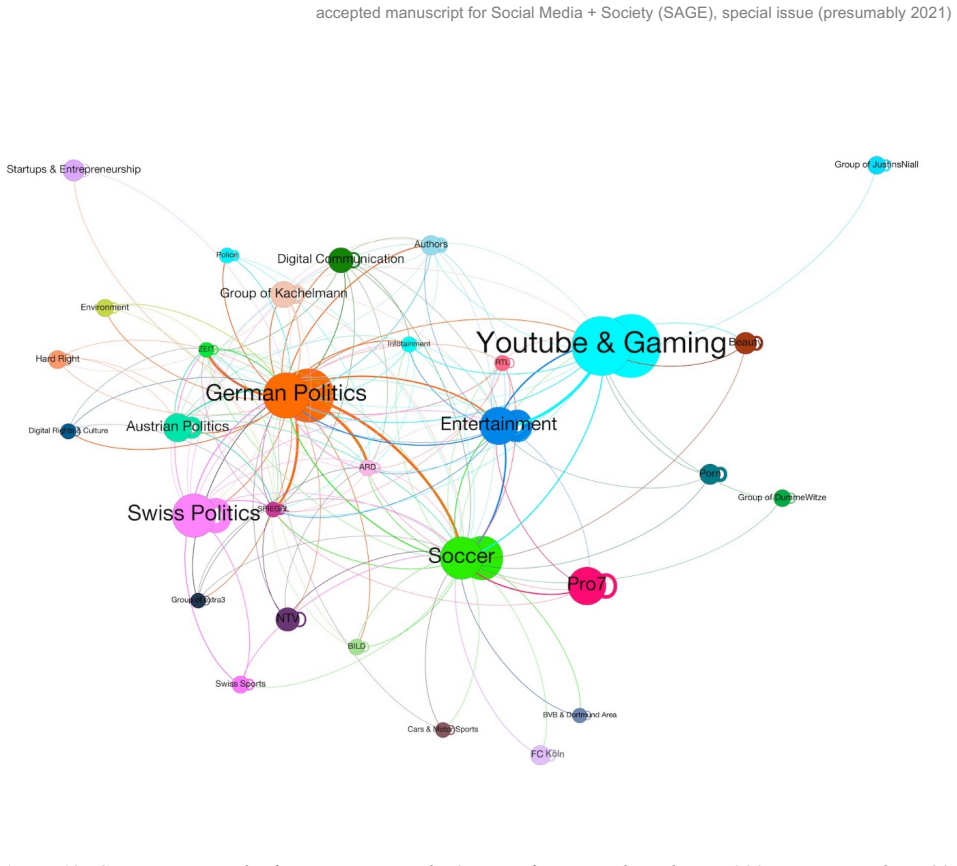
The central claim is that a practical adaptation of the rank degree method can approximate the most central and influential accounts of a language-based follow network using only cost-free Twitter standard APIs. In the adapted procedure, each walker starts from a random German-interface account, looks up its most recent 5,000 friends, chooses the friend with the highest follower count whose interface language is German and whose edge is not yet burned, and repeats from that friend; when stuck, the walker jumps to a new random seed. Because the walk always moves to a high-follower account and burns traversed edges, the sample accumulates a set of accounts that are followed by many others, i.e., the influential core. The paper reports that the resulting influencer sample of about 199,000 accounts (those with at least one incoming sampled edge) has tweet activity and follower counts orders of magnitude higher than a random baseline, covers about 40 percent of the friends of an average German-using account, and reaches 85 percent of a random test sample with more than one friend. From this, the authors conclude that the sample approximates the proverbial top 1 to 10 percent of influential accounts in the German Twittersphere, and they demonstrate that community detection on the sample's 3-core reveals distinct topical communities such as German politics, football, Austrian politics, and YouTubers.
Load-bearing premise
The load-bearing premise is that the adapted walk—using directed edges, follower-count ranking, 5,000-friend truncation, 200 non-collapsing walkers, and seed-jumping—still identifies the influential core as well as the original rank degree method did on undirected networks; the authors explicitly state this transfer still has to be tested on known networks.
Editorial extensions
If this is right
- Researchers can map the influential core of any language-based Twittersphere with only free API access, making cross-national comparison of public spheres feasible for small teams.
- The sampled account set can serve as a monitoring frame for studying opinion leadership, agenda setting, automated accounts, and the behaviour of the most visible Twitter users over time.
- The same walk can be redirected by changing the seed pool, for example to topic-based or event-based follow networks rather than language-based ones.
- Because the sample covers 40 percent of an average account's friends and reaches 85 percent of a random test sample, it may serve as a proxy for the content-exposure backbone that mention or retweet networks miss, including silent listening.
Reading between the lines
- The evidence compares the sample against a 2016 benchmark, so the top-10-percent claim is anchored to a network that has aged; a replication against a freshly drawn random sample of current German-using accounts would test the claim under present conditions.
- Because the API returns the 5,000 most recent friends, the walk may favour recently active accounts; weighting coverage by friend-list position or timeline exposure could reveal whether the sample truly captures the most-seen accounts or merely the most recently active ones.
- If the adaptations preserve centrality, the algorithm becomes a generic API-budget-aware network sampler whose parameters (walker count, friend-list truncation, ranking heuristic) could be tuned against known graphs, a direction the paper itself flags for future work.
Signed reviews
Editorial analysis
A structured set of objections, weighed in public.
Referee Report
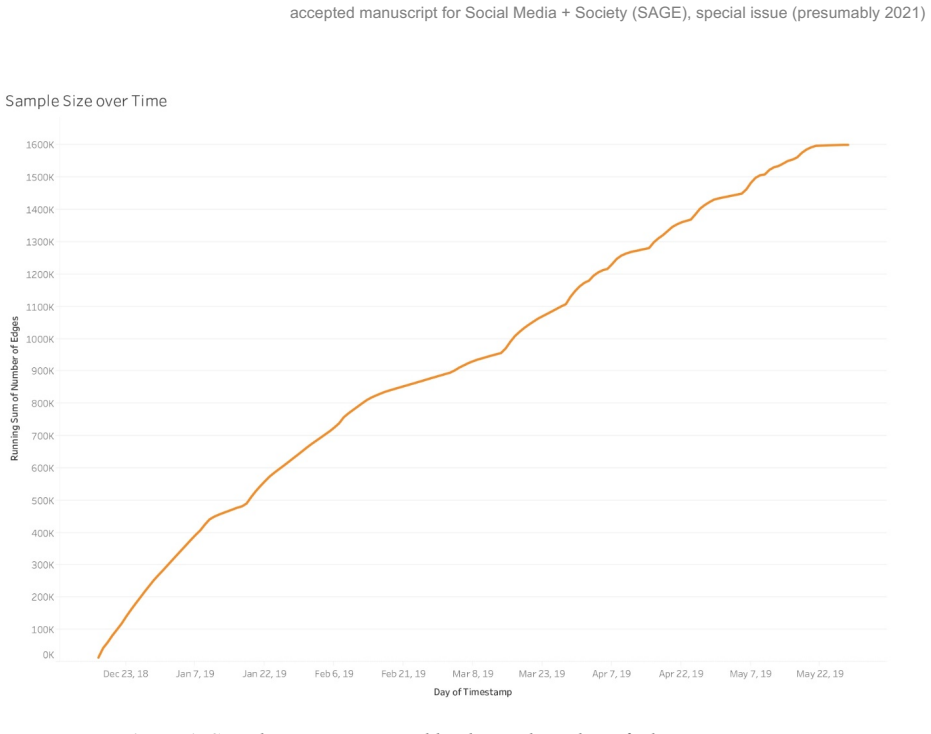
Summary. The paper adapts the rank degree graph-sampling method to the Twitter standard API in order to collect a sample of the German-speaking Twittersphere's follow network. The collection ran from December 2018 to May 2019 and gathered 937,809 accounts by running 200 parallel walkers that, at each step, select the friend with the highest follower count among the last 5,000 friends of the current account, subject to a German interface-language filter. The authors then define an 'influencer sample' of about 199,000 accounts with at least one incoming edge in the collected network and evaluate this subsample against a random baseline from the 2016 TrISMA collection. They report that accounts in the influencer sample have much higher activity and follower counts, that on average 40 percent of a random German Twitter account's friends are in the sample, and that the sample reaches 85 percent of accounts in a random test sample. A further test case applies infomap community detection and keyword extraction to the 3-core of the sampled network and identifies interpretable topical communities (e.g., German politics, Swiss politics, gaming, football, hard-right discourse). The authors conclude that the adapted method approximates the top 1 to 10 percent of influential accounts in the German Twittersphere and opens avenues for comparative research on other language-based Twitterspheres.
Significance. If the central claim holds, the paper offers a practical, low-cost method for mapping the influential backbone of a language-based Twittersphere under increasingly restrictive API conditions, which would be of clear value to computational social science and media studies. The manuscript has notable strengths: the method is described in enough detail to be replicated; the prototype code is openly available; the authors are transparent about the adaptations made to the original rank degree method; and the community-detection test is a concrete demonstration of how the data can be used. The observed differences between the influencer sample and the random baseline are large and visually striking. However, the current evaluation does not yet establish that the adapted walk preserves the topology of the influential core in a way that a simpler high-follower selection procedure would not, and the paper's own Outlook concedes that the centrality-preserving properties of the original method still need to be tested on known networks.
major comments (4)
- [Evaluating the Sample Quality (Figure 5)] The comparison of follower counts between the influencer sample and the TrISMA benchmark is partly circular: the samplers explicitly choose the friend with the highest follower count at each step (Section 'Our adaptation and implementation of the Rank Degree method', step 3), so the follower-count distribution of the resulting sample is a direct consequence of the selection rule rather than an independent validation of the method's ability to find influential accounts. An additional baseline that selects the 199,000 accounts with the highest follower counts directly, or a random-walk variant that does not rank by followers, would be needed to isolate what the rank-degree walk contributes beyond simple follower-count maximization.
- [Coverage and Reach (Table 1, Figures 6-11)] The coverage and reach metrics are compared only against a random baseline, not against a baseline consisting of the most-followed accounts. Because random Twitter users preferentially follow high-follower accounts, a sample constructed purely by picking high-follower accounts would also be expected to show elevated coverage and reach relative to a random sample. The reported 40 percent coverage and 85 percent reach are therefore consistent with the much weaker claim that the most-followed accounts in a language community are widely followed; they do not by themselves demonstrate that the walk-based sampling preserves influential-spreader topology or that the method outperforms a simple top-follower list.
- [Outlook] The paper explicitly states that the adapted method 'still has to be tested with known networks' and that the application to directed networks and the non-dynamic ranking 'might lead to significant differences in the sample quality.' This is an admission that the load-bearing transfer from the original rank degree method, whose centrality-preserving properties were established in the lab, has not been validated for the Twitter adaptation. None of the current evaluation substitutes for that ground-truth test, since all metrics are computed either on the sampled network itself or against random baselines from a historical dataset.
- [Evaluating the Sample Quality (Figures 4 and 5)] The benchmark TrISMA data were collected in 2016, while the sample's activity and follower counts were measured in 2018-2019. Follower counts generally accrue over time for existing accounts, and the activity measure is computed over different observation windows, so part of the reported 'orders of magnitude' difference may be a temporal artifact. The coverage and reach analysis correctly retrieves contemporaneous friend lists for the test sample, and a similar approach should be used for the activity and follower-count comparisons, or the temporal mismatch should be explicitly quantified and controlled.
minor comments (6)
- [Abstract and Conclusion] The abstract and conclusion refer to 'the sample' when the quality metrics are computed on the filtered influencer sample of about 199,000 accounts, while the raw collection contains 937,809 accounts; the scope of the claim should be stated more precisely in both places.
- [Figures 4 and 5] The phrase 'orders of magnitude' is used without a precise quantitative statement; reporting median or mean fold-differences and their confidence intervals would make the claim more informative.
- [Coverage and Reach (Table 1)] The differences between the influencer and baseline samples are reported without confidence intervals or significance tests; given the large observed gap, adding a simple two-sample test or bootstrap intervals would strengthen the presentation.
- [Sampling (Adaptation 1)] The decision to look up only the last 5,000 friends means that high-follower accounts followed earlier are systematically excluded; this is a further deviation from the original rank degree method and should be discussed explicitly as a potential source of bias.
- [Test Case: Topical Communities in the German Twittersphere] The thresholds used for the 3-core filter, the top-50 keyword cutoff, and the 5-percent keyword-usage cutoff are stated to be arbitrary; the robustness checks mentioned in the text are not shown, so the relevant sensitivity analysis should be reported in the main text or the supplement.
- [Figures 10 and 11] The term 'rank-reach' is used in the figure captions but is not defined in the main text; a one-sentence definition in the caption or the methods section would improve clarity.
Circularity Check
The 'influencer sample' validation is partly self-referential: the sampler greedily maximizes follower count, and the paper then cites follower count (plus popularity-driven coverage/reach) as evidence that the sample is influential.
-
self definitional
[Methods and Analysis, 'Our adaptation and implementation of the Rank Degree method', steps 2-3; and 'Activity and Centrality' evaluation.]
"2. Look up the last 5,000 friends of w and rank them by their follower count. 3. Choose the friend v with the highest follower count ... the usage of the follower number is only a heuristic for assessing influence, an approximation of the in-degree in our network of interest ... this sample exhibits indeed a high-influence profile in terms of activity and in-degree centrality (as measured by the follower numbers reported by the Twitter API)."
The sample is constructed by repeatedly following the highest-follower-count friend available (subject to language and unburned-edge constraints). The same follower count is then used as evidence that the sampled accounts are influential, so the high follower-number distribution is largely a property of the selection rule rather than an independent empirical finding. Coverage and reach are also popularity-driven: a random account is much more likely to follow an account with many followers, so the reported 40 percent coverage and 85 percent reach are expected consequences of selecting high-follower nodes, not independent confirmation that the walk-based method preserves the influential-spreader topology of the original rank-degree algorithm.
-
fitted input called prediction
[Methods and Analysis, 'Coverage and Reach' (final paragraph before 'Test Case: Topical Communities').]
"our sample still represents less than 10 percent of this population. Taking this and everything above into account, we conclude that the influencer sample is a good approximation of the most influential core of the German-using Twittersphere."
The 'top 1 to 10 percent' claim is operationalized by comparing the sample's size to a population estimate, while 'everything above' includes the follower-count metric that the sampler was explicitly designed to maximize. The paper never validates against an external ranking of influential accounts or against the full follow network; the conclusion that the sample is the influential top decile is therefore a restatement of the sampling criterion combined with a size calculation, rather than an independent test of the sample's influence.
full rationale
The central sampling claim is partially circular. The algorithm's core step ranks friends by follower count and walks to the highest-follower account; therefore, showing that the sample has high follower numbers is showing the construction's own input. Coverage and reach, while not directly optimized, are strongly coupled to follower counts through Twitter's preferential-attachment dynamics, so they provide only weak independent support. The paper does contain genuinely independent evidence: the high activity distribution is not directly selected for, and the community-detection/keyword test demonstrates that the sampled network is interpretable and resembles the Australian analysis. The Outlook explicitly concedes that the adapted method 'still has to be tested with known networks' and that the directed application and non-dynamic ranking 'might lead to significant differences in the sample quality'; this is an important validation gap and a correctness risk, but it is not itself circularity. Self-citations to TrISMA (Bruns et al., 2016) and Münch (2019) provide the seed pool and a qualitative comparison, but they are not the load-bearing argument that the adapted sampler preserves centrality; the rank-degree provenance is from external authors (Voudigari, Salamanos et al.). Because one of the main validation metrics is built into the selection rule while other metrics and the practical community-mapping application remain independent, the appropriate circularity score is 5: partial circularity, not a fully forced result.
Assumptions & free parameters
free parameters (4)
- 5,000 friend list truncation
- 200 parallel walkers =
200
- 3-core filter for community detection
- Keyword thresholds =
top 50 keywords and 5% usage cutoff
assumptions (5)
- domain assumption Rank degree sampling preserves influential spreaders when about 20% of the network is explored (Salamanos et al. 2017).
- domain assumption Follower count is a valid approximation of in-degree and of influence in the German Twittersphere.
- domain assumption Twitter interface language setting identifies the German-speaking Twittersphere.
- domain assumption The 2016 TrISMA collection is a near-complete benchmark of German-using Twitter accounts.
- domain assumption The random test sample of 597 accounts with retrievable friends represents German-using accounts in 2019.
Cite this review
Pith. "Pith review of Walking Through Twitter: Sampling a Language-Based Follow Network of Influential Twitter Accounts." pith.science (2026). https://pith.science/paper/WXVQCYMB
@misc{pith2026190807788,
  author       = {Pith},
  title        = {Pith review of: Walking Through Twitter: Sampling a Language-Based Follow Network of Influential Twitter Accounts},
  year         = {2026},
  howpublished = {\url{https://pith.science/paper/WXVQCYMB}},
  note         = {Machine review of arXiv:1908.07788}
}
read the original abstract
Twitter continuously tightens the access to its data via the publicly accessible, cost-free standard APIs. This especially applies to the follow network. In light of this, we successfully modified a network sampling method to work efficiently with the Twitter standard API in order to retrieve the most central and influential accounts of a language-based Twitter follow network: the German Twittersphere. We provide evidence that the method is able to approximate a set of the top 1 to 10 percent of influential accounts in the German Twittersphere in terms of activity, follower numbers, coverage and reach. Furthermore, we demonstrate the usefulness of these data by presenting the first overview of topical communities within the German Twittersphere and their network structure. The presented data mining method opens up further avenues of enquiry, such as the collection and comparison of language-based Twitterspheres other than the German one, its further development for the collection of follow networks around certain topics or accounts of interest, and its application to other online social networks and platforms in conjunction with concepts such as agenda setting and opinion leadership.
Figures


Figures from the paper (10 more)


Reference graph
Works this paper leans on
-
[5]
If all vs in the seeds are leaves (degree = 1), select new initial seeds. 6. Repeat 1. – 7. until sample is of size x. From the steps outlined above, it becomes evident that the process is deterministic in that it completely depends on the initial seeds chosen (and, in case 5. is executed, on the new initial seeds). Moreover, any selected node can be visi...
work page 2016
-
[7]
Repeat steps 2. - 7. with v as the new starting point. To use the full capacity of the API calls available to us, we used 200 parallel walkers. Contrasting to the original rank degree method, we do not let the walkers collapse when they land on the same node for time efficiency reasons but let them execute consecutively. While close to the feasible maximu...
Reviewed August 14, 2026 · model on record in the stance chip above.
Discussion (0). Continue with ORCID to comment.