REVIEW 3 major objections 6 minor 35 references
Lower bounds for eigenvalues of the Steklov eigenvalue problem with variable coefficients
T0 review · 3 major / 6 minor · reviewed 2026-08-14 · deepseek-v4-flash
Pith's one-line read The paper proves that a simple correction to Crouzeix-Raviart finite element eigenvalues yields asymptotic lower bounds for the Steklov eigenvalue problem with variable coefficients, without requiring singular eigenfunctions or large…
desk verdict Useful extension of corrected CR lower bounds to variable-coefficient Steklov problems; d=3 proof leans on an unpublished preprint and experiments never vary coefficients, but the core is sound enough to referee. read the letter →
The pith
A machine-rendered reading of the paper's core claim, the machinery that carries it, and where it could break.
The reading
What carries the argument
The machinery is the correction formula (3.5): $\lambda_c^h=\lambda_h/(1+M/\lambda_h)$, where $M=\frac{\delta}{\alpha_0}\sum_\kappa(\|(\alpha-I_0\alpha)\nabla u_h\|_{0,\kappa}+C h_\kappa\|\beta u_h\|_{0,\kappa})^2$, with $\delta>1$ an arbitrary constant, $I_0$ the piecewise constant interpolant, $\alpha_0$ the positive lower bound of $\alpha$, and $C$ an explicit constant from Poincare- and trace-type inequalities. The correction is designed so that, inside the eigenvalue-difference identity (3.2), the boundary and interpolation terms are dominated by the positive energy term $(1-1/\delta)\alpha_0\sum_\kappa|u-u_h|^2_{1,\kappa}+\sum_\kappa\int_\kappa\beta(u-u_h)^2dx$. The identity (3.2) is the engine: it decomposes $\lambda-\lambda_h$ into a discrete energy error, a boundary term, and interpolation-orthogonality terms, and the assumption $\|u-u_h\|_h\ge C h^{1+r/2}$ is exactly what the proof uses to control the boundary contribution.
What would settle it
On a convex domain with smooth eigenfunction, compute the exact eigenvalue and the CR eigenvalue on successively refined meshes while monitoring $\|u-u_h\|_h$. If $\|u-u_h\|_h$ decays faster than $C h^{1+r/2}$, the proof of Theorem 3.1 does not apply; if the corrected eigenvalue $\lambda_c^h$ ever lies above the exact eigenvalue for small $h$, the claimed lower-bound property fails as stated. A separate check is to compare Lemma 2.1 against a known exact solution on tetrahedral meshes to confirm the three-dimensional error rate and constants.
Extended reading notes
Core claim
The central claim is Theorem 3.1: for the Steklov problem $-\operatorname{div}(\alpha\nabla u)+\beta u=0$ in $\Omega$ with $\alpha\partial u/\partial\nu=\lambda u$ on $\partial\Omega$, the corrected CR eigenvalue $\lambda_c^h$ defined by (3.5) satisfies $\lambda\ge\lambda_c^h$ for all sufficiently small mesh size $h$, provided the discrete error satisfies $\|u-u_h\|_h\ge C h^{1+r/2}$. Theorem 3.2 then gives the exact identity $\lambda-\lambda_c^h=\lambda-\lambda_h+\lambda_h M/(\lambda_h+M)$ with $|M|\le C h^2$, so the corrected eigenvalue keeps the same convergence order as the uncorrected CR eigenvalue. Taken together, the paper reads these results as removing the earlier restrictions that the eigenfunction be singular or the eigenvalue be large enough: a corrected lower bound now holds for smooth and singular eigenfunctions alike, on two- and three-dimensional polygonal domains.
Load-bearing premise
The load-bearing premise is that the error estimates of Lemma 2.1 hold in three dimensions with the stated rates and constants, and that the discrete error never decays faster than $C h^{1+r/2}$; the three-dimensional estimate rests on an unpublished preprint by the same authors, and the lower-bound assumption is not guaranteed by the problem data alone.
Editorial extensions
If this is right
- Once the mesh is fine enough, the corrected eigenvalue $\lambda_c^h$ is a lower bound for the exact eigenvalue in cases where the original CR approximation converges from above.
- The corrected eigenvalue converges at the same asymptotic order as the uncorrected CR eigenvalue, so the lower-bound property does not cost convergence rate.
- Since $M$ is built only from local quantities and the computed CR eigenfunction, the correction adds essentially no computational time beyond the original solve.
- The same correction recipe applies to the enriched Crouzeix-Raviart element, extending the lower-bound property to variable-coefficient Steklov problems for that element as well.
- In the numerical tests, the average $(\lambda_h+\lambda_c^h)/2$ gives a more accurate approximation than the corrected value alone and often no worse accuracy than the uncorrected value.
Reading between the lines
- The structure of the correction suggests a general recipe for variable-coefficient eigenvalue problems: subtract a term proportional to the local oscillation of the coefficients on each element, whenever the nonconforming space has the interpolation orthogonality property used in (2.10).
- If a computable a posteriori bound could replace the assumption $\|u-u_h\|_h\ge C h^{1+r/2}$, the corrected eigenvalue would become a guaranteed lower bound rather than an asymptotic one; the numerical results are consistent with the bound holding in all tested cases.
- The identity in Theorem 3.2 separates the corrected error into the standard error plus an $O(h^2)$ term involving a computable quantity $M$, which points toward verified enclosure methods if a certified upper bound on $M$ is available.
Signed reviews
Editorial analysis
A structured set of objections, weighed in public.
Referee Report
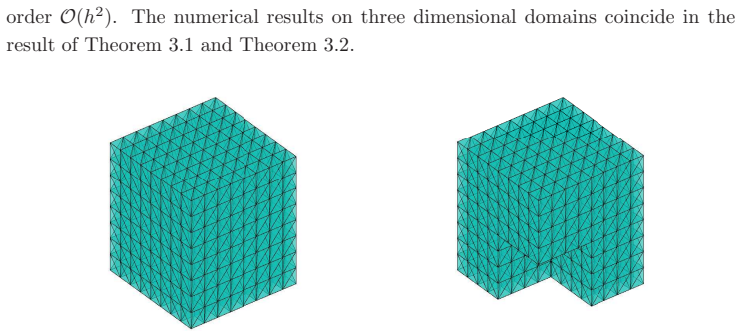
Summary. The manuscript proposes a correction formula for Crouzeix–Raviart finite element eigenvalue approximations for the Steklov eigenvalue problem (1.1) with variable coefficients α, β on polygonal domains in R² and R³. The corrected eigenvalue λ_c^h is defined in (3.5), and Theorem 3.1 states that, under the conditions of Lemma 2.1 and an additional lower-bound assumption on the discrete error, λ ≥ λ_c^h for sufficiently small mesh size. Theorem 3.2 gives the identity λ − λ_c^h = λ − λ_h + λ_h M/(λ_h + M) with M = O(h²), showing the corrected eigenvalue converges at the same order as the uncorrected CR eigenvalue. Numerical experiments on square, L-shaped, hexagonal, cube, and Fichera corner domains with α = β = 1 illustrate the theoretical convergence order.
Significance. If the main theorem is fully established, the paper would extend asymptotic lower-bound results for Steklov eigenvalues to variable coefficients and remove the earlier restrictions of singular eigenfunctions or sufficiently large eigenvalues. The correction formula is explicit and computationally cheap, and Theorem 3.2 is a clean algebraic statement. However, the d = 3 branch of the main theorem depends on an unpublished preprint by the same group for the key a priori estimates, and the numerical experiments use only constant coefficients, so the variable-coefficient claim is not tested experimentally. These issues limit the present significance and require verification before the result can be considered fully reliable.
major comments (3)
- [§2, Lemma 2.1 and §3, Theorem 3.1] For Ω ⊂ R³, the proof of Lemma 2.1 is a single sentence that refers to Theorem 4 of [33], an unpublished arXiv preprint by the same authors. The boundary estimate (2.8), which is used critically in (3.14)–(3.15) to control the nonconforming consistency term, must be established for variable coefficients and for all r ∈ (0, 1/2) in three dimensions. As written, the manuscript does not verify that [33, Thm 4] supplies this estimate under the present assumptions; the cited works [16, 1, 25] appear to address two-dimensional or constant-coefficient settings. The d = 3 branch of Theorem 3.1 is therefore not independently verifiable from the manuscript.
- [§4, Numerical experiments] All numerical experiments take α = β = 1, so the coefficient variation term (α − I_0 α) in the correction (3.5) vanishes identically. The central novelty of the paper is the variable-coefficient setting, and the correction's effectiveness for nonconstant α and β is not tested. The authors should include at least one example with genuinely variable α and/or β on a polygonal domain where the exact eigenvalue or a high-accuracy reference is available, and they should state the value of δ used in the correction.
- [Abstract and §1] The abstract and introduction state that the corrected eigenvalues are lower bounds whether eigenfunctions are singular or smooth and whether eigenvalues are large or not, but Theorem 3.1 requires the additional assumption ‖u − u_h‖_h ≥ C h^{1+r/2}. This assumption is not mentioned in the abstract and is not proved from the problem data; it is likely automatic in typical cases, but it is a genuine hypothesis of the theorem and should be stated whenever the result is summarized.
minor comments (6)
- [Title] The title contains typographical errors: 'EIGENV ALUES' should be 'EIGENVALUES', and 'EIGENV ALUE' should be 'EIGENVALUE'.
- [§3, text near (3.16)] The power of h in the fourth term of (3.16) appears as C h^{1/2+r}, whereas the derivation just before it yields C h^{r/2}. The correct exponent should be r/2; this is a typo in the display, though the argument is unaffected because both terms are higher-order under the assumption.
- [§4, Table 1] The entry '0.39329 159' contains an unintended space; it should be '0.39329159'.
- [§4.2] The description of the Fichera corner domain reads '[−1, 1]^3 \ (−1, )]^3', which appears to be a typesetting error; the omission should be corrected.
- [§1 and §4] The phrase 'knot that (3.9) is valid' at the end of the proof of Theorem 3.1 should read 'know that'.
- [References] Reference [33] is an unpublished arXiv preprint; if it remains the sole support for the d = 3 estimates, the authors should either provide the proof in the manuscript or clearly indicate that [33] has been accepted for publication and give a citable version.
Circularity Check
For d=3, the main lower-bound theorem reduces to Lemma 2.1, whose d=3 proof is delegated to an unpublished same-author preprint [33]; the correction formula itself is not circular.
-
self citation load bearing
[Section 2, Lemma 2.1 proof; used in Theorem 3.1 via (2.8) and the estimates at (3.14)-(3.16)]
"when Ω ⊂ R3, using similar arguments to the case of Ω ⊂ R2 (as well as referring to Theorem 4 in [33]), we can prove that the lemma is valid."
Theorem 3.1 derives λ ≥ λ_c^h from the exact identity (3.2) together with Lemma 2.1's estimates (2.6)-(2.8); in particular, (2.8) controls the boundary consistency term at (3.14) and is essential to the sign argument at (3.16). For d=3 the lemma is not proved in this manuscript: its proof is one sentence delegating the whole d=3 case to Theorem 4 of [33], an unpublished arXiv preprint by the same three authors (Yang, Zhang, Bi). No statement of [33, Thm 4]'s hypotheses, no proof, and no reproduction is given, so the d=3 branch of the central claim reduces to a same-author citation rather than to a derivation contained in the present paper.
full rationale
The correction formula (3.5) is not circular: it is an a posteriori modification of the CR eigenvalue λ_h built from the CR eigenfunction u_h and coefficient jump terms, not from the exact eigenvalue λ, and no fitted parameter is renamed as a prediction. Theorem 3.1 is proved from the exact identity (3.2) with estimates on the four terms; Theorem 3.2 is the algebraic identity (3.17); Lemma 3.1 is proved in the text; and Lemmas 2.2 and 2.3 give explicit constants with derivations. The only load-bearing unverified link is the d=3 proof of Lemma 2.1, where the manuscript cites the same authors' unpublished preprint [33] for the essential estimate (2.8). Because the central claim is stated for d=2 and d=3 and the d=3 branch depends on that self-citation, a moderate circularity score is warranted. The extra assumption ||u-u_h||_h ≥ C h^{1+r/2} is a genuine hypothesis rather than a hidden fit, and the numerical experiments set α=β=1, which limits validation but is not circular. Overall score: 4, reflecting load-bearing self-citation for d=3 while the central correction method has independent content.
Assumptions & free parameters
free parameters (1)
- δ =
unspecified (any δ > 1)
assumptions (4)
- domain assumption Regularity of the source problem: if f ∈ L²(∂Ω), the solution φ ∈ H^{1+r}(Ω) for r ∈ (0, 1/2), cited from Savaré [26] and Garau-Morin [12].
- domain assumption CR finite element error bounds in Lemma 2.1 (estimates (2.6)-(2.8)) hold under the stated conditions, with d=3 relying on Theorem 4 of [33], an unpublished preprint by the same group.
- ad hoc to paper Theorem 3.1 assumes ‖u−u_h‖_h ≥ C h^{1+r/2} for the eigenpair being corrected.
- domain assumption Coefficients α ∈ W^{1,∞}(Ω) with α ≥ α_0 > 0 and β ∈ L^∞(Ω) with positive lower bound.
Cite this review
Pith. "Pith review of Lower bounds for eigenvalues of the Steklov eigenvalue problem with variable coefficients." pith.science (2026). https://pith.science/paper/WYMH23ZN
@misc{pith2026190809087,
  author       = {Pith},
  title        = {Pith review of: Lower bounds for eigenvalues of the Steklov eigenvalue problem with variable coefficients},
  year         = {2026},
  howpublished = {\url{https://pith.science/paper/WYMH23ZN}},
  note         = {Machine review of arXiv:1908.09087}
}
read the original abstract
In this paper, using new correction to the Crouzeix-Raviart finite element eigenvalue approximations, we obtain lower eigenvalue bounds for the Steklov eigenvalue problem with variable coefficients on d-dimensional domains (d = 2,3). In addition, we prove that the corrected eigenvalues asymptotically converge to the exact ones from below whether the eigenfunctions are singular or smooth and whether the eigenvalues are large enough or not. Further, we prove that the corrected eigenvalues still maintain the same convergence order as that of uncorrected eigenvalues. Finally, numerical experiments validate our theoretical results.
Figures


Figures from the paper (1 more)

Reference graph
Works this paper leans on
-
[33]
Y. Yang, Y. Zhang, H. Bi : Non-conforming Crouzeix-Raviar element approximation f or Stekloff eigenvalues in inverse scattering. arXiv:1808.01 609 [math.NA] (2018)
work page 2018
-
[1]
A.E. Alonso, A.D. Russo : Spectral approximation of variationally-posed eigenval ue problems by nonconforming methods, J. Comput. Appl. Math. 223 (2009), 177-197
work page 2009
-
[2]
M.G. Armentano, R.G. Duran : Asymptotic lower bounds for eigenvalues by nonconforming finite element methods, Electron. Trans. Numer. Anal. 17 (2004), 93-101
work page 2004
-
[3]
I. Babuska, J.E. Osborn : Eigenvalue Problems. in: Ciarlet, P.G., Lions, J.L. (eds. ) Finite Element Methods (Part 1), Handbook of Numerical Analysis, E lsevier Science Publishers, North-Holand 2 (1991), 640-787
work page 1991
-
[4]
D.Boffi : Finite element approximation of eigenvalue problems, Act a. Numer. 19(2010), 1-120. 14 Table 2. The CR finite element eigenvalues approximations on Ω ⊂ R3. domain C F h λ 1,h λ 2,h λ 5,h h λ 1,h λ 2,h λ 3,h 0.6124 0.1623444 1.11356 1.56489 0.8660 0.268747 0.54947 0.72763 0.3062 0.1622261 1.14537 1.65619 0.4330 0.268359 0.56641 0.73377 0.1531 0.1621...
work page 2010
-
[5]
S.C. Brenner, L.R. Scott : The Mathematical Theory of Finite Element Methods, 2nd ed. Springer-Verlag, New york, 2002
work page 2002
-
[6]
C. Carstensen, J. Gedicke, D. Rim : Explicit error estimates for courant, Crouzeix-Raviart and Raviart-Thomas finite element methods, J. Comput. Math. 30 (2012), 337-353
work page 2012
-
[7]
C. Carstensen, J. Gedicke : Guaranteed lower bounds for eigenvalues, Math. Comput. 83 (2014), 2605-2629
work page 2014
Show all 35 references
-
[8]
Gallistl : Guaranteed lower eigenvalue bounds for the biharmonic equ ation
C.Carstensen, D. Gallistl : Guaranteed lower eigenvalue bounds for the biharmonic equ ation. Numer. Math. 126 (2014), 33-51
2014
-
[9]
Chavel, E
I. Chavel, E. Feldman : An optimal Poincar´ e inequality for convex domains of non- negative curvature, Archive for Rational Mechanics and Analysis 65 (1977), 263-273
1977
-
[10]
Chen: iFEM: an innovative finite element methods package in MATLA B, Technical Report, University of California at Irvine (2009)
L. Chen: iFEM: an innovative finite element methods package in MATLA B, Technical Report, University of California at Irvine (2009)
2009
-
[11]
Crouzeix, P.A
M. Crouzeix, P.A. Raviart : Conforming and nonconforming finite element methods for so lving the stationary stokes equations. RAIRO Anal. Numer. 7(1973), 33-75
1973
-
[12]
Garau, P
E.M. Garau, P. Morin : Convergence and quasi-optimality of adaptive FEM for Stek lov eigen- value problems, IMA J. Numer. Anal. 1 (2011), 914-946
2011
-
[13]
J. Hu, Y. Huang : Lower bounds for eigenvalues of the Stokes operator, Adv. A ppl. Math. Mech. 5 (2013), 1-18
2013
-
[14]
J. Hu, Y. Huang, Q. Lin : Lower bounds for eigenvalues of elliptic operators: by non conform- ing finite element methods, J. Sci. Comput. 61 (2014), 196-221
2014
-
[15]
J. Hu, Y. Huang, R. Ma : Guaranteed lower bounds for eigenvalues of elliptic opera tors, J. Sci. Comput. 67 (2016), 1181-1197
2016
-
[16]
Q. Li, Q. Lin, H. Xie : Nonconforming finite element approximations of the Steklo v eigenvalue problem and its lower bound approximations, Appl. Math. 58 (2013), 129-151
2013
-
[17]
Li : Lower approximation of eigenvalue by the nonconforming fin ite element method, J
Y. Li : Lower approximation of eigenvalue by the nonconforming fin ite element method, J. Math. Numer. Sin. 30 (2008), 195-200. 15
2008
-
[18]
Q. Li, X. Liu : Explicit finite element error estimates for nonhomogeneou s neumann problems, Appl. Math. 63 (2018), 367-379
2018
-
[19]
Lin, H.T
Q. Lin, H.T. Huang, Z.C. Li : New expansions of numerical eigenvalues for −△u = λpu by nonconforming element, Math. Comput. 77 (2008), 2061-2084
2008
-
[20]
Q. Lin, H. Xie, F. Luo, Y. Li, Y. Yang : Stokes eigenvalue approximations from Below with nonconforming mixed finite element methods, Math. Pract. Th eory(in Chinese) 40 (2010), 157-168
2010
-
[21]
Q. Lin, H. Xie : Recent result on lower bounds of eigenvalue problems by non conforming finte element methods, Inverse Probl. Imag. 7 (2013), 795-811
2013
-
[22]
Liu : A framework of verified eigenvalue bounds for self-adjoint differential operators, Appl
X. Liu : A framework of verified eigenvalue bounds for self-adjoint differential operators, Appl. Math. Comput. 267 (2015), 341-355
2015
-
[23]
F.S. Luo, Q. Lin, H. Xie : Computing the lower and upper bounds of Laplace eigenvalue prob- lem: by combining conforming and nonconforming finite eleme ntmethods. Sci. ChinaMath. 55 (2012), 1069-1082
2012
-
[24]
Oden, J.N
J.T. Oden, J.N. Reddy : An introduction to the mathematical theory of finite elemen ts. Courier Dover Publications, New York (2012)
2012
-
[25]
Russo, A.E
A.D. Russo, A.E. Alonso : A posteriori error estimates for nonconforming approxima tions of Steklov eigenvalue problems. Comput. Math. Appl. 62(2011), 4100-4117
2011
-
[26]
Savar´ e: Regularity results for elliptic equations in Lipschitz do mains, J
G. Savar´ e: Regularity results for elliptic equations in Lipschitz do mains, J. Funct. Anal. 152 (1998), 176-201
1998
-
[27]
ˇSebestov´ a, T
I. ˇSebestov´ a, T. Vejchodsk´ y: Two-Sided bounds for eigenvalues of differential operator s with applications to Friedrichs, Poincar´ e, Trace, and similarconstants, J. Funct. Anal. 152 (1998), 176-201
1998
-
[28]
M. Xie, H. Xie, X. Liu : Explicit lower bounds for Stokes eigenvalue problems by us ing nonconforming finite elements, JPN J. Ind. Appl. Math. 35 (2018), 1-20
2018
-
[29]
Y. Yang, Q. Lin, H. Bi, Q. Li : Lower eigenvalues approximation by Morley elements, Adv. Comput. Math. 36 (2012), 443-450
2012
-
[30]
Y. Yang, Q. Li, S. Li : Nonconforming finite element approximations of the Steklo v eigenvalue problem, Appl. Numer. Math. 59 (2009), 2388-2401
2009
-
[31]
Y. Yang, Z. Zhang, F. Lin : Eigenvalue approximation from below using non-conformin g finite elements, Sci. China. Math. 53 (2010), 137-150
2010
-
[32]
Y. Yang, J. Han, H. Bi, Y. Yu : The lower/upper bound property of the nonoconforming Crouzeix-Raviart element eigenvalues on adaptive meshes, J. Sci. Comput. 62 (2015), 284- 299
2015
-
[34]
C. You, H. Xie, X. Liu : Guaranteed eigenvalue bounds for the Steklov eigenvalue p roblem, arXiv:1808.08148v1 [math.NA] (2018)
2018 arXiv
-
[35]
Zhang, Y
Z. Zhang, Y. Yang, Z. Chen : Eigenvalue approximation from below by Wilsons elements, Chin. J. Numer. Math. Appl. 29 (2007), 81-84. Authors’ addresses: Yu Zhang, School of Mathematical Sciences, Guizhou Normal Universi ty, Guiyang 550001, China; School of Mathematics & Statist...
2007
Reviewed August 14, 2026 · model on record in the stance chip above.
Discussion (0). Continue with ORCID to comment.